By
Tushar Bhatt
4/12/2019Atmiya University - Rajkot 1
Content
 Introduction
 Random Experiments
 Sample space
 Events and their probabilities
 Random variable probability distribution
 t-test, Paired t – test, F – test (ANOVA)
 Comparison of results of above tests
4/12/2019Atmiya University - Rajkot 2
 Introduction
4/12/2019Atmiya University - Rajkot 3
 Def : Experiment/ Random experiment
An activity or phenomenon that is under consideration is called an
experiment .
 Def : Trial
A single performance of an experiment is briefly called a trial.
 Def : Outcome or Sample points
The experiment can produce a variety of results called outcomes or
sample points.
 Introduction
4/12/2019Atmiya University - Rajkot 4
 Def : Sample space
The set of all possible outcomes of an experiment is called sample
space and it is denoted by S .
 For example :
1. A random experiment of tossing a coin then S = { H, T }
2. A random experiment of throwing a die then S = { 1,2,3,4,5,6 }
3. If two coins are tossed simultaneously then
S = { (H, H), (T, T), (H, T), (T, H) }
 Introduction
4/12/2019Atmiya University - Rajkot 5
 Def : Event
Any subset of sample space is called event.
 For example :
1. A random experiment of throwing a die then S = { 1,2,3,4,5,6 }
let A be an event that an odd number appears on the die then
A = { 1, 3, 5 }
 Introduction
4/12/2019Atmiya University - Rajkot 6
 Def : Favourable outcomes
If an event A is defined on sample space S then the sample points
which are included in A are called favourable outcomes for the
event A.
 For example :
1. A random experiment of throwing a die then S = { 1,2,3,4,5,6 }
let A = { 1,2,3,4 } in which 1,2,3,4 are favourable outcomes.
 Types of event
4/12/2019Atmiya University - Rajkot 7
 Def : Exhaustive events
The total number of all possible outcomes of an experiment is
called exhaustive events.
 For example :
1. In tossing a coin there are two exhaustive events (a) Head and
(b) Tail.
 Types of event
4/12/2019Atmiya University - Rajkot 8
 Def : Mutually exclusive events
-Events are said to be mutually exclusive or disjoint or
incompatible, if one and only one of them can take place at a time .
- If then the events A and B are said to be mutually
exclusive events.
 For example :
1. In tossing a coin the events (a) Head and (b) Tail are mutually
exclusive.
A B  
 Types of event
4/12/2019Atmiya University - Rajkot 9
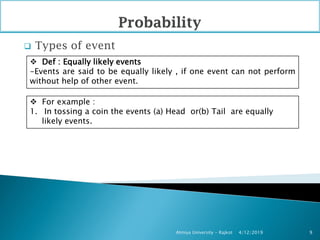
 Def : Equally likely events
-Events are said to be equally likely , if one event can not perform
without help of other event.
 For example :
1. In tossing a coin the events (a) Head or(b) Tail are equally
likely events.
 Types of event
4/12/2019Atmiya University - Rajkot 10
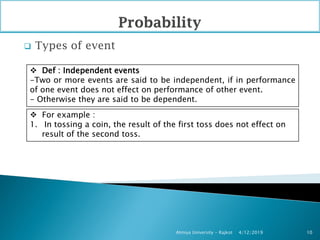
 Def : Independent events
-Two or more events are said to be independent, if in performance
of one event does not effect on performance of other event.
- Otherwise they are said to be dependent.
 For example :
1. In tossing a coin, the result of the first toss does not effect on
result of the second toss.
 Types of event
4/12/2019Atmiya University - Rajkot 11
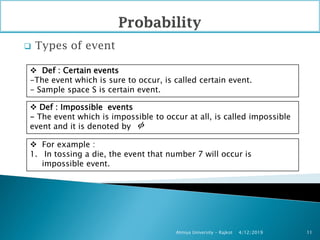
 Def : Certain events
-The event which is sure to occur, is called certain event.
- Sample space S is certain event.
 Def : Impossible events
- The event which is impossible to occur at all, is called impossible
event and it is denoted by 
 For example :
1. In tossing a die, the event that number 7 will occur is
impossible event.
 Types of event
4/12/2019Atmiya University - Rajkot 12
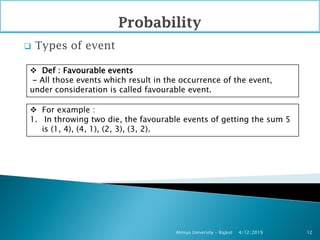
 Def : Favourable events
- All those events which result in the occurrence of the event,
under consideration is called favourable event.
 For example :
1. In throwing two die, the favourable events of getting the sum 5
is (1, 4), (4, 1), (2, 3), (3, 2).
 Types of event
4/12/2019Atmiya University - Rajkot 13
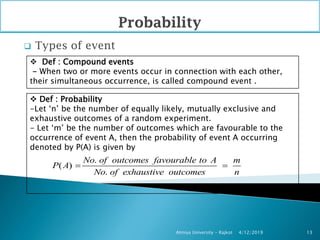
 Def : Compound events
- When two or more events occur in connection with each other,
their simultaneous occurrence, is called compound event .
 Def : Probability
-Let ‘n’ be the number of equally likely, mutually exclusive and
exhaustive outcomes of a random experiment.
- Let ‘m’ be the number of outcomes which are favourable to the
occurrence of event A, then the probability of event A occurring
denoted by P(A) is given by
.
( )
.
No of outcomes favourable to A m
P A
No of exhaustive outcomes n
 
 Probability
4/12/2019Atmiya University - Rajkot 14
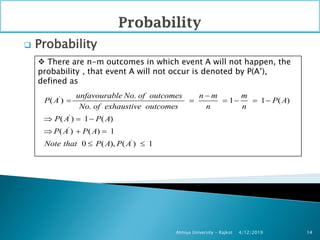
 There are n-m outcomes in which event A will not happen, the
probability , that event A will not occur is denoted by P(A’),
defined as
'
'
'
'
.
( ) 1 1 ( )
.
( ) 1 ( )
( ) ( ) 1
0 ( ), ( ) 1
unfavourable No of outcomes n m m
P A P A
No of exhaustive outcomes n n
P A P A
P A P A
Note that P A P A

     
  
  
 
 Probability
4/12/2019Atmiya University - Rajkot 15
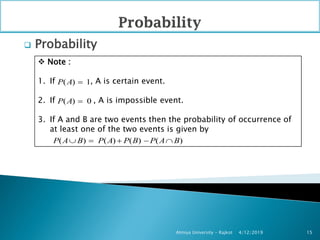
 Note :
1. If , A is certain event.
2. If , A is impossible event.
3. If A and B are two events then the probability of occurrence of
at least one of the two events is given by
( ) 1P A 
( ) 0P A 
( ) ( ) ( ) ( )P A B P A P B P A B    
 Probability
4/12/2019Atmiya University - Rajkot 16
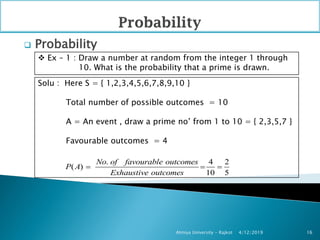
 Ex – 1 : Draw a number at random from the integer 1 through
10. What is the probability that a prime is drawn.
Solu : Here S = { 1,2,3,4,5,6,7,8,9,10 }
Total number of possible outcomes = 10
A = An event , draw a prime no’ from 1 to 10 = { 2,3,5,7 }
Favourable outcomes = 4
. 4 2
( )
10 5
No of favourable outcomes
P A
Exhaustive outcomes
  
 Probability
4/12/2019Atmiya University - Rajkot 17
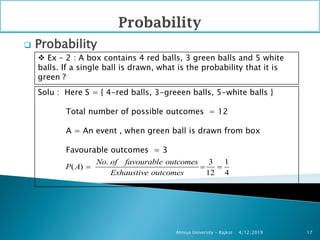
 Ex – 2 : A box contains 4 red balls, 3 green balls and 5 white
balls. If a single ball is drawn, what is the probability that it is
green ?
Solu : Here S = { 4-red balls, 3-greeen balls, 5-white balls }
Total number of possible outcomes = 12
A = An event , when green ball is drawn from box
Favourable outcomes = 3
. 3 1
( )
12 4
No of favourable outcomes
P A
Exhaustive outcomes
  
 Probability
4/12/2019Atmiya University - Rajkot 18
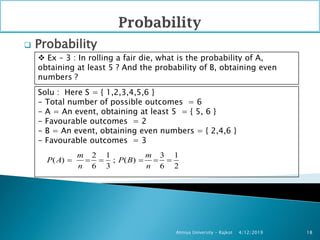
 Ex – 3 : In rolling a fair die, what is the probability of A,
obtaining at least 5 ? And the probability of B, obtaining even
numbers ?
Solu : Here S = { 1,2,3,4,5,6 }
- Total number of possible outcomes = 6
- A = An event, obtaining at least 5 = { 5, 6 }
- Favourable outcomes = 2
- B = An event, obtaining even numbers = { 2,4,6 }
- Favourable outcomes = 3
2 1 3 1
( ) ; ( )
6 3 6 2
m m
P A P B
n n
     
 Permutations
4/12/2019Atmiya University - Rajkot 19
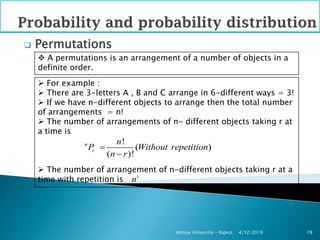
 A permutations is an arrangement of a number of objects in a
definite order.
 For example :
 There are 3-letters A , B and C arrange in 6-different ways = 3!
 If we have n-different objects to arrange then the total number
of arrangements = n!
 The number of arrangements of n- different objects taking r at
a time is
 The number of arrangement of n-different objects taking r at a
time with repetition is
!
( )
( )!
n
r
n
P Without repetition
n r


r
n
 Permutations
4/12/2019Atmiya University - Rajkot 20
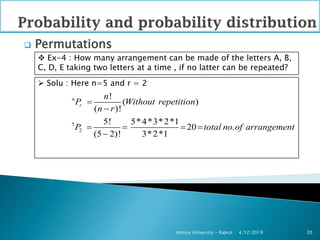
 Ex-4 : How many arrangement can be made of the letters A, B,
C, D, E taking two letters at a time , if no latter can be repeated?
 Solu : Here n=5 and r = 2
5
2
!
( )
( )!
5! 5*4*3*2*1
20 .
(5 2)! 3*2*1
n
r
n
P Without repetition
n r
P total no of arrangement


   

 Permutations
4/12/2019Atmiya University - Rajkot 21
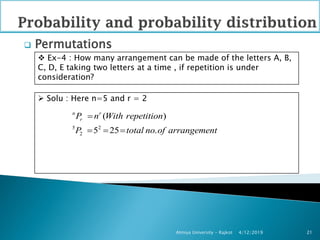
 Ex-4 : How many arrangement can be made of the letters A, B,
C, D, E taking two letters at a time , if repetition is under
consideration?
 Solu : Here n=5 and r = 2
5 2
2
( )
5 25 .
n r
rP n With repetition
P total no of arrangement

  
 Combinations :
4/12/2019Atmiya University - Rajkot 22
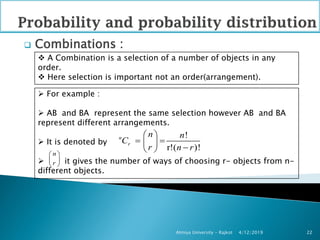
 A Combination is a selection of a number of objects in any
order.
 Here selection is important not an order(arrangement).
 For example :
 AB and BA represent the same selection however AB and BA
represent different arrangements.
 It is denoted by
 it gives the number of ways of choosing r- objects from n-
different objects.
!
r!( )!
n
r
n n
C
r n r
 
  
 n
r
 
 
 
 Combinations :
4/12/2019Atmiya University - Rajkot 23
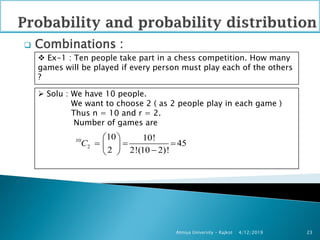
 Ex-1 : Ten people take part in a chess competition. How many
games will be played if every person must play each of the others
?
 Solu : We have 10 people.
We want to choose 2 ( as 2 people play in each game )
Thus n = 10 and r = 2.
Number of games are
10
2
10 10!
45
2 2!(10 2)!
C
 
   
 
 Note :
4/12/2019Atmiya University - Rajkot 24
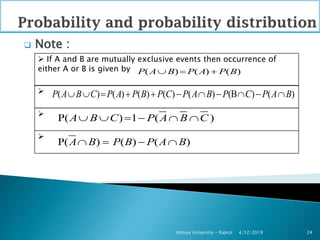
 If A and B are mutually exclusive events then occurrence of
either A or B is given by ( ) ( ) ( )P A B P A P B  
 ( ) ( ) ( ) ( ) ( ) (B ) ( )P A B C P A P B P C P A B P C P A B          

P( ) 1 ( )A B C P A B C     

P( ) ( ) ( )A B P B P A B   
4/12/2019Atmiya University - Rajkot 25
4/12/2019Atmiya University - Rajkot 26
4/12/2019Atmiya University - Rajkot 27
4/12/2019Atmiya University - Rajkot 28
4/12/2019Atmiya University - Rajkot 29
4/12/2019Atmiya University - Rajkot 30
4/12/2019Atmiya University - Rajkot 31
4/12/2019Atmiya University - Rajkot 32
4/12/2019Atmiya University - Rajkot 33
4/12/2019Atmiya University - Rajkot 34
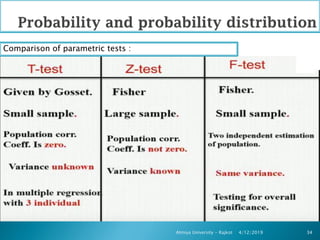
Comparison of parametric tests :
4/12/2019Atmiya University - Rajkot 35

Random Variable and Probability Distribution

  • 1.
  • 2.
    Content  Introduction  RandomExperiments  Sample space  Events and their probabilities  Random variable probability distribution  t-test, Paired t – test, F – test (ANOVA)  Comparison of results of above tests 4/12/2019Atmiya University - Rajkot 2
  • 3.
     Introduction 4/12/2019Atmiya University- Rajkot 3  Def : Experiment/ Random experiment An activity or phenomenon that is under consideration is called an experiment .  Def : Trial A single performance of an experiment is briefly called a trial.  Def : Outcome or Sample points The experiment can produce a variety of results called outcomes or sample points.
  • 4.
     Introduction 4/12/2019Atmiya University- Rajkot 4  Def : Sample space The set of all possible outcomes of an experiment is called sample space and it is denoted by S .  For example : 1. A random experiment of tossing a coin then S = { H, T } 2. A random experiment of throwing a die then S = { 1,2,3,4,5,6 } 3. If two coins are tossed simultaneously then S = { (H, H), (T, T), (H, T), (T, H) }
  • 5.
     Introduction 4/12/2019Atmiya University- Rajkot 5  Def : Event Any subset of sample space is called event.  For example : 1. A random experiment of throwing a die then S = { 1,2,3,4,5,6 } let A be an event that an odd number appears on the die then A = { 1, 3, 5 }
  • 6.
     Introduction 4/12/2019Atmiya University- Rajkot 6  Def : Favourable outcomes If an event A is defined on sample space S then the sample points which are included in A are called favourable outcomes for the event A.  For example : 1. A random experiment of throwing a die then S = { 1,2,3,4,5,6 } let A = { 1,2,3,4 } in which 1,2,3,4 are favourable outcomes.
  • 7.
     Types ofevent 4/12/2019Atmiya University - Rajkot 7  Def : Exhaustive events The total number of all possible outcomes of an experiment is called exhaustive events.  For example : 1. In tossing a coin there are two exhaustive events (a) Head and (b) Tail.
  • 8.
     Types ofevent 4/12/2019Atmiya University - Rajkot 8  Def : Mutually exclusive events -Events are said to be mutually exclusive or disjoint or incompatible, if one and only one of them can take place at a time . - If then the events A and B are said to be mutually exclusive events.  For example : 1. In tossing a coin the events (a) Head and (b) Tail are mutually exclusive. A B  
  • 9.
     Types ofevent 4/12/2019Atmiya University - Rajkot 9  Def : Equally likely events -Events are said to be equally likely , if one event can not perform without help of other event.  For example : 1. In tossing a coin the events (a) Head or(b) Tail are equally likely events.
  • 10.
     Types ofevent 4/12/2019Atmiya University - Rajkot 10  Def : Independent events -Two or more events are said to be independent, if in performance of one event does not effect on performance of other event. - Otherwise they are said to be dependent.  For example : 1. In tossing a coin, the result of the first toss does not effect on result of the second toss.
  • 11.
     Types ofevent 4/12/2019Atmiya University - Rajkot 11  Def : Certain events -The event which is sure to occur, is called certain event. - Sample space S is certain event.  Def : Impossible events - The event which is impossible to occur at all, is called impossible event and it is denoted by   For example : 1. In tossing a die, the event that number 7 will occur is impossible event.
  • 12.
     Types ofevent 4/12/2019Atmiya University - Rajkot 12  Def : Favourable events - All those events which result in the occurrence of the event, under consideration is called favourable event.  For example : 1. In throwing two die, the favourable events of getting the sum 5 is (1, 4), (4, 1), (2, 3), (3, 2).
  • 13.
     Types ofevent 4/12/2019Atmiya University - Rajkot 13  Def : Compound events - When two or more events occur in connection with each other, their simultaneous occurrence, is called compound event .  Def : Probability -Let ‘n’ be the number of equally likely, mutually exclusive and exhaustive outcomes of a random experiment. - Let ‘m’ be the number of outcomes which are favourable to the occurrence of event A, then the probability of event A occurring denoted by P(A) is given by . ( ) . No of outcomes favourable to A m P A No of exhaustive outcomes n  
  • 14.
     Probability 4/12/2019Atmiya University- Rajkot 14  There are n-m outcomes in which event A will not happen, the probability , that event A will not occur is denoted by P(A’), defined as ' ' ' ' . ( ) 1 1 ( ) . ( ) 1 ( ) ( ) ( ) 1 0 ( ), ( ) 1 unfavourable No of outcomes n m m P A P A No of exhaustive outcomes n n P A P A P A P A Note that P A P A               
  • 15.
     Probability 4/12/2019Atmiya University- Rajkot 15  Note : 1. If , A is certain event. 2. If , A is impossible event. 3. If A and B are two events then the probability of occurrence of at least one of the two events is given by ( ) 1P A  ( ) 0P A  ( ) ( ) ( ) ( )P A B P A P B P A B    
  • 16.
     Probability 4/12/2019Atmiya University- Rajkot 16  Ex – 1 : Draw a number at random from the integer 1 through 10. What is the probability that a prime is drawn. Solu : Here S = { 1,2,3,4,5,6,7,8,9,10 } Total number of possible outcomes = 10 A = An event , draw a prime no’ from 1 to 10 = { 2,3,5,7 } Favourable outcomes = 4 . 4 2 ( ) 10 5 No of favourable outcomes P A Exhaustive outcomes   
  • 17.
     Probability 4/12/2019Atmiya University- Rajkot 17  Ex – 2 : A box contains 4 red balls, 3 green balls and 5 white balls. If a single ball is drawn, what is the probability that it is green ? Solu : Here S = { 4-red balls, 3-greeen balls, 5-white balls } Total number of possible outcomes = 12 A = An event , when green ball is drawn from box Favourable outcomes = 3 . 3 1 ( ) 12 4 No of favourable outcomes P A Exhaustive outcomes   
  • 18.
     Probability 4/12/2019Atmiya University- Rajkot 18  Ex – 3 : In rolling a fair die, what is the probability of A, obtaining at least 5 ? And the probability of B, obtaining even numbers ? Solu : Here S = { 1,2,3,4,5,6 } - Total number of possible outcomes = 6 - A = An event, obtaining at least 5 = { 5, 6 } - Favourable outcomes = 2 - B = An event, obtaining even numbers = { 2,4,6 } - Favourable outcomes = 3 2 1 3 1 ( ) ; ( ) 6 3 6 2 m m P A P B n n      
  • 19.
     Permutations 4/12/2019Atmiya University- Rajkot 19  A permutations is an arrangement of a number of objects in a definite order.  For example :  There are 3-letters A , B and C arrange in 6-different ways = 3!  If we have n-different objects to arrange then the total number of arrangements = n!  The number of arrangements of n- different objects taking r at a time is  The number of arrangement of n-different objects taking r at a time with repetition is ! ( ) ( )! n r n P Without repetition n r   r n
  • 20.
     Permutations 4/12/2019Atmiya University- Rajkot 20  Ex-4 : How many arrangement can be made of the letters A, B, C, D, E taking two letters at a time , if no latter can be repeated?  Solu : Here n=5 and r = 2 5 2 ! ( ) ( )! 5! 5*4*3*2*1 20 . (5 2)! 3*2*1 n r n P Without repetition n r P total no of arrangement       
  • 21.
     Permutations 4/12/2019Atmiya University- Rajkot 21  Ex-4 : How many arrangement can be made of the letters A, B, C, D, E taking two letters at a time , if repetition is under consideration?  Solu : Here n=5 and r = 2 5 2 2 ( ) 5 25 . n r rP n With repetition P total no of arrangement    
  • 22.
     Combinations : 4/12/2019AtmiyaUniversity - Rajkot 22  A Combination is a selection of a number of objects in any order.  Here selection is important not an order(arrangement).  For example :  AB and BA represent the same selection however AB and BA represent different arrangements.  It is denoted by  it gives the number of ways of choosing r- objects from n- different objects. ! r!( )! n r n n C r n r       n r      
  • 23.
     Combinations : 4/12/2019AtmiyaUniversity - Rajkot 23  Ex-1 : Ten people take part in a chess competition. How many games will be played if every person must play each of the others ?  Solu : We have 10 people. We want to choose 2 ( as 2 people play in each game ) Thus n = 10 and r = 2. Number of games are 10 2 10 10! 45 2 2!(10 2)! C        
  • 24.
     Note : 4/12/2019AtmiyaUniversity - Rajkot 24  If A and B are mutually exclusive events then occurrence of either A or B is given by ( ) ( ) ( )P A B P A P B    ( ) ( ) ( ) ( ) ( ) (B ) ( )P A B C P A P B P C P A B P C P A B            P( ) 1 ( )A B C P A B C       P( ) ( ) ( )A B P B P A B   
  • 25.
  • 26.
  • 27.
  • 28.
  • 29.
  • 30.
  • 31.
  • 32.
  • 33.
  • 34.
    4/12/2019Atmiya University -Rajkot 34 Comparison of parametric tests :
  • 35.