Climate Change

     Lecture given by Duncan Green
     Head of Research at Oxfam GB
 Notre Dame University, September 2009

Part of a series of From Poverty to Power lectures.
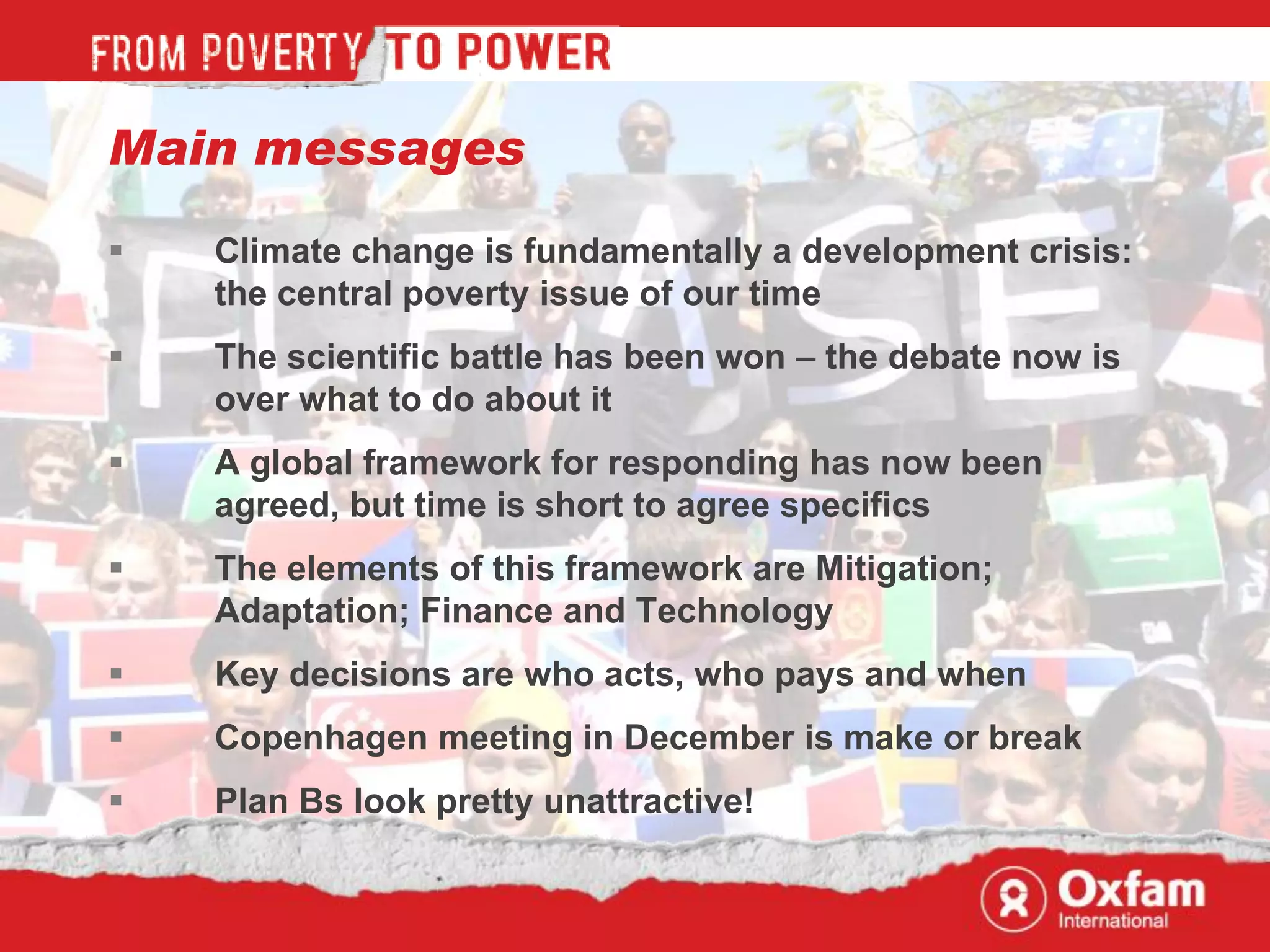
Main messages
   Climate change is fundamentally a development crisis:
    the central poverty issue of our time
   The scientific battle has been won – the debate now is
    over what to do about it
   A global framework for responding has now been
    agreed, but time is short to agree specifics
   The elements of this framework are Mitigation;
    Adaptation; Finance and Technology
   Key decisions are who acts, who pays and when
   Copenhagen meeting in December is make or break
   Plan Bs look pretty unattractive!
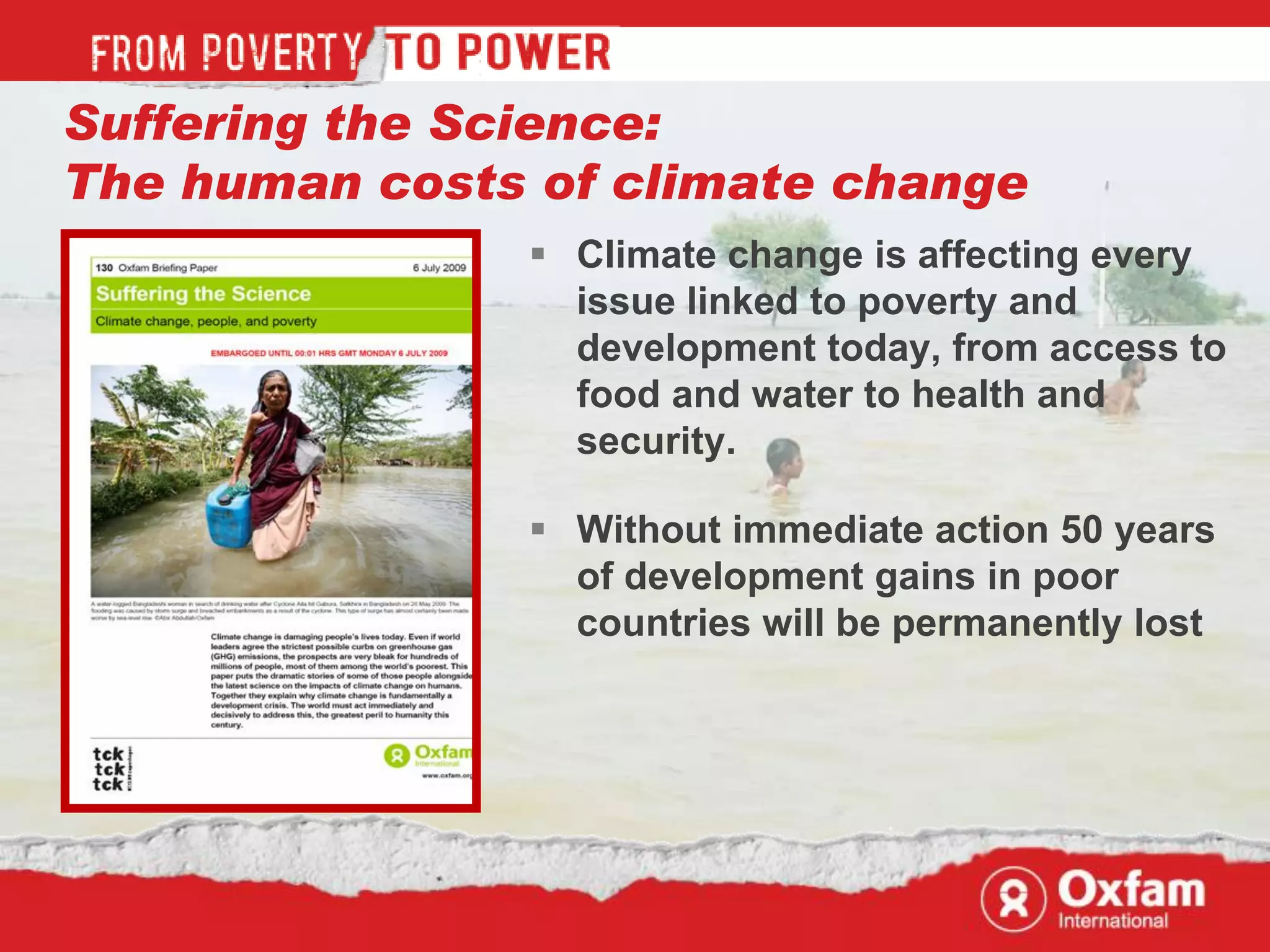
Suffering the Science:
The human costs of climate change
                Climate change is affecting every
                 issue linked to poverty and
                 development today, from access to
                 food and water to health and
                 security.

                Without immediate action 50 years
                 of development gains in poor
                 countries will be permanently lost
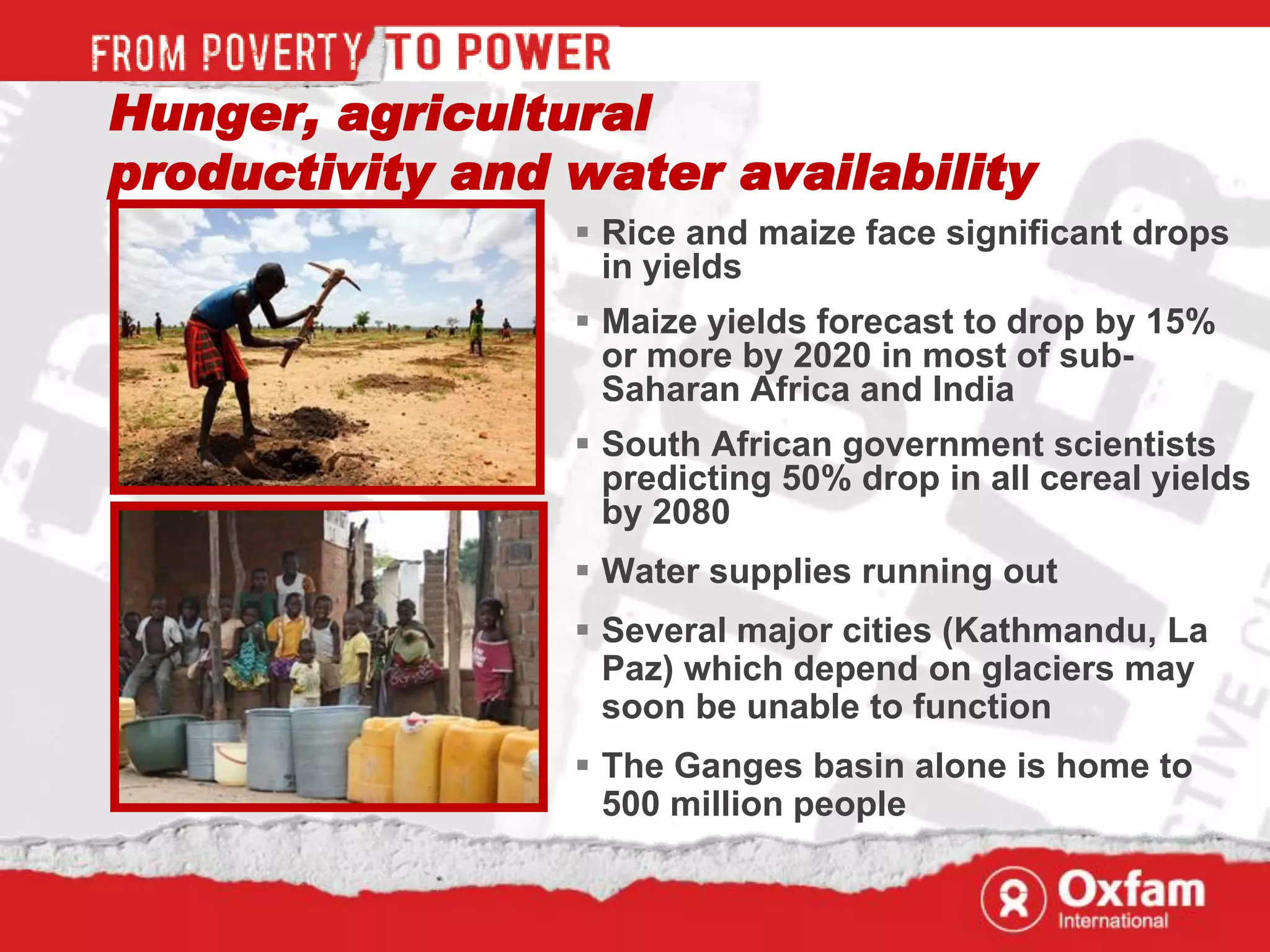
Hunger, agricultural
productivity and water availability
                  Rice and maize face significant drops
                   in yields
                  Maize yields forecast to drop by 15%
                   or more by 2020 in most of sub-
                   Saharan Africa and India
                  South African government scientists
                   predicting 50% drop in all cereal yields
                   by 2080
                  Water supplies running out
                  Several major cities (Kathmandu, La
                   Paz) which depend on glaciers may
                   soon be unable to function
                  The Ganges basin alone is home to
                   500 million people
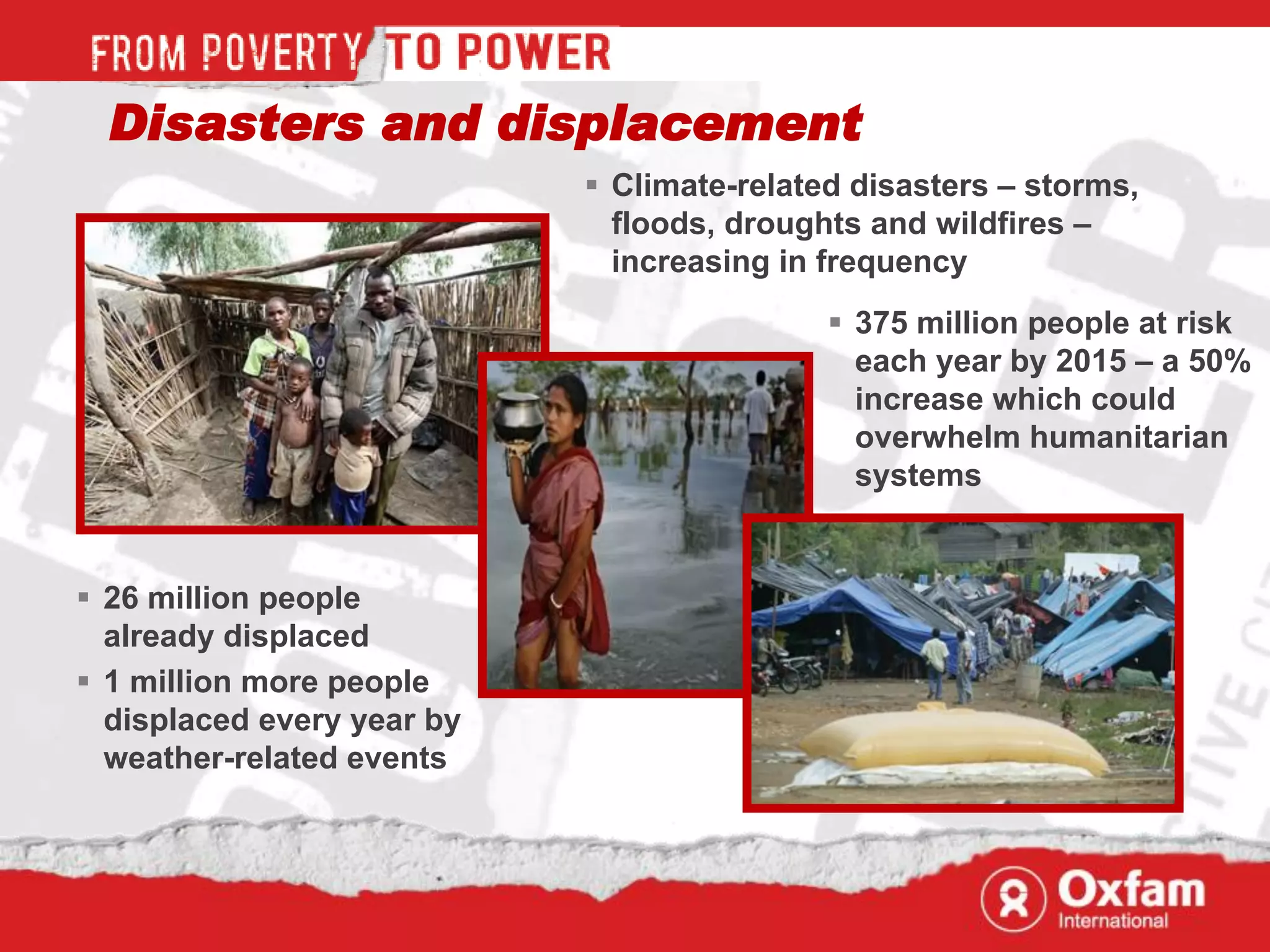
Disasters and displacement
                             Climate-related disasters – storms,
                              floods, droughts and wildfires –
                              increasing in frequency
                                             375 million people at risk
                                              each year by 2015 – a 50%
                                              increase which could
                                              overwhelm humanitarian
                                              systems


 26 million people
  already displaced
 1 million more people
  displaced every year by
  weather-related events
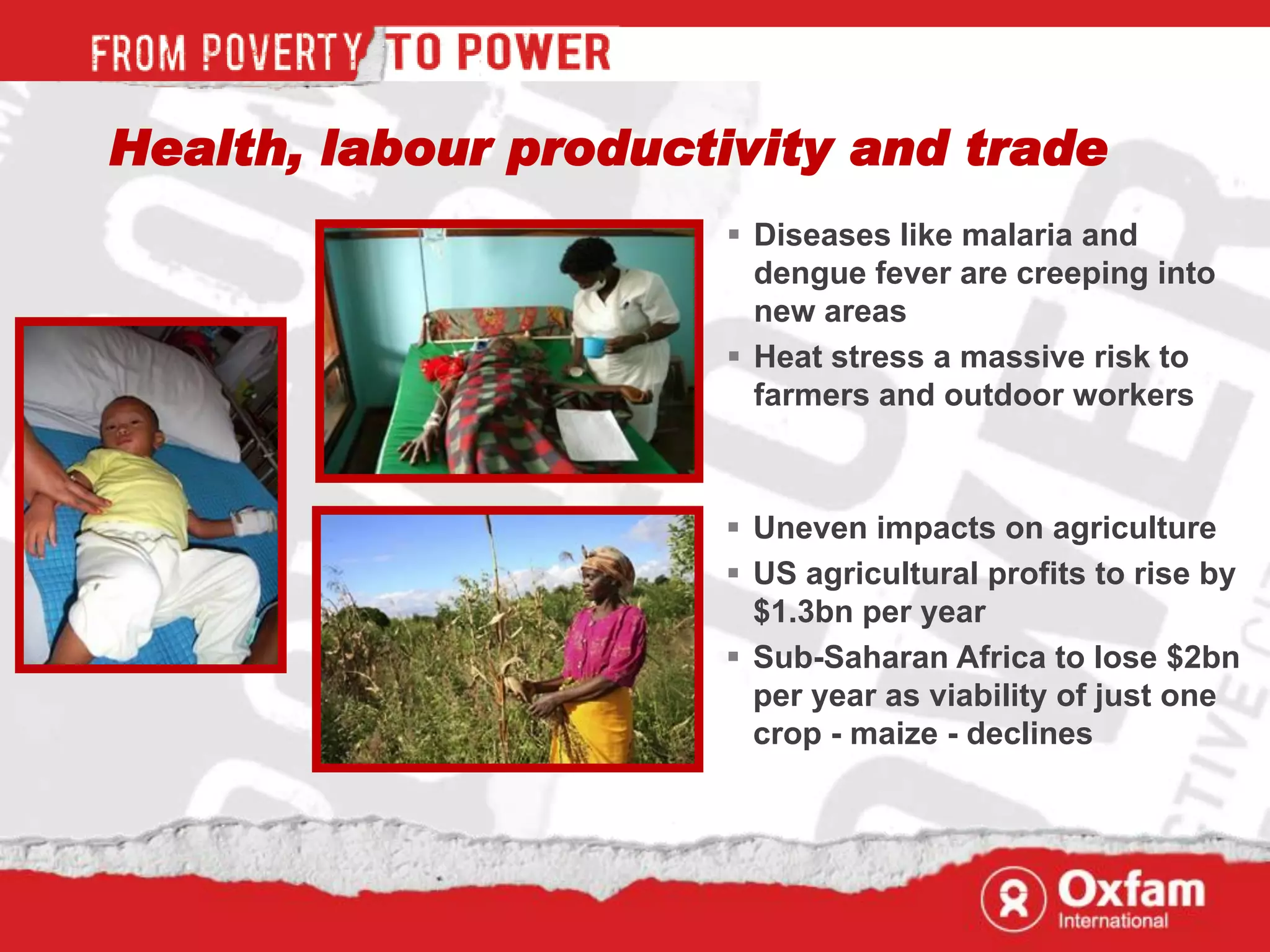
Health, labour productivity and trade
                       Diseases like malaria and
                        dengue fever are creeping into
                        new areas
                       Heat stress a massive risk to
                        farmers and outdoor workers


                       Uneven impacts on agriculture
                       US agricultural profits to rise by
                        $1.3bn per year
                       Sub-Saharan Africa to lose $2bn
                        per year as viability of just one
                        crop - maize - declines
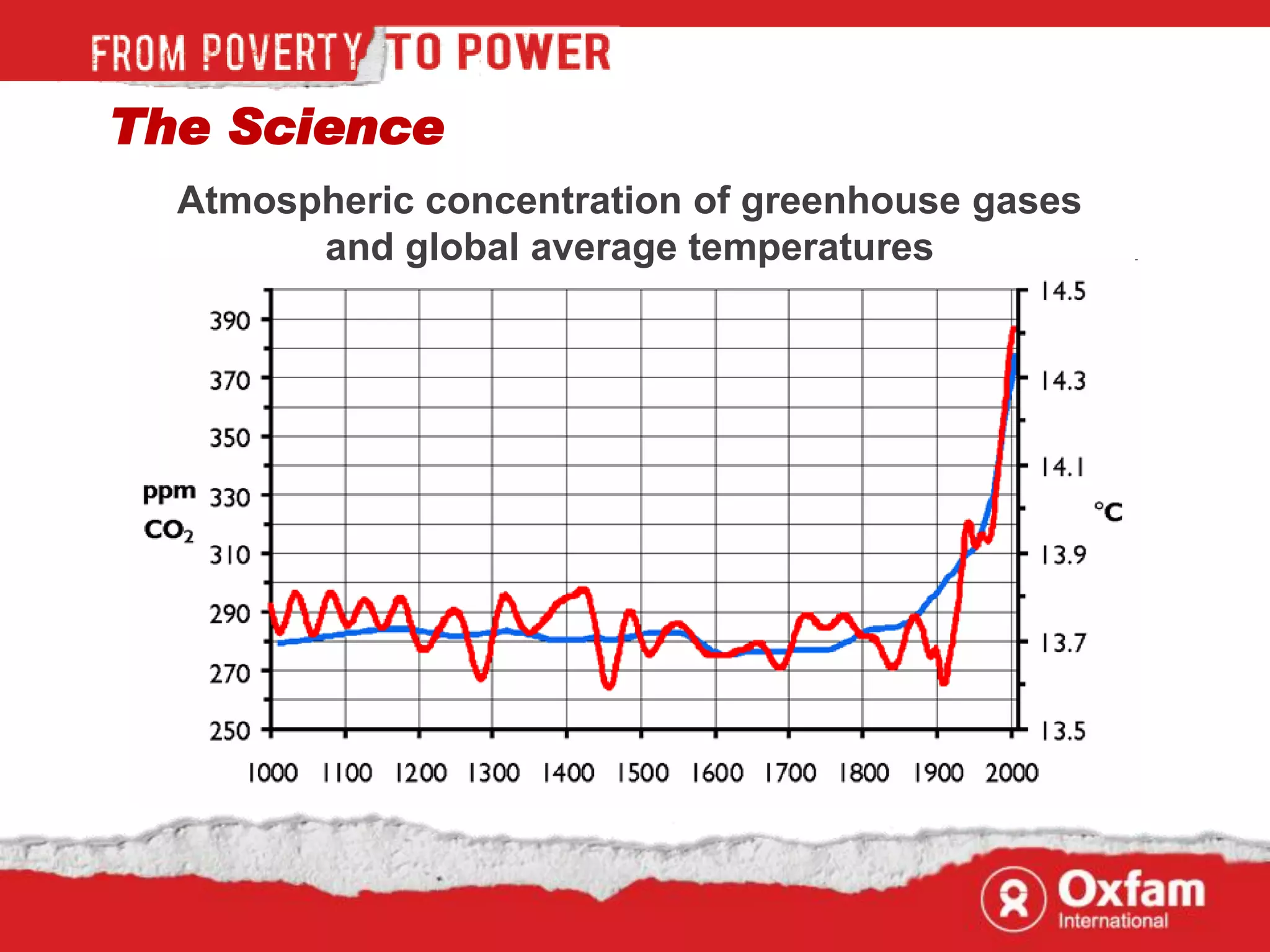
The Science
  Atmospheric concentration of greenhouse gases
        and global average temperatures
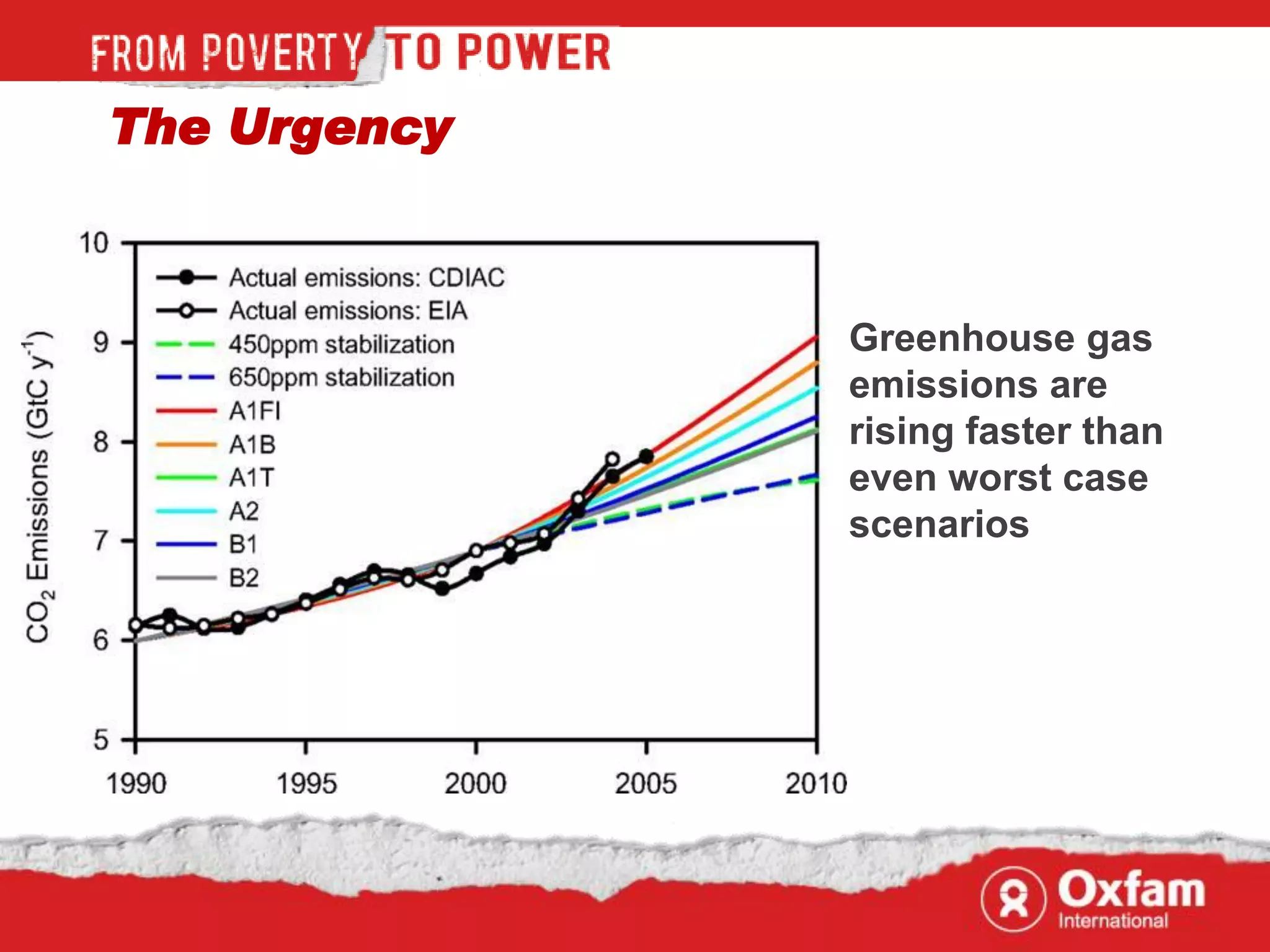
The Urgency


              Greenhouse gas
              emissions are
              rising faster than
              even worst case
              scenarios
So what do we do?

   Adaptation: helping people to build their resilience
    to climate change
     – Adaptation is good development
     – Best way is to build human security
     – Who pays? How much?

   Mitigation: cutting global emissions
     – Who cuts? How fast?
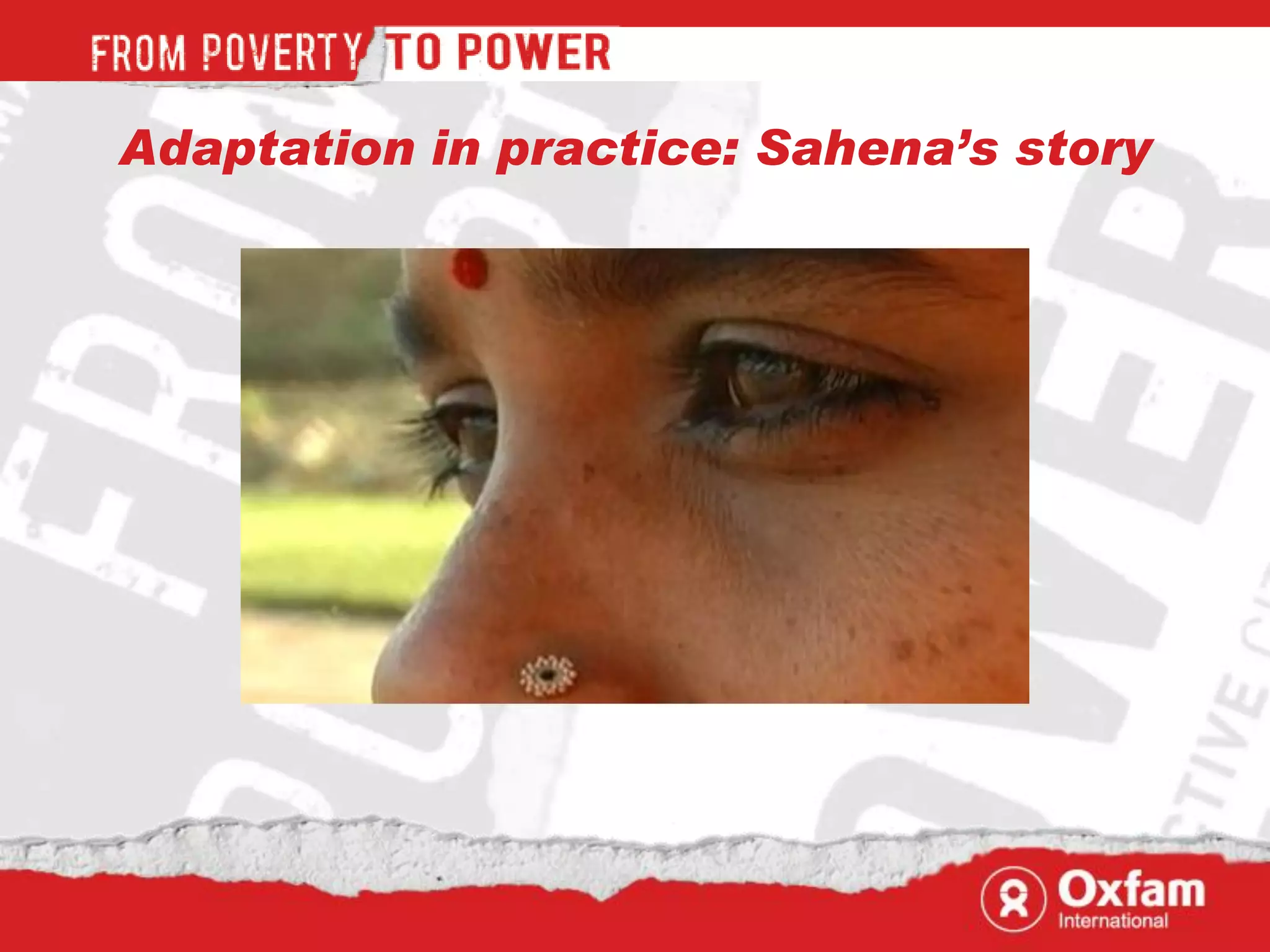
Adaptation in practice: Sahena’s story
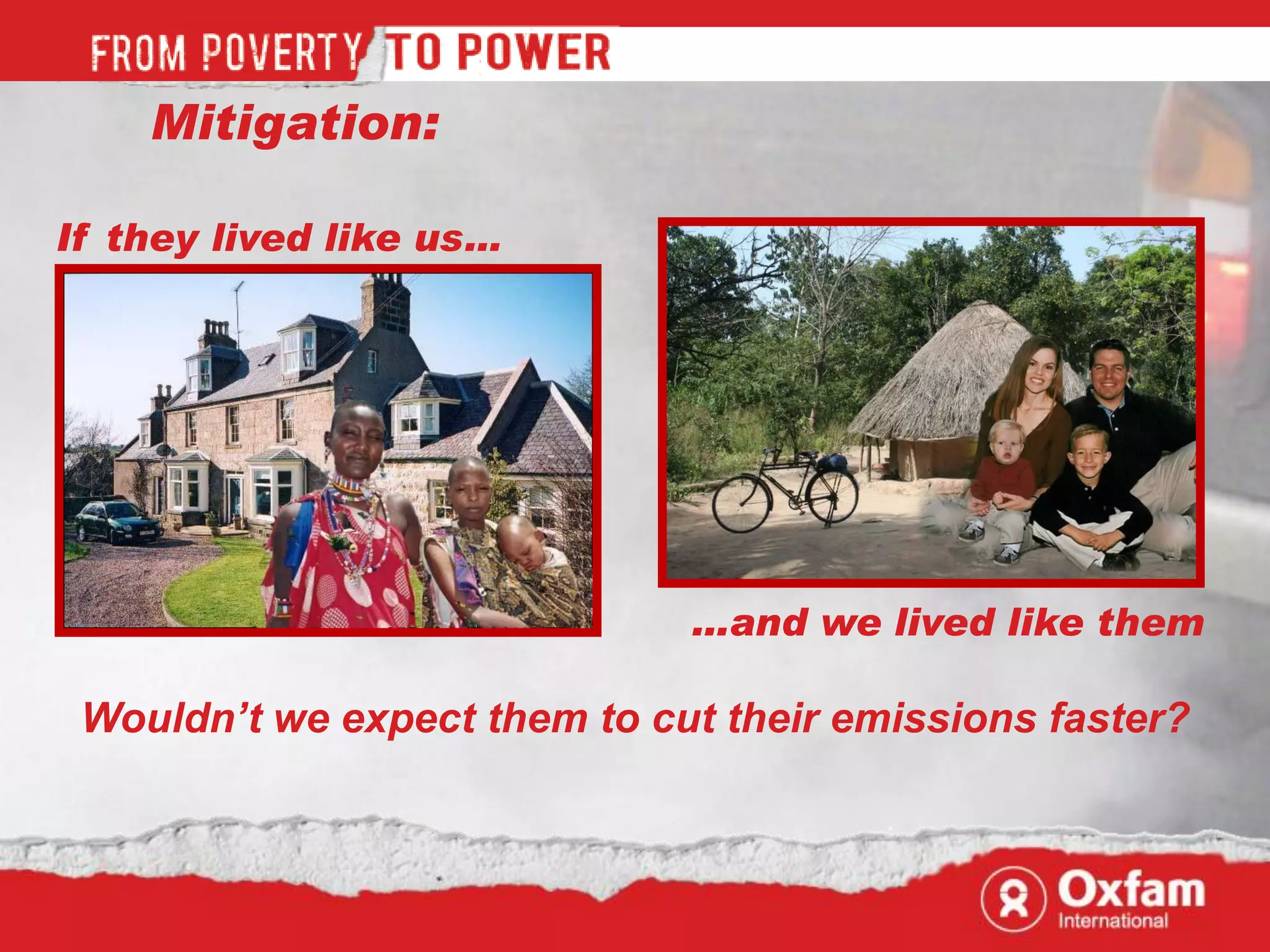
Mitigation:

If they lived like us…


                              …and we lived like them

 Wouldn’t we expect them to cut their emissions faster?
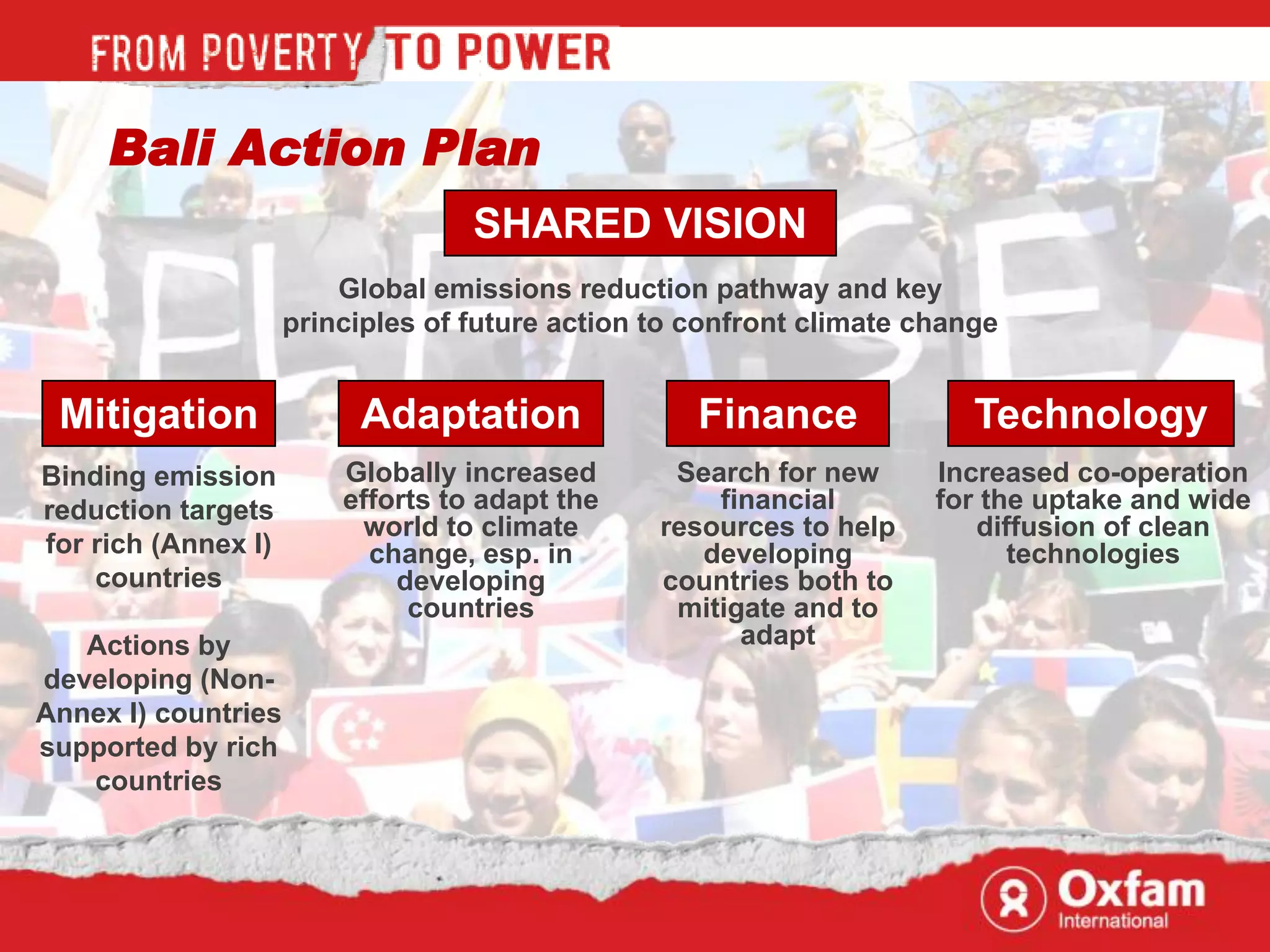
Bali Action Plan
                                   SHARED VISION
                         Global emissions reduction pathway and key
                     principles of future action to confront climate change


 Mitigation               Adaptation                Finance              Technology
Binding emission         Globally increased       Search for new      Increased co-operation
reduction targets        efforts to adapt the        financial        for the uptake and wide
                           world to climate      resources to help       diffusion of clean
for rich (Annex I)         change, esp. in          developing              technologies
    countries                developing          countries both to
                              countries           mitigate and to
   Actions by                                          adapt
developing (Non-
Annex I) countries
supported by rich
   countries
The crunch moment: Copenhagen
 COP-15: 15th meeting of the 192 countries that signed the
  UN Framework Convention on Climate Change (UNFCCC)
 UNFCCC (drawn up at 1992 Rio Earth Summit):
   – Aims to stabilise greenhouse gas concentrations at
     levels that prevent dangerous climate change; effort to
     be shared based on principle of “common but
     differentiated responsibilities”
   – Rich countries (Annex I) shall reduce their emissions
     first and fastest, and support developing countries in
     both mitigation and adaptation, by providing financial
     support and technology transfer
   – Developing countries‟ (Non-Annex I) actions to address
     emissions contingent upon support from rich countries
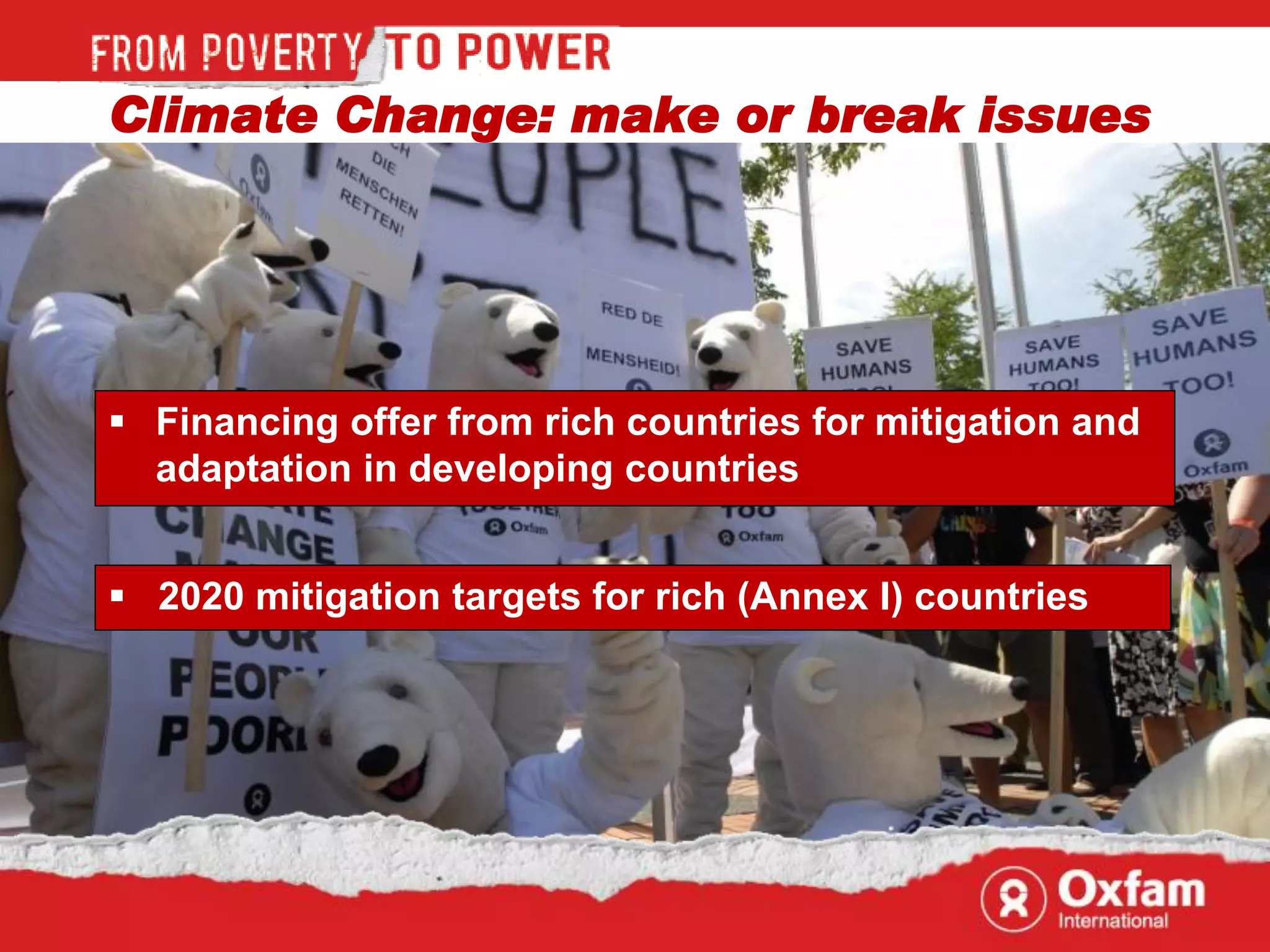
Climate Change: make or break issues


 Financing offer from rich countries for mitigation and
  adaptation in developing countries


 2020 mitigation targets for rich (Annex I) countries
What do we need at Copenhagen?
A SAFE and FAIR deal

SAFE:
  To reduce emissions sufficiently to avoid
   catastrophic climate change

FAIR:
   So that rich countries finally take responsibility
    for the crisis they have created, committing to:
      - cut emissions first, furthest and fastest
      - financing for mitigation and adaptation in
         developing countries
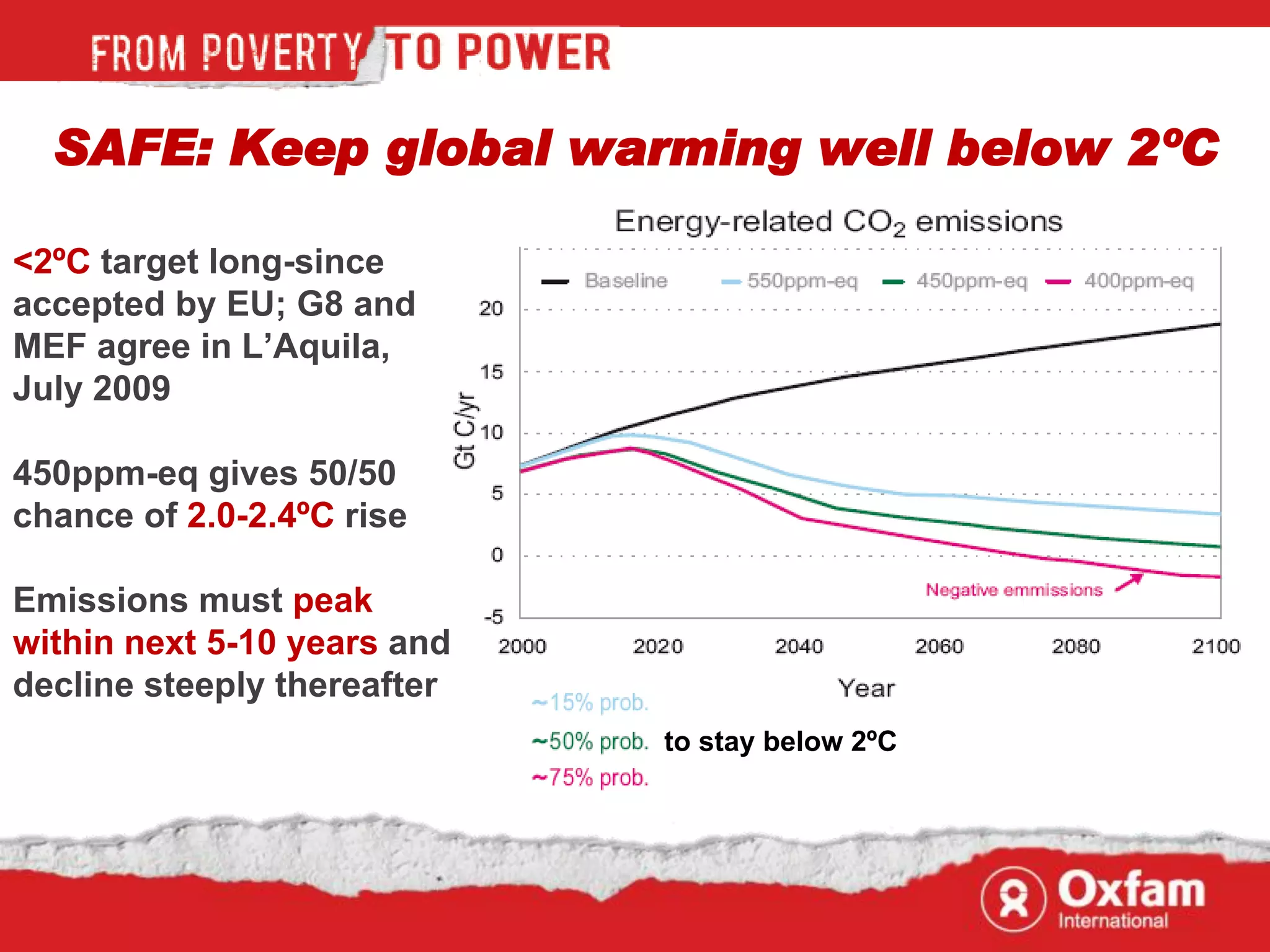
SAFE: Keep global warming well below 2ºC

<2ºC target long-since
accepted by EU; G8 and
MEF agree in L‟Aquila,
July 2009

450ppm-eq gives 50/50
chance of 2.0-2.4ºC rise

Emissions must peak
within next 5-10 years and
decline steeply thereafter
                             to stay below 2ºC
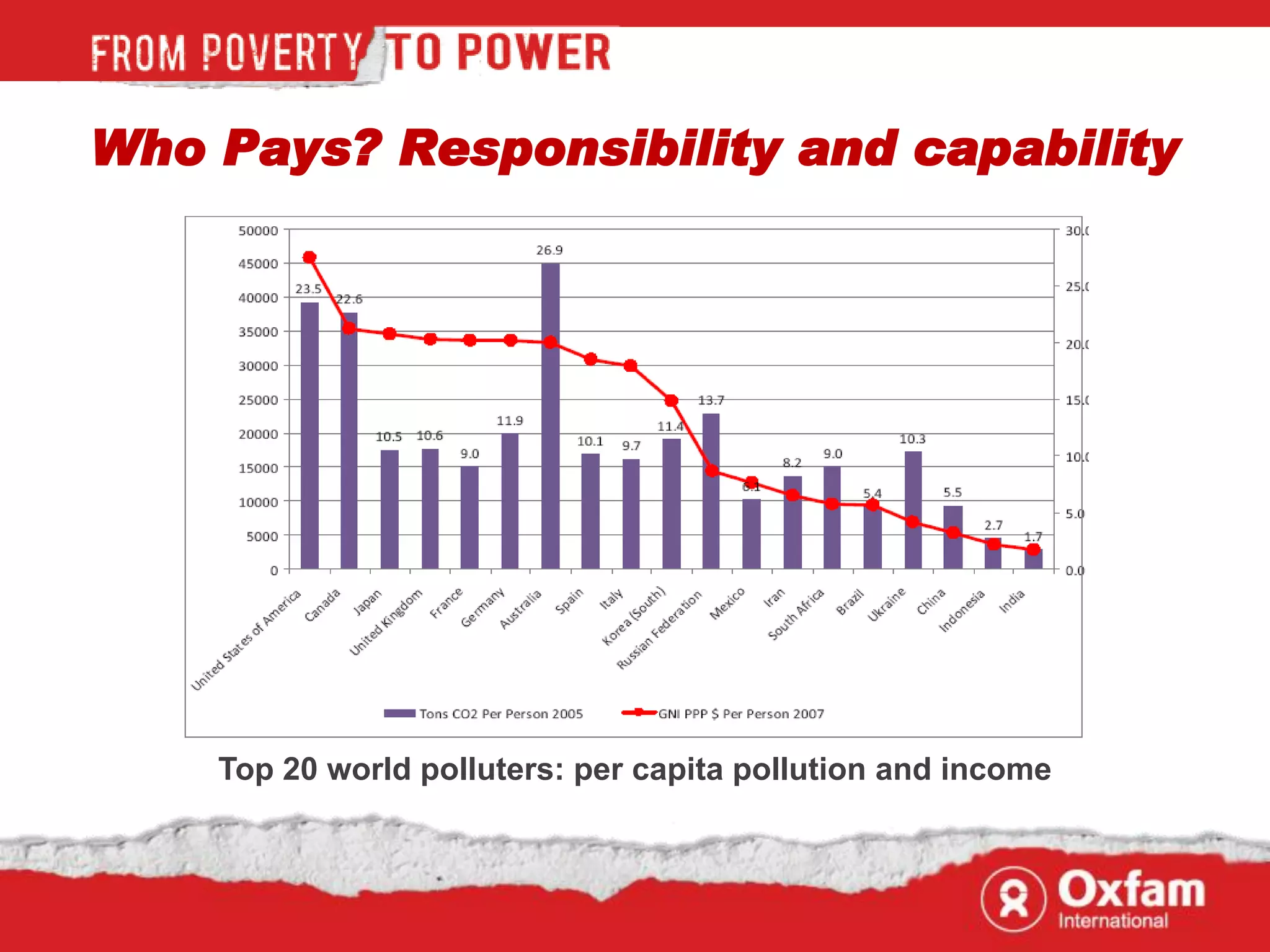
Who Pays? Responsibility and capability


    Top 20 world polluters: per capita pollution and income
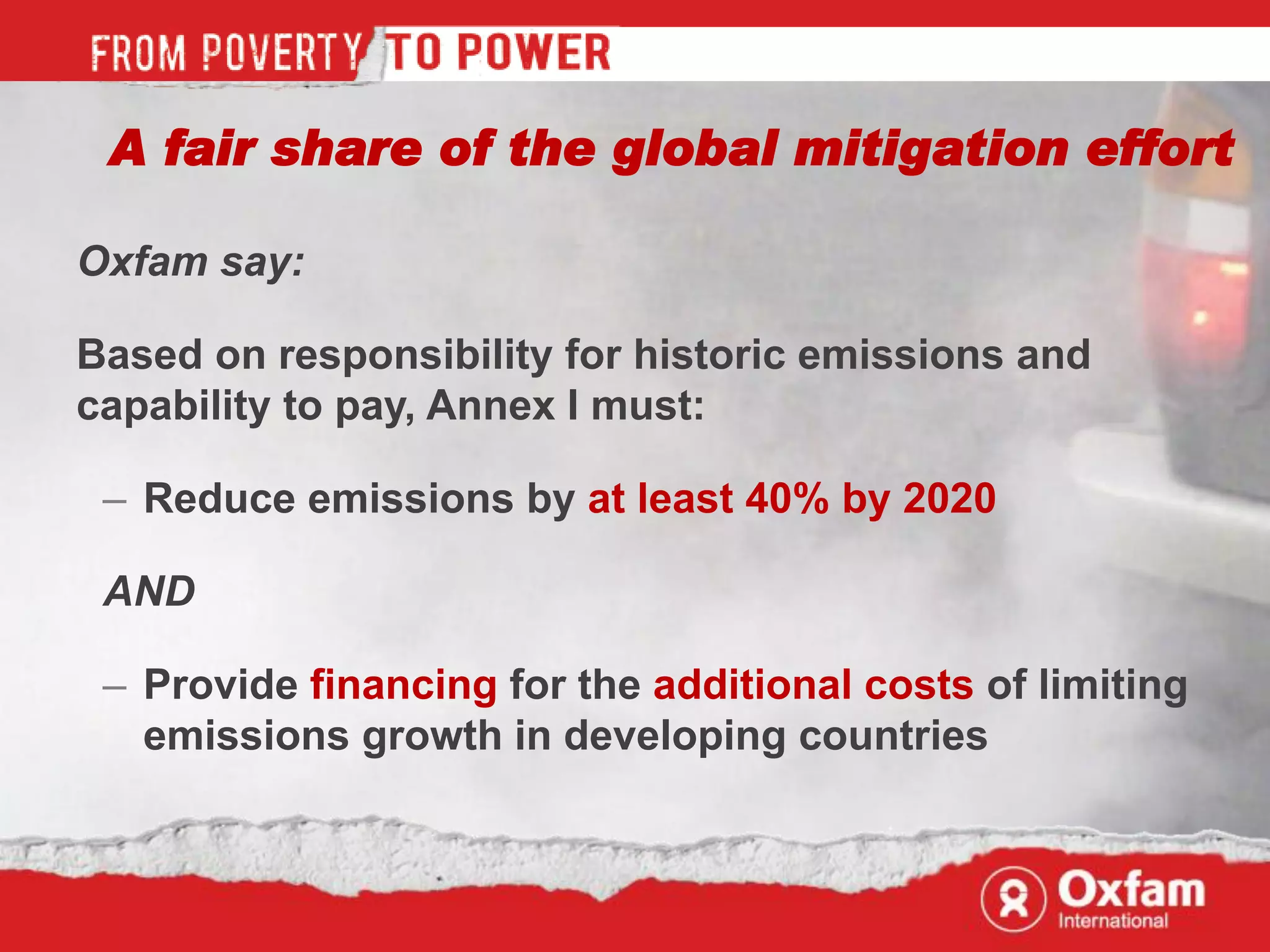
A fair share of the global mitigation effort

Oxfam say:

Based on responsibility for historic emissions and
capability to pay, Annex I must:

 – Reduce emissions by at least 40% by 2020

 AND

 – Provide financing for the additional costs of limiting
   emissions growth in developing countries
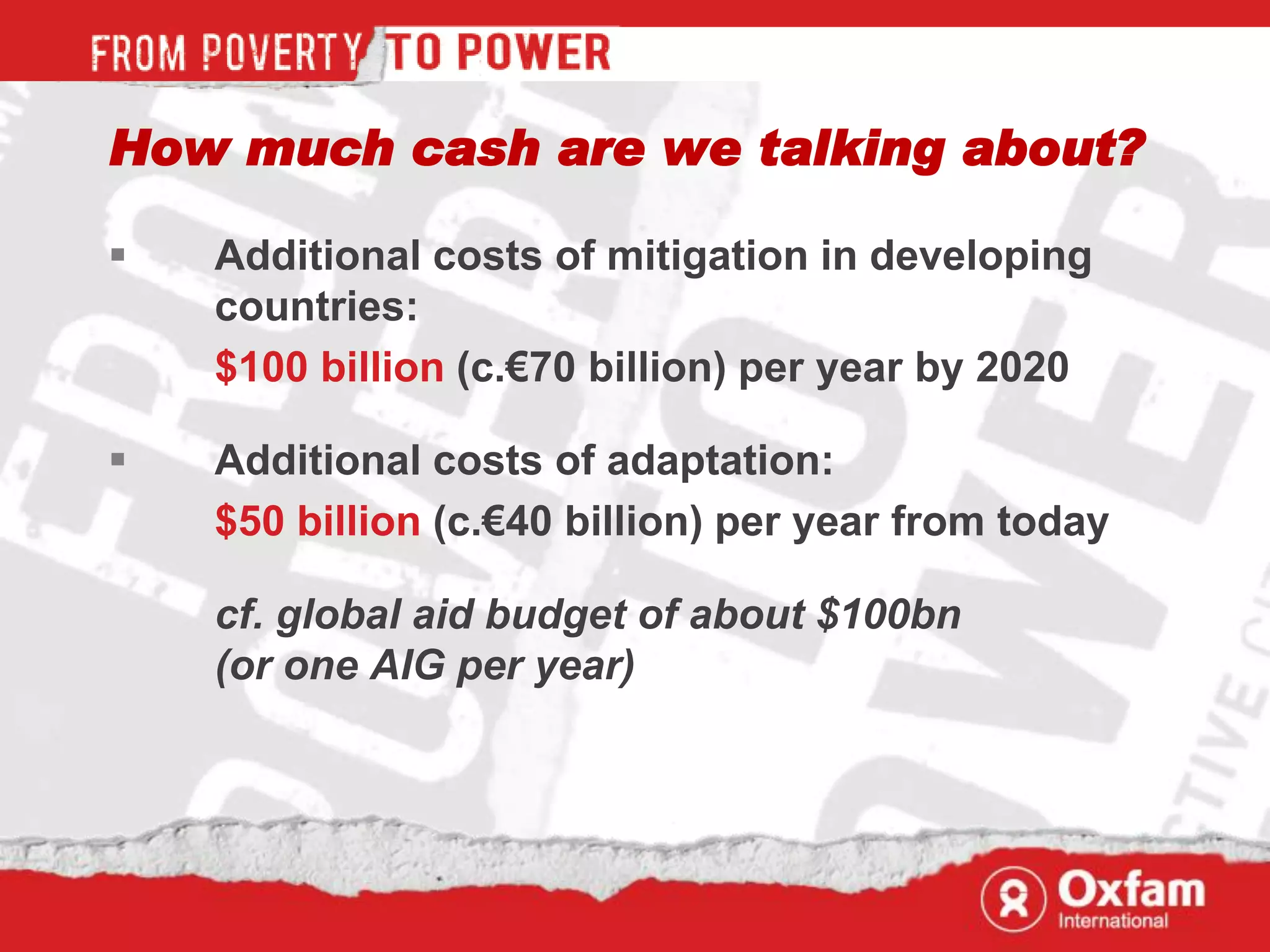
How much cash are we talking about?

   Additional costs of mitigation in developing
    countries:
    $100 billion (c.€70 billion) per year by 2020

   Additional costs of adaptation:
    $50 billion (c.€40 billion) per year from today

    cf. global aid budget of about $100bn
    (or one AIG per year)
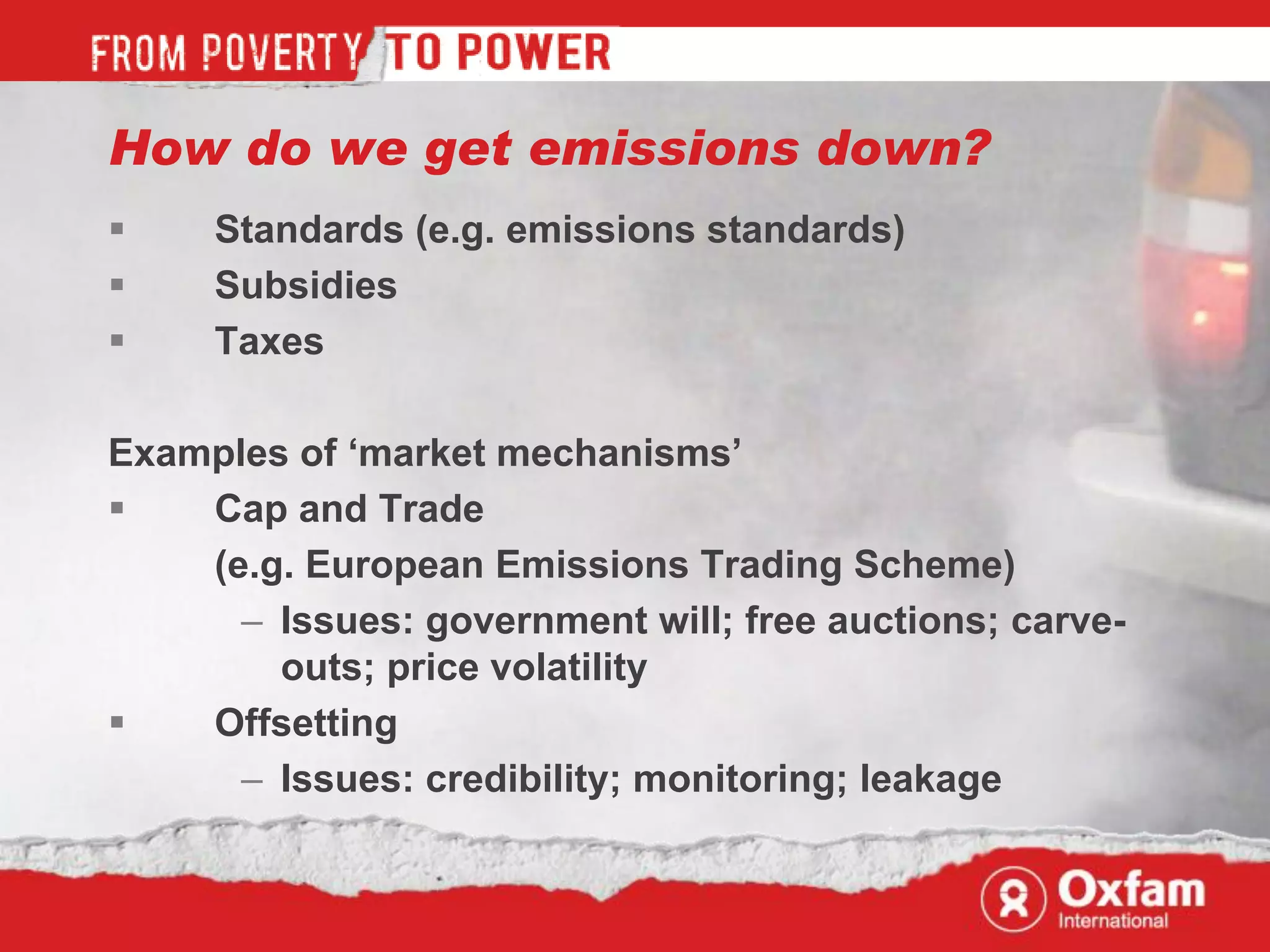
How do we get emissions down?
    Standards (e.g. emissions standards)
    Subsidies
    Taxes

Examples of „market mechanisms‟
   Cap and Trade
    (e.g. European Emissions Trading Scheme)
      – Issues: government will; free auctions; carve-
        outs; price volatility
   Offsetting
      – Issues: credibility; monitoring; leakage
A FAIR and SAFE deal

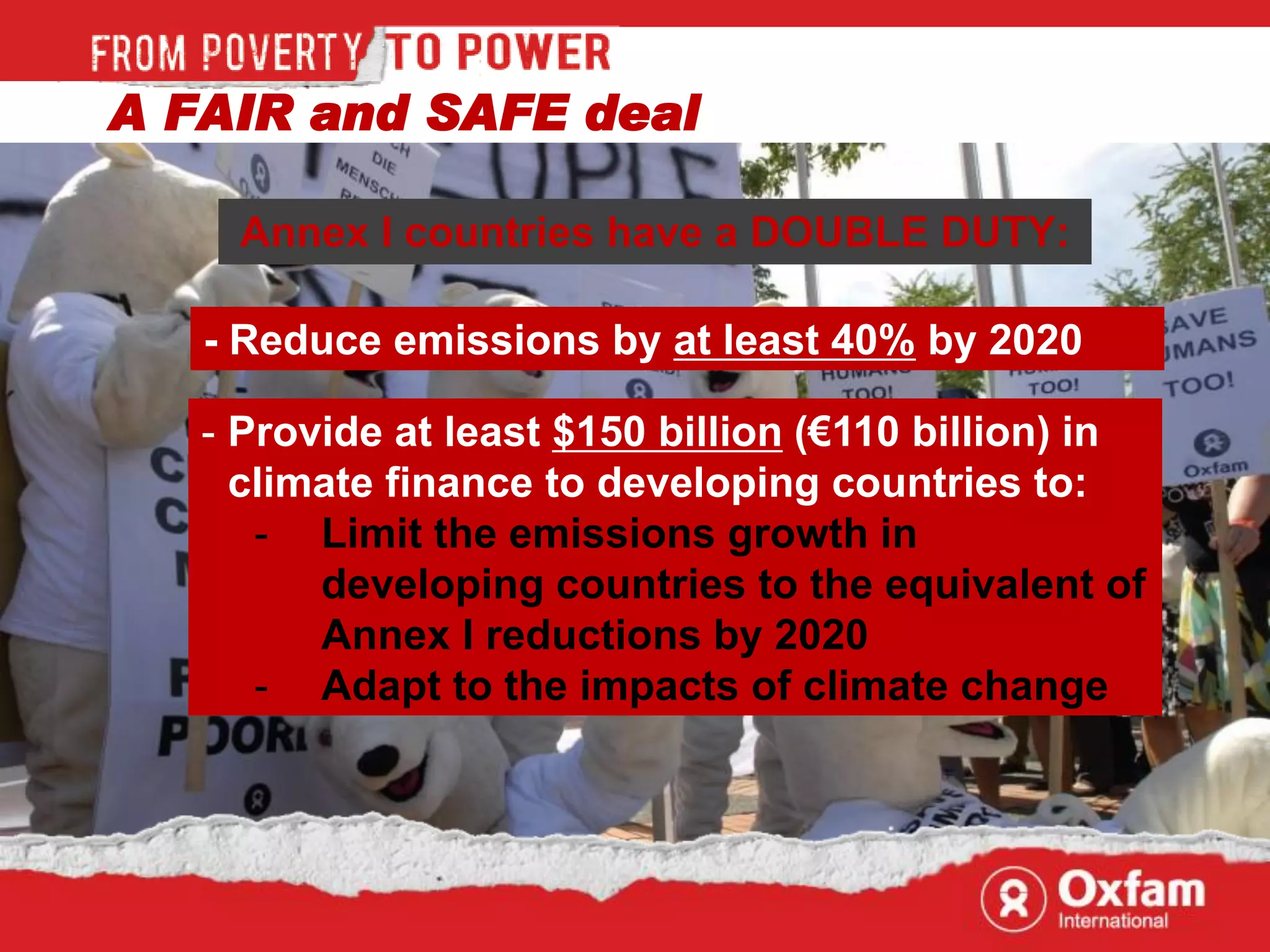
     Annex I countries have a DOUBLE DUTY:

   - Reduce emissions by at least 40% by 2020

   - Provide at least $150 billion (€110 billion) in
     climate finance to developing countries to:
      - Limit the emissions growth in
         developing countries to the equivalent of
         Annex I reductions by 2020
      - Adapt to the impacts of climate change
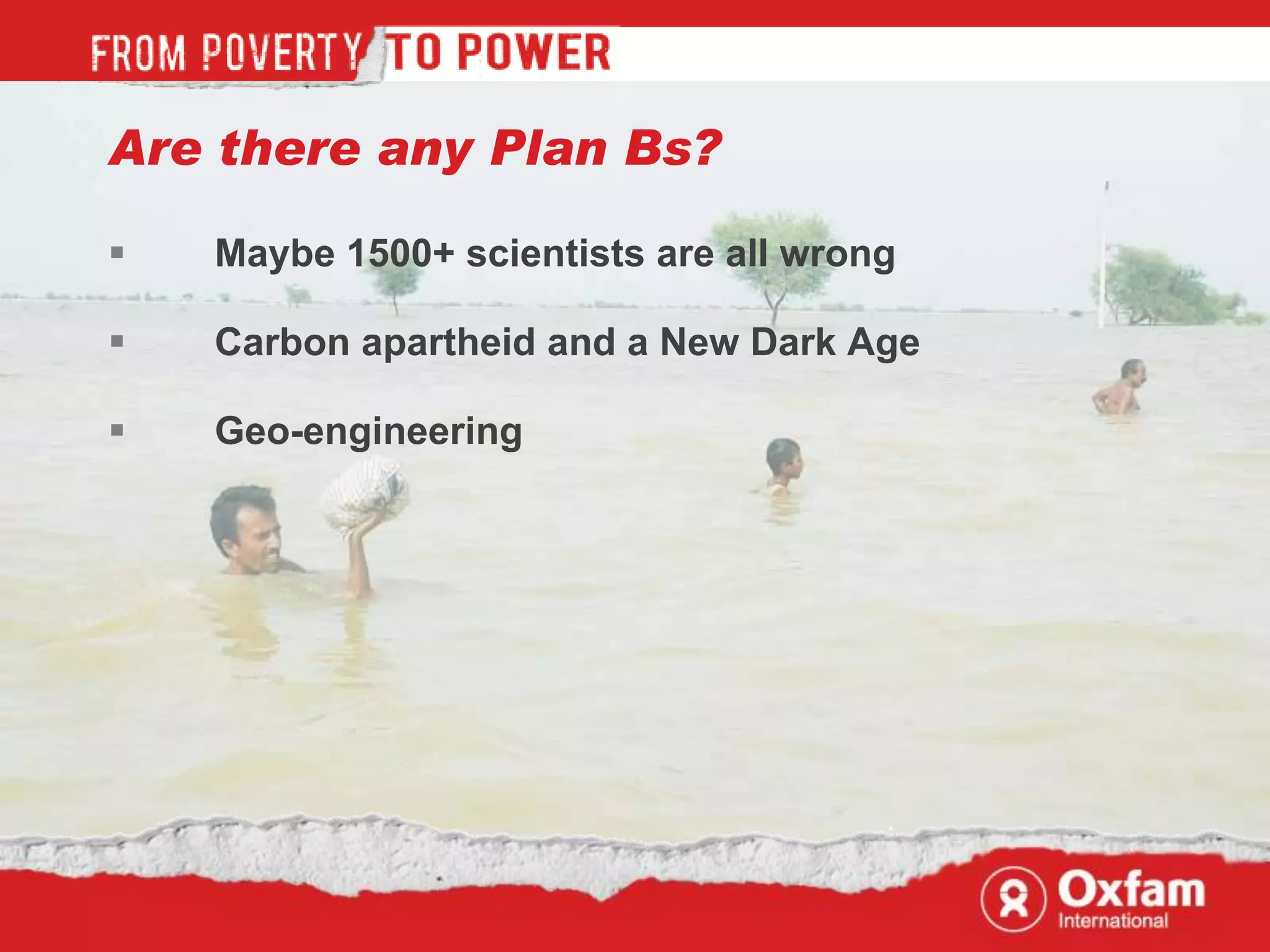
Are there any Plan Bs?

   Maybe 1500+ scientists are all wrong

   Carbon apartheid and a New Dark Age

   Geo-engineering
The Urgency of Now
Further Reading from the Blog

   CC and Flooding in Bangladesh,
    http://www.oxfamblogs.org/fp2p/?p=676
   Organic farming and CC,
    http://www.oxfamblogs.org/fp2p/?p=395
   What has CC done to the seasons?,
    http://www.oxfamblogs.org/fp2p/?p=387
   CC and natural disasters,
    http://www.oxfamblogs.org/fp2p/?p=232
   Building a low carbon economy,
    http://www.oxfamblogs.org/fp2p/?p=187
Further Reading and Links

   UN Intergovernmental Panel on Climate Change,
    http://www.ipcc.ch
   „What is the Economics of Climate Change?‟ Stern
    Review, 2006
   Oxfam America climate change campaign,
    http://www.oxfamamerica.org/issues/climate-
    change

Climate Change, From Poverty to Power Lecture

  • 1.
    Climate Change Lecture given by Duncan Green Head of Research at Oxfam GB Notre Dame University, September 2009 Part of a series of From Poverty to Power lectures.
  • 2.
    Main messages  Climate change is fundamentally a development crisis: the central poverty issue of our time  The scientific battle has been won – the debate now is over what to do about it  A global framework for responding has now been agreed, but time is short to agree specifics  The elements of this framework are Mitigation; Adaptation; Finance and Technology  Key decisions are who acts, who pays and when  Copenhagen meeting in December is make or break  Plan Bs look pretty unattractive!
  • 3.
    Suffering the Science: Thehuman costs of climate change  Climate change is affecting every issue linked to poverty and development today, from access to food and water to health and security.  Without immediate action 50 years of development gains in poor countries will be permanently lost
  • 4.
    Hunger, agricultural productivity andwater availability  Rice and maize face significant drops in yields  Maize yields forecast to drop by 15% or more by 2020 in most of sub- Saharan Africa and India  South African government scientists predicting 50% drop in all cereal yields by 2080  Water supplies running out  Several major cities (Kathmandu, La Paz) which depend on glaciers may soon be unable to function  The Ganges basin alone is home to 500 million people
  • 5.
    Disasters and displacement  Climate-related disasters – storms, floods, droughts and wildfires – increasing in frequency  375 million people at risk each year by 2015 – a 50% increase which could overwhelm humanitarian systems  26 million people already displaced  1 million more people displaced every year by weather-related events
  • 6.
    Health, labour productivityand trade  Diseases like malaria and dengue fever are creeping into new areas  Heat stress a massive risk to farmers and outdoor workers  Uneven impacts on agriculture  US agricultural profits to rise by $1.3bn per year  Sub-Saharan Africa to lose $2bn per year as viability of just one crop - maize - declines
  • 7.
    The Science Atmospheric concentration of greenhouse gases and global average temperatures
  • 8.
    The Urgency Greenhouse gas emissions are rising faster than even worst case scenarios
  • 9.
    So what dowe do?  Adaptation: helping people to build their resilience to climate change – Adaptation is good development – Best way is to build human security – Who pays? How much?  Mitigation: cutting global emissions – Who cuts? How fast?
  • 10.
    Adaptation in practice:Sahena’s story
  • 11.
    Mitigation: If they livedlike us… …and we lived like them Wouldn’t we expect them to cut their emissions faster?
  • 12.
    Bali Action Plan SHARED VISION Global emissions reduction pathway and key principles of future action to confront climate change Mitigation Adaptation Finance Technology Binding emission Globally increased Search for new Increased co-operation reduction targets efforts to adapt the financial for the uptake and wide world to climate resources to help diffusion of clean for rich (Annex I) change, esp. in developing technologies countries developing countries both to countries mitigate and to Actions by adapt developing (Non- Annex I) countries supported by rich countries
  • 13.
    The crunch moment:Copenhagen  COP-15: 15th meeting of the 192 countries that signed the UN Framework Convention on Climate Change (UNFCCC)  UNFCCC (drawn up at 1992 Rio Earth Summit): – Aims to stabilise greenhouse gas concentrations at levels that prevent dangerous climate change; effort to be shared based on principle of “common but differentiated responsibilities” – Rich countries (Annex I) shall reduce their emissions first and fastest, and support developing countries in both mitigation and adaptation, by providing financial support and technology transfer – Developing countries‟ (Non-Annex I) actions to address emissions contingent upon support from rich countries
  • 14.
    Climate Change: makeor break issues  Financing offer from rich countries for mitigation and adaptation in developing countries  2020 mitigation targets for rich (Annex I) countries
  • 15.
    What do weneed at Copenhagen? A SAFE and FAIR deal SAFE:  To reduce emissions sufficiently to avoid catastrophic climate change FAIR:  So that rich countries finally take responsibility for the crisis they have created, committing to: - cut emissions first, furthest and fastest - financing for mitigation and adaptation in developing countries
  • 16.
    SAFE: Keep globalwarming well below 2ºC <2ºC target long-since accepted by EU; G8 and MEF agree in L‟Aquila, July 2009 450ppm-eq gives 50/50 chance of 2.0-2.4ºC rise Emissions must peak within next 5-10 years and decline steeply thereafter to stay below 2ºC
  • 17.
    Who Pays? Responsibilityand capability Top 20 world polluters: per capita pollution and income
  • 18.
    A fair shareof the global mitigation effort Oxfam say: Based on responsibility for historic emissions and capability to pay, Annex I must: – Reduce emissions by at least 40% by 2020 AND – Provide financing for the additional costs of limiting emissions growth in developing countries
  • 19.
    How much cashare we talking about?  Additional costs of mitigation in developing countries: $100 billion (c.€70 billion) per year by 2020  Additional costs of adaptation: $50 billion (c.€40 billion) per year from today cf. global aid budget of about $100bn (or one AIG per year)
  • 20.
    How do weget emissions down?  Standards (e.g. emissions standards)  Subsidies  Taxes Examples of „market mechanisms‟  Cap and Trade (e.g. European Emissions Trading Scheme) – Issues: government will; free auctions; carve- outs; price volatility  Offsetting – Issues: credibility; monitoring; leakage
  • 21.
    A FAIR andSAFE deal Annex I countries have a DOUBLE DUTY: - Reduce emissions by at least 40% by 2020 - Provide at least $150 billion (€110 billion) in climate finance to developing countries to: - Limit the emissions growth in developing countries to the equivalent of Annex I reductions by 2020 - Adapt to the impacts of climate change
  • 22.
    Are there anyPlan Bs?  Maybe 1500+ scientists are all wrong  Carbon apartheid and a New Dark Age  Geo-engineering
  • 23.
  • 24.
    Further Reading fromthe Blog  CC and Flooding in Bangladesh, http://www.oxfamblogs.org/fp2p/?p=676  Organic farming and CC, http://www.oxfamblogs.org/fp2p/?p=395  What has CC done to the seasons?, http://www.oxfamblogs.org/fp2p/?p=387  CC and natural disasters, http://www.oxfamblogs.org/fp2p/?p=232  Building a low carbon economy, http://www.oxfamblogs.org/fp2p/?p=187
  • 25.
    Further Reading andLinks  UN Intergovernmental Panel on Climate Change, http://www.ipcc.ch  „What is the Economics of Climate Change?‟ Stern Review, 2006  Oxfam America climate change campaign, http://www.oxfamamerica.org/issues/climate- change