Presented by: - Mohamed Fdaili
- Amina Zakani
- Chaimaa Oukrati
Framed by: Mr.A.Neddami
2
Conclusion
Diode applications
Types of diodes
Diode characteristics
What is a diode ?
P-N Junction
Introduction
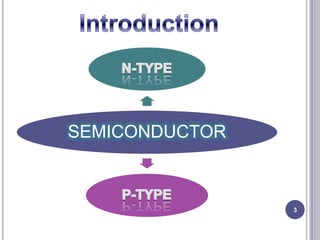
SEMICONDUCTOR
3
4
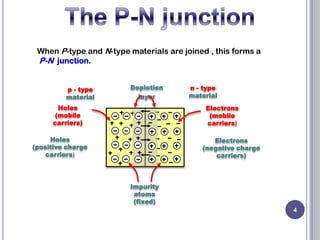
When P-type and N-type materials are joined , this forms a
P-N junction.
Impurity
atoms
(fixed)
p - type
material
n - type
material
Holes
(mobile
carriers)
Electrons
(mobile
carriers)
Electrons
(negative charge
carriers)
Holes
(positive charge
carriers)
Depletion
layer
5
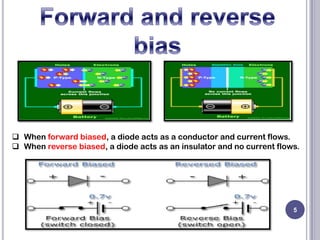
 When forward biased, a diode acts as a conductor and current flows.
 When reverse biased, a diode acts as an insulator and no current flows.
6
It is an electronic device that ideally conducts in
only one direction.
Actual Features : Electrical Symbol :
 Ideal Diode Model (without threshold )
7
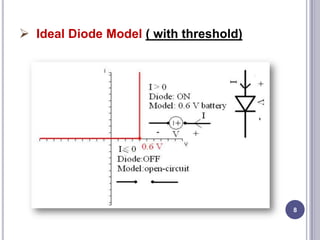
 Ideal Diode Model ( with threshold)
8
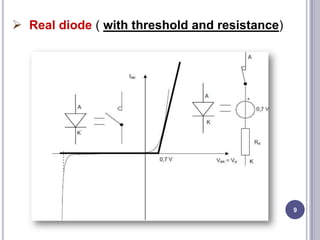
 Real diode ( with threshold and resistance)
9
10
s
I I
qV
kT
where
I diode current with reversebias
q coulomb the electronic ch e
k
eV
K
Boltzmann s cons t






 







 
 


0
0
19
5
1
1602 10
862 10
exp ,
. , arg
. , ' tan
11
• Light Emitting Diode (LED)
• Avalanche Diode.
• Laser Diode.
• Schottky Diode.
• Photo Diode.
• Varicap Diode or Varactor Diode.
• Zener Diode.
• Rectifier Diode.
Logic gates :
Diodes can be combined with other components to
construct AND and OR logic gates. This is referred to
as diode logic.
Temperature measurement :
A diode can be used as a temperature measuring
device, since the forward voltage drop across the diode
depends on temperature, as in a Silicon band gap
temperature sensor.
Power conversion :
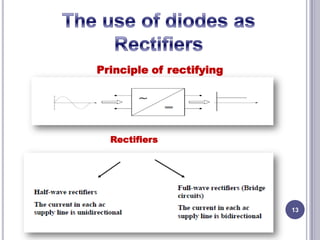
Rectifiers are constructed from diodes, where they are
used to convert alternating current (AC) electricity
into direct current (DC).
12
Principle of rectifying
13
Rectifiers
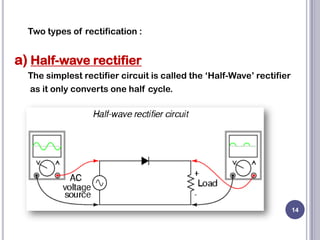
Two types of rectification :
a) Half-wave rectifier
The simplest rectifier circuit is called the ‘Half-Wave’ rectifier
as it only converts one half cycle.
14
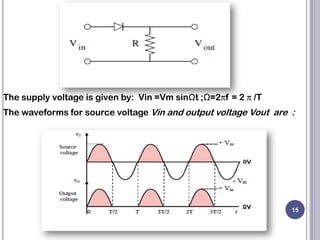
The supply voltage is given by: Vin =Vm sinΩt ;Ω=2πf = 2 π /T
The waveforms for source voltage Vin and output voltage Vout are :
15
 Output DC voltage :
Vave =Vm/ Iave=Vave/R
16
b) Full-wave rectifier
 Two diodes :
The full wave rectifier consists of two diodes and a resister as
shown in Figure:
17
DC voltage output:
Vave =2Vm/ Iave=Vave/R
18
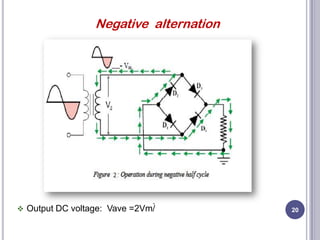
 Four diodes :
positive alternation
19
 Output DC voltage: Vave =2Vm/ 20
Negative alternation
21
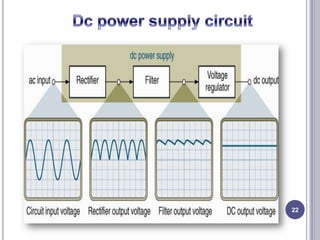
with capacitor filter :
22
23
24

Diodes

  • 1.
    Presented by: -Mohamed Fdaili - Amina Zakani - Chaimaa Oukrati Framed by: Mr.A.Neddami
  • 2.
    2 Conclusion Diode applications Types ofdiodes Diode characteristics What is a diode ? P-N Junction Introduction
  • 3.
  • 4.
    4 When P-type andN-type materials are joined , this forms a P-N junction. Impurity atoms (fixed) p - type material n - type material Holes (mobile carriers) Electrons (mobile carriers) Electrons (negative charge carriers) Holes (positive charge carriers) Depletion layer
  • 5.
    5  When forwardbiased, a diode acts as a conductor and current flows.  When reverse biased, a diode acts as an insulator and no current flows.
  • 6.
    6 It is anelectronic device that ideally conducts in only one direction. Actual Features : Electrical Symbol :
  • 7.
     Ideal DiodeModel (without threshold ) 7
  • 8.
     Ideal DiodeModel ( with threshold) 8
  • 9.
     Real diode( with threshold and resistance) 9
  • 10.
    10 s I I qV kT where I diodecurrent with reversebias q coulomb the electronic ch e k eV K Boltzmann s cons t                      0 0 19 5 1 1602 10 862 10 exp , . , arg . , ' tan
  • 11.
    11 • Light EmittingDiode (LED) • Avalanche Diode. • Laser Diode. • Schottky Diode. • Photo Diode. • Varicap Diode or Varactor Diode. • Zener Diode. • Rectifier Diode.
  • 12.
    Logic gates : Diodescan be combined with other components to construct AND and OR logic gates. This is referred to as diode logic. Temperature measurement : A diode can be used as a temperature measuring device, since the forward voltage drop across the diode depends on temperature, as in a Silicon band gap temperature sensor. Power conversion : Rectifiers are constructed from diodes, where they are used to convert alternating current (AC) electricity into direct current (DC). 12
  • 13.
  • 14.
    Two types ofrectification : a) Half-wave rectifier The simplest rectifier circuit is called the ‘Half-Wave’ rectifier as it only converts one half cycle. 14
  • 15.
    The supply voltageis given by: Vin =Vm sinΩt ;Ω=2πf = 2 π /T The waveforms for source voltage Vin and output voltage Vout are : 15
  • 16.
     Output DCvoltage : Vave =Vm/ Iave=Vave/R 16
  • 17.
    b) Full-wave rectifier Two diodes : The full wave rectifier consists of two diodes and a resister as shown in Figure: 17
  • 18.
    DC voltage output: Vave=2Vm/ Iave=Vave/R 18
  • 19.
     Four diodes: positive alternation 19
  • 20.
     Output DCvoltage: Vave =2Vm/ 20 Negative alternation
  • 21.
  • 22.
  • 23.
  • 24.