EC04 - 702:
MICROWAVE DEVICES AND COMMUNICATION
By
AJAL.AJ
Faculty , Dept of ECE
METS SCHOOL OF ENGINEERING,MALA
1. With this paper, student should be able to
understand the working principle and use of
various microwave components and semiconductor
devices.
This paper also provides the basic aspects of
terrestrial and satellite microwave communication
links
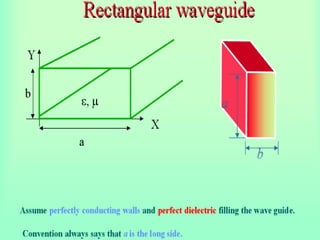
Objectives:
2.
Module I (13 hours)
Basics of microwave Engineering
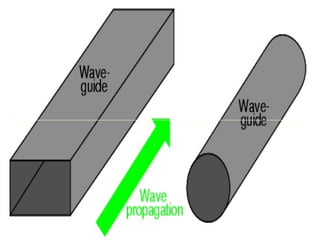
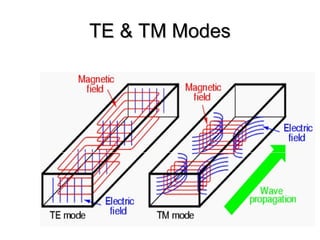
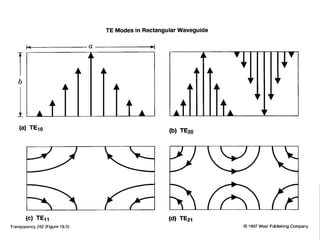
• Theory of waveguide transmission -
rectangular waveguides - TE modes - TM
modes - waveguide components -
rectangular cavity resonator - circular
cavity resonator (only basic ideas) - E-
plane tee - magic tee - isolator - circulator
-directional coupler - S matrix
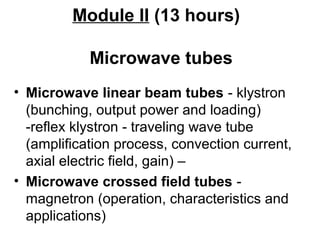
Module II (13 hours)
Microwave tubes
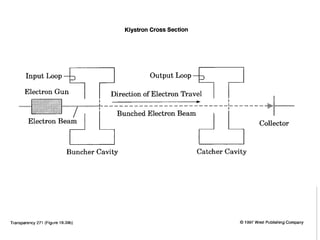
• Microwave linear beam tubes - klystron
(bunching, output power and loading)
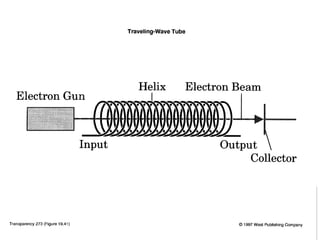
-reflex klystron - traveling wave tube
(amplification process, convection current,
axial electric field, gain) –
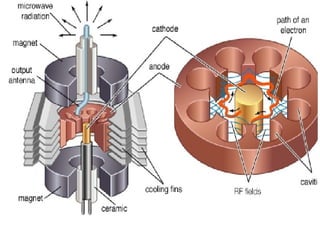
• Microwave crossed field tubes -
magnetron (operation, characteristics and
applications)
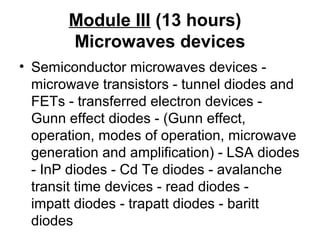
Module III (13 hours)
Microwaves devices
• Semiconductor microwaves devices -
microwave transistors - tunnel diodes and
FETs - transferred electron devices -
Gunn effect diodes - (Gunn effect,
operation, modes of operation, microwave
generation and amplification) - LSA diodes
- InP diodes - Cd Te diodes - avalanche
transit time devices - read diodes -
impatt diodes - trapatt diodes - baritt
diodes
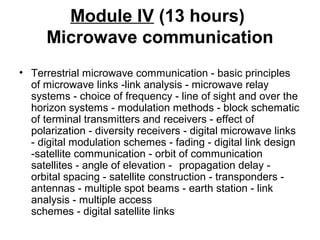
Module IV (13 hours)
Microwave communication
• Terrestrial microwave communication - basic principles
of microwave links -link analysis - microwave relay
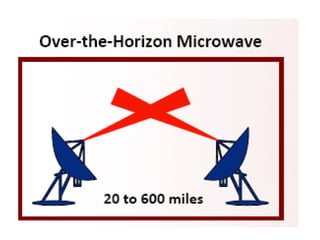
systems - choice of frequency - line of sight and over the
horizon systems - modulation methods - block schematic
of terminal transmitters and receivers - effect of
polarization - diversity receivers - digital microwave links
- digital modulation schemes - fading - digital link design
-satellite communication - orbit of communication
satellites - angle of elevation - propagation delay -
orbital spacing - satellite construction - transponders -
antennas - multiple spot beams - earth station - link
analysis - multiple access
schemes - digital satellite links
MODULE 1
Basics of microwave Engineering
Why Going For NewWhy Going For New
Wave guidingWave guiding
Structures instead ofStructures instead of
transmission linestransmission lines
??????
TE & TM ModesTE & TM Modes
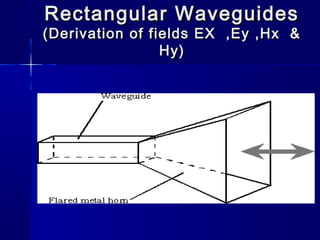
Rectangular WaveguidesRectangular Waveguides
(Derivation of fields EX ,Ey ,Hx &(Derivation of fields EX ,Ey ,Hx &
Hy)Hy)
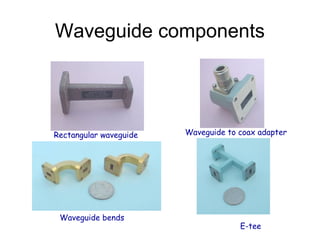
Waveguide components
Rectangular waveguide Waveguide to coax adapter
E-tee
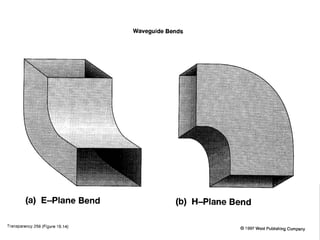
Waveguide bends
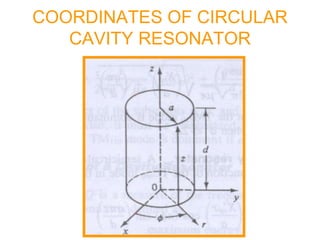
COORDINATES OF CIRCULAR
CAVITY RESONATOR
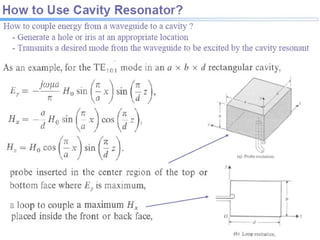
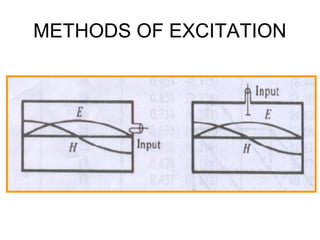
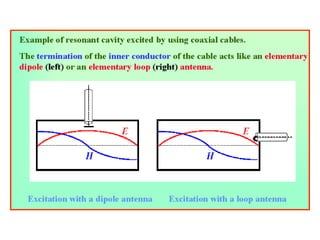
METHODS OF EXCITATION
WHY GOING FOR
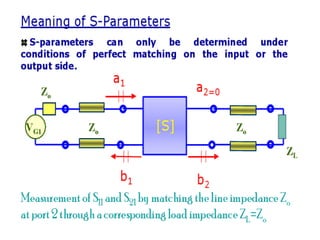
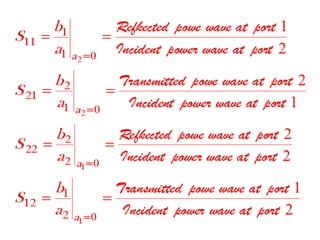
SCATTERING
PARAMETERS IN CASE OF
MICROWAVE
NETWORKS ???
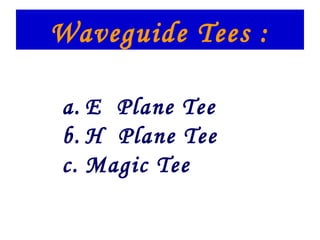
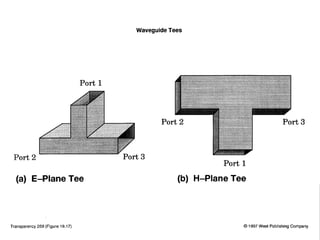
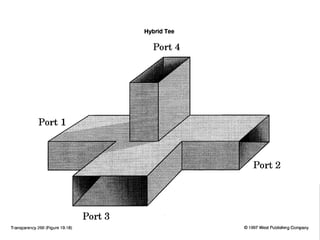
Waveguide Tees :
a. E Plane Tee
b. H Plane Tee
c. Magic Tee
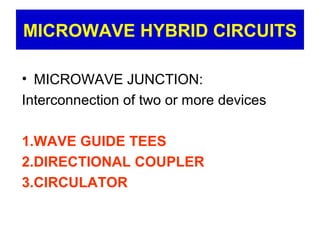
MICROWAVE HYBRID CIRCUITS
• MICROWAVE JUNCTION:
Interconnection of two or more devices
1.WAVE GUIDE TEES
2.DIRECTIONAL COUPLER
3.CIRCULATOR
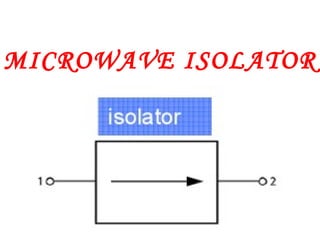
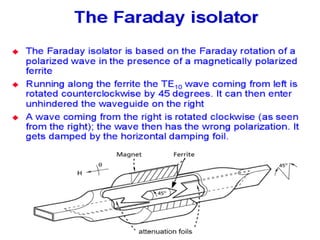
MICROWAVE ISOLATOR
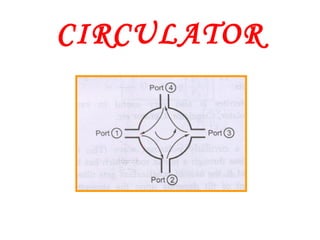
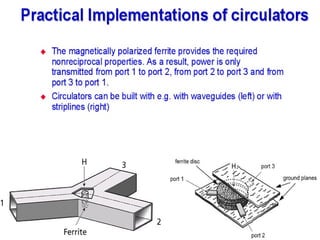
CIRCULATOR
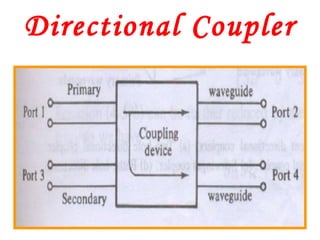
Directional Coupler
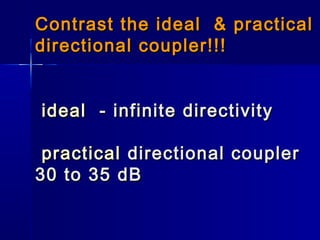
Contrast the ideal & practicalContrast the ideal & practical
directional coupler!!!directional coupler!!!
idealideal - infinite directivity- infinite directivity
practicalpractical directional couplerdirectional coupler
30 to 35 dB30 to 35 dB
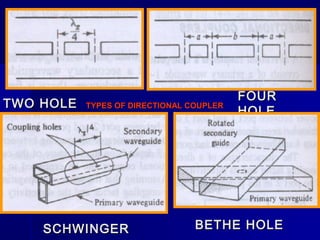
TWO HOLETWO HOLE
FOURFOUR
HOLEHOLE
SCHWINGERSCHWINGER BETHE HOLEBETHE HOLE
TYPES OF DIRECTIONAL COUPLERTYPES OF DIRECTIONAL COUPLER
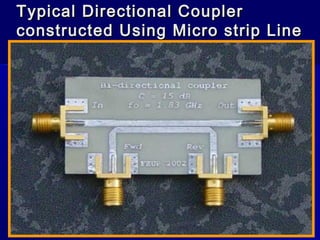
Typical Directional CouplerTypical Directional Coupler
constructed Using Micro strip Lineconstructed Using Micro strip Line
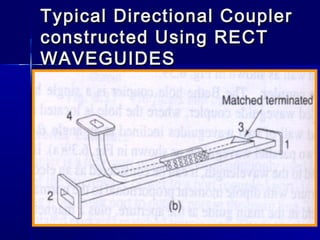
Typical Directional CouplerTypical Directional Coupler
constructed Using RECTconstructed Using RECT
WAVEGUIDESWAVEGUIDES
MODULE 2
Microwave tubes
Microwave Tubes
• Used for high power/high frequency
combination
• Tubes generate and amplify high levels of
microwave power more cheaply than solid
state devices
• Conventional tubes can be modified for low
capacitance but specialized microwave
tubes are also used
Evolution of microwave tubes
• 1935 – Heil oscillator
• 1939 – klystron amplifier
• 1944 – Helix type TWT
• In the early 1950s – low power output of linear
beam tubes to high power levels
• Finally invention of Magnetrons
• Several devices were developed – two
significant devices among them are
1) extended interaction klystron
2) Twystron hybrid amplifier
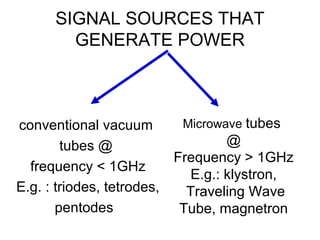
SIGNAL SOURCES THAT
GENERATE POWER
Microwave tubes
@
Frequency > 1GHz
E.g.: klystron,
Traveling Wave
Tube, magnetron
conventional vacuum
tubes @
frequency < 1GHz
E.g. : triodes, tetrodes,
pentodes
What are all the constraints of
ordinary vacuum tubes at
frequencies beyond 1 GHz????
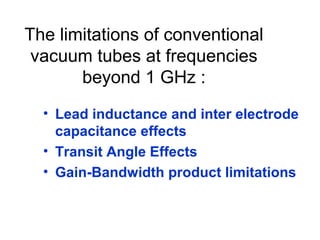
The limitations of conventional
vacuum tubes at frequencies
beyond 1 GHz :
• Lead inductance and inter electrode
capacitance effects
• Transit Angle Effects
• Gain-Bandwidth product limitations
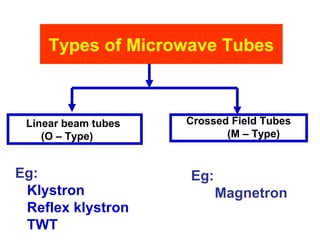
Types of Microwave Tubes
Linear beam tubes
(O – Type)
Crossed Field Tubes
(M – Type)
Eg:
Klystron
Reflex klystron
TWT
Eg:
Magnetron
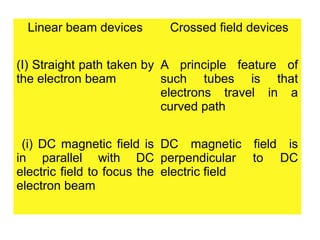
Linear beam devices Crossed field devices
(I) Straight path taken by
the electron beam
A principle feature of
such tubes is that
electrons travel in a
curved path
(i) DC magnetic field is
in parallel with DC
electric field to focus the
electron beam
DC magnetic field is
perpendicular to DC
electric field
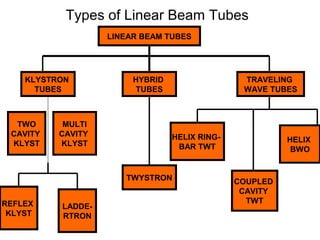
Types of Linear Beam Tubes
TWYSTRON
MULTI
CAVITY
KLYST
TWO
CAVITY
KLYST
LINEAR BEAM TUBES
KLYSTRON
TUBES
HYBRID
TUBES
TRAVELING
WAVE TUBES
REFLEX
KLYST
LADDE-
RTRON
HELIX RING-
BAR TWT
COUPLED
CAVITY
TWT
HELIX
BWO
TWYSTRON
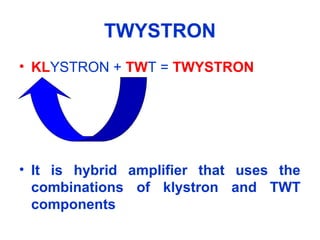
• KLYSTRON + TWT = TWYSTRON
• It is hybrid amplifier that uses the
combinations of klystron and TWT
components
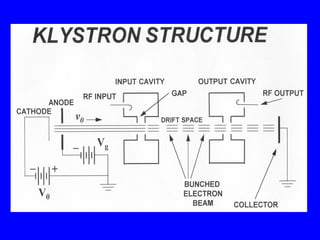
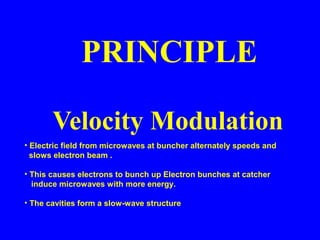
Velocity Modulation
PRINCIPLE
• Electric field from microwaves at buncher alternately speeds and
slows electron beam .
• This causes electrons to bunch up Electron bunches at catcher
induce microwaves with more energy.
• The cavities form a slow-wave structure
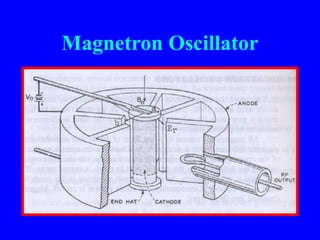
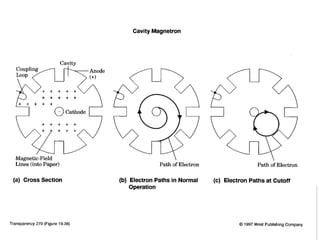
Magnetron Oscillator
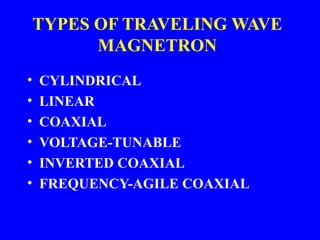
TYPES OF TRAVELING WAVE
MAGNETRON
• CYLINDRICAL
• LINEAR
• COAXIAL
• VOLTAGE-TUNABLE
• INVERTED COAXIAL
• FREQUENCY-AGILE COAXIAL
33
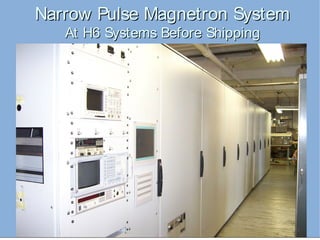
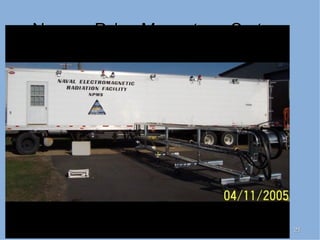
Narrow Pulse Magnetron SystemNarrow Pulse Magnetron System
At H6 Systems Before ShippingAt H6 Systems Before Shipping
2121
Narrow Pulse Magnetron SystemNarrow Pulse Magnetron System
Naval Electromagnetic Radiation FacilityNaval Electromagnetic Radiation Facility
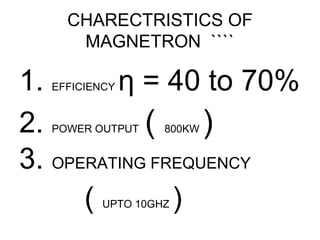
CHARECTRISTICS OF
MAGNETRON ````
1. EFFICIENCY η = 40 to 70%
2. POWER OUTPUT ( 800KW )
3. OPERATING FREQUENCY
( UPTO 10GHZ )
MODULE 3
Microwave Devices
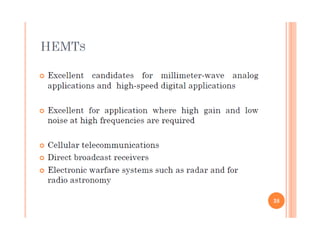
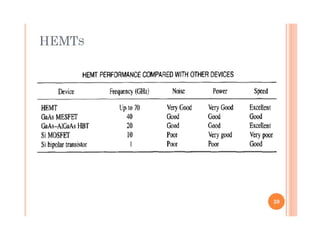
Microwave Devices
• A semiconductor device for the generation
or amplification of electromagnetic energy
at microwave frequencies.
DEFINITION…
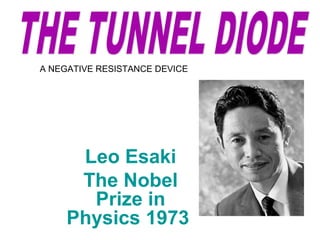
Leo Esaki
The Nobel
Prize in
Physics 1973
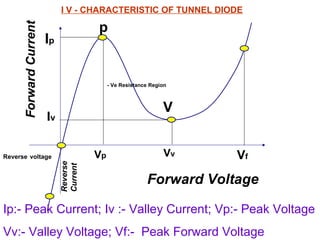
A NEGATIVE RESISTANCE DEVICE
APPLICATIONS
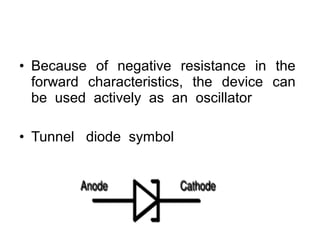
• Because of negative resistance in the
forward characteristics, the device can
be used actively as an oscillator
• Tunnel diode symbol
- Ve Resistance Region
VfVp
Ip
Vv
Forward Voltage
Reverse voltage
Iv
Reverse
Current
ForwardCurrent
Ip:- Peak Current; Iv :- Valley Current; Vp:- Peak Voltage
Vv:- Valley Voltage; Vf:- Peak Forward Voltage
I V - CHARACTERISTIC OF TUNNEL DIODE
p
V
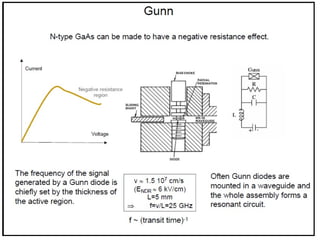
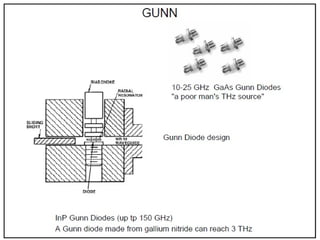
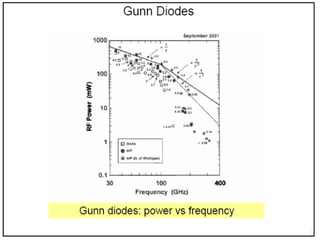
GUNN DIODE
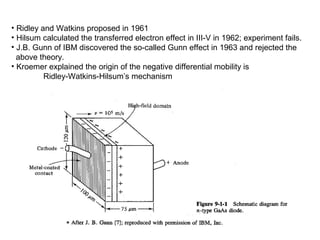
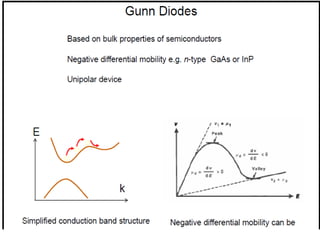
• Ridley and Watkins proposed in 1961
• Hilsum calculated the transferred electron effect in III-V in 1962; experiment fails.
• J.B. Gunn of IBM discovered the so-called Gunn effect in 1963 and rejected the
above theory.
• Kroemer explained the origin of the negative differential mobility is
Ridley-Watkins-Hilsum’s mechanism
Avalanche Transit-time Devices
ATD ’s
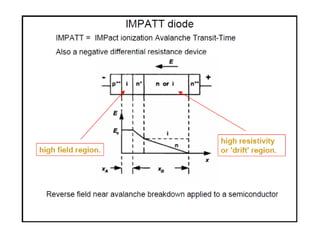
• IMPATT Diode (IMPact Ionization
Avalanche Transit Time Diode)
• TRAPATT diode (Trapped plasma
avalanche triggered transit-time )
• BARRITT diode (Barrier injection transit-
time diode )
READ DIODE
READ DIODE
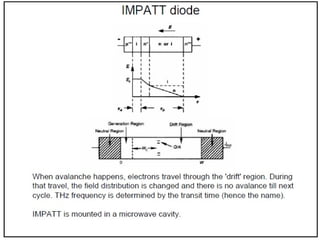
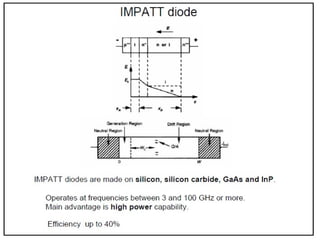
• The basic operating principle of IMPATT
diode can be understood by studying the
structure proposed by READ in 1959
known as READ diode
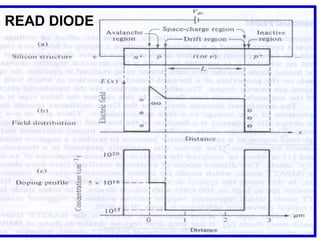
• A read diode structure , doping profile and
DC electric field distribution is shown in fig
READ DIODE
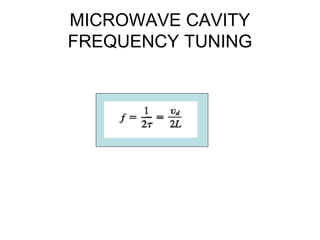
MICROWAVE CAVITY
FREQUENCY TUNING
IMPATT DIODE
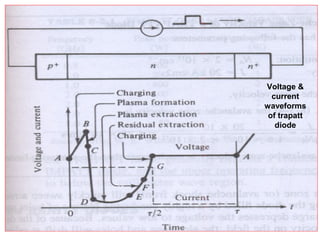
TRAPATT DIODES
Voltage &
current
waveforms
of trapatt
diode
BARRIER-INJECTION TRANSIT-TIME DIODE
BARITT
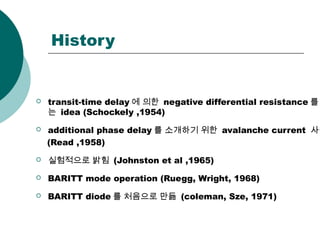
History
 transit-time delay 에 의한 negative differential resistance 를
는 idea (Schockely ,1954)
 additional phase delay 를 소개하기 위한 avalanche current 사용
(Read ,1958)
 실험적으로 밝힘 (Johnston et al ,1965)
 BARITT mode operation (Ruegg, Wright, 1968)
 BARITT diode 를 처음으로 만듦 (coleman, Sze, 1971)
Structure
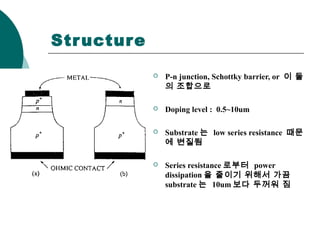
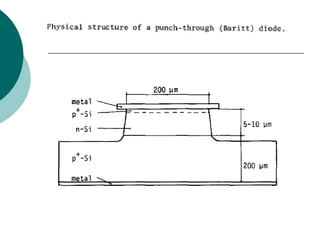
 P-n junction, Schottky barrier, or 이 둘
의 조합으로
 Doping level : 0.5~10um
 Substrate 는 low series resistance 때문
에 변질됨
 Series resistance 로부터 power
dissipation 을 줄이기 위해서 가끔
substrate 는 10um 보다 두꺼워 짐
FGV
Characteristic
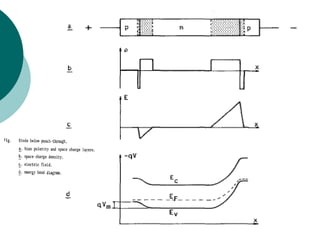
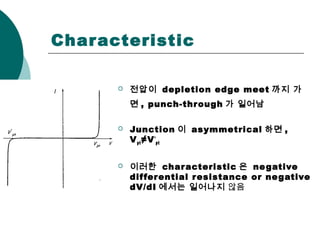
 전압이 depletion edge meet 까지 가
면 , punch-through 가 일어남
 Junction 이 asymmetrical 하면 ,
Vpt≠V‘
pt
 이러한 characteristic 은 negative
differential resistance or negative
dV/dI 에서는 일어나지 않음
Characteristic
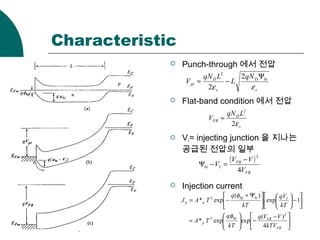
 Punch-through 에서 전압
 Flat-band condition 에서 전압
 V1= injecting junction 을 지나는
공급된 전압의 일부
 Injection current
s
biD
s
D
pt
qN
L
LqN
V
εε
Ψ
−≈
2
2
2
s
D
FB
LqN
V
ε2
2
≈
( )
FB
FB
Ibi
V
VV
V
4
2
−
=−Ψ
4
)(
expexp*
1exp
)(
exp*
2
2
2





 −
−





≈






−










 Ψ+
−=
FB
FBbp
p
Ibibp
pp
kTV
VVq
kT
q
TA
kT
qV
kT
q
TAJ
φ
φ
Characteristic
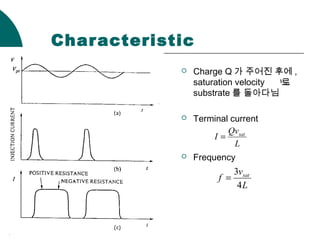
 Charge Q 가 주어진 후에 ,
saturation velocity 로
substrate 를 돌아다님
 Terminal current
 Frequency
L
Qv
I sat
=
L
v
f sat
4
3
=
satv
Characteristic
Application
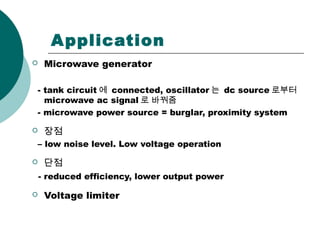
 Microwave generator
- tank circuit 에 connected, oscillator 는 dc source 로부터
microwave ac signal 로 바꿔줌
- microwave power source = burglar, proximity system
 장점
– low noise level. Low voltage operation
 단점
- reduced efficiency, lower output power
 Voltage limiter
Related Device
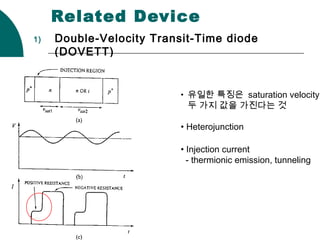
1) Double-Velocity Transit-Time diode
(DOVETT)
• 유일한 특징은 saturation velocity
두 가지 값을 가진다는 것
• Heterojunction
• Injection current
- thermionic emission, tunneling
Related Device
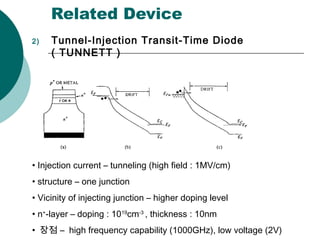
2) Tunnel-Injection Transit-Time Diode
( TUNNETT )
• Injection current – tunneling (high field : 1MV/cm)
• structure – one junction
• Vicinity of injecting junction – higher doping level
• n+
-layer – doping : 1019
cm-3
, thickness : 10nm
• 장점 – high frequency capability (1000GHz), low voltage (2V)
Related Device
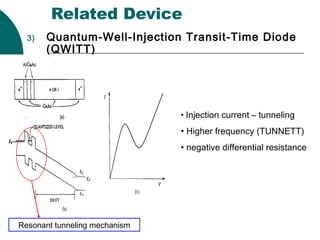
3) Quantum-Well-Injection Transit-Time Diode
(QWITT)
• Injection current – tunneling
• Higher frequency (TUNNETT)
• negative differential resistance
Resonant tunneling mechanism
MODULE 4
Microwave communication
MODULE 4
• IT’S ALL ABOUT TWO
COMMUNICATION SYSTEMS:
1. TERRESTRIAL MICROWAVE
COMMUNICATION SYSTEM
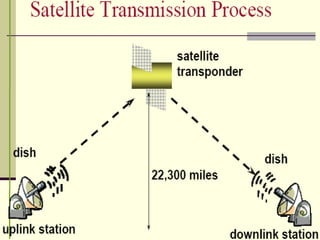
2. SATELLITE MICROWAVE
COMMUNICATION SYSTEM
140
History of Communication
Satelite
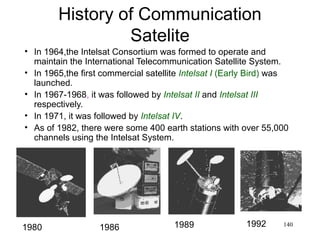
• In 1964,the Intelsat Consortium was formed to operate and
maintain the International Telecommunication Satellite System.
• In 1965,the first commercial satellite Intelsat I (Early Bird) was
launched.
• In 1967-1968, it was followed by Intelsat II and Intelsat III
respectively.
• In 1971, it was followed by Intelsat IV.
• As of 1982, there were some 400 earth stations with over 55,000
channels using the Intelsat System.
19861980 1989 1992
Some of the everyday Technologies
that depend on radio waves:
• AM and FM radio broadcasts
• Cordless phones
• Garage door openers
• Wireless networks
• Radio-controlled toys
• Television broadcasts
• Cell phones
• GPS receivers
• Ham radios
• Satellite communications
• Police radios
• Wireless clocks
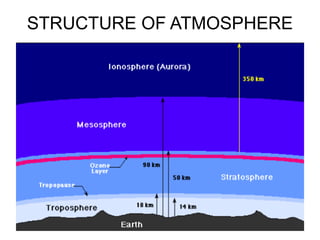
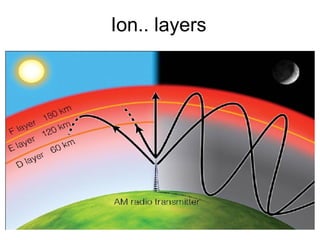
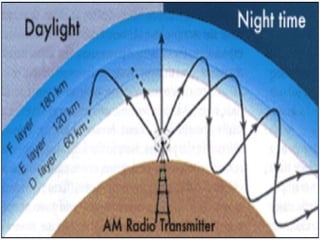
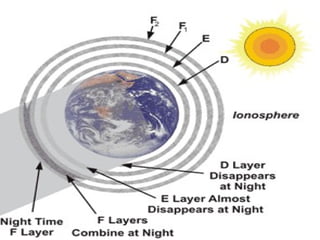
STRUCTURE OF ATMOSPHERE
Ion.. layers
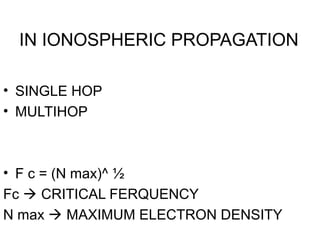
IN IONOSPHERIC PROPAGATION
• SINGLE HOP
• MULTIHOP
• F c = (N max)^ ½
Fc  CRITICAL FERQUENCY
N max  MAXIMUM ELECTRON DENSITY
MODES OF PROPAGATION
EM SPECTRUM
• Electromagnetic waves has been classified
into several ranges of frequencies
• Very low frequency (3 kHz to 30 kHz)
• Low frequency (30 kHz to 300 kHz)
• Medium frequency (300 kHz to 3000 kHz) &
so on
• Even though the frequency range is very
vast ; the propagation of these frequencies
through the free space can be grouped into 3
distinct modes:
1. The ground wave propagation
2. The sky wave propagation
3. The space wave propagation
1. Ground wave propagation
• Radio waves below 3 MHz which includes
VLF, LF & MF – propagated through the
surface of the earth
• This form of prop. Is “Ground wave
propagation”
2.Sky wave propagation
• Freq.'s in the range of 3 MHz to 30 MHz –
propagated through the ionosphere
• The propagation of these waves are said
to be “sky wave propagation”
3.Space wave propagation
• At the freq.’s above 30 MHz – propagated
through the troposphere
• These waves are called as “space waves”
or “tropospheric” waves
• The propagation of these waves are said
to be “space wave propagation”
MORE ABOUT SPACE WAVE
PROPAGATION....
• LOS path
• Ground reflected path
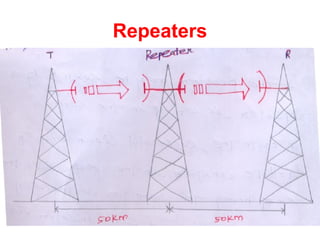
Repeaters
DIVERSITY RECEPTION SCHEMES
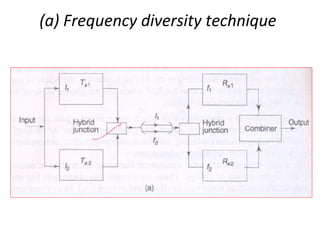
(a) Frequency diversity technique
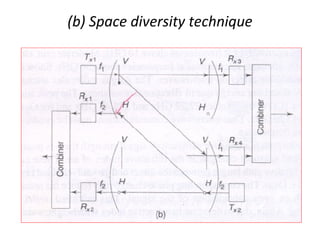
(b) Space diversity technique
(c) Polarization Diversity
• A single RF carrier is propagated with two
different electromagnetic polarization
• This is achieved by using vertically &
horizontally polarized antennas at the
transmitter and receiver
• The idea is that EM waves of different
polarization may not experience the same
transmission degradation
• may be used with space diversity
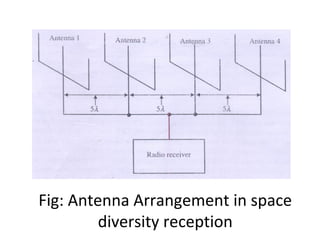
Fig: Antenna Arrangement in space
diversity reception
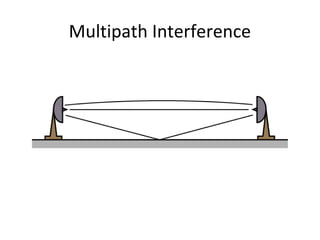
Multipath Interference
Fading
Four types of fading:
1. absorption fading
2. reflection multipath fading
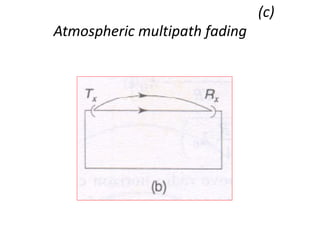
3. atmospheric multipath fading and
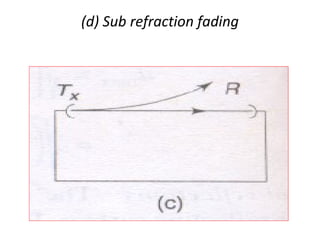
4. sub-refraction fading
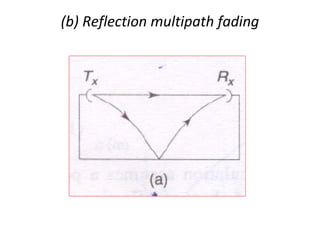
(b) Reflection multipath fading
(c)
Atmospheric multipath fading
(d) Sub refraction fading
What is a Spot Beam?
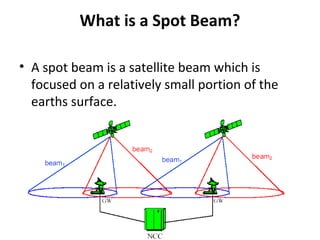
• A spot beam is a satellite beam which is
focused on a relatively small portion of the
earths surface.
Uplinking
Antenna
Satellite
IMD Server,Delhi
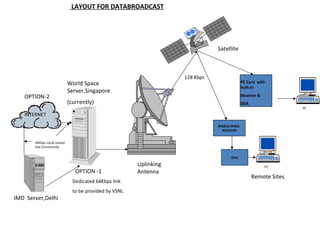
LAYOUT FOR DATABROADCAST
WORLD SPACE
RECEIVER
DDA
128 Kbps
PC
PC
Remote Sites
INTERNET
OPTION-2
World Space
Server,Singapore
(currently)
OPTION -1
Dedicated 64Kbps link
to be provided by VSNL
PC Card with
built-in
Receiver &
DDA
64Kbps Local Leased
line Connectivity
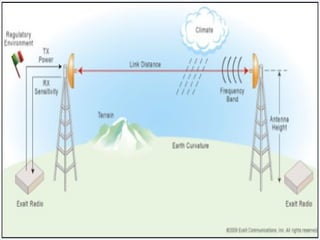
FACTORS AFFECTING MW
LINK
Following major phenomenon affect MW
Link
• 1. REFLECTION
• 2. REFRACTION
• 3. DIFFRACTION
• 4. SCATTERING
• 5. ABSORPTION
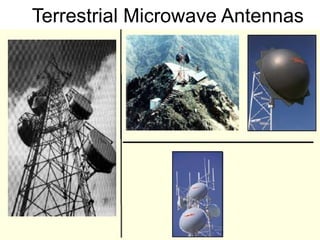
Terrestrial Microwave Antennas
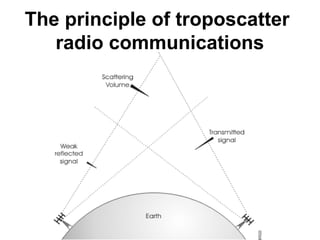
The principle of troposcatter
radio communications
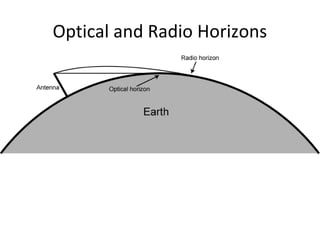
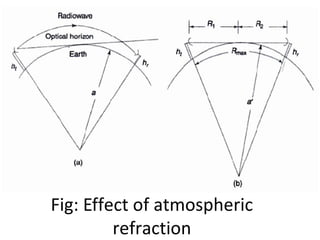
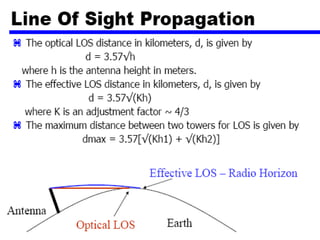
Optical and Radio Horizons
Fig: Effect of atmospheric
refraction
THANK YOU

Mw day 1

  • 1.
    EC04 - 702: MICROWAVEDEVICES AND COMMUNICATION By AJAL.AJ Faculty , Dept of ECE METS SCHOOL OF ENGINEERING,MALA
  • 2.
    1. With thispaper, student should be able to understand the working principle and use of various microwave components and semiconductor devices. This paper also provides the basic aspects of terrestrial and satellite microwave communication links Objectives: 2.
  • 3.
    Module I (13hours) Basics of microwave Engineering • Theory of waveguide transmission - rectangular waveguides - TE modes - TM modes - waveguide components - rectangular cavity resonator - circular cavity resonator (only basic ideas) - E- plane tee - magic tee - isolator - circulator -directional coupler - S matrix
  • 4.
    Module II (13hours) Microwave tubes • Microwave linear beam tubes - klystron (bunching, output power and loading) -reflex klystron - traveling wave tube (amplification process, convection current, axial electric field, gain) – • Microwave crossed field tubes - magnetron (operation, characteristics and applications)
  • 5.
    Module III (13hours) Microwaves devices • Semiconductor microwaves devices - microwave transistors - tunnel diodes and FETs - transferred electron devices - Gunn effect diodes - (Gunn effect, operation, modes of operation, microwave generation and amplification) - LSA diodes - InP diodes - Cd Te diodes - avalanche transit time devices - read diodes - impatt diodes - trapatt diodes - baritt diodes
  • 6.
    Module IV (13hours) Microwave communication • Terrestrial microwave communication - basic principles of microwave links -link analysis - microwave relay systems - choice of frequency - line of sight and over the horizon systems - modulation methods - block schematic of terminal transmitters and receivers - effect of polarization - diversity receivers - digital microwave links - digital modulation schemes - fading - digital link design -satellite communication - orbit of communication satellites - angle of elevation - propagation delay - orbital spacing - satellite construction - transponders - antennas - multiple spot beams - earth station - link analysis - multiple access schemes - digital satellite links
  • 7.
    MODULE 1 Basics ofmicrowave Engineering
  • 8.
    Why Going ForNewWhy Going For New Wave guidingWave guiding Structures instead ofStructures instead of transmission linestransmission lines ??????
  • 10.
    TE & TMModesTE & TM Modes
  • 13.
    Rectangular WaveguidesRectangular Waveguides (Derivationof fields EX ,Ey ,Hx &(Derivation of fields EX ,Ey ,Hx & Hy)Hy)
  • 14.
    Waveguide components Rectangular waveguideWaveguide to coax adapter E-tee Waveguide bends
  • 15.
  • 17.
  • 19.
    WHY GOING FOR SCATTERING PARAMETERSIN CASE OF MICROWAVE NETWORKS ???
  • 22.
    Waveguide Tees : a.E Plane Tee b. H Plane Tee c. Magic Tee
  • 26.
    MICROWAVE HYBRID CIRCUITS •MICROWAVE JUNCTION: Interconnection of two or more devices 1.WAVE GUIDE TEES 2.DIRECTIONAL COUPLER 3.CIRCULATOR
  • 27.
  • 29.
  • 31.
  • 32.
    Contrast the ideal& practicalContrast the ideal & practical directional coupler!!!directional coupler!!! idealideal - infinite directivity- infinite directivity practicalpractical directional couplerdirectional coupler 30 to 35 dB30 to 35 dB
  • 33.
    TWO HOLETWO HOLE FOURFOUR HOLEHOLE SCHWINGERSCHWINGERBETHE HOLEBETHE HOLE TYPES OF DIRECTIONAL COUPLERTYPES OF DIRECTIONAL COUPLER
  • 34.
    Typical Directional CouplerTypicalDirectional Coupler constructed Using Micro strip Lineconstructed Using Micro strip Line
  • 35.
    Typical Directional CouplerTypicalDirectional Coupler constructed Using RECTconstructed Using RECT WAVEGUIDESWAVEGUIDES
  • 36.
  • 37.
    Microwave Tubes • Usedfor high power/high frequency combination • Tubes generate and amplify high levels of microwave power more cheaply than solid state devices • Conventional tubes can be modified for low capacitance but specialized microwave tubes are also used
  • 38.
    Evolution of microwavetubes • 1935 – Heil oscillator • 1939 – klystron amplifier • 1944 – Helix type TWT • In the early 1950s – low power output of linear beam tubes to high power levels • Finally invention of Magnetrons • Several devices were developed – two significant devices among them are 1) extended interaction klystron 2) Twystron hybrid amplifier
  • 39.
    SIGNAL SOURCES THAT GENERATEPOWER Microwave tubes @ Frequency > 1GHz E.g.: klystron, Traveling Wave Tube, magnetron conventional vacuum tubes @ frequency < 1GHz E.g. : triodes, tetrodes, pentodes
  • 40.
    What are allthe constraints of ordinary vacuum tubes at frequencies beyond 1 GHz????
  • 41.
    The limitations ofconventional vacuum tubes at frequencies beyond 1 GHz : • Lead inductance and inter electrode capacitance effects • Transit Angle Effects • Gain-Bandwidth product limitations
  • 42.
    Types of MicrowaveTubes Linear beam tubes (O – Type) Crossed Field Tubes (M – Type) Eg: Klystron Reflex klystron TWT Eg: Magnetron
  • 43.
    Linear beam devicesCrossed field devices (I) Straight path taken by the electron beam A principle feature of such tubes is that electrons travel in a curved path (i) DC magnetic field is in parallel with DC electric field to focus the electron beam DC magnetic field is perpendicular to DC electric field
  • 44.
    Types of LinearBeam Tubes TWYSTRON MULTI CAVITY KLYST TWO CAVITY KLYST LINEAR BEAM TUBES KLYSTRON TUBES HYBRID TUBES TRAVELING WAVE TUBES REFLEX KLYST LADDE- RTRON HELIX RING- BAR TWT COUPLED CAVITY TWT HELIX BWO
  • 45.
    TWYSTRON • KLYSTRON +TWT = TWYSTRON • It is hybrid amplifier that uses the combinations of klystron and TWT components
  • 48.
    Velocity Modulation PRINCIPLE • Electricfield from microwaves at buncher alternately speeds and slows electron beam . • This causes electrons to bunch up Electron bunches at catcher induce microwaves with more energy. • The cavities form a slow-wave structure
  • 52.
  • 54.
    TYPES OF TRAVELINGWAVE MAGNETRON • CYLINDRICAL • LINEAR • COAXIAL • VOLTAGE-TUNABLE • INVERTED COAXIAL • FREQUENCY-AGILE COAXIAL
  • 55.
    33 Narrow Pulse MagnetronSystemNarrow Pulse Magnetron System At H6 Systems Before ShippingAt H6 Systems Before Shipping
  • 56.
    2121 Narrow Pulse MagnetronSystemNarrow Pulse Magnetron System Naval Electromagnetic Radiation FacilityNaval Electromagnetic Radiation Facility
  • 57.
    CHARECTRISTICS OF MAGNETRON ```` 1.EFFICIENCY η = 40 to 70% 2. POWER OUTPUT ( 800KW ) 3. OPERATING FREQUENCY ( UPTO 10GHZ )
  • 58.
  • 59.
    Microwave Devices • Asemiconductor device for the generation or amplification of electromagnetic energy at microwave frequencies. DEFINITION…
  • 98.
    Leo Esaki The Nobel Prizein Physics 1973 A NEGATIVE RESISTANCE DEVICE
  • 105.
  • 106.
    • Because ofnegative resistance in the forward characteristics, the device can be used actively as an oscillator • Tunnel diode symbol
  • 107.
    - Ve ResistanceRegion VfVp Ip Vv Forward Voltage Reverse voltage Iv Reverse Current ForwardCurrent Ip:- Peak Current; Iv :- Valley Current; Vp:- Peak Voltage Vv:- Valley Voltage; Vf:- Peak Forward Voltage I V - CHARACTERISTIC OF TUNNEL DIODE p V
  • 108.
  • 109.
    • Ridley andWatkins proposed in 1961 • Hilsum calculated the transferred electron effect in III-V in 1962; experiment fails. • J.B. Gunn of IBM discovered the so-called Gunn effect in 1963 and rejected the above theory. • Kroemer explained the origin of the negative differential mobility is Ridley-Watkins-Hilsum’s mechanism
  • 115.
    Avalanche Transit-time Devices ATD’s • IMPATT Diode (IMPact Ionization Avalanche Transit Time Diode) • TRAPATT diode (Trapped plasma avalanche triggered transit-time ) • BARRITT diode (Barrier injection transit- time diode ) READ DIODE
  • 116.
    READ DIODE • Thebasic operating principle of IMPATT diode can be understood by studying the structure proposed by READ in 1959 known as READ diode • A read diode structure , doping profile and DC electric field distribution is shown in fig
  • 117.
  • 118.
  • 119.
  • 123.
  • 124.
  • 125.
  • 126.
    History  transit-time delay에 의한 negative differential resistance 를 는 idea (Schockely ,1954)  additional phase delay 를 소개하기 위한 avalanche current 사용 (Read ,1958)  실험적으로 밝힘 (Johnston et al ,1965)  BARITT mode operation (Ruegg, Wright, 1968)  BARITT diode 를 처음으로 만듦 (coleman, Sze, 1971)
  • 127.
    Structure  P-n junction,Schottky barrier, or 이 둘 의 조합으로  Doping level : 0.5~10um  Substrate 는 low series resistance 때문 에 변질됨  Series resistance 로부터 power dissipation 을 줄이기 위해서 가끔 substrate 는 10um 보다 두꺼워 짐
  • 129.
  • 130.
    Characteristic  전압이 depletionedge meet 까지 가 면 , punch-through 가 일어남  Junction 이 asymmetrical 하면 , Vpt≠V‘ pt  이러한 characteristic 은 negative differential resistance or negative dV/dI 에서는 일어나지 않음
  • 131.
    Characteristic  Punch-through 에서전압  Flat-band condition 에서 전압  V1= injecting junction 을 지나는 공급된 전압의 일부  Injection current s biD s D pt qN L LqN V εε Ψ −≈ 2 2 2 s D FB LqN V ε2 2 ≈ ( ) FB FB Ibi V VV V 4 2 − =−Ψ 4 )( expexp* 1exp )( exp* 2 2 2       − −      ≈       −            Ψ+ −= FB FBbp p Ibibp pp kTV VVq kT q TA kT qV kT q TAJ φ φ
  • 132.
    Characteristic  Charge Q가 주어진 후에 , saturation velocity 로 substrate 를 돌아다님  Terminal current  Frequency L Qv I sat = L v f sat 4 3 = satv
  • 133.
  • 134.
    Application  Microwave generator -tank circuit 에 connected, oscillator 는 dc source 로부터 microwave ac signal 로 바꿔줌 - microwave power source = burglar, proximity system  장점 – low noise level. Low voltage operation  단점 - reduced efficiency, lower output power  Voltage limiter
  • 135.
    Related Device 1) Double-VelocityTransit-Time diode (DOVETT) • 유일한 특징은 saturation velocity 두 가지 값을 가진다는 것 • Heterojunction • Injection current - thermionic emission, tunneling
  • 136.
    Related Device 2) Tunnel-InjectionTransit-Time Diode ( TUNNETT ) • Injection current – tunneling (high field : 1MV/cm) • structure – one junction • Vicinity of injecting junction – higher doping level • n+ -layer – doping : 1019 cm-3 , thickness : 10nm • 장점 – high frequency capability (1000GHz), low voltage (2V)
  • 137.
    Related Device 3) Quantum-Well-InjectionTransit-Time Diode (QWITT) • Injection current – tunneling • Higher frequency (TUNNETT) • negative differential resistance Resonant tunneling mechanism
  • 138.
  • 139.
    MODULE 4 • IT’SALL ABOUT TWO COMMUNICATION SYSTEMS: 1. TERRESTRIAL MICROWAVE COMMUNICATION SYSTEM 2. SATELLITE MICROWAVE COMMUNICATION SYSTEM
  • 140.
    140 History of Communication Satelite •In 1964,the Intelsat Consortium was formed to operate and maintain the International Telecommunication Satellite System. • In 1965,the first commercial satellite Intelsat I (Early Bird) was launched. • In 1967-1968, it was followed by Intelsat II and Intelsat III respectively. • In 1971, it was followed by Intelsat IV. • As of 1982, there were some 400 earth stations with over 55,000 channels using the Intelsat System. 19861980 1989 1992
  • 141.
    Some of theeveryday Technologies that depend on radio waves: • AM and FM radio broadcasts • Cordless phones • Garage door openers • Wireless networks • Radio-controlled toys • Television broadcasts • Cell phones • GPS receivers • Ham radios • Satellite communications • Police radios • Wireless clocks
  • 142.
  • 143.
  • 146.
    IN IONOSPHERIC PROPAGATION •SINGLE HOP • MULTIHOP • F c = (N max)^ ½ Fc  CRITICAL FERQUENCY N max  MAXIMUM ELECTRON DENSITY
  • 147.
  • 148.
    EM SPECTRUM • Electromagneticwaves has been classified into several ranges of frequencies • Very low frequency (3 kHz to 30 kHz) • Low frequency (30 kHz to 300 kHz) • Medium frequency (300 kHz to 3000 kHz) & so on
  • 149.
    • Even thoughthe frequency range is very vast ; the propagation of these frequencies through the free space can be grouped into 3 distinct modes: 1. The ground wave propagation 2. The sky wave propagation 3. The space wave propagation
  • 150.
    1. Ground wavepropagation • Radio waves below 3 MHz which includes VLF, LF & MF – propagated through the surface of the earth • This form of prop. Is “Ground wave propagation”
  • 151.
    2.Sky wave propagation •Freq.'s in the range of 3 MHz to 30 MHz – propagated through the ionosphere • The propagation of these waves are said to be “sky wave propagation”
  • 152.
    3.Space wave propagation •At the freq.’s above 30 MHz – propagated through the troposphere • These waves are called as “space waves” or “tropospheric” waves • The propagation of these waves are said to be “space wave propagation”
  • 153.
    MORE ABOUT SPACEWAVE PROPAGATION.... • LOS path • Ground reflected path
  • 154.
  • 155.
  • 156.
  • 157.
  • 158.
    (c) Polarization Diversity •A single RF carrier is propagated with two different electromagnetic polarization • This is achieved by using vertically & horizontally polarized antennas at the transmitter and receiver • The idea is that EM waves of different polarization may not experience the same transmission degradation • may be used with space diversity
  • 159.
    Fig: Antenna Arrangementin space diversity reception
  • 160.
  • 161.
  • 162.
    Four types offading: 1. absorption fading 2. reflection multipath fading 3. atmospheric multipath fading and 4. sub-refraction fading
  • 163.
  • 164.
  • 165.
  • 166.
    What is aSpot Beam? • A spot beam is a satellite beam which is focused on a relatively small portion of the earths surface.
  • 167.
    Uplinking Antenna Satellite IMD Server,Delhi LAYOUT FORDATABROADCAST WORLD SPACE RECEIVER DDA 128 Kbps PC PC Remote Sites INTERNET OPTION-2 World Space Server,Singapore (currently) OPTION -1 Dedicated 64Kbps link to be provided by VSNL PC Card with built-in Receiver & DDA 64Kbps Local Leased line Connectivity
  • 169.
    FACTORS AFFECTING MW LINK Followingmajor phenomenon affect MW Link • 1. REFLECTION • 2. REFRACTION • 3. DIFFRACTION • 4. SCATTERING • 5. ABSORPTION
  • 170.
  • 174.
    The principle oftroposcatter radio communications
  • 175.
  • 176.
    Fig: Effect ofatmospheric refraction
  • 181.

Editor's Notes

  • #127 다른점 - injection current 가 barrier 넘어로 thermionic emission을 통해야 한다는 점 - avalanche current와 같지 않게 BARITT diode injection current는 injection phase delay를 가지지 않음
  • #131 전압이 depletion edge meet까지 가면, punch-through가 일어난다 Junction
  • #132 Schottky-barrier injection에서 (a)는 under thermal equilibrium이고 (b)는 punch-through에서 이고, (c)는 flat –band condition에서의 상태를 나타낸 것이다. Injection cycle에서 bias 는 Vpt와 Vfb사이이다. P-n junction의 경우 Øbp=0
  • #133 (a)는 trminal 전압 이고, (b)는 injection current이고, (c) terminal current 의 파형이다 라모 쇼클리 이론에 의하면 L부분에 위치한 두개의 일렉트로드에서 움직이는 charge 는 터미널 전류를 야기시킨다 전압이 계속 positive cycle이기 때문에 이 부분에서 전류의 일부는 dissipative하다. 이것이 IMPATT diode 와 비교해 BARITT diode의 reduced efficiency가 더 많이 감소되는 이유이다 Maximum efficiency는 BARITT diode에서 10%, IMPATT diode 에서는 15%이다 Terminal current pulse width는 transit time에 의해 결정 된다, 그리고 그것은 ¾ cycle이다
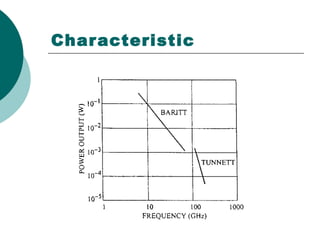
  • #134 BARITT의 파워 프리퀀시 특징에 대해 나타낸 표이다. 파워는 f의 제곱에 비례하여 감소한다
  • #135 IMPATT와 관련이 있는 에벌런치 전류는 노이즈가 많고, 75~150V나 되는 높은 전압을 필요로 함 펀치 뜨루 다이오드는 지너 다이오드 우개를 back to back 로 연결해서 대체 할 수도 있음음
  • #136 이것의 유일한 특징은 나뉘어져 있다는 것이다. Heterojunction 에 의해 saturation velocity가 달라진다.
  • #137 (a)는 structure이고, (b)는 피엔 정션 인젝터에서 밴드 투 밴드 터널링 에너지 밴드 diagram이고, (c) 는 쇼트키 배리어 인젝터에서 배리어를 통한 터널링 에너지 밴드 diagram이다.
  • #138 (a)는 structure이고, (b)는 에너지 밴드 diagram이고, (c) 는 레조넌트 터널 다이오드 인젝터의 아이브이 특성. 8장에서 보았던