PreparedbyAtheenaPandian
SIGNAL
GENERATOR
What is Signal Generator?
Requirements
Purpose
Uses
Working
Types
Applications
1.
2.
3.
4.
5.
6.
7.
Today's Topic
TopicsforDiscussion
What is
Signal
Generator?
SignalGenerator
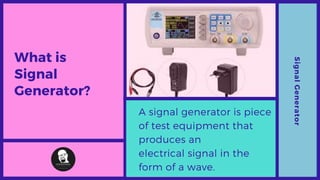
A signal generator is piece
of test equipment that
produces an
electrical signal in the
form of a wave.
A SIGNAL GENERATOR IS AN
ELECTRONIC DEVICE THAT
GENERATES REPEATING OR
NON-REPEATING
ELECTRONIC SIGNALS IN
EITHER THE ANALOG OR THE
DIGITAL DOMAIN.
According
to WIKI,
The signal
Generator
is?
Basics of Biomedical
Requirements of signal
generator
the requirements are common to all the types
1. The output frequency of signal generator should be
very stable
2. The amplitude of output signal of signal
generator should be controllable from low values to
relatively large values
3. The amplitude of output signal must be stable.
PURPOSE OF SIGNAL
GENERATOR
A common use is to test the response of circuits to a known input signal.
Most function generators allow you to generate sine, square or triangular AC
function signals.
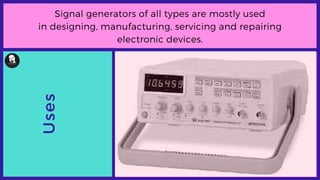
Uses
Signal generators of all types are mostly used
in designing, manufacturing, servicing and repairing
electronic devices.
TYPES
Function generators
RF and microwave signal generators
Pitch generators
Arbitrary waveform generators
Digital pattern generators,and
Frequency generators.
1.
2.
3.
4.
5.
6.
The most basic signal created
from a signal generator is the
continuous wave (CW) signal, or
sine wave, which has no
modulation and is produced by a
basic signal source.
Varying the sine wave's
amplitude achieves AM and pulse
modulation. Varying the sine
wave's frequency or
phase generates FM and ΦM,
respectively.
How a
Signal
Generated?
SIGNAL GENERATOR
Signal generator is a kind of equipment that
can provide all kinds of
frequency, waveform and output
electric signal.
Signal generator, also known as signal source
or oscillator, has a wide range
of applications in the field of production
practice and science and technology.
Applications
Basics of Biomedical
THANK YOU

Signal generator basics

  • 1.
  • 2.
    What is SignalGenerator? Requirements Purpose Uses Working Types Applications 1. 2. 3. 4. 5. 6. 7. Today's Topic TopicsforDiscussion
  • 3.
    What is Signal Generator? SignalGenerator A signal generator ispiece of test equipment that produces an electrical signal in the form of a wave.
  • 4.
    A SIGNAL GENERATORIS AN ELECTRONIC DEVICE THAT GENERATES REPEATING OR NON-REPEATING ELECTRONIC SIGNALS IN EITHER THE ANALOG OR THE DIGITAL DOMAIN. According to WIKI, The signal Generator is? Basics of Biomedical
  • 5.
    Requirements of signal generator the requirements arecommon to all the types 1. The output frequency of signal generator should be very stable 2. The amplitude of output signal of signal generator should be controllable from low values to relatively large values 3. The amplitude of output signal must be stable.
  • 6.
    PURPOSE OF SIGNAL GENERATOR Acommon use is to test the response of circuits to a known input signal. Most function generators allow you to generate sine, square or triangular AC function signals.
  • 7.
    Uses Signal generators of alltypes are mostly used in designing, manufacturing, servicing and repairing electronic devices.
  • 8.
    TYPES Function generators RF and microwave signalgenerators Pitch generators Arbitrary waveform generators Digital pattern generators,and Frequency generators. 1. 2. 3. 4. 5. 6.
  • 9.
    The most basic signal created froma signal generator is the continuous wave (CW) signal, or sine wave, which has no modulation and is produced by a basic signal source. Varying the sine wave's amplitude achieves AM and pulse modulation. Varying the sine wave's frequency or phase generates FM and ΦM, respectively. How a Signal Generated? SIGNAL GENERATOR
  • 10.
    Signal generator is akind of equipment that can provide all kinds of frequency, waveform and output electric signal. Signal generator, also known as signal source or oscillator, has a wide range of applications in the field of production practice and science and technology. Applications Basics of Biomedical
  • 11.