PIN DIODE
VARACTOR DIODE
Nirav Patel
100110111003
Batch – 1A11
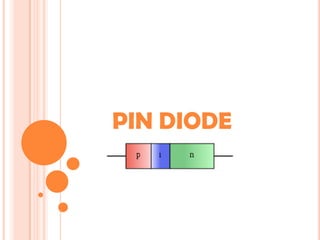
PIN DIODE
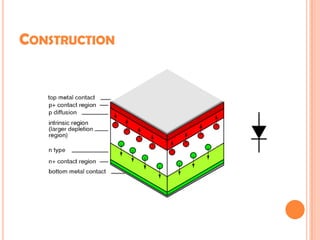
CONSTRUCTION
INTRODUCTION
 A PIN diode is a diode with a wide, lightly doped
'near' intrinsic semiconductor region between a p-
type semiconductor and an n-type
semiconductor region. The p-type and n-type
regions are typically heavily doped because they
are used for ohmic contacts.
 The wide intrinsic region is in contrast to an
ordinary PN diode. The wide intrinsic region makes
the PIN diode an inferior rectifier (one typical
function of a diode), but it makes the PIN diode
suitable for attenuators, fast
switches, photodetectors, and high voltage power
electronics applications.
 The speed of the PIN diode is limited by variation in
the time it takes electrons to pass through the
device. This time spread can be spread in two
ways:
 By increasing the bias-voltage
 By reducing the thickness of intrinsic layer
 TYPES:
 Metal-Semiconductor PIN diode
 Heterojunction PIN diode
OPERATION
 A microwave PIN diode is a semiconductor device
that operates as a variable resistor at RF and
Microwave frequencies.
 A PIN diode is a current controlled device in
contrast to a varactor diode which is a voltage
controlled device.
 When the forward bias control current of the PIN
diode is varied continuously, it can be used for
attenuating, leveling, and amplitude modulating an
RF signal.
 When the control current is switched on and off, or
in discrete steps, the device can be used for
switching, pulse modulating, and phase shifting an
RF signal.
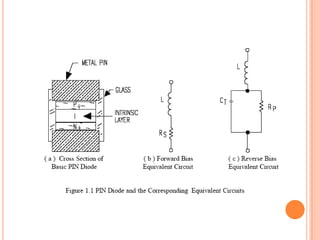
 A drawing of a PIN diode chip is shown in Figure
1.1 (a). The performance characteristics of the PIN
diode depend mainly on the chip geometry and the
processed semiconductor material in the intrinsic or
I - region, of the finished diode.
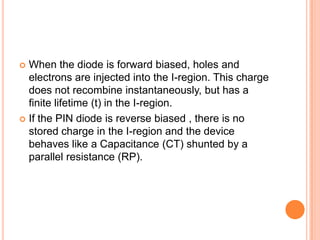
 When the diode is forward biased, holes and
electrons are injected into the I-region. This charge
does not recombine instantaneously, but has a
finite lifetime (t) in the I-region.
 If the PIN diode is reverse biased , there is no
stored charge in the I-region and the device
behaves like a Capacitance (CT) shunted by a
parallel resistance (RP).
APPLICATIONS
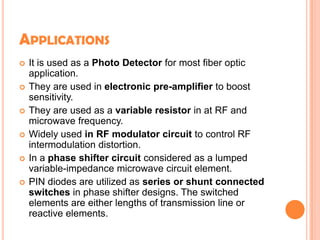
 It is used as a Photo Detector for most fiber optic
application.
 They are used in electronic pre-amplifier to boost
sensitivity.
 They are used as a variable resistor in at RF and
microwave frequency.
 Widely used in RF modulator circuit to control RF
intermodulation distortion.
 In a phase shifter circuit considered as a lumped
variable-impedance microwave circuit element.
 PIN diodes are utilized as series or shunt connected
switches in phase shifter designs. The switched
elements are either lengths of transmission line or
reactive elements.
VARACTOR DIODE
INTRODUCTION
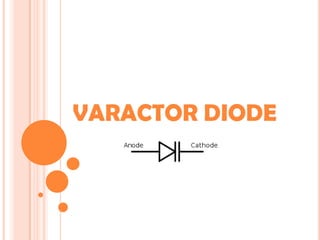
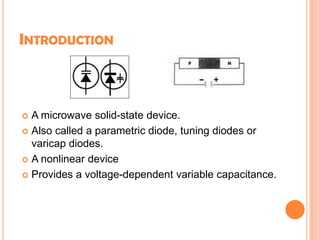
 A microwave solid-state device.
 Also called a parametric diode, tuning diodes or
varicap diodes.
 A nonlinear device
 Provides a voltage-dependent variable capacitance.
TYPES OF VARACTOR DIODE
 Abrupt and hyper abrupt type : When the
changeover p-n junction is abrupt then it is called
abrupt type. When change is very abrupt, they are
called hyper abrupt type. They are used in
oscillators to sweep for different frequencies.
 Gallium-arsenide varactor diodes : The
semiconductor material used is gallium arsenide.
They are used for frequencies from 18 GHz up to
and beyond 600 GHz.
IMPORTANT CRITERIA
 Capacitance : Capacitance of the device.
Capacitance from a few picoFarads to hundreds of
picoFarads is provided.
 Capacitance range : Range of capacitance
produced when voltage is varied.
 Voltage range : The minimum and maximum
voltage that can be applied to the device.
 Bias current : The bias is always reverse. This
means that the varactor diode does not conduct
electricity. If the bias is turned positive then the
device will start conducting.
 Other criteria to be considered include : reverse
and breakdown voltage, leakage current, junction
temperature.
 Voltage and other transients must be avoided.
Transients can occur if the DC voltage is put off.
CHARACTERISTICS
 Low-noise characteristic : produce much less noise
than most conventional amplifiers.
 Low cost
 High reliability
 Light weight
 Small size
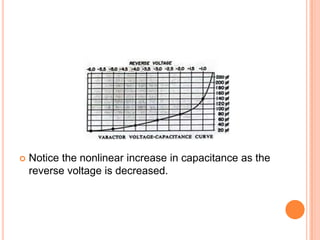
 Notice the nonlinear increase in capacitance as the
reverse voltage is decreased.
OPERATION
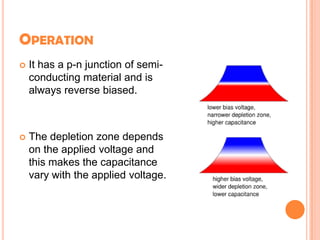
 It has a p-n junction of semi-
conducting material and is
always reverse biased.
 The depletion zone depends
on the applied voltage and
this makes the capacitance
vary with the applied voltage.
APPLICATIONS
 FREQUENCY MULTIPLIERS - used in applications
where it’s difficult to generate microwave signals.
 Producing relatively high power outputs at
frequencies up to 100GHz.
 Does not have gain ; in fact, it produces a signal
power loss,
 Output can be as high as 80% of the input.
 PARAMETRIC AMPLIFIERS. - named for the time-
varying parameter, or value of capacitance,
associated with the operation.
 Since the underlying principle of operation is based
on reactance, the parametric amplifier is sometimes
called a REACTANCE AMPLIFIER.
 TUNING - Since the frequency can be made to vary
they are used as electronic tuning devices in tuners
for television, mobiles.
 Other Applications:
They are used in PLL, voltage controlled oscillators,
harmonic generation, electronic tuning devices in
tuners for television, mobiles, parametric
amplification, AM radios, voltage-variable tuning,
frequency multipliers, etc.
Pin Diode & Varactor Diode

Pin Diode & Varactor Diode

  • 1.
    PIN DIODE VARACTOR DIODE NiravPatel 100110111003 Batch – 1A11
  • 2.
  • 3.
  • 4.
    INTRODUCTION  A PINdiode is a diode with a wide, lightly doped 'near' intrinsic semiconductor region between a p- type semiconductor and an n-type semiconductor region. The p-type and n-type regions are typically heavily doped because they are used for ohmic contacts.  The wide intrinsic region is in contrast to an ordinary PN diode. The wide intrinsic region makes the PIN diode an inferior rectifier (one typical function of a diode), but it makes the PIN diode suitable for attenuators, fast switches, photodetectors, and high voltage power electronics applications.
  • 5.
     The speedof the PIN diode is limited by variation in the time it takes electrons to pass through the device. This time spread can be spread in two ways:  By increasing the bias-voltage  By reducing the thickness of intrinsic layer  TYPES:  Metal-Semiconductor PIN diode  Heterojunction PIN diode
  • 6.
    OPERATION  A microwavePIN diode is a semiconductor device that operates as a variable resistor at RF and Microwave frequencies.  A PIN diode is a current controlled device in contrast to a varactor diode which is a voltage controlled device.  When the forward bias control current of the PIN diode is varied continuously, it can be used for attenuating, leveling, and amplitude modulating an RF signal.
  • 7.
     When thecontrol current is switched on and off, or in discrete steps, the device can be used for switching, pulse modulating, and phase shifting an RF signal.  A drawing of a PIN diode chip is shown in Figure 1.1 (a). The performance characteristics of the PIN diode depend mainly on the chip geometry and the processed semiconductor material in the intrinsic or I - region, of the finished diode.
  • 9.
     When thediode is forward biased, holes and electrons are injected into the I-region. This charge does not recombine instantaneously, but has a finite lifetime (t) in the I-region.  If the PIN diode is reverse biased , there is no stored charge in the I-region and the device behaves like a Capacitance (CT) shunted by a parallel resistance (RP).
  • 10.
    APPLICATIONS  It isused as a Photo Detector for most fiber optic application.  They are used in electronic pre-amplifier to boost sensitivity.  They are used as a variable resistor in at RF and microwave frequency.  Widely used in RF modulator circuit to control RF intermodulation distortion.  In a phase shifter circuit considered as a lumped variable-impedance microwave circuit element.  PIN diodes are utilized as series or shunt connected switches in phase shifter designs. The switched elements are either lengths of transmission line or reactive elements.
  • 11.
  • 12.
    INTRODUCTION  A microwavesolid-state device.  Also called a parametric diode, tuning diodes or varicap diodes.  A nonlinear device  Provides a voltage-dependent variable capacitance.
  • 13.
    TYPES OF VARACTORDIODE  Abrupt and hyper abrupt type : When the changeover p-n junction is abrupt then it is called abrupt type. When change is very abrupt, they are called hyper abrupt type. They are used in oscillators to sweep for different frequencies.  Gallium-arsenide varactor diodes : The semiconductor material used is gallium arsenide. They are used for frequencies from 18 GHz up to and beyond 600 GHz.
  • 14.
    IMPORTANT CRITERIA  Capacitance: Capacitance of the device. Capacitance from a few picoFarads to hundreds of picoFarads is provided.  Capacitance range : Range of capacitance produced when voltage is varied.  Voltage range : The minimum and maximum voltage that can be applied to the device.
  • 15.
     Bias current: The bias is always reverse. This means that the varactor diode does not conduct electricity. If the bias is turned positive then the device will start conducting.  Other criteria to be considered include : reverse and breakdown voltage, leakage current, junction temperature.  Voltage and other transients must be avoided. Transients can occur if the DC voltage is put off.
  • 16.
    CHARACTERISTICS  Low-noise characteristic: produce much less noise than most conventional amplifiers.  Low cost  High reliability  Light weight  Small size
  • 17.
     Notice thenonlinear increase in capacitance as the reverse voltage is decreased.
  • 18.
    OPERATION  It hasa p-n junction of semi- conducting material and is always reverse biased.  The depletion zone depends on the applied voltage and this makes the capacitance vary with the applied voltage.
  • 19.
    APPLICATIONS  FREQUENCY MULTIPLIERS- used in applications where it’s difficult to generate microwave signals.  Producing relatively high power outputs at frequencies up to 100GHz.  Does not have gain ; in fact, it produces a signal power loss,  Output can be as high as 80% of the input.
  • 20.
     PARAMETRIC AMPLIFIERS.- named for the time- varying parameter, or value of capacitance, associated with the operation.  Since the underlying principle of operation is based on reactance, the parametric amplifier is sometimes called a REACTANCE AMPLIFIER.
  • 21.
     TUNING -Since the frequency can be made to vary they are used as electronic tuning devices in tuners for television, mobiles.  Other Applications: They are used in PLL, voltage controlled oscillators, harmonic generation, electronic tuning devices in tuners for television, mobiles, parametric amplification, AM radios, voltage-variable tuning, frequency multipliers, etc.