Inverting Amplifier
Dr.R.Hepzi Pramila Devamani,
Assistant Professor of Physics,
V.V.Vanniaperumal College for Women,
Virudhunagar
Operational Amplifier:
An operational amplifier (Op-Amp)is an integrated circuit
that uses external voltage to amplify the input through a very
high gain.
Applications:
• Inverting Amplifier
• Non-inverting Amplifier
• Summing amplifier
• Subtracting Amplifier
• Integrator
• Differentiator
Inverting amplifier:
Definition:
Inverting amplifier is one in which the output is exactly 180 degree
out of phase with respect to input.Output is an inverted amplified
version of input.If we apply a positive voltage,output will be
negative.
Circuit Diagram:
Circuit Operation:
• A voltage source Vs (a.c or d.c) is connected to the inverting
terminal of the op-amp through the resistance R.
• A negative feedback is given by connecting a resistance Rf between
the output and the inverting input terminals.
• Negative feed back means the returning signal has a phase that
opposes the input signal.
• The feed back, in this case, is voltage shunt feed back.
• Let V3 be the source voltage,Vi be the differential input voltage
(voltage at s)and Vo be the output voltage.
Derivation:
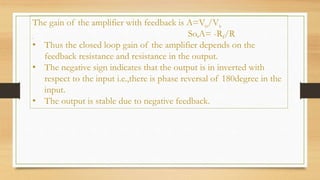
The gain of the amplifier with feedback is A=Vo/Vs
. So,A= -Rf/R
• Thus the closed loop gain of the amplifier depends on the
feedback resistance and resistance in the output.
• The negative sign indicates that the output is in inverted with
respect to the input i.e.,there is phase reversal of 180degree in the
input.
• The output is stable due to negative feedback.
Advantages:
• It follows the negative feedback.So the gain factor of these
amplifier is very high.
• The output generated will be out of phase with the applied input
signal.
• The potential values at both the inverting and non-inverting
terminals are maintained at zero.
Disadvantages:
• The gain is high but the feedback that is followed must be
maintained to be distortion less.
• The applied input signal should not contain the noise because
small value applied will be multiplied and obtained at the output.
THANK YOU

Inverting amplifier

  • 1.
    Inverting Amplifier Dr.R.Hepzi PramilaDevamani, Assistant Professor of Physics, V.V.Vanniaperumal College for Women, Virudhunagar
  • 2.
    Operational Amplifier: An operationalamplifier (Op-Amp)is an integrated circuit that uses external voltage to amplify the input through a very high gain.
  • 3.
    Applications: • Inverting Amplifier •Non-inverting Amplifier • Summing amplifier • Subtracting Amplifier • Integrator • Differentiator
  • 4.
    Inverting amplifier: Definition: Inverting amplifieris one in which the output is exactly 180 degree out of phase with respect to input.Output is an inverted amplified version of input.If we apply a positive voltage,output will be negative.
  • 5.
  • 6.
    Circuit Operation: • Avoltage source Vs (a.c or d.c) is connected to the inverting terminal of the op-amp through the resistance R. • A negative feedback is given by connecting a resistance Rf between the output and the inverting input terminals. • Negative feed back means the returning signal has a phase that opposes the input signal. • The feed back, in this case, is voltage shunt feed back. • Let V3 be the source voltage,Vi be the differential input voltage (voltage at s)and Vo be the output voltage.
  • 7.
  • 8.
    The gain ofthe amplifier with feedback is A=Vo/Vs . So,A= -Rf/R • Thus the closed loop gain of the amplifier depends on the feedback resistance and resistance in the output. • The negative sign indicates that the output is in inverted with respect to the input i.e.,there is phase reversal of 180degree in the input. • The output is stable due to negative feedback.
  • 9.
    Advantages: • It followsthe negative feedback.So the gain factor of these amplifier is very high. • The output generated will be out of phase with the applied input signal. • The potential values at both the inverting and non-inverting terminals are maintained at zero.
  • 10.
    Disadvantages: • The gainis high but the feedback that is followed must be maintained to be distortion less. • The applied input signal should not contain the noise because small value applied will be multiplied and obtained at the output.
  • 11.