Clinical Pharmacy
University of Lahore
     Islamabad Campus


       Assignment
Subject: Clinical Pharmacy
Digoxin
Introduction
Digoxin, also known as digitalis, is a purified cardiac glycoside extracted from the plant,
Digitalis lanata. Digoxin is widely used in the treatment of various heart conditions,
namely cardiac arrythmias atrial fibrillation, atrial flutter and cardiac failure that cannot
be controlled by other medication.


Mechanism of action
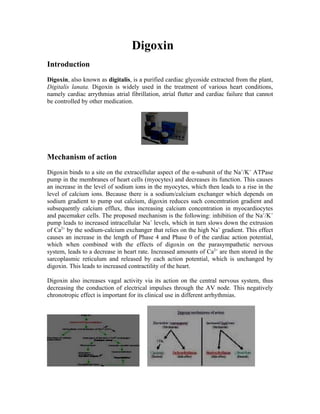
Digoxin binds to a site on the extracellular aspect of the α-subunit of the Na+/K+ ATPase
pump in the membranes of heart cells (myocytes) and decreases its function. This causes
an increase in the level of sodium ions in the myocytes, which then leads to a rise in the
level of calcium ions. Because there is a sodium/calcium exchanger which depends on
sodium gradient to pump out calcium, digoxin reduces such concentration gradient and
subsequently calcium efflux, thus increasing calcium concentration in myocardiocytes
and pacemaker cells. The proposed mechanism is the following: inhibition of the Na+/K+
pump leads to increased intracellular Na+ levels, which in turn slows down the extrusion
of Ca2+ by the sodium-calcium exchanger that relies on the high Na+ gradient. This effect
causes an increase in the length of Phase 4 and Phase 0 of the cardiac action potential,
which when combined with the effects of digoxin on the parasympathetic nervous
system, leads to a decrease in heart rate. Increased amounts of Ca2+ are then stored in the
sarcoplasmic reticulum and released by each action potential, which is unchanged by
digoxin. This leads to increased contractility of the heart.

Digoxin also increases vagal activity via its action on the central nervous system, thus
decreasing the conduction of electrical impulses through the AV node. This negatively
chronotropic effect is important for its clinical use in different arrhythmias.
Therapeutic and Clinical Indication
   •   Congestive Cardiac failure
   •   Cardiac arrhythmias
   •   Artrial Fibrillation and flutter associated with CHF and Cardiac Arrythmias


               Congestive Cardiac Failure ( CHF)
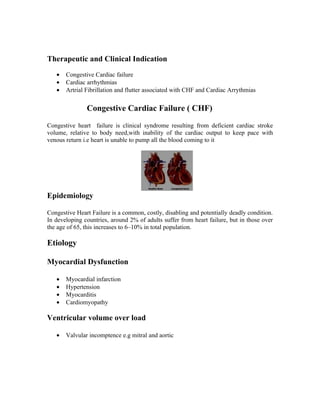
Congestive heart failure is clinical syndrome resulting from deficient cardiac stroke
volume, relative to body need,with inability of the cardiac output to keep pace with
venous return i.e heart is unable to pump all the blood coming to it


Epidemiology

Congestive Heart Failure is a common, costly, disabling and potentially deadly condition.
In developing countries, around 2% of adults suffer from heart failure, but in those over
the age of 65, this increases to 6–10% in total population.

Etiology

Myocardial Dysfunction

   •   Myocardial infarction
   •   Hypertension
   •   Myocarditis
   •   Cardiomyopathy

Ventricular volume over load

   •   Valvular incomptence e.g mitral and aortic
Ventricular outflow obstruction

   •   Systemic or Pulmonary Hypertension
   •   Aortic or Pulmonary stenosis


Ventricular inflow obstruction
   •   Mitral or tricuspid valve stenosis
   •   Constrictive Cardiomyopathy
   •   Restrictive Cardiomyopathy

Obligatory high cardiac output

   •   Anemia
   •   Thyrotoxocosis
   •   Beri Beri
   •   Patent ductus arteriousus(PDA)

Altererd ryhthm

   •   Atrial fibrillation


Pathophysiology

Decreased cardiac output
Decreased cardiac output due to decrease heart function results in diminished arterial
tree. Therefore blood supply of the organ is reduced which may leed to ischemia.

Damming of Blood

Heart fails to pump the whole blood coming to it resulting in blood damming back into
venous system, accumualtion of deoxygenated blood in the tissue venous system may
produced disturbed organ function.
Compensatory Mechanism
As the heart beguns to fails a number of local compensatory mechanism are activated in a
attempt to maintain normal cardiac output such compensatory methods are;
    • Increased sympathetic activity:
    • It leads to increase the heart rate and increased force of contraction of cardiac
       muscles that leads to increase cardiac output.
    • Hypertrophy of cardiac muscles:
    • It is a compensatory mechanism to eject all the venous blood that comes to the
       heart.
    • Dillation of heart chambers;

When the combination of increased sympathatic activity and hypertrophy approves
insufficient to maintain the cardiac output heart dillates.

Compensatory Heart Failure: -
According to Frank’s Starling Law increase length of cardiac muscles fibres increase the
force of contraction. If the dillated ventricle is able to maintain cardiac output this stage is
called heart failure.

Decompensatory Heart Failure
When the heart come dillated beyond the point at which adequate myocardial contractile,
tension can be generated dillation no longer results increase contractality resulting in
progressively decrease cardiac output this stage is called Decompensatory heart failure.
In this stage venous circulation increases due to decrease pumping capacity of heart
resulting in accumulation of venous return in the heart or in tissues draining the heart.


Clinical Manifestation
Symptoms

    •   Dyspnea
    •   Orthropnea
    •   Paroxysmal nocturnal dyspnea
    •   Fatigue
    •   Sudden death
Signs

  •   Tachycardia
  •   Third heart sound
  •   Fine crypts at lung bases
  •   Cardiomegaly
  •   Pleural effusion
  •   Edema of dependant part
  •   Distened neck veins
  •   Tender Hepatomegaly


Diagnosis
  •   ECG: show depression of ST segment
  •   ETT :when history is suggestive of angina but ECG is normal ETT is performed
      for diagnostics
  •   Heart Scan :It shows schemic area in myocardiam
  •   Angiography: It provides information about the extent and site of coronary artery
      stenosis usually performed bypass surgery.
  •   Echocardiography
  •   Chest X-ray etc
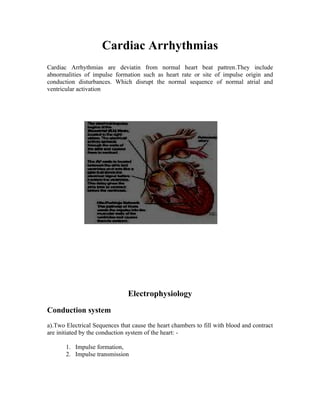
Cardiac Arrhythmias
Cardiac Arrhythmias are deviatin from normal heart beat pattren.They include
abnormalities of impulse formation such as heart rate or site of impulse origin and
conduction disturbances. Which disrupt the normal sequence of normal atrial and
ventricular activation


                               Electrophysiology
Conduction system
a).Two Electrical Sequences that cause the heart chambers to fill with blood and contract
are initiated by the conduction system of the heart: -

       1. Impulse formation,
       2. Impulse transmission
b). Four main structures composed of tissue that can generate or conduct electric impulse
make up the conduction system of the heart: -

        1.   SA node
        2.   AV node
        3.   Bundle of His
        4.   Purkinje fibre


Myocardial Action potential

It consist of five phases in which depolarization and repolarization results from changes
in the electrical potential across the cell membrane caused by exchange of sodium ion
alongwith activity of calcium ions: -

   1.   Phase 0 (rapid depolarization)
   2.   Phase 1 (Early rapid repolarization)
   3.   Phase 2 (Plateau)
   4.   Phase 3 (Final rapid repolarization)
   5.   Phase 4 (Slow depolarization)


Classification of arrythmias
These are generally classified by origin: -

   1. Supraventricle arrythmias: stem from enhance automaticity of the SA node or
      another pacemaker region above the bundle of His or from reentry conduction
   2. Ventricular arrythmias: They occur below the bundle of His when an ectopic
      pacemaker trigers of ventricular contraction before the SA node fires, for example
      from a conduction disturbance or ventricular irrtability.
Etiology: -

      •   Heart diseases for example CAD, VHD etc.
      •   MI
      •   Toxic doses of acrdioactive drugs
      •   Vagal Stimulation
      •   Hyperkalemia / hypokalemia
      •   COPD
      •   Increased sympathetic tone
      •   Thyroid disorders

Pathophsiology: -
Abnormal impulse formation abnormal impulse conduction or combination of both may
give rise to arrythmias.

Abnormal impulse formation may stem from: -

   1. Depressed automatacity as in escapes beats bradycardia
   2. Increased automatacityas in premature beats tachcardia and extra systole
   3. Depolarization triggers activity to sustain ectopic firing

Abnormal Impulse Conduction results from:
   1. A conduction block or delay
   2. Reentry occurs when an impulse is rerouted through certain region in ehich it has
      already travels thus impulse depolarizes the same tissue more then ones producing
      the additional impulse.


Hence arrythmias may decrease cardiac output reduce B.P and disrupt perfusion of
vital organs. Specific pathophysiology consequences depend on the type of the
arrythmias present.
Clinical Manifestation
Sign and symptoms

   •   Chest pain
   •   Anxiety and confusion from reduce brain perffusion
   •   Dyspnea
   •   Abnormal pulse rate rhythm, or amplitude
   •   Reduce B.P
   •   Palpitation
   •   Weakness
   •   Convulsion
   •   Hypotension


Diagnostic test result
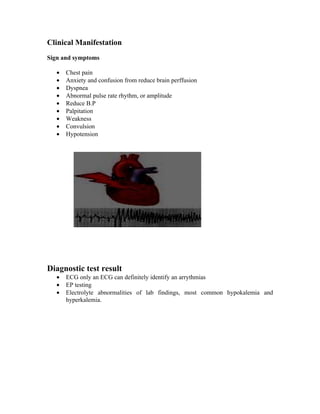
   •   ECG only an ECG can definitely identify an arrythmias
   •   EP testing
   •   Electrolyte abnormalities of lab findings, most common hypokalemia and
       hyperkalemia.
Atrial Fibrillation

Atrial fibrillation (AF or A-fib) is the most common cardiac arrhythmia (abnormal heart
rhythm) and involves the two upper chambers (atria) of the heart. Its name comes from
the fibrillating (i.e. quivering) of the heart muscles of the atria, instead of a coordinated
contraction. It can often be identified by taking a pulse and observing that the heartbeats
don't occur at regular intervals. However, a stronger indicator of AF is the absence of P
waves on an electrocardiogram (ECG) which are normally present when there is a
coordinated atrial contraction at the beginning of each heart beat. Risk increases with age,
with 8% of people over 80 having AF.


                           Atrial flutter

Atrial flutter (AFL) is an abnormal heart rhythm that occurs in the atria of the heart.
When it first occurs, it is usually associated with a fast heart rate or tachycardia (230–380
beats per minute) and falls into the category of supra-ventricular tachycardias. While this
rhythm occurs most often in individuals with cardiovascular disease (e.g. hypertension,
coronary artery disease, and cardiomyopathy), it may occur spontaneously in people with
otherwise normal hearts. It is typically not a stable rhythm, and frequently degenerates
into atrial fibrillation (AF). However, it does rarely persist for months to years.

Atrial flutter was first identified as an independent medical condition in 1920 by the
British physician Sir Thomas Lewis (1882–1945) and colleagues.
Dose & Administration
To treat the above mentioned indication digoxin widely used with proper monitoring, the
dose of digoxin for each patient has to be tailored according to age lean body weight and
renal function. The difference in bioavailability in IV and oral fromulation must be
considered when changing from one dosage to another for e.g if patient is switched from
oral IV formulation the dosage should be reduced by approx. 33%,

Adults and Childrens Over 10 years: -

   •   Rapid oral loading; 0.75-1.5mg single dose

   •   Slow oral loading; 0.25-0.75mg should be given daily for one week by an
       appropriate mention dose.Clinical reponse should be seen within a week.

Maintenance Dose: -

It should be based upon the % of the body stores of digoxin, lost each day through
elimination.
Emergency parentral loading:-
0.5-1mg


Neonates,Infants and Children upto to 10 years
IV Loading Dose
Neonates (<1.5kg) 20microgram/kg over 24 hours
Neonates(1.5 to 2.5 kg) 30microgram/kg over 24 hours
Neonates upto to 2 years 35microgram/kg over24hours
2 to 5 years 35microgram/kg over 24 hours
5 to 10 years 25microgram/kg over 24 hours
Oral Loading Dose
Neonates (<1.5kg) 20microgram/kg over 24 hours
Neonates(1.5 to 2.5 kg) 30microgram/kg over 24 hours
Neonates upto to 2 years 45icrogram/kg over24hours
2 to 5 years 35crogram/kg over 24 hours
5 to 10 years 25microgram/kg over 24 hours


The loading should be administred in divided doses with approximately half of total
given dose first and further fractions of the total dose at intervals of 4-8 hours for oral and
4-8hours Infusion for 10-20mis for IV.


Maintenasnce Dose
Neonates: daily dose = 24percent of 24 hours loading dose IV&oral
2-upto 10 years: daily dose=25percent of 24hours loading dose IV&oral


Therapeutic Range: 0.8-1.0ng/ml


Precautions and monitoring effects
Serum electrolyte balance should be monitoring for Precautionory measurement to ensure
patient safety and eficacy.
   •   Potassium antagonize the digoxin
   •   Calcium ions acts synergestically with digoxin
   •   Magnesium levels inversely related to digoxin activity
Serum Digoxin Level
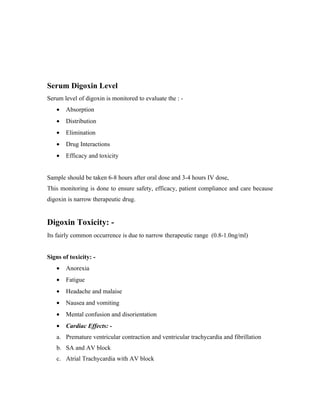
Serum level of digoxin is monitored to evaluate the : -
   •   Absorption
   •   Distribution
   •   Elimination
   •   Drug Interactions
   •   Efficacy and toxicity


Sample should be taken 6-8 hours after oral dose and 3-4 hours IV dose,
This monitoring is done to ensure safety, efficacy, patient compliance and care because
digoxin is narrow therapeutic drug.


Digoxin Toxicity: -
Its fairly common occurrence is due to narrow therapeutic range (0.8-1.0ng/ml)


Signs of toxicity: -
   •   Anorexia
   •   Fatigue
   •   Headache and malaise
   •   Nausea and vomiting
   •   Mental confusion and disorientation
   •   Cardiac Effects: -
   a. Premature ventricular contraction and ventricular trachycardia and fibrillation
   b. SA and AV block
   c. Atrial Trachycardia with AV block
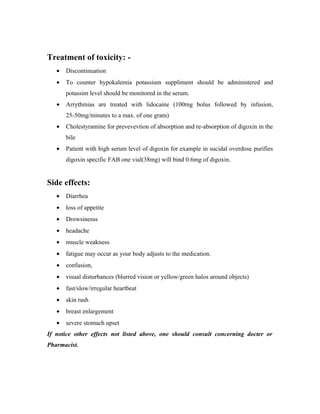
Treatment of toxicity: -
   •   Discontinuation
   •   To counter hypokalemia potassium suppliment should be administered and
       potassim level should be monitored in the serum.
   •   Arrythmias are treated with lidocaine (100mg bolus followed by infusion,
       25-50mg/minutes to a max. of one gram)
   •   Cholestyramine for prevevevtion of absorption and re-absorption of digoxin in the
       bile
   •   Patient with high serum level of digoxin for example in sucidal overdose purifies
       digoxin specific FAB one vial(38mg) will bind 0.6mg of digoxin.


Side effects:
   •   Diarrhea
   •   loss of appetite
   •   Drowsinesss
   •   headache
   •   muscle weakness
   •   fatigue may occur as your body adjusts to the medication.
   •   confusion,
   •   visual disturbances (blurred vision or yellow/green halos around objects)
   •   fast/slow/irregular heartbeat
   •   skin rash
   •   breast enlargement
   •   severe stomach upset
If notice other effects not listed above, one should consult concerning docter or
Pharmacist.
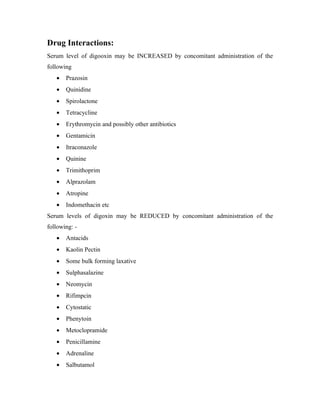
Drug Interactions:
Serum level of digooxin may be INCREASED by concomitant administration of the
following
   •   Prazosin
   •   Quinidine
   •   Spirolactone
   •   Tetracycline
   •   Erythromycin and possibly other antibiotics
   •   Gentamicin
   •   Itraconazole
   •   Quinine
   •   Trimithoprim
   •   Alprazolam
   •   Atropine
   •   Indomethacin etc
Serum levels of digoxin may be REDUCED by concomitant administration of the
following: -
   •   Antacids
   •   Kaolin Pectin
   •   Some bulk forming laxative
   •   Sulphasalazine
   •   Neomycin
   •   Rifimpcin
   •   Cytostatic
   •   Phenytoin
   •   Metoclopramide
   •   Penicillamine
   •   Adrenaline
   •   Salbutamol
•    Cholestyramine.


Available Brands in Pakistan Till 2008
Lanoxin……..GSK
Tabs and inj
Digox………..Platinum Pharmaceuticals
Tabs
Digoxin………Global Pharmaceuticals
Tabs
Doxin…………Xenon Pharmaceuticals
Syrup


                          Refrences


   •    Coomprehensive Pharmacy Review 7TH Edition
   •    Essentials of Medical Pathology 2nd Edition
   •    Pakistan Drug Manual 2008
   •    GlaxoSmithKline United Kingdom
   •    www.wilipedia.org
   •    www.drugs.com
   •    Good and Gillman Pharmacology and Clinical Basis of Therapeutics 11th
        Edition

Digoxin

  • 1.
  • 2.
    University of Lahore Islamabad Campus Assignment Subject: Clinical Pharmacy
  • 3.
    Digoxin Introduction Digoxin, also knownas digitalis, is a purified cardiac glycoside extracted from the plant, Digitalis lanata. Digoxin is widely used in the treatment of various heart conditions, namely cardiac arrythmias atrial fibrillation, atrial flutter and cardiac failure that cannot be controlled by other medication. Mechanism of action Digoxin binds to a site on the extracellular aspect of the α-subunit of the Na+/K+ ATPase pump in the membranes of heart cells (myocytes) and decreases its function. This causes an increase in the level of sodium ions in the myocytes, which then leads to a rise in the level of calcium ions. Because there is a sodium/calcium exchanger which depends on sodium gradient to pump out calcium, digoxin reduces such concentration gradient and subsequently calcium efflux, thus increasing calcium concentration in myocardiocytes and pacemaker cells. The proposed mechanism is the following: inhibition of the Na+/K+ pump leads to increased intracellular Na+ levels, which in turn slows down the extrusion of Ca2+ by the sodium-calcium exchanger that relies on the high Na+ gradient. This effect causes an increase in the length of Phase 4 and Phase 0 of the cardiac action potential, which when combined with the effects of digoxin on the parasympathetic nervous system, leads to a decrease in heart rate. Increased amounts of Ca2+ are then stored in the sarcoplasmic reticulum and released by each action potential, which is unchanged by digoxin. This leads to increased contractility of the heart. Digoxin also increases vagal activity via its action on the central nervous system, thus decreasing the conduction of electrical impulses through the AV node. This negatively chronotropic effect is important for its clinical use in different arrhythmias.
  • 4.
    Therapeutic and ClinicalIndication • Congestive Cardiac failure • Cardiac arrhythmias • Artrial Fibrillation and flutter associated with CHF and Cardiac Arrythmias Congestive Cardiac Failure ( CHF) Congestive heart failure is clinical syndrome resulting from deficient cardiac stroke volume, relative to body need,with inability of the cardiac output to keep pace with venous return i.e heart is unable to pump all the blood coming to it Epidemiology Congestive Heart Failure is a common, costly, disabling and potentially deadly condition. In developing countries, around 2% of adults suffer from heart failure, but in those over the age of 65, this increases to 6–10% in total population. Etiology Myocardial Dysfunction • Myocardial infarction • Hypertension • Myocarditis • Cardiomyopathy Ventricular volume over load • Valvular incomptence e.g mitral and aortic
  • 5.
    Ventricular outflow obstruction • Systemic or Pulmonary Hypertension • Aortic or Pulmonary stenosis Ventricular inflow obstruction • Mitral or tricuspid valve stenosis • Constrictive Cardiomyopathy • Restrictive Cardiomyopathy Obligatory high cardiac output • Anemia • Thyrotoxocosis • Beri Beri • Patent ductus arteriousus(PDA) Altererd ryhthm • Atrial fibrillation Pathophysiology Decreased cardiac output Decreased cardiac output due to decrease heart function results in diminished arterial tree. Therefore blood supply of the organ is reduced which may leed to ischemia. Damming of Blood Heart fails to pump the whole blood coming to it resulting in blood damming back into venous system, accumualtion of deoxygenated blood in the tissue venous system may produced disturbed organ function.
  • 6.
    Compensatory Mechanism As theheart beguns to fails a number of local compensatory mechanism are activated in a attempt to maintain normal cardiac output such compensatory methods are; • Increased sympathetic activity: • It leads to increase the heart rate and increased force of contraction of cardiac muscles that leads to increase cardiac output. • Hypertrophy of cardiac muscles: • It is a compensatory mechanism to eject all the venous blood that comes to the heart. • Dillation of heart chambers; When the combination of increased sympathatic activity and hypertrophy approves insufficient to maintain the cardiac output heart dillates. Compensatory Heart Failure: - According to Frank’s Starling Law increase length of cardiac muscles fibres increase the force of contraction. If the dillated ventricle is able to maintain cardiac output this stage is called heart failure. Decompensatory Heart Failure When the heart come dillated beyond the point at which adequate myocardial contractile, tension can be generated dillation no longer results increase contractality resulting in progressively decrease cardiac output this stage is called Decompensatory heart failure. In this stage venous circulation increases due to decrease pumping capacity of heart resulting in accumulation of venous return in the heart or in tissues draining the heart. Clinical Manifestation Symptoms • Dyspnea • Orthropnea • Paroxysmal nocturnal dyspnea • Fatigue • Sudden death
  • 7.
    Signs • Tachycardia • Third heart sound • Fine crypts at lung bases • Cardiomegaly • Pleural effusion • Edema of dependant part • Distened neck veins • Tender Hepatomegaly Diagnosis • ECG: show depression of ST segment • ETT :when history is suggestive of angina but ECG is normal ETT is performed for diagnostics • Heart Scan :It shows schemic area in myocardiam • Angiography: It provides information about the extent and site of coronary artery stenosis usually performed bypass surgery. • Echocardiography • Chest X-ray etc
  • 8.
    Cardiac Arrhythmias Cardiac Arrhythmiasare deviatin from normal heart beat pattren.They include abnormalities of impulse formation such as heart rate or site of impulse origin and conduction disturbances. Which disrupt the normal sequence of normal atrial and ventricular activation Electrophysiology Conduction system a).Two Electrical Sequences that cause the heart chambers to fill with blood and contract are initiated by the conduction system of the heart: - 1. Impulse formation, 2. Impulse transmission
  • 9.
    b). Four mainstructures composed of tissue that can generate or conduct electric impulse make up the conduction system of the heart: - 1. SA node 2. AV node 3. Bundle of His 4. Purkinje fibre Myocardial Action potential It consist of five phases in which depolarization and repolarization results from changes in the electrical potential across the cell membrane caused by exchange of sodium ion alongwith activity of calcium ions: - 1. Phase 0 (rapid depolarization) 2. Phase 1 (Early rapid repolarization) 3. Phase 2 (Plateau) 4. Phase 3 (Final rapid repolarization) 5. Phase 4 (Slow depolarization) Classification of arrythmias These are generally classified by origin: - 1. Supraventricle arrythmias: stem from enhance automaticity of the SA node or another pacemaker region above the bundle of His or from reentry conduction 2. Ventricular arrythmias: They occur below the bundle of His when an ectopic pacemaker trigers of ventricular contraction before the SA node fires, for example from a conduction disturbance or ventricular irrtability.
  • 10.
    Etiology: - • Heart diseases for example CAD, VHD etc. • MI • Toxic doses of acrdioactive drugs • Vagal Stimulation • Hyperkalemia / hypokalemia • COPD • Increased sympathetic tone • Thyroid disorders Pathophsiology: - Abnormal impulse formation abnormal impulse conduction or combination of both may give rise to arrythmias. Abnormal impulse formation may stem from: - 1. Depressed automatacity as in escapes beats bradycardia 2. Increased automatacityas in premature beats tachcardia and extra systole 3. Depolarization triggers activity to sustain ectopic firing Abnormal Impulse Conduction results from: 1. A conduction block or delay 2. Reentry occurs when an impulse is rerouted through certain region in ehich it has already travels thus impulse depolarizes the same tissue more then ones producing the additional impulse. Hence arrythmias may decrease cardiac output reduce B.P and disrupt perfusion of vital organs. Specific pathophysiology consequences depend on the type of the arrythmias present.
  • 11.
    Clinical Manifestation Sign andsymptoms • Chest pain • Anxiety and confusion from reduce brain perffusion • Dyspnea • Abnormal pulse rate rhythm, or amplitude • Reduce B.P • Palpitation • Weakness • Convulsion • Hypotension Diagnostic test result • ECG only an ECG can definitely identify an arrythmias • EP testing • Electrolyte abnormalities of lab findings, most common hypokalemia and hyperkalemia.
  • 12.
    Atrial Fibrillation Atrial fibrillation(AF or A-fib) is the most common cardiac arrhythmia (abnormal heart rhythm) and involves the two upper chambers (atria) of the heart. Its name comes from the fibrillating (i.e. quivering) of the heart muscles of the atria, instead of a coordinated contraction. It can often be identified by taking a pulse and observing that the heartbeats don't occur at regular intervals. However, a stronger indicator of AF is the absence of P waves on an electrocardiogram (ECG) which are normally present when there is a coordinated atrial contraction at the beginning of each heart beat. Risk increases with age, with 8% of people over 80 having AF. Atrial flutter Atrial flutter (AFL) is an abnormal heart rhythm that occurs in the atria of the heart. When it first occurs, it is usually associated with a fast heart rate or tachycardia (230–380 beats per minute) and falls into the category of supra-ventricular tachycardias. While this rhythm occurs most often in individuals with cardiovascular disease (e.g. hypertension, coronary artery disease, and cardiomyopathy), it may occur spontaneously in people with otherwise normal hearts. It is typically not a stable rhythm, and frequently degenerates into atrial fibrillation (AF). However, it does rarely persist for months to years. Atrial flutter was first identified as an independent medical condition in 1920 by the British physician Sir Thomas Lewis (1882–1945) and colleagues.
  • 13.
    Dose & Administration Totreat the above mentioned indication digoxin widely used with proper monitoring, the dose of digoxin for each patient has to be tailored according to age lean body weight and renal function. The difference in bioavailability in IV and oral fromulation must be considered when changing from one dosage to another for e.g if patient is switched from oral IV formulation the dosage should be reduced by approx. 33%, Adults and Childrens Over 10 years: - • Rapid oral loading; 0.75-1.5mg single dose • Slow oral loading; 0.25-0.75mg should be given daily for one week by an appropriate mention dose.Clinical reponse should be seen within a week. Maintenance Dose: - It should be based upon the % of the body stores of digoxin, lost each day through elimination. Emergency parentral loading:- 0.5-1mg Neonates,Infants and Children upto to 10 years IV Loading Dose Neonates (<1.5kg) 20microgram/kg over 24 hours Neonates(1.5 to 2.5 kg) 30microgram/kg over 24 hours Neonates upto to 2 years 35microgram/kg over24hours 2 to 5 years 35microgram/kg over 24 hours 5 to 10 years 25microgram/kg over 24 hours
  • 14.
    Oral Loading Dose Neonates(<1.5kg) 20microgram/kg over 24 hours Neonates(1.5 to 2.5 kg) 30microgram/kg over 24 hours Neonates upto to 2 years 45icrogram/kg over24hours 2 to 5 years 35crogram/kg over 24 hours 5 to 10 years 25microgram/kg over 24 hours The loading should be administred in divided doses with approximately half of total given dose first and further fractions of the total dose at intervals of 4-8 hours for oral and 4-8hours Infusion for 10-20mis for IV. Maintenasnce Dose Neonates: daily dose = 24percent of 24 hours loading dose IV&oral 2-upto 10 years: daily dose=25percent of 24hours loading dose IV&oral Therapeutic Range: 0.8-1.0ng/ml Precautions and monitoring effects Serum electrolyte balance should be monitoring for Precautionory measurement to ensure patient safety and eficacy. • Potassium antagonize the digoxin • Calcium ions acts synergestically with digoxin • Magnesium levels inversely related to digoxin activity
  • 15.
    Serum Digoxin Level Serumlevel of digoxin is monitored to evaluate the : - • Absorption • Distribution • Elimination • Drug Interactions • Efficacy and toxicity Sample should be taken 6-8 hours after oral dose and 3-4 hours IV dose, This monitoring is done to ensure safety, efficacy, patient compliance and care because digoxin is narrow therapeutic drug. Digoxin Toxicity: - Its fairly common occurrence is due to narrow therapeutic range (0.8-1.0ng/ml) Signs of toxicity: - • Anorexia • Fatigue • Headache and malaise • Nausea and vomiting • Mental confusion and disorientation • Cardiac Effects: - a. Premature ventricular contraction and ventricular trachycardia and fibrillation b. SA and AV block c. Atrial Trachycardia with AV block
  • 16.
    Treatment of toxicity:- • Discontinuation • To counter hypokalemia potassium suppliment should be administered and potassim level should be monitored in the serum. • Arrythmias are treated with lidocaine (100mg bolus followed by infusion, 25-50mg/minutes to a max. of one gram) • Cholestyramine for prevevevtion of absorption and re-absorption of digoxin in the bile • Patient with high serum level of digoxin for example in sucidal overdose purifies digoxin specific FAB one vial(38mg) will bind 0.6mg of digoxin. Side effects: • Diarrhea • loss of appetite • Drowsinesss • headache • muscle weakness • fatigue may occur as your body adjusts to the medication. • confusion, • visual disturbances (blurred vision or yellow/green halos around objects) • fast/slow/irregular heartbeat • skin rash • breast enlargement • severe stomach upset If notice other effects not listed above, one should consult concerning docter or Pharmacist.
  • 17.
    Drug Interactions: Serum levelof digooxin may be INCREASED by concomitant administration of the following • Prazosin • Quinidine • Spirolactone • Tetracycline • Erythromycin and possibly other antibiotics • Gentamicin • Itraconazole • Quinine • Trimithoprim • Alprazolam • Atropine • Indomethacin etc Serum levels of digoxin may be REDUCED by concomitant administration of the following: - • Antacids • Kaolin Pectin • Some bulk forming laxative • Sulphasalazine • Neomycin • Rifimpcin • Cytostatic • Phenytoin • Metoclopramide • Penicillamine • Adrenaline • Salbutamol
  • 18.
    Cholestyramine. Available Brands in Pakistan Till 2008 Lanoxin……..GSK Tabs and inj Digox………..Platinum Pharmaceuticals Tabs Digoxin………Global Pharmaceuticals Tabs Doxin…………Xenon Pharmaceuticals Syrup Refrences • Coomprehensive Pharmacy Review 7TH Edition • Essentials of Medical Pathology 2nd Edition • Pakistan Drug Manual 2008 • GlaxoSmithKline United Kingdom • www.wilipedia.org • www.drugs.com • Good and Gillman Pharmacology and Clinical Basis of Therapeutics 11th Edition