
HEPARIN 
DR.VENKATESH.K 
JR 
UROLOGY
• Heparin is a glycosaminoglycan found in the 
secretory granules of mast cells. 
• Molecular weight of 10,000-40,000. 
• Polymer of alternating D-glucuronic acid and 
N-acetyl-D-glucosamine residues. 
• Heparan sulfate on the surface of vascular 
endothelial cells or in the subendothelial 
extracellular matrix interacts with circulating 
antithrombin (see below) to provide a natural 
antithrombotic mechanism.
imp 
• Patients with malignancies may experience 
bleeding related to circulating heparan sulfate 
or related glycosaminoglycans that probably 
originate from lysis of the tumor cells.
Source: 
• Heparin is commonly extracted from porcine 
intestinal mucosa or bovine lung. 
• Biological activity is measured in USP units. 
• The USP unit is the quantity of heparin that 
prevents 1 ml of citrated sheep plasma from 
clotting for 1 hour after the addition of 0.2 ml 
of 1% CaCl2.
LMW-HEPARIN 
• Low-molecular-weight heparins (1000 to 10,000 
daltons; mean, 4500 daltons, or 15MS units) are 
isolated from standard heparin by gel filtration 
chromatography, precipitation with ethanol, or 
partial depolymerization with nitrous acid and 
other chemical or enzymatic reagents. 
• Activity measured by factor-Xa inhibition assay, 
mediated by antithrombin.
MOA 
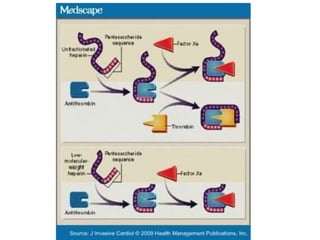
• Heparin catalyzes the inhibition of several 
coagulation proteases by antithrombin. 
• AT- inhibits activated coagulation factors of 
the intrinsic and common pathways, including 
thrombin, Xa, and IXa. 
• Heparin increases the rate of the thrombin-antithrombin 
reaction at least a thousandfold 
by serving as a catalytic template to which 
both the inhibitor and the protease bind.
• The binding site for antithrombin on heparin is a 
specific pentasaccharide sequence that contains a 
3-O-sulfated glucosamine residue. 
• This structure occurs in about 30% of heparin 
molecules and less abundantly in heparan sulfate. 
• Heparin molecules containing fewer than 18 
monosaccharide units (<5400 daltons) also do not 
catalyze inhibition of thrombin by antithrombin.
• High-molecular-weight (HMW) fractions of 
heparin with high affinity for antithrombin 
markedly inhibit blood coagulation by 
inhibiting all three factors, especially thrombin 
and factor Xa 
• Low-molecular-weight heparin preparations 
produce an anticoagulant effect mainly 
through inhibition of Xa by antithrombin, 
because the majority of molecules are of 
insufficient length to catalyze inhibition of 
thrombin.
When the concentration of heparin in plasma is 
0.1 to 1 units/ml, thrombin, factor IXa, and 
factor Xa are inhibited rapidly (half-lives less 
than 0.1 second) by antithrombin.
• Bound forms of clotting factors are not 
inhibited by heparin. 
• Platelet factor 4, released from the a-granules 
during platelet aggregation, blocks binding of 
antithrombin to heparin or heparan sulfate and 
may promote local clot formation at the site of 
hemostasis.
High dose 
• It can interfere with platelet aggregation and 
there by prolong bleeding time. 
At lower doses 
• Heparin "clears" lipemic plasma in vivo by 
causing the release of lipoprotein lipase into 
the circulation. Lipoprotein lipase hydrolyzes 
triglycerides to glycerol and free fatty acids.
USES: 
• Prevention and treatment of DVT and 
pulmonary embolism 
intermittent low dose heparin admin-5000IU 
sc 8-12hrly. 
LMW heparin-enoxaparin 30mg sc 12hrly 
-dalteparin5000U,s.c/day 
Infusion in case of estd thrombus.
Contd… 
• Myocardial infarction: prophylaxis,during 
coronary angioplasty and stent placement. 
• Unstable angina: reduce chances of MI. 
• Miscellaneous: DIC,peripheral 
embolism,during hemodialysis.
Contraindication: 
• Hypersensitivity. 
• Actively bleeding or hemophilia, significant 
thrombocytopenia, purpura. 
• Severe hypertension. 
• Intracranial hemorrhage. 
• Infective endocarditis, active tuberculosis, 
ulcerative lesions of the gastrointestinal tract.
Contd.. 
• Threatened abortion, visceral carcinoma, or 
advanced hepatic or renal disease. 
• Avoided in those patients who have recently 
had surgery of the brain, spinal cord, or eye. 
• Patients who are undergoing lumbar puncture 
or regional anesthetic block.
S.E of Heparin: 
• HIT 
• Osteoporosis and spontaneous fractures on 
prolonged use. 
• Transient alopecia. 
• Hypersensitivity.
LMWH: advantages 
• Given by s.c-better bioavailability 70-90% 
• Longer elemination half-life- once daily 
dosing 
• Do not prolong APTT and whole blood 
clotting time-monitorng is not requiredas with 
UFH. 
• Dose is given in mg not in units.
FONDAPARINUX 
• Synthetic derivative. 
• Dose-2.5mg OD 6hrs after Sx. 
• S.C route 100% bioavailability. 
• Half-life-17-21hrs 
• Excreted unchanged in urine-CI when cr. 
Clearance is<30ml/min.
Thank u