PowerPoint to accompany


Foundations in Microbiology
          Fifth Edition

                                        Talaro
                                     Chapter
                                       1

    Copyright The McGraw-Hill Companies, Inc. Permission required for reproduction or display.
Microbiology
• The study of of organisms too small to be
  seen without magnification
  –   bacteria
  –   viruses
  –   fungi
  –   protozoa
  –   helminths (worms)
  –   algae

                                              2
Branches of study within
            microbiology
•   Immunology
•   Public health microbiology & epidemiology
•   Food, dairy and aquatic microbiology
•   Biotechnology
•   Genetic engineering & recombinant DNA
    technology

                                            3
Microbes are involved in
•   nutrient production & energy flow
•   decomposition
•   production of foods, drugs & vaccines
•   bioremediation
•   causing disease


                                            4
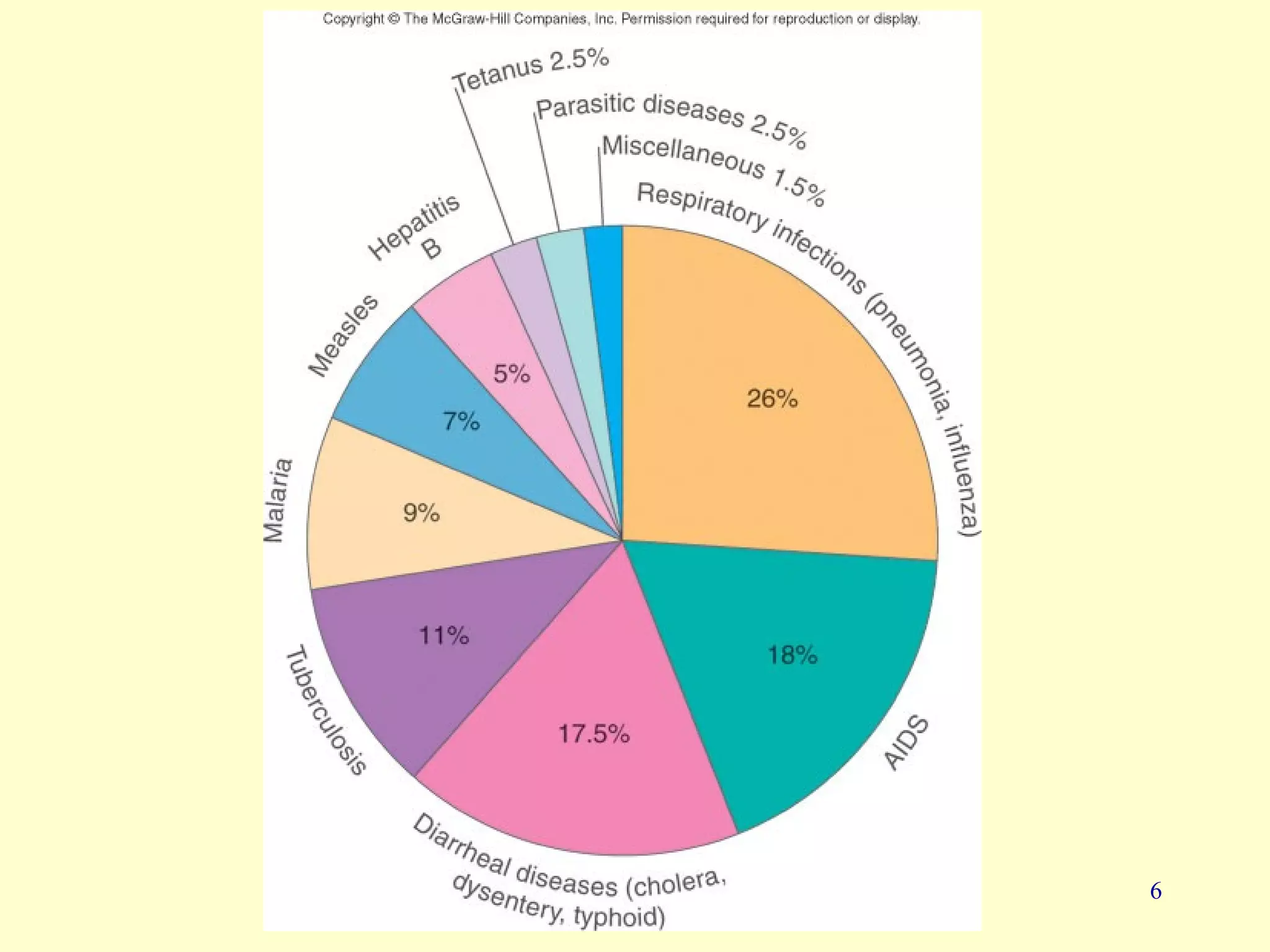
Impact of pathogens
• Nearly 2,000 different microbes cause
  diseases
• 10 B infections/year worldwide
• 13 M deaths from infections/year worldwide


                                           5
6
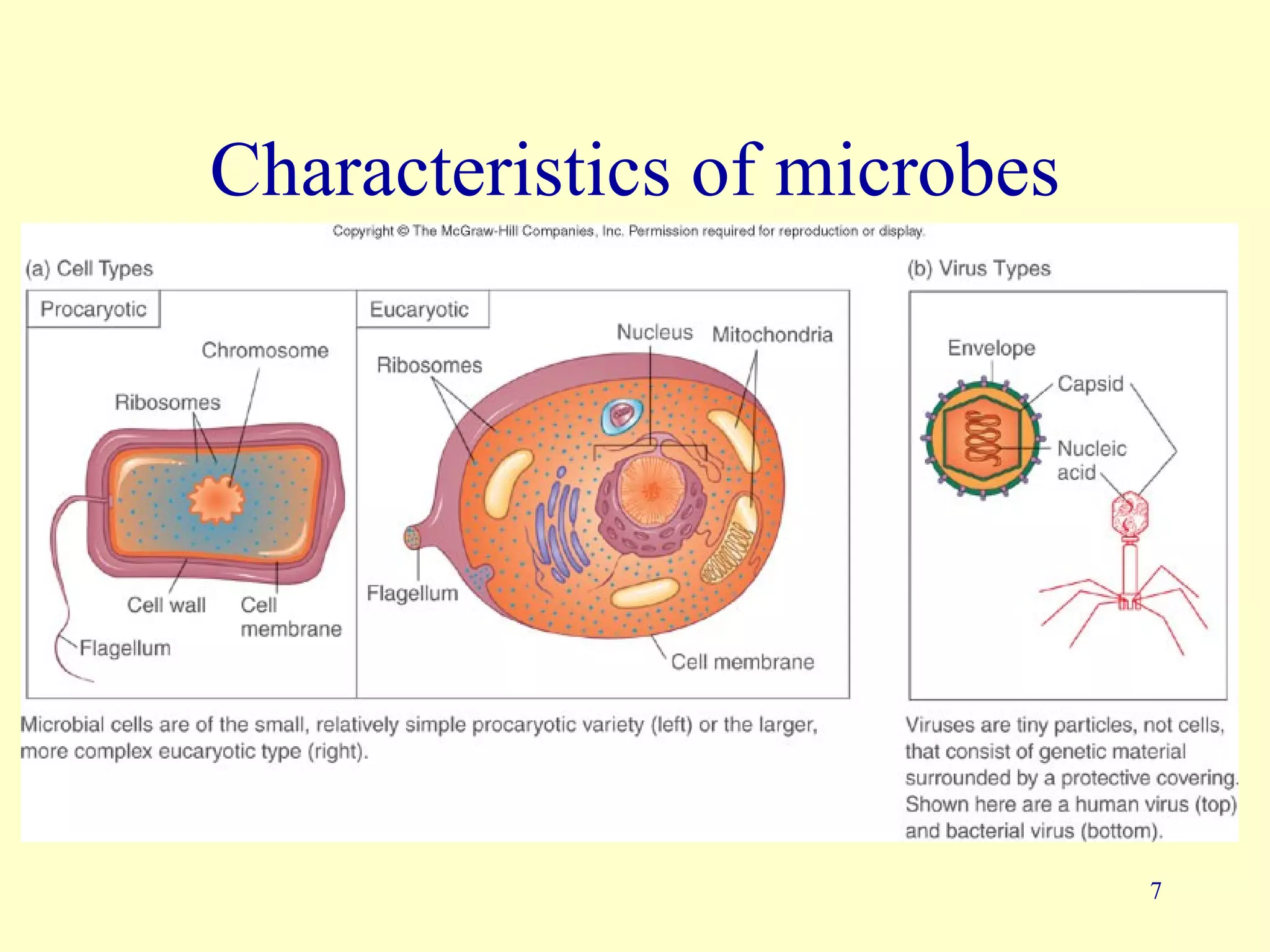
Characteristics of microbes


                              7
8
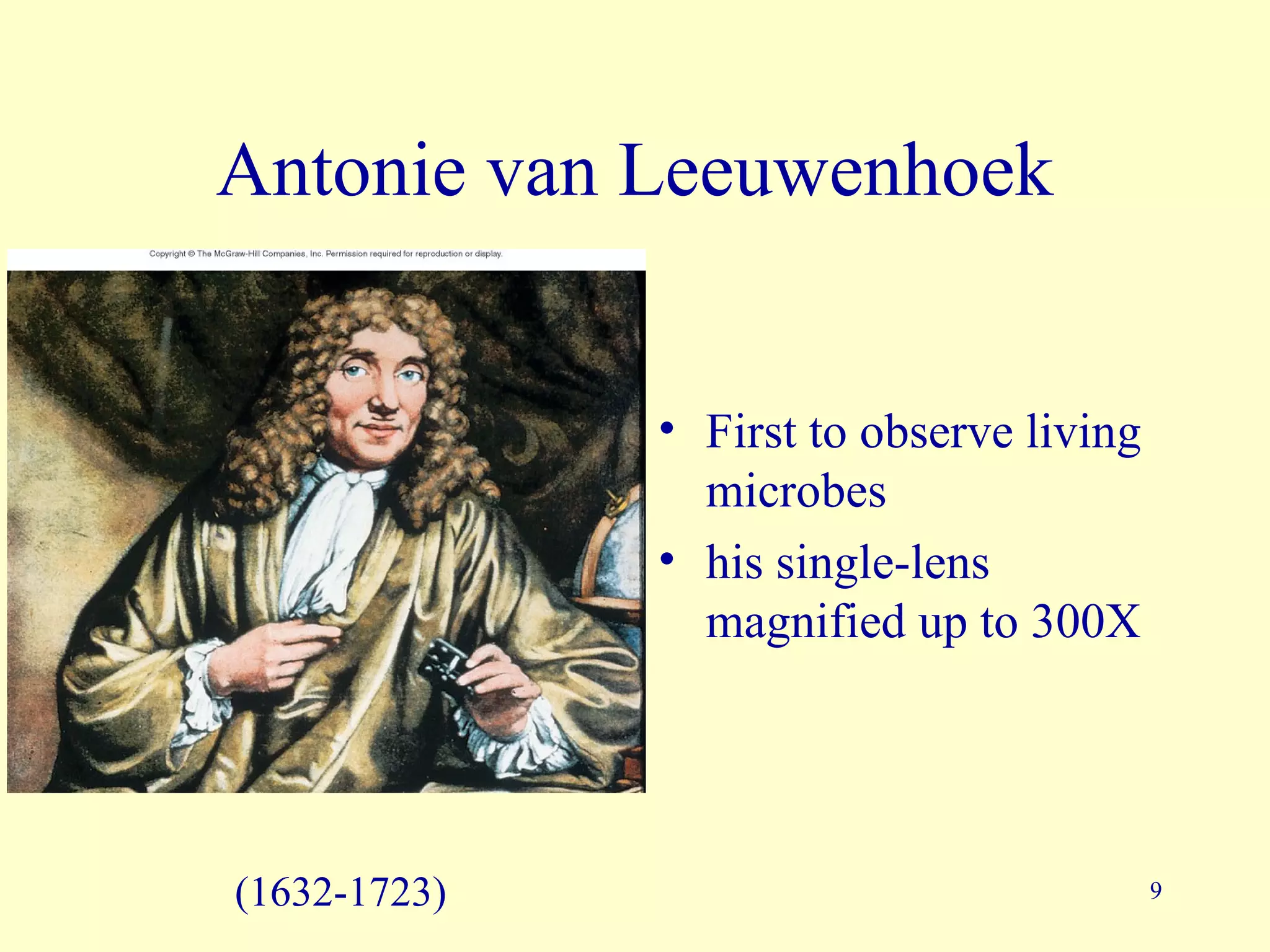
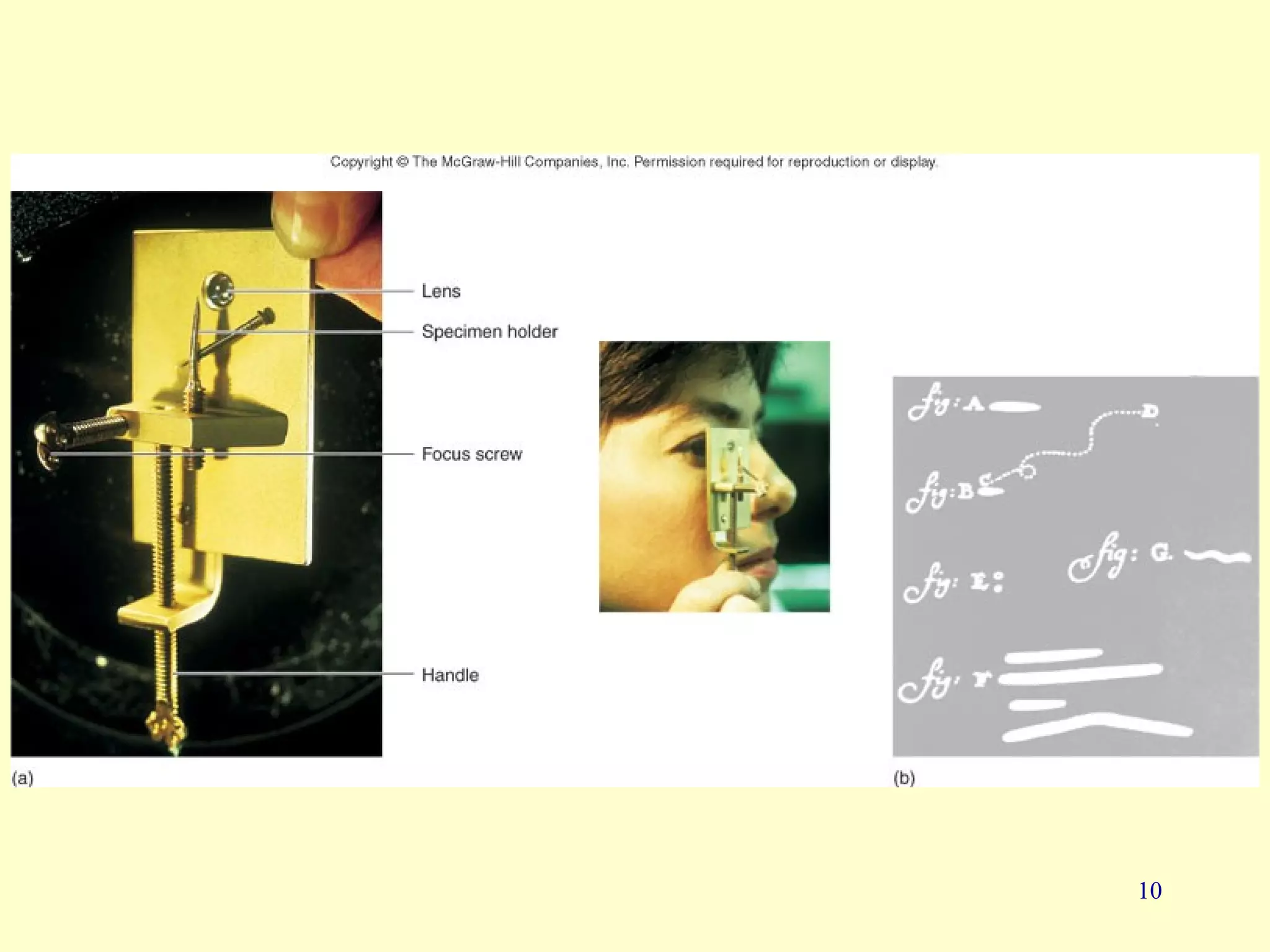
Antonie van Leeuwenhoek


              • First to observe living
                microbes
              • his single-lens
                magnified up to 300X


(1632-1723)                               9
10
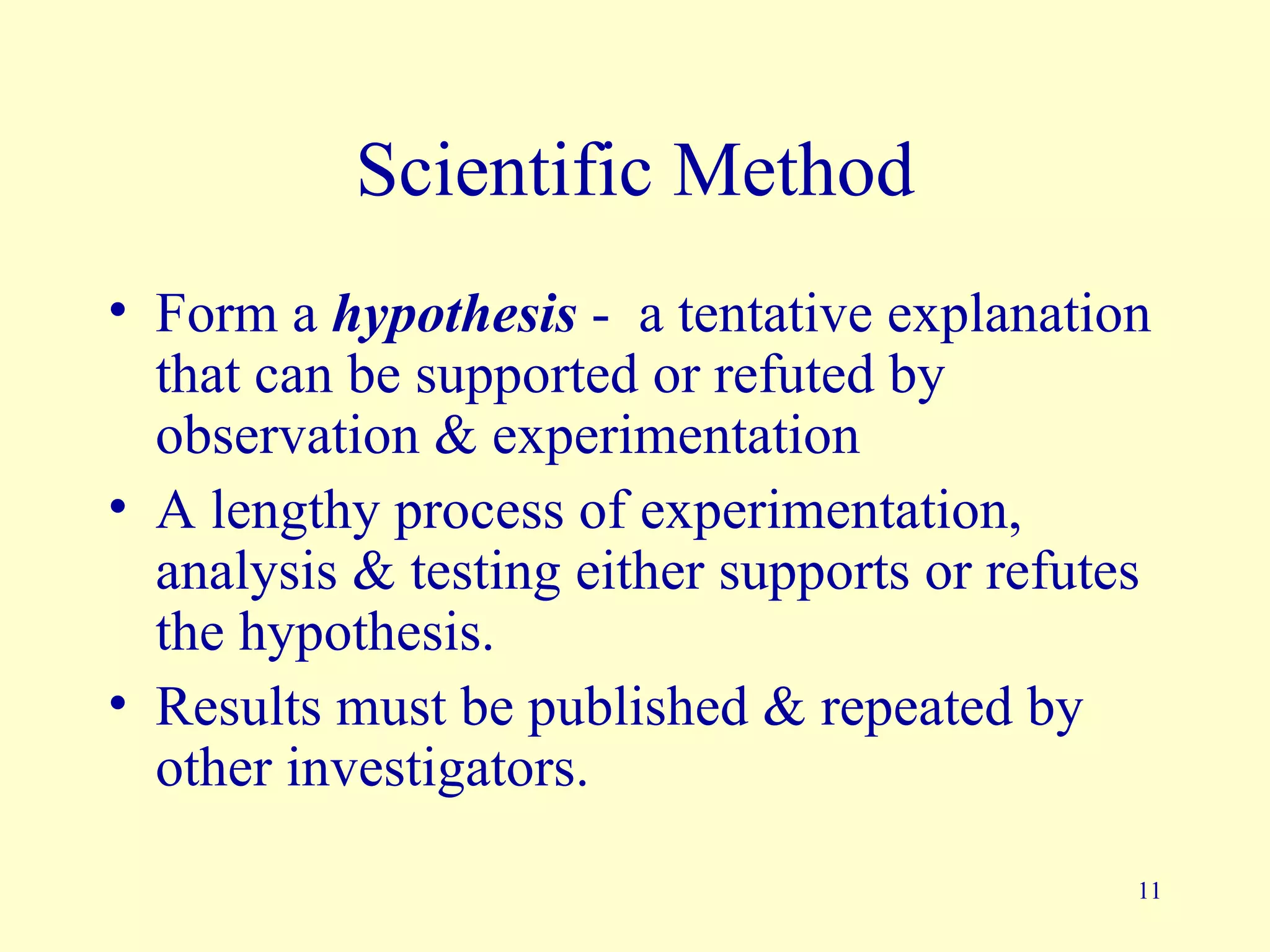
Scientific Method
• Form a hypothesis - a tentative explanation
  that can be supported or refuted by
  observation & experimentation
• A lengthy process of experimentation,
  analysis & testing either supports or refutes
  the hypothesis.
• Results must be published & repeated by
  other investigators.

                                              11
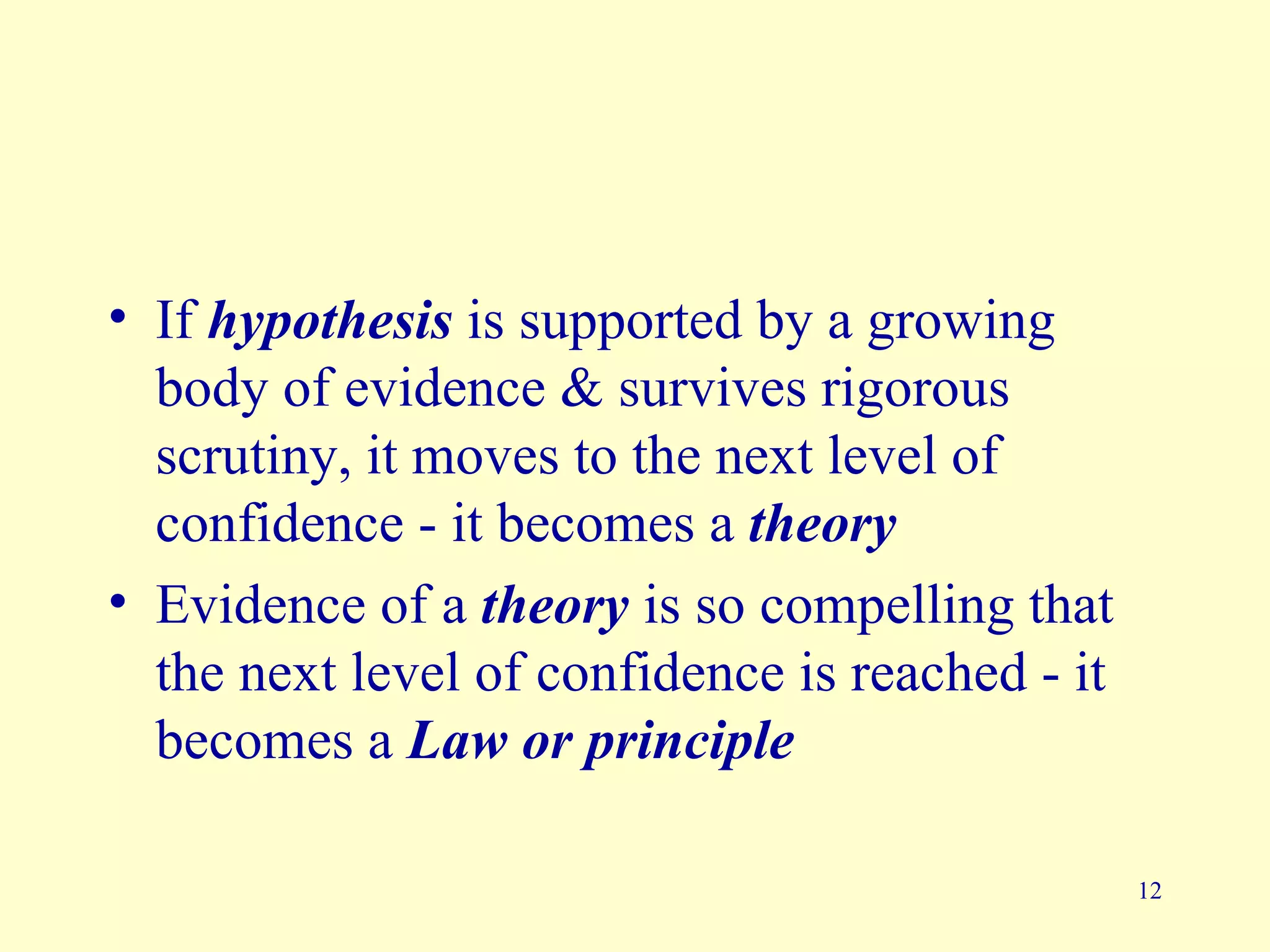
• If hypothesis is supported by a growing
  body of evidence & survives rigorous
  scrutiny, it moves to the next level of
  confidence - it becomes a theory
• Evidence of a theory is so compelling that
  the next level of confidence is reached - it
  becomes a Law or principle

                                                 12
Spontaneous generation

  Early belief that some forms of life
could arise from vital forces present in
  nonliving or decomposing matter.
       (flies from manure, etc)
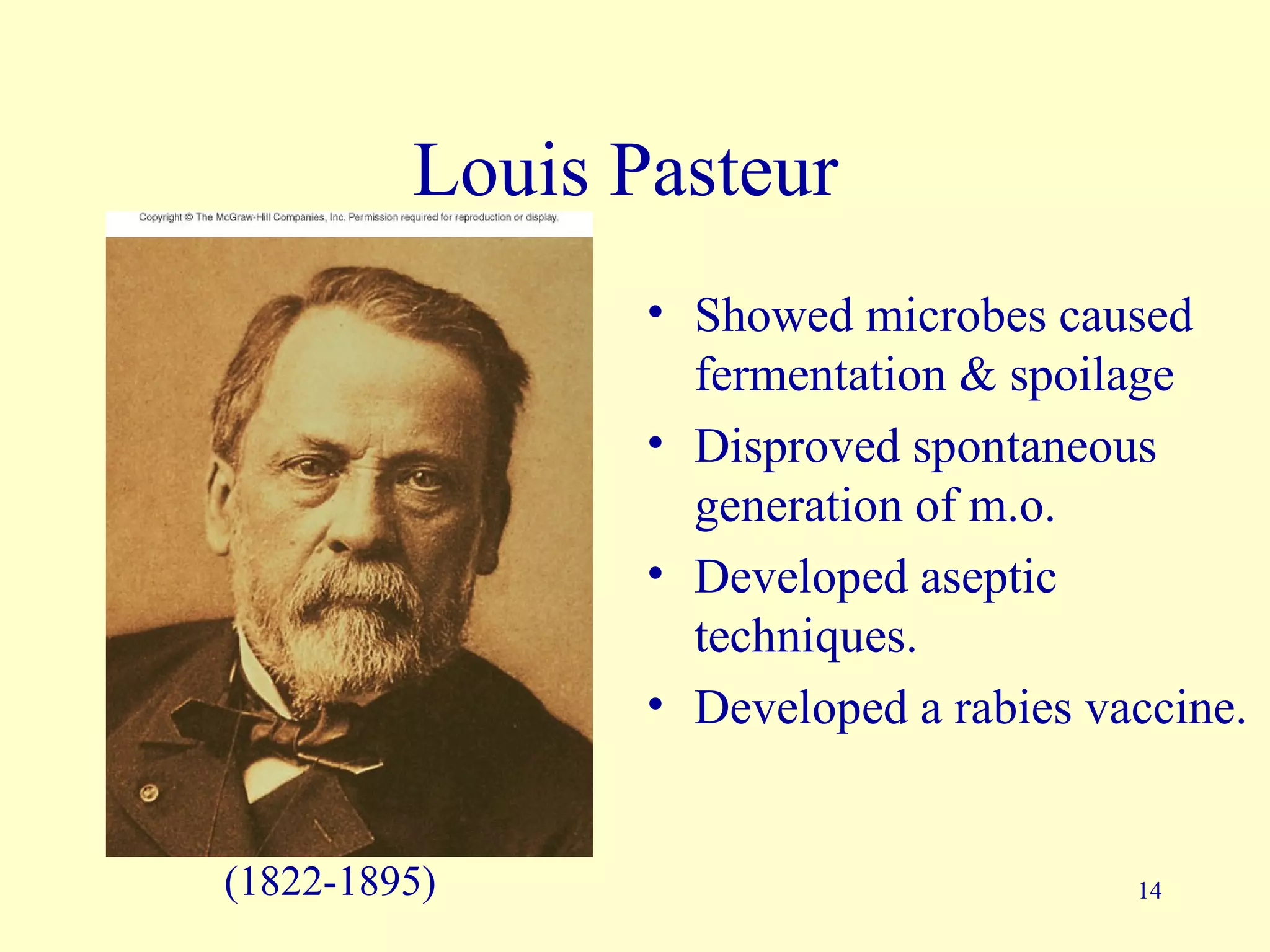
Louis Pasteur
                • Showed microbes caused
                  fermentation & spoilage
                • Disproved spontaneous
                  generation of m.o.
                • Developed aseptic
                  techniques.
                • Developed a rabies vaccine.


(1822-1895)                            14
Germ theory of disease

Many diseases are caused by the growth
of microbes in the body and not by sins,
     bad character, or poverty, etc.
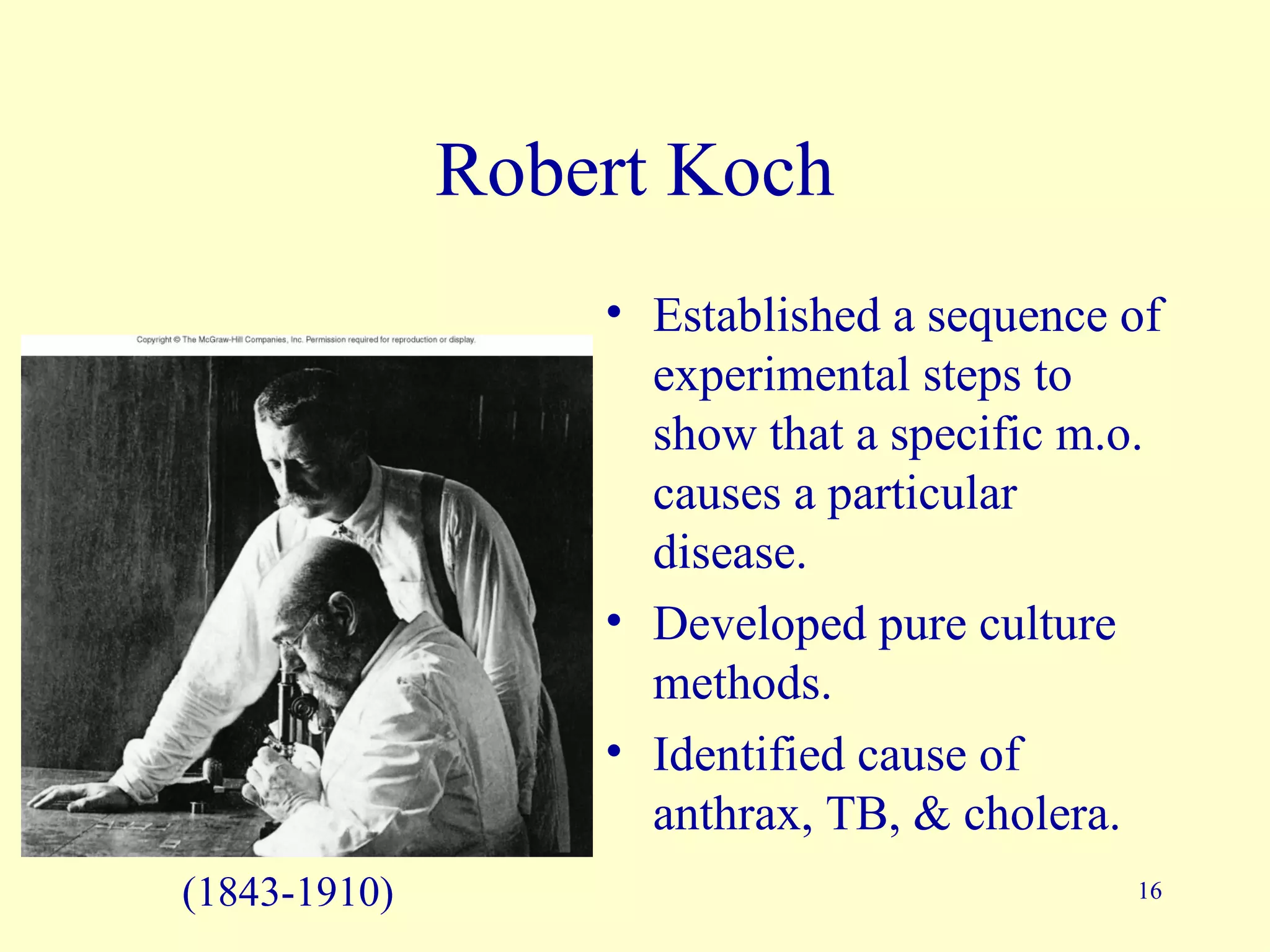
Robert Koch
                  • Established a sequence of
                    experimental steps to
                    show that a specific m.o.
                    causes a particular
                    disease.
                  • Developed pure culture
                    methods.
                  • Identified cause of
                    anthrax, TB, & cholera.
(1843-1910)                                16
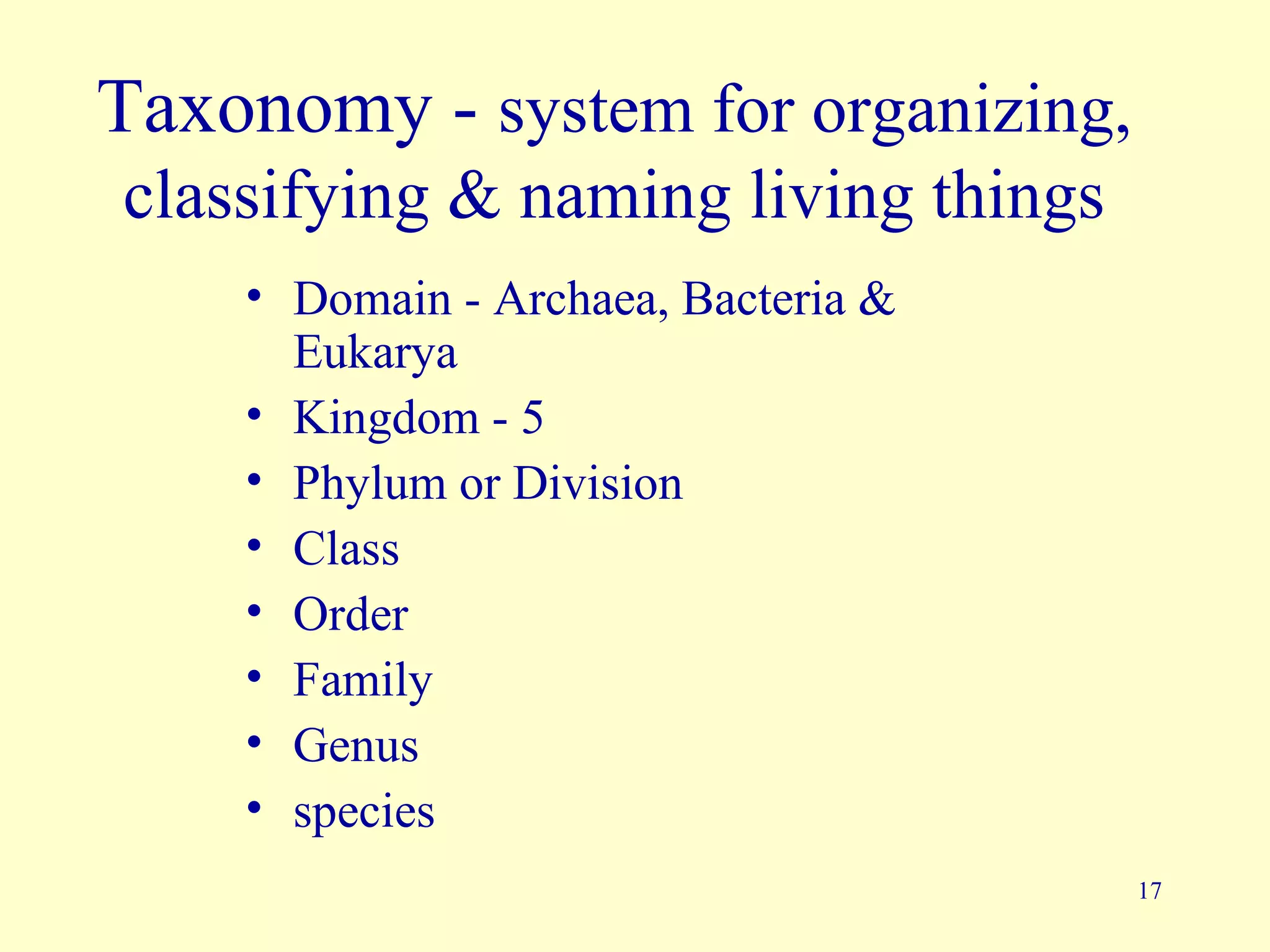
Taxonomy - system for organizing,
classifying & naming living things
    • Domain - Archaea, Bacteria &
      Eukarya
    • Kingdom - 5
    • Phylum or Division
    • Class
    • Order
    • Family
    • Genus
    • species
                                     17
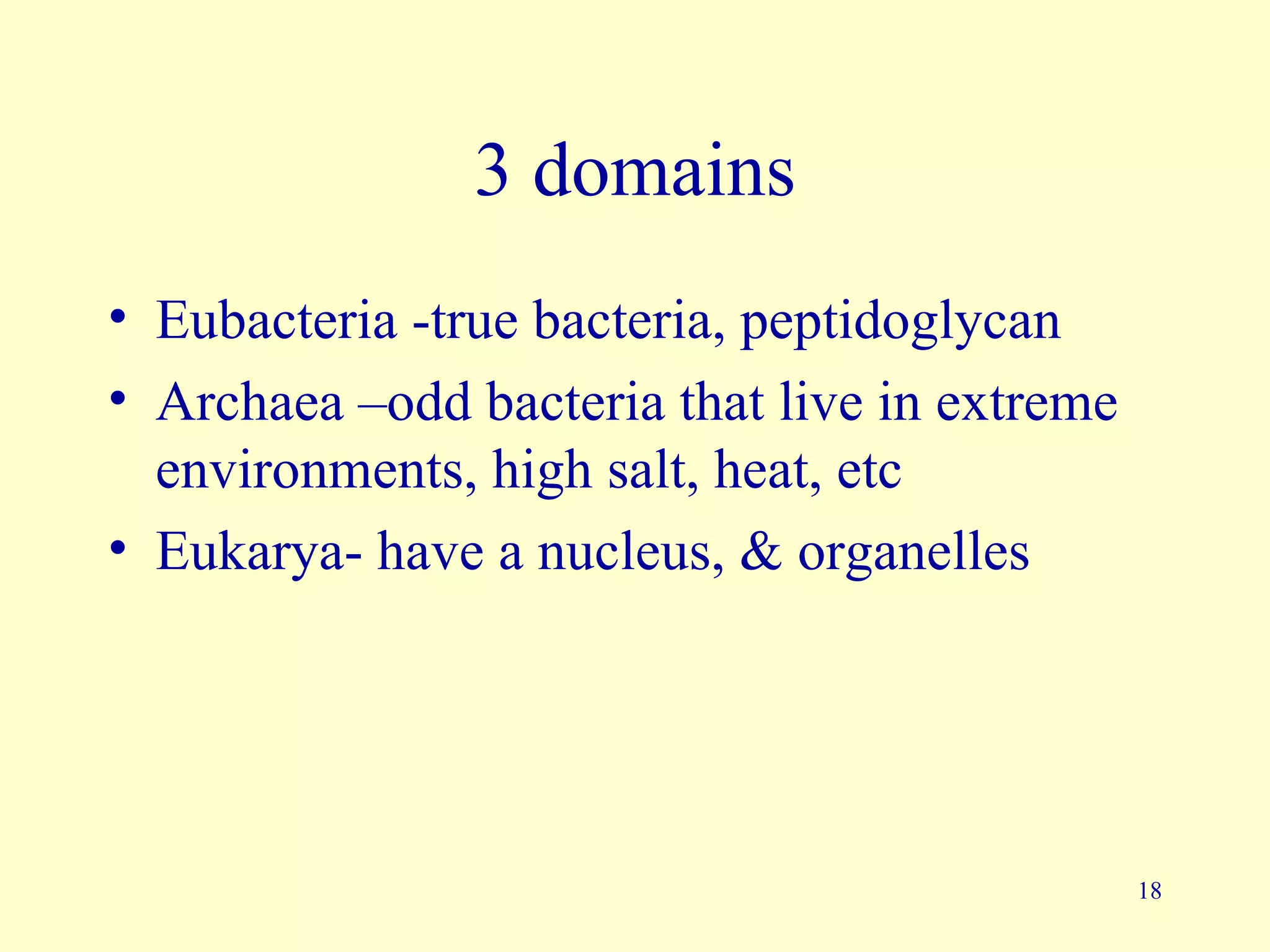
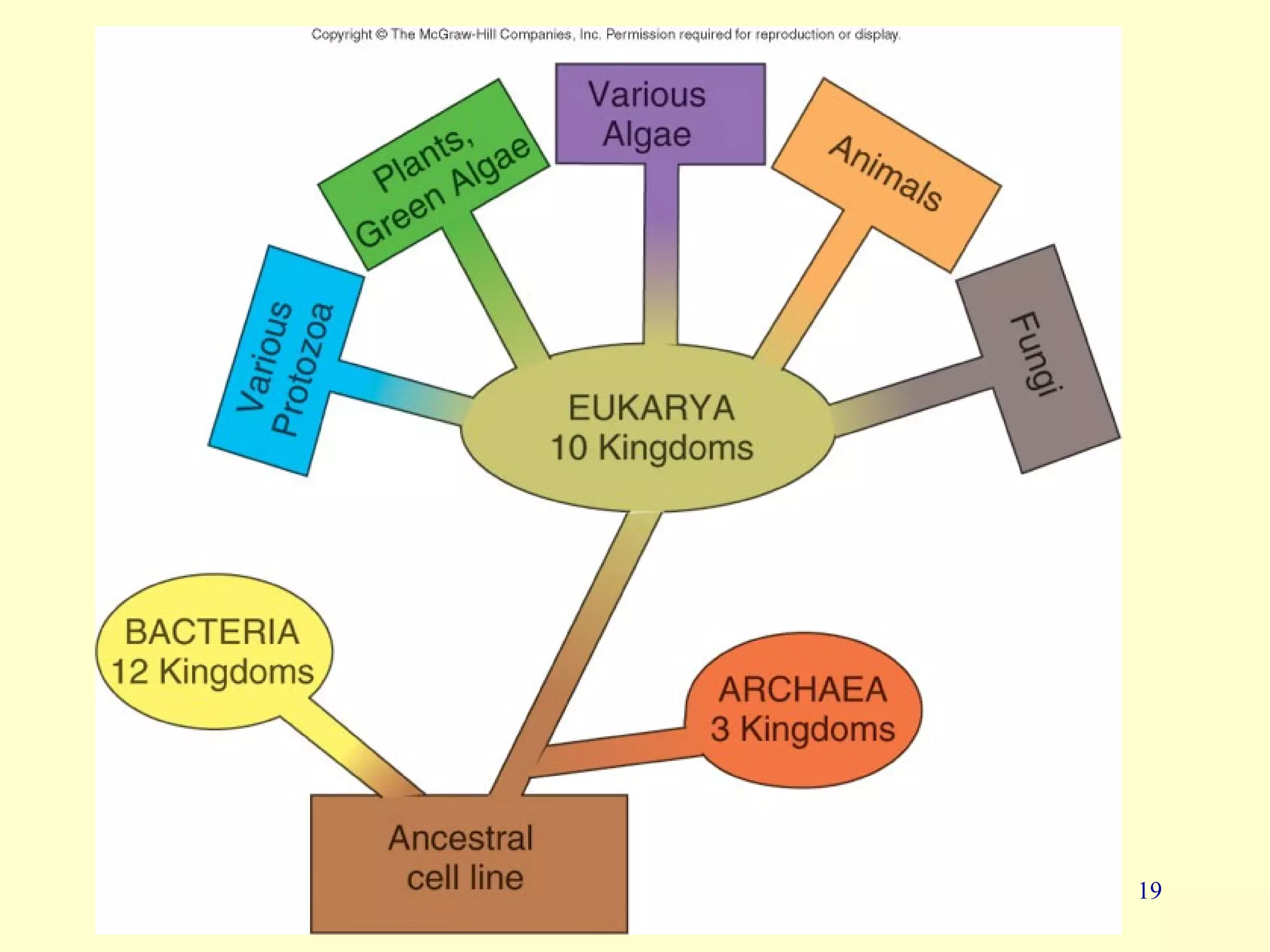
3 domains
• Eubacteria -true bacteria, peptidoglycan
• Archaea –odd bacteria that live in extreme
  environments, high salt, heat, etc
• Eukarya- have a nucleus, & organelles


                                               18
19
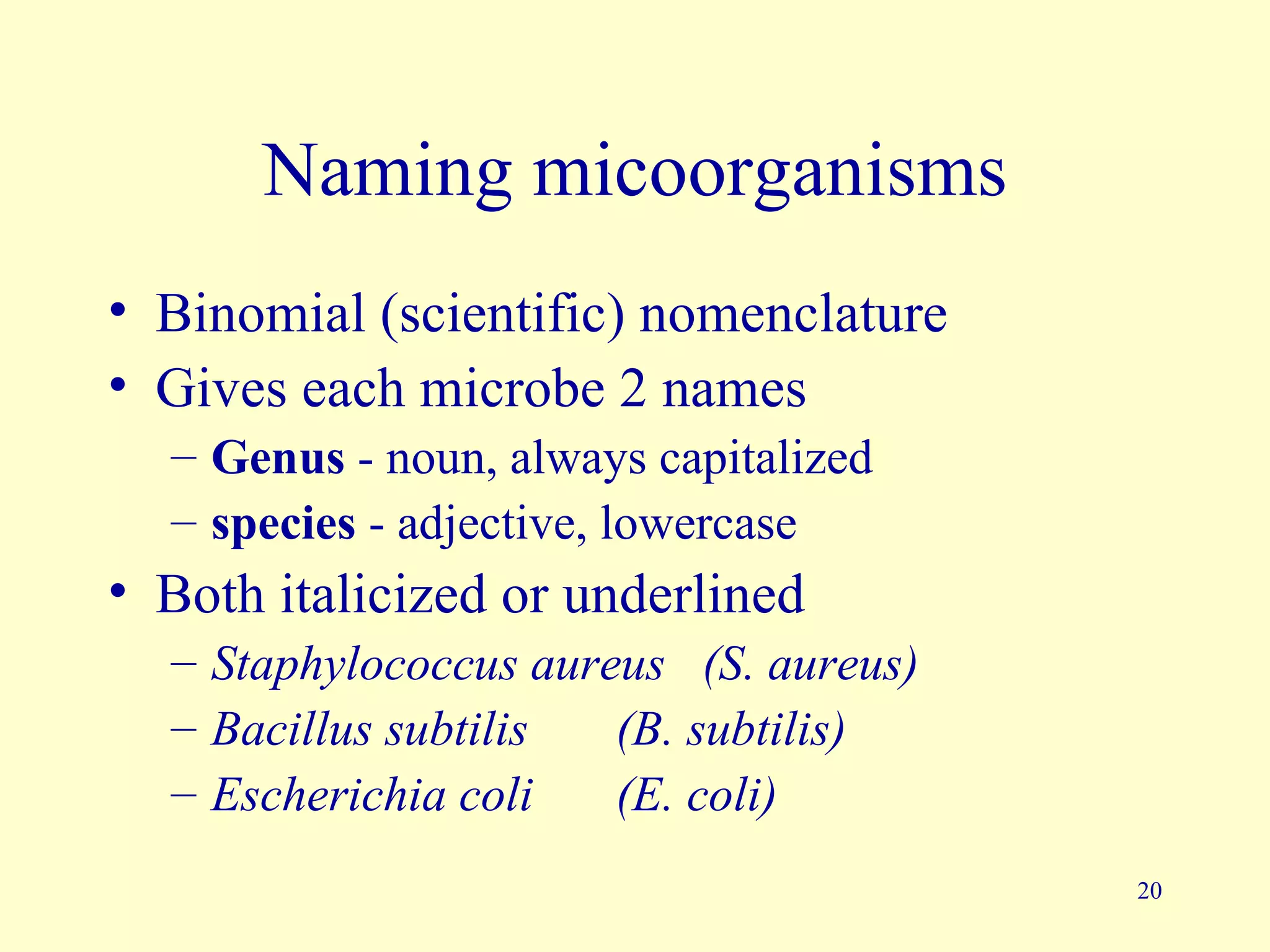
Naming micoorganisms
• Binomial (scientific) nomenclature
• Gives each microbe 2 names
  – Genus - noun, always capitalized
  – species - adjective, lowercase
• Both italicized or underlined
  – Staphylococcus aureus (S. aureus)
  – Bacillus subtilis  (B. subtilis)
  – Escherichia coli   (E. coli)
                                        20
Evolution- living things change
 gradually over millions of years
• Changes favoring survival are retained &
  less beneficial changes are lost.
• All new species originate from preexisting
  species.
• Closely related organism have similar
  features because they evolved from
  common ancestral forms.
• Evolution usually progresses toward greater
  complexity.                                21
22

1 introduction to microbiology

  • 1.
    PowerPoint to accompany Foundationsin Microbiology Fifth Edition Talaro Chapter 1 Copyright The McGraw-Hill Companies, Inc. Permission required for reproduction or display.
  • 2.
    Microbiology • The studyof of organisms too small to be seen without magnification – bacteria – viruses – fungi – protozoa – helminths (worms) – algae 2
  • 3.
    Branches of studywithin microbiology • Immunology • Public health microbiology & epidemiology • Food, dairy and aquatic microbiology • Biotechnology • Genetic engineering & recombinant DNA technology 3
  • 4.
    Microbes are involvedin • nutrient production & energy flow • decomposition • production of foods, drugs & vaccines • bioremediation • causing disease 4
  • 5.
    Impact of pathogens •Nearly 2,000 different microbes cause diseases • 10 B infections/year worldwide • 13 M deaths from infections/year worldwide 5
  • 6.
  • 7.
  • 8.
  • 9.
    Antonie van Leeuwenhoek • First to observe living microbes • his single-lens magnified up to 300X (1632-1723) 9
  • 10.
  • 11.
    Scientific Method • Forma hypothesis - a tentative explanation that can be supported or refuted by observation & experimentation • A lengthy process of experimentation, analysis & testing either supports or refutes the hypothesis. • Results must be published & repeated by other investigators. 11
  • 12.
    • If hypothesisis supported by a growing body of evidence & survives rigorous scrutiny, it moves to the next level of confidence - it becomes a theory • Evidence of a theory is so compelling that the next level of confidence is reached - it becomes a Law or principle 12
  • 13.
    Spontaneous generation Early belief that some forms of life could arise from vital forces present in nonliving or decomposing matter. (flies from manure, etc)
  • 14.
    Louis Pasteur • Showed microbes caused fermentation & spoilage • Disproved spontaneous generation of m.o. • Developed aseptic techniques. • Developed a rabies vaccine. (1822-1895) 14
  • 15.
    Germ theory ofdisease Many diseases are caused by the growth of microbes in the body and not by sins, bad character, or poverty, etc.
  • 16.
    Robert Koch • Established a sequence of experimental steps to show that a specific m.o. causes a particular disease. • Developed pure culture methods. • Identified cause of anthrax, TB, & cholera. (1843-1910) 16
  • 17.
    Taxonomy - systemfor organizing, classifying & naming living things • Domain - Archaea, Bacteria & Eukarya • Kingdom - 5 • Phylum or Division • Class • Order • Family • Genus • species 17
  • 18.
    3 domains • Eubacteria-true bacteria, peptidoglycan • Archaea –odd bacteria that live in extreme environments, high salt, heat, etc • Eukarya- have a nucleus, & organelles 18
  • 19.
  • 20.
    Naming micoorganisms • Binomial(scientific) nomenclature • Gives each microbe 2 names – Genus - noun, always capitalized – species - adjective, lowercase • Both italicized or underlined – Staphylococcus aureus (S. aureus) – Bacillus subtilis (B. subtilis) – Escherichia coli (E. coli) 20
  • 21.
    Evolution- living thingschange gradually over millions of years • Changes favoring survival are retained & less beneficial changes are lost. • All new species originate from preexisting species. • Closely related organism have similar features because they evolved from common ancestral forms. • Evolution usually progresses toward greater complexity. 21
  • 22.