SEDATIVE/HYPNOTICS
   ANXIOLYTICS

 Martha I. Dávila-García, Ph.D.
      Howard University
 Department of Pharmacology
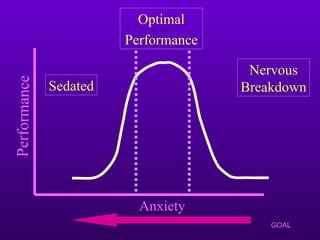
Optimal
                        Performance

                                       Nervous
Performance


              Sedated                 Breakdown


                          Anxiety
                                          GOAL
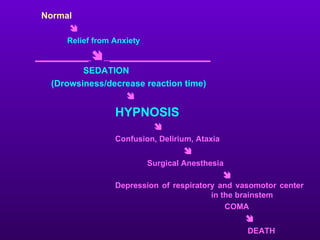
Normal
      
     Relief from Anxiety

_________  _________________
         SEDATION
  (Drowsiness/decrease reaction time)
                  
                 HYPNOSIS
                            
                 Confusion, Delirium, Ataxia
                                    
                           Surgical Anesthesia
                                               
                 Depression of respiratory and vasomotor center
                                         in the brainstem
                                             COMA
                                                   
                                                   DEATH
SEDATIVE/HYPNOTICS
         ANXIOLYTICS
• Major therapeutic use is to relief anxiety
  (anxiolytics) or induce sleep (hypnotics).
• Hypnotic effects can be achieved with most
  anxiolytic drugs just by increasing the dose.
• The distinction between a "pathological" and
  "normal" state of anxiety is hard to draw, but
  in spite of, or despite of, this diagnostic
  vagueness, anxiolytics are among the most
  prescribed substances worldwide.
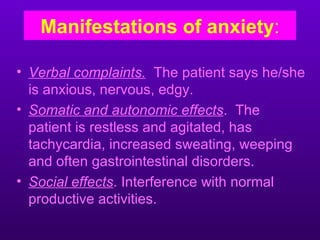
Manifestations of anxiety:

• Verbal complaints. The patient says he/she
  is anxious, nervous, edgy.
• Somatic and autonomic effects. The
  patient is restless and agitated, has
  tachycardia, increased sweating, weeping
  and often gastrointestinal disorders.
• Social effects. Interference with normal
  productive activities.
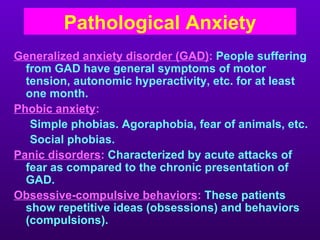
Pathological Anxiety
Generalized anxiety disorder (GAD): People suffering
  from GAD have general symptoms of motor
  tension, autonomic hyperactivity, etc. for at least
  one month.
Phobic anxiety:
   Simple phobias. Agoraphobia, fear of animals, etc.
   Social phobias.
Panic disorders: Characterized by acute attacks of
  fear as compared to the chronic presentation of
  GAD.
Obsessive-compulsive behaviors: These patients
  show repetitive ideas (obsessions) and behaviors
  (compulsions).
Causes of Anxiety

1). Medical:
  o Respiratory
  o Endocrine
  o Cardiovascular
  o Metabolic
  o Neurologic.
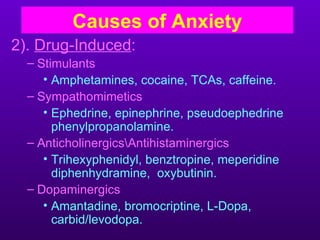
Causes of Anxiety
2). Drug-Induced:
  – Stimulants
     • Amphetamines, cocaine, TCAs, caffeine.
  – Sympathomimetics
     • Ephedrine, epinephrine, pseudoephedrine
       phenylpropanolamine.
  – AnticholinergicsAntihistaminergics
     • Trihexyphenidyl, benztropine, meperidine
       diphenhydramine, oxybutinin.
  – Dopaminergics
     • Amantadine, bromocriptine, L-Dopa,
       carbid/levodopa.
Causes of Anxiety
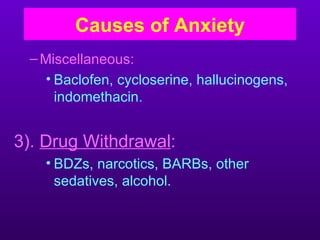
 – Miscellaneous:
    • Baclofen, cycloserine, hallucinogens,
      indomethacin.


3). Drug Withdrawal:
   • BDZs, narcotics, BARBs, other
     sedatives, alcohol.
Anxiolytics


Strategy for treatment
Reduce anxiety without causing sedation.
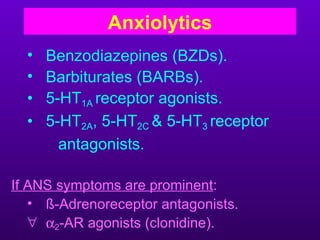
Anxiolytics
  •   Benzodiazepines (BZDs).
  •   Barbiturates (BARBs).
  •   5-HT1A receptor agonists.
  •   5-HT2A, 5-HT2C & 5-HT3 receptor
        antagonists.

If ANS symptoms are prominent:
   • ß-Adrenoreceptor antagonists.
   ∀ α2-AR agonists (clonidine).
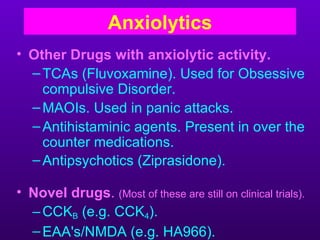
Anxiolytics
• Other Drugs with anxiolytic activity.
  – TCAs (Fluvoxamine). Used for Obsessive
    compulsive Disorder.
  – MAOIs. Used in panic attacks.
  – Antihistaminic agents. Present in over the
    counter medications.
  – Antipsychotics (Ziprasidone).

• Novel drugs. (Most of these are still on clinical trials).
  – CCKB (e.g. CCK4).
  – EAA's/NMDA (e.g. HA966).
Sedative/Hypnotics
• A hypnotic should produce, as much as
  possible, a state of sleep that resembles
  normal sleep.
Sedative/Hypnosis
• By definition all sedative/hypnotics will induce
  sleep at high doses.
• Normal sleep consists of distinct stages,
  based on three physiologic measures:
  electroencephalogram, electromyogram,
  electronystagmogram.
  Two distinct phases are distinguished which
  occur cyclically over 90 min:
1) Non-rapid eye movement (NREM). 70-75% of total
  sleep. 4 stages. Most sleep  stage 2.
2) Rapid eye movement (REM). Recalled dreams.
Properties of Sedative/Hypnotics in
                 Sleep
1) The latency of sleep onset is decreased
  (time to fall asleep).
2) The duration of stage 2 NREM sleep is
  increased.
3) The duration of REM sleep is decreased.
4) The duration of slow-wave sleep (when
  somnambulism and nightmares occur) is
  decreased.
Tolerance occurs after 1-2 weeks.
Other Properties of Sedative/Hypnotics

• Some sedative/hypnotics will depress
  the CNS to stage III of anesthesia.
• Due to their fast onset of action and
  short duration, barbiturates such as
  thiopental and methohexital are used
  as adjuncts in general anesthesia.
Sedative/Hypnotics
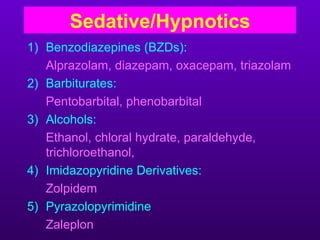
1) Benzodiazepines (BZDs):
   Alprazolam, diazepam, oxacepam, triazolam
2) Barbiturates:
   Pentobarbital, phenobarbital
3) Alcohols:
   Ethanol, chloral hydrate, paraldehyde,
   trichloroethanol,
4) Imidazopyridine Derivatives:
   Zolpidem
5) Pyrazolopyrimidine
   Zaleplon
Sedative/Hypnotics
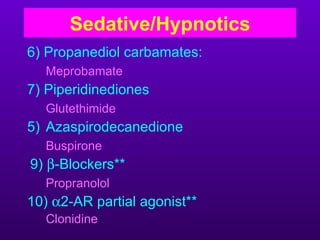
6) Propanediol carbamates:
  Meprobamate
7) Piperidinediones
  Glutethimide
5) Azaspirodecanedione
  Buspirone
9) β-Blockers**
  Propranolol
10) α2-AR partial agonist**
  Clonidine
Sedative/Hypnotics

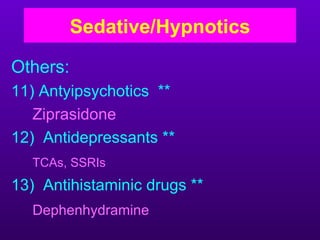
Others:
11) Antyipsychotics **
   Ziprasidone
12) Antidepressants **
  TCAs, SSRIs
13) Antihistaminic drugs **
  Dephenhydramine
Sedative/Hypnotics
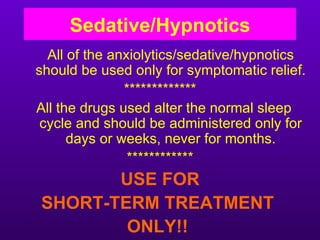
  All of the anxiolytics/sedative/hypnotics
should be used only for symptomatic relief.
               *************
All the drugs used alter the normal sleep
 cycle and should be administered only for
      days or weeks, never for months.
                ************
       USE FOR
SHORT-TERM TREATMENT
        ONLY!!
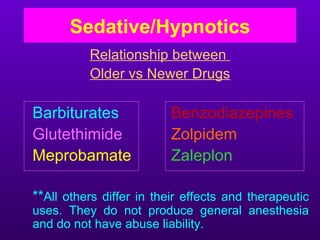
Sedative/Hypnotics
          Relationship between
          Older vs Newer Drugs

Barbiturates              Benzodiazepines
Glutethimide              Zolpidem
Meprobamate               Zaleplon

**All others differ in their effects and therapeutic
uses. They do not produce general anesthesia
and do not have abuse liability.
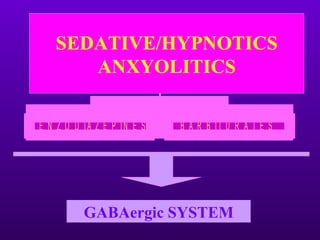
SEDATIVE/HYPNOTICS
        ANXYOLITICS

B E N Z O D IA Z E P IN E S   B A R B IT U R A T E S


            GABAergic SYSTEM
Sedative/Hypnotics

The benzodiazepines are the most
  important sedative hypnotics.

Developed to avoid undesirable
  effects of barbiturates (abuse
  liability).
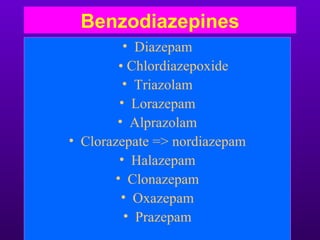
Benzodiazepines
          • Diazepam
         • Chlordiazepoxide
          • Triazolam
         • Lorazepam
        • Alprazolam
• Clorazepate => nordiazepam
         • Halazepam
        • Clonazepam
          • Oxazepam
          • Prazepam
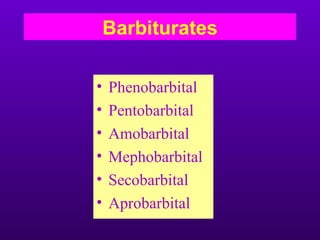
Barbiturates

•   Phenobarbital
•   Pentobarbital
•   Amobarbital
•   Mephobarbital
•   Secobarbital
•   Aprobarbital
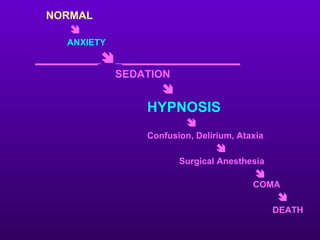
NORMAL
    
    ANXIETY
_________  _________________
              SEDATION
                     
                  HYPNOSIS
                           
                  Confusion, Delirium, Ataxia
                                  
                         Surgical Anesthesia
                                           
                                          COMA
                                                
                                                DEATH
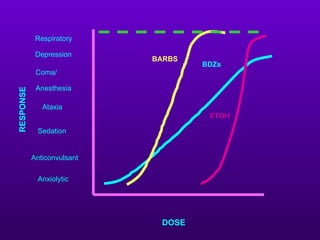
Respiratory

            Depression
                            BARBS
                                    BDZs
            Coma/

            Anesthesia
RESPONSE


              Ataxia
                                     ETOH

            Sedation


           Anticonvulsant

            Anxiolytic


                             DOSE
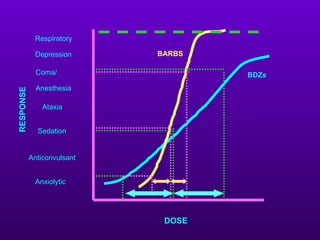
Respiratory

            Depression      BARBS

             Coma/                  BDZs
             Anesthesia
RESPONSE


               Ataxia


             Sedation


           Anticonvulsant


            Anxiolytic


                             DOSE
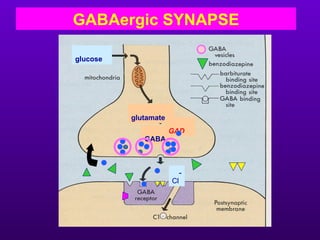
GABAergic SYNAPSE

glucose


          glutamate
                      GAD
             GABA


                           -
                      Cl
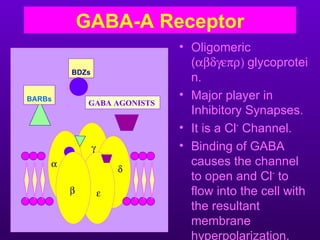
GABA-A Receptor
                             • Oligomeric
                               (αβδγεπρ) glycoprotei
        BDZs
                               n.
BARBs                        • Major player in
             GABA AGONISTS
                               Inhibitory Synapses.
                             • It is a Cl- Channel.
               γ             • Binding of GABA
    α                          causes the channel
                       δ
                               to open and Cl- to
        β          ε           flow into the cell with
                               the resultant
                               membrane
                               hyperpolarization.
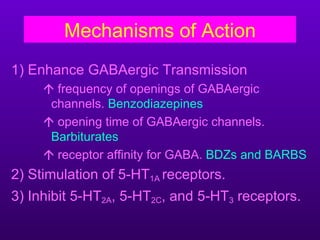
Mechanisms of Action
1) Enhance GABAergic Transmission
      frequency of openings of GABAergic
      channels. Benzodiazepines
      opening time of GABAergic channels.
      Barbiturates
      receptor affinity for GABA. BDZs and BARBS
2) Stimulation of 5-HT1A receptors.
3) Inhibit 5-HT2A, 5-HT2C, and 5-HT3 receptors.
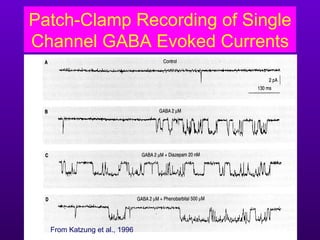
Patch-Clamp Recording of Single
Channel GABA Evoked Currents


  From Katzung et al., 1996
Benzodiazepines
PHARMACOLOGY
• BDZs potentiate GABAergic inhibition at all
  levels of the neuraxis.
• BDZs cause more frequent openings of the
  GABA-Cl- channel via membrane
  hyperpolarization, and increased receptor
  affinity for GABA.
• BDZs act on BZ1 (α1 and α2 subunit-containing)
  and BZ2 (α5 subunit-containing) receptors.
• May cause euphoria, impaired judgement, loss
  of cell control and anterograde amnesic effects.
Pharmacokinetics of Benzodiazepines


• Although BDZs are highly protein bound
  (60-95%),      few    clinically significant
  interactions.*
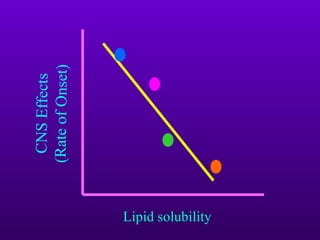
• High lipid solubility  high rate of entry
  into CNS  rapid onset.

*The only exception is chloral hydrate and warfarin
CNS Effects
                   (Rate of Onset)


Lipid solubility
Pharmacokinetics of Benzodiazepines
• Hepatic metabolism. Almost all BDZs
  undergo      microsomal     oxidation     (N-
  dealkylation and aliphatic hydroxylation)
  and conjugation (to glucoronides).
• Rapid tissue redistribution  long acting
   long half lives and elimination half lives
  (from 10 to > 100 hrs).
• All BDZs cross the placenta  detectable
  in breast milk  may exert depressant
  effects on the CNS of the lactating infant.
Pharmacokinetics of Benzodiazepines

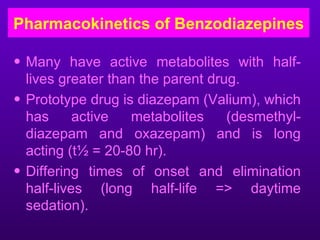
• Many have active metabolites with half-
  lives greater than the parent drug.
• Prototype drug is diazepam (Valium), which
  has      active  metabolites     (desmethyl-
  diazepam and oxazepam) and is long
  acting (t½ = 20-80 hr).
• Differing times of onset and elimination
  half-lives (long half-life => daytime
  sedation).
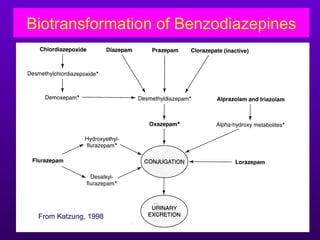
Biotransformation of Benzodiazepines


 From Katzung, 1998
Biotransformation of
             Benzodiazepines
• Keep in mind that with formation of active
  metabolites, the kinetics of the parent drug
  may not reflect the time course of the
  pharmacological effect.
• Estazolam, oxazepam, and lorazepam,
  which are directly metabolized to
  glucoronides have the least residual
  (drowsiness) effects.
• All of these drugs and their metabolites are
  excreted in urine.
Properties of Benzodiazepines

• BDZs have a wide margin of safety if used
  for short periods. Prolonged use may cause
  dependence.
• BDZs have little effect on respiratory or
  cardiovascular function compared to BARBS
  and other sedative-hypnotics.
• BDZs depress the turnover rates of
  norepinephrine (NE), dopamine (DA) and
  serotonin (5-HT) in various brain nuclei.
Side Effects of Benzodiazepines

• Related primarily to the CNS depression
  and include: drowsiness, excess sedation,
  impaired coordination, nausea, vomiting,
  confusion and memory loss. Tolerance
  develops to most of these effects.
• Dependence with these drugs may
  develop.
• Serious withdrawal syndrome can
  include convulsions and death.
Sedative/Hypnotics


• They produce a pronounce, graded,
  dose-dependent depression of the
  central nervous system.
Toxicity/Overdose with
             Benzodiazepines
• Drug overdose is treated with flumazenil (a BDZ
  receptor antagonist, short half-life), but respiratory
  function should be adequately supported and
  carefully monitored.

• Seizures and cardiac arrhythmias may occur
  following flumazenil administration when BDZ are
  taken with TCAs.

• Flumazenil is not effective against BARBs
  overdose.
Drug-Drug Interactions with BDZs
• BDZ's have additive effects with other CNS
  depressants (narcotics), alcohol => have a
  greatly reduced margin of safety.
• BDZs reduce the effect of antiepileptic
  drugs.
• Combination of anxiolytic drugs should be
  avoided.
• Concurrent use with ODC antihistaminic and
  anticholinergic drugs as well as the
  consumption of alcohol should be avoided.
• SSRI’s and oral contraceptives decrease
  metabolism of BDZs.
Pharmacokinetics of Barbiturates
• Rapid absorption following oral
  administration.
• Rapid onset of central effects.
• Extensively metabolized in liver (except
  phenobarbital), however, there are no
  active metabolites.
• Phenobarbital is excreted unchanged.
  Its excretion can be increased by
  alkalinization of the urine.
Pharmacokinetics of Barbiturates
• In the elderly and in those with limited
  hepatic function, dosages should be
  reduced.
• Phenobarbital and meprobamate cause
  autometabolism by induction of liver
  enzymes.
Properties of Barbiturates
Mechanism of Action.
  • They increase the duration of GABA-gated
    channel openings.
  • At high concentrations may be GABA-
    mimetic.

 Less selective than BDZs, they also:
  • Depress actions of excitatory
    neurotransmitters.
  • Exert nonsynaptic membrane effects.
Toxicity/Overdose
• Strong physiological dependence may
  develop upon long-term use.
• Depression of the medullary respiratory
  centers is the usual cause of death of
  sedative/hypnotic overdose. Also loss of
  brainstem vasomotor control and
  myocardial depression.
Toxicity/Overdose
• Withdrawal is characterized by increase
  anxiety, insomnia, CNS excitability and
  convulsions.
• Drugs with long-half lives have mildest
  withdrawal (.
• Drugs with quick onset of action are most
  abused.
• No medication against overdose with
  BARBs.
• Contraindicated in patients with porphyria.
Sedative/Hypnotics
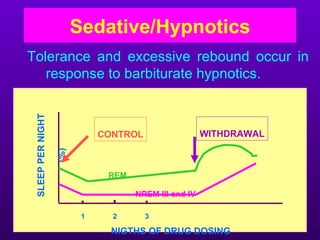
Tolerance and excessive rebound occur in
   response to barbiturate hypnotics.
 SLEEP PER NIGHT


                              CONTROL                  WITHDRAWAL
                   (%)


                               REM

                                     NREM III and IV

                          1     2       3

                                NIGTHS OF DRUG DOSING
Miscellaneous Drugs

• Buspirone
• Chloral hydrate
• Hydroxyzine
• Meprobamate (Similar to BARBS)
• Zolpidem (BZ1 selective)
• Zaleplon (BZ1 selective)
BUSPIRONE
• Most selective anxiolytic currently available.
• The anxiolytic effect of this drug takes
  several weeks to develop => used for GAD.
• Buspirone does not have sedative effects
  and does not potentiate CNS depressants.
• Has a relatively high margin of safety, few
  side effects and does not appear to be
  associated with drug dependence.
• No rebound anxiety or signs of withdrawal
  when discontinued.
BUSPIRONE
Side effects:
  • Tachycardia, palpitations,
    nervousness, GI distress and
    paresthesias may occur.
  • Causes a dose-dependent pupillary
    constriction.
BUSPIRONE
Mechanism of Action:
 • Acts as a partial agonist at the 5-HT1A
   receptor presynaptically inhibiting
   serotonin release.
 • The metabolite 1-PP has α2 -AR
   blocking action.
Pharmacokinetics of BUSPIRONE
• Not effective in panic disorders.
• Rapidly absorbed orally.
• Undergoes extensive hepatic metabolism
  (hydroxylation and dealkylation) to form
  several active metabolites (e.g. 1-(2-
  pyrimidyl-piperazine, 1-PP)
• Well tolerated by elderly, but may have slow
  clearance.
• Analogs: Ipsapirone, gepirone, tandospirone.
Zolpidem
• Structurally unrelated but as effective as
  BDZs.
• Minimal muscle relaxing and anticonvulsant
  effect.
• Rapidly metabolized by liver enzymes into
  inactive metabolites.
• Dosage should be reduced in patients with
  hepatic dysfunction, the elderly and patients
  taking cimetidine.
Properties of Zolpidem
Mechanism of Action:
  • Binds selectively to BZ1 receptors.
  • Facilitates   GABA-mediated           neuronal
    inhibition.

  • Actions are antagonized by flumazenil
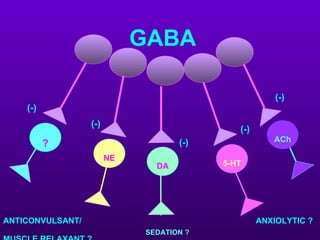
GABA

                                                       (-)
    (-)
                  (-)
                                             (-)
                                    (-)               ACh
          ?
                        NE
                               DA         5-HT


ANTICONVULSANT/                                    ANXIOLYTIC ?
                             SEDATION ?
Properties of Other drugs.

• Chloral hydrate
• Is used in institutionalized patients. It
  displaces warfarin (anti-coagulant) from
  plasma proteins.
• Extensive biotransformation.
Properties of Other Drugs
α2-Adrenoreceptor Agonists (eg. Clonidine)
• Antihypertensive.
• Has been used for the treatment of panic
  attacks.
• Has been useful in suppressing anxiety
  during the management of withdrawal from
  nicotine and opioid analgesics.
• Withdrawal from clonidine, after protracted
  use, may lead to a life-threatening
  hypertensive crisis.
Properties of Other Drugs
β-Adrenoreceptor Antagonists
   (eg. Propranolol)
  • Use to treat some forms of anxiety,
    particularly when physical (autonomic)
    symptoms (sweating, tremor, tachycardia)
    are severe.
  • Adverse effects of propranolol may
    include:     lethargy, vivid    dreams,
    hallucinations.
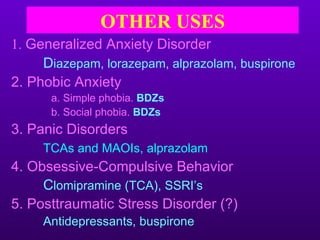
OTHER USES
1. Generalized Anxiety Disorder
     Diazepam, lorazepam, alprazolam, buspirone
2. Phobic Anxiety
      a. Simple phobia. BDZs
      b. Social phobia. BDZs
3. Panic Disorders
     TCAs and MAOIs, alprazolam
4. Obsessive-Compulsive Behavior
     Clomipramine (TCA), SSRI’s
5. Posttraumatic Stress Disorder (?)
     Antidepressants, buspirone
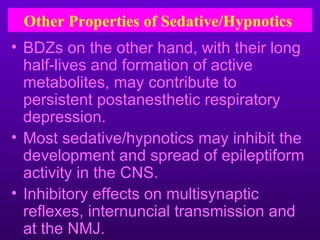
Other Properties of Sedative/Hypnotics
• BDZs on the other hand, with their long
  half-lives and formation of active
  metabolites, may contribute to
  persistent postanesthetic respiratory
  depression.
• Most sedative/hypnotics may inhibit the
  development and spread of epileptiform
  activity in the CNS.
• Inhibitory effects on multisynaptic
  reflexes, internuncial transmission and
  at the NMJ.
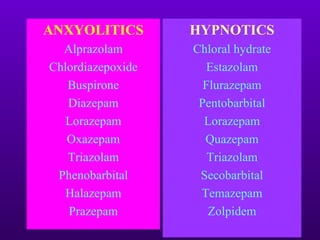
ANXYOLITICS        HYPNOTICS
  Alprazolam       Chloral hydrate
Chlordiazepoxide      Estazolam
   Buspirone         Flurazepam
   Diazepam         Pentobarbital
   Lorazepam         Lorazepam
   Oxazepam          Quazepam
   Triazolam          Triazolam
 Phenobarbital      Secobarbital
   Halazepam        Temazepam
   Prazepam           Zolpidem
References:
• Katzung, B.G. (2001) Basic and Clinical
  Pharmacology. 7th ed. Appleton and Lange.
  Stamford, CT.
• Brody, T.M., Larner,J., and Minneman, K.P. (1998)
  Human Pharmacology: Molecular to Clinical. 2nd ed.
  Mosby-Year Book Inc. St. Louis, Missouri.
• Rang, H.P. et al. (1995) Pharmacology . Churchill
  Livingston. NY., N.Y.
• Harman, J.G. et al. (1996) Goodman and Gilman's
  The Pharmacological Basis of Therapeutics. 9th ed.
  McGraw Hill.

Anxiolytic drugs

  • 1.
    SEDATIVE/HYPNOTICS ANXIOLYTICS Martha I. Dávila-García, Ph.D. Howard University Department of Pharmacology
  • 2.
    Optimal Performance Nervous Performance Sedated Breakdown Anxiety GOAL
  • 3.
    Normal  Relief from Anxiety _________  _________________ SEDATION (Drowsiness/decrease reaction time)  HYPNOSIS  Confusion, Delirium, Ataxia  Surgical Anesthesia  Depression of respiratory and vasomotor center in the brainstem COMA  DEATH
  • 4.
    SEDATIVE/HYPNOTICS ANXIOLYTICS • Major therapeutic use is to relief anxiety (anxiolytics) or induce sleep (hypnotics). • Hypnotic effects can be achieved with most anxiolytic drugs just by increasing the dose. • The distinction between a "pathological" and "normal" state of anxiety is hard to draw, but in spite of, or despite of, this diagnostic vagueness, anxiolytics are among the most prescribed substances worldwide.
  • 5.
    Manifestations of anxiety: •Verbal complaints. The patient says he/she is anxious, nervous, edgy. • Somatic and autonomic effects. The patient is restless and agitated, has tachycardia, increased sweating, weeping and often gastrointestinal disorders. • Social effects. Interference with normal productive activities.
  • 6.
    Pathological Anxiety Generalized anxietydisorder (GAD): People suffering from GAD have general symptoms of motor tension, autonomic hyperactivity, etc. for at least one month. Phobic anxiety: Simple phobias. Agoraphobia, fear of animals, etc. Social phobias. Panic disorders: Characterized by acute attacks of fear as compared to the chronic presentation of GAD. Obsessive-compulsive behaviors: These patients show repetitive ideas (obsessions) and behaviors (compulsions).
  • 7.
    Causes of Anxiety 1).Medical: o Respiratory o Endocrine o Cardiovascular o Metabolic o Neurologic.
  • 8.
    Causes of Anxiety 2).Drug-Induced: – Stimulants • Amphetamines, cocaine, TCAs, caffeine. – Sympathomimetics • Ephedrine, epinephrine, pseudoephedrine phenylpropanolamine. – AnticholinergicsAntihistaminergics • Trihexyphenidyl, benztropine, meperidine diphenhydramine, oxybutinin. – Dopaminergics • Amantadine, bromocriptine, L-Dopa, carbid/levodopa.
  • 9.
    Causes of Anxiety – Miscellaneous: • Baclofen, cycloserine, hallucinogens, indomethacin. 3). Drug Withdrawal: • BDZs, narcotics, BARBs, other sedatives, alcohol.
  • 10.
    Anxiolytics Strategy for treatment Reduceanxiety without causing sedation.
  • 11.
    Anxiolytics • Benzodiazepines (BZDs). • Barbiturates (BARBs). • 5-HT1A receptor agonists. • 5-HT2A, 5-HT2C & 5-HT3 receptor antagonists. If ANS symptoms are prominent: • ß-Adrenoreceptor antagonists. ∀ α2-AR agonists (clonidine).
  • 12.
    Anxiolytics • Other Drugswith anxiolytic activity. – TCAs (Fluvoxamine). Used for Obsessive compulsive Disorder. – MAOIs. Used in panic attacks. – Antihistaminic agents. Present in over the counter medications. – Antipsychotics (Ziprasidone). • Novel drugs. (Most of these are still on clinical trials). – CCKB (e.g. CCK4). – EAA's/NMDA (e.g. HA966).
  • 13.
    Sedative/Hypnotics • A hypnoticshould produce, as much as possible, a state of sleep that resembles normal sleep.
  • 14.
    Sedative/Hypnosis • By definitionall sedative/hypnotics will induce sleep at high doses. • Normal sleep consists of distinct stages, based on three physiologic measures: electroencephalogram, electromyogram, electronystagmogram. Two distinct phases are distinguished which occur cyclically over 90 min: 1) Non-rapid eye movement (NREM). 70-75% of total sleep. 4 stages. Most sleep  stage 2. 2) Rapid eye movement (REM). Recalled dreams.
  • 15.
    Properties of Sedative/Hypnoticsin Sleep 1) The latency of sleep onset is decreased (time to fall asleep). 2) The duration of stage 2 NREM sleep is increased. 3) The duration of REM sleep is decreased. 4) The duration of slow-wave sleep (when somnambulism and nightmares occur) is decreased. Tolerance occurs after 1-2 weeks.
  • 16.
    Other Properties ofSedative/Hypnotics • Some sedative/hypnotics will depress the CNS to stage III of anesthesia. • Due to their fast onset of action and short duration, barbiturates such as thiopental and methohexital are used as adjuncts in general anesthesia.
  • 17.
    Sedative/Hypnotics 1) Benzodiazepines (BZDs): Alprazolam, diazepam, oxacepam, triazolam 2) Barbiturates: Pentobarbital, phenobarbital 3) Alcohols: Ethanol, chloral hydrate, paraldehyde, trichloroethanol, 4) Imidazopyridine Derivatives: Zolpidem 5) Pyrazolopyrimidine Zaleplon
  • 18.
    Sedative/Hypnotics 6) Propanediol carbamates: Meprobamate 7) Piperidinediones Glutethimide 5) Azaspirodecanedione Buspirone 9) β-Blockers** Propranolol 10) α2-AR partial agonist** Clonidine
  • 19.
    Sedative/Hypnotics Others: 11) Antyipsychotics ** Ziprasidone 12) Antidepressants ** TCAs, SSRIs 13) Antihistaminic drugs ** Dephenhydramine
  • 20.
    Sedative/Hypnotics Allof the anxiolytics/sedative/hypnotics should be used only for symptomatic relief. ************* All the drugs used alter the normal sleep cycle and should be administered only for days or weeks, never for months. ************ USE FOR SHORT-TERM TREATMENT ONLY!!
  • 21.
    Sedative/Hypnotics Relationship between Older vs Newer Drugs Barbiturates Benzodiazepines Glutethimide Zolpidem Meprobamate Zaleplon **All others differ in their effects and therapeutic uses. They do not produce general anesthesia and do not have abuse liability.
  • 22.
    SEDATIVE/HYPNOTICS ANXYOLITICS B E N Z O D IA Z E P IN E S B A R B IT U R A T E S GABAergic SYSTEM
  • 23.
    Sedative/Hypnotics The benzodiazepines arethe most important sedative hypnotics. Developed to avoid undesirable effects of barbiturates (abuse liability).
  • 24.
    Benzodiazepines • Diazepam • Chlordiazepoxide • Triazolam • Lorazepam • Alprazolam • Clorazepate => nordiazepam • Halazepam • Clonazepam • Oxazepam • Prazepam
  • 25.
    Barbiturates • Phenobarbital • Pentobarbital • Amobarbital • Mephobarbital • Secobarbital • Aprobarbital
  • 26.
    NORMAL  ANXIETY _________  _________________ SEDATION  HYPNOSIS  Confusion, Delirium, Ataxia  Surgical Anesthesia  COMA  DEATH
  • 27.
    Respiratory Depression BARBS BDZs Coma/ Anesthesia RESPONSE Ataxia ETOH Sedation Anticonvulsant Anxiolytic DOSE
  • 28.
    Respiratory Depression BARBS Coma/ BDZs Anesthesia RESPONSE Ataxia Sedation Anticonvulsant Anxiolytic DOSE
  • 29.
    GABAergic SYNAPSE glucose glutamate GAD GABA - Cl
  • 30.
    GABA-A Receptor • Oligomeric (αβδγεπρ) glycoprotei BDZs n. BARBs • Major player in GABA AGONISTS Inhibitory Synapses. • It is a Cl- Channel. γ • Binding of GABA α causes the channel δ to open and Cl- to β ε flow into the cell with the resultant membrane hyperpolarization.
  • 31.
    Mechanisms of Action 1)Enhance GABAergic Transmission  frequency of openings of GABAergic channels. Benzodiazepines  opening time of GABAergic channels. Barbiturates  receptor affinity for GABA. BDZs and BARBS 2) Stimulation of 5-HT1A receptors. 3) Inhibit 5-HT2A, 5-HT2C, and 5-HT3 receptors.
  • 32.
    Patch-Clamp Recording ofSingle Channel GABA Evoked Currents From Katzung et al., 1996
  • 33.
    Benzodiazepines PHARMACOLOGY • BDZs potentiateGABAergic inhibition at all levels of the neuraxis. • BDZs cause more frequent openings of the GABA-Cl- channel via membrane hyperpolarization, and increased receptor affinity for GABA. • BDZs act on BZ1 (α1 and α2 subunit-containing) and BZ2 (α5 subunit-containing) receptors. • May cause euphoria, impaired judgement, loss of cell control and anterograde amnesic effects.
  • 34.
    Pharmacokinetics of Benzodiazepines •Although BDZs are highly protein bound (60-95%), few clinically significant interactions.* • High lipid solubility  high rate of entry into CNS  rapid onset. *The only exception is chloral hydrate and warfarin
  • 35.
    CNS Effects (Rate of Onset) Lipid solubility
  • 36.
    Pharmacokinetics of Benzodiazepines •Hepatic metabolism. Almost all BDZs undergo microsomal oxidation (N- dealkylation and aliphatic hydroxylation) and conjugation (to glucoronides). • Rapid tissue redistribution  long acting  long half lives and elimination half lives (from 10 to > 100 hrs). • All BDZs cross the placenta  detectable in breast milk  may exert depressant effects on the CNS of the lactating infant.
  • 37.
    Pharmacokinetics of Benzodiazepines •Many have active metabolites with half- lives greater than the parent drug. • Prototype drug is diazepam (Valium), which has active metabolites (desmethyl- diazepam and oxazepam) and is long acting (t½ = 20-80 hr). • Differing times of onset and elimination half-lives (long half-life => daytime sedation).
  • 38.
  • 39.
    Biotransformation of Benzodiazepines • Keep in mind that with formation of active metabolites, the kinetics of the parent drug may not reflect the time course of the pharmacological effect. • Estazolam, oxazepam, and lorazepam, which are directly metabolized to glucoronides have the least residual (drowsiness) effects. • All of these drugs and their metabolites are excreted in urine.
  • 40.
    Properties of Benzodiazepines •BDZs have a wide margin of safety if used for short periods. Prolonged use may cause dependence. • BDZs have little effect on respiratory or cardiovascular function compared to BARBS and other sedative-hypnotics. • BDZs depress the turnover rates of norepinephrine (NE), dopamine (DA) and serotonin (5-HT) in various brain nuclei.
  • 41.
    Side Effects ofBenzodiazepines • Related primarily to the CNS depression and include: drowsiness, excess sedation, impaired coordination, nausea, vomiting, confusion and memory loss. Tolerance develops to most of these effects. • Dependence with these drugs may develop. • Serious withdrawal syndrome can include convulsions and death.
  • 42.
    Sedative/Hypnotics • They producea pronounce, graded, dose-dependent depression of the central nervous system.
  • 43.
    Toxicity/Overdose with Benzodiazepines • Drug overdose is treated with flumazenil (a BDZ receptor antagonist, short half-life), but respiratory function should be adequately supported and carefully monitored. • Seizures and cardiac arrhythmias may occur following flumazenil administration when BDZ are taken with TCAs. • Flumazenil is not effective against BARBs overdose.
  • 44.
    Drug-Drug Interactions withBDZs • BDZ's have additive effects with other CNS depressants (narcotics), alcohol => have a greatly reduced margin of safety. • BDZs reduce the effect of antiepileptic drugs. • Combination of anxiolytic drugs should be avoided. • Concurrent use with ODC antihistaminic and anticholinergic drugs as well as the consumption of alcohol should be avoided. • SSRI’s and oral contraceptives decrease metabolism of BDZs.
  • 45.
    Pharmacokinetics of Barbiturates •Rapid absorption following oral administration. • Rapid onset of central effects. • Extensively metabolized in liver (except phenobarbital), however, there are no active metabolites. • Phenobarbital is excreted unchanged. Its excretion can be increased by alkalinization of the urine.
  • 46.
    Pharmacokinetics of Barbiturates •In the elderly and in those with limited hepatic function, dosages should be reduced. • Phenobarbital and meprobamate cause autometabolism by induction of liver enzymes.
  • 47.
    Properties of Barbiturates Mechanismof Action. • They increase the duration of GABA-gated channel openings. • At high concentrations may be GABA- mimetic. Less selective than BDZs, they also: • Depress actions of excitatory neurotransmitters. • Exert nonsynaptic membrane effects.
  • 48.
    Toxicity/Overdose • Strong physiologicaldependence may develop upon long-term use. • Depression of the medullary respiratory centers is the usual cause of death of sedative/hypnotic overdose. Also loss of brainstem vasomotor control and myocardial depression.
  • 49.
    Toxicity/Overdose • Withdrawal ischaracterized by increase anxiety, insomnia, CNS excitability and convulsions. • Drugs with long-half lives have mildest withdrawal (. • Drugs with quick onset of action are most abused. • No medication against overdose with BARBs. • Contraindicated in patients with porphyria.
  • 50.
    Sedative/Hypnotics Tolerance and excessiverebound occur in response to barbiturate hypnotics. SLEEP PER NIGHT CONTROL WITHDRAWAL (%) REM NREM III and IV 1 2 3 NIGTHS OF DRUG DOSING
  • 51.
    Miscellaneous Drugs • Buspirone •Chloral hydrate • Hydroxyzine • Meprobamate (Similar to BARBS) • Zolpidem (BZ1 selective) • Zaleplon (BZ1 selective)
  • 52.
    BUSPIRONE • Most selectiveanxiolytic currently available. • The anxiolytic effect of this drug takes several weeks to develop => used for GAD. • Buspirone does not have sedative effects and does not potentiate CNS depressants. • Has a relatively high margin of safety, few side effects and does not appear to be associated with drug dependence. • No rebound anxiety or signs of withdrawal when discontinued.
  • 53.
    BUSPIRONE Side effects: • Tachycardia, palpitations, nervousness, GI distress and paresthesias may occur. • Causes a dose-dependent pupillary constriction.
  • 54.
    BUSPIRONE Mechanism of Action: • Acts as a partial agonist at the 5-HT1A receptor presynaptically inhibiting serotonin release. • The metabolite 1-PP has α2 -AR blocking action.
  • 55.
    Pharmacokinetics of BUSPIRONE •Not effective in panic disorders. • Rapidly absorbed orally. • Undergoes extensive hepatic metabolism (hydroxylation and dealkylation) to form several active metabolites (e.g. 1-(2- pyrimidyl-piperazine, 1-PP) • Well tolerated by elderly, but may have slow clearance. • Analogs: Ipsapirone, gepirone, tandospirone.
  • 56.
    Zolpidem • Structurally unrelatedbut as effective as BDZs. • Minimal muscle relaxing and anticonvulsant effect. • Rapidly metabolized by liver enzymes into inactive metabolites. • Dosage should be reduced in patients with hepatic dysfunction, the elderly and patients taking cimetidine.
  • 57.
    Properties of Zolpidem Mechanismof Action: • Binds selectively to BZ1 receptors. • Facilitates GABA-mediated neuronal inhibition. • Actions are antagonized by flumazenil
  • 58.
    GABA (-) (-) (-) (-) (-) ACh ? NE DA 5-HT ANTICONVULSANT/ ANXIOLYTIC ? SEDATION ?
  • 59.
    Properties of Otherdrugs. • Chloral hydrate • Is used in institutionalized patients. It displaces warfarin (anti-coagulant) from plasma proteins. • Extensive biotransformation.
  • 60.
    Properties of OtherDrugs α2-Adrenoreceptor Agonists (eg. Clonidine) • Antihypertensive. • Has been used for the treatment of panic attacks. • Has been useful in suppressing anxiety during the management of withdrawal from nicotine and opioid analgesics. • Withdrawal from clonidine, after protracted use, may lead to a life-threatening hypertensive crisis.
  • 61.
    Properties of OtherDrugs β-Adrenoreceptor Antagonists (eg. Propranolol) • Use to treat some forms of anxiety, particularly when physical (autonomic) symptoms (sweating, tremor, tachycardia) are severe. • Adverse effects of propranolol may include: lethargy, vivid dreams, hallucinations.
  • 62.
    OTHER USES 1. GeneralizedAnxiety Disorder Diazepam, lorazepam, alprazolam, buspirone 2. Phobic Anxiety a. Simple phobia. BDZs b. Social phobia. BDZs 3. Panic Disorders TCAs and MAOIs, alprazolam 4. Obsessive-Compulsive Behavior Clomipramine (TCA), SSRI’s 5. Posttraumatic Stress Disorder (?) Antidepressants, buspirone
  • 63.
    Other Properties ofSedative/Hypnotics • BDZs on the other hand, with their long half-lives and formation of active metabolites, may contribute to persistent postanesthetic respiratory depression. • Most sedative/hypnotics may inhibit the development and spread of epileptiform activity in the CNS. • Inhibitory effects on multisynaptic reflexes, internuncial transmission and at the NMJ.
  • 64.
    ANXYOLITICS HYPNOTICS Alprazolam Chloral hydrate Chlordiazepoxide Estazolam Buspirone Flurazepam Diazepam Pentobarbital Lorazepam Lorazepam Oxazepam Quazepam Triazolam Triazolam Phenobarbital Secobarbital Halazepam Temazepam Prazepam Zolpidem
  • 65.
    References: • Katzung, B.G.(2001) Basic and Clinical Pharmacology. 7th ed. Appleton and Lange. Stamford, CT. • Brody, T.M., Larner,J., and Minneman, K.P. (1998) Human Pharmacology: Molecular to Clinical. 2nd ed. Mosby-Year Book Inc. St. Louis, Missouri. • Rang, H.P. et al. (1995) Pharmacology . Churchill Livingston. NY., N.Y. • Harman, J.G. et al. (1996) Goodman and Gilman's The Pharmacological Basis of Therapeutics. 9th ed. McGraw Hill.