PowerPoint to accompany


Foundations in Microbiology
          Fifth Edition

                                        Talaro
                                     Chapter
                                       14

    Copyright The McGraw-Hill Companies, Inc. Permission required for reproduction or display.
The Nature of Host Defenses
           Chapter 14         2
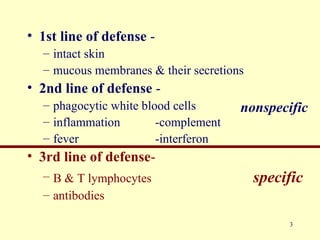
• 1st line of defense -
  – intact skin
  – mucous membranes & their secretions
• 2nd line of defense -
  – phagocytic white blood cells      nonspecific
  – inflammation        -complement
  – fever               -interferon
• 3rd line of defense-
  – B & T lymphocytes                     specific
  – antibodies

                                               3
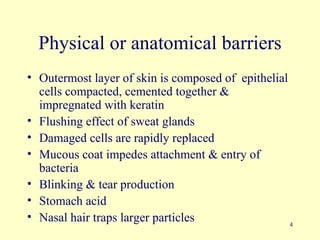
Physical or anatomical barriers
• Outermost layer of skin is composed of epithelial
  cells compacted, cemented together &
  impregnated with keratin
• Flushing effect of sweat glands
• Damaged cells are rapidly replaced
• Mucous coat impedes attachment & entry of
  bacteria
• Blinking & tear production
• Stomach acid
• Nasal hair traps larger particles                 4
Chemical defenses
• Sebaceous secretions
• Lysozyme, an enzyme that hydrolyzes the cell wall of
  bacteria, in tears
• High lactic acid & electrolyte concentration in sweat
• Skin’s acidic pH
• Hydrochloric acid in stomach
• Digestive juices and bile of intestines
• Semen contains antimicrobial chemical
• Vagina has acidic pH
                                                     5
Physical & chemical barriers


                               6
7
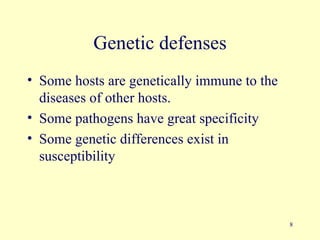
Genetic defenses
• Some hosts are genetically immune to the
  diseases of other hosts.
• Some pathogens have great specificity
• Some genetic differences exist in
  susceptibility


                                             8
A healthy immune system is
           responsible for
1. Surveillance of the body
2. Recognition of foreign material
3. Destruction of entities deemed to be
   foreign


                                          9
10
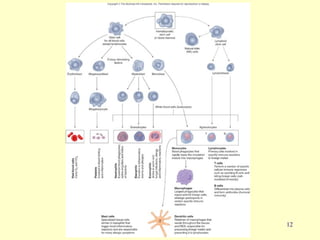
Leukocytes
• Neutrophils- 55-90% - lobed nuclei with lavender
  granules; phagocytes
• Eosinophils – 1-3% - orange granules & bilobed
  nucleus; destroy eucaryotic pathogens
• Basophils, mast cells – 0.5% constricted nuclei, dark
  blue granules; release potent chemical mediators
• Lymphocytes – 20-35% - large nucleus B & T cells
  involved in the specific immune response
• Monocytes, macrophages – 3-7%- large nucleus;
  phagocytic
                                                     11
12
Characteristics of leukocytes
• Diapedesis – migration of cells out of blood
  vessels into the tissues
• Chemotaxis – migration in response to
  specific chemicals at the site of injury or
  infection


                                             13
14
Lymphatic system
1. Provides an auxiliary route for return of
   extracellular fluid to the circulatory
   system
2. Acts as a drain-off system for the
   inflammatory response
3. Renders surveillance, recognition, and
   protection against foreign material

                                               15
16
17
18
Lymphatic fluid
• Lymph is a plasmalike liquid carried by
  lymphatic circulation
• Formed when blood components move out
  of blood vessels into extracellular spaces
• Made up of water, dissolved salts, 2-5%
  proteins
• Transports white blood cells, fats, cellular
  debris & infectious agents
                                                 19
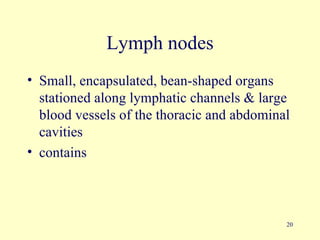
Lymph nodes
• Small, encapsulated, bean-shaped organs
  stationed along lymphatic channels & large
  blood vessels of the thoracic and abdominal
  cavities
• contains


                                            20
Stages of inflammation
1. Blood vessels dilate in response to chemical
   mediators and cytokines
2. Edema swells tissues, helping prevent spread of
   infection
3. WBC’s, microbes, debris and fluid collect to
   form pus
4. Pyrogens may induce fever
5. Macrophages and neutrophils engage
   phagocytosis
                                                     21
22
Activities of phagocytes
1. To survey tissue compartments &
   discover microbes, particulate matter &
   dead or injured cells
2. To infest and eliminate these materials
3. To extract immunogenic information from
   foreign matter


                                         23
Phases of phagocytosis


                         24
Interferon
• Small protein produced by certain cells
   – Alpha interferon- lymphocytes & macrophages
   – Beta interferon – fibroblasts & epithelial cells
   – Gamma interferon – T cells
• Produced in response to viruses, RNA, immune
  products, and various antigens
• Bind to cell surfaces and induce expression of
  antiviral proteins
• Inhibit expression of cancer genes

                                                        25
Interferon


             26
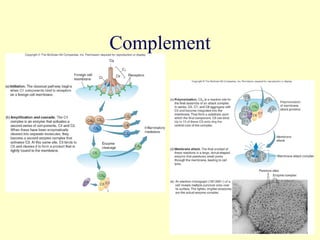
Complement
• Consists of 26 blood proteins that work in
  concert to destroy bacteria and viruses
• Complement proteins are activated by
  cleavage
• Classical pathway
• Alternative pathway


                                               27
Complement


             28
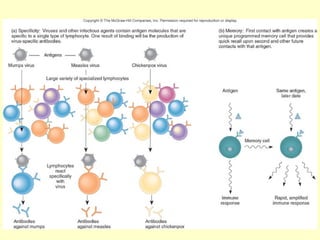
Specific immunities
• B and T lymphocytes
• Specificity and memory


                              29
30

Human natural defence system

  • 1.
    PowerPoint to accompany Foundationsin Microbiology Fifth Edition Talaro Chapter 14 Copyright The McGraw-Hill Companies, Inc. Permission required for reproduction or display.
  • 2.
    The Nature ofHost Defenses Chapter 14 2
  • 3.
    • 1st lineof defense - – intact skin – mucous membranes & their secretions • 2nd line of defense - – phagocytic white blood cells nonspecific – inflammation -complement – fever -interferon • 3rd line of defense- – B & T lymphocytes specific – antibodies 3
  • 4.
    Physical or anatomicalbarriers • Outermost layer of skin is composed of epithelial cells compacted, cemented together & impregnated with keratin • Flushing effect of sweat glands • Damaged cells are rapidly replaced • Mucous coat impedes attachment & entry of bacteria • Blinking & tear production • Stomach acid • Nasal hair traps larger particles 4
  • 5.
    Chemical defenses • Sebaceoussecretions • Lysozyme, an enzyme that hydrolyzes the cell wall of bacteria, in tears • High lactic acid & electrolyte concentration in sweat • Skin’s acidic pH • Hydrochloric acid in stomach • Digestive juices and bile of intestines • Semen contains antimicrobial chemical • Vagina has acidic pH 5
  • 6.
  • 7.
  • 8.
    Genetic defenses • Somehosts are genetically immune to the diseases of other hosts. • Some pathogens have great specificity • Some genetic differences exist in susceptibility 8
  • 9.
    A healthy immunesystem is responsible for 1. Surveillance of the body 2. Recognition of foreign material 3. Destruction of entities deemed to be foreign 9
  • 10.
  • 11.
    Leukocytes • Neutrophils- 55-90%- lobed nuclei with lavender granules; phagocytes • Eosinophils – 1-3% - orange granules & bilobed nucleus; destroy eucaryotic pathogens • Basophils, mast cells – 0.5% constricted nuclei, dark blue granules; release potent chemical mediators • Lymphocytes – 20-35% - large nucleus B & T cells involved in the specific immune response • Monocytes, macrophages – 3-7%- large nucleus; phagocytic 11
  • 12.
  • 13.
    Characteristics of leukocytes •Diapedesis – migration of cells out of blood vessels into the tissues • Chemotaxis – migration in response to specific chemicals at the site of injury or infection 13
  • 14.
  • 15.
    Lymphatic system 1. Providesan auxiliary route for return of extracellular fluid to the circulatory system 2. Acts as a drain-off system for the inflammatory response 3. Renders surveillance, recognition, and protection against foreign material 15
  • 16.
  • 17.
  • 18.
  • 19.
    Lymphatic fluid • Lymphis a plasmalike liquid carried by lymphatic circulation • Formed when blood components move out of blood vessels into extracellular spaces • Made up of water, dissolved salts, 2-5% proteins • Transports white blood cells, fats, cellular debris & infectious agents 19
  • 20.
    Lymph nodes • Small,encapsulated, bean-shaped organs stationed along lymphatic channels & large blood vessels of the thoracic and abdominal cavities • contains 20
  • 21.
    Stages of inflammation 1.Blood vessels dilate in response to chemical mediators and cytokines 2. Edema swells tissues, helping prevent spread of infection 3. WBC’s, microbes, debris and fluid collect to form pus 4. Pyrogens may induce fever 5. Macrophages and neutrophils engage phagocytosis 21
  • 22.
  • 23.
    Activities of phagocytes 1.To survey tissue compartments & discover microbes, particulate matter & dead or injured cells 2. To infest and eliminate these materials 3. To extract immunogenic information from foreign matter 23
  • 24.
  • 25.
    Interferon • Small proteinproduced by certain cells – Alpha interferon- lymphocytes & macrophages – Beta interferon – fibroblasts & epithelial cells – Gamma interferon – T cells • Produced in response to viruses, RNA, immune products, and various antigens • Bind to cell surfaces and induce expression of antiviral proteins • Inhibit expression of cancer genes 25
  • 26.
  • 27.
    Complement • Consists of26 blood proteins that work in concert to destroy bacteria and viruses • Complement proteins are activated by cleavage • Classical pathway • Alternative pathway 27
  • 28.
  • 29.
    Specific immunities • Band T lymphocytes • Specificity and memory 29
  • 30.