Dr. Mark A. McGinley BIOL 5311 Spring 2011 Frequency Distributions
Graphs Graphs are an important tool for scientists. Graphs are a way of visually displaying information.
Frequency Distributions Frequency Distributions are a very important type of graph for biologists. We will use frequency distributions in at least two situations When we sample the number of individuals of different species within a community When we sample the variation in traits among individuals within a population.
Frequency Distributions Let’s learn all about frequency distributions and how to make one!
Frequency Distribution: Abundance Biologists were interested in studying the number of birds in the woods They went out into the woods for one hour and counted how many birds of different types they saw. The number of birds of each species they counted would be a measure of its “frequency”
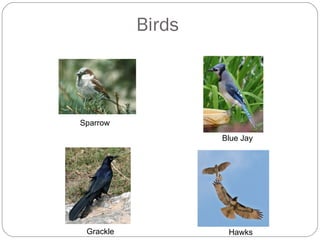
Birds  Sparrow Blue Jay Grackle Hawks
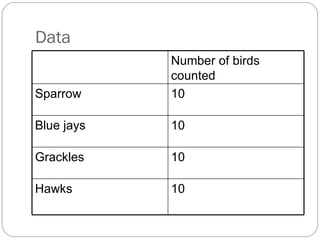
Data Number of birds counted Sparrow 10 Blue jays 10 Grackles 10 Hawks 10
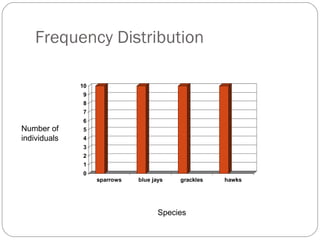
Frequency Distribution A frequency distribution plots the number of individuals of each species that are found in a sample. Sparrows –  10 Blue jays -  10 Grackles -  10 Hawks -  10
Frequency Distribution Species Number of  individuals
Turning Graphs into Words It is very important for scientists to be able to look at a graph (a picture) and describe the information held in that graph in words. Let’s practice that.
Describing a Frequency Distribution In this community there were four species of birds and each of these species had 10 individuals. Important information There were 4 species of birds Each species of birds had the same number of individuals (10 individuals)
Let’s use math to help us answer some questions about the birds in the woods 1.  What fraction of birds in the woods are sparrows? 2. What percentage of birds in the woods are hawks?
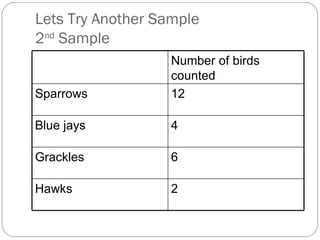
Lets Try Another Sample 2 nd  Sample Number of birds counted Sparrows 12 Blue jays 4 Grackles 6 Hawks 2
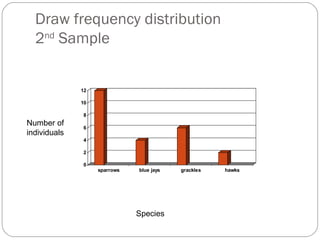
Draw frequency distribution 2 nd  Sample Species Number of individuals
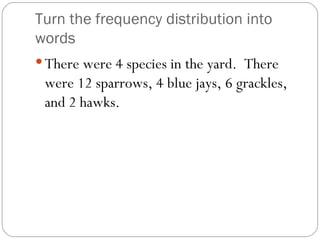
Turn the frequency distribution into words There were 4 species in the yard.  There were 12 sparrows, 4 blue jays, 6 grackles, and 2 hawks.
Let’s use math to help us answer some questions about the birds in the woods 1.  What fraction of the birds in the woods are grackles? 2.  What percentage of birds in the woods are hawks? 3. Which species makes up the largest fraction of the birds in the woods? 4. Rank the species from most common to the least common.
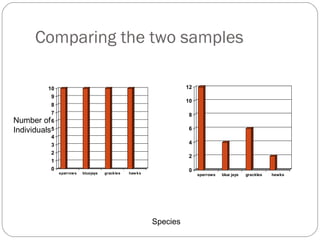
Comparing the two samples Species Number of Individuals
Let’s compare the 1 st  and the 2 nd  sample Just like in the first sample there were 4 types of birds found in the yard in the second sample. However, in the second sample the number of individuals of each type of bird was different.
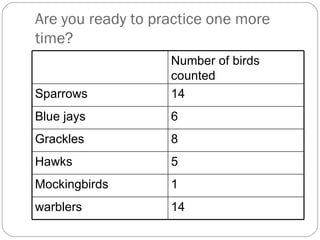
Are you ready to practice one more time? Number of birds counted Sparrows 14 Blue jays 6 Grackles 8 Hawks 5 Mockingbirds 1 warblers 14
Now you are ready to conduct your own study. How many brothers and sisters do people in your class have? How would you study this? You could ask every person in the class how many brothers and sisters they have. It really helps scientists if they think carefully about how they will keep track of their information.
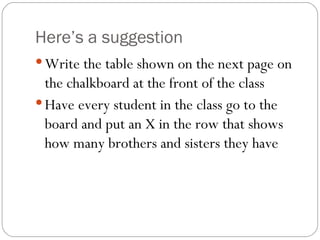
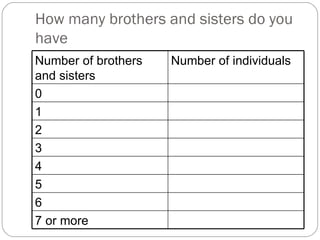
Here’s a suggestion Write the table shown on the next page on the chalkboard at the front of the class Have every student in the class go to the board and put an X in the row that shows how many brothers and sisters they have
How many brothers and sisters do you have Number of brothers and sisters Number of individuals 0 1 2 3 4 5 6 7 or more
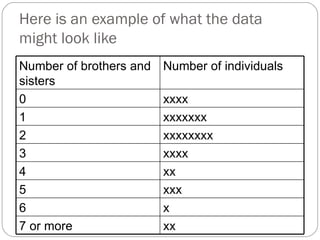
Here is an example of what the data might look like Number of brothers and sisters Number of individuals 0 xxxx 1 xxxxxxx 2 xxxxxxxx 3 xxxx 4 xx 5 xxx 6 x 7 or more xx
What should you do next? Count the number of Xs in each row.
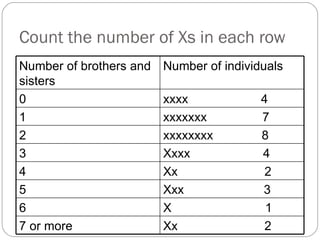
Count the number of Xs in each row Number of brothers and sisters Number of individuals 0 xxxx  4 1 xxxxxxx  7 2 xxxxxxxx  8 3 Xxxx  4 4 Xx  2 5 Xxx  3 6 X  1 7 or more Xx  2
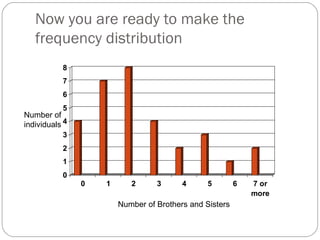
Now you are ready to make the frequency distribution  Number of Brothers and Sisters Number of  individuals
Turn the graph into words
Let’s use math to answer some questions. 1. Does everyone have the same number of brothers and sisters? 2. What is the fewest number of brothers and sisters and what is the largest number of brothers and sisters that any student in the class has? 3.  What number of brothers and sisters is most common in the class? 4.  What fraction of the class has more than three brothers and sisters? 5. What percentage of the class are only children?

Frequency distributions

  • 1.
    Dr. Mark A.McGinley BIOL 5311 Spring 2011 Frequency Distributions
  • 2.
    Graphs Graphs arean important tool for scientists. Graphs are a way of visually displaying information.
  • 3.
    Frequency Distributions FrequencyDistributions are a very important type of graph for biologists. We will use frequency distributions in at least two situations When we sample the number of individuals of different species within a community When we sample the variation in traits among individuals within a population.
  • 4.
    Frequency Distributions Let’slearn all about frequency distributions and how to make one!
  • 5.
    Frequency Distribution: AbundanceBiologists were interested in studying the number of birds in the woods They went out into the woods for one hour and counted how many birds of different types they saw. The number of birds of each species they counted would be a measure of its “frequency”
  • 6.
    Birds SparrowBlue Jay Grackle Hawks
  • 7.
    Data Number ofbirds counted Sparrow 10 Blue jays 10 Grackles 10 Hawks 10
  • 8.
    Frequency Distribution Afrequency distribution plots the number of individuals of each species that are found in a sample. Sparrows – 10 Blue jays - 10 Grackles - 10 Hawks - 10
  • 9.
    Frequency Distribution SpeciesNumber of individuals
  • 10.
    Turning Graphs intoWords It is very important for scientists to be able to look at a graph (a picture) and describe the information held in that graph in words. Let’s practice that.
  • 11.
    Describing a FrequencyDistribution In this community there were four species of birds and each of these species had 10 individuals. Important information There were 4 species of birds Each species of birds had the same number of individuals (10 individuals)
  • 12.
    Let’s use mathto help us answer some questions about the birds in the woods 1. What fraction of birds in the woods are sparrows? 2. What percentage of birds in the woods are hawks?
  • 13.
    Lets Try AnotherSample 2 nd Sample Number of birds counted Sparrows 12 Blue jays 4 Grackles 6 Hawks 2
  • 14.
    Draw frequency distribution2 nd Sample Species Number of individuals
  • 15.
    Turn the frequencydistribution into words There were 4 species in the yard. There were 12 sparrows, 4 blue jays, 6 grackles, and 2 hawks.
  • 16.
    Let’s use mathto help us answer some questions about the birds in the woods 1. What fraction of the birds in the woods are grackles? 2. What percentage of birds in the woods are hawks? 3. Which species makes up the largest fraction of the birds in the woods? 4. Rank the species from most common to the least common.
  • 17.
    Comparing the twosamples Species Number of Individuals
  • 18.
    Let’s compare the1 st and the 2 nd sample Just like in the first sample there were 4 types of birds found in the yard in the second sample. However, in the second sample the number of individuals of each type of bird was different.
  • 19.
    Are you readyto practice one more time? Number of birds counted Sparrows 14 Blue jays 6 Grackles 8 Hawks 5 Mockingbirds 1 warblers 14
  • 20.
    Now you areready to conduct your own study. How many brothers and sisters do people in your class have? How would you study this? You could ask every person in the class how many brothers and sisters they have. It really helps scientists if they think carefully about how they will keep track of their information.
  • 21.
    Here’s a suggestionWrite the table shown on the next page on the chalkboard at the front of the class Have every student in the class go to the board and put an X in the row that shows how many brothers and sisters they have
  • 22.
    How many brothersand sisters do you have Number of brothers and sisters Number of individuals 0 1 2 3 4 5 6 7 or more
  • 23.
    Here is anexample of what the data might look like Number of brothers and sisters Number of individuals 0 xxxx 1 xxxxxxx 2 xxxxxxxx 3 xxxx 4 xx 5 xxx 6 x 7 or more xx
  • 24.
    What should youdo next? Count the number of Xs in each row.
  • 25.
    Count the numberof Xs in each row Number of brothers and sisters Number of individuals 0 xxxx 4 1 xxxxxxx 7 2 xxxxxxxx 8 3 Xxxx 4 4 Xx 2 5 Xxx 3 6 X 1 7 or more Xx 2
  • 26.
    Now you areready to make the frequency distribution Number of Brothers and Sisters Number of individuals
  • 27.
    Turn the graphinto words
  • 28.
    Let’s use mathto answer some questions. 1. Does everyone have the same number of brothers and sisters? 2. What is the fewest number of brothers and sisters and what is the largest number of brothers and sisters that any student in the class has? 3. What number of brothers and sisters is most common in the class? 4. What fraction of the class has more than three brothers and sisters? 5. What percentage of the class are only children?