






WHO ARE WE?
THOMAS WENDT

WILL EVANS

UX Strategist

Managing Director

Surrounding Signifiers

TLC Labs

thomas@srsg.co
@thomas_wendt

will@tlclabs.co
@semanticwill

#NYinnovates
LET’S START WITH AN EXERCISE
WHICH IS TIMEBOXED
CHARACTER SKETCH
What is Design Thinking?
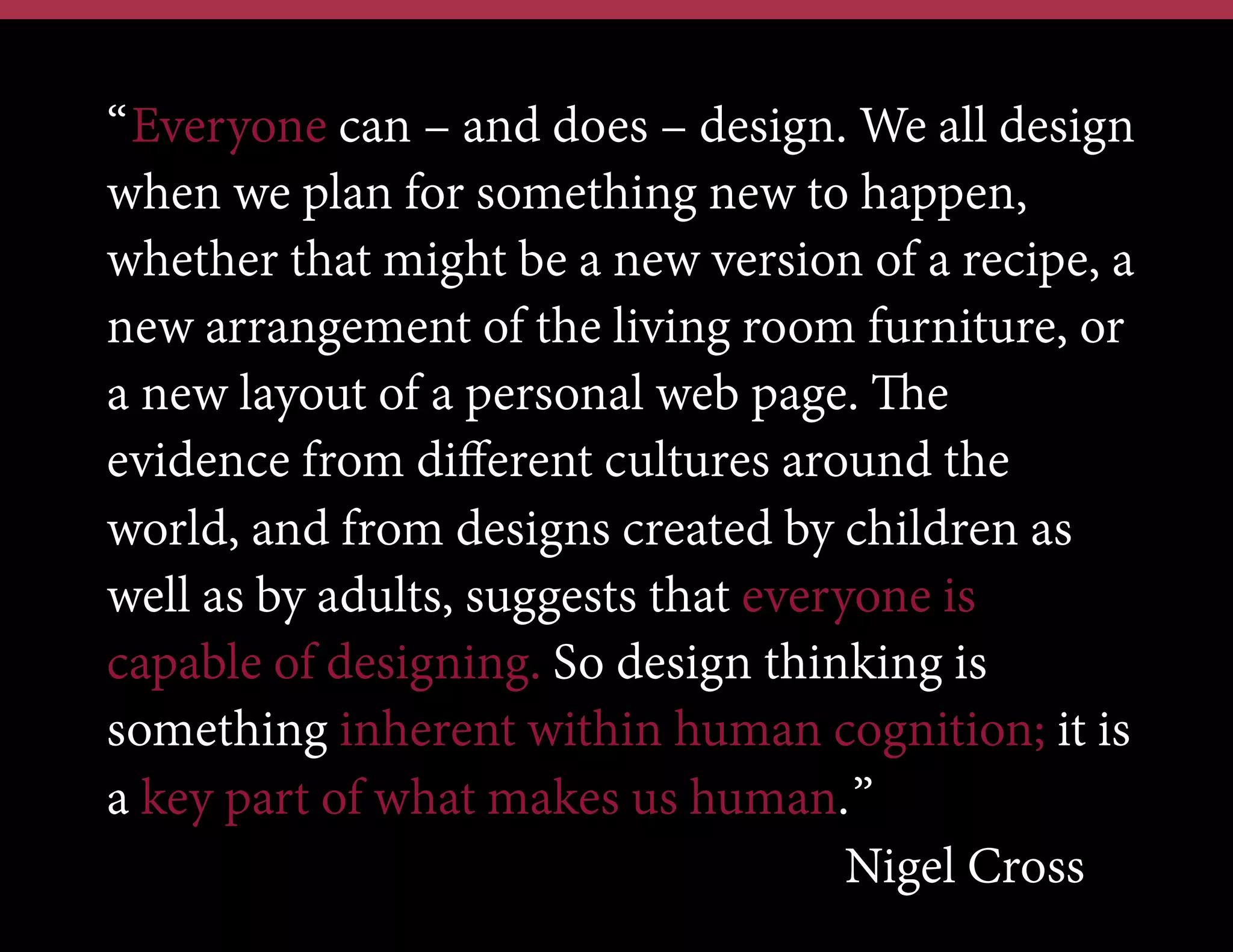
“Everyone can – and does – design. We all design
when we plan for something new to happen,
whether that might be a new version of a recipe, a
new arrangement of the living room furniture, or
a new layout of a personal web page. The
evidence from different cultures around the
world, and from designs created by children as
well as by adults, suggests that everyone is
capable of designing. So design thinking is
something inherent within human cognition; it is
a key part of what makes us human.”
Nigel Cross
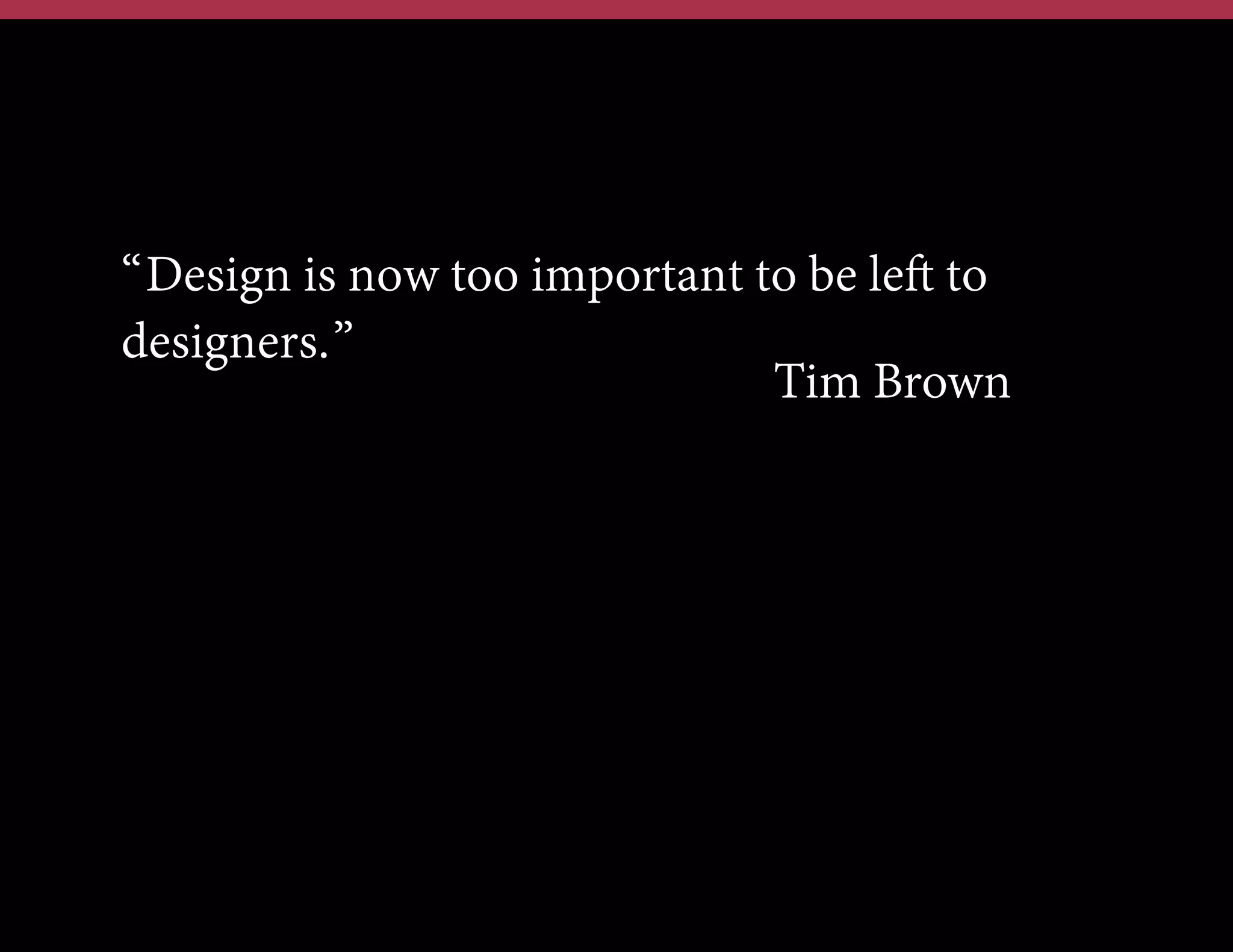
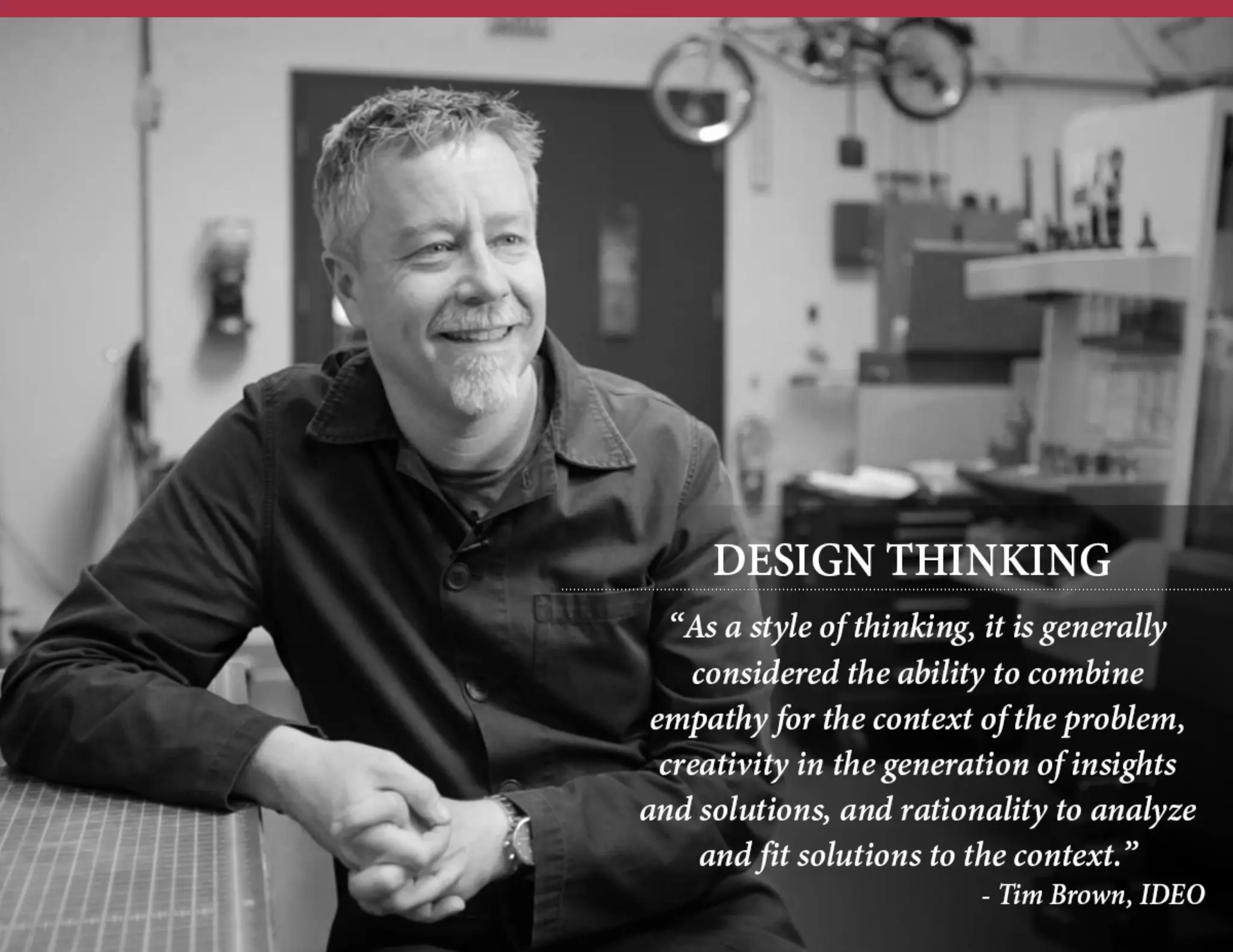
“Design is now too important to be left to
designers.”
Tim Brown
ANOTHER DEFINITION

An approach to solving problems by
understanding people’s needs and synthesizing
insights to solve those needs – in context.
DESIGN THINKING PREMISE

Only through contact, observation, and empathy
with customers can you hope to design solutions
to fit their needs.
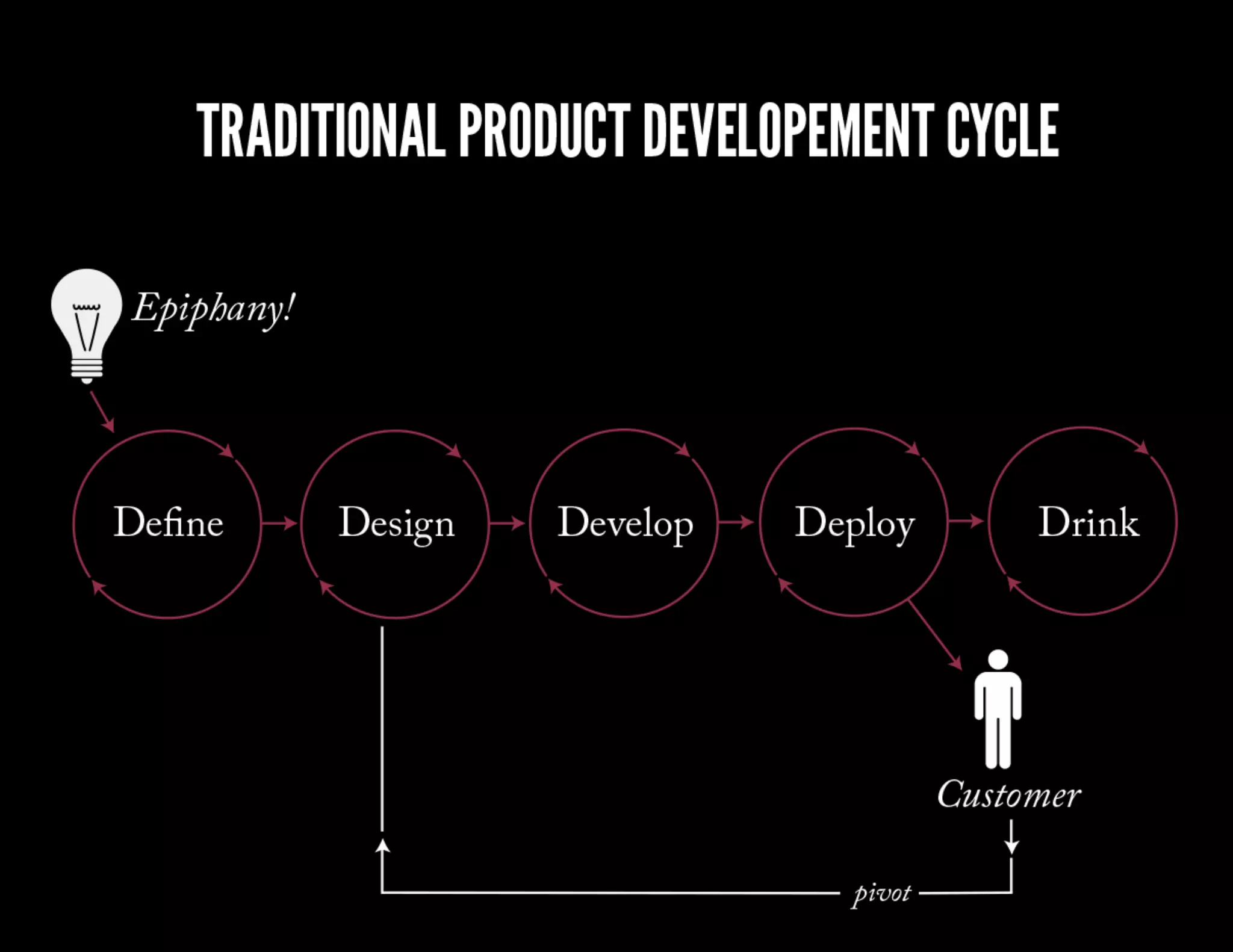
AS OPPOSED TO?
•  We have this problem, lets jump in and
brainstorm a solution
•  We have a new technology, what can we
possibly use it for?
•  Our competitors just launched X; how quickly
can we also do X?
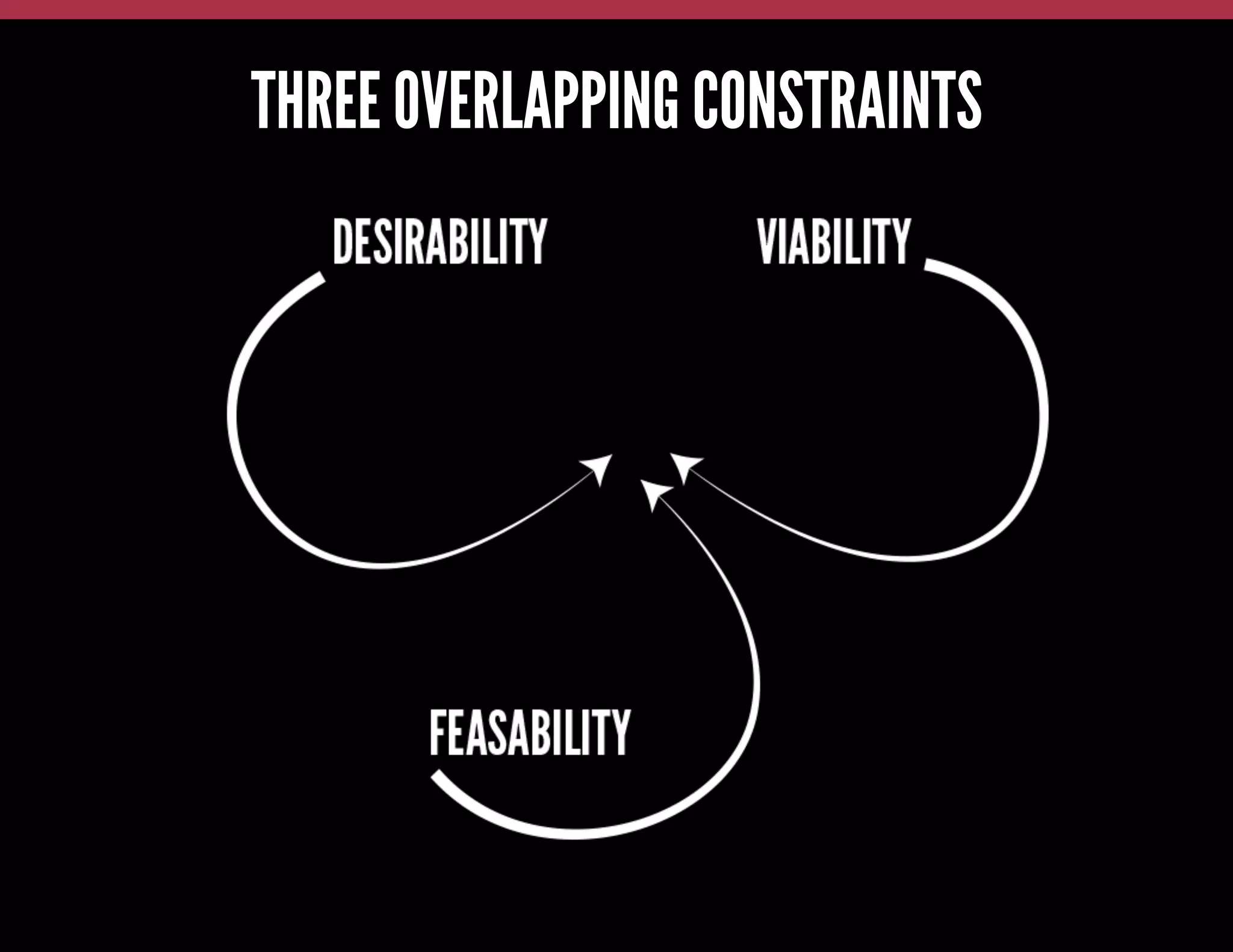
THREE OVERLAPPING CONSTRAINTS
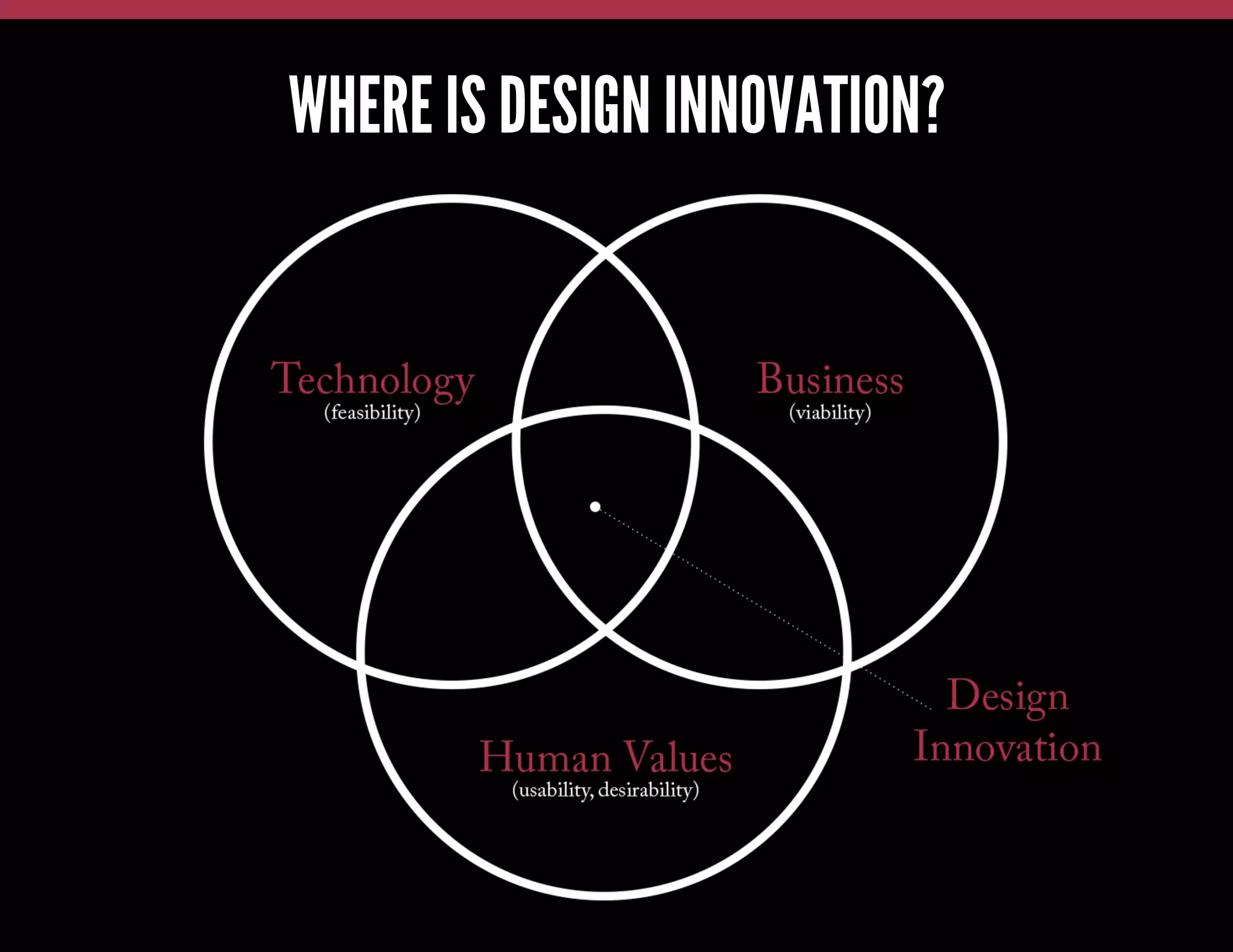
WHERE IS DESIGN INNOVATION?
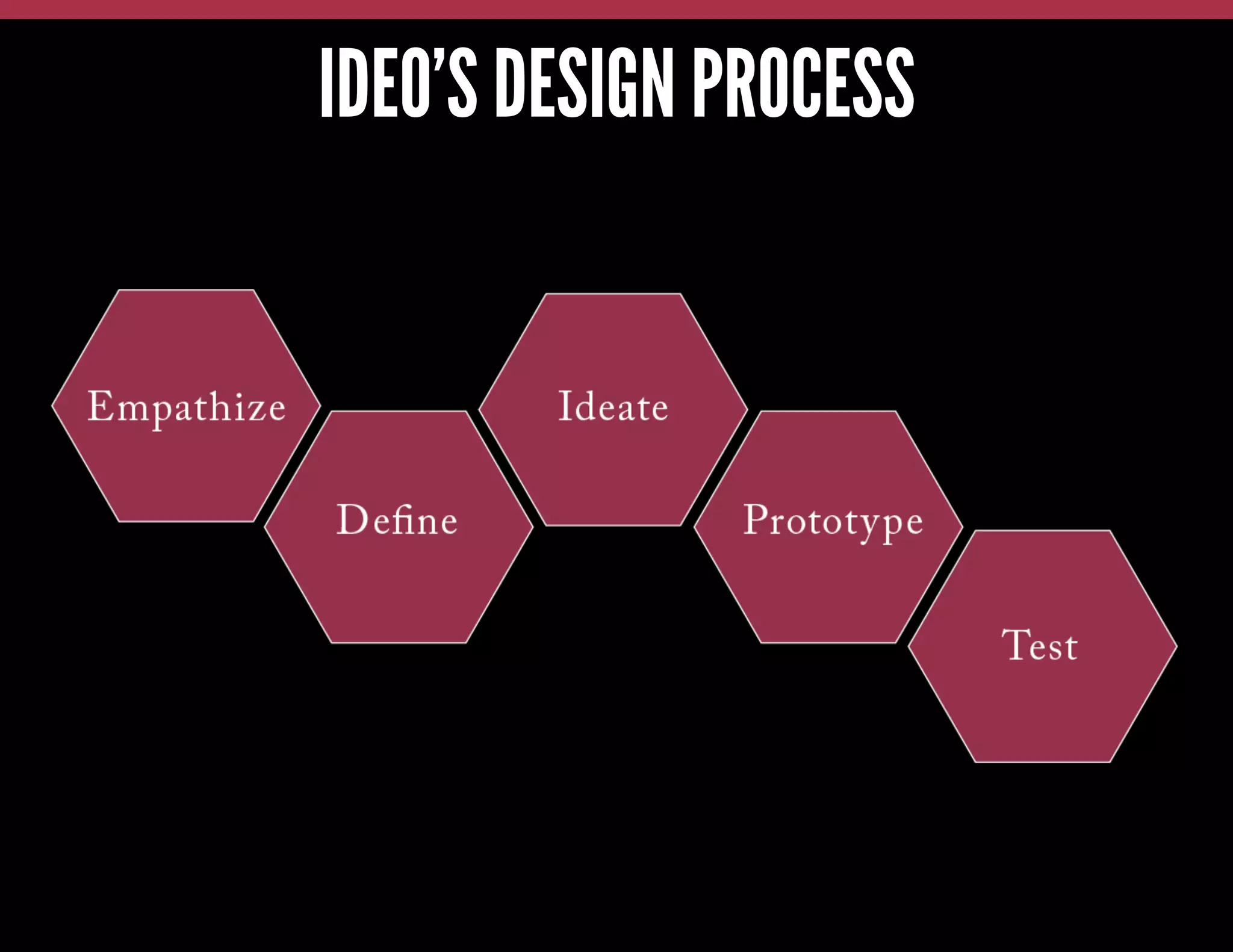
IDEO’S DESIGN PROCESS
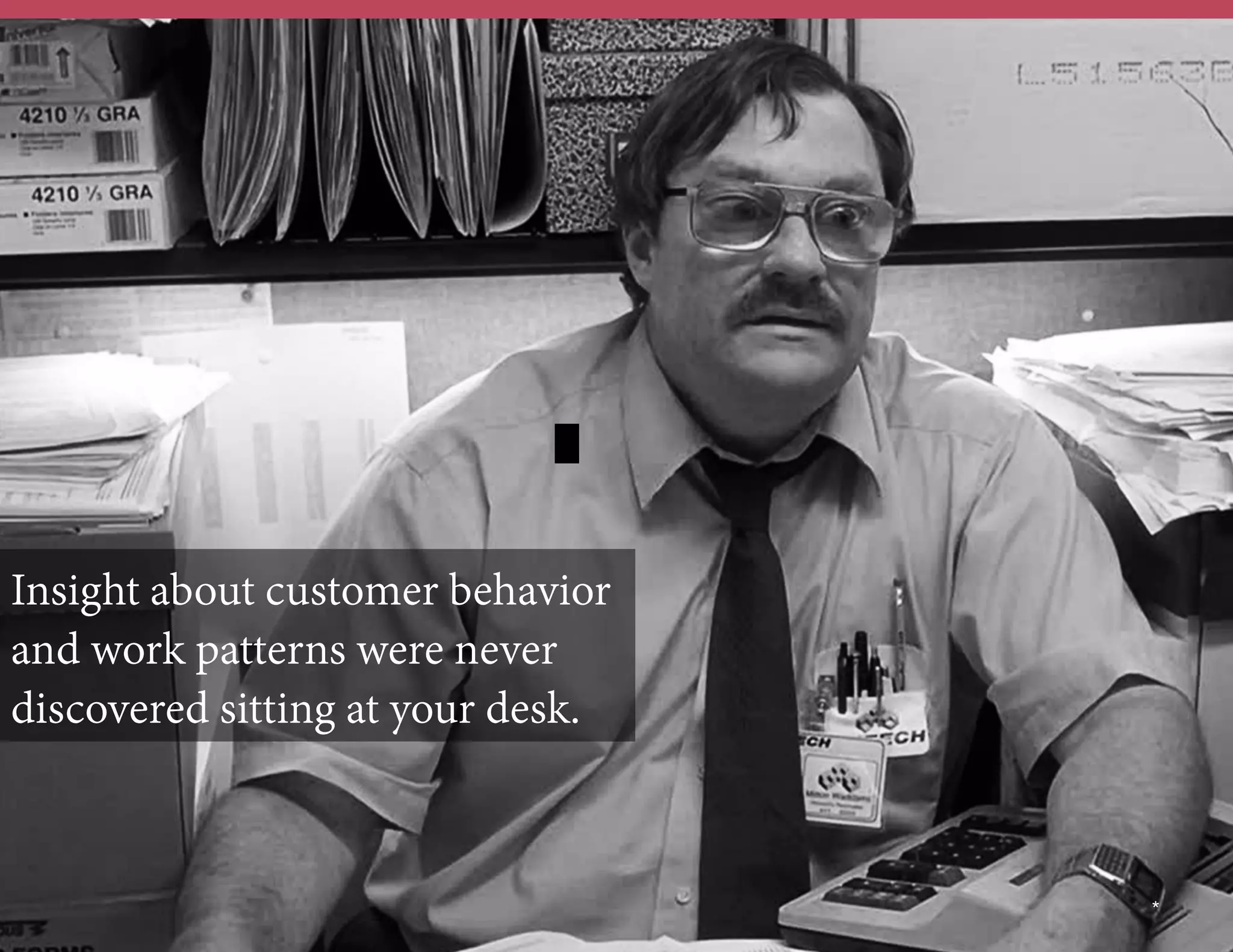
Insight about customer behavior
and work patterns were never
discovered sitting at your desk.


*
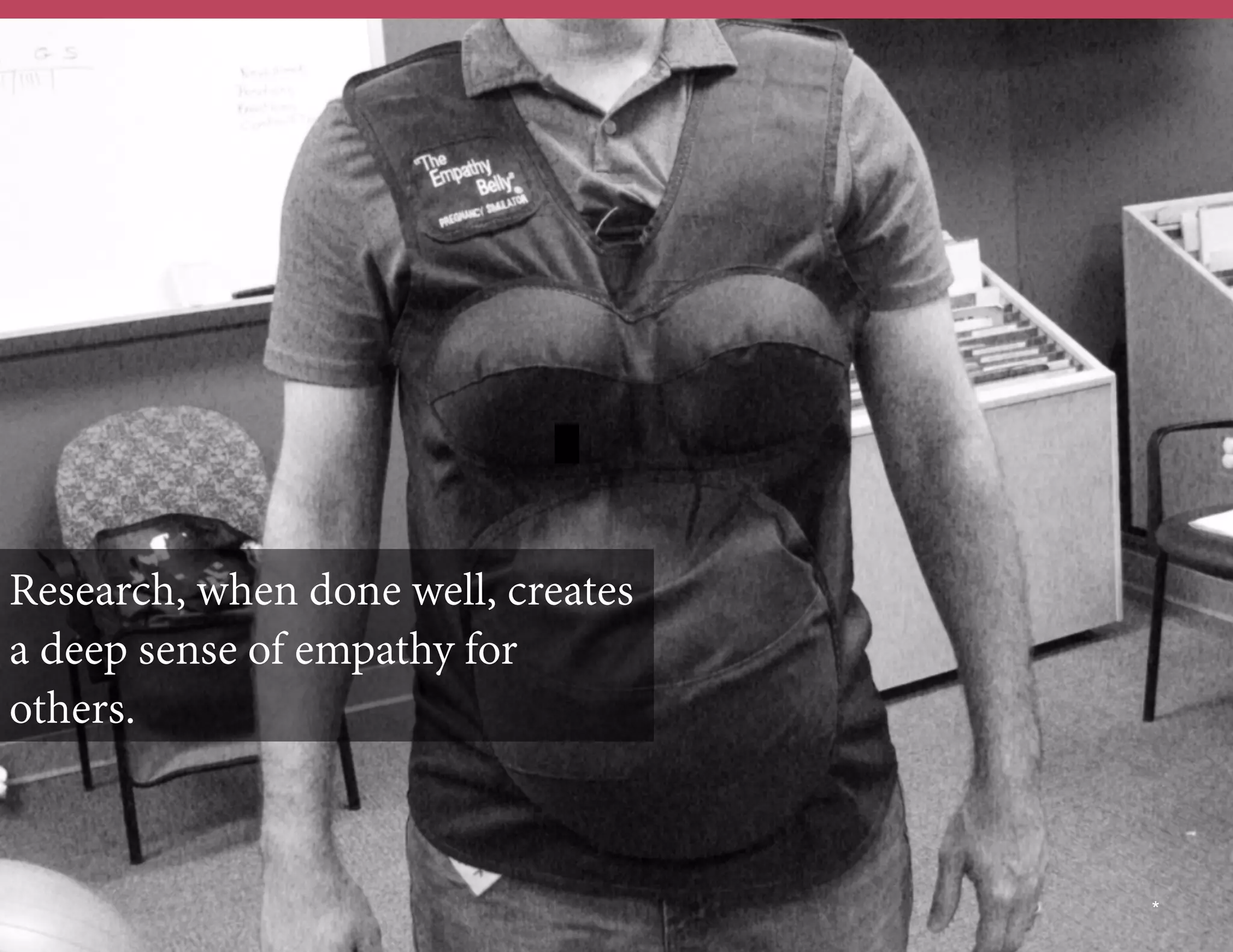
Research, when done well, creates
a deep sense of empathy for
others.


*
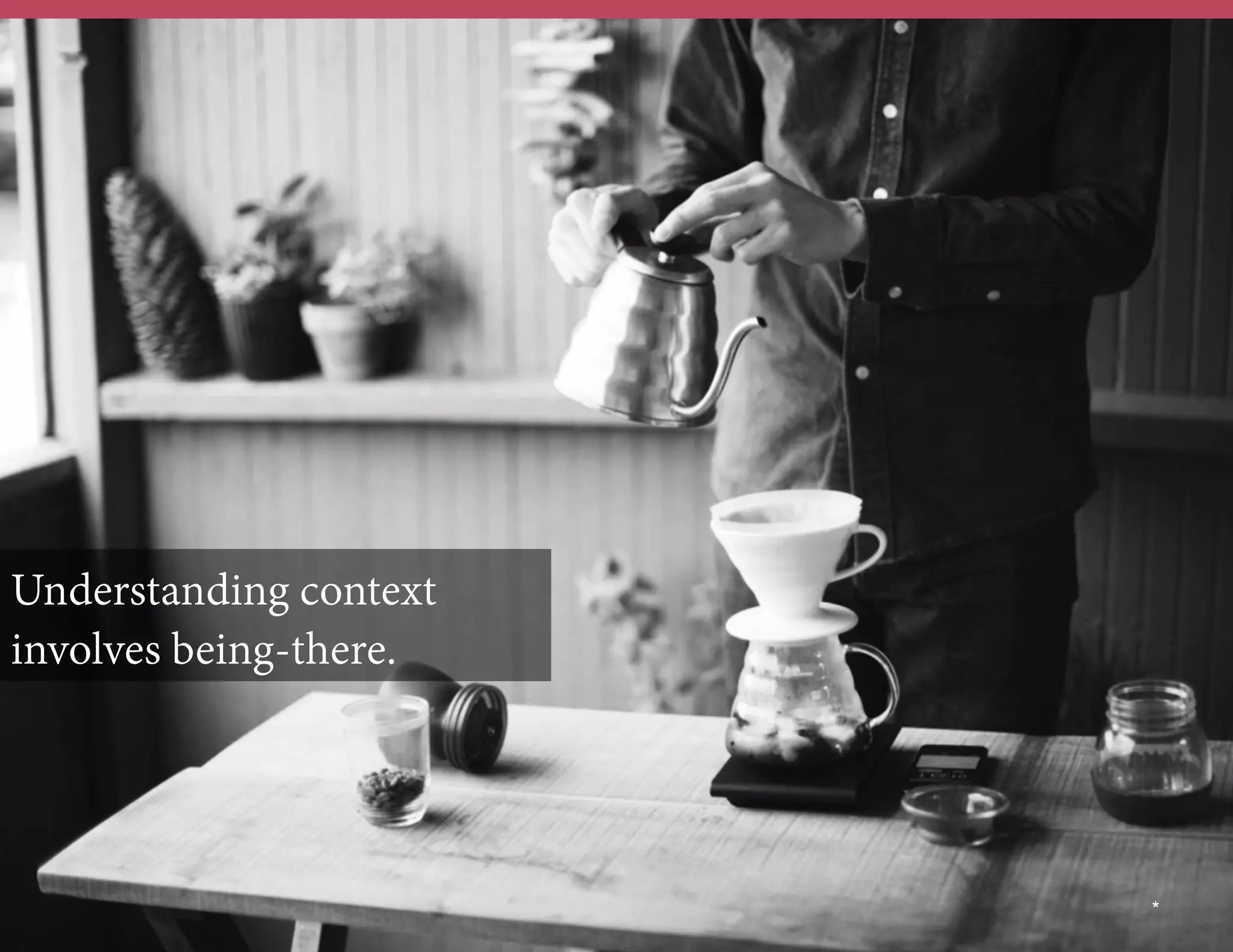
Understanding context
involves being-there.


*
You are not the user.


*
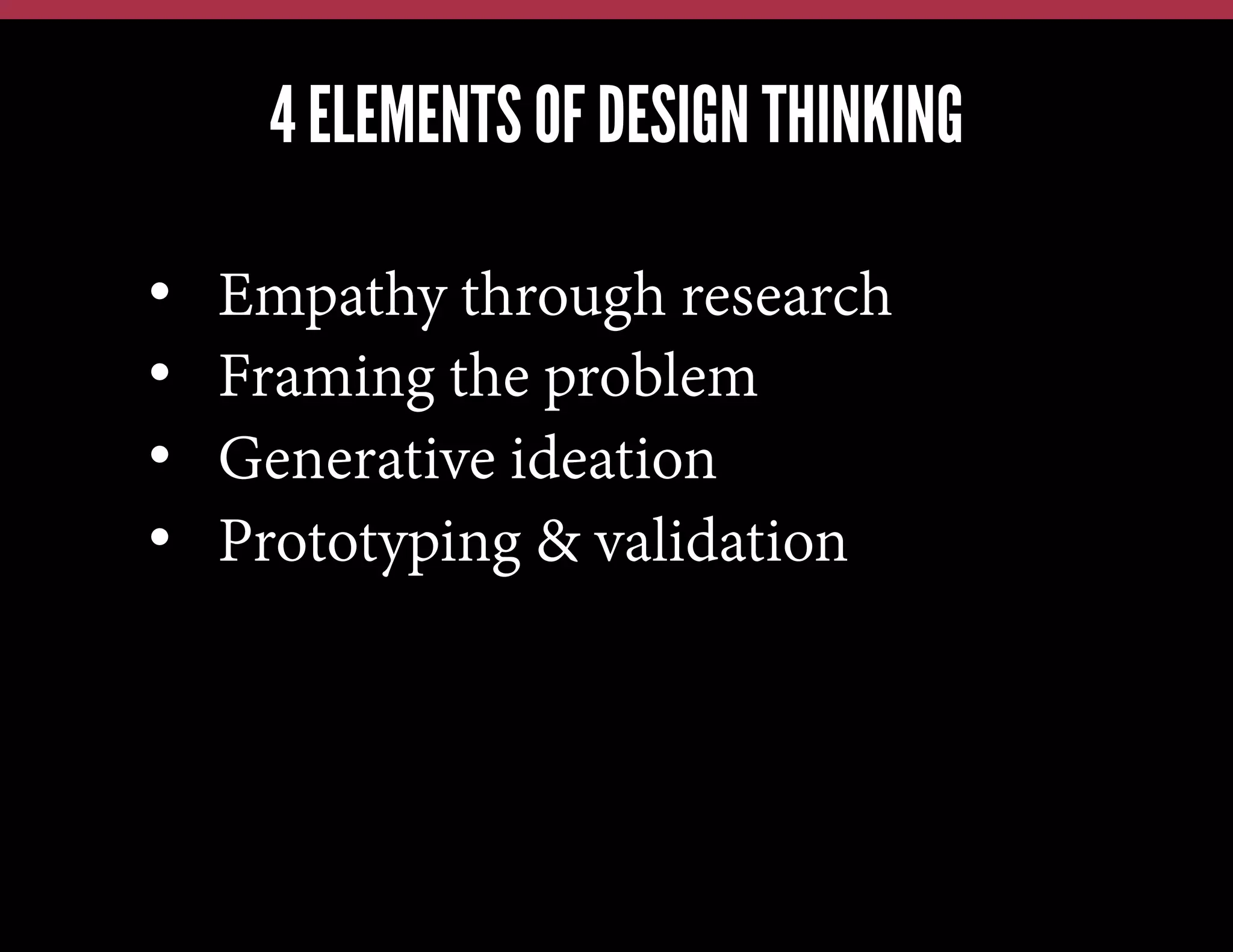
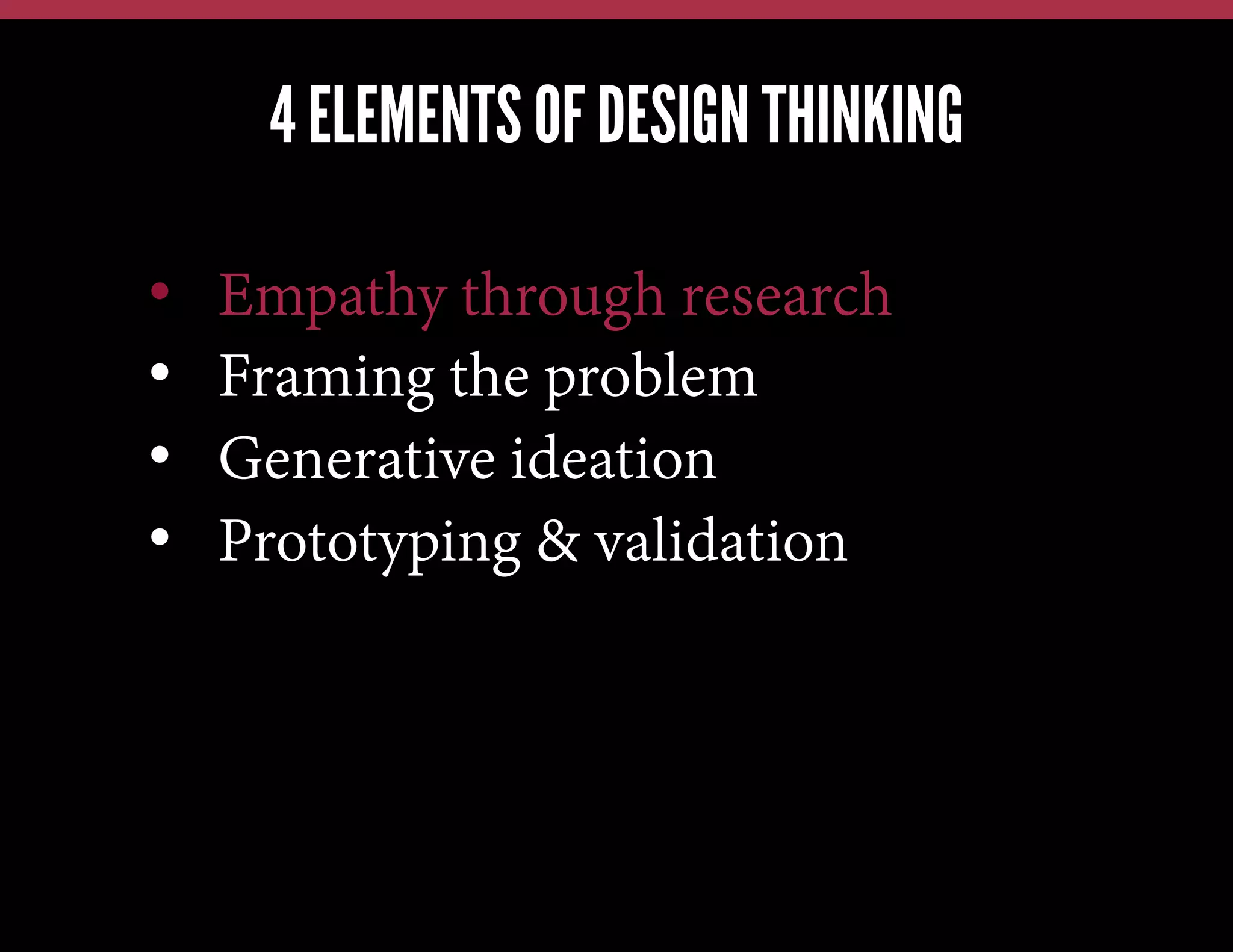
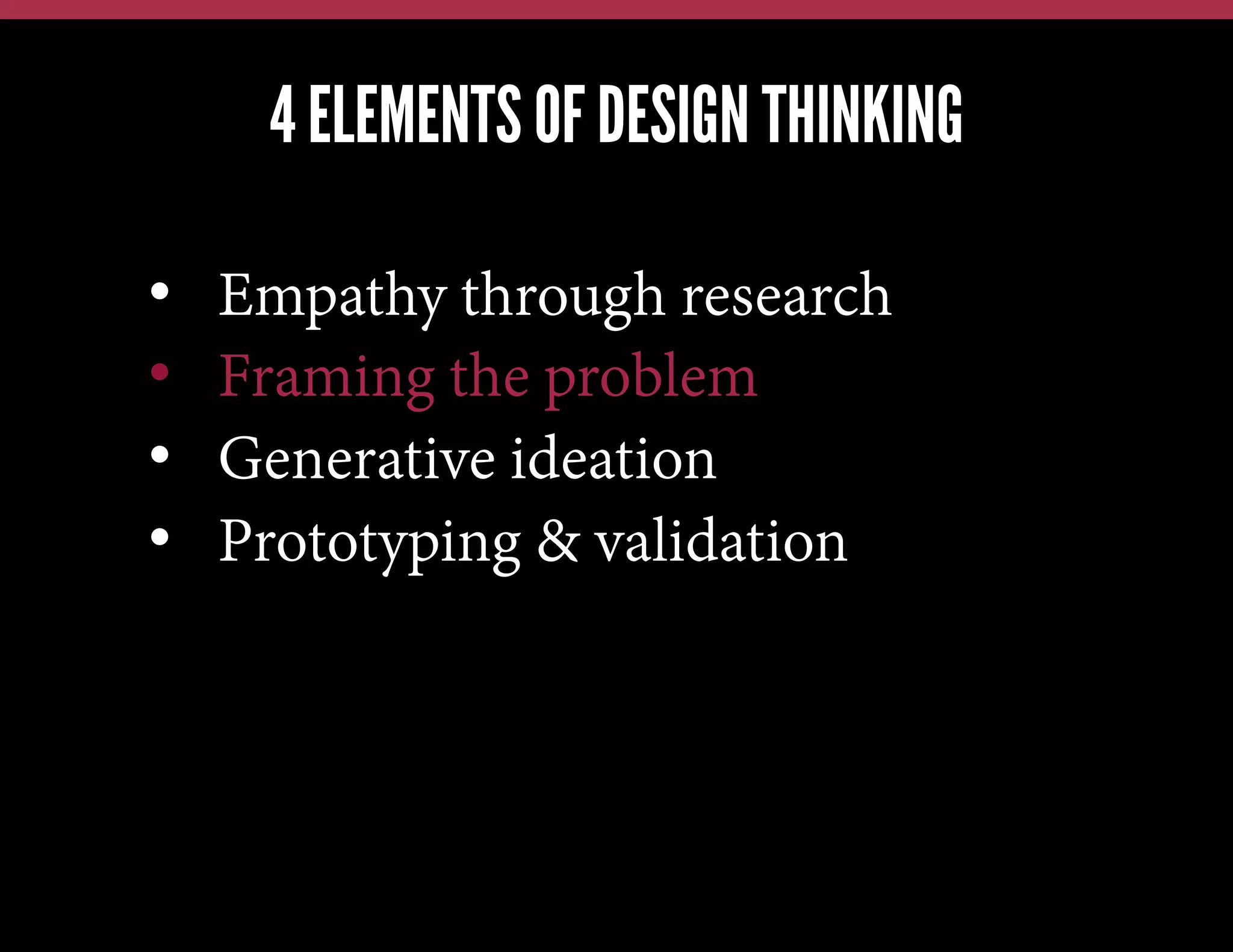
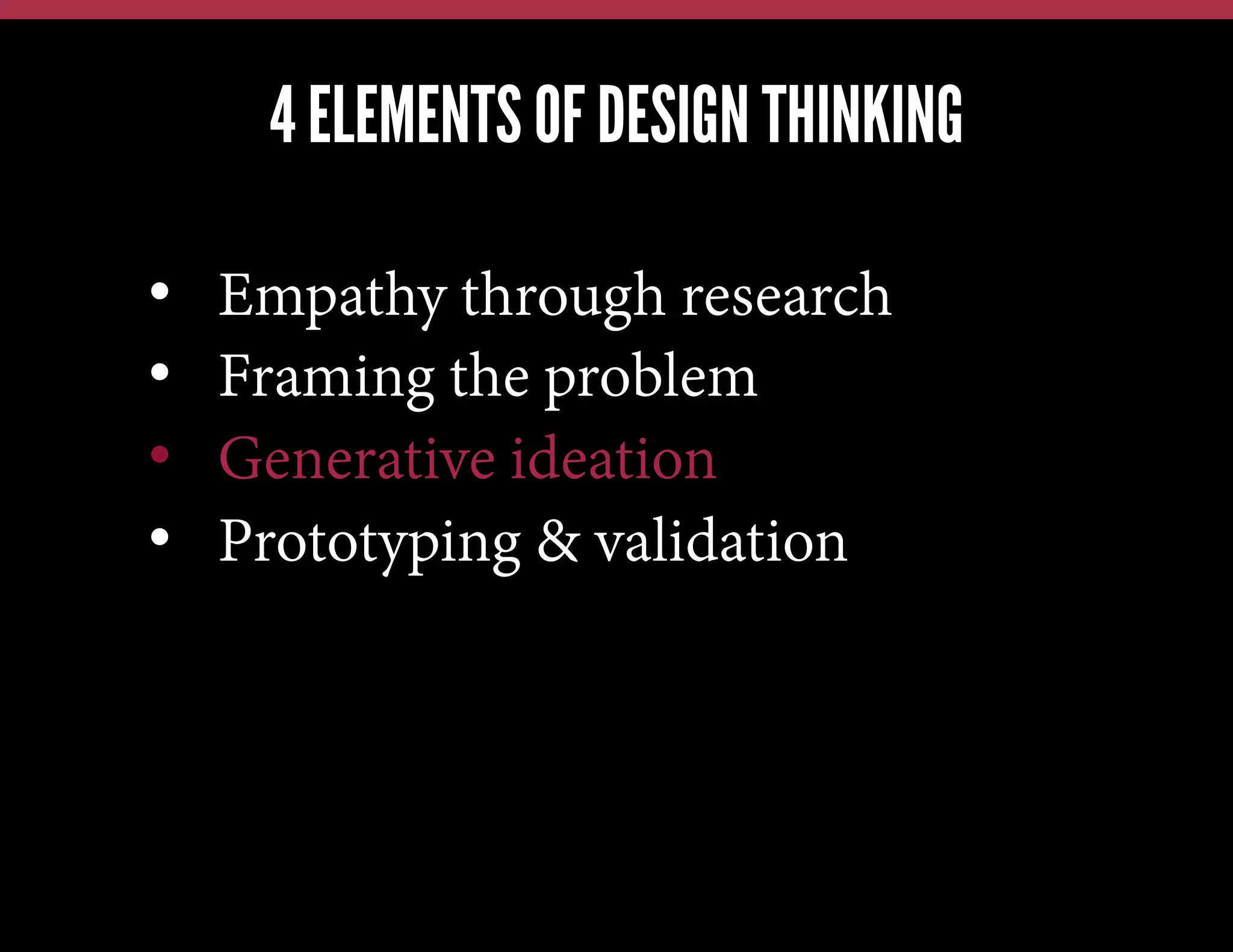
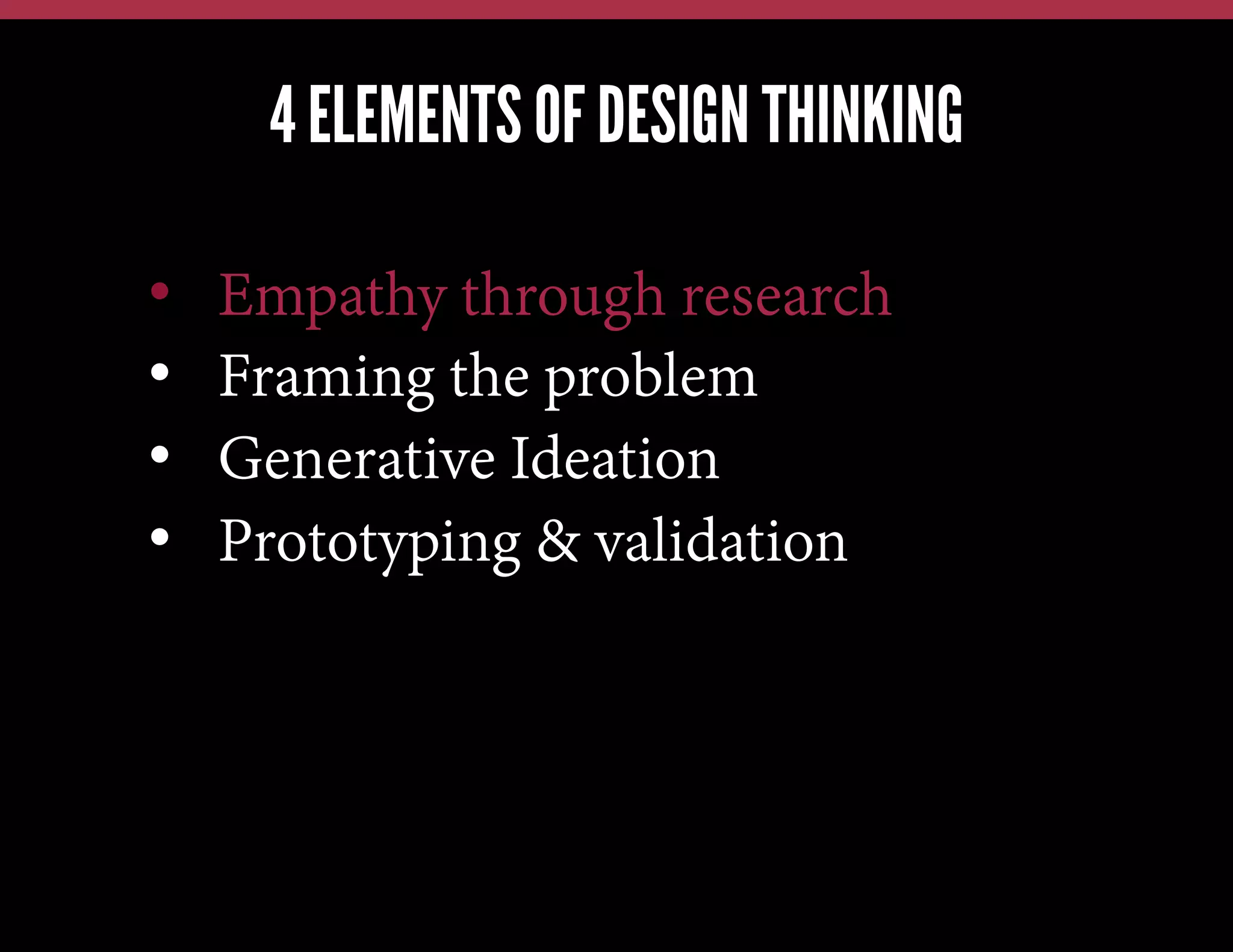
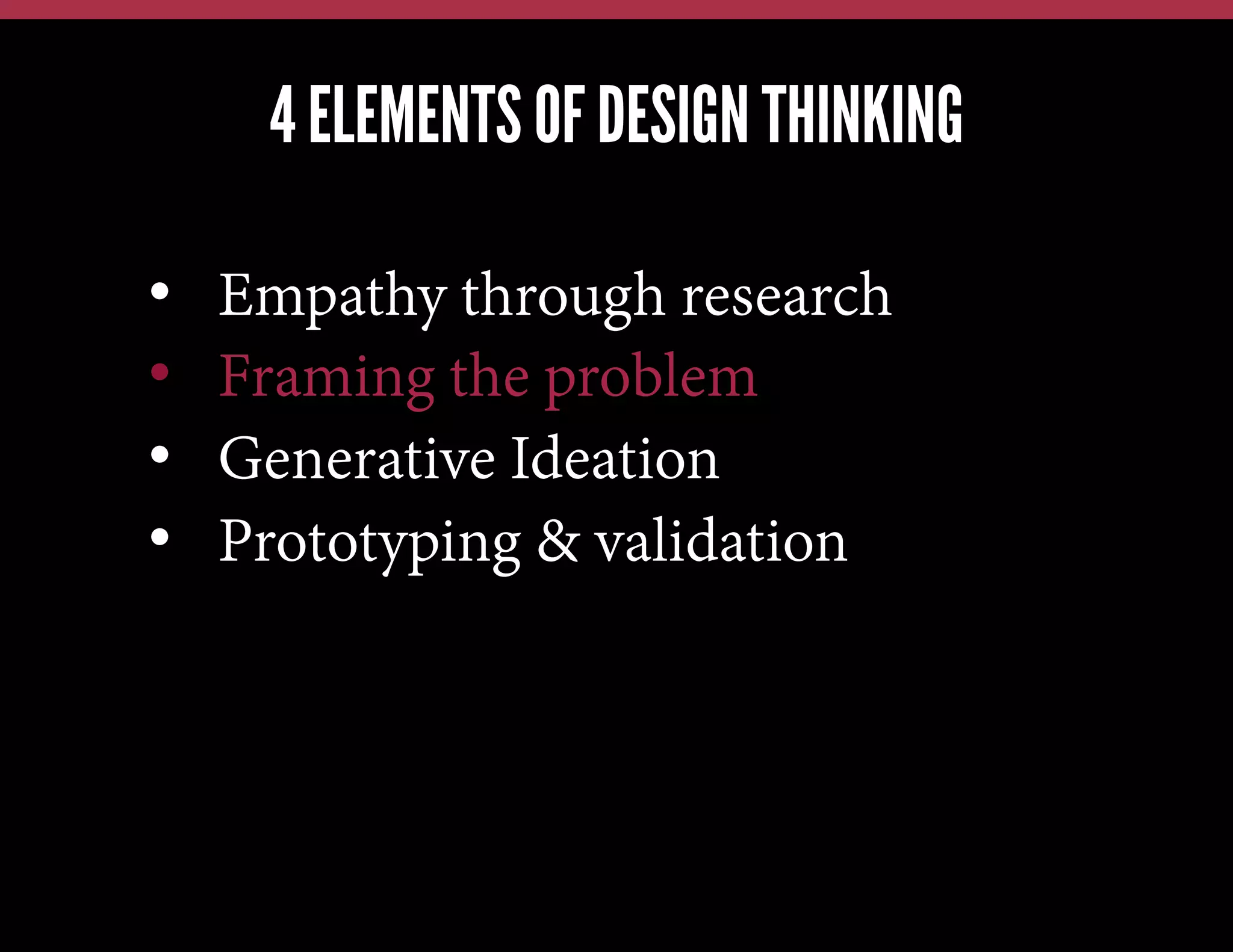
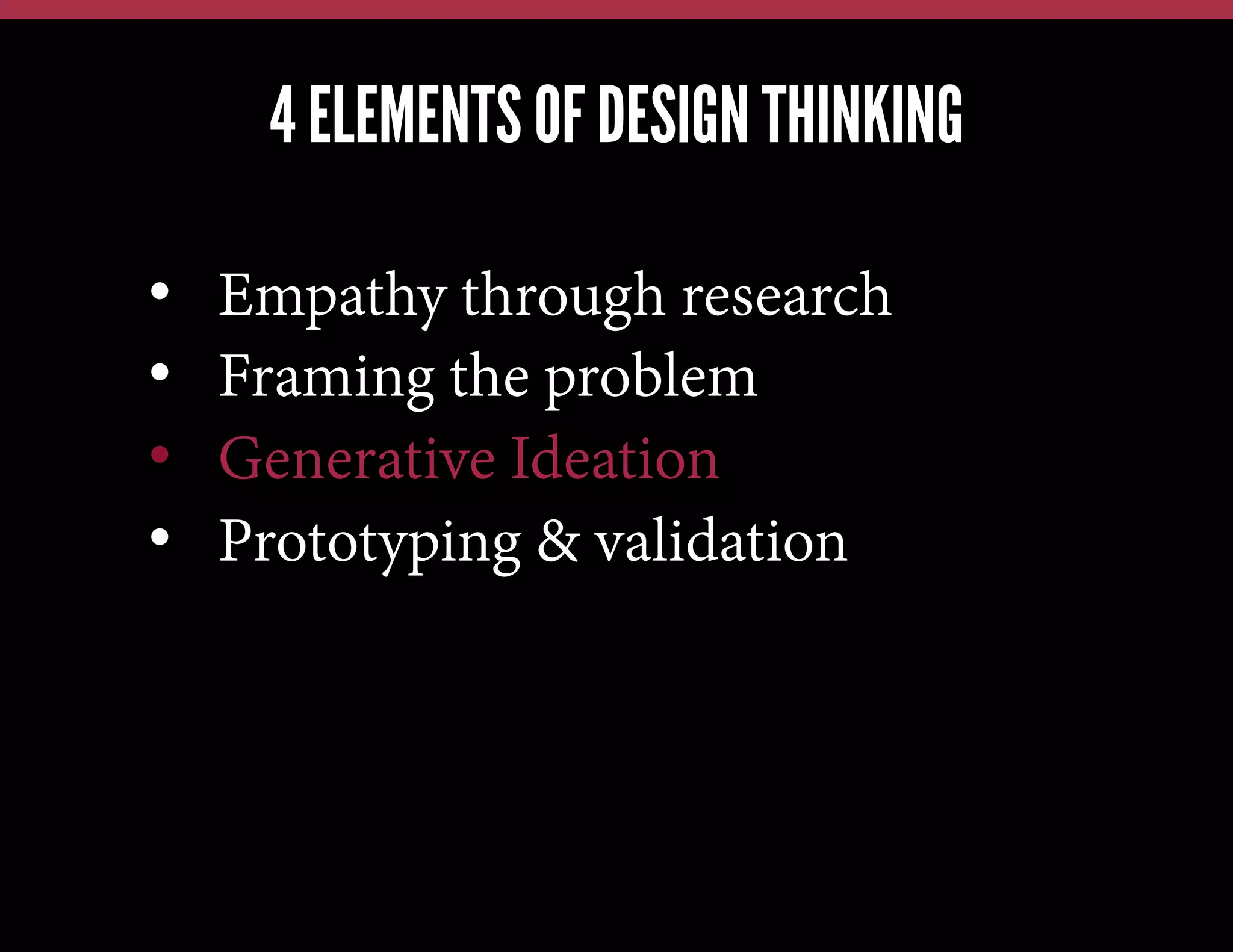
4 ELEMENTS OF DESIGN THINKING
We have this problem, lets jump in and brainstorm a solution
We have a new technology, what can we possibly use it for?
Our competitors just launched X; how quickly can we also do X?

• 
• 
• 
• 

Empathy through research
Framing the problem
Generative ideation
Prototyping & validation
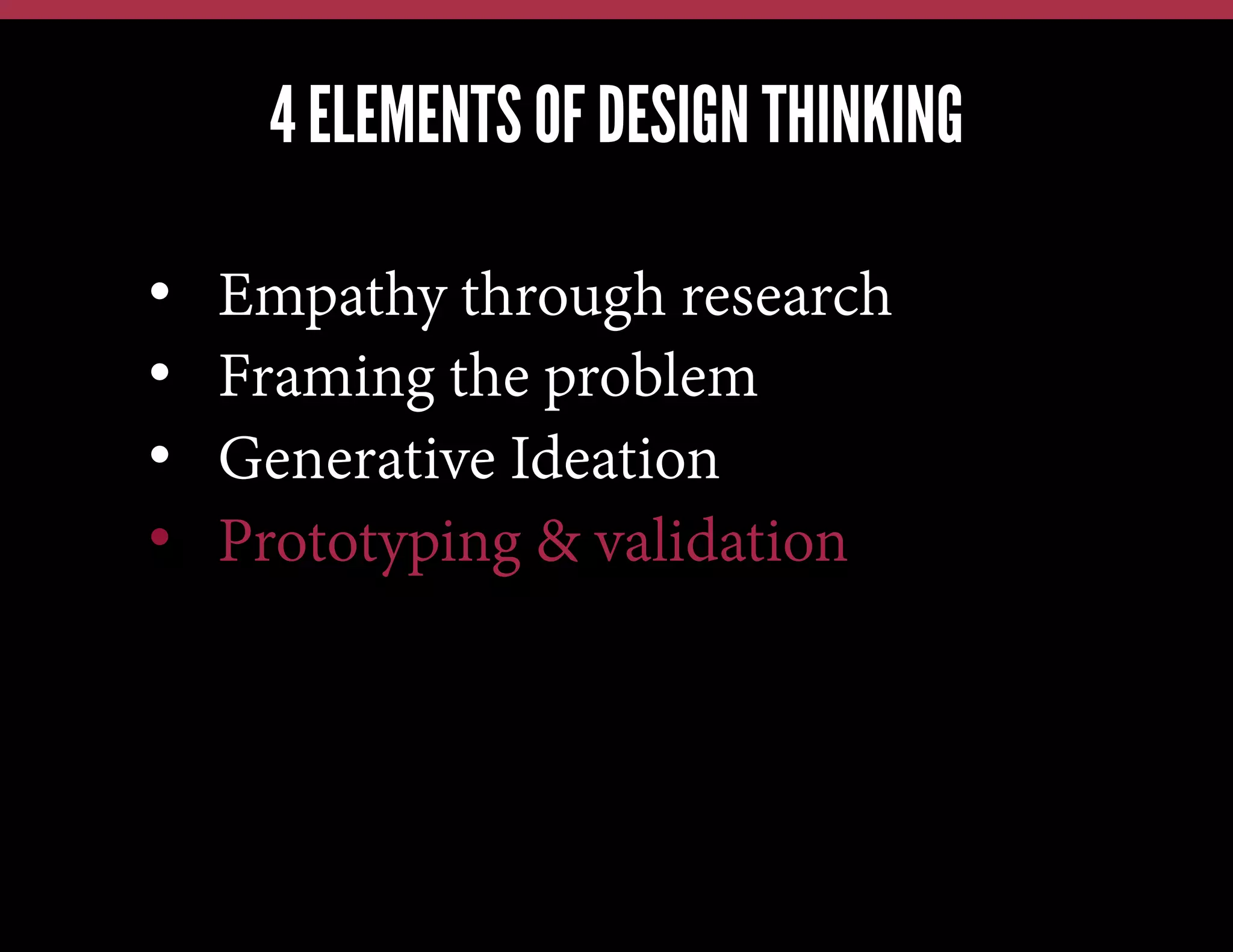
4 ELEMENTS OF DESIGN THINKING
We have this problem, lets jump in and brainstorm a solution
We have a new technology, what can we possibly use it for?
Our competitors just launched X; how quickly can we also do X?

• 
• 
• 
• 

Empathy through research
Framing the problem
Generative ideation
Prototyping & validation
BASICS OF CUSTOMER RESEARCH
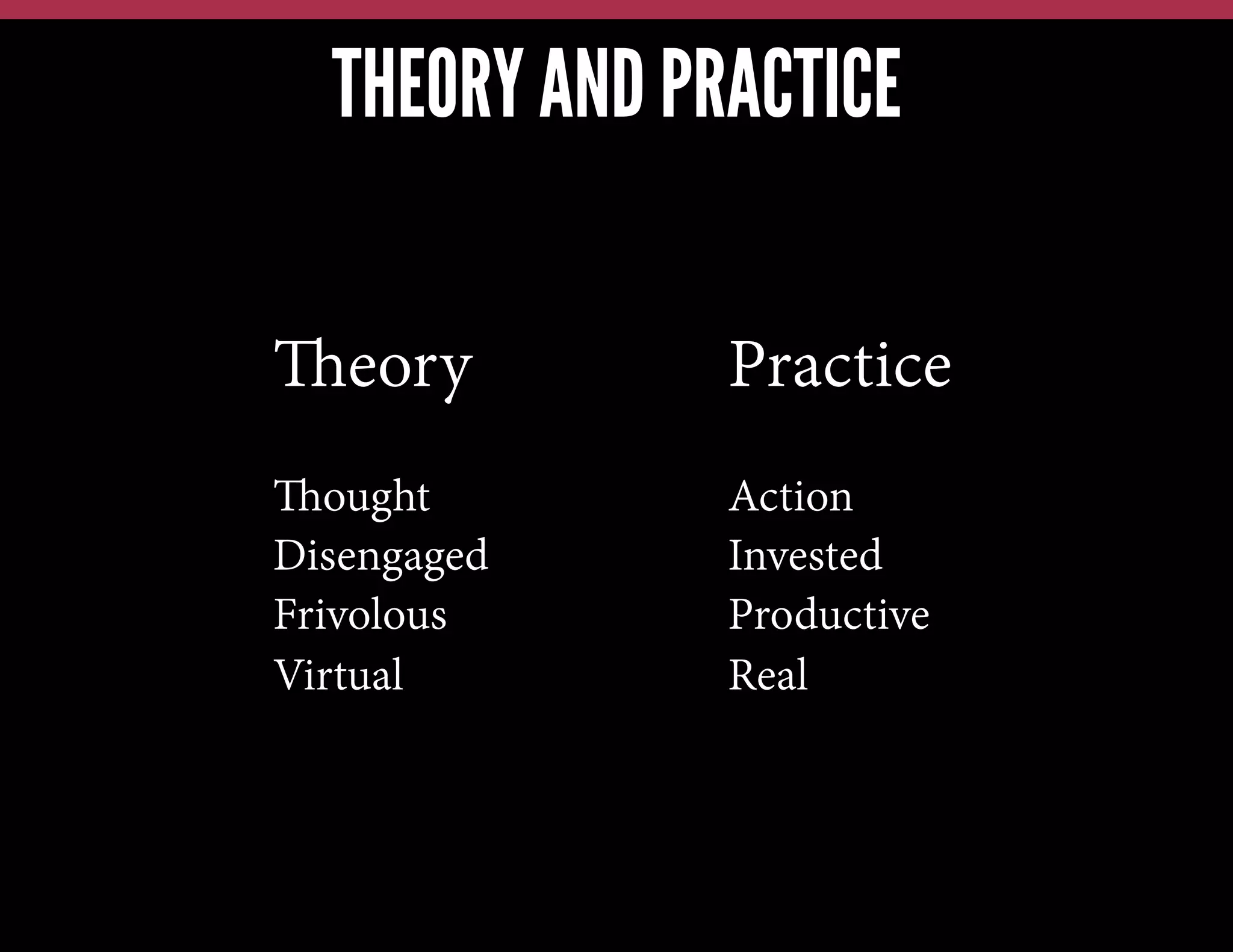
THEORY AND PRACTICE
Theory

Practice

Thought
Disengaged
Frivolous
Virtual

Action
Invested
Productive
Real
THEORY AND PRACTICE
Praxis
Process by which theory, lesson, or skill is enacted,
practiced, embodied, or realized.
THEORY AND PRACTICE
“Apart from inquiry, apart from the praxis, individuals
cannot be truly human. Knowledge emerges only through
invention and re-invention, through the restless, impatient,
continuing, hopeful inquiry human beings pursue in the
world, with the world, and with each other.”
Paulo Freire
SYMPATHY
syn - together
pathos - feeling
1. harmony of or agreement in feeling, as between persons
or on the part of one person with respect to another.
2. the harmony of feeling naturally existing between
persons of like tastes or opinion or of congenial
dispositions.
3. the fact or power of sharing the feelings of another,
especially in sorrow or trouble; fellow feeling, compassion,
or commiseration.
EMPATHY
en - in
pathos - feeling
1. the intellectual identification with or vicarious
experiencing of the feelings, thoughts, or attitudes of
another.
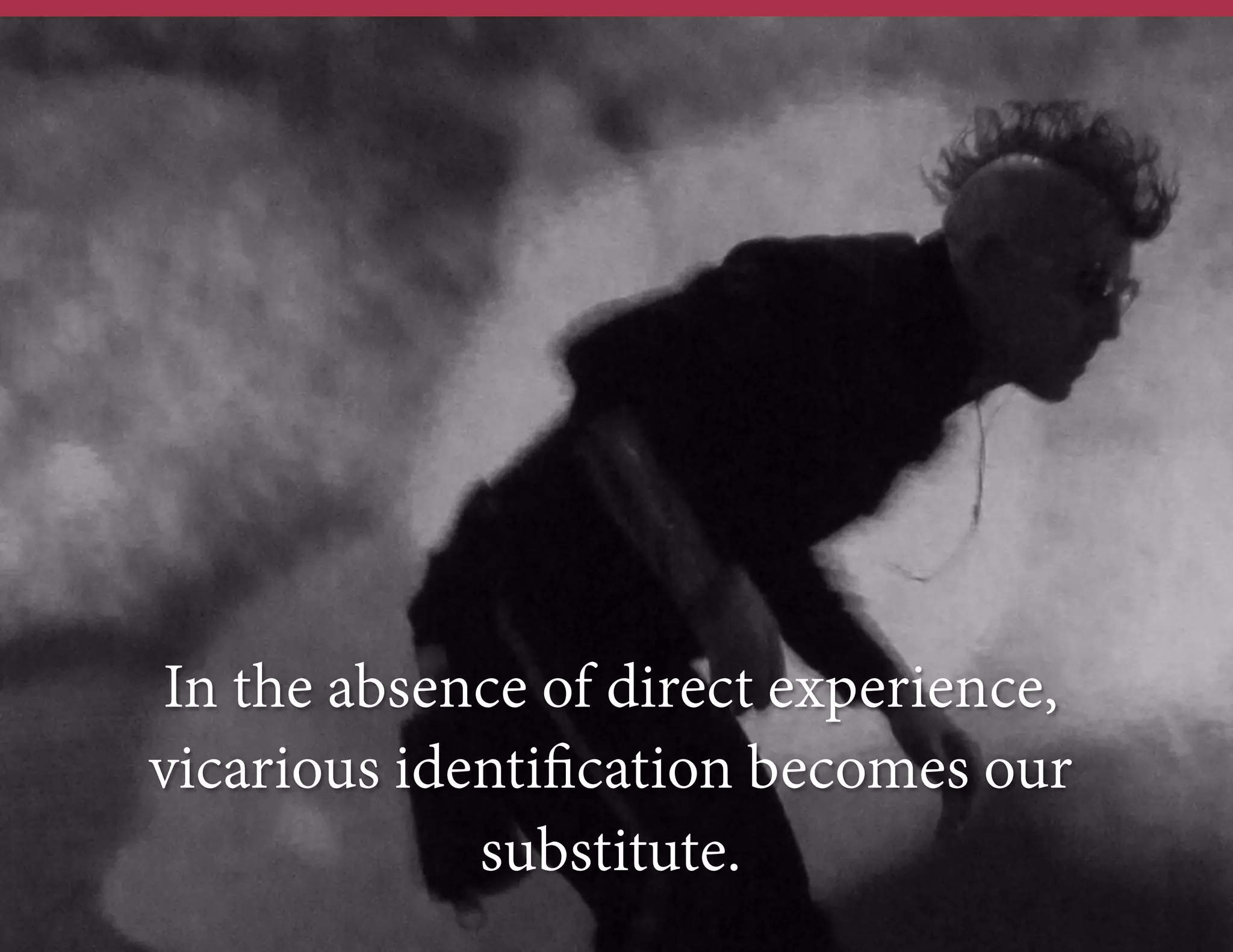
In the absence of direct experience,
vicarious identification becomes our
substitute.
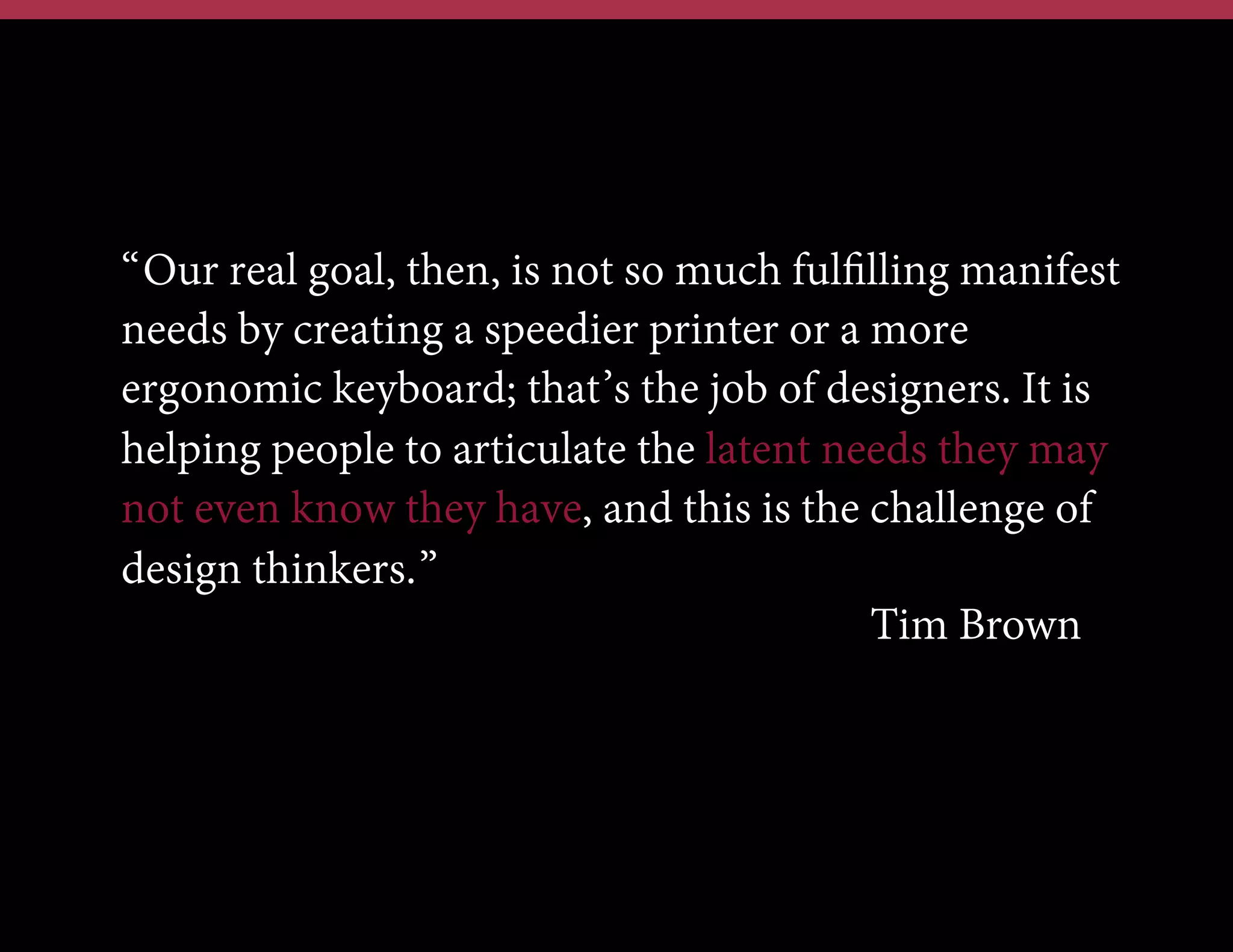
“Our real goal, then, is not so much fulfilling manifest
needs by creating a speedier printer or a more
ergonomic keyboard; that’s the job of designers. It is
helping people to articulate the latent needs they may
not even know they have, and this is the challenge of
design thinkers.”
Tim Brown
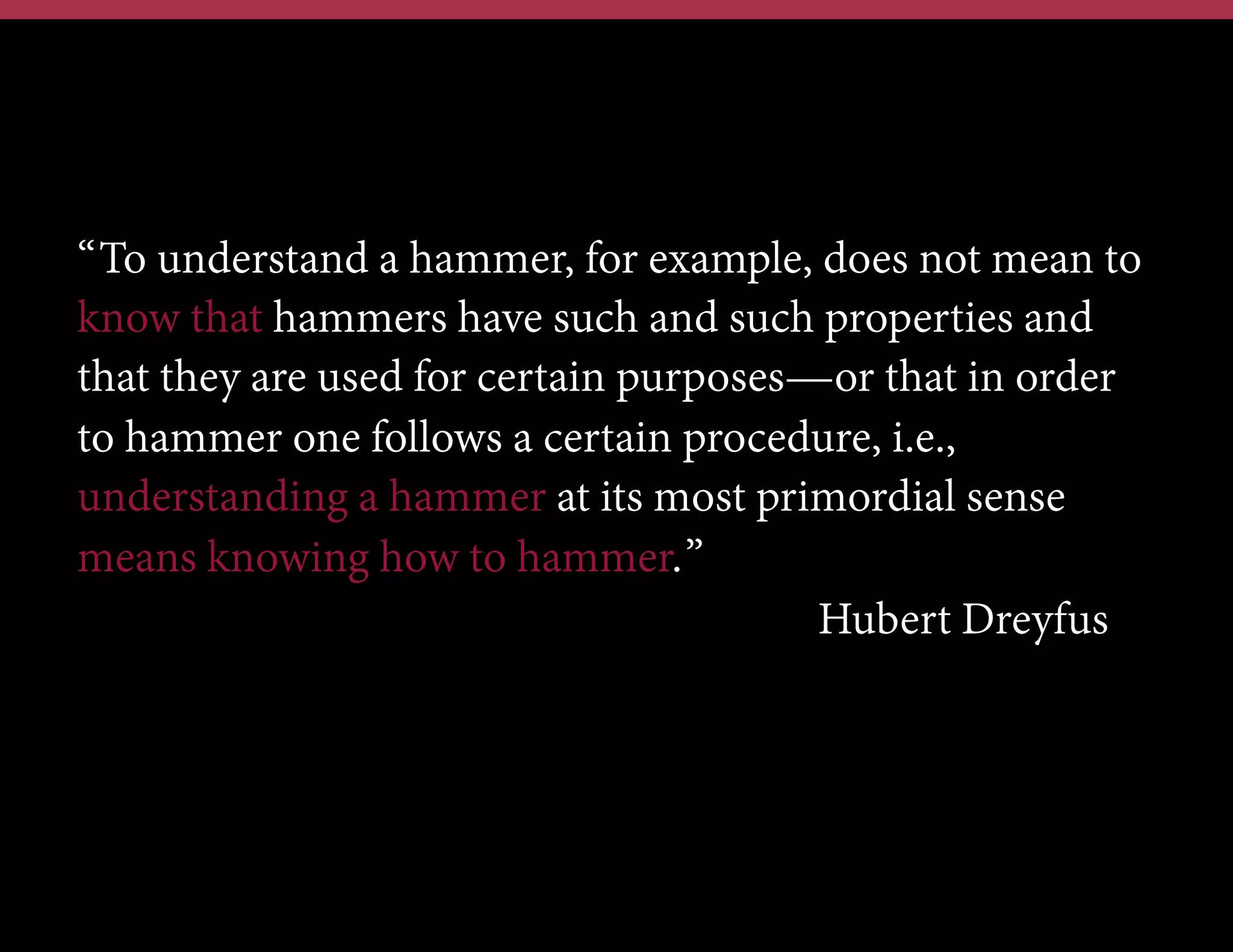
“To understand a hammer, for example, does not mean to
know that hammers have such and such properties and
that they are used for certain purposes—or that in order
to hammer one follows a certain procedure, i.e.,
understanding a hammer at its most primordial sense
means knowing how to hammer.”
Hubert Dreyfus
Customer Research
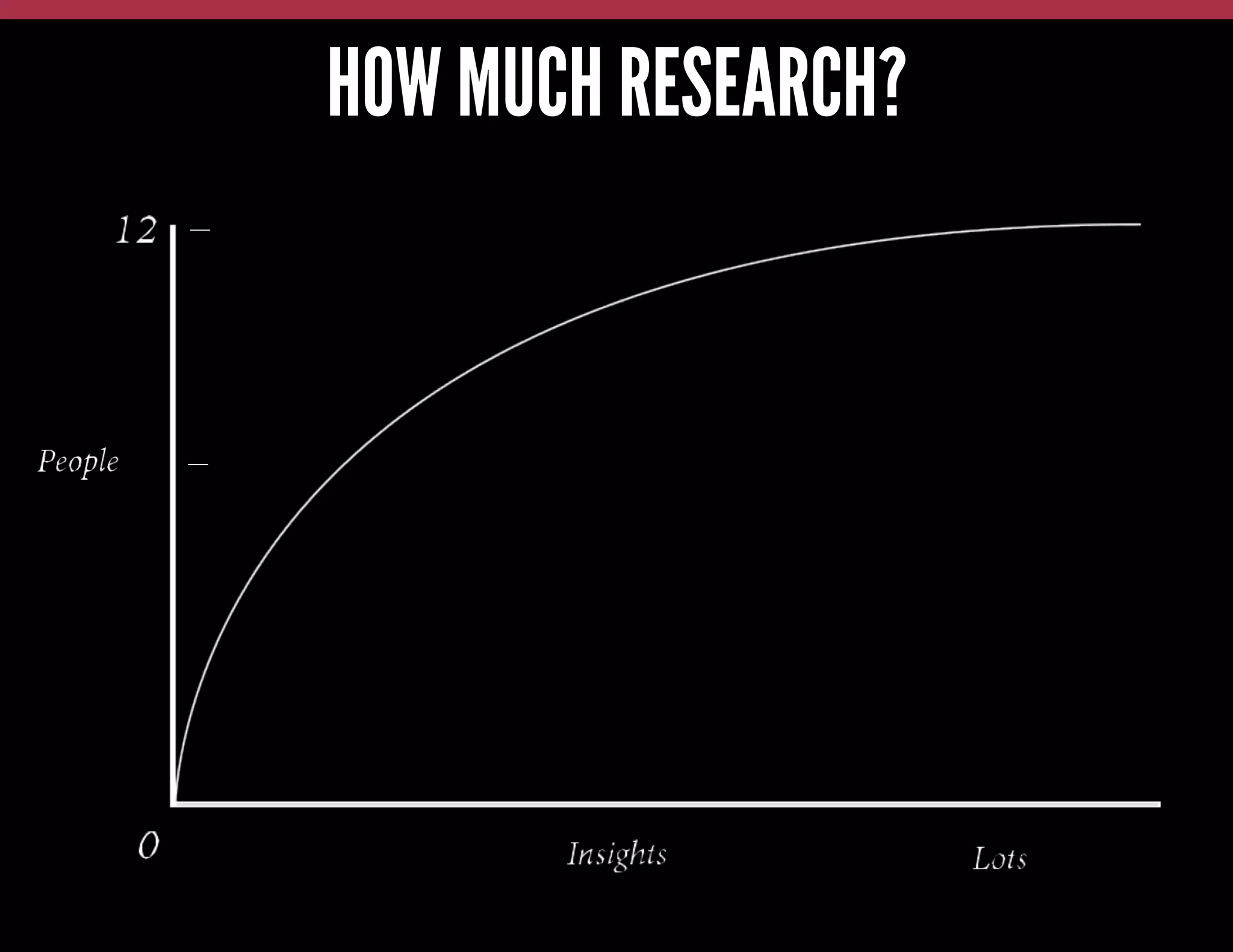
HOW MUCH RESEARCH?

People	
  

Insights	
  

Lot
s	
  
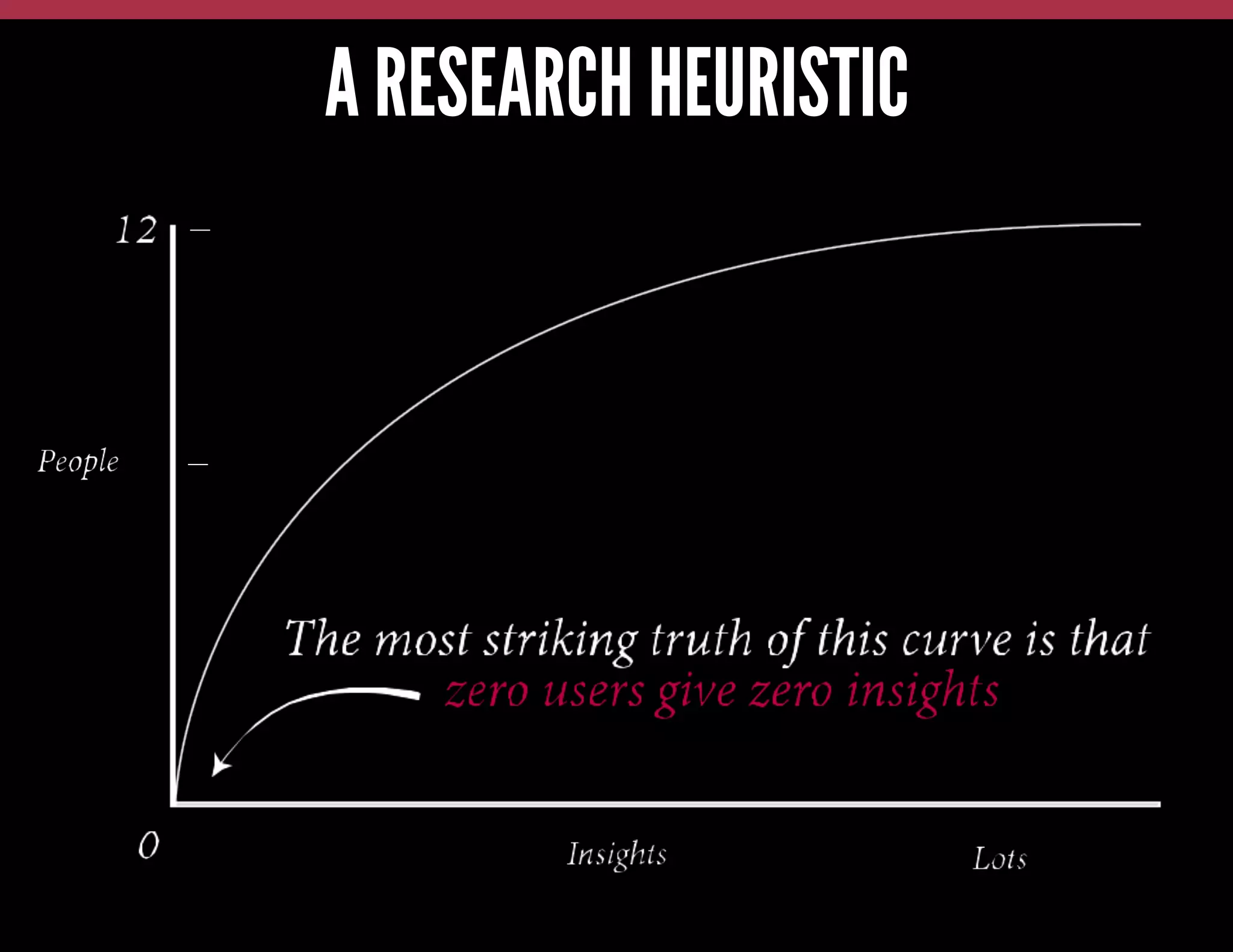
A RESEARCH HEURISTIC
12	
  

People	
  

Insights	
  

Lot
s	
  
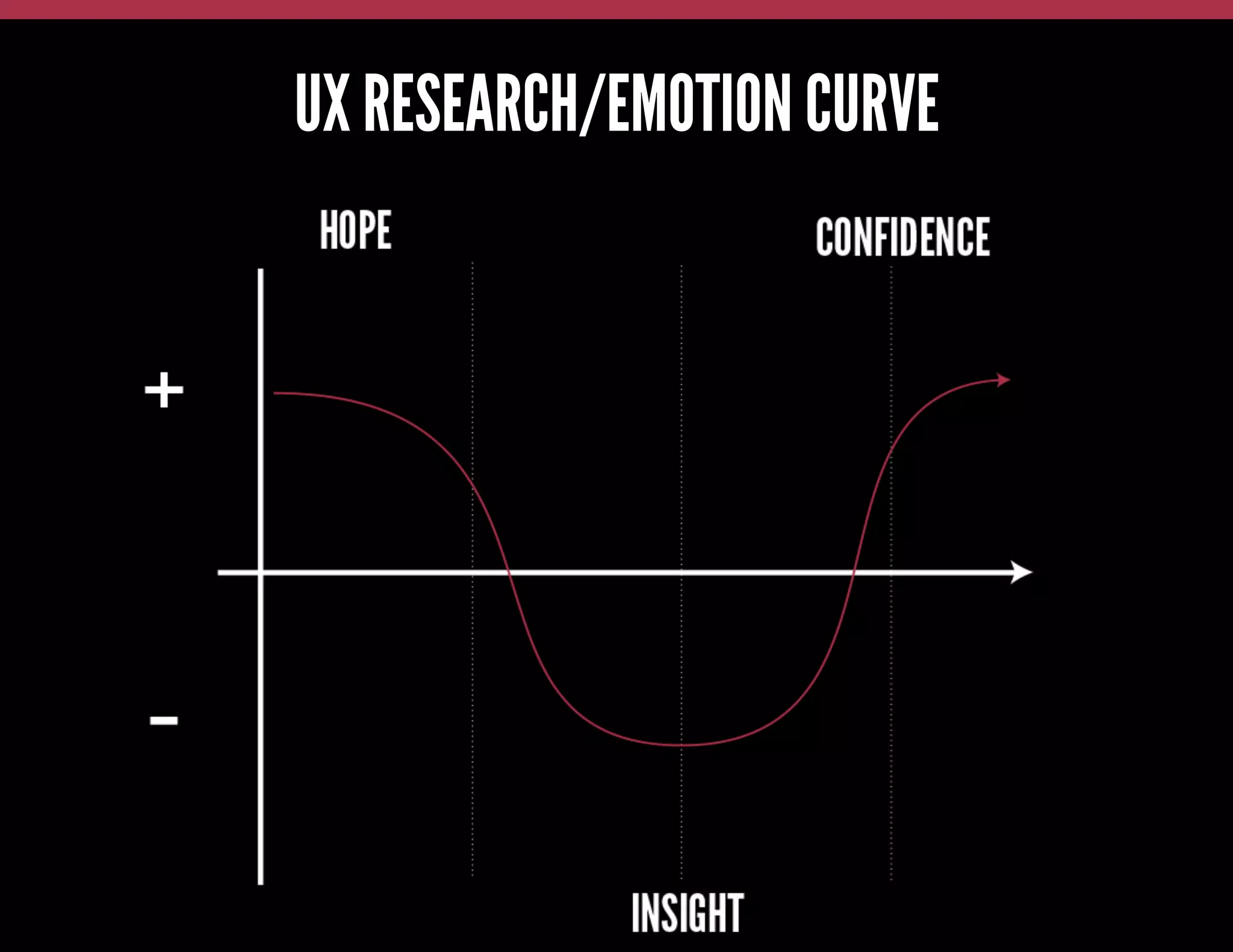
UX RESEARCH/EMOTION CURVE
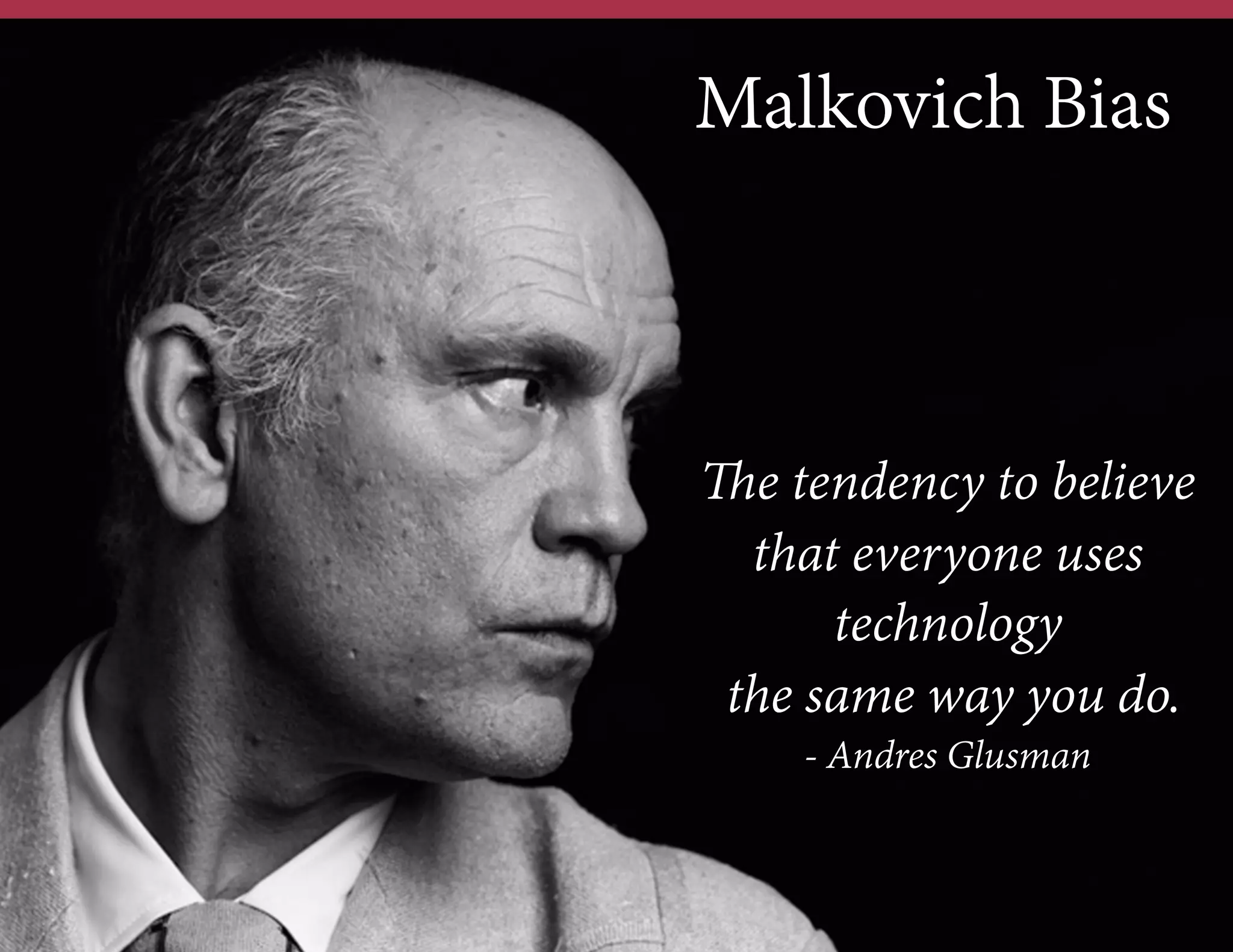
Malkovich Bias

The tendency to believe
that everyone uses
technology
the same way you do.
- Andres Glusman
ETHNOGRAPHY
Literally “writing culture”
Ethnography is:
1.  The process of “deep hanging out.”
2.  The richest research method we have.
3.  Something you should be doing all the time.
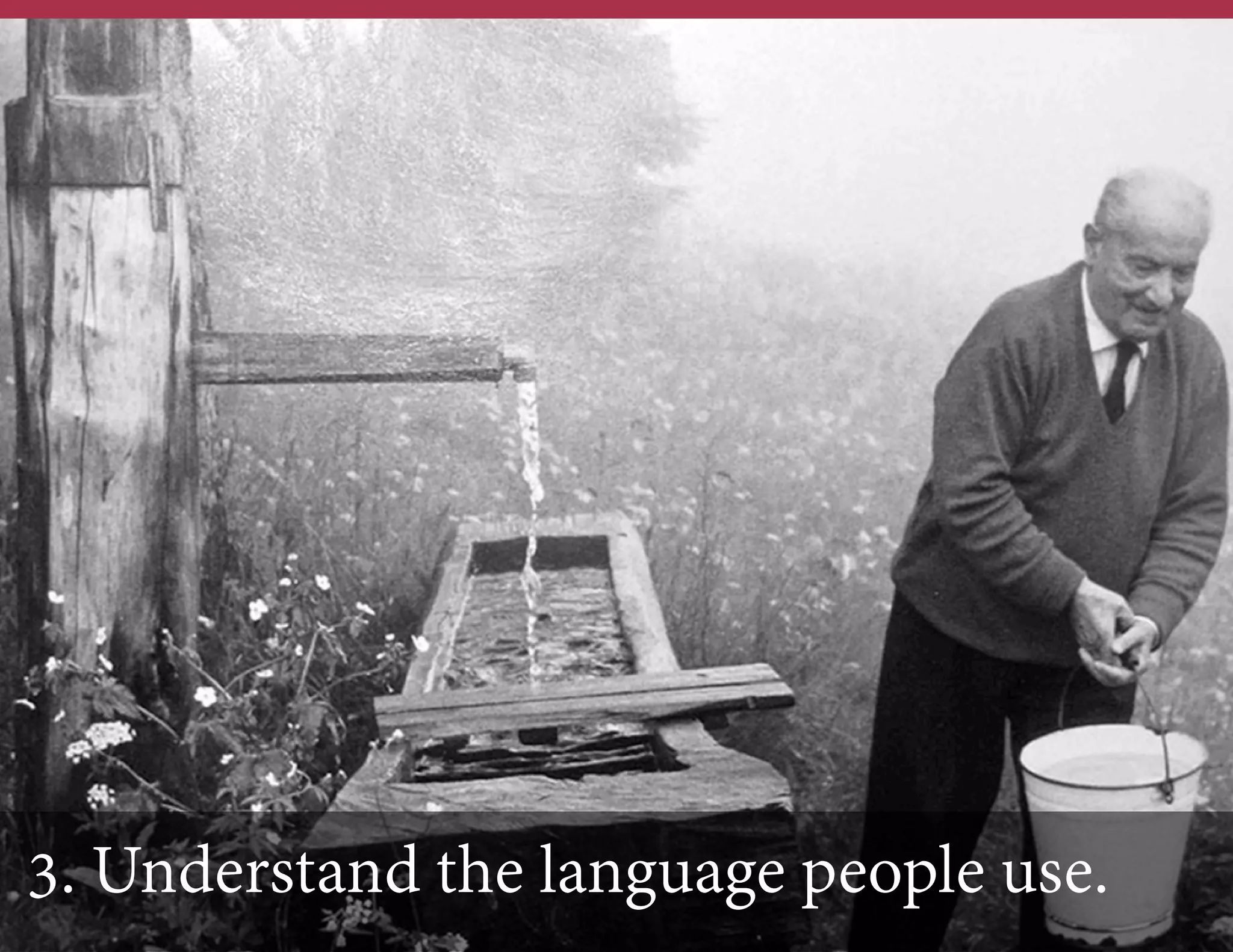
Ethnography
Allows Us To
1. Discover the semantics of living
2. Decode signifiers of cultural practice
3. Understand the language people use.
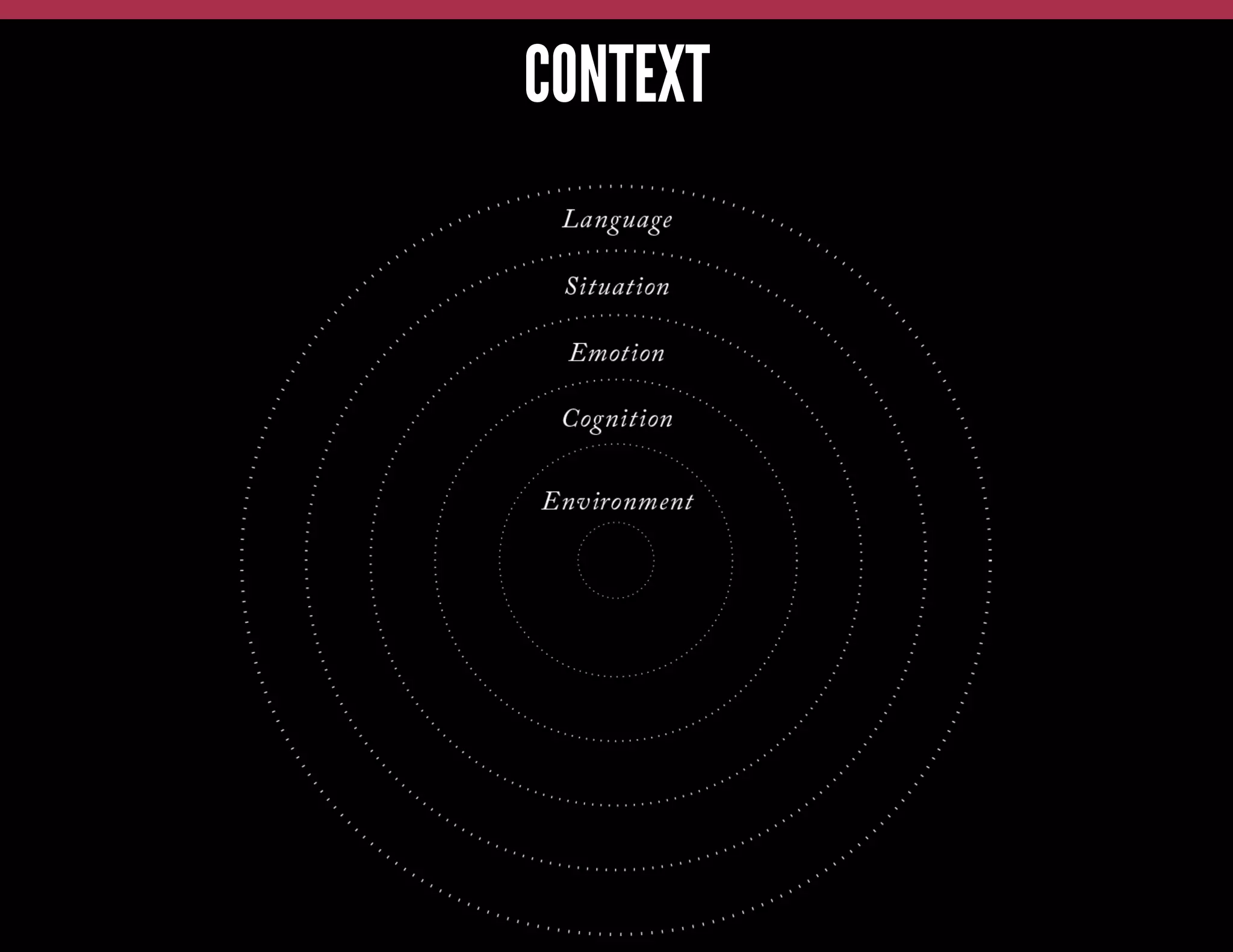
CONTEXT
Keys
To Good
Ethnography
Delve deeply into the context, lives, cultures, and rituals of a few
people rather than study a large number of people superficially.
This isn’t about booty calls, this is about relationships.
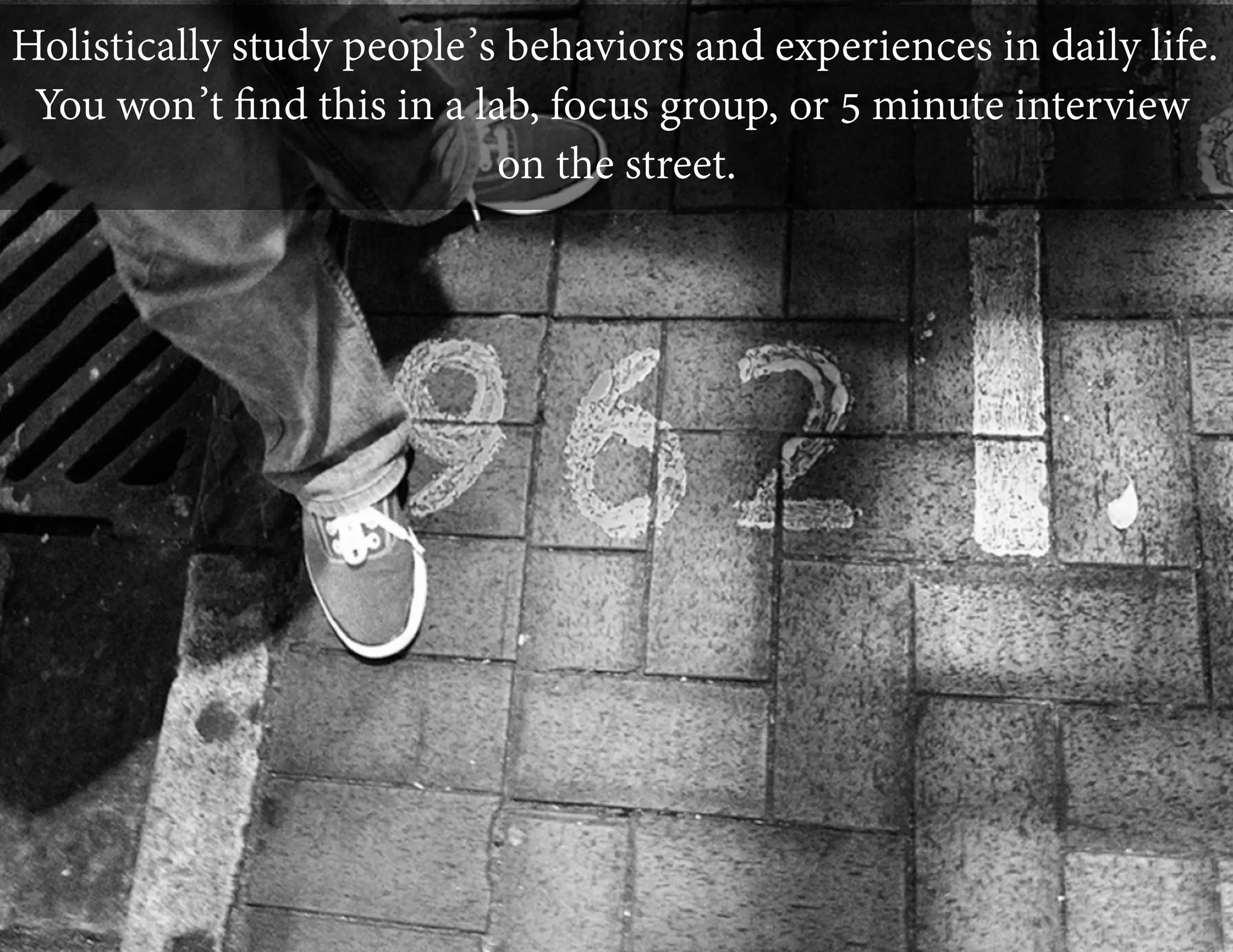
Holistically study people’s behaviors and experiences in daily life.
You won’t find this in a lab, focus group, or 5 minute interview
on the street.
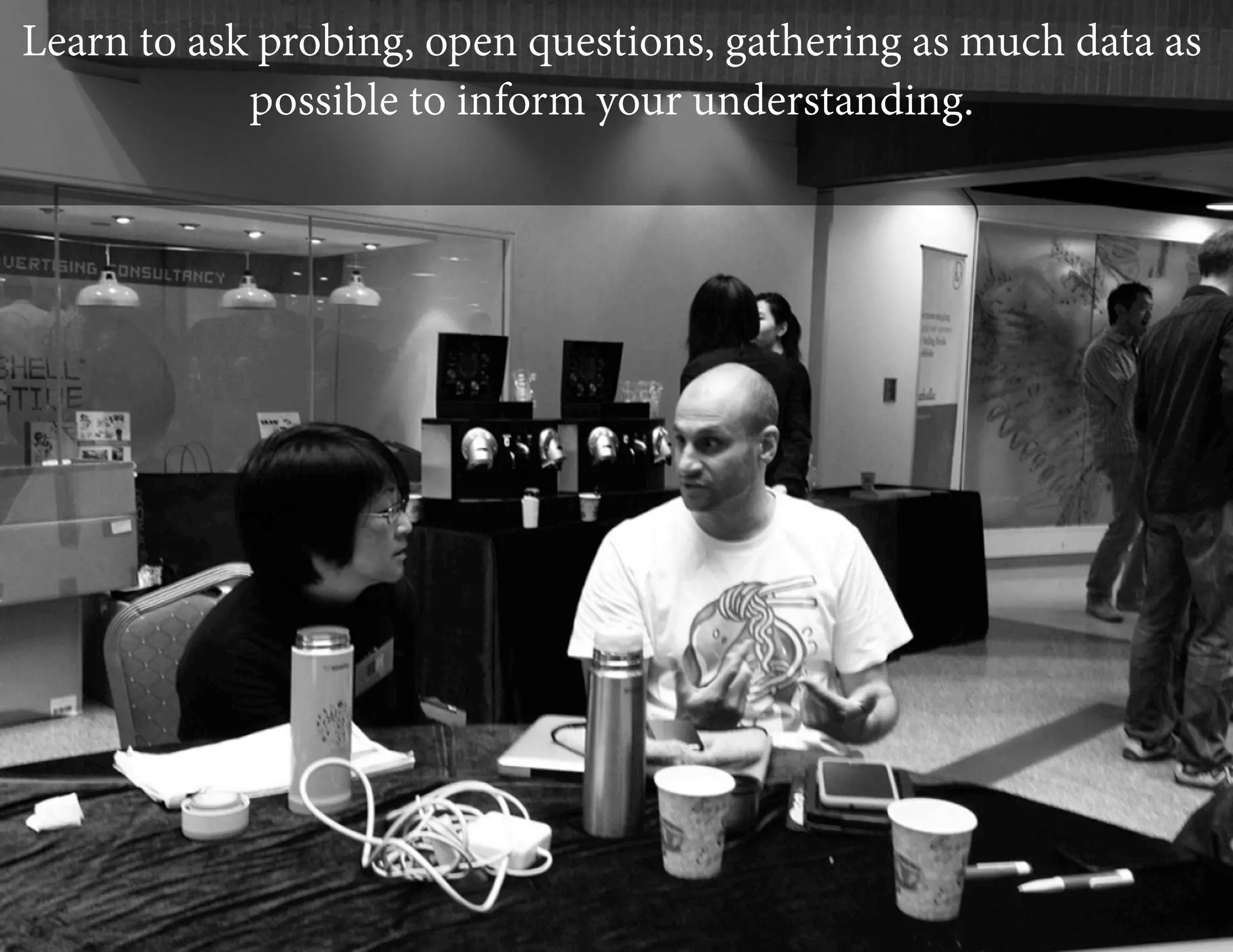
Learn to ask probing, open questions, gathering as much data as
possible to inform your understanding.
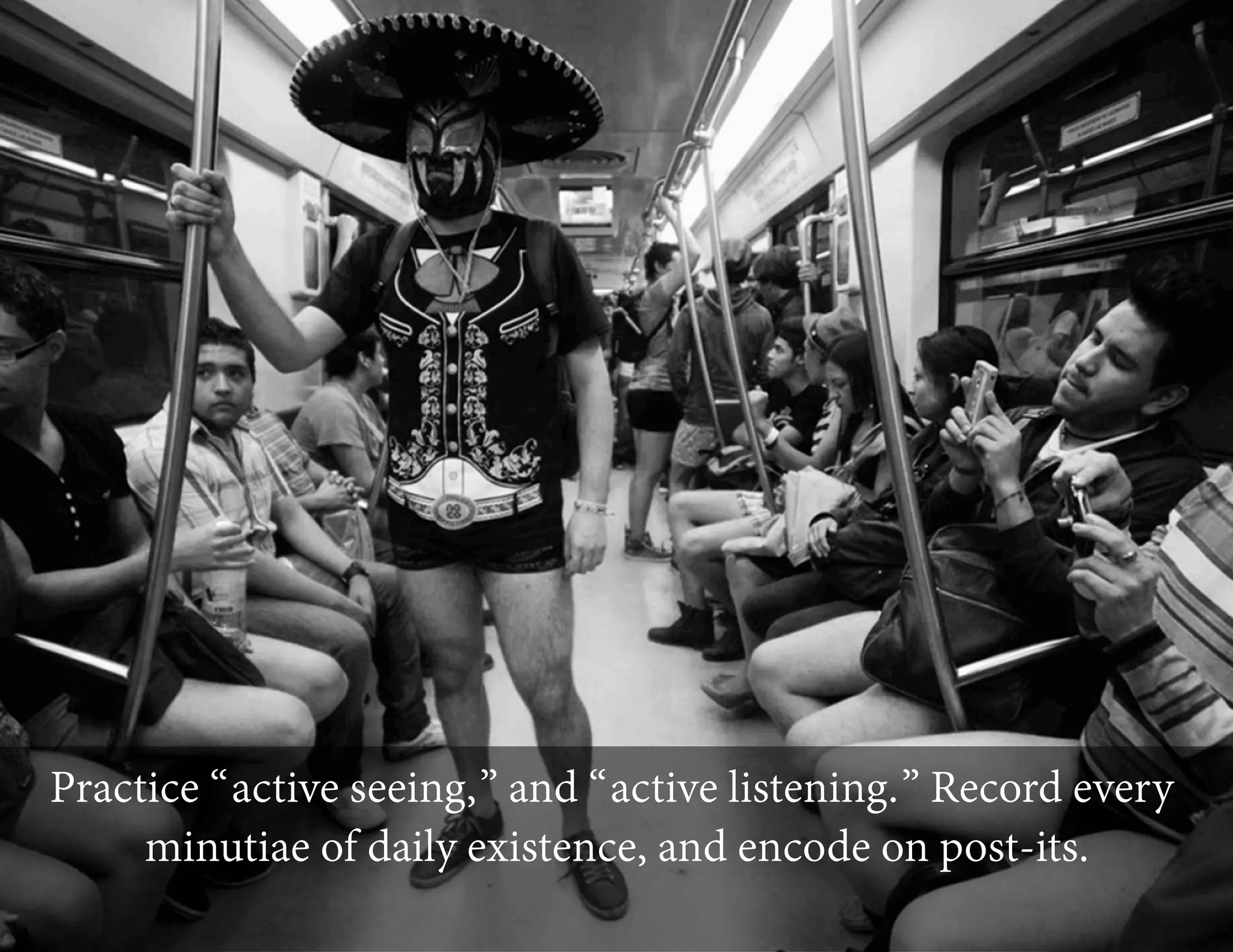
Practice “active seeing,” and “active listening.” Record every
minutiae of daily existence, and encode on post-its.
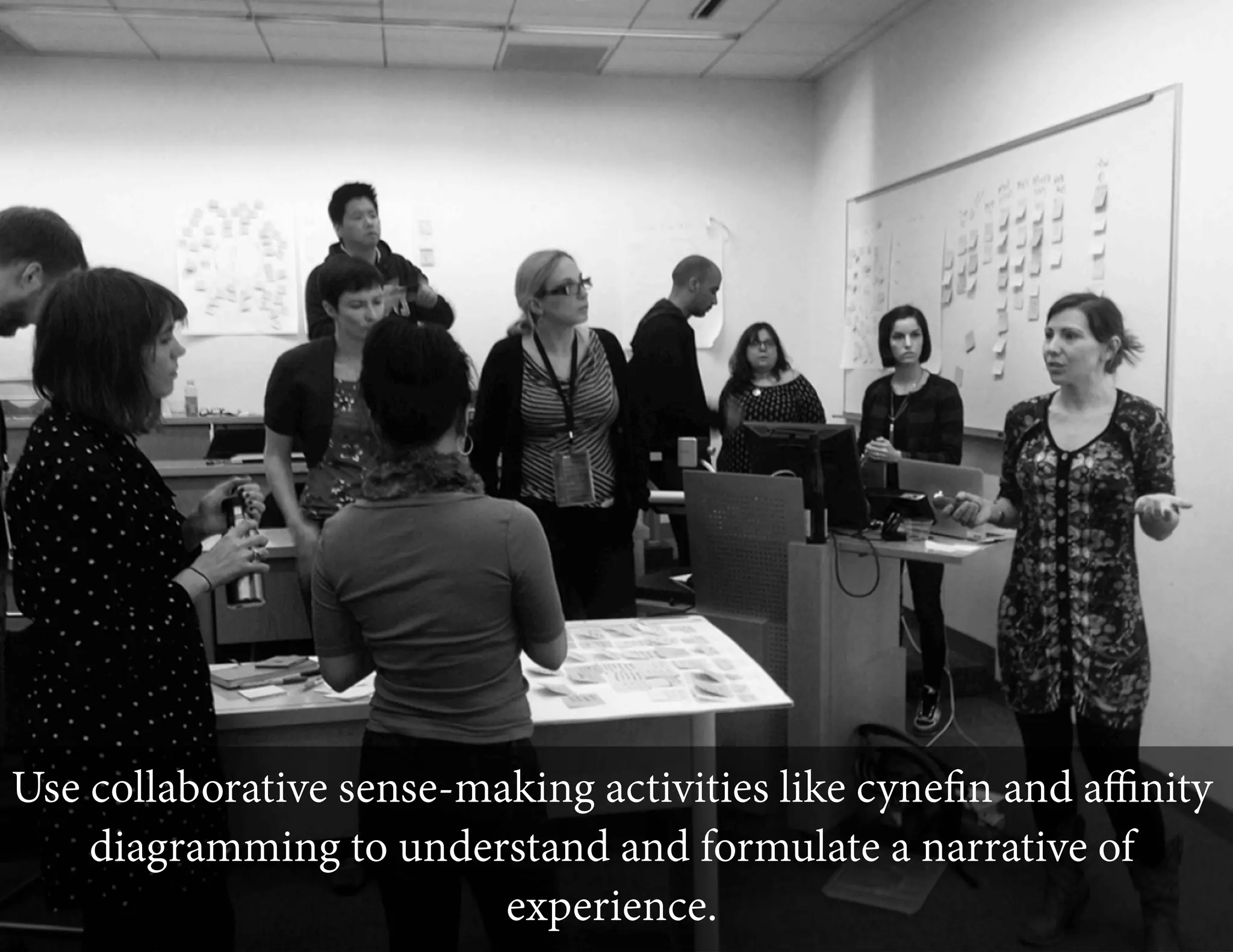
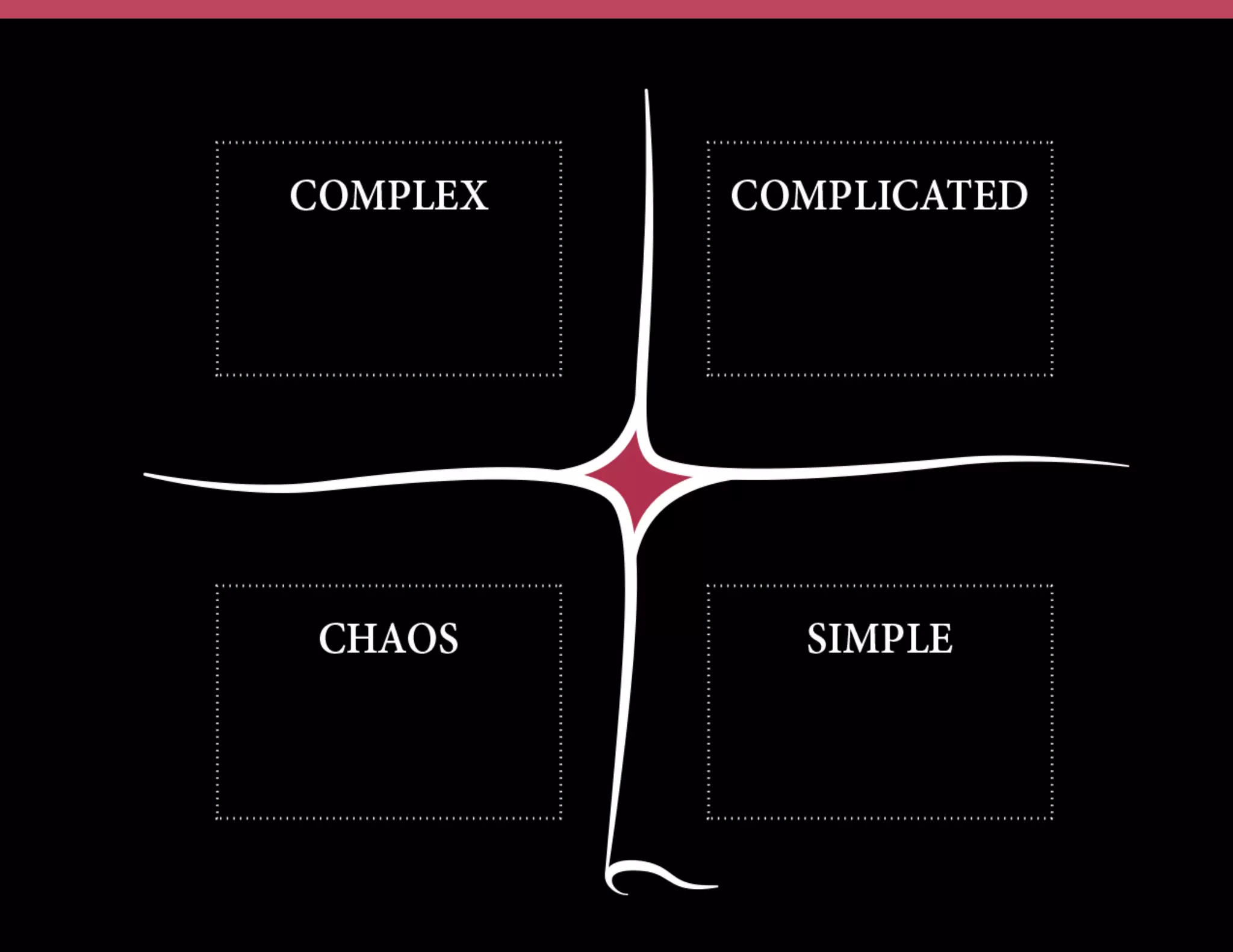
Use collaborative sense-making activities like cynefin and affinity
diagramming to understand and formulate a narrative of
experience.
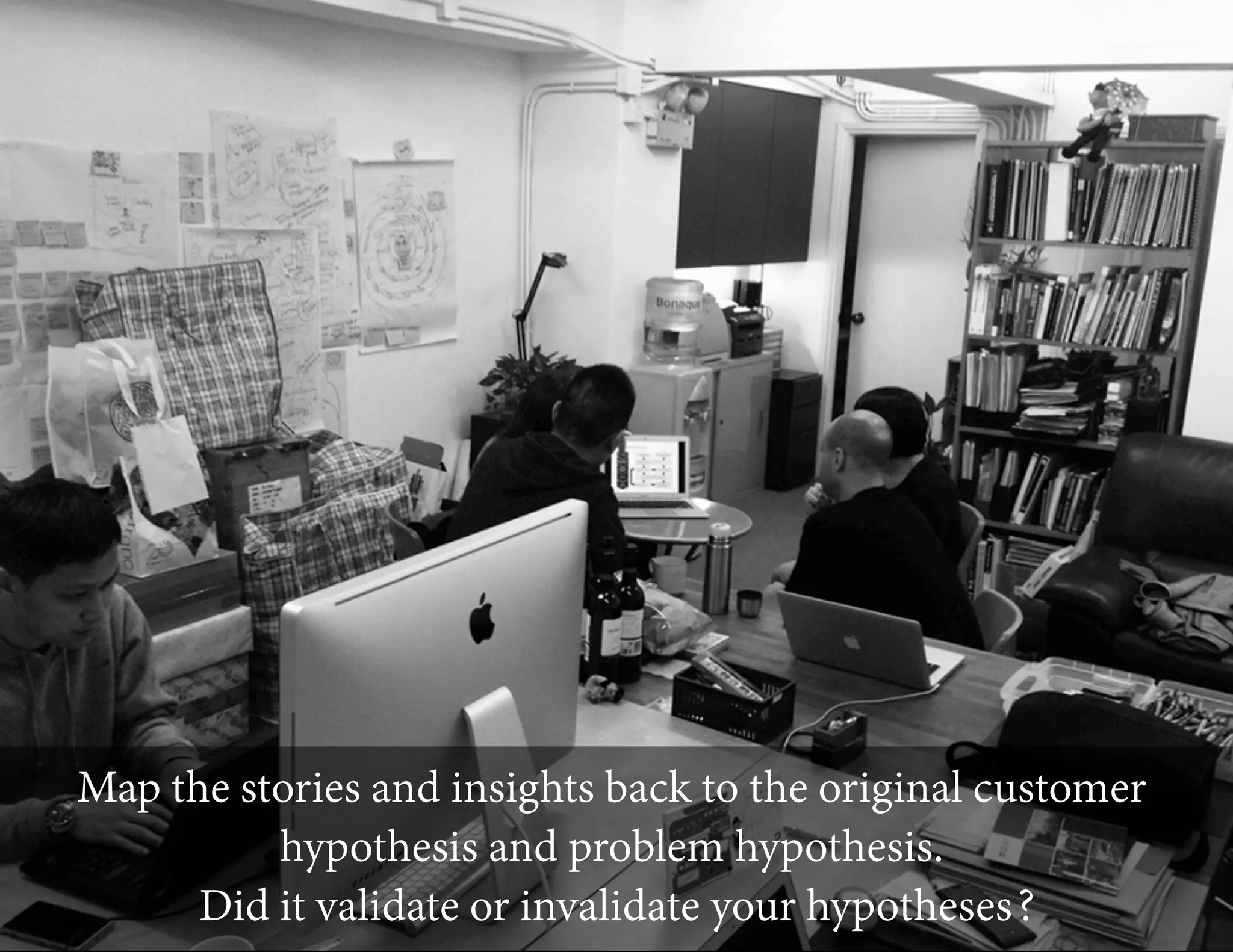
Map the stories and insights back to the original customer
hypothesis and problem hypothesis.
Did it validate or invalidate your hypotheses?
4 ELEMENTS OF DESIGN THINKING
We have this problem, lets jump in and brainstorm a solution
We have a new technology, what can we possibly use it for?
Our competitors just launched X; how quickly can we also do X?

• 
• 
• 
• 

Empathy through research
Framing the problem
Generative ideation
Prototyping & validation
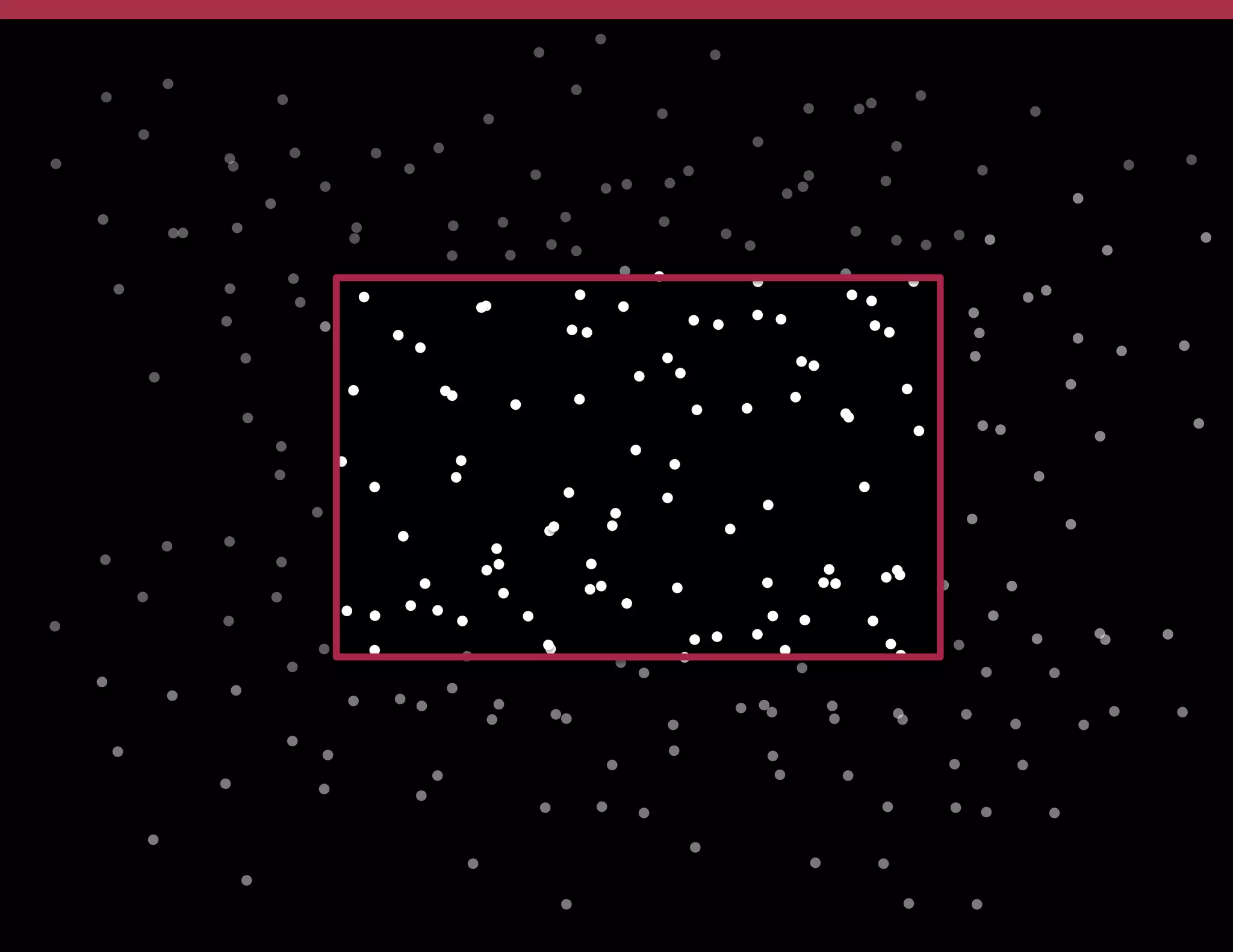
How do we make sense of the world so that we can act in it?

FRAMING AND SENSEMAKING
ON FRAMING
“A frame is, simplistically, a point of view; often, and
particularly in technical situations, this point of view
is deemed “irrelevant” or “biasing” because it
implicitly references a non-objective way of
considering a situation or idea. But a frame – while
certainly subjective and often biasing – is of critical
use to the designer, as it is something that is shaped
over the long-term aggregation of thoughts and
experiences.”
Jon Kolko
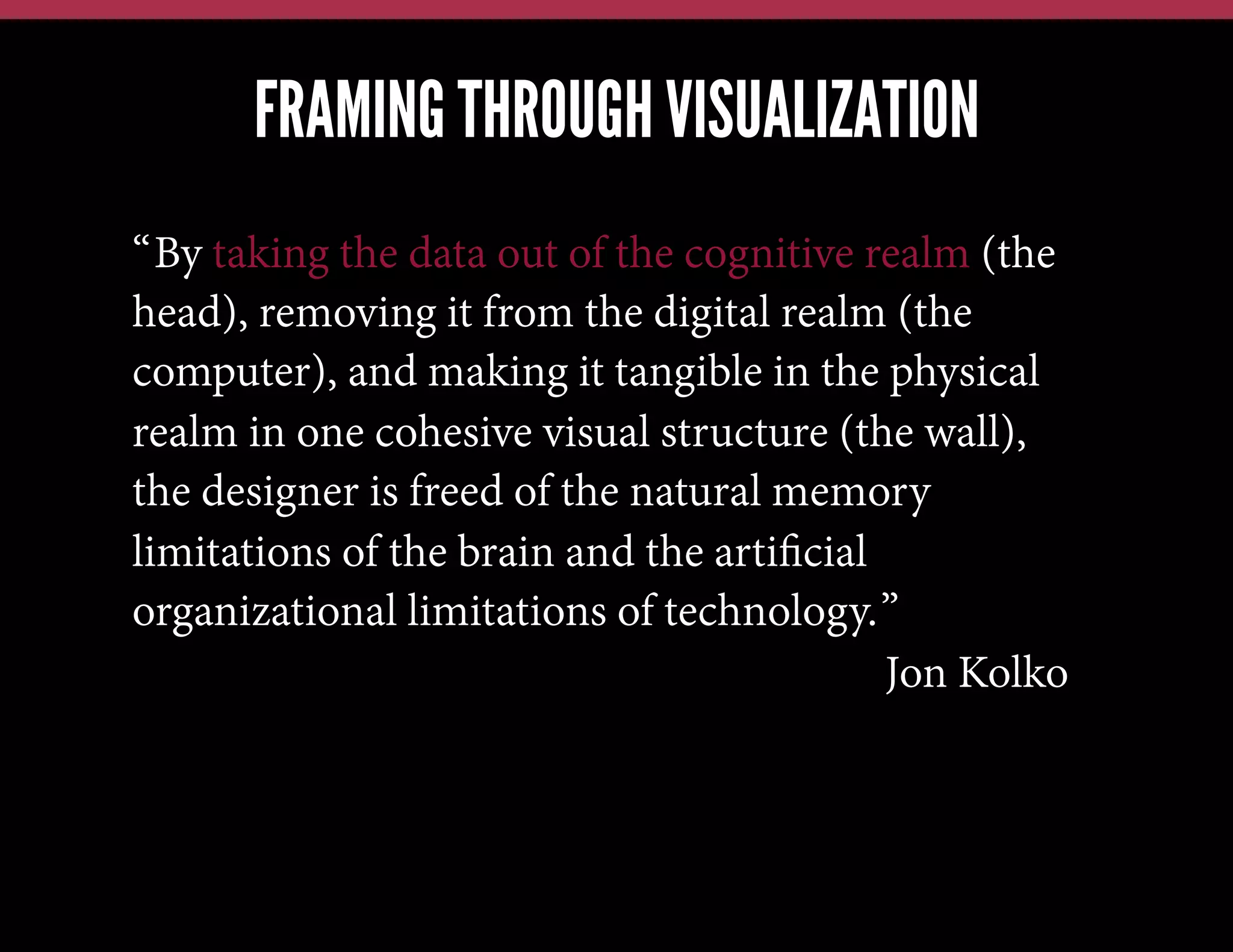
FRAMING THROUGH VISUALIZATION
“By taking the data out of the cognitive realm (the
head), removing it from the digital realm (the
computer), and making it tangible in the physical
realm in one cohesive visual structure (the wall),
the designer is freed of the natural memory
limitations of the brain and the artificial
organizational limitations of technology.”
Jon Kolko
SENSEMAKING
The act of assigning meaning to experience.
Extraction of meaning out of a situation.
Sometimes purposeful, sometimes not.
Micro and macro.
CYNEFIN

The place of your multiple
affiliations or belongings.
4 ELEMENTS OF DESIGN THINKING
We have this problem, lets jump in and brainstorm a solution
We have a new technology, what can we possibly use it for?
Our competitors just launched X; how quickly can we also do X?

• 
• 
• 
• 

Empathy through research
Framing the problem
Generative ideation
Prototyping & validation
GENERATIVE IDEATION
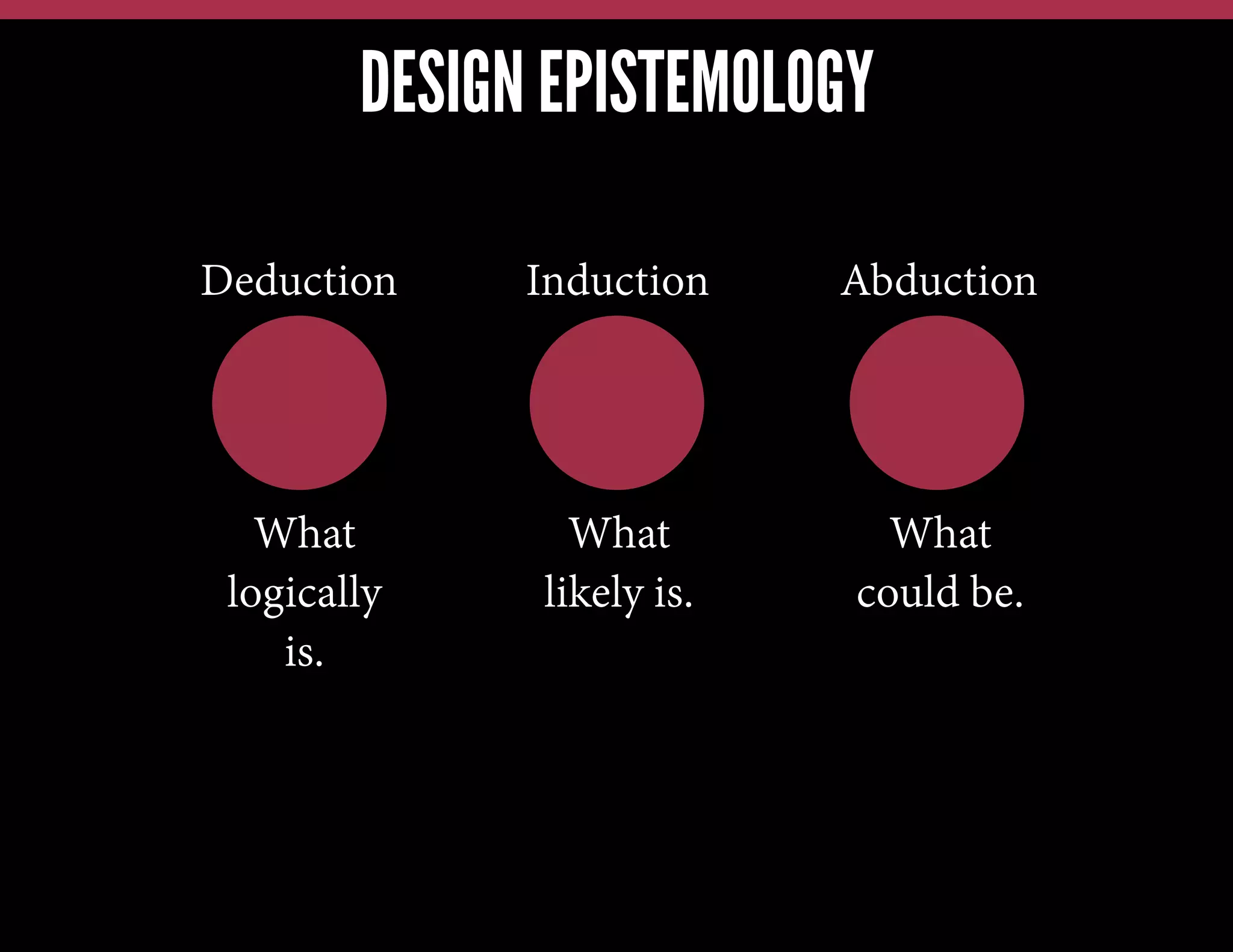
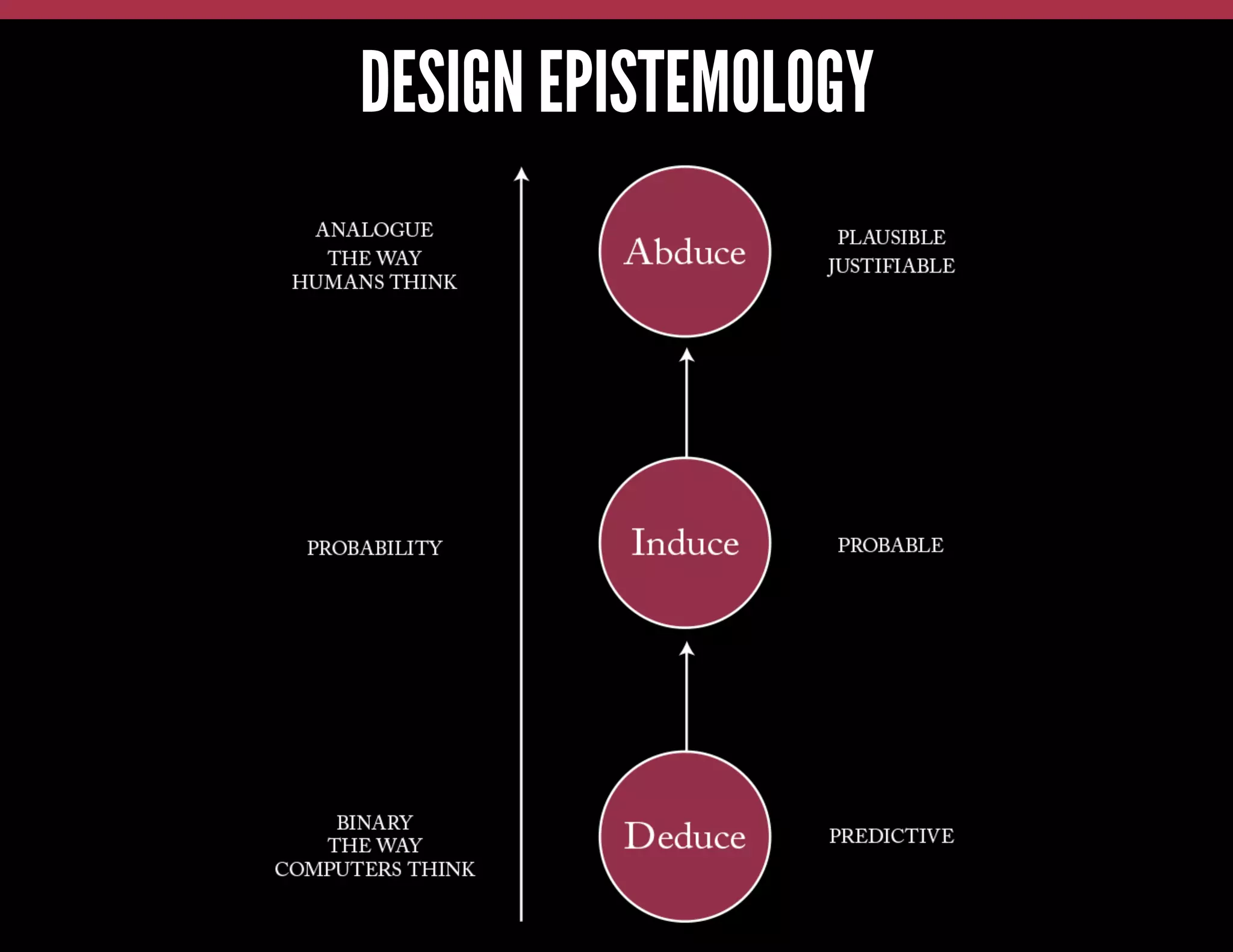
DESIGN EPISTEMOLOGY
Deduction

Induction

Abduction

What
logically
is.

What
likely is.

What
could be.
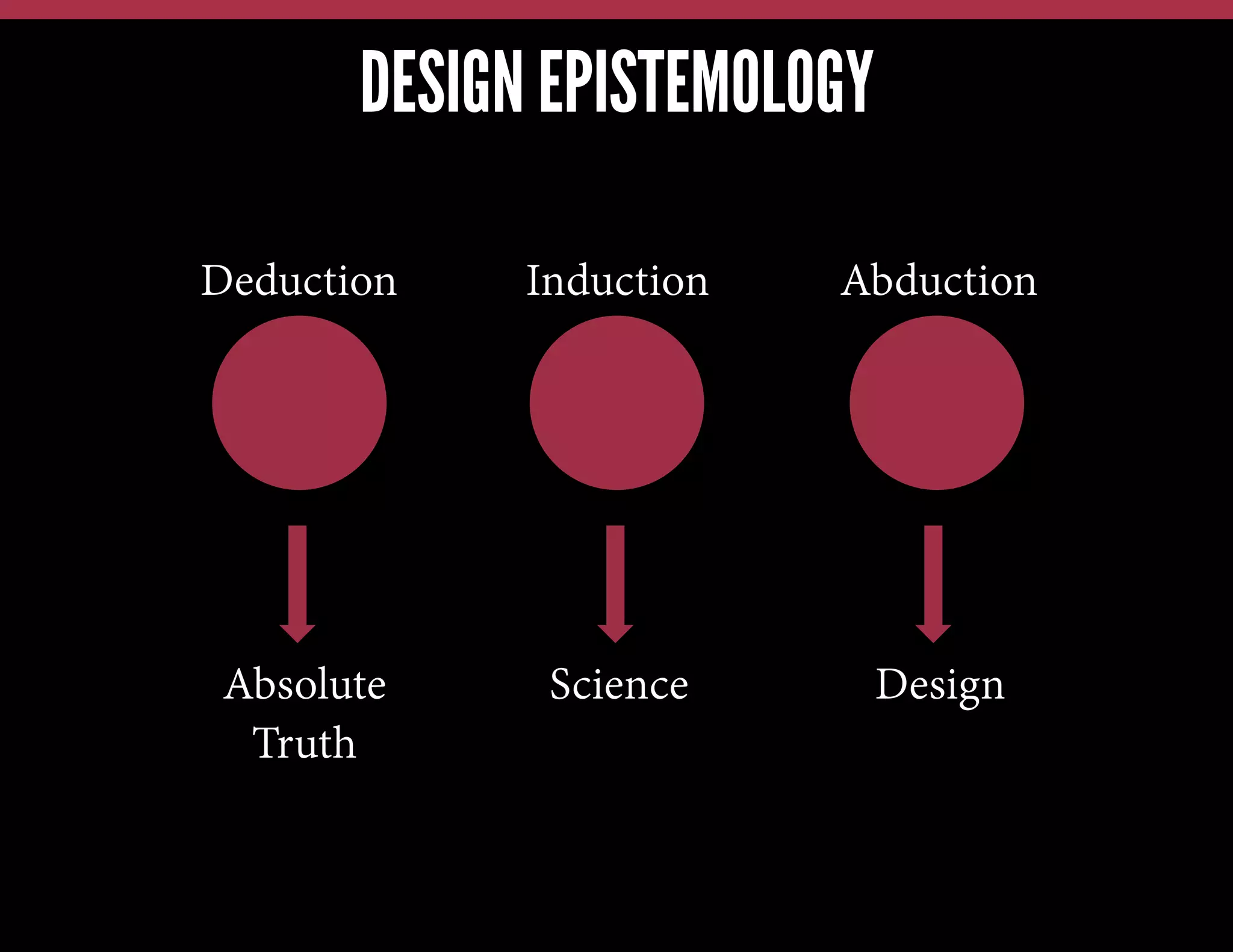
DESIGN EPISTEMOLOGY
Deduction

Induction

Abduction

Absolute
Truth

Science

Design
DESIGN EPISTEMOLOGY
Ideation Process
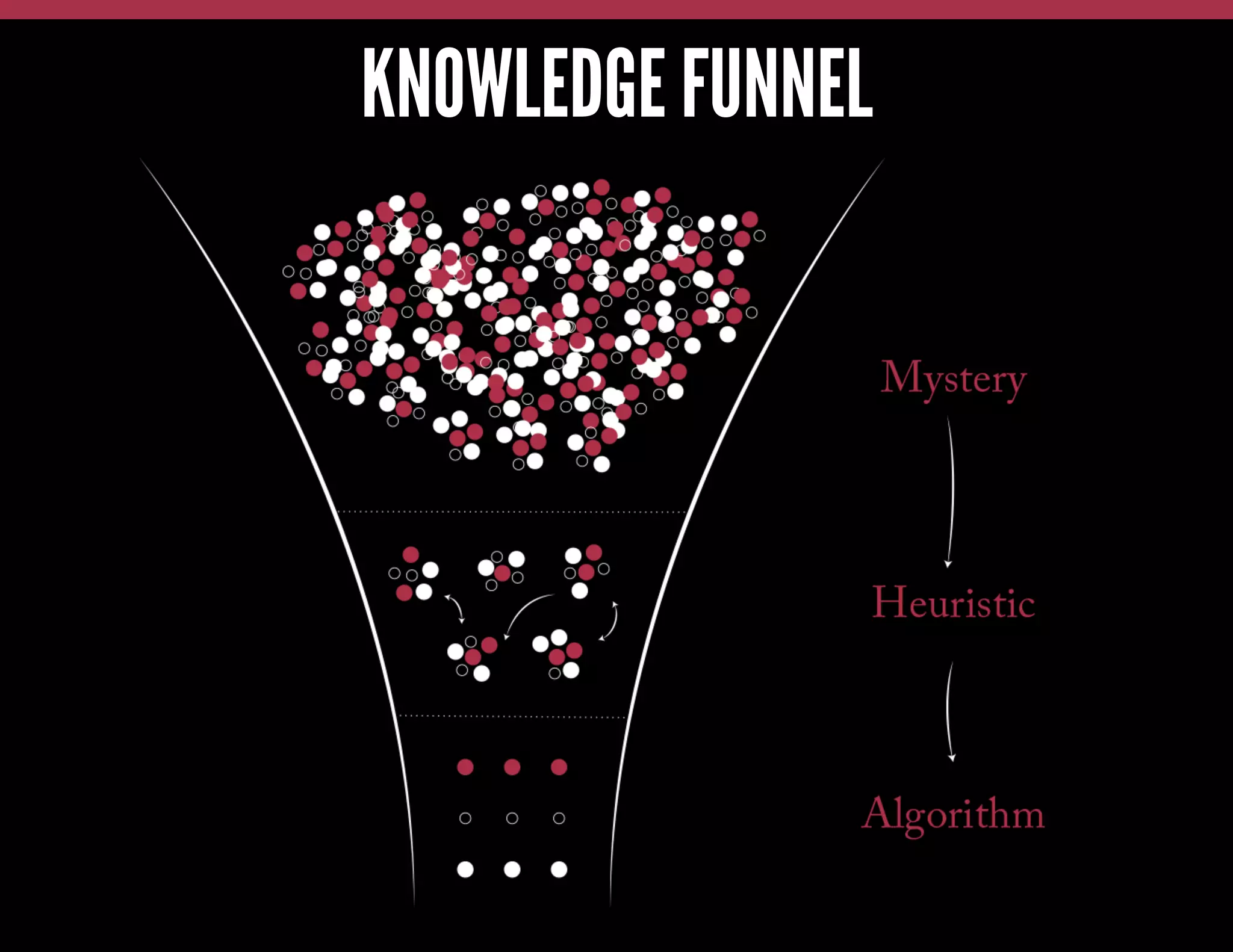
KNOWLEDGE FUNNEL
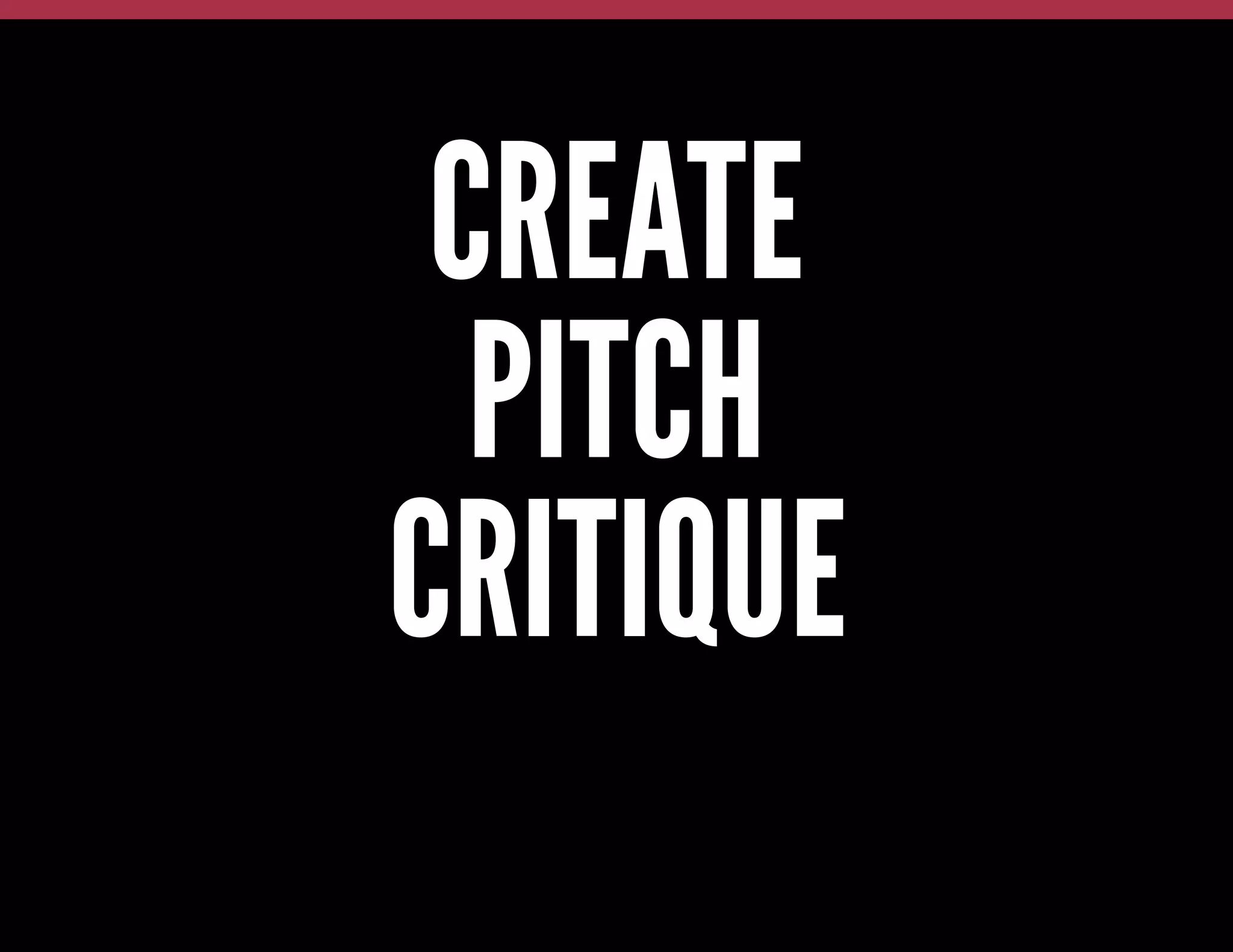
CREATE
PITCH
CRITIQUE
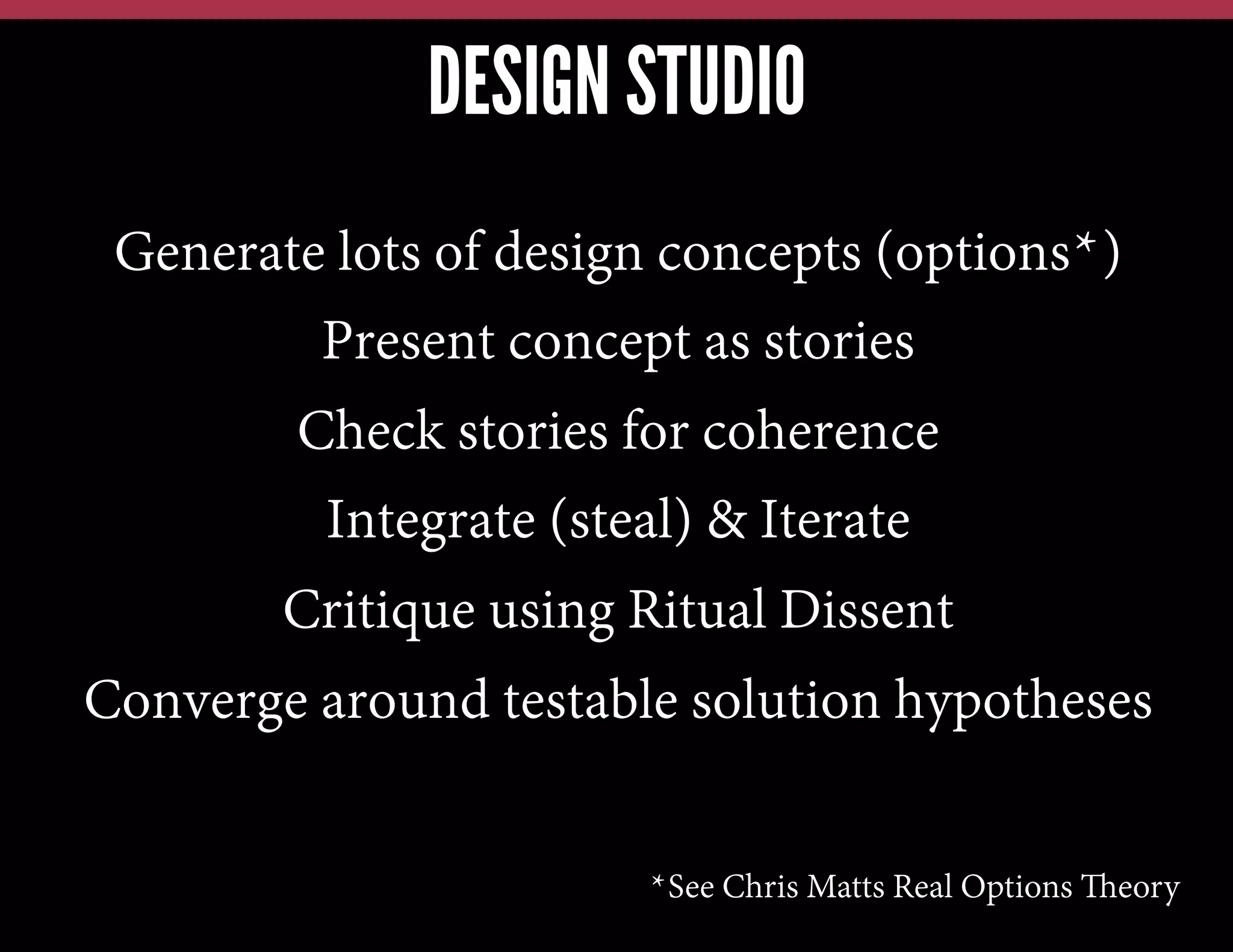
DESIGN STUDIO
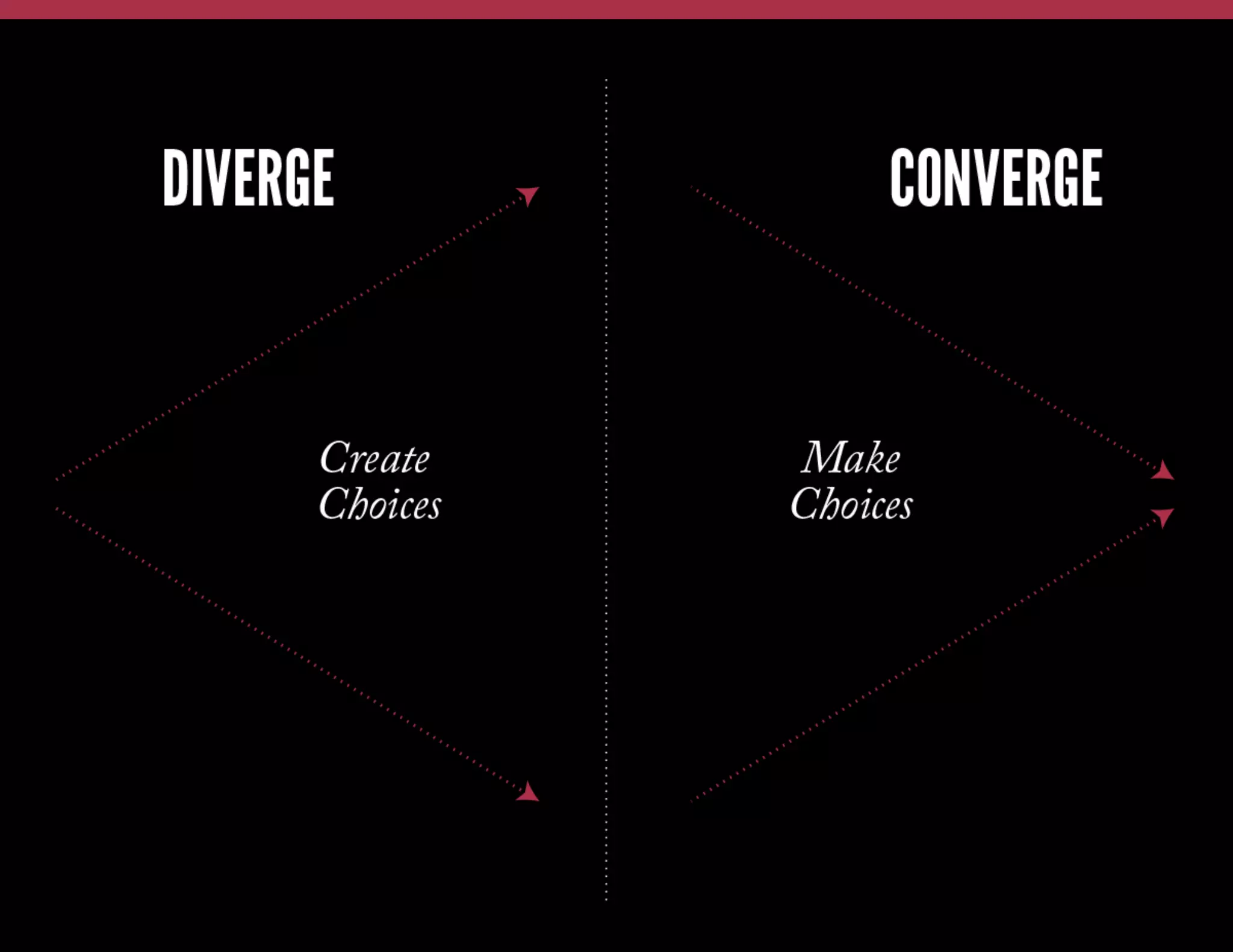
Generate lots of design concepts (options*)
Present concept as stories
Check stories for coherence
Integrate (steal) & Iterate
Critique using Ritual Dissent
Converge around testable solution hypotheses
*See Chris Matts Real Options Theory
4 ELEMENTS OF DESIGN THINKING
We have this problem, lets jump in and brainstorm a solution
We have a new technology, what can we possibly use it for?
Our competitors just launched X; how quickly can we also do X?

• 
• 
• 
• 

Empathy through research
Framing the problem
Generative ideation
Prototyping & validation
PROTOTYPES AND VALIDATION
WHY PROTOTYPE?
•  Explore
• Quickly create testable solution options
• Identifies problems before they’re coded
• Reflection-in-action*

•  Experiment
• Early frequent feedback from customers
• Low opportunity cost

•  Evolve understanding of customer behaviors
* “Theory in Practice,” Chris Argyris & Donald Schön
GET OUT
OF YOUR
HEAD
WHAT FIDELITY?
•  Low fidelity
• Paper
•  Medium fidelity
• Axure
• Omnigraffle
• Indigo Studio
• Clickable Wireframes
•  High Fidelity
• Twitter Bootstrap
• jQueryUI
• Zurb Foundation

Beware of “endowment effect,”
also called the divestiture
aversion.
Once people invest time/effort
“sketching with code,” its very
difficult to throw the concept
away and explore new options.”
Identify what you want to learn,
pick the least effort to go through
Build > Measure > Learn
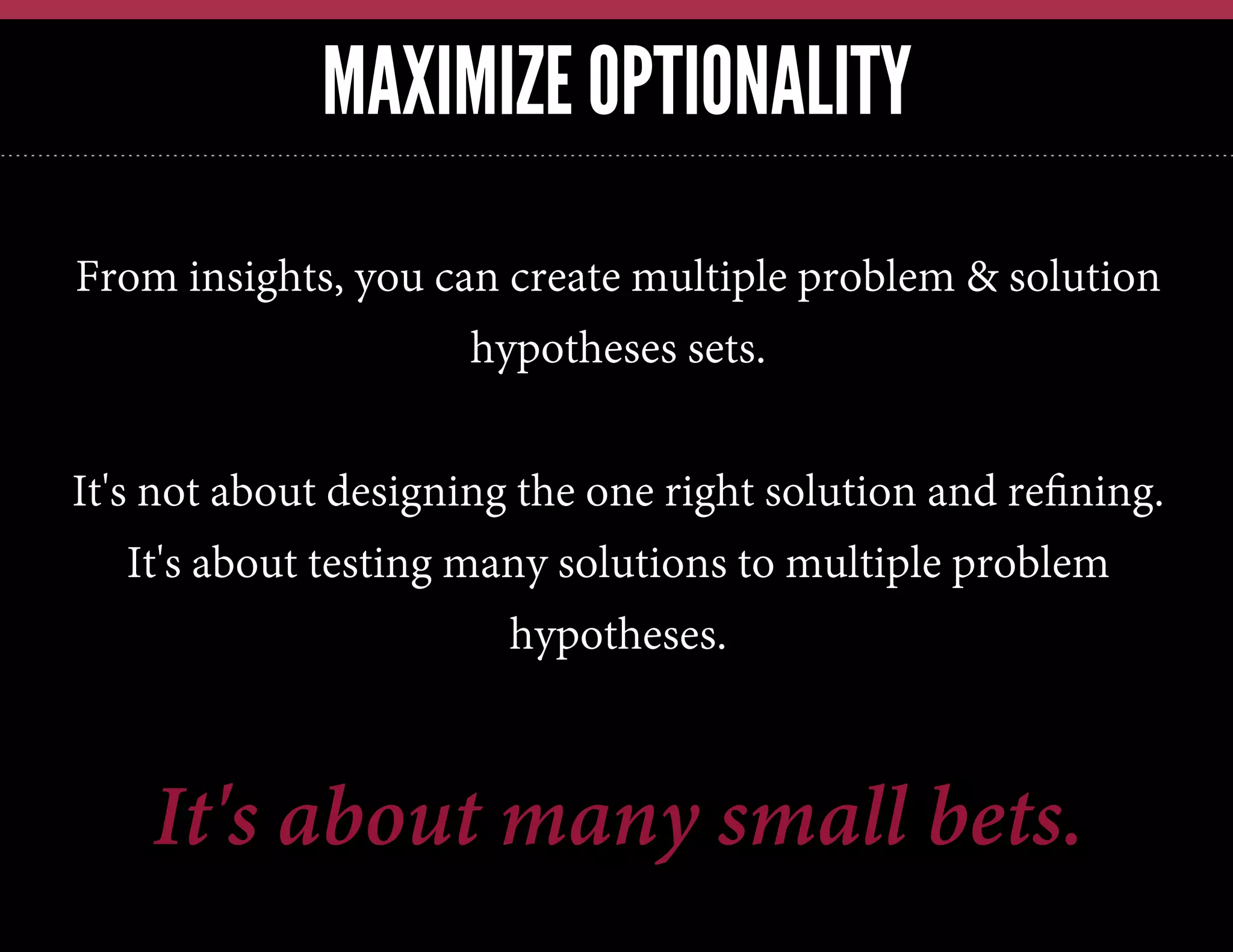
MAXIMIZE OPTIONALITY
From insights, you can create multiple problem & solution
hypotheses sets.
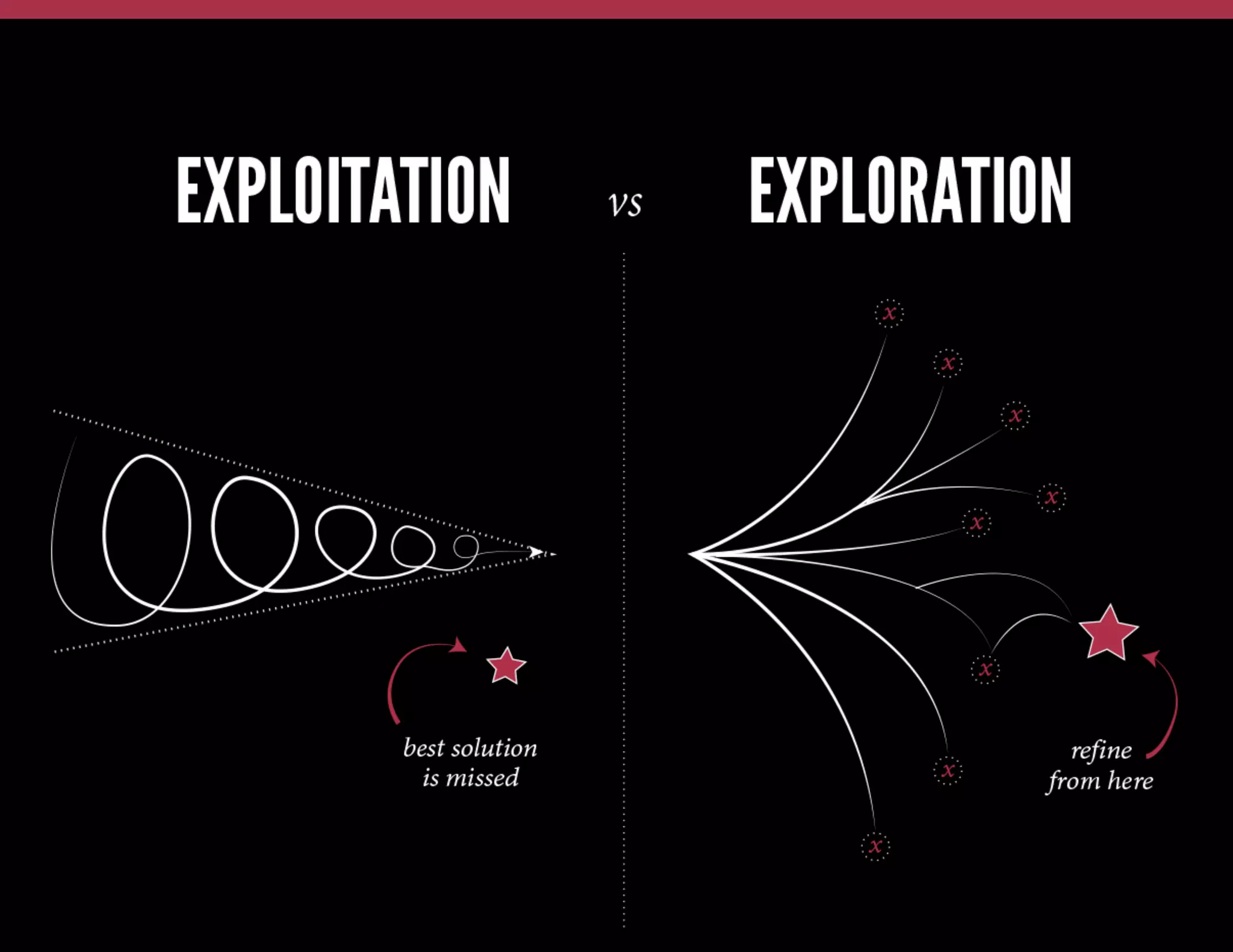
It's not about designing the one right solution and refining.
It's about testing many solutions to multiple problem
hypotheses.

It's about many small bets.
Conclusions
4 ELEMENTS OF DESIGN THINKING
We have this problem, lets jump in and brainstorm a solution
We have a new technology, what can we possibly use it for?
Our competitors just launched X; how quickly can we also do X?

• 
• 
• 
• 

Empathy through research
Framing the problem
Generative Ideation
Prototyping & validation
4 ELEMENTS OF DESIGN THINKING
We have this problem, lets jump in and brainstorm a solution
We have a new technology, what can we possibly use it for?
Our competitors just launched X; how quickly can we also do X?

• 
• 
• 
• 

Empathy through research
Framing the problem
Generative Ideation
Prototyping & validation
4 ELEMENTS OF DESIGN THINKING
We have this problem, lets jump in and brainstorm a solution
We have a new technology, what can we possibly use it for?
Our competitors just launched X; how quickly can we also do X?

• 
• 
• 
• 

Empathy through research
Framing the problem
Generative Ideation
Prototyping & validation
4 ELEMENTS OF DESIGN THINKING
We have this problem, lets jump in and brainstorm a solution
We have a new technology, what can we possibly use it for?
Our competitors just launched X; how quickly can we also do X?

• 
• 
• 
• 

Empathy through research
Framing the problem
Generative Ideation
Prototyping & validation
DESIGNER’S MANTRA
We cannot think about solutions until we
understand the problem.
DESIGNER’S PARADOX
We cannot think about solutions until we
understand the problem.
AND
We cannot understand a problem until we think
about solutions.
 	
  
THOMAS WENDT

WILL EVANS

@thomas_wendt
thomas@srsg.co

@semanticwill
will@tlclabs.co

Thanks!

Design Thinking Workshop

  • 2.
    WHO ARE WE? THOMASWENDT WILL EVANS UX Strategist Managing Director Surrounding Signifiers TLC Labs thomas@srsg.co @thomas_wendt will@tlclabs.co @semanticwill #NYinnovates
  • 3.
    LET’S START WITHAN EXERCISE
  • 4.
  • 5.
  • 6.
    What is DesignThinking?
  • 7.
    “Everyone can –and does – design. We all design when we plan for something new to happen, whether that might be a new version of a recipe, a new arrangement of the living room furniture, or a new layout of a personal web page. The evidence from different cultures around the world, and from designs created by children as well as by adults, suggests that everyone is capable of designing. So design thinking is something inherent within human cognition; it is a key part of what makes us human.” Nigel Cross
  • 8.
    “Design is nowtoo important to be left to designers.” Tim Brown
  • 10.
    ANOTHER DEFINITION An approachto solving problems by understanding people’s needs and synthesizing insights to solve those needs – in context.
  • 11.
    DESIGN THINKING PREMISE Onlythrough contact, observation, and empathy with customers can you hope to design solutions to fit their needs.
  • 12.
    AS OPPOSED TO? • We have this problem, lets jump in and brainstorm a solution •  We have a new technology, what can we possibly use it for? •  Our competitors just launched X; how quickly can we also do X?
  • 14.
  • 15.
    WHERE IS DESIGNINNOVATION?
  • 16.
  • 17.
    Insight about customerbehavior and work patterns were never discovered sitting at your desk.     *
  • 18.
    Research, when donewell, creates a deep sense of empathy for others.     *
  • 19.
  • 20.
    You are notthe user.     *
  • 21.
    4 ELEMENTS OFDESIGN THINKING We have this problem, lets jump in and brainstorm a solution We have a new technology, what can we possibly use it for? Our competitors just launched X; how quickly can we also do X? •  •  •  •  Empathy through research Framing the problem Generative ideation Prototyping & validation
  • 22.
    4 ELEMENTS OFDESIGN THINKING We have this problem, lets jump in and brainstorm a solution We have a new technology, what can we possibly use it for? Our competitors just launched X; how quickly can we also do X? •  •  •  •  Empathy through research Framing the problem Generative ideation Prototyping & validation
  • 23.
  • 24.
  • 25.
    THEORY AND PRACTICE Praxis Processby which theory, lesson, or skill is enacted, practiced, embodied, or realized.
  • 26.
    THEORY AND PRACTICE “Apartfrom inquiry, apart from the praxis, individuals cannot be truly human. Knowledge emerges only through invention and re-invention, through the restless, impatient, continuing, hopeful inquiry human beings pursue in the world, with the world, and with each other.” Paulo Freire
  • 27.
    SYMPATHY syn - together pathos- feeling 1. harmony of or agreement in feeling, as between persons or on the part of one person with respect to another. 2. the harmony of feeling naturally existing between persons of like tastes or opinion or of congenial dispositions. 3. the fact or power of sharing the feelings of another, especially in sorrow or trouble; fellow feeling, compassion, or commiseration.
  • 28.
    EMPATHY en - in pathos- feeling 1. the intellectual identification with or vicarious experiencing of the feelings, thoughts, or attitudes of another.
  • 29.
    In the absenceof direct experience, vicarious identification becomes our substitute.
  • 31.
    “Our real goal,then, is not so much fulfilling manifest needs by creating a speedier printer or a more ergonomic keyboard; that’s the job of designers. It is helping people to articulate the latent needs they may not even know they have, and this is the challenge of design thinkers.” Tim Brown
  • 32.
    “To understand ahammer, for example, does not mean to know that hammers have such and such properties and that they are used for certain purposes—or that in order to hammer one follows a certain procedure, i.e., understanding a hammer at its most primordial sense means knowing how to hammer.” Hubert Dreyfus
  • 34.
    Customer Research HOW MUCHRESEARCH? People   Insights   Lot s  
  • 35.
    A RESEARCH HEURISTIC 12   People   Insights   Lot s  
  • 36.
  • 37.
    Malkovich Bias The tendencyto believe that everyone uses technology the same way you do. - Andres Glusman
  • 38.
    ETHNOGRAPHY Literally “writing culture” Ethnographyis: 1.  The process of “deep hanging out.” 2.  The richest research method we have. 3.  Something you should be doing all the time.
  • 39.
  • 40.
    1. Discover thesemantics of living
  • 41.
    2. Decode signifiersof cultural practice
  • 42.
    3. Understand thelanguage people use.
  • 43.
  • 44.
  • 45.
    Delve deeply intothe context, lives, cultures, and rituals of a few people rather than study a large number of people superficially. This isn’t about booty calls, this is about relationships.
  • 46.
    Holistically study people’sbehaviors and experiences in daily life. You won’t find this in a lab, focus group, or 5 minute interview on the street.
  • 47.
    Learn to askprobing, open questions, gathering as much data as possible to inform your understanding.
  • 48.
    Practice “active seeing,”and “active listening.” Record every minutiae of daily existence, and encode on post-its.
  • 49.
    Use collaborative sense-makingactivities like cynefin and affinity diagramming to understand and formulate a narrative of experience.
  • 50.
    Map the storiesand insights back to the original customer hypothesis and problem hypothesis. Did it validate or invalidate your hypotheses?
  • 51.
    4 ELEMENTS OFDESIGN THINKING We have this problem, lets jump in and brainstorm a solution We have a new technology, what can we possibly use it for? Our competitors just launched X; how quickly can we also do X? •  •  •  •  Empathy through research Framing the problem Generative ideation Prototyping & validation
  • 52.
    How do wemake sense of the world so that we can act in it? FRAMING AND SENSEMAKING
  • 55.
    ON FRAMING “A frameis, simplistically, a point of view; often, and particularly in technical situations, this point of view is deemed “irrelevant” or “biasing” because it implicitly references a non-objective way of considering a situation or idea. But a frame – while certainly subjective and often biasing – is of critical use to the designer, as it is something that is shaped over the long-term aggregation of thoughts and experiences.” Jon Kolko
  • 56.
    FRAMING THROUGH VISUALIZATION “Bytaking the data out of the cognitive realm (the head), removing it from the digital realm (the computer), and making it tangible in the physical realm in one cohesive visual structure (the wall), the designer is freed of the natural memory limitations of the brain and the artificial organizational limitations of technology.” Jon Kolko
  • 57.
    SENSEMAKING The act ofassigning meaning to experience. Extraction of meaning out of a situation. Sometimes purposeful, sometimes not. Micro and macro.
  • 58.
    CYNEFIN The place ofyour multiple affiliations or belongings.
  • 60.
    4 ELEMENTS OFDESIGN THINKING We have this problem, lets jump in and brainstorm a solution We have a new technology, what can we possibly use it for? Our competitors just launched X; how quickly can we also do X? •  •  •  •  Empathy through research Framing the problem Generative ideation Prototyping & validation
  • 61.
  • 62.
  • 63.
  • 64.
  • 67.
  • 68.
  • 70.
  • 71.
    DESIGN STUDIO Generate lotsof design concepts (options*) Present concept as stories Check stories for coherence Integrate (steal) & Iterate Critique using Ritual Dissent Converge around testable solution hypotheses *See Chris Matts Real Options Theory
  • 72.
    4 ELEMENTS OFDESIGN THINKING We have this problem, lets jump in and brainstorm a solution We have a new technology, what can we possibly use it for? Our competitors just launched X; how quickly can we also do X? •  •  •  •  Empathy through research Framing the problem Generative ideation Prototyping & validation
  • 73.
  • 74.
    WHY PROTOTYPE? •  Explore • Quicklycreate testable solution options • Identifies problems before they’re coded • Reflection-in-action* •  Experiment • Early frequent feedback from customers • Low opportunity cost •  Evolve understanding of customer behaviors * “Theory in Practice,” Chris Argyris & Donald Schön
  • 75.
  • 76.
    WHAT FIDELITY? •  Lowfidelity • Paper •  Medium fidelity • Axure • Omnigraffle • Indigo Studio • Clickable Wireframes •  High Fidelity • Twitter Bootstrap • jQueryUI • Zurb Foundation Beware of “endowment effect,” also called the divestiture aversion. Once people invest time/effort “sketching with code,” its very difficult to throw the concept away and explore new options.” Identify what you want to learn, pick the least effort to go through Build > Measure > Learn
  • 77.
    MAXIMIZE OPTIONALITY From insights,you can create multiple problem & solution hypotheses sets. It's not about designing the one right solution and refining. It's about testing many solutions to multiple problem hypotheses. It's about many small bets.
  • 78.
  • 79.
    4 ELEMENTS OFDESIGN THINKING We have this problem, lets jump in and brainstorm a solution We have a new technology, what can we possibly use it for? Our competitors just launched X; how quickly can we also do X? •  •  •  •  Empathy through research Framing the problem Generative Ideation Prototyping & validation
  • 80.
    4 ELEMENTS OFDESIGN THINKING We have this problem, lets jump in and brainstorm a solution We have a new technology, what can we possibly use it for? Our competitors just launched X; how quickly can we also do X? •  •  •  •  Empathy through research Framing the problem Generative Ideation Prototyping & validation
  • 81.
    4 ELEMENTS OFDESIGN THINKING We have this problem, lets jump in and brainstorm a solution We have a new technology, what can we possibly use it for? Our competitors just launched X; how quickly can we also do X? •  •  •  •  Empathy through research Framing the problem Generative Ideation Prototyping & validation
  • 82.
    4 ELEMENTS OFDESIGN THINKING We have this problem, lets jump in and brainstorm a solution We have a new technology, what can we possibly use it for? Our competitors just launched X; how quickly can we also do X? •  •  •  •  Empathy through research Framing the problem Generative Ideation Prototyping & validation
  • 83.
    DESIGNER’S MANTRA We cannotthink about solutions until we understand the problem.
  • 84.
    DESIGNER’S PARADOX We cannotthink about solutions until we understand the problem. AND We cannot understand a problem until we think about solutions.
  • 85.
  • 86.