Design Thinking & Product Innovation
Dr. Nagesh Vadaparthi
Professor (IT)
DEPARTMENT OF INFORMATION TECHNOLOGY
MVGR COLLEGE OF ENGINEERING (Autonomous)
Vizianagaram - 535005
Unit – I
Introduction to Design Thinking
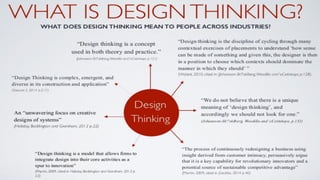
Design Thinking
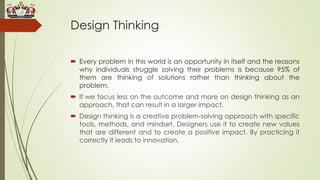
 Every problem in this world is an opportunity in itself and the reasons
why individuals struggle solving their problems is because 95% of
them are thinking of solutions rather than thinking about the
problem.
 If we focus less on the outcome and more on design thinking as an
approach, that can result in a larger impact.
 Design thinking is a creative problem-solving approach with specific
tools, methods, and mindset. Designers use it to create new values
that are different and to create a positive impact. By practicing it
correctly it leads to innovation.
Example
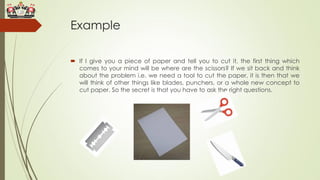
 If I give you a piece of paper and tell you to cut it, the first thing which
comes to your mind will be where are the scissors? If we sit back and think
about the problem i.e. we need a tool to cut the paper, it is then that we
will think of other things like blades, punchers, or a whole new concept to
cut paper. So the secret is that you have to ask the right questions.
So…..
“Design thinking”
is an attitude that gets you ‘un-stuck’.
Why design thinking?
 Because it gives the designers a new way of tackling problems. Instead of
following the normal convergent approach where they make the best
choice out of available alternatives, it encourages them to explore new
alternatives, new solutions, new ideas that have not existed before.
 When we are given a task to design something we should disrupt the
problem and find out what the real goal is by asking ‘Why’ till we reach the
ultimate goal. This is called a root cause analysis. Similarly, there are various
tools, methods, and mindsets designers must use to give better solutions.
 Stanford and IDEO have done an extensive study on these methods and
tools to be followed for design thinking.
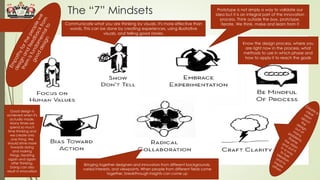
Communicate what you are thinking by visuals. It's more effective than
words. This can be done by creating experiences, using illustrative
visuals, and telling good stories.
The “7” Mindsets Prototype is not simply a way to validate our
idea but it is an integral part of the innovation
process. Think outside the box, prototype,
iterate. We think, make and learn from it
Know the design process, where you
are right now in the process, what
methods to use in which phase and
how to apply it to reach the goals
Good design is
achieved when it's
actually made.
Many times we
spend so much
time thinking and
we create only
one thing. We
should strive more
towards doing
and making
things, iterating
again and again
after thinking.
Doing can also
result in innovation
Bringing together designers and innovators from different backgrounds,
varied interests, and viewpoints. When people from different fields come
together, breakthrough insights can come up
Methods
There are many different methods to be used in
different phases in the design process. These
methods aid us to achieve the perfect solution
we are looking for.
“4” Methods
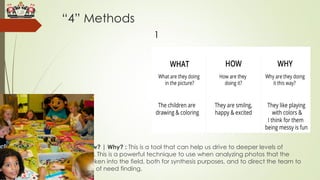
 What? | How? | Why? : This is a tool that can help us drive to deeper levels of
observation. This is a powerful technique to use when analyzing photos that the
team has taken into the field, both for synthesis purposes, and to direct the team to
future areas of need finding.
1
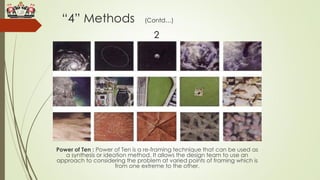
Power of Ten : Power of Ten is a re-framing technique that can be used as
a synthesis or ideation method. It allows the design team to use an
approach to considering the problem at varied points of framing which is
from one extreme to the other.
“4” Methods (Contd…)
2
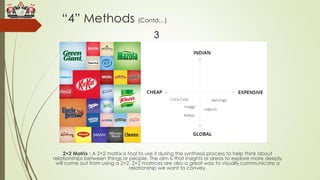
2×2 Matrix : A 2×2 matrix is tool to use it during the synthesis process to help think about
relationships between things or people. The aim is that insights or areas to explore more deeply
will come out from using a 2×2. 2×2 matrices are also a great way to visually communicate a
relationship we want to convey.
“4” Methods (Contd…)
3
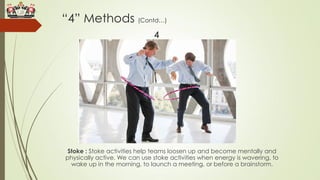
Stoke : Stoke activities help teams loosen up and become mentally and
physically active. We can use stoke activities when energy is wavering, to
wake up in the morning, to launch a meeting, or before a brainstorm.
“4” Methods (Contd…)
4
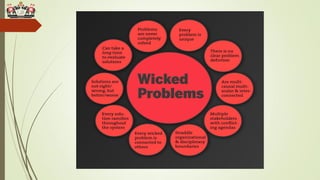
Wicked Problem
Courtesy: Systems Innovation. Source: Youtube
Wicked Problems
 A wicked problem is a social or cultural problem that is difficult or
impossible to solve for as many as four reasons: incomplete or contradictory
knowledge, the number of people and opinions involved, the large
economic burden, and the interconnected nature of these problems with
other problems.
How to Solve Wicked Problems?
 Solutions to wicked problems are not true or false; they can only be good
or bad. You cannot immediately test a solution to a wicked problem. Every
solution to a wicked problem is a "one-shot operation" because there is no
opportunity to learn by trial and error—every attempt counts significantly.
Design Thinking
 Design thinking informs human-centred innovation. It begins with
developing an understanding of customers' or users' unmet or unarticulated
needs. ... Design thinking minimises the uncertainty and risk of innovation by
engaging customers or users through a series of prototypes to learn, test,
and refine concepts.
 Design Thinking is extremely user-centric. It focuses on humans first and
foremost, seeking to understand people’s needs and come up with
effective solutions to meet those needs. It is what we call a solution-based
approach to problem-solving.
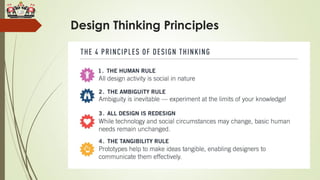
Design Thinking Principles
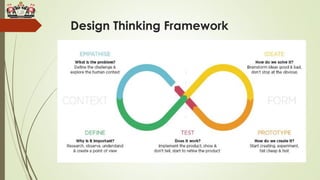
Design Thinking Framework
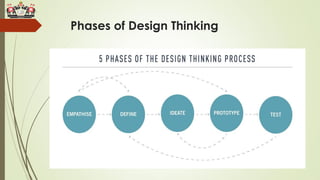
Phases of Design Thinking
Empathise
 The first stage of the Design Thinking process is to gain an empathic
understanding of the problem you are trying to solve.
 This involves consulting experts to find out more about the area of concern
through observing, engaging and empathizing with people to understand their
experiences and motivations, as well as immersing yourself in the physical
environment so you can gain a deeper personal understanding of the issues
involved.
 Empathy is crucial to a human-centered design process such as Design
Thinking, and empathy allows design thinkers to set aside their own assumptions
about the world in order to gain insight into users and their needs.
 Depending on time constraints, a substantial amount of information is gathered
at this stage to use during the next stage and to develop the best possible
understanding of the users, their needs, and the problems that underlie the
development of that particular product.
Define (the Problem)
 During the Define stage, you put together the information you have created and
gathered during the Empathise stage. This is where you will analyse your observations and
synthesise them in order to define the core problems that you and your team have
identified up to this point. You should seek to define the problem as a problem statement
in a human-centred manner.
 Instead of defining the problem as your own wish or a need of the company such as,
“We need to increase our food-product market share among young teenage girls by 5%,” a
much better way to define the problem would be, “Teenage girls need to eat nutritious food
in order to thrive, be healthy and grow.”
 The Define stage will help the designers in your team gather great ideas to establish
features, functions, and any other elements that will allow them to solve the problems or,
at the very least, allow users to resolve issues themselves with the minimum of difficulty. In
the Define stage you will start to progress to the third stage, Ideate, by asking questions
which can help you look for ideas for solutions by asking:
“How might we… encourage teenage girls to perform an action that benefits them and also
involves your company’s food-product or service?”
Ideate
 During the third stage of the Design Thinking process, designers are ready to
start generating ideas. You’ve grown to understand your users and their needs
in the Empathise stage, and you’ve analysed and synthesised your observations
in the Define stage, and ended up with a human-centered problem statement.
 With this solid background, you and your team members can start to "think
outside the box" to identify new solutions to the problem statement you’ve
created, and you can start to look for alternative ways of viewing the problem.
 There are hundreds of Ideation techniques such as Brainstorm, Brainwrite, Worst
Possible Idea, and SCAMPER.
 Brainstorm and Worst Possible Idea sessions are typically used to stimulate free
thinking and to expand the problem space. It is important to get as many ideas
or problem solutions as possible at the beginning of the Ideation phase.
 You should pick some other Ideation techniques by the end of the Ideation
phase to help you investigate and test your ideas so you can find the best way
to either solve a problem or provide the elements required to circumvent it.
Prototype
 The design team will now produce a number of inexpensive, scaled down
versions of the product or specific features found within the product, so they
can investigate the problem solutions generated in the previous stage.
 Prototypes may be shared and tested within the team itself, in other
departments, or on a small group of people outside the design team.
 This is an experimental phase, and the aim is to identify the best possible solution
for each of the problems identified during the first three stages.
 The solutions are implemented within the prototypes, and, one by one, they are
investigated and either accepted, improved and re-examined, or rejected on
the basis of the users’ experiences.
 By the end of this stage, the design team will have a better idea of the
constraints inherent to the product and the problems that are present, and
have a clearer view of how real users would behave, think, and feel when
interacting with the end product.
Test
 Designers or evaluators rigorously test the complete product using the best
solutions identified during the prototyping phase.
 This is the final stage of the 5 stage-model, but in an iterative process, the
results generated during the testing phase are often used to redefine one
or more problems and inform the understanding of the users, the conditions
of use, how people think, behave, and feel, and to empathise.
 Even during this phase, alterations and refinements are made in order to
rule out problem solutions and derive as deep an understanding of the
product and its users as possible.
The Non-Linear Nature of Design Thinking
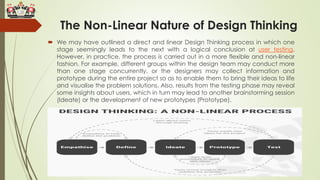
 We may have outlined a direct and linear Design Thinking process in which one
stage seemingly leads to the next with a logical conclusion at user testing.
However, in practice, the process is carried out in a more flexible and non-linear
fashion. For example, different groups within the design team may conduct more
than one stage concurrently, or the designers may collect information and
prototype during the entire project so as to enable them to bring their ideas to life
and visualise the problem solutions. Also, results from the testing phase may reveal
some insights about users, which in turn may lead to another brainstorming session
(Ideate) or the development of new prototypes (Prototype).
The Non-Linear Nature of Design Thinking
(Contd…)
 It is important to note that the five stages are not always sequential — they do not
have to follow any specific order and they can often occur in parallel and be
repeated iteratively. As such, the stages should be understood as different modes
that contribute to a project, rather than sequential steps. However, the amazing
thing about the five-stage Design Thinking model is that it systematises and
identifies the 5 stages/modes you would expect to carry out in a design project –
and in any innovative problem-solving project. Every project will involve activities
specific to the product under development, but the central idea behind each
stage remains the same.
The Origin of the 5-Stage Model
 In his 1969 seminal text on design methods, “The Sciences of the Artificial,” Nobel
Prize laureate Herbert Simon outlined one of the first formal models of the Design
Thinking process. Simon's model consists of seven major stages, each with
component stages and activities, and was largely influential in shaping some of
the most widely used Design Thinking process models today. There are many
variants of the Design Thinking process in use in the 21st century, and while they
may have different numbers of stages ranging from three to seven, they are all
based upon the same principles featured in Simon’s 1969 model. We focus on
the five-stage Design Thinking model proposed by the Hasso-Plattner Institute of
Design at Stanford (d.school).
The Take Away
 In essence, the Design Thinking process is iterative, flexible and focused on
collaboration between designers and users, with an emphasis on bringing
ideas to life based on how real users think, feel and behave.
 Design Thinking tackles complex problems by:
 Empathising: Understanding the human needs involved.
 Defining: Re-framing and defining the problem in human-centric ways.
 Ideating: Creating many ideas in ideation sessions.
 Prototyping: Adopting a hands-on approach in prototyping.
 Testing: Developing a prototype/solution to the problem.
THANK YOU