innovation | digital transformation | value creation | (r)evolution
What is Design Thinking?
Workshop | February 2018
David Terrar | Founder & CXO – Agile Elephant | @DT on Twitter
innovation | digital transformation | value creation | (r)evolution
Design is a way of changing life and
influencing the future
Sir Ernest Hall
Pianist, Entrepreneur, and Philanthropist
The ultimate defense against
complexity
David Gelernter
Professor of Computer Science, Yale
Simplicity is the ultimate
sophistication
Leonardo da Vinci
innovation | digital transformation | value creation | (r)evolution
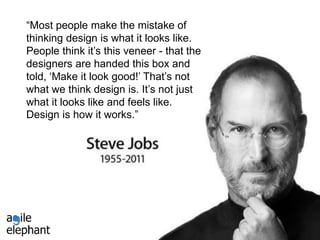
“Most people make the mistake of
thinking design is what it looks like.
People think it’s this veneer - that the
designers are handed this box and
told, ‘Make it look good!’ That’s not
what we think design is. It’s not just
what it looks like and feels like.
Design is how it works.”
innovation | digital transformation | value creation | (r)evolution
“Design-thinking firms stand apart in their
willingness to engage in the task of continuously
redesigning their business… to create advances
in both innovation and efficiency - the
combination that produces the most powerful
competitive edge.”
Roger Martin, author of the Design of Business
innovation | digital transformation | value creation | (r)evolution
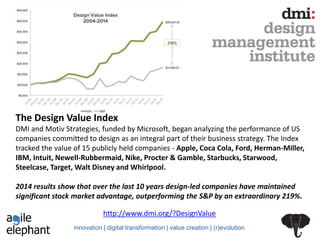
The Design Value Index
DMI and Motiv Strategies, funded by Microsoft, began analyzing the performance of US
companies committed to design as an integral part of their business strategy. The Index
tracked the value of 15 publicly held companies - Apple, Coca Cola, Ford, Herman-Miller,
IBM, Intuit, Newell-Rubbermaid, Nike, Procter & Gamble, Starbucks, Starwood,
Steelcase, Target, Walt Disney and Whirlpool.
2014 results show that over the last 10 years design-led companies have maintained
significant stock market advantage, outperforming the S&P by an extraordinary 219%.
http://www.dmi.org/?DesignValue
innovation | digital transformation | value creation | (r)evolution
What is Design Thinking?
• History back to the 60s
• Lots of thinkers and contributors involved
• 1987 - Peter Rowe of Harvard publishes Design
Thinking
• 1991 - IDEO design company showcases their design
process, draws heavily on the Stanford curriculum
• 2005 - Stanford's d.school begins teaching design
thinking as a formal method
• See David Kelley (of IDEO) TED talks
• User-centred approach to problem solving
innovation | digital transformation | value creation | (r)evolution
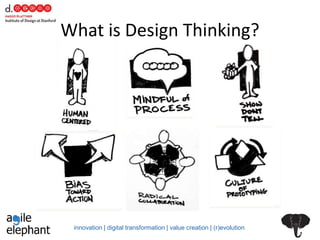
What is Design Thinking?
innovation | digital transformation | value creation | (r)evolution
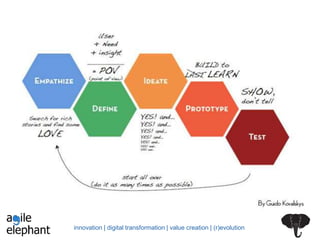
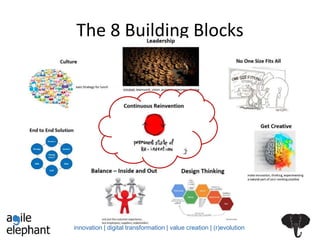
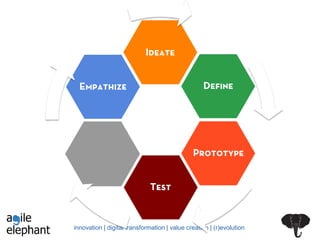
The 8 Building Blocks
innovation | digital transformation | value creation | (r)evolution
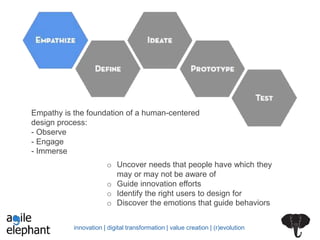
Empathy is the foundation of a human-centered
design process:
- Observe
- Engage
- Immerse
o Uncover needs that people have which they
may or may not be aware of
o Guide innovation efforts
o Identify the right users to design for
o Discover the emotions that guide behaviors
innovation | digital transformation | value creation | (r)evolution
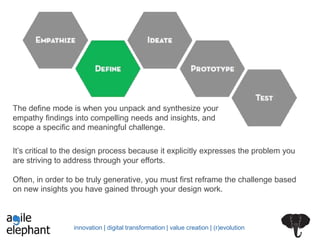
The define mode is when you unpack and synthesize your
empathy findings into compelling needs and insights, and
scope a specific and meaningful challenge.
It’s critical to the design process because it explicitly expresses the problem you
are striving to address through your efforts.
Often, in order to be truly generative, you must first reframe the challenge based
on new insights you have gained through your design work.
innovation | digital transformation | value creation | (r)evolution
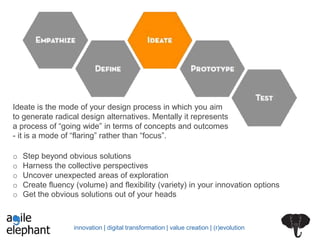
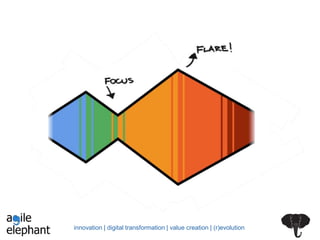
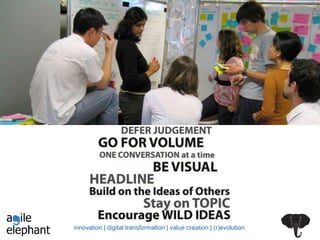
Ideate is the mode of your design process in which you aim
to generate radical design alternatives. Mentally it represents
a process of “going wide” in terms of concepts and outcomes
- it is a mode of “flaring” rather than “focus”.
o Step beyond obvious solutions
o Harness the collective perspectives
o Uncover unexpected areas of exploration
o Create fluency (volume) and flexibility (variety) in your innovation options
o Get the obvious solutions out of your heads
innovation | digital transformation | value creation | (r)evolution
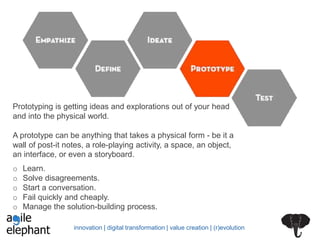
Prototyping is getting ideas and explorations out of your head
and into the physical world.
A prototype can be anything that takes a physical form - be it a
wall of post-it notes, a role-playing activity, a space, an object,
an interface, or even a storyboard.
o Learn.
o Solve disagreements.
o Start a conversation.
o Fail quickly and cheaply.
o Manage the solution-building process.
innovation | digital transformation | value creation | (r)evolution
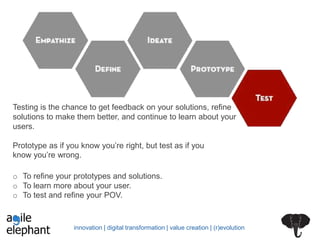
Testing is the chance to get feedback on your solutions, refine
solutions to make them better, and continue to learn about your
users.
Prototype as if you know you’re right, but test as if you
know you’re wrong.
o To refine your prototypes and solutions.
o To learn more about your user.
o To test and refine your POV.
innovation | digital transformation | value creation | (r)evolution
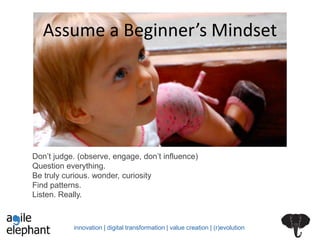
Assume a Beginner’s Mindset
Don’t judge. (observe, engage, don’t influence)
Question everything.
Be truly curious. wonder, curiosity
Find patterns.
Listen. Really.
innovation | digital transformation | value creation | (r)evolution
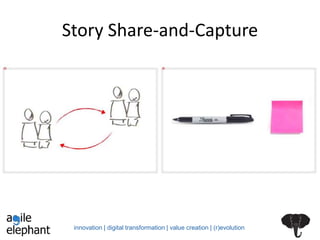
Story Share-and-Capture
innovation | digital transformation | value creation | (r)evolution
What? | How? | Why?
Set-up: Divide a sheet into three sections: What?, How?, and Why?
Start with concrete observations (What):
• What is the person you’re observing doing
• Notice and write down
• Try to be objective and don’t make assumptions in this first part.
Move to understanding (How):
• How are they doing what they are doing?
• Does it require effort?
• Do they appear rushed? Use descriptive phrases packed with adjectives.
Step out on a limb of interpretation (Why):
• Why are they doing what they’re doing?
• What are the motivations and emotions.
• Understand the meaning and assumptions of the situation.
innovation | digital transformation | value creation | (r)evolution
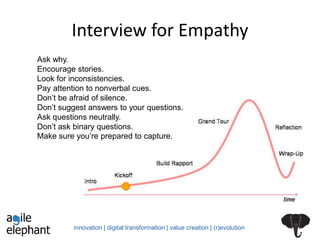
Interview for Empathy
Ask why.
Encourage stories.
Look for inconsistencies.
Pay attention to nonverbal cues.
Don’t be afraid of silence.
Don’t suggest answers to your questions.
Ask questions neutrally.
Don’t ask binary questions.
Make sure you’re prepared to capture.
innovation | digital transformation | value creation | (r)evolution
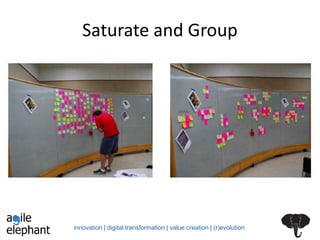
Saturate and Group
innovation | digital transformation | value creation | (r)evolution
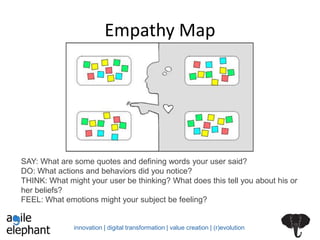
Empathy Map
SAY: What are some quotes and defining words your user said?
DO: What actions and behaviors did you notice?
THINK: What might your user be thinking? What does this tell you about his or
her beliefs?
FEEL: What emotions might your subject be feeling?
innovation | digital transformation | value creation | (r)evolution
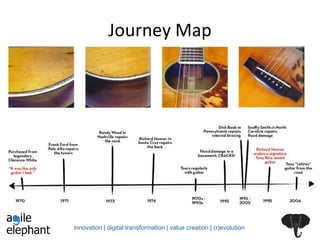
Journey Map
innovation | digital transformation | value creation | (r)evolution
Other techniques
• Camera Study
• Extreme Users
• Analogous Empathy
• Composite Character Profile
• Powers of Ten
• 2x2 Matrix
• Why-How Laddering
• Point-of-View Analogy
• “How Might We” Questions
innovation | digital transformation | value creation | (r)evolution
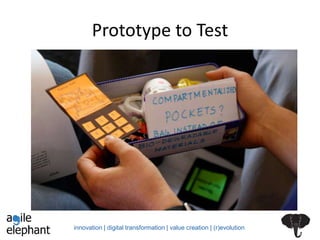
Prototype to Test
innovation | digital transformation | value creation | (r)evolution
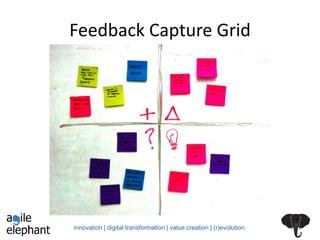
Feedback Capture Grid
innovation | digital transformation | value creation | (r)evolution
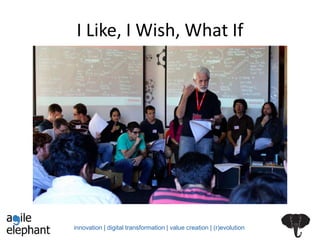
I Like, I Wish, What If
innovation | digital transformation | value creation | (r)evolution
Resources
https://dschool.stanford.edu/groups/designresources/
http://dschool.stanford.edu/use-our-methods/
http://dschool.stanford.edu/wp-content/uploads/2013/10/METHODCARDS-v3-slim.pdf
http://blog.ted.com/10-talks-about-the-beauty-and-difficulty-of-being-creative/
https://www.ted.com/talks/david_kelley_on_human_centered_design?language=en
innovation | digital transformation | value creation | (r)evolution
David Terrar
Agile Elephant | Bloor | Cloud Industry Forum
p: +44 (0)1727 866309
m: +44 (0)7715 159423
e: dt@d2c.org.uk
w: www.theagileelephant.com
skype: david_terrar
twitter: http://twittter.com/DT @DT
linkedin: http://www.linkedin.com/in/davidterrar
blog: http://theagileelephant.com/blog
& http://medium.com/@DT

What is Design Thinking?

  • 1.
    innovation | digitaltransformation | value creation | (r)evolution What is Design Thinking? Workshop | February 2018 David Terrar | Founder & CXO – Agile Elephant | @DT on Twitter
  • 2.
    innovation | digitaltransformation | value creation | (r)evolution Design is a way of changing life and influencing the future Sir Ernest Hall Pianist, Entrepreneur, and Philanthropist The ultimate defense against complexity David Gelernter Professor of Computer Science, Yale Simplicity is the ultimate sophistication Leonardo da Vinci
  • 3.
    innovation | digitaltransformation | value creation | (r)evolution “Most people make the mistake of thinking design is what it looks like. People think it’s this veneer - that the designers are handed this box and told, ‘Make it look good!’ That’s not what we think design is. It’s not just what it looks like and feels like. Design is how it works.”
  • 4.
    innovation | digitaltransformation | value creation | (r)evolution “Design-thinking firms stand apart in their willingness to engage in the task of continuously redesigning their business… to create advances in both innovation and efficiency - the combination that produces the most powerful competitive edge.” Roger Martin, author of the Design of Business
  • 5.
    innovation | digitaltransformation | value creation | (r)evolution The Design Value Index DMI and Motiv Strategies, funded by Microsoft, began analyzing the performance of US companies committed to design as an integral part of their business strategy. The Index tracked the value of 15 publicly held companies - Apple, Coca Cola, Ford, Herman-Miller, IBM, Intuit, Newell-Rubbermaid, Nike, Procter & Gamble, Starbucks, Starwood, Steelcase, Target, Walt Disney and Whirlpool. 2014 results show that over the last 10 years design-led companies have maintained significant stock market advantage, outperforming the S&P by an extraordinary 219%. http://www.dmi.org/?DesignValue
  • 6.
    innovation | digitaltransformation | value creation | (r)evolution What is Design Thinking? • History back to the 60s • Lots of thinkers and contributors involved • 1987 - Peter Rowe of Harvard publishes Design Thinking • 1991 - IDEO design company showcases their design process, draws heavily on the Stanford curriculum • 2005 - Stanford's d.school begins teaching design thinking as a formal method • See David Kelley (of IDEO) TED talks • User-centred approach to problem solving
  • 7.
    innovation | digitaltransformation | value creation | (r)evolution What is Design Thinking?
  • 8.
    innovation | digitaltransformation | value creation | (r)evolution
  • 9.
    innovation | digitaltransformation | value creation | (r)evolution The 8 Building Blocks
  • 10.
    innovation | digitaltransformation | value creation | (r)evolution Empathy is the foundation of a human-centered design process: - Observe - Engage - Immerse o Uncover needs that people have which they may or may not be aware of o Guide innovation efforts o Identify the right users to design for o Discover the emotions that guide behaviors
  • 11.
    innovation | digitaltransformation | value creation | (r)evolution The define mode is when you unpack and synthesize your empathy findings into compelling needs and insights, and scope a specific and meaningful challenge. It’s critical to the design process because it explicitly expresses the problem you are striving to address through your efforts. Often, in order to be truly generative, you must first reframe the challenge based on new insights you have gained through your design work.
  • 12.
    innovation | digitaltransformation | value creation | (r)evolution Ideate is the mode of your design process in which you aim to generate radical design alternatives. Mentally it represents a process of “going wide” in terms of concepts and outcomes - it is a mode of “flaring” rather than “focus”. o Step beyond obvious solutions o Harness the collective perspectives o Uncover unexpected areas of exploration o Create fluency (volume) and flexibility (variety) in your innovation options o Get the obvious solutions out of your heads
  • 13.
    innovation | digitaltransformation | value creation | (r)evolution
  • 14.
    innovation | digitaltransformation | value creation | (r)evolution
  • 15.
    innovation | digitaltransformation | value creation | (r)evolution Prototyping is getting ideas and explorations out of your head and into the physical world. A prototype can be anything that takes a physical form - be it a wall of post-it notes, a role-playing activity, a space, an object, an interface, or even a storyboard. o Learn. o Solve disagreements. o Start a conversation. o Fail quickly and cheaply. o Manage the solution-building process.
  • 16.
    innovation | digitaltransformation | value creation | (r)evolution Testing is the chance to get feedback on your solutions, refine solutions to make them better, and continue to learn about your users. Prototype as if you know you’re right, but test as if you know you’re wrong. o To refine your prototypes and solutions. o To learn more about your user. o To test and refine your POV.
  • 17.
    innovation | digitaltransformation | value creation | (r)evolution
  • 18.
    innovation | digitaltransformation | value creation | (r)evolution Assume a Beginner’s Mindset Don’t judge. (observe, engage, don’t influence) Question everything. Be truly curious. wonder, curiosity Find patterns. Listen. Really.
  • 19.
    innovation | digitaltransformation | value creation | (r)evolution Story Share-and-Capture
  • 20.
    innovation | digitaltransformation | value creation | (r)evolution What? | How? | Why? Set-up: Divide a sheet into three sections: What?, How?, and Why? Start with concrete observations (What): • What is the person you’re observing doing • Notice and write down • Try to be objective and don’t make assumptions in this first part. Move to understanding (How): • How are they doing what they are doing? • Does it require effort? • Do they appear rushed? Use descriptive phrases packed with adjectives. Step out on a limb of interpretation (Why): • Why are they doing what they’re doing? • What are the motivations and emotions. • Understand the meaning and assumptions of the situation.
  • 21.
    innovation | digitaltransformation | value creation | (r)evolution Interview for Empathy Ask why. Encourage stories. Look for inconsistencies. Pay attention to nonverbal cues. Don’t be afraid of silence. Don’t suggest answers to your questions. Ask questions neutrally. Don’t ask binary questions. Make sure you’re prepared to capture.
  • 22.
    innovation | digitaltransformation | value creation | (r)evolution Saturate and Group
  • 23.
    innovation | digitaltransformation | value creation | (r)evolution Empathy Map SAY: What are some quotes and defining words your user said? DO: What actions and behaviors did you notice? THINK: What might your user be thinking? What does this tell you about his or her beliefs? FEEL: What emotions might your subject be feeling?
  • 24.
    innovation | digitaltransformation | value creation | (r)evolution Journey Map
  • 25.
    innovation | digitaltransformation | value creation | (r)evolution Other techniques • Camera Study • Extreme Users • Analogous Empathy • Composite Character Profile • Powers of Ten • 2x2 Matrix • Why-How Laddering • Point-of-View Analogy • “How Might We” Questions
  • 26.
    innovation | digitaltransformation | value creation | (r)evolution Prototype to Test
  • 27.
    innovation | digitaltransformation | value creation | (r)evolution Feedback Capture Grid
  • 28.
    innovation | digitaltransformation | value creation | (r)evolution I Like, I Wish, What If
  • 29.
    innovation | digitaltransformation | value creation | (r)evolution Resources https://dschool.stanford.edu/groups/designresources/ http://dschool.stanford.edu/use-our-methods/ http://dschool.stanford.edu/wp-content/uploads/2013/10/METHODCARDS-v3-slim.pdf http://blog.ted.com/10-talks-about-the-beauty-and-difficulty-of-being-creative/ https://www.ted.com/talks/david_kelley_on_human_centered_design?language=en
  • 30.
    innovation | digitaltransformation | value creation | (r)evolution David Terrar Agile Elephant | Bloor | Cloud Industry Forum p: +44 (0)1727 866309 m: +44 (0)7715 159423 e: dt@d2c.org.uk w: www.theagileelephant.com skype: david_terrar twitter: http://twittter.com/DT @DT linkedin: http://www.linkedin.com/in/davidterrar blog: http://theagileelephant.com/blog & http://medium.com/@DT