Design thinking is a process that uses four foundational practices: empathy, ethnography, abductive thinking, and iterative user testing. It involves comprehending user needs through observation and testing prototypes with users to iteratively design solutions that are user-centered. The stages of design thinking are comprehension, definition, ideation, prototyping, and evaluation.
Introduction
As the digitalrealm becomes ever more central to our lives, the
design of its interfaces becomes ever more important to people’s
quality of life.
3.
Introduction
Design brings itsown cybernetic sensibility to delivering products
and services. The design community has encoded this sensibility
into a set of practices and principles known as design thinking.
4.
Practices
Design thinking isbuilt upon four foundational practices:
Empathy Ethnography
Abductive thinking Iterative user testing
5.
Empathy
It makes thecustomer’s perspective on a problem the starting point
for all design activity. It reflects the philosophy of user-centeredness.
6.
Empathy
No matter howbeautiful a design solution, it doesn’t actually solve
anything if it doesn’t work from the user’s point of view. An elegant chair
that no one can sit in is a user-centered design failure.
7.
Ethnography
It’s a disciplinedprocess of nonjudgmentally observing users within their own
realms.Without ethnography, designers risk unconsciously imposing their own
biases instead of truly seeing the problem from the customer’s perspective.
8.
Abductive thinking
It’s theprocess of finding creative solutions where there are no correct or
best ones. It succeeds in situations where analytical engineering fails. It
strives for designs that are practical as well as beautiful and inspiring.
9.
Iterative user testing
Itforces designers to repeatedly test and revise their beliefs about a
solution. Design thinking views the development of a solution to a problem
as the starting point, not the conclusion.
10.
Iterative user testing
Usertesting exposes proposed designs to the harsh reality of usage in the
form of prototypes. Repeated revision and retesting leads to successively
better designs.
11.
Stages of DesignThinking
As well as it does on graphic media, Design Thinking works also for
software development, and it can be a very useful tool to understand the
needs of the final user or client, and it can be synthesized in five stages.
12.
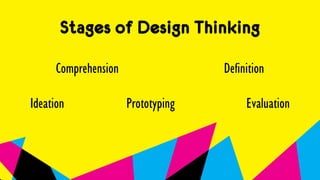
Stages of DesignThinking
Comprehension Definition
Ideation Prototyping Evaluation
13.
Comprehension
It works sideby side with empathy. The developers must understand the final
users’ lives, their problems and needs. It’s important to get involved with the users
in order to make this stage work completely.
14.
Definition
The information gatheredin the previous stage has to be evaluated and only keep
the most valuable and relevant data, in order to build a general idea of the user’s
daily life, their problems and needs.
15.
Ideation
At this point,ideas for the creation of a solution are generated massively. It’s
imperative not to discard any idea, no matter how non-viable it seems.
Mind maps and brainstorming can be useful for this.
16.
Prototyping
With a solutionin mind, the creation of a minimum viable product starts on this
stage. A piece of software can be developed so it can be presented for the final
users to interact with it and give their initial impressions.
17.
Evaluation
The minimum viableproduct is tested and users give their feedback about it. This
stage is helpful because you can find and correct errors to be eliminated when
the final product comes to life.
18.
Questions
1. Name oneof the four practices of design thinking.
2. ¿What is the “Prototyping” stage about?

 Most read

 Most read
 Most read