
DESIGN THINKING
O V E R V I E W
I T E R A T I V E P R O B L E M - S O L V I N G P R O C E S S
FROM
TECH-CENTERED
TO
HUMAN-CENTERED
Reason is the capacity for consciously making sense of
things, applying logic, establishing and verifying facts,
and changing or justifying practices, institutions, and
beliefs based on new or existing information.*
Reasoning is associated with thinking, cognition, and
intellect. Reasoning may be subdivided into forms of
logical reasoning (forms associated with the strict
sense):
• deductive reasoning
• inductive reasoning
• abductive reasoning
REASONING
*wikipedia.org
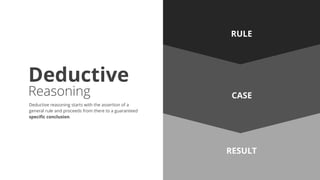
CASE
RULE
RESULT
Deductive
Reasoning
Deductive reasoning starts with the assertion of a
general rule and proceeds from there to a guaranteed
specific conclusion.
RESULT
CASE
RULE
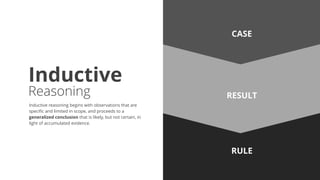
RESULT
CASE
RULE
Inductive
Reasoning
Inductive reasoning begins with observations that are
specific and limited in scope, and proceeds to a
generalized conclusion that is likely, but not certain, in
light of accumulated evidence.
RESULT
RULE
CASE
RESULT
CASE
RULE
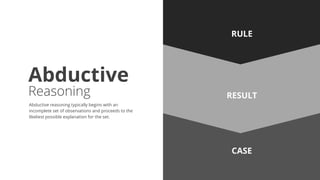
RESULT
RULE
CASE
Abductive
Reasoning
Abductive reasoning typically begins with an
incomplete set of observations and proceeds to the
likeliest possible explanation for the set.
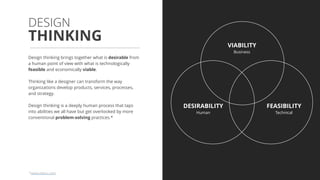
Design thinking brings together what is desirable from
a human point of view with what is technologically
feasible and economically viable.
Thinking like a designer can transform the way
organizations develop products, services, processes,
and strategy.
Design thinking is a deeply human process that taps
into abilities we all have but get overlooked by more
conventional problem-solving practices.*
THINKING
DESIGN
VIABILITY
Business
DESIRABILITY
Human
FEASIBILITY
Technical
*www.ideou.com
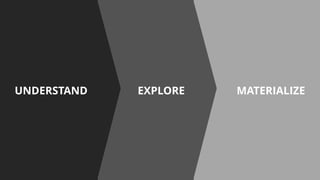
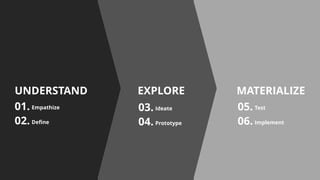
UNDERSTAND EXPLORE MATERIALIZE
Empathize01.
Define02.
Ideate03.
Prototype04.
Test05.
Implement06.
Empathize
Conduct research in order to develop knowledge about
what your users do, say, think, and feel.
Directly observe what they do, how they think, and what
they want, asking yourself things like ‘what motivates or
discourages users?’ or ‘where do they experience
frustration?’*
Define
Combine all your research and observe where your users’
problems exist. In pinpointing your users’ needs, begin to
Organize all your observations and draw parallels across
your users’ current experiences. Is there a common pain
point across many different users? Identify unmet user
needs.*
UNDERSTAND 01.
02.
*www.nngroup.com
Ideate
Brainstorm a range of crazy, creative ideas that address the
unmet user needs identified in the define phase.*
Prototype
Build real, tactile representations for a subset of your
ideas. The goal of this phase is to understand what
components of your ideas work, and which do not.
Make your ideas tactile.*
EXPLORE 03.
04.
*www.nngroup.com
Test
Return to your users for feedback. Ask yourself ‘Does this
solution meet users’ needs?’ and ‘Has it improved how they
feel, think, or do their tasks?’.
Put your prototype in front of real customers and verify
that it achieves your goals.*
Implement
Put the vision into effect. Ensure that your solution is
materialized and touches the lives of your end users.*
MATERIALIZE 05.
06.
*www.nngroup.com
Design Thinking 101 - Nielsen Norman Group
https://www.nngroup.com/articles/design-thinking/
SOURCES
Ideo U
http://www.ideou.com/pages/design-thinking
Change by Design: How Design Thinking Transforms Organizations and Inspires Innovation. T. Brown
https://www.amazon.com/Change-Design-Transforms-Organizations-Innovation/dp/0061766089
TED Talks - Designers - think big!
https://www.ted.com/talks/tim_brown_urges_designers_to_think_big
T H A N K Y O U
@lameraluca
lucalamera

Introduction to Design Thinking

  • 1.
    DESIGN THINKING O VE R V I E W I T E R A T I V E P R O B L E M - S O L V I N G P R O C E S S
  • 2.
  • 3.
    Reason is thecapacity for consciously making sense of things, applying logic, establishing and verifying facts, and changing or justifying practices, institutions, and beliefs based on new or existing information.* Reasoning is associated with thinking, cognition, and intellect. Reasoning may be subdivided into forms of logical reasoning (forms associated with the strict sense): • deductive reasoning • inductive reasoning • abductive reasoning REASONING *wikipedia.org
  • 4.
    CASE RULE RESULT Deductive Reasoning Deductive reasoning startswith the assertion of a general rule and proceeds from there to a guaranteed specific conclusion.
  • 5.
    RESULT CASE RULE RESULT CASE RULE Inductive Reasoning Inductive reasoning beginswith observations that are specific and limited in scope, and proceeds to a generalized conclusion that is likely, but not certain, in light of accumulated evidence.
  • 6.
    RESULT RULE CASE RESULT CASE RULE RESULT RULE CASE Abductive Reasoning Abductive reasoning typicallybegins with an incomplete set of observations and proceeds to the likeliest possible explanation for the set.
  • 7.
    Design thinking bringstogether what is desirable from a human point of view with what is technologically feasible and economically viable. Thinking like a designer can transform the way organizations develop products, services, processes, and strategy. Design thinking is a deeply human process that taps into abilities we all have but get overlooked by more conventional problem-solving practices.* THINKING DESIGN VIABILITY Business DESIRABILITY Human FEASIBILITY Technical *www.ideou.com
  • 8.
  • 9.
  • 10.
    Empathize Conduct research inorder to develop knowledge about what your users do, say, think, and feel. Directly observe what they do, how they think, and what they want, asking yourself things like ‘what motivates or discourages users?’ or ‘where do they experience frustration?’* Define Combine all your research and observe where your users’ problems exist. In pinpointing your users’ needs, begin to Organize all your observations and draw parallels across your users’ current experiences. Is there a common pain point across many different users? Identify unmet user needs.* UNDERSTAND 01. 02. *www.nngroup.com
  • 11.
    Ideate Brainstorm a rangeof crazy, creative ideas that address the unmet user needs identified in the define phase.* Prototype Build real, tactile representations for a subset of your ideas. The goal of this phase is to understand what components of your ideas work, and which do not. Make your ideas tactile.* EXPLORE 03. 04. *www.nngroup.com
  • 12.
    Test Return to yourusers for feedback. Ask yourself ‘Does this solution meet users’ needs?’ and ‘Has it improved how they feel, think, or do their tasks?’. Put your prototype in front of real customers and verify that it achieves your goals.* Implement Put the vision into effect. Ensure that your solution is materialized and touches the lives of your end users.* MATERIALIZE 05. 06. *www.nngroup.com
  • 13.
    Design Thinking 101- Nielsen Norman Group https://www.nngroup.com/articles/design-thinking/ SOURCES Ideo U http://www.ideou.com/pages/design-thinking Change by Design: How Design Thinking Transforms Organizations and Inspires Innovation. T. Brown https://www.amazon.com/Change-Design-Transforms-Organizations-Innovation/dp/0061766089 TED Talks - Designers - think big! https://www.ted.com/talks/tim_brown_urges_designers_to_think_big
  • 14.
    T H AN K Y O U @lameraluca lucalamera