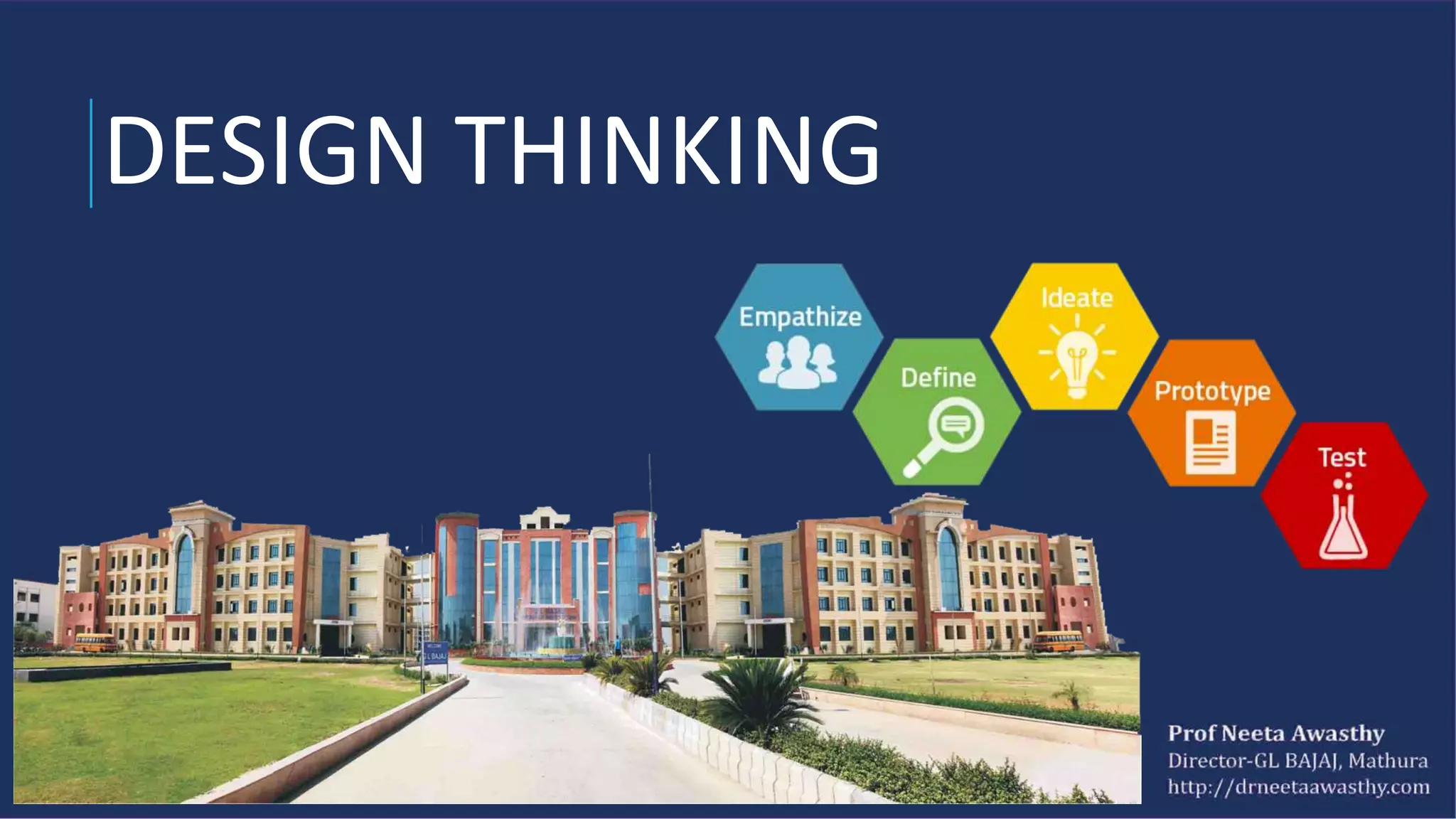
DESIGN THINKING
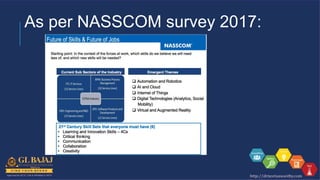
As per NASSCOM survey 2017:
Prerequisites...
Creative Confidence
Visual Shorthand Communication
Task 1. Do you think you are
creative
Draw a portrait of yourself.
Task 1. Do you think you are
creative
Draw a portrait of yourself.
Key Takeaways of this TASK:
Being creative is not being artistic
Ability to show unfinished work
Ability to participate in something you are not good at
This is ‘Creative Confidence’
Task 2: Draw to Communicate
Man
Woman
Baby
Door
House
Innovation
Task 2: Draw to Communicate
Man
Woman
Baby
Door
House
Innovation
Key Takeaway of this Task:
Ability to find something you don’t have a clear answer to
This is Visual Shorthand Communication
Prerequisites...
Creative Confidence
Visual Shorthand Communication
These abilities make an individual who generates Innovative Ideas
SOME WEIRD QUESTIONS
How to make a dripless ice cream?
How to add an iodine patch to all Indian women?
How can we have sachets which open easily but not leak?
How can we convert our TV to smart TV?
How to use Petrol cars with CNG?
How to convert old fittings to have an LED bulb?
How to use plastic and fly ash as building material?
How to leak proof ceilings with organic material?
How to make a cold chain feasible?
How to make a single port for charging & output signal
Answer:
DESIGN THINKING
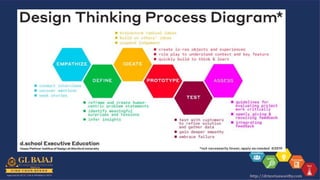
Design Thinking as a Process
...as per D. School Executive Education, Stanford University
1. Empathize
2. Define
3. Ideate
4. Prototype
5. Test
6. Assess
Process1: EMPATHIZE
D. School- Conduct Interviews, Uncover Emotions, Seek
Stories
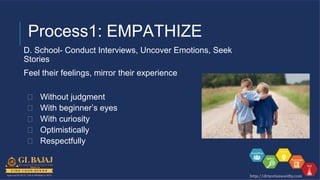
Process1: EMPATHIZE
D. School- Conduct Interviews, Uncover Emotions, Seek
Stories
Feel their feelings, mirror their experience
� Without judgment
� With beginner’s eyes
� With curiosity
� Optimistically
� Respectfully
Process2:
Define Problem Statement or
ANALYSE
D. School-
Reframe and create human centric problem statements
Identify meaningful surprises & tensions
Infer insights
Process2:
Define Problem Statement or
ANALYSE
D. School-
Reframe and create human centric problem statements
Identify meaningful surprises & tensions
Infer insights
Focus on Individuals and not on groups
Take care of extreme users :
CEO of OXO replaced peeler with cushy Handle to address the extreme
user.
Process3: Ideate or SOLVE
D. School- Brainstorming Sessions around the Problem
Brainstorm Radical Ideas
Build on others’ ideas
Suspend Judgement
Process3: Ideate or SOLVE
D. School- Brainstorming Sessions around the Problem
Brainstorm Radical Ideas
Build on others’ ideas
Suspend Judgement
Be visual
Stay on topic
Go for many ideas
Encourage wild ideas
One conversation only
Process4: Prototype (part of SOLVE)
D. School-
Create Lo-res objects and experiences
Role Pay to understand context and key features
Quickly build to think and learn
Process4: Prototype (part of SOLVE)
D. School-
Create Lo-res objects and experiences
Role Pay to understand context and key features
Quickly build to think and learn
Sketch 5-7 radical ways of meeting your user’s needs
Make charts
Make models
Try Simulating them
...find the ‘Best one’
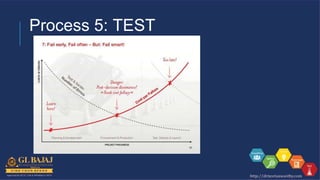
Process 5: Test
D. School-
Test with customers to refine solution and gather data
Gain deeper empathy
Embrace failure
Process 5: Test
D. School-
Test with customers to refine solution and gather data
Gain deeper empathy
Embrace failure
Share your idea
Get the feedback
Process 5: TEST
Process 6: Assess
D. School-
Guidelines for evaluating project work Critically
Openly Giving & receiving feedback
Integrating
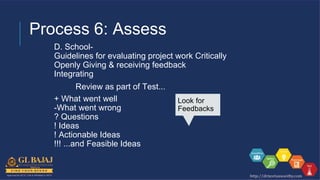
Process 6: Assess
D. School-
Guidelines for evaluating project work Critically
Openly Giving & receiving feedback
Integrating
+ What went well
-What went wrong
? Questions
! Ideas
! Actionable Ideas
!!! ...and Feasible Ideas
Look for
Feedbacks
Review as part of Test...
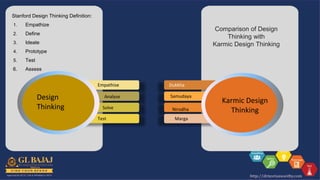
Design
Thinking
Empathise
Analyse
Solve
Test
Karmic Design
Thinking
Dukkha
Samudaya
Nirodha
Marga
Comparison of Design
Thinking with
Karmic Design Thinking
Stanford Design Thinking Definition:
1. Empathize
2. Define
3. Ideate
4. Prototype
5. Test
6. Assess
Case Study 1: She can’t carry a
bag.
She would carry a suitcase with wheels to workplace:
…
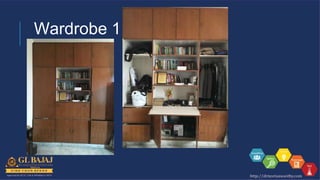
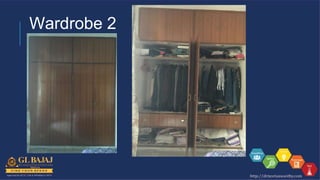
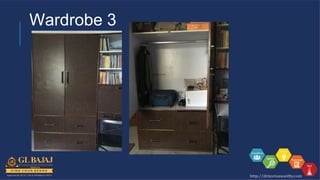
Case Study 2: A wardrobe
Wardrobe 1
Wardrobe 2
Wardrobe 3
PROJECT 1: Design an ideal wallet for your
buddy
Sketch your best idea:
Design an improved wallet:
...as per Design Process
Facts (Physical/ material/color/cost/weight/brand)
Form (shapes/size/texture/pockets/patterns)
Function (Main use/ occasion/ storage idea/ carried)
Relationship (What your buddy carries in the wallet that you don’t/
What would he or she would hate to lose/Is it the reflection of his/
her personality)
Project 2: Design a coconut cutter
To Summarize
Design Thinking is a User Centric Approach.
It is :
� People Centric – empathy is the key
� Highly Creative-Integrative thinking is the key
� Hands-On – Failure is a necessary part of the process
� Iterative- A cycle of “ Understand>Create>Learn”.
Design Principles
...by Dieter Ram (...Data Harms)
1. Good design is innovative
2. Good design makes a product useful
3. Good design is aesthetic
4. Good design makes a product understandable
5. Good design is unobtrusive
6. Good design is honest
7. Good design is long-lasting
8. Good design is thorough down to the last detail
9. Good design is environmentally-friendly
10.Good design is as little design as possible
courtesy: https://3dstartpoint.com/design-principles-for-3d-printing/
drneetaa@gmail.com
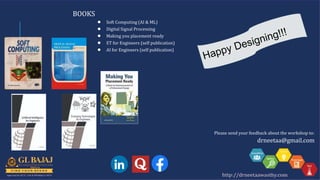
BOOKS
● Soft Computing (AI & ML)
● Digital Signal Processing
● Making you placement ready
● ET for Engineers (self publication)
● AI for Engineers (self publication)
Please send your feedback about the workshop to:

Comparative Design thinking

  • 1.
  • 3.
    As per NASSCOMsurvey 2017:
  • 4.
  • 5.
    Task 1. Doyou think you are creative Draw a portrait of yourself.
  • 6.
    Task 1. Doyou think you are creative Draw a portrait of yourself. Key Takeaways of this TASK: Being creative is not being artistic Ability to show unfinished work Ability to participate in something you are not good at This is ‘Creative Confidence’
  • 7.
    Task 2: Drawto Communicate Man Woman Baby Door House Innovation
  • 8.
    Task 2: Drawto Communicate Man Woman Baby Door House Innovation Key Takeaway of this Task: Ability to find something you don’t have a clear answer to This is Visual Shorthand Communication
  • 9.
    Prerequisites... Creative Confidence Visual ShorthandCommunication These abilities make an individual who generates Innovative Ideas
  • 10.
    SOME WEIRD QUESTIONS Howto make a dripless ice cream? How to add an iodine patch to all Indian women? How can we have sachets which open easily but not leak? How can we convert our TV to smart TV? How to use Petrol cars with CNG? How to convert old fittings to have an LED bulb? How to use plastic and fly ash as building material? How to leak proof ceilings with organic material? How to make a cold chain feasible? How to make a single port for charging & output signal
  • 11.
  • 13.
    Design Thinking asa Process ...as per D. School Executive Education, Stanford University 1. Empathize 2. Define 3. Ideate 4. Prototype 5. Test 6. Assess
  • 14.
    Process1: EMPATHIZE D. School-Conduct Interviews, Uncover Emotions, Seek Stories
  • 15.
    Process1: EMPATHIZE D. School-Conduct Interviews, Uncover Emotions, Seek Stories Feel their feelings, mirror their experience � Without judgment � With beginner’s eyes � With curiosity � Optimistically � Respectfully
  • 16.
    Process2: Define Problem Statementor ANALYSE D. School- Reframe and create human centric problem statements Identify meaningful surprises & tensions Infer insights
  • 17.
    Process2: Define Problem Statementor ANALYSE D. School- Reframe and create human centric problem statements Identify meaningful surprises & tensions Infer insights Focus on Individuals and not on groups Take care of extreme users : CEO of OXO replaced peeler with cushy Handle to address the extreme user.
  • 18.
    Process3: Ideate orSOLVE D. School- Brainstorming Sessions around the Problem Brainstorm Radical Ideas Build on others’ ideas Suspend Judgement
  • 19.
    Process3: Ideate orSOLVE D. School- Brainstorming Sessions around the Problem Brainstorm Radical Ideas Build on others’ ideas Suspend Judgement Be visual Stay on topic Go for many ideas Encourage wild ideas One conversation only
  • 20.
    Process4: Prototype (partof SOLVE) D. School- Create Lo-res objects and experiences Role Pay to understand context and key features Quickly build to think and learn
  • 21.
    Process4: Prototype (partof SOLVE) D. School- Create Lo-res objects and experiences Role Pay to understand context and key features Quickly build to think and learn Sketch 5-7 radical ways of meeting your user’s needs Make charts Make models Try Simulating them ...find the ‘Best one’
  • 22.
    Process 5: Test D.School- Test with customers to refine solution and gather data Gain deeper empathy Embrace failure
  • 23.
    Process 5: Test D.School- Test with customers to refine solution and gather data Gain deeper empathy Embrace failure Share your idea Get the feedback
  • 24.
  • 25.
    Process 6: Assess D.School- Guidelines for evaluating project work Critically Openly Giving & receiving feedback Integrating
  • 26.
    Process 6: Assess D.School- Guidelines for evaluating project work Critically Openly Giving & receiving feedback Integrating + What went well -What went wrong ? Questions ! Ideas ! Actionable Ideas !!! ...and Feasible Ideas Look for Feedbacks Review as part of Test...
  • 27.
    Design Thinking Empathise Analyse Solve Test Karmic Design Thinking Dukkha Samudaya Nirodha Marga Comparison ofDesign Thinking with Karmic Design Thinking Stanford Design Thinking Definition: 1. Empathize 2. Define 3. Ideate 4. Prototype 5. Test 6. Assess
  • 28.
    Case Study 1:She can’t carry a bag. She would carry a suitcase with wheels to workplace: …
  • 29.
    Case Study 2:A wardrobe
  • 30.
  • 31.
  • 32.
  • 33.
    PROJECT 1: Designan ideal wallet for your buddy Sketch your best idea:
  • 34.
    Design an improvedwallet: ...as per Design Process Facts (Physical/ material/color/cost/weight/brand) Form (shapes/size/texture/pockets/patterns) Function (Main use/ occasion/ storage idea/ carried) Relationship (What your buddy carries in the wallet that you don’t/ What would he or she would hate to lose/Is it the reflection of his/ her personality)
  • 35.
    Project 2: Designa coconut cutter
  • 36.
    To Summarize Design Thinkingis a User Centric Approach. It is : � People Centric – empathy is the key � Highly Creative-Integrative thinking is the key � Hands-On – Failure is a necessary part of the process � Iterative- A cycle of “ Understand>Create>Learn”.
  • 37.
    Design Principles ...by DieterRam (...Data Harms) 1. Good design is innovative 2. Good design makes a product useful 3. Good design is aesthetic 4. Good design makes a product understandable 5. Good design is unobtrusive 6. Good design is honest 7. Good design is long-lasting 8. Good design is thorough down to the last detail 9. Good design is environmentally-friendly 10.Good design is as little design as possible courtesy: https://3dstartpoint.com/design-principles-for-3d-printing/
  • 38.
    drneetaa@gmail.com BOOKS ● Soft Computing(AI & ML) ● Digital Signal Processing ● Making you placement ready ● ET for Engineers (self publication) ● AI for Engineers (self publication) Please send your feedback about the workshop to: