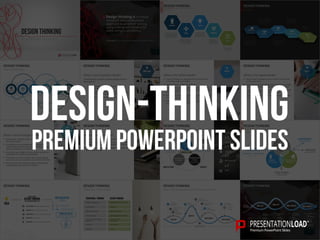
PREMIUM POWERPOINT SLIDES
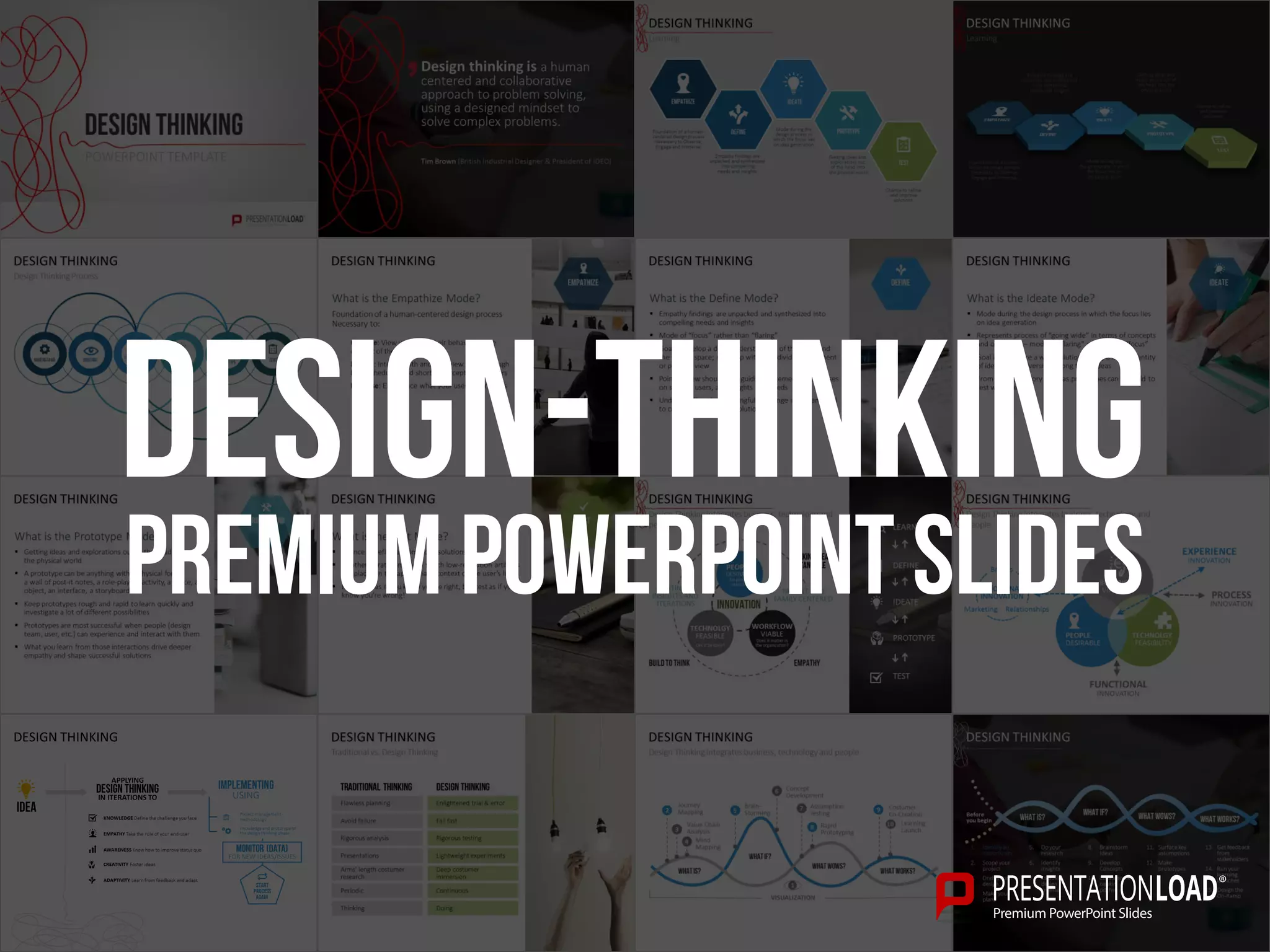
Design-thinking
DESIGN THINKING
POWERPOINT TEMPLATE
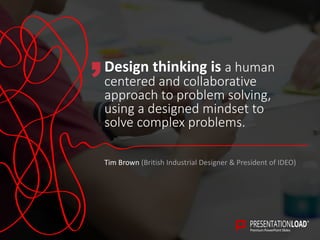
Design thinking is a human
centered and collaborative
approach to problem solving,
using a designed mindset to
solve complex problems.
Tim Brown (British Industrial Designer & President of IDEO)
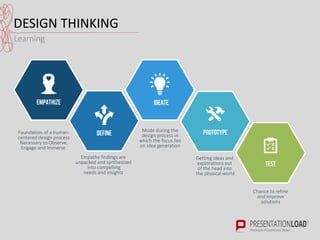
DESIGN THINKING
Learning
Ideate
Test
empathize
prototypeFoundation of a human-
centered design process
Necessary to Observe,
Engage and Immerse.
Chance to refine
and improve
solutions
Define
Empathy findings are
unpacked and synthesized
into compelling
needs and insights
Mode during the
design process in
which the focus lies
on idea generation
Getting ideas and
explorations out
of the head into
the physical world
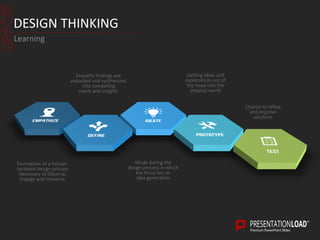
DESIGN THINKING
Learning
Foundation of a human-
centered design process
Necessary to Observe,
Engage and Immerse.
Empathy findings are
unpacked and synthesized
into compelling
needs and insights
Mode during the
design process in which
the focus lies on
idea generation
Getting ideas and
explorations out of
the head into the
physical world
Chance to refine
and improve
solutions
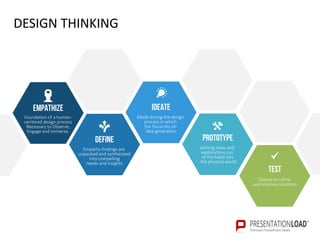
DESIGN THINKINGDESIGN THINKING
empathize
Foundation of a human-
centered design process
Necessary to Observe,
Engage and Immerse.
Define
Empathy findings are
unpacked and synthesized
into compelling
needs and insights
Ideate
Mode during the design
process in which
the focus lies on
idea generation
prototype
Getting ideas and
explorations out
of the head into
the physical world
Test
Chance to refine
and improve solutions
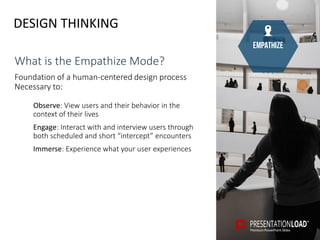
DESIGN THINKING
empathize
What is the Empathize Mode?
Foundation of a human-centered design process
Necessary to:
Observe: View users and their behavior in the
context of their lives
Engage: Interact with and interview users through
both scheduled and short “intercept” encounters
Immerse: Experience what your user experiences
DESIGN THINKING
define
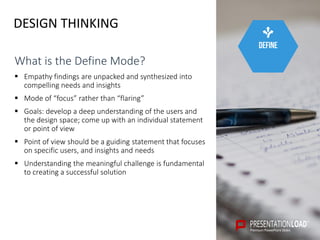
What is the Define Mode?
 Empathy findings are unpacked and synthesized into
compelling needs and insights
 Mode of “focus” rather than “flaring”
 Goals: develop a deep understanding of the users and
the design space; come up with an individual statement
or point of view
 Point of view should be a guiding statement that focuses
on specific users, and insights and needs
 Understanding the meaningful challenge is fundamental
to creating a successful solution
DESIGN THINKING
ideate
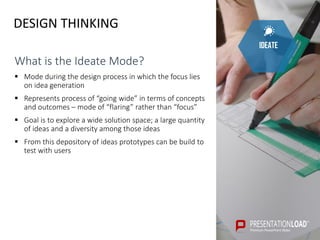
What is the Ideate Mode?
 Mode during the design process in which the focus lies
on idea generation
 Represents process of “going wide” in terms of concepts
and outcomes – mode of “flaring” rather than “focus”
 Goal is to explore a wide solution space; a large quantity
of ideas and a diversity among those ideas
 From this depository of ideas prototypes can be build to
test with users
DESIGN THINKING
prototyping
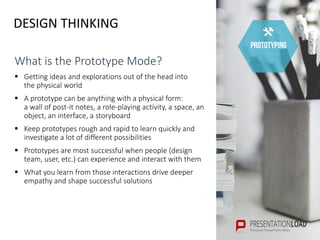
What is the Prototype Mode?
 Getting ideas and explorations out of the head into
the physical world
 A prototype can be anything with a physical form:
a wall of post-it notes, a role-playing activity, a space, an
object, an interface, a storyboard
 Keep prototypes rough and rapid to learn quickly and
investigate a lot of different possibilities
 Prototypes are most successful when people (design
team, user, etc.) can experience and interact with them
 What you learn from those interactions drive deeper
empathy and shape successful solutions
DESIGN THINKING
Test
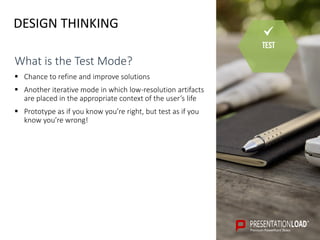
What is the Test Mode?
 Chance to refine and improve solutions
 Another iterative mode in which low-resolution artifacts
are placed in the appropriate context of the user’s life
 Prototype as if you know you’re right, but test as if you
know you’re wrong!
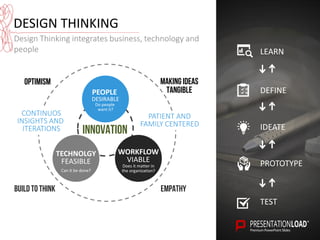
DESIGN THINKING
Design Thinking integrates business, technology and
people
INNOVATION
TECHNOLGY
FEASIBLE
Can it be done?
WORKFLOW
VIABLE
Does it matter in
the organization?
PEOPLE
DESIRABLE
Do people
want it?
PATIENT AND
FAMILY CENTERED
CONTINUOS
INSIGHTS AND
ITERATIONS
OPTIMISM MAKINGIDEAS
TANGIBLE
EMPATHYBUILD TO THINK
LEARN
DEFINE
IDEATE
PROTOTYPE
TEST
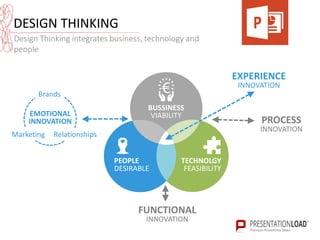
DESIGN THINKING
Design Thinking integrates business, technology and
people
PEOPLE
DESIRABLE
BUSSINESS
VIABILITYEMOTIONAL
INNOVATION
Brands
Marketing Relationships
EXPERIENCE
INNOVATION
PROCESS
INNOVATION
FUNCTIONAL
INNOVATION
TECHNOLGY
FEASIBILITY
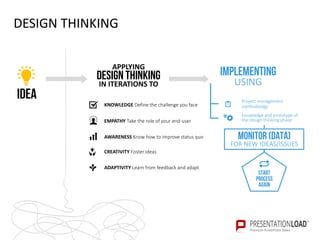
DESIGN THINKING
Idea
IMPLEMENTING
USING
APPLYING
DESIGN THINKING
IN ITERATIONS TO
MONITOR (DATA)
FOR NEW IDEAS/ISSUES
Start
process
again
Project management
methodology
Knowledge and prototype of
the design thinking phaseEMPATHY Take the role of your end-user
AWARENESS Know how to improve status quo
ADAPTIVITY Learn from feedback and adapt
KNOWLEDGE Define the challenge you face
CREATIVITY Foster ideas
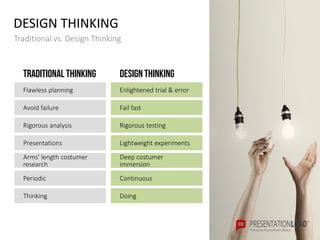
DESIGN THINKING
Traditional vs. Design Thinking
Flawless planning
Avoid failure
Rigorous analysis
Presentations
Arms' length costumer
research
Periodic
Thinking
Enlightened trial & error
Fail fast
Rigorous testing
Lightweight experiments
Deep costumer
immersion
Continuous
Doing
TRADITIONAL THINKING DESIGNTHINKING
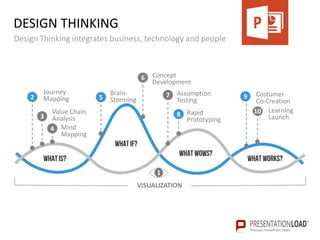
DESIGN THINKING
Design Thinking integrates business, technology and people
10
WHATIS?
WHAT IF?
WHAT WOWS?
WHATWORKS?
Journey
Mapping
Value Chain
Analysis
Mind
Mapping
Brain-
Storming
Concept
Development
Assumption
Testing
Rapid
Prototyping
Costumer
Co-Creation
Learning
Launch
VISUALIZATION
72
3
4
5
6
8
9
1
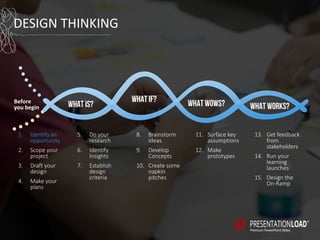
DESIGN THINKING
WHAT IS?
WHAT IF? WHAT WOWS? WHAT WORKS?
Before
you begin
1. Identify an
opportunity
2. Scope your
project
3. Draft your
design
4. Make your
plans
13. Get feedback
from
stakeholders
14. Run your
learning
launches
15. Design the
On-Ramp
11. Surface key
assumptions
12. Make
prototypes
8. Brainstorm
Ideas
9. Develop
Concepts
10. Create some
napkin
pitches
5. Do your
research
6. Identify
Insights
7. Establish
design
criteria
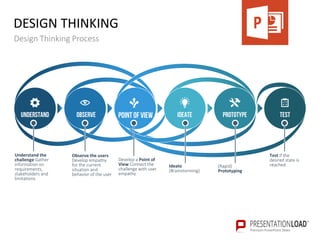
DESIGN THINKING
Design Thinking Process
Understand Pointof viewObserve Ideate Prototype Test
Understand the
challenge Gather
information on
requirements,
stakeholders and
limitations
Observe the users
Develop empathy
for the current
situation and
behavior of the user
Develop a Point of
View Connect the
challenge with user
empathy
Ideate
(Brainstorming)
(Rapid)
Prototyping
Test if the
desired state is
reached
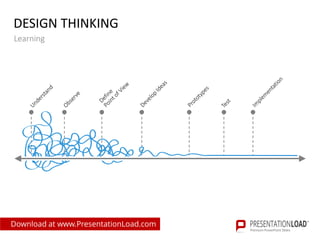
DESIGN THINKING
Learning
Download at www.PresentationLoad.com
DESIGN THINKING
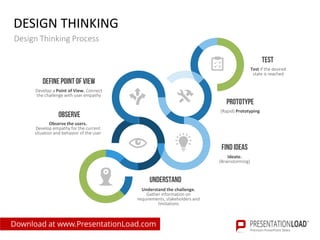
Design Thinking Process
understand
Define pointof view
observe
Find ideas
Prototype
Test
Understand the challenge.
Gather information on
requirements, stakeholders and
limitations
Observe the users.
Develop empathy for the current
situation and behavior of the user
Develop a Point of View. Connect
the challenge with user empathy
Ideate.
(Brainstorming)
(Rapid) Prototyping
Test if the desired
state is reached
Download at www.PresentationLoad.com
Click here to visit www.PresentationLoad.com
DOWNLOAD POWERPOINT SLIDES

Design-Thinking

  • 1.
  • 2.
  • 3.
    Design thinking isa human centered and collaborative approach to problem solving, using a designed mindset to solve complex problems. Tim Brown (British Industrial Designer & President of IDEO)
  • 4.
    DESIGN THINKING Learning Ideate Test empathize prototypeFoundation ofa human- centered design process Necessary to Observe, Engage and Immerse. Chance to refine and improve solutions Define Empathy findings are unpacked and synthesized into compelling needs and insights Mode during the design process in which the focus lies on idea generation Getting ideas and explorations out of the head into the physical world
  • 5.
    DESIGN THINKING Learning Foundation ofa human- centered design process Necessary to Observe, Engage and Immerse. Empathy findings are unpacked and synthesized into compelling needs and insights Mode during the design process in which the focus lies on idea generation Getting ideas and explorations out of the head into the physical world Chance to refine and improve solutions
  • 6.
    DESIGN THINKINGDESIGN THINKING empathize Foundationof a human- centered design process Necessary to Observe, Engage and Immerse. Define Empathy findings are unpacked and synthesized into compelling needs and insights Ideate Mode during the design process in which the focus lies on idea generation prototype Getting ideas and explorations out of the head into the physical world Test Chance to refine and improve solutions
  • 7.
    DESIGN THINKING empathize What isthe Empathize Mode? Foundation of a human-centered design process Necessary to: Observe: View users and their behavior in the context of their lives Engage: Interact with and interview users through both scheduled and short “intercept” encounters Immerse: Experience what your user experiences
  • 8.
    DESIGN THINKING define What isthe Define Mode?  Empathy findings are unpacked and synthesized into compelling needs and insights  Mode of “focus” rather than “flaring”  Goals: develop a deep understanding of the users and the design space; come up with an individual statement or point of view  Point of view should be a guiding statement that focuses on specific users, and insights and needs  Understanding the meaningful challenge is fundamental to creating a successful solution
  • 9.
    DESIGN THINKING ideate What isthe Ideate Mode?  Mode during the design process in which the focus lies on idea generation  Represents process of “going wide” in terms of concepts and outcomes – mode of “flaring” rather than “focus”  Goal is to explore a wide solution space; a large quantity of ideas and a diversity among those ideas  From this depository of ideas prototypes can be build to test with users
  • 10.
    DESIGN THINKING prototyping What isthe Prototype Mode?  Getting ideas and explorations out of the head into the physical world  A prototype can be anything with a physical form: a wall of post-it notes, a role-playing activity, a space, an object, an interface, a storyboard  Keep prototypes rough and rapid to learn quickly and investigate a lot of different possibilities  Prototypes are most successful when people (design team, user, etc.) can experience and interact with them  What you learn from those interactions drive deeper empathy and shape successful solutions
  • 11.
    DESIGN THINKING Test What isthe Test Mode?  Chance to refine and improve solutions  Another iterative mode in which low-resolution artifacts are placed in the appropriate context of the user’s life  Prototype as if you know you’re right, but test as if you know you’re wrong!
  • 12.
    DESIGN THINKING Design Thinkingintegrates business, technology and people INNOVATION TECHNOLGY FEASIBLE Can it be done? WORKFLOW VIABLE Does it matter in the organization? PEOPLE DESIRABLE Do people want it? PATIENT AND FAMILY CENTERED CONTINUOS INSIGHTS AND ITERATIONS OPTIMISM MAKINGIDEAS TANGIBLE EMPATHYBUILD TO THINK LEARN DEFINE IDEATE PROTOTYPE TEST
  • 13.
    DESIGN THINKING Design Thinkingintegrates business, technology and people PEOPLE DESIRABLE BUSSINESS VIABILITYEMOTIONAL INNOVATION Brands Marketing Relationships EXPERIENCE INNOVATION PROCESS INNOVATION FUNCTIONAL INNOVATION TECHNOLGY FEASIBILITY
  • 14.
    DESIGN THINKING Idea IMPLEMENTING USING APPLYING DESIGN THINKING INITERATIONS TO MONITOR (DATA) FOR NEW IDEAS/ISSUES Start process again Project management methodology Knowledge and prototype of the design thinking phaseEMPATHY Take the role of your end-user AWARENESS Know how to improve status quo ADAPTIVITY Learn from feedback and adapt KNOWLEDGE Define the challenge you face CREATIVITY Foster ideas
  • 15.
    DESIGN THINKING Traditional vs.Design Thinking Flawless planning Avoid failure Rigorous analysis Presentations Arms' length costumer research Periodic Thinking Enlightened trial & error Fail fast Rigorous testing Lightweight experiments Deep costumer immersion Continuous Doing TRADITIONAL THINKING DESIGNTHINKING
  • 16.
    DESIGN THINKING Design Thinkingintegrates business, technology and people 10 WHATIS? WHAT IF? WHAT WOWS? WHATWORKS? Journey Mapping Value Chain Analysis Mind Mapping Brain- Storming Concept Development Assumption Testing Rapid Prototyping Costumer Co-Creation Learning Launch VISUALIZATION 72 3 4 5 6 8 9 1
  • 17.
    DESIGN THINKING WHAT IS? WHATIF? WHAT WOWS? WHAT WORKS? Before you begin 1. Identify an opportunity 2. Scope your project 3. Draft your design 4. Make your plans 13. Get feedback from stakeholders 14. Run your learning launches 15. Design the On-Ramp 11. Surface key assumptions 12. Make prototypes 8. Brainstorm Ideas 9. Develop Concepts 10. Create some napkin pitches 5. Do your research 6. Identify Insights 7. Establish design criteria
  • 18.
    DESIGN THINKING Design ThinkingProcess Understand Pointof viewObserve Ideate Prototype Test Understand the challenge Gather information on requirements, stakeholders and limitations Observe the users Develop empathy for the current situation and behavior of the user Develop a Point of View Connect the challenge with user empathy Ideate (Brainstorming) (Rapid) Prototyping Test if the desired state is reached
  • 19.
    DESIGN THINKING Learning Download atwww.PresentationLoad.com
  • 20.
    DESIGN THINKING Design ThinkingProcess understand Define pointof view observe Find ideas Prototype Test Understand the challenge. Gather information on requirements, stakeholders and limitations Observe the users. Develop empathy for the current situation and behavior of the user Develop a Point of View. Connect the challenge with user empathy Ideate. (Brainstorming) (Rapid) Prototyping Test if the desired state is reached Download at www.PresentationLoad.com
  • 21.
    Click here tovisit www.PresentationLoad.com DOWNLOAD POWERPOINT SLIDES