INNOVATIONANDDESIGNTHINKING
ByMr
. T.PMushayavanhu
Learningobjectives
Understandtheneedforinnovation
DefineDesign Thinking
Describe the three spacesof design
thinking
Outline theDesignThinkingProcess
Theneedforinnovation
 Increasing pressure to differentiate services and products to
adapt to a rapidly changing economy.
 A growing focus on environmental issues that require businesses
to maintain growth sustainably
 Advancements in technology
 Global competition
 Changing customer behavior
 Knowledge and opportunities that customers and users can
provide
In their search for user-centered approaches to innovation,
companies have shown an increasing interest in design
thinking (Carlgren et al., 2014), which has gained much
popularity as an innovation approach.
DESIGNTHINKING
WhatisDesignThinking?
 Amethodof focusing innovationonpeople/users
anddesigning basedon:
 What people need and want
 What people like or dislike
 Inregards to production, packaging, marketing, retailing,
support, or all of them
 Askill that allows a designer to align what people want
withwhatcanbe done,andproducea viable business
strategythat createscustomervalue and market
opportunity
DESIGNTHINKING(CONT
.)
 A human-centred collaborative approach to
problem solving that iscreative , iterative
and practical (Brown, 2008)
 It isan approachto solve designproblems
by understanding user’sneedsand
developing insightsto addressthoseneeds
i.e. a usercentered approachto problem
solving
DESIGNTHINKING(CONT
.)
 Designthinkingispeople focused(User/
customer/ stakeholder-centered).It is
anchored by itscommitmentto satisfying
(and preferably delighting) users,
customers, and stakeholders.
 Designisnot only what it looksor feels
like, it isalso how it works.- Steve Jobs
DESIGNTHINKING(CONT
.)
 IDEOdefines DTas“a human-centered
approach to innovation thatdraws from
thedesigner's toolkit to integrate theneeds
of people, thepossibilities of technology,
and the requirements for businesssuccess”
(www.ideo.com).
DESIGN THINKING (CONT
.)
 Designthinking isaniterative
problem solving processof discovery,
ideation, and experimentation that
employsdesignbasedtechniquesto
gain insight and yield innovative
solutionsfor virtually any type of
organizational or businesschallenge
DESIGN THINKING (CONT
.)
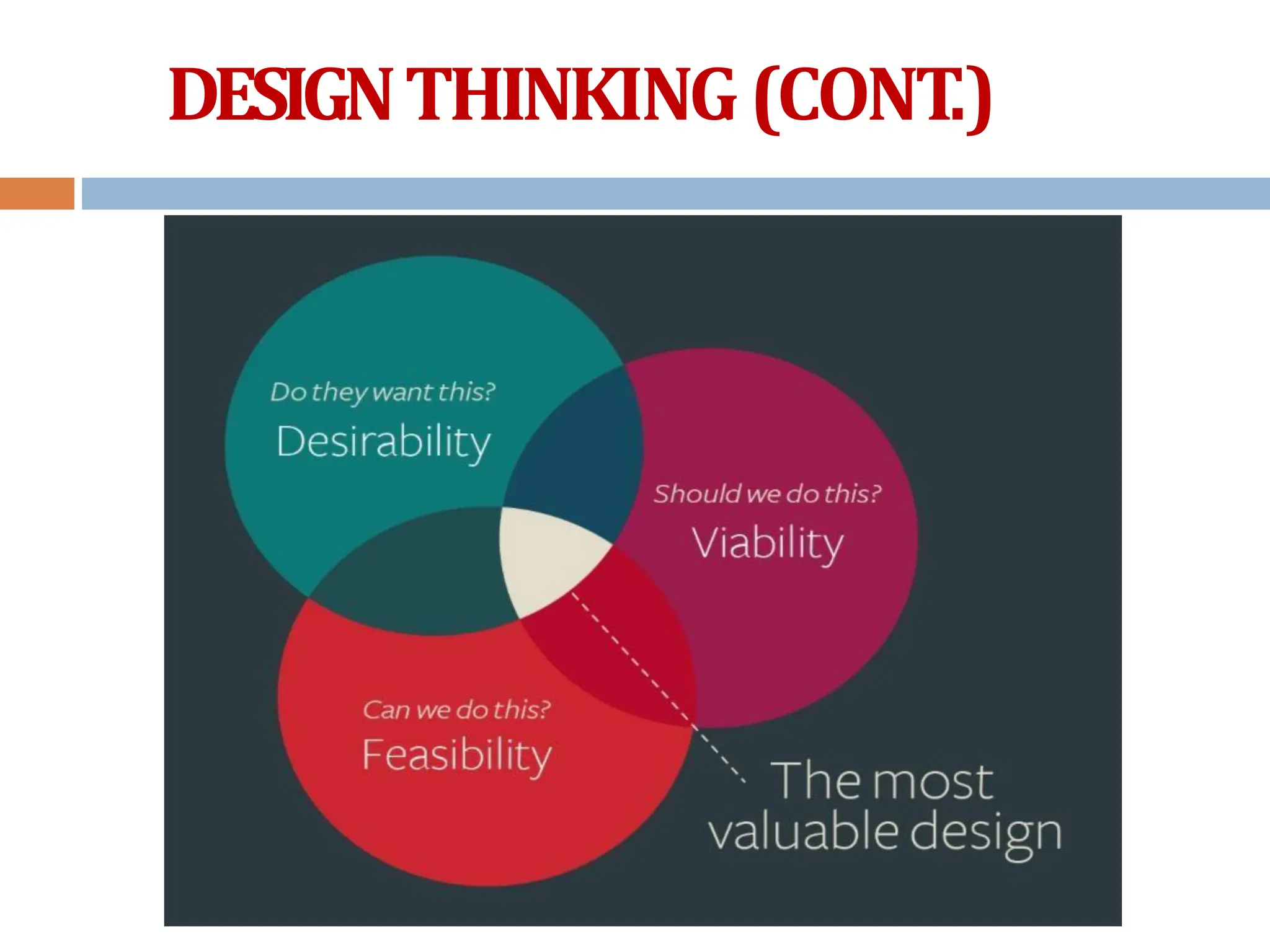
 a systemof threeoverlapping spaces,in
whichviability refers to thebusiness
perspective of DT,desirability reflectsthe
user’sperspective,and feasibility
encompassesthetechnology perspective.
 Innovation increaseswhenall three
perspectivesare addressed
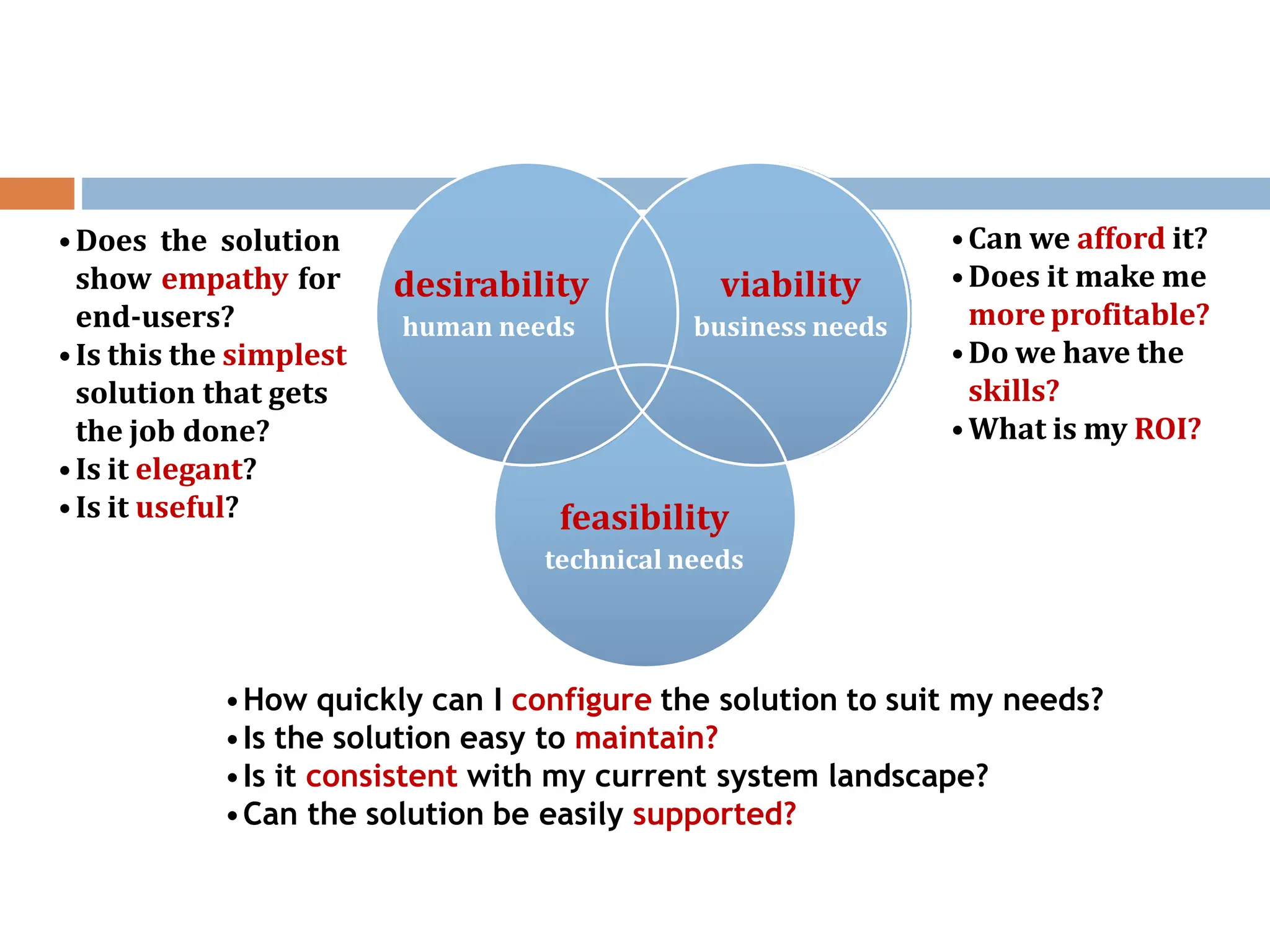
•How quickly can I configure the solution to suit my needs?
•Is the solution easy to maintain?
•Is it consistent with my current system landscape?
•Can the solution be easily supported?
•Does the solution
show empathy for
end-users?
•Is this the simplest
solution that gets
the job done?
•Is it elegant?
•Is it useful?
•Can we afford it?
•Does it make me
more profitable?
•Do we have the
skills?
•What is my ROI?
feasibility
technical needs
desirability
human needs
viability
business needs
DESIGNTHINKING(CONT
.)
Desirability
 Will thissolutionfill a need?
A great place to start isby checking to seeif the
project/solution isadding value to theworld.
 Will itfitintopeople’slives?
Understanding thepeople usingour solutiontells
ushow they liveand inwhat way our solution
supportsor conflicts with their lifestyle and use
cases.
 Will itappeal tothem?Will they actually want
it?
Feasibility
 Isthetechnology (orresources) neededto
powerthedesignsolutionavailableorwithin
reach?
Sometimesthe goal isto create a new technology,
but sometimeswe needto workwithwhat we’ve
got. Determinewhat your goal isonthis front early
on.
 How longwill thistake?
Isit realistic?
Feasibility (Cont.)
 Cantheorganizationactually makeit
happen?
Duringtheconvergent phaseof the
ideation processof a project, we have to
look at questionsof feasibility. Asolution
only workswhentheteam can actually
make it work inthelong run.
Viability
 Will the design solution align with the
organization’slong-termgoals?
By understanding what the business wants
to accomplish, we can focus our energy in
theright direction.
 Isthesolutioncost-effective?
 Is the solution sustainable? What will
thereturnontheinvestmentlooklike?
Viability (Cont.)
 Measuretheeffort needed to execute on a
solutionwith thepotential payoff in terms
of desired outcomes—whether
they’re financial, social impact-related, or
someotherquantifiable measure.If the
investmentfar outweighsthe benefits,it
may be worth focusingona different
solution.
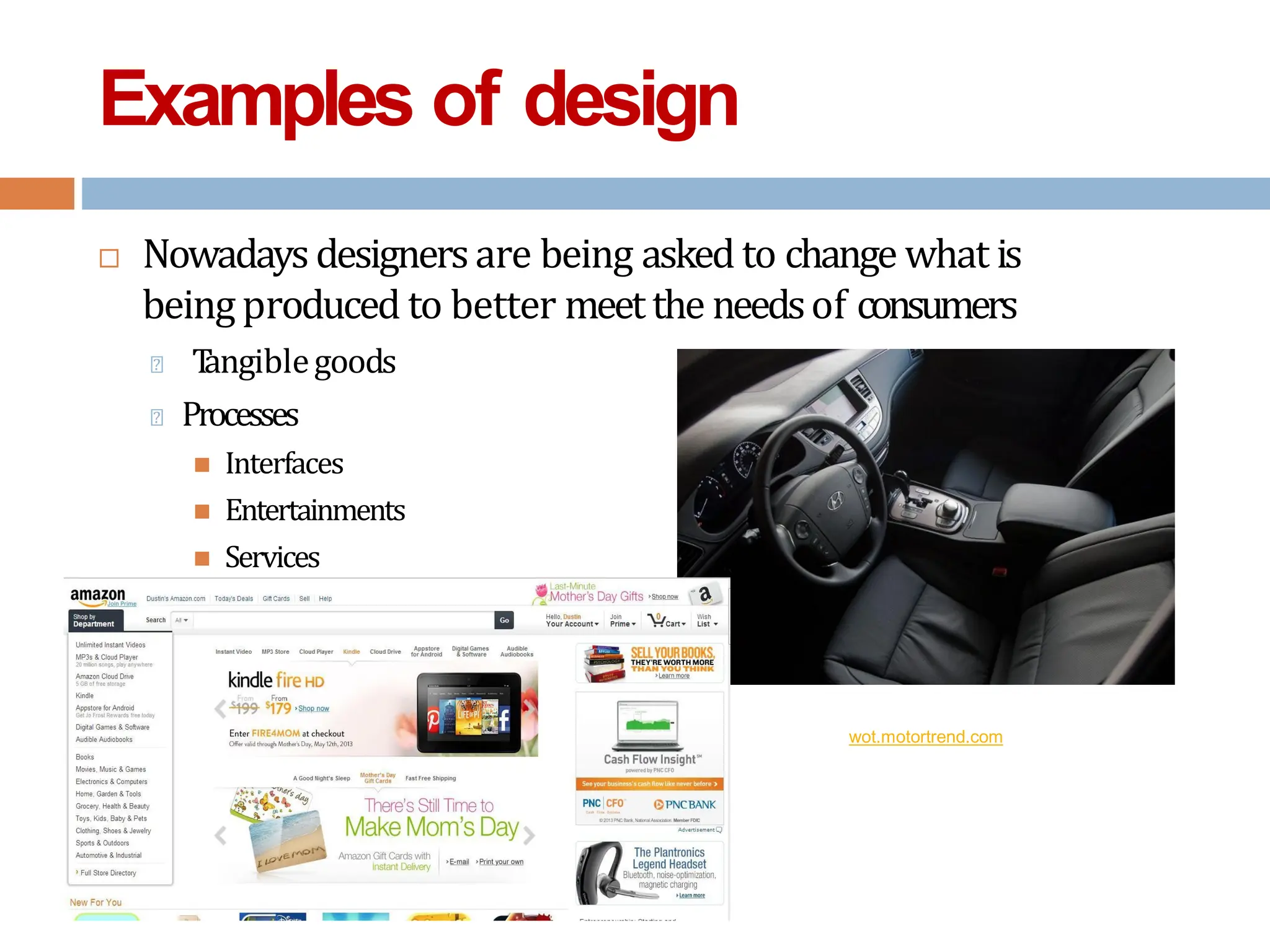
Examples of design
 Nowadays designersare being asked to change what is
being produced to better meetthe needsof consumers
🞑 T
angiblegoods
🞑 Processes
 Interfaces
 Entertainments
 Services
wot.motortrend.com
TheDesignThinking Mindset
 Only throughobservation, contactand
empathy withend userscan onedesign
solutionsthat address theuser’sneeds
asopposed to
“Wehavethistechnology
, what canweuseit
for?”
“ Our competitorslaunchedX ; howcanwe do
Xquickly?”
i. Cost
ii. Quality
iii. Time-to-market
iv. Customer satisfaction
v. Competitive advantage.
Major factors in design strategy
TheDesignThinkingProcess
Key elements
• P
eople centered
• Highly creative
• Hands- onfor action
• Iterative
The design thinking process
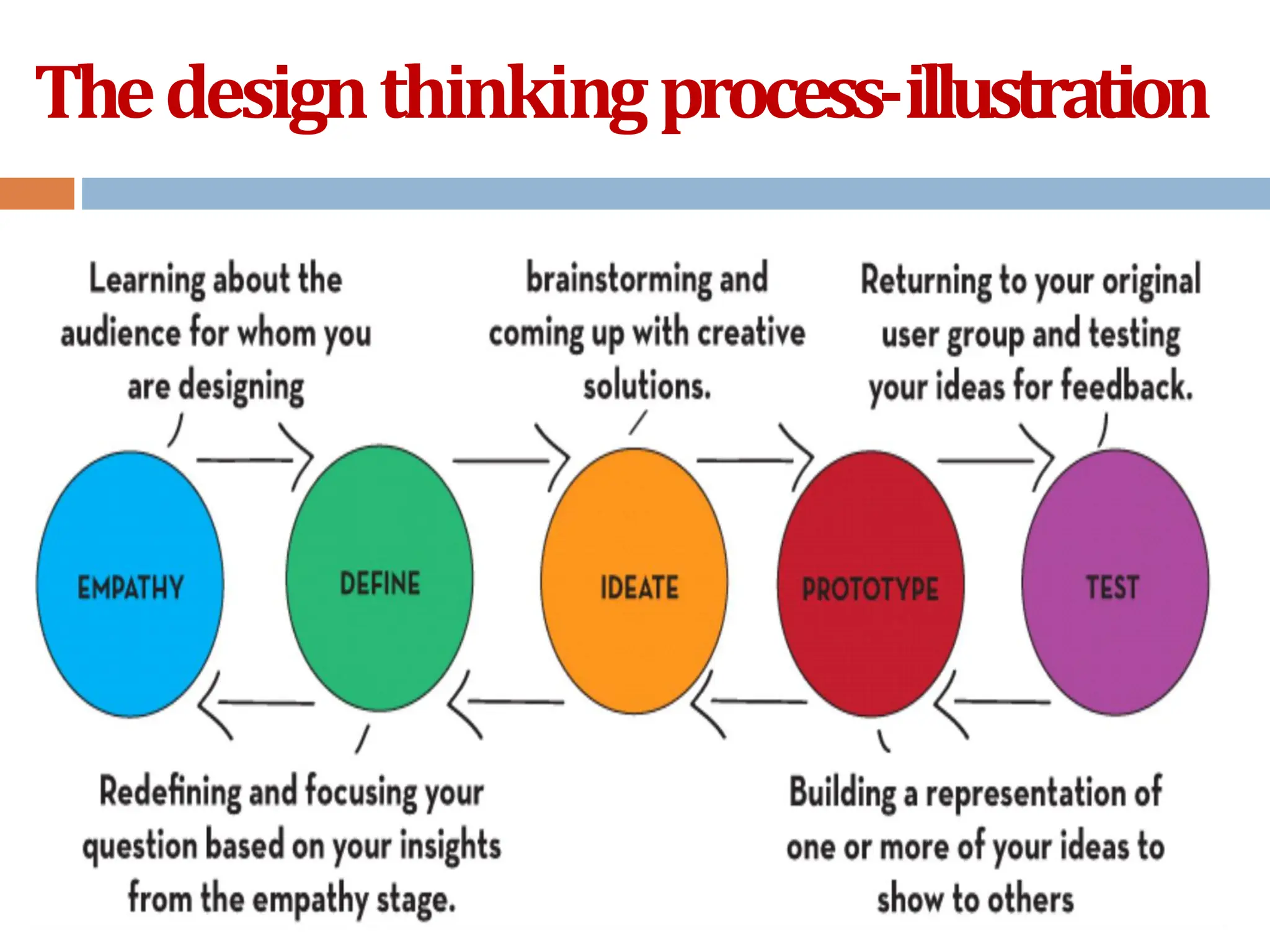
1.Empathy
2.Define
3.Ideate
4.Prototype
5.Test
Thedesignthinkingprocess-illustration
EMPATHY
• Empathy is defined as “deep understanding of the problems and realities of
the users one is designing for”. It involves learning about the challenges users
face. The process involves observing, engaging and empathising with the
users in order to understand their experiences and needs.
• It is the cornerstone of any successful design project. The extent to which the
designer empathises with the users ultimately determines the outcome of the
design.
• Will it be user-friendly?
• Will it give solutions to the users’ problem?
• Building empathy at every opportunity, getting to know your users,
experiencing users pain points and using this empathy to make smart design
decisions.
• Need to understand how the users feel when interacting with a certain product.
Empathising Cont.’
• Inorder to empathise, we need to understand our
users
– We need to research our market
• Someof thiscanbe done throughweb research,
e.g. scalingtheproblem,gaining a foothold
understandingof how usersoperate.
• However the real empathising starts in the
context of ongoing dialogue with potential
users.
Empathising Cont.’
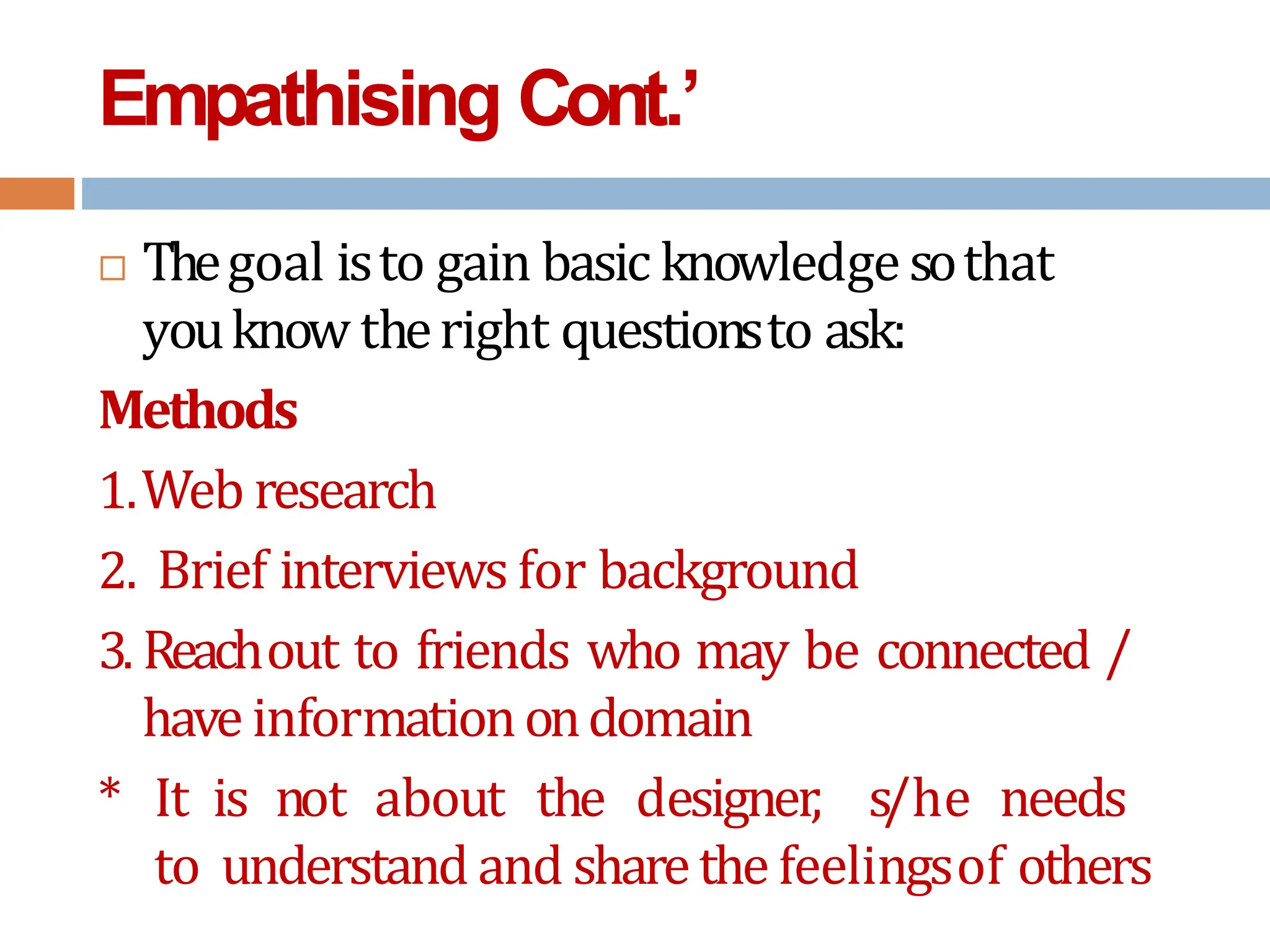
 Thegoal isto gain basic knowledgesothat
youknow theright questionsto ask:
Methods
1.Web research
2. Brief interviews for background
3. Reachout to friends who may be connected /
have informationondomain
* It is not about the designer, s/he needs
to understand and sharethe feelingsof others
Empathising Cont.’
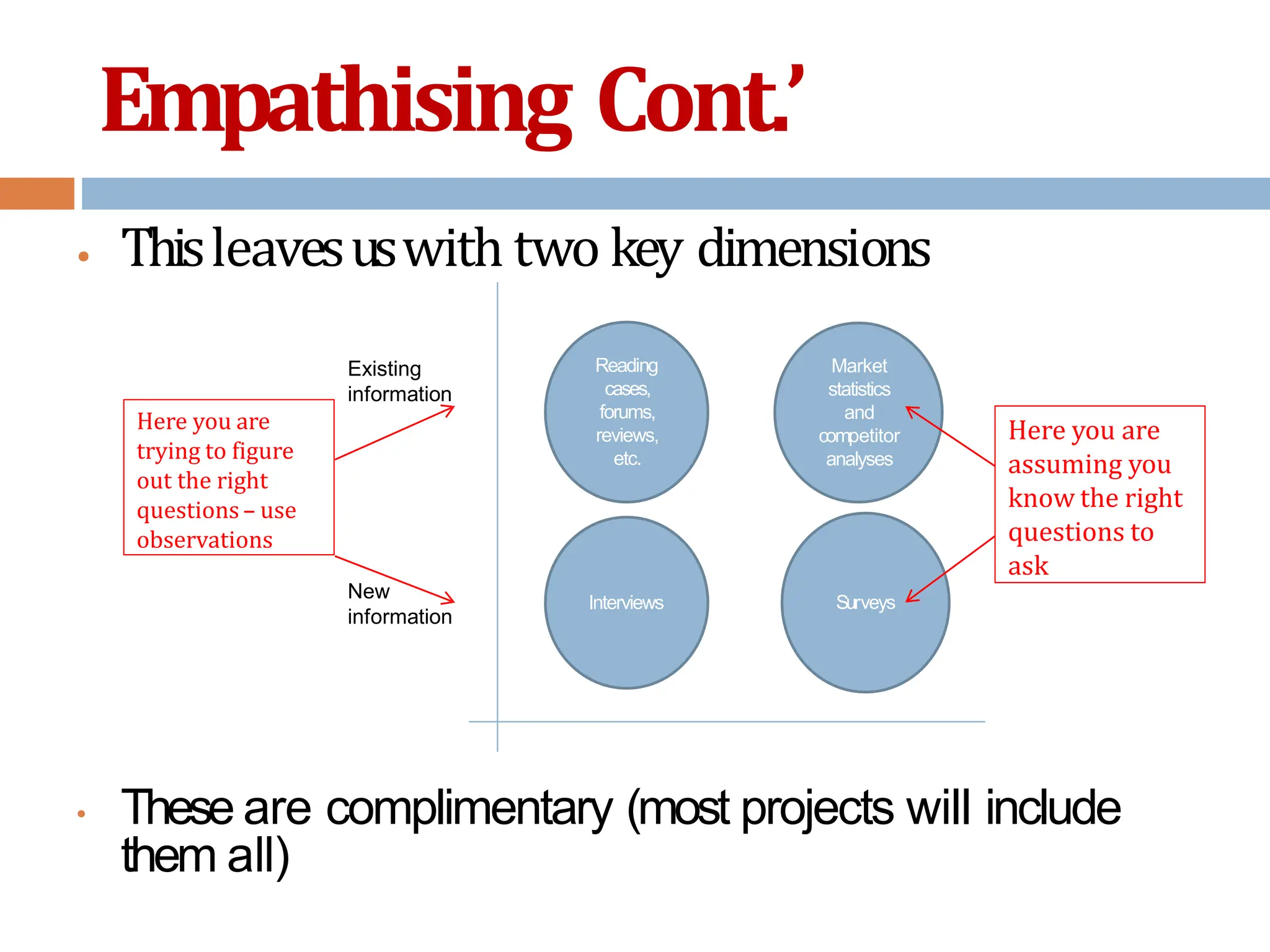
• Thisleavesuswith two key dimensions
• These are complimentary (most projects will include
them all)
Existing
information
New
information
Reading
cases,
forums,
reviews,
etc.
Interviews
Market
statistics
and
competitor
analyses
Surveys
Here you are
assuming you
know the right
questions to
ask
Here you are
trying to figure
out the right
questions– use
observations
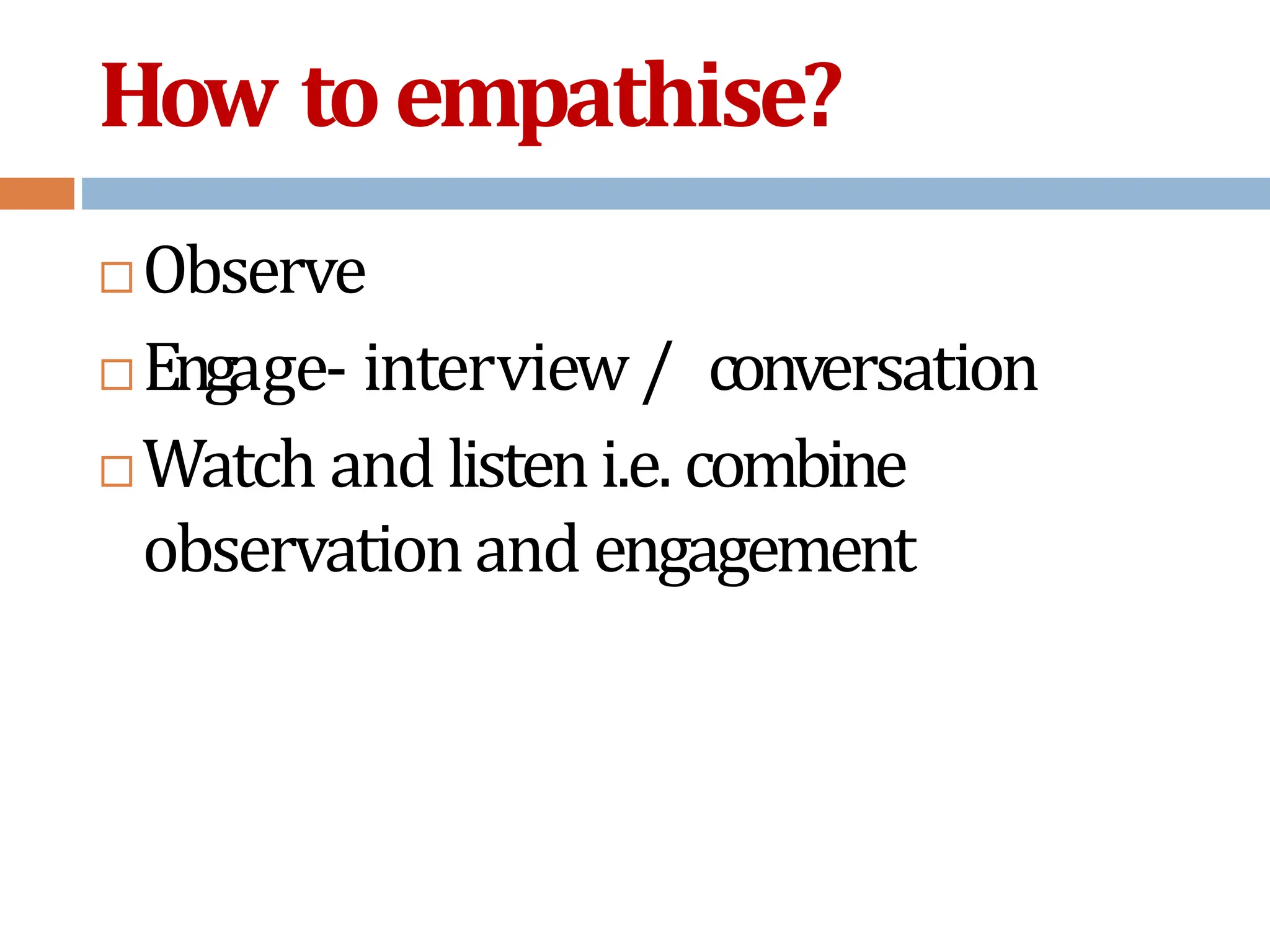
How toempathise?
 Observe
 Engage- interview/ conversation
 Watch and listeni.e. combine
observationand engagement
Defining
• Listpain points,i.e. things that userscomplain
about
• Formalisetheseinto a problem statement.
– Thisstatement should:
• Make it clear whomthe useris
• Aggregate smaller concernsinto onelarger issue
– Thisstatement should NOT:
• Narrow the problemdownina way that lends
itself towardsspecific solutions
Ideating
 Thisstage iswhere your opportunity to flex your
creative musclescomesin
 Quantity isyour friend! If youare struggling to come up
with 20-30 ideas, thenyour problemstatementwas too
restrictive
 Abandonjudgement– noidea isa bad idea aslong as
it fitswiththeneedsidentified inyourproblem
statement
 Visualisethings!Get a penandpaper out(or
whatever mediumyou find comfortable) and draw
pictures, bubble-diagrams, etc.
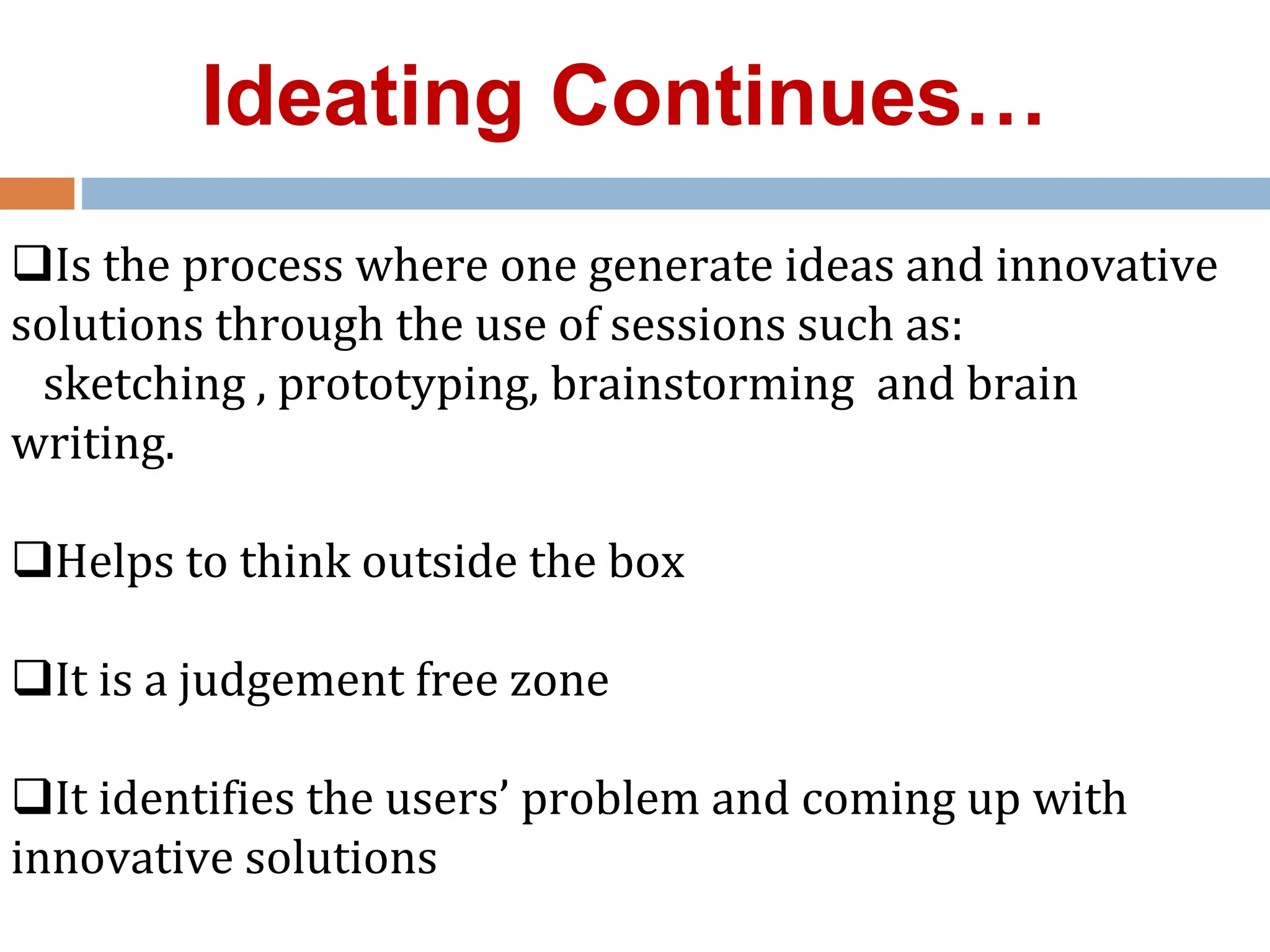
Is the process where one generate ideas and innovative
solutions through the use of sessions such as:
sketching , prototyping, brainstorming and brain
writing.
Helps to think outside the box
It is a judgement free zone
It identifies the users’ problem and coming up with
innovative solutions
Ideating Continues…
It helps the designer to accumulate the unique
perspectives and creativity of different people,
ensuring diversity of ideas and ultimately coming up
with innovative solutions.
It is all about creativity and fun.
In this phase , quantity is encouraged rather
quality - Engineers maybe asked to generate a
hundreds of ideas in a single session.
Ideating Continues….
IdeatingContinues….
 Ideate isthe modeof thedesignprocessin
whichoneconcentrates onidea
generation.
 Mentally it represents a processof “going
wide” in termsof conceptsand outcomes.
 Ideation provides both thefuel and also
thesource material for building
prototypes and getting innovative
solutionsinto the handsof theusers.
Prototyping
 Prototypes consist of anything frompaper
based representationsto fully functional
product
 It allowsthreethings
Y
ou can figure out if and how your idea can
be implemented
It gives you a way of discussing things with
users in a shared language, i.e. “is this what
youmeant?”
Ideas canbe tested with users
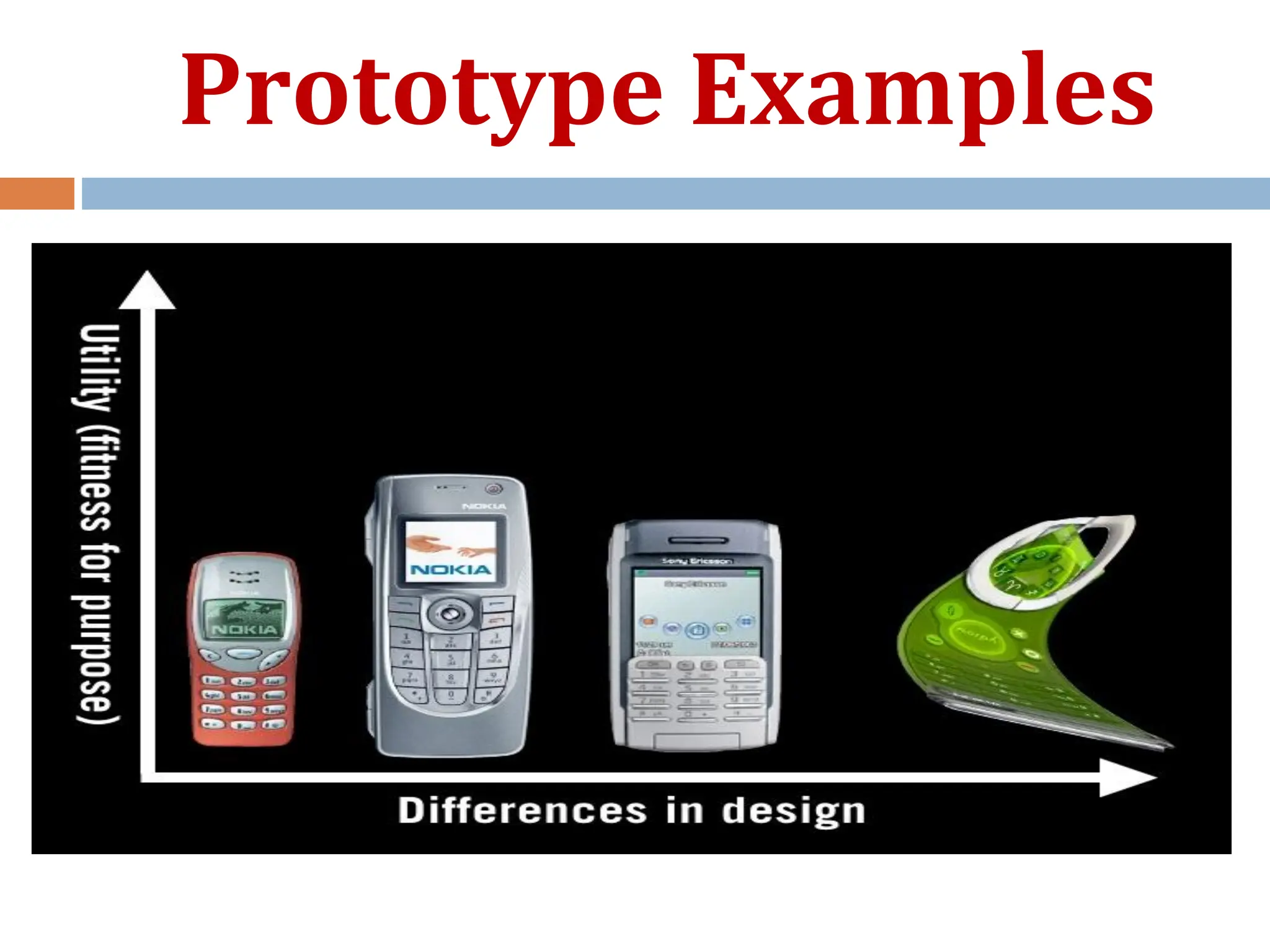
Prototype Examples
Testing
 T
estingservestwopurposes
 To evaluate ideas
 T
o generate new ideas fromusers
 With thisin mind, a few tips:
 T
estwith usersthat are representative and
appropriately critical
 Try to minimizeusers’nerves/sense that they
are being observed
 Prioritise key tasks(youcan’t test everything)
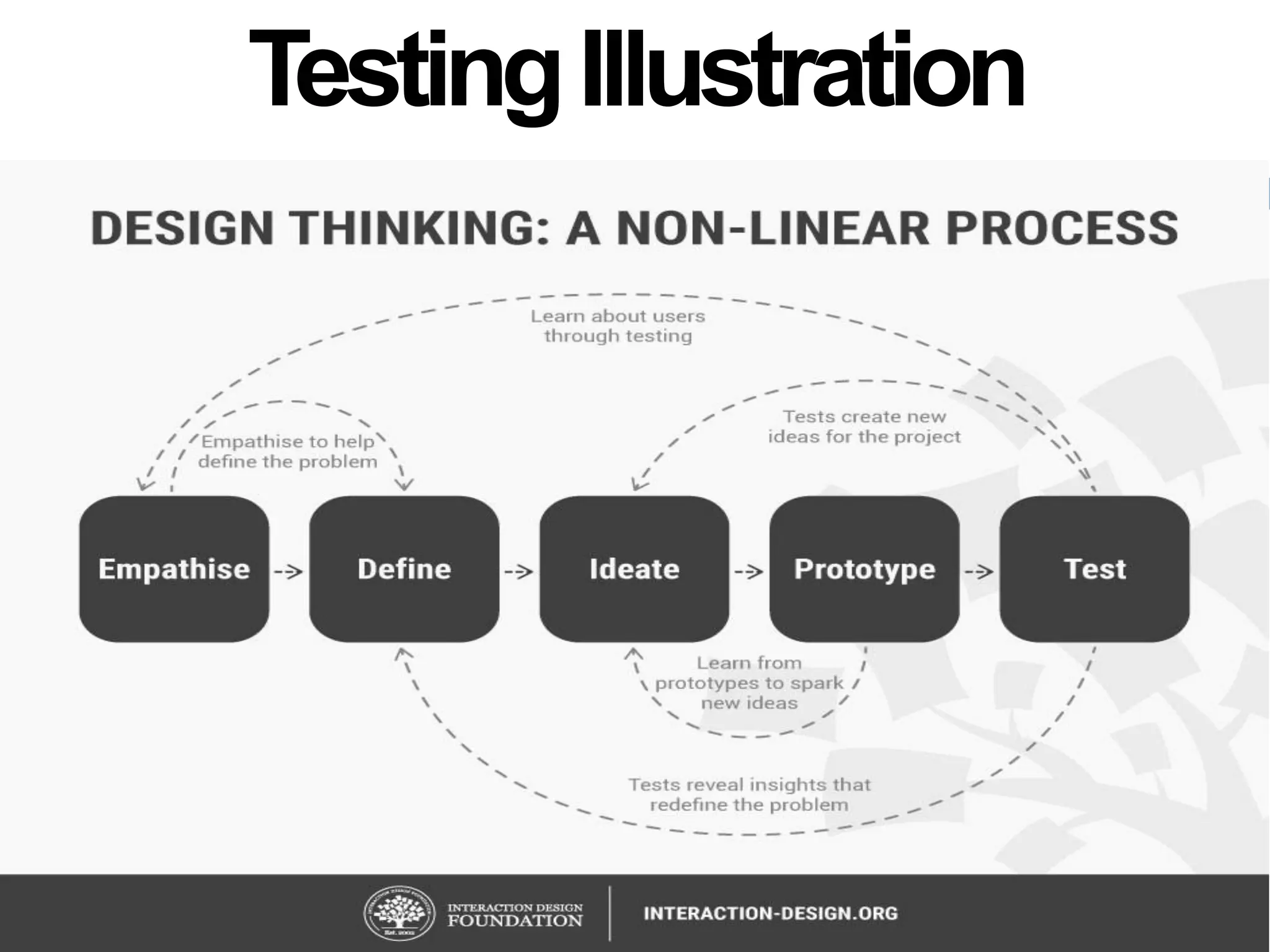
It is part of an iterative process that provides feedback
The purpose of testing is to learn what works and what
does not work and then iterate
It involves going back to prototype and modifying
based on feedback
Testing ensures that designers learn what works and
what doesn’t work for the users
Testing Continue…..
TestingIllustration
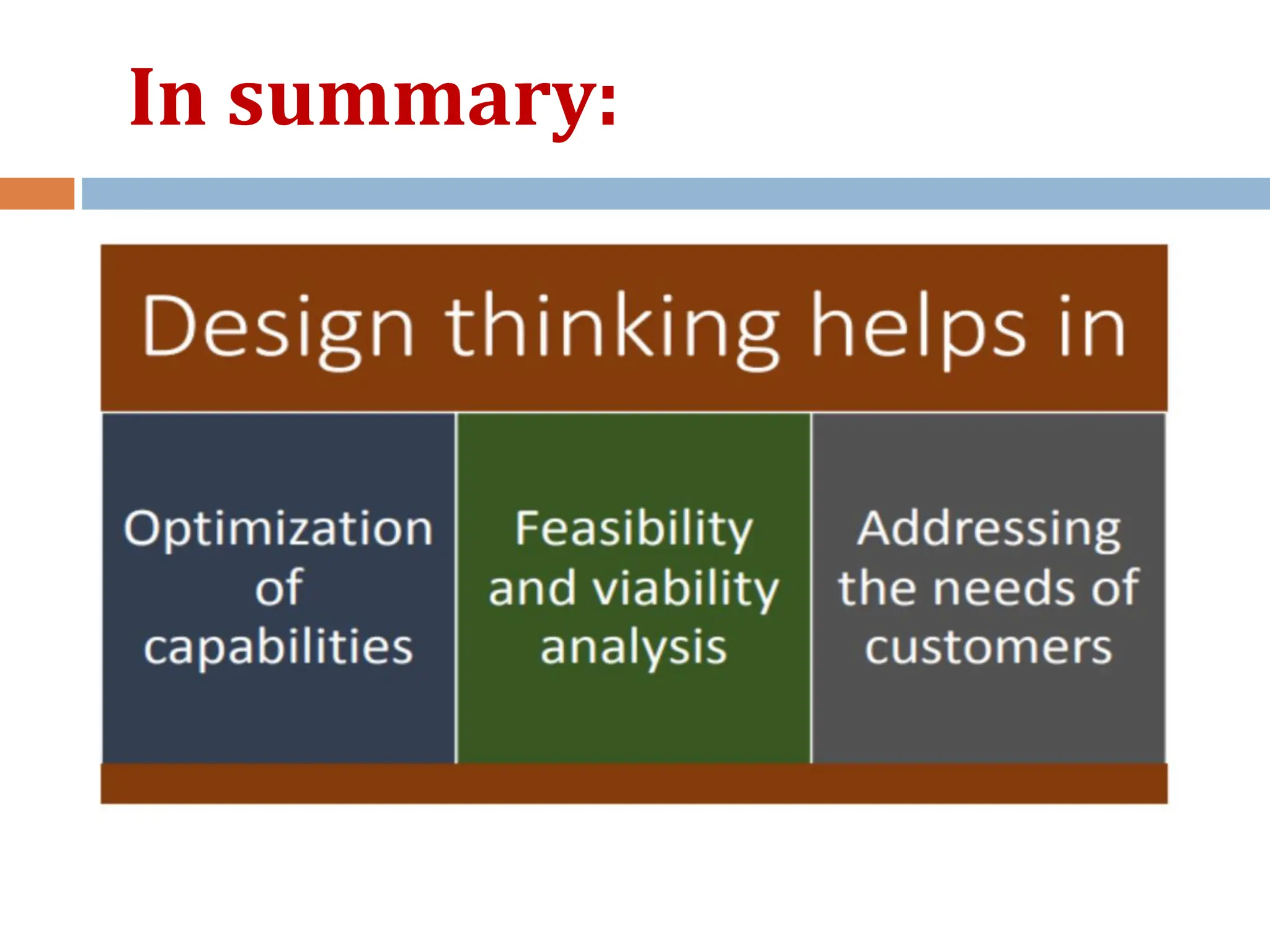
In summary:
THE END

Lesson 2 - INNOVATION AND DESIGN THINKING_2024.pdf

  • 1.
  • 2.
    Learningobjectives Understandtheneedforinnovation DefineDesign Thinking Describe thethree spacesof design thinking Outline theDesignThinkingProcess
  • 3.
    Theneedforinnovation  Increasing pressureto differentiate services and products to adapt to a rapidly changing economy.  A growing focus on environmental issues that require businesses to maintain growth sustainably  Advancements in technology  Global competition  Changing customer behavior  Knowledge and opportunities that customers and users can provide In their search for user-centered approaches to innovation, companies have shown an increasing interest in design thinking (Carlgren et al., 2014), which has gained much popularity as an innovation approach.
  • 4.
    DESIGNTHINKING WhatisDesignThinking?  Amethodof focusinginnovationonpeople/users anddesigning basedon:  What people need and want  What people like or dislike  Inregards to production, packaging, marketing, retailing, support, or all of them  Askill that allows a designer to align what people want withwhatcanbe done,andproducea viable business strategythat createscustomervalue and market opportunity
  • 5.
    DESIGNTHINKING(CONT .)  A human-centredcollaborative approach to problem solving that iscreative , iterative and practical (Brown, 2008)  It isan approachto solve designproblems by understanding user’sneedsand developing insightsto addressthoseneeds i.e. a usercentered approachto problem solving
  • 6.
    DESIGNTHINKING(CONT .)  Designthinkingispeople focused(User/ customer/stakeholder-centered).It is anchored by itscommitmentto satisfying (and preferably delighting) users, customers, and stakeholders.  Designisnot only what it looksor feels like, it isalso how it works.- Steve Jobs
  • 7.
    DESIGNTHINKING(CONT .)  IDEOdefines DTas“ahuman-centered approach to innovation thatdraws from thedesigner's toolkit to integrate theneeds of people, thepossibilities of technology, and the requirements for businesssuccess” (www.ideo.com).
  • 8.
    DESIGN THINKING (CONT .) Designthinking isaniterative problem solving processof discovery, ideation, and experimentation that employsdesignbasedtechniquesto gain insight and yield innovative solutionsfor virtually any type of organizational or businesschallenge
  • 9.
    DESIGN THINKING (CONT .) a systemof threeoverlapping spaces,in whichviability refers to thebusiness perspective of DT,desirability reflectsthe user’sperspective,and feasibility encompassesthetechnology perspective.  Innovation increaseswhenall three perspectivesare addressed
  • 10.
    •How quickly canI configure the solution to suit my needs? •Is the solution easy to maintain? •Is it consistent with my current system landscape? •Can the solution be easily supported? •Does the solution show empathy for end-users? •Is this the simplest solution that gets the job done? •Is it elegant? •Is it useful? •Can we afford it? •Does it make me more profitable? •Do we have the skills? •What is my ROI? feasibility technical needs desirability human needs viability business needs
  • 11.
  • 12.
    Desirability  Will thissolutionfilla need? A great place to start isby checking to seeif the project/solution isadding value to theworld.  Will itfitintopeople’slives? Understanding thepeople usingour solutiontells ushow they liveand inwhat way our solution supportsor conflicts with their lifestyle and use cases.  Will itappeal tothem?Will they actually want it?
  • 13.
    Feasibility  Isthetechnology (orresources)neededto powerthedesignsolutionavailableorwithin reach? Sometimesthe goal isto create a new technology, but sometimeswe needto workwithwhat we’ve got. Determinewhat your goal isonthis front early on.  How longwill thistake? Isit realistic?
  • 14.
    Feasibility (Cont.)  Cantheorganizationactuallymakeit happen? Duringtheconvergent phaseof the ideation processof a project, we have to look at questionsof feasibility. Asolution only workswhentheteam can actually make it work inthelong run.
  • 15.
    Viability  Will thedesign solution align with the organization’slong-termgoals? By understanding what the business wants to accomplish, we can focus our energy in theright direction.  Isthesolutioncost-effective?  Is the solution sustainable? What will thereturnontheinvestmentlooklike?
  • 16.
    Viability (Cont.)  Measuretheeffortneeded to execute on a solutionwith thepotential payoff in terms of desired outcomes—whether they’re financial, social impact-related, or someotherquantifiable measure.If the investmentfar outweighsthe benefits,it may be worth focusingona different solution.
  • 17.
    Examples of design Nowadays designersare being asked to change what is being produced to better meetthe needsof consumers 🞑 T angiblegoods 🞑 Processes  Interfaces  Entertainments  Services wot.motortrend.com
  • 18.
    TheDesignThinking Mindset  Onlythroughobservation, contactand empathy withend userscan onedesign solutionsthat address theuser’sneeds asopposed to “Wehavethistechnology , what canweuseit for?” “ Our competitorslaunchedX ; howcanwe do Xquickly?”
  • 19.
    i. Cost ii. Quality iii.Time-to-market iv. Customer satisfaction v. Competitive advantage. Major factors in design strategy
  • 20.
    TheDesignThinkingProcess Key elements • P eoplecentered • Highly creative • Hands- onfor action • Iterative
  • 21.
    The design thinkingprocess 1.Empathy 2.Define 3.Ideate 4.Prototype 5.Test
  • 22.
  • 23.
    EMPATHY • Empathy isdefined as “deep understanding of the problems and realities of the users one is designing for”. It involves learning about the challenges users face. The process involves observing, engaging and empathising with the users in order to understand their experiences and needs. • It is the cornerstone of any successful design project. The extent to which the designer empathises with the users ultimately determines the outcome of the design. • Will it be user-friendly? • Will it give solutions to the users’ problem? • Building empathy at every opportunity, getting to know your users, experiencing users pain points and using this empathy to make smart design decisions. • Need to understand how the users feel when interacting with a certain product.
  • 24.
    Empathising Cont.’ • Inorderto empathise, we need to understand our users – We need to research our market • Someof thiscanbe done throughweb research, e.g. scalingtheproblem,gaining a foothold understandingof how usersoperate. • However the real empathising starts in the context of ongoing dialogue with potential users.
  • 25.
    Empathising Cont.’  Thegoalisto gain basic knowledgesothat youknow theright questionsto ask: Methods 1.Web research 2. Brief interviews for background 3. Reachout to friends who may be connected / have informationondomain * It is not about the designer, s/he needs to understand and sharethe feelingsof others
  • 26.
    Empathising Cont.’ • Thisleavesuswithtwo key dimensions • These are complimentary (most projects will include them all) Existing information New information Reading cases, forums, reviews, etc. Interviews Market statistics and competitor analyses Surveys Here you are assuming you know the right questions to ask Here you are trying to figure out the right questions– use observations
  • 27.
    How toempathise?  Observe Engage- interview/ conversation  Watch and listeni.e. combine observationand engagement
  • 28.
    Defining • Listpain points,i.e.things that userscomplain about • Formalisetheseinto a problem statement. – Thisstatement should: • Make it clear whomthe useris • Aggregate smaller concernsinto onelarger issue – Thisstatement should NOT: • Narrow the problemdownina way that lends itself towardsspecific solutions
  • 29.
    Ideating  Thisstage iswhereyour opportunity to flex your creative musclescomesin  Quantity isyour friend! If youare struggling to come up with 20-30 ideas, thenyour problemstatementwas too restrictive  Abandonjudgement– noidea isa bad idea aslong as it fitswiththeneedsidentified inyourproblem statement  Visualisethings!Get a penandpaper out(or whatever mediumyou find comfortable) and draw pictures, bubble-diagrams, etc.
  • 30.
    Is the processwhere one generate ideas and innovative solutions through the use of sessions such as: sketching , prototyping, brainstorming and brain writing. Helps to think outside the box It is a judgement free zone It identifies the users’ problem and coming up with innovative solutions Ideating Continues…
  • 31.
    It helps thedesigner to accumulate the unique perspectives and creativity of different people, ensuring diversity of ideas and ultimately coming up with innovative solutions. It is all about creativity and fun. In this phase , quantity is encouraged rather quality - Engineers maybe asked to generate a hundreds of ideas in a single session. Ideating Continues….

  • 32.
    IdeatingContinues….  Ideate isthemodeof thedesignprocessin whichoneconcentrates onidea generation.  Mentally it represents a processof “going wide” in termsof conceptsand outcomes.  Ideation provides both thefuel and also thesource material for building prototypes and getting innovative solutionsinto the handsof theusers.
  • 33.
    Prototyping  Prototypes consistof anything frompaper based representationsto fully functional product  It allowsthreethings Y ou can figure out if and how your idea can be implemented It gives you a way of discussing things with users in a shared language, i.e. “is this what youmeant?” Ideas canbe tested with users
  • 34.
  • 35.
    Testing  T estingservestwopurposes  Toevaluate ideas  T o generate new ideas fromusers  With thisin mind, a few tips:  T estwith usersthat are representative and appropriately critical  Try to minimizeusers’nerves/sense that they are being observed  Prioritise key tasks(youcan’t test everything)
  • 36.
    It is partof an iterative process that provides feedback The purpose of testing is to learn what works and what does not work and then iterate It involves going back to prototype and modifying based on feedback Testing ensures that designers learn what works and what doesn’t work for the users Testing Continue…..
  • 37.
  • 38.
  • 39.