Design Mindset
& HOW TO APPLY TO STARTUP THINKING
Hi!
Mindset

The established set of
attitude held by
someone

For most professions, can be divided into two
parts.
First being skills, which is what designers train
for in design schools and use in their day to
day ‘designing’ activities.
Second being mindset, this is the way of
thinking that is a comes as a part and parcel
of the profession. This can be understood and
applied anywhere…
WHAT IS

DESIGN?
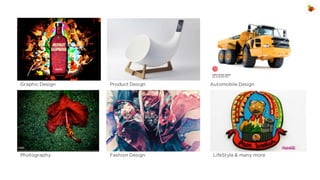
Graphic Design

Product Design

Photography

Fashion Design

Automobile Design

LifeStyle & many more
De•sign [dəzajn]
is a method of problem solving.

Design was understood or rather
misunderstood as a way to design something
rather than a process to solve a problem.
Definitions have give a better picture.

The simplest definition. Design is so many things,
executed in many different ways, but the function
is always the same. Whether it’s blueprints, a clever
UI, a brochure, or a chair – design can help solve a
visual or physical problem.
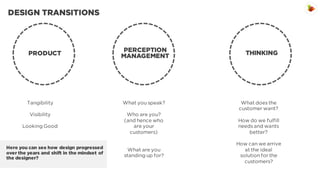
DESIGN TRANSITIONS

PRODUCT

PERCEPTION
MANAGEMENT

Tangibility

What you speak?

Visibility

Who are you?
(and hence who
are your
customers)

Looking Good

Here you can see how design progressed
over the years and shift in the mindset of
the designer?

What are you
standing up for?

THINKING

What does the
customer want?
How do we fulfill
needs and wants
better?
How can we arrive
at the ideal
solution for the
customers?
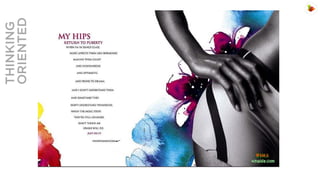
PRODUCT
FOCUSED
PERCEPTION
MANAGEMENT
THINKING
ORIENTED
WHAT IS

DESIGN
MINDSET
?
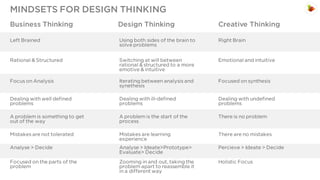
MINDSETS FOR DESIGN THINKING
Business Thinking

Design Thinking

Creative Thinking

Left Brained

Using both sides of the brain to
solve problems

Right Brain

Rational & Structured

Switching at will between
rational & structured to a more
emotive & intuitive

Emotional and intuitive

Focus on Analysis

Iterating between analysis and
synethesis

Focused on synthesis

Dealing with well defined
problems

Dealing with ill-defined
problems

Dealing with undefined
problems

A problem is something to get
out of the way

A problem is the start of the
process

There is no problem

Mistakes are not tolerated

Mistakes are learning
experience

There are no mistakes

Analyse > Decide

Analyse > Ideate>Prototype>
Evaluate> Decide

Percieve > Ideate > Decide

Focused on the parts of the
problem

Zooming in and out, taking the
problem apart to reassemble it
in a different way

Holistic Focus
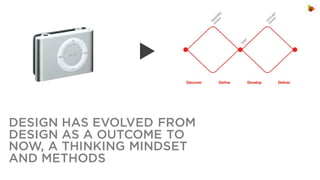
DESIGN HAS EVOLVED FROM
DESIGN AS A OUTCOME TO
NOW, A THINKING MINDSET
AND METHODS
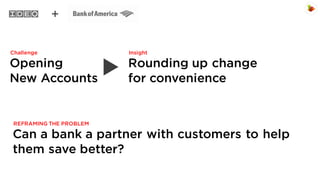
Challenge

Insight

Opening
New Accounts

Rounding up change
for convenience

REFRAMING THE PROBLEM

Can a bank a partner with customers to help
them save better?
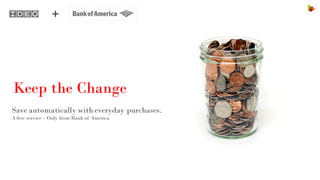
Keep the Change
Save automatically with everyday purchases.
A free service – Only from Bank of America
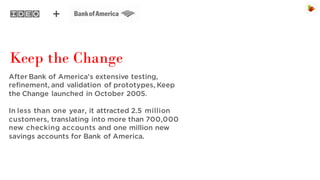
Keep the Change
After Bank of America’s extensive testing,
refinement, and validation of prototypes, Keep
the Change launched in October 2005.
In less than one year, it attracted 2.5 million
customers, translating into more than 700,000
new checking accounts and one million new
savings accounts for Bank of America.
The Sex Profile // Case Study
http://vimeo.com/32788295
Why

STARTUPS
+ DESIGN?
(or for that matter, anything + design)
WHY?

BECAUSE

Startup problems have unique
problems which most often requires
reframing …
WHY?

BECAUSE

Startups usually are into the process
of ‘founder-centric design’ than user
centric design….
WHY?

BECAUSE

Startups are more focused on ‘lets
feature fill the product’ than ‘lets
design a service that would really
matter to my customer’
WHY?

BECAUSE

Startup business landscape is
dynamic and they require iterative
process to sail through….
WHY?

BECAUSE

Because startup need more faster
methods and visual tools that help
everybody be on the same page
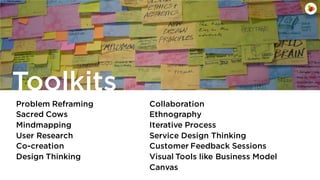
Toolkits
Problem Reframing
Sacred Cows
Mindmapping
User Research
Co-creation
Design Thinking

Collaboration
Ethnography
Iterative Process
Service Design Thinking
Customer Feedback Sessions
Visual Tools like Business Model
Canvas
Excercise
(this is the fun part)

Form small groups of 6
Take up a small industry /
service / product category that
you use
And lets do a ‘sacred cow’
exercise to look at some new
opportunities

WHAT IS A ‘SACRED COW’?
Every idea or thought is based on assumptions
and pillars of thought, without which we think it
would not exist or work. What innovators and
game changers understood that every pillar that
we look at that supports any industry today is
only bound to change with time… and hence
they tend to question these very pillars in hope
to come to something new.
WHATS THE EXERCISE?
Take anything, industry and take a note of the all
the ‘sacred cows’ that people say are given for
that industry …. Like at a time, that we would
surely remember … starting up meant having an
office space. Today a lot of startups, only have
only spaces or virtual offices.
The idea is to question these norms to get to
something new. Also understand, sacred cows is
not the same as competitors. Its not used to
create differentiation with your competitors… its
done to innovate.
(For fun, try the same exercise but not with industries or professions,
do it with your friends or relationships… you’d find interesting ideas … )
Traditional approaches fall short of problem solving in a complex
world wherein problems are dynamic and complex, a designers
mindset gives the required lenses or perspective to sail through
smoothly.
Thank you
© Vizen Design & Consulting 2014 | www.vizen.in
Francis Xavier | Principal Designer / Vizen Design & Consulting | francis@vizen.in

Design Mindset

  • 1.
    Design Mindset & HOWTO APPLY TO STARTUP THINKING
  • 2.
  • 3.
    Mindset The established setof attitude held by someone For most professions, can be divided into two parts. First being skills, which is what designers train for in design schools and use in their day to day ‘designing’ activities. Second being mindset, this is the way of thinking that is a comes as a part and parcel of the profession. This can be understood and applied anywhere…
  • 4.
  • 5.
    Graphic Design Product Design Photography FashionDesign Automobile Design LifeStyle & many more
  • 6.
    De•sign [dəzajn] is amethod of problem solving. Design was understood or rather misunderstood as a way to design something rather than a process to solve a problem. Definitions have give a better picture. The simplest definition. Design is so many things, executed in many different ways, but the function is always the same. Whether it’s blueprints, a clever UI, a brochure, or a chair – design can help solve a visual or physical problem.
  • 7.
    DESIGN TRANSITIONS PRODUCT PERCEPTION MANAGEMENT Tangibility What youspeak? Visibility Who are you? (and hence who are your customers) Looking Good Here you can see how design progressed over the years and shift in the mindset of the designer? What are you standing up for? THINKING What does the customer want? How do we fulfill needs and wants better? How can we arrive at the ideal solution for the customers?
  • 8.
  • 9.
  • 10.
  • 11.
  • 12.
    MINDSETS FOR DESIGNTHINKING Business Thinking Design Thinking Creative Thinking Left Brained Using both sides of the brain to solve problems Right Brain Rational & Structured Switching at will between rational & structured to a more emotive & intuitive Emotional and intuitive Focus on Analysis Iterating between analysis and synethesis Focused on synthesis Dealing with well defined problems Dealing with ill-defined problems Dealing with undefined problems A problem is something to get out of the way A problem is the start of the process There is no problem Mistakes are not tolerated Mistakes are learning experience There are no mistakes Analyse > Decide Analyse > Ideate>Prototype> Evaluate> Decide Percieve > Ideate > Decide Focused on the parts of the problem Zooming in and out, taking the problem apart to reassemble it in a different way Holistic Focus
  • 13.
    DESIGN HAS EVOLVEDFROM DESIGN AS A OUTCOME TO NOW, A THINKING MINDSET AND METHODS
  • 14.
    Challenge Insight Opening New Accounts Rounding upchange for convenience REFRAMING THE PROBLEM Can a bank a partner with customers to help them save better?
  • 15.
    Keep the Change Saveautomatically with everyday purchases. A free service – Only from Bank of America
  • 16.
    Keep the Change AfterBank of America’s extensive testing, refinement, and validation of prototypes, Keep the Change launched in October 2005. In less than one year, it attracted 2.5 million customers, translating into more than 700,000 new checking accounts and one million new savings accounts for Bank of America.
  • 17.
    The Sex Profile// Case Study http://vimeo.com/32788295
  • 18.
    Why STARTUPS + DESIGN? (or forthat matter, anything + design)
  • 19.
    WHY? BECAUSE Startup problems haveunique problems which most often requires reframing …
  • 20.
    WHY? BECAUSE Startups usually areinto the process of ‘founder-centric design’ than user centric design….
  • 21.
    WHY? BECAUSE Startups are morefocused on ‘lets feature fill the product’ than ‘lets design a service that would really matter to my customer’
  • 22.
    WHY? BECAUSE Startup business landscapeis dynamic and they require iterative process to sail through….
  • 23.
    WHY? BECAUSE Because startup needmore faster methods and visual tools that help everybody be on the same page
  • 24.
    Toolkits Problem Reframing Sacred Cows Mindmapping UserResearch Co-creation Design Thinking Collaboration Ethnography Iterative Process Service Design Thinking Customer Feedback Sessions Visual Tools like Business Model Canvas
  • 25.
    Excercise (this is thefun part) Form small groups of 6 Take up a small industry / service / product category that you use And lets do a ‘sacred cow’ exercise to look at some new opportunities WHAT IS A ‘SACRED COW’? Every idea or thought is based on assumptions and pillars of thought, without which we think it would not exist or work. What innovators and game changers understood that every pillar that we look at that supports any industry today is only bound to change with time… and hence they tend to question these very pillars in hope to come to something new. WHATS THE EXERCISE? Take anything, industry and take a note of the all the ‘sacred cows’ that people say are given for that industry …. Like at a time, that we would surely remember … starting up meant having an office space. Today a lot of startups, only have only spaces or virtual offices. The idea is to question these norms to get to something new. Also understand, sacred cows is not the same as competitors. Its not used to create differentiation with your competitors… its done to innovate. (For fun, try the same exercise but not with industries or professions, do it with your friends or relationships… you’d find interesting ideas … )
  • 26.
    Traditional approaches fallshort of problem solving in a complex world wherein problems are dynamic and complex, a designers mindset gives the required lenses or perspective to sail through smoothly.
  • 27.
    Thank you © VizenDesign & Consulting 2014 | www.vizen.in Francis Xavier | Principal Designer / Vizen Design & Consulting | francis@vizen.in