UNIT I : Introduction to Design Thinking
By
Mr.S.Selvaraj
Asst. Professor (SRG) / CSE
Kongu Engineering College
Perundurai, Erode, Tamilnadu, India
18GEO03 – Design Thinking for Engineers
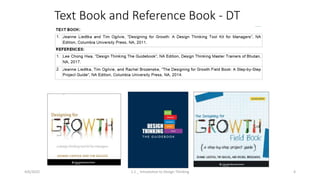
Thanks to and Resource from : Jeanne Liedtka and Tim Ogilvie, "Designing for Growth: A Design Thinking Tool Kit for Managers", NA Edition, Columbia University
Press, NA, 2011 & Lee Chong Hwa, "Design Thinking The Guidebook", NA Edition, Design Thinking Master Trainers of Bhutan, NA, 2017.
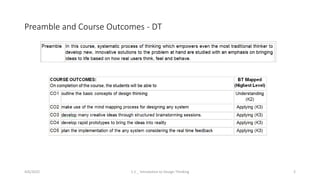
Preamble and Course Outcomes - DT
4/6/2022 1.1 _ Introdution to Design Thinking 2
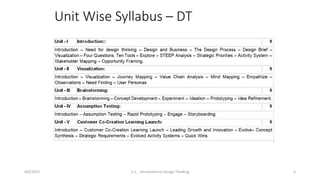
Unit Wise Syllabus – DT
4/6/2022 1.1 _ Introdution to Design Thinking 3
Text Book and Reference Book - DT
4/6/2022 1.1 _ Introdution to Design Thinking 4
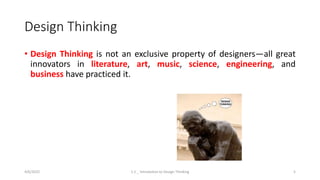
Design Thinking
• Design Thinking is not an exclusive property of designers—all great
innovators in literature, art, music, science, engineering, and
business have practiced it.
4/6/2022 1.1 _ Introdution to Design Thinking 5
Why call it Design Thinking?
What’s special about Design Thinking?
• It is that designers’ work processes can help us
systematically extract, teach, learn and apply these
human-centered techniques to solve problems in a
creative and innovative way –
• in our designs,
• in our businesses,
• in our countries,
• in our lives.
4/6/2022 1.1 _ Introdution to Design Thinking 6
Design Thinking - All over the World
• Some of the world’s leading brands, such as Apple, Google, Samsung
and GE, have rapidly adopted the Design Thinking approach.
• Design Thinking is being taught at leading universities around the
world, including d.school, Stanford, Harvard and MIT.
4/6/2022 1.1 _ Introdution to Design Thinking 7
Design Thinking Institute at Stanford University
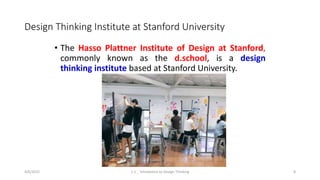
• The Hasso Plattner Institute of Design at Stanford,
commonly known as the d.school, is a design
thinking institute based at Stanford University.
4/6/2022 1.1 _ Introdution to Design Thinking 8
Design Thinking Process
• There are many variants of the Design Thinking process in use today,
and they have from three to seven phases, stages, or modes.
• However, all variants of Design Thinking are very similar.
• All variants of Design Thinking embody the same principles, which
were first described by Nobel Prize laureate Herbert Simon in The
Sciences of the Artificial book in 1969.
4/6/2022 1.1 _ Introdution to Design Thinking 9
Design Thinking Process
• Here, we will focus on the five-phase model proposed by the Hasso-
Plattner Institute of Design at Stanford, which is also known as
d.school.
• We’ve chosen d.school’s approach because they’re at the forefront of
applying and teaching Design Thinking.
4/6/2022 1.1 _ Introdution to Design Thinking 10
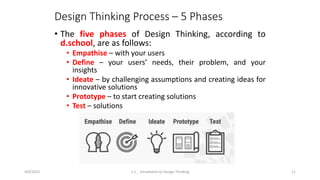
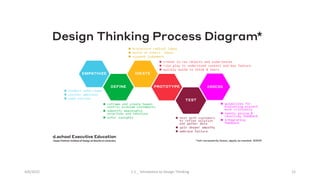
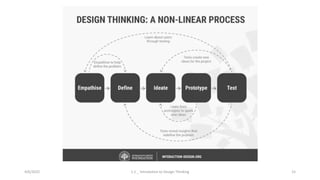
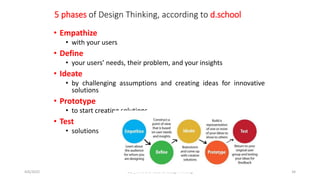
Design Thinking Process – 5 Phases
• The five phases of Design Thinking, according to
d.school, are as follows:
• Empathise – with your users
• Define – your users’ needs, their problem, and your
insights
• Ideate – by challenging assumptions and creating ideas for
innovative solutions
• Prototype – to start creating solutions
• Test – solutions
4/6/2022 1.1 _ Introdution to Design Thinking 11
4/6/2022 1.1 _ Introdution to Design Thinking 12
4/6/2022 1.1 _ Introdution to Design Thinking 13
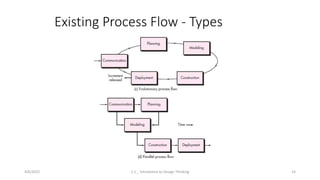
Existing Process Flow - Types
4/6/2022 1.1 _ Introdution to Design Thinking 14
Existing Process Flow - Types
4/6/2022 1.1 _ Introdution to Design Thinking 15
Design Thinking - Points
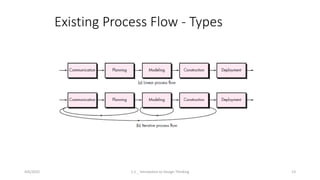
• It is important to note that the five phases, stages, or modes are not
always sequential.
• They do not have to follow any specific order and can often occur in
parallel and repeat iteratively.
• Given that, you should not understand the phases as a hierarchical
or step-by-step process.
• Instead, you should look at it as an overview of the modes or phases
that contribute to an innovative project, rather than sequential steps.
4/6/2022 1.1 _ Introdution to Design Thinking 16
The Problem with Ingrained Patterns of Thinking
• Humans naturally develop patterns of thinking
modeled on repetitive activities and commonly
accessed knowledge.
• These patterns of thinking are often referred to
as schemas, which are
• organized sets of information
• relationships between things, actions
• thoughts that are stimulated and initiated in the human
mind
• For example, we have a schema for dogs which
encompasses the presence of four legs, fur, sharp
teeth, a tail, paws, and a number of other perceptible
characteristics.
4/6/2022 1.1 _ Introdution to Design Thinking 17
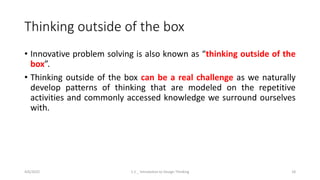
Thinking outside of the box
• Innovative problem solving is also known as “thinking outside of the
box”.
• Thinking outside of the box can be a real challenge as we naturally
develop patterns of thinking that are modeled on the repetitive
activities and commonly accessed knowledge we surround ourselves
with.
4/6/2022 1.1 _ Introdution to Design Thinking 18
Read the Problem and Give your Solution
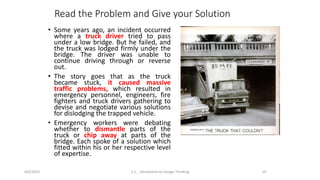
• Some years ago, an incident occurred
where a truck driver tried to pass
under a low bridge. But he failed, and
the truck was lodged firmly under the
bridge. The driver was unable to
continue driving through or reverse
out.
• The story goes that as the truck
became stuck, it caused massive
traffic problems, which resulted in
emergency personnel, engineers, fire
fighters and truck drivers gathering to
devise and negotiate various solutions
for dislodging the trapped vehicle.
• Emergency workers were debating
whether to dismantle parts of the
truck or chip away at parts of the
bridge. Each spoke of a solution which
fitted within his or her respective level
of expertise.
4/6/2022 1.1 _ Introdution to Design Thinking 19
One of the fine thinking by a small boy
4/6/2022 1.1 _ Introdution to Design Thinking 20
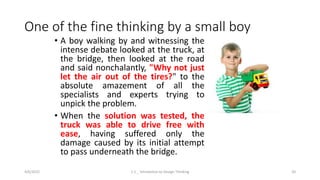
• A boy walking by and witnessing the
intense debate looked at the truck, at
the bridge, then looked at the road
and said nonchalantly, "Why not just
let the air out of the tires?" to the
absolute amazement of all the
specialists and experts trying to
unpick the problem.
• When the solution was tested, the
truck was able to drive free with
ease, having suffered only the
damage caused by its initial attempt
to pass underneath the bridge.
Storytelling
4/6/2022 1.1 _ Introdution to Design Thinking 21
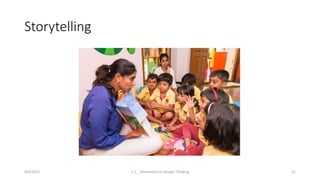
The Power of Storytelling
• Why did we tell you this story?
• Telling stories can help us inspire opportunities, ideas and
solutions.
• Stories are framed around real people and their lives.
• Stories are important because they are accounts of specific
events, not general statements.
• They provide us with concrete details that help us imagine
solutions to particular problems.
• Please watch this 1-minute video to help you get
started understanding what Design Thinking is about.
• https://www.youtube.com/watch?v=eDICzreiJXA
4/6/2022 1.1 _ Introdution to Design Thinking 22
Take away
• Design Thinking is essentially a problem-solving approach specific to
design, which involves assessing known aspects of a problem and
identifying the more ambiguous or peripheral factors that contribute to the
conditions of a problem.
• This contrasts with a more scientific approach where the concrete and
known aspects are tested in order to arrive at a solution.
• Design Thinking is an iterative process in which knowledge is constantly
being questioned and acquired so it can help us redefine a problem in an
attempt to identify alternative strategies and solutions that might not be
instantly apparent with our initial level of understanding.
• Design Thinking is often referred to as ‘outside the box thinking’, as
designers are attempting to develop new ways of thinking that do not abide
by the dominant or more common problem-solving methods – just like
artists do.
• At the heart of Design Thinking is the intention to improve products by
analyzing how users interact with them and investigating the conditions in
which they operate.
• Design Thinking offers us a means of digging that bit deeper to uncover
ways of improving user experiences.
4/6/2022 1.1 _ Introdution to Design Thinking 23
Thank you
4/6/2022 1.1 _ Introdution to Design Thinking 24
Poll Question1
• No.of phases of design thinking?
• 3
• 4
• 5
• 6
4/6/2022 1.1 _ Introdution to Design Thinking 25
Poll Question 2
• Design Thinking is a ___
• Linear Process Flow
• Non-Linear Process Flow
4/6/2022 1.1 _ Introdution to Design Thinking 26
Poll Question 3
• Design Thinking is also called as___
• Outside the box thinking
• Inside the box thinking
4/6/2022 1.1 _ Introdution to Design Thinking 27
Poll Question 4
• 1st phase of Design Thinking is ___
• Define
• Empathise
• Prototype
• Ideate
• Test
4/6/2022 1.1 _ Introdution to Design Thinking 28
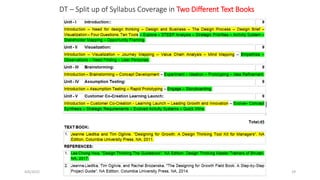
DT – Split up of Syllabus Coverage in Two Different Text Books
4/6/2022 1.2 _ Intro and Need for Design Thinking 29
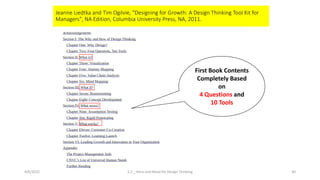
Jeanne Liedtka and Tim Ogilvie, "Designing for Growth: A Design Thinking Tool Kit for
Managers", NA Edition, Columbia University Press, NA, 2011.
4/6/2022 1.2 _ Intro and Need for Design Thinking 30
First Book Contents
Completely Based
on
4 Questions and
10 Tools
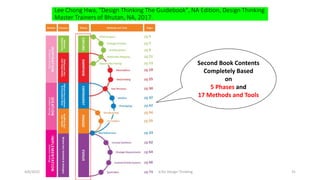
Lee Chong Hwa, "Design Thinking The Guidebook", NA Edition, Design Thinking
Master Trainers of Bhutan, NA, 2017.
4/6/2022 1.2 _ Intro and Need for Design Thinking 31
Second Book Contents
Completely Based
on
5 Phases and
17 Methods and Tools
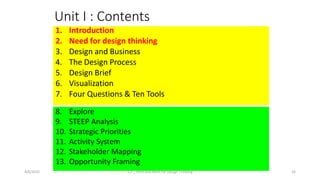
Unit I : Contents
1. Introduction
2. Need for design thinking
3. Design and Business
4. The Design Process
5. Design Brief
6. Visualization
7. Four Questions & Ten Tools
4/6/2022 32
1.2 _ Intro and Need for Design Thinking
8. Explore
9. STEEP Analysis
10. Strategic Priorities
11. Activity System
12. Stakeholder Mapping
13. Opportunity Framing
Introduction
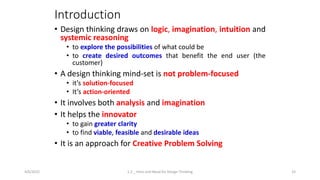
• Design thinking draws on logic, imagination, intuition and
systemic reasoning
• to explore the possibilities of what could be
• to create desired outcomes that benefit the end user (the
customer)
• A design thinking mind-set is not problem-focused
• it’s solution-focused
• It’s action-oriented
• It involves both analysis and imagination
• It helps the innovator
• to gain greater clarity
• to find viable, feasible and desirable ideas
• It is an approach for Creative Problem Solving
4/6/2022 1.2 _ Intro and Need for Design Thinking 33
5 phases of Design Thinking, according to d.school
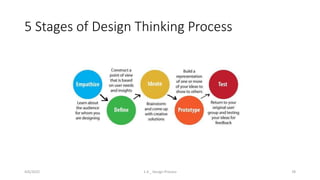
• Empathize
• with your users
• Define
• your users’ needs, their problem, and your insights
• Ideate
• by challenging assumptions and creating ideas for innovative
solutions
• Prototype
• to start creating solutions
• Test
• solutions
4/6/2022 1.2 _ Intro and Need for Design Thinking 34
4 Phases / 4 ?’s of Design Thinking Based on Jeanne Liedtka et
al. (1st Text Book)
• What is? - explores current reality
• What if? - envisions a new future
• What wows? – makes some choices
• What works? - takes us into the marketplace
4/6/2022 1.2 _ Intro and Need for Design Thinking 35
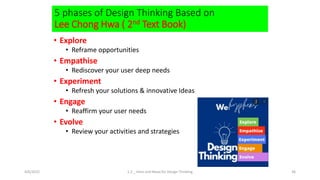
5 phases of Design Thinking Based on
Lee Chong Hwa ( 2nd Text Book)
• Explore
• Reframe opportunities
• Empathise
• Rediscover your user deep needs
• Experiment
• Refresh your solutions & innovative Ideas
• Engage
• Reaffirm your user needs
• Evolve
• Review your activities and strategies
4/6/2022 1.2 _ Intro and Need for Design Thinking 36
Need for Design Thinking
• Every managers needs design.
• Design has a lot of different meanings.
• It is actually a systematic approach to problem solving.
• It starts with customers and the ability to create a better
future for them.
• It acknowledges that we probably won’t get that right the
first time.
• It does not require supernatural powers.
• Recent explosion of interest in design thinking has a lot
more fueling it than Apple’s success and high profile.
4/6/2022 1.2 _ Intro and Need for Design Thinking 37
Need for Design Thinking
• Design thinking can do for organic growth and innovation what TQM did
for quality.
• Design thinking will be practiced at varying levels by people with different
talents and capabilities.
• Design thinking by translating “design” from an abstract idea into a
practical, everyday tool any manager can profit from.
• Using a business perspective and business language, we’ll
• translate the vocabulary of design
• unpack the mysterious connection between design thinking and profitable growth
• introduce a systematic process (complete with simple Project Management Aids
(PMA))
4/6/2022 1.2 _ Intro and Need for Design Thinking 38
Thank you
4/6/2022 1.2 _ Intro and Need for Design Thinking 39
Poll Question 1
• Empathise phase focuses on whom?
• Manager
• Developer
• User
4/6/2022 1.2 _ Intro and Need for Design Thinking 40
Poll Question 2
• Design thinking mind-set is not ____ ?
• Solution Focused
• Problem Focused
• Action Focused
4/6/2022 1.2 _ Intro and Need for Design Thinking 41
Poll Question 3
• What is 1st phases of Design Thinking Based on Lee Chong Hwa ____
?
• Explore
• Empathise
• Experiment
• Engage
• Evolve
4/6/2022 1.2 _ Intro and Need for Design Thinking 42
Poll Question 4
• Design Thinking is starts with ____ ?
• Manager
• Customer
• Programmer
• Developer
4/6/2022 1.2 _ Intro and Need for Design Thinking 43
What if Managers Thought Like Designers?
• What would be different if managers thought more like designers?
• We have three words for you:
• Empathy
• Invention
• Iteration
4/6/2022 1.3 _ Design and Business 44
Empathy
• Design starts with empathy, establishing a deep
understanding of those we are designing for.
• Managers who thought like designers would put
themselves in their customers’ shoes.
• It involves developing an understanding of both their
emotional and their “rational” needs and wants.
• To be a customer –centric and know your customer.
• Great designs inspire —they grab us at an emotional
level.
4/6/2022 1.3 _ Design and Business 45
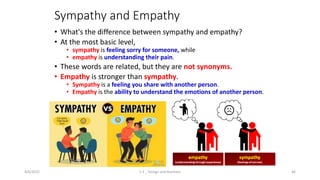
Sympathy and Empathy
• What's the difference between sympathy and empathy?
• At the most basic level,
• sympathy is feeling sorry for someone, while
• empathy is understanding their pain.
• These words are related, but they are not synonyms.
• Empathy is stronger than sympathy.
• Sympathy is a feeling you share with another person.
• Empathy is the ability to understand the emotions of another person.
4/6/2022 1.3 _ Design and Business 46
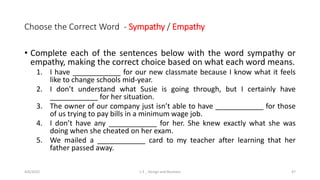
Choose the Correct Word - Sympathy / Empathy
• Complete each of the sentences below with the word sympathy or
empathy, making the correct choice based on what each word means.
1. I have ____________ for our new classmate because I know what it feels
like to change schools mid-year.
2. I don’t understand what Susie is going through, but I certainly have
____________ for her situation.
3. The owner of our company just isn’t able to have ____________ for those
of us trying to pay bills in a minimum wage job.
4. I don’t have any ____________ for her. She knew exactly what she was
doing when she cheated on her exam.
5. We mailed a ____________ card to my teacher after learning that her
father passed away.
4/6/2022 1.3 _ Design and Business 47
Answer Key
• Check your answers using the answer key below.
1. empathy
2. sympathy
3. empathy
4. sympathy
5. sympathy
4/6/2022 1.3 _ Design and Business 48
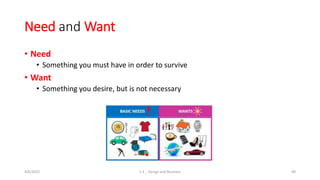
Need and Want
• Need
• Something you must have in order to survive
• Want
• Something you desire, but is not necessary
4/6/2022 1.3 _ Design and Business 49
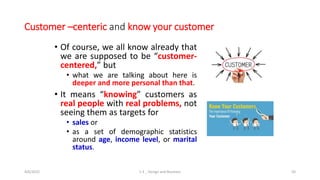
Customer –centeric and know your customer
• Of course, we all know already that
we are supposed to be “customer-
centered,” but
• what we are talking about here is
deeper and more personal than that.
• It means “knowing” customers as
real people with real problems, not
seeing them as targets for
• sales or
• as a set of demographic statistics
around age, income level, or marital
status.
4/6/2022 1.3 _ Design and Business 50
Invention
4/6/2022 1.3 _ Design and Business 51
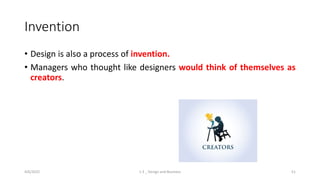
• Design is also a process of invention.
• Managers who thought like designers would think of themselves as
creators.
Iteration
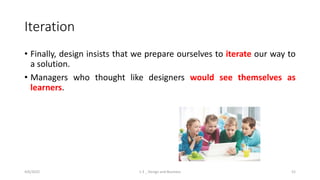
• Finally, design insists that we prepare ourselves to iterate our way to
a solution.
• Managers who thought like designers would see themselves as
learners.
4/6/2022 1.3 _ Design and Business 52
Design and Business
• Consider a challenge faced by a leading consumer products firm.
• How to think about and respond to changes in the retail marketplace
over the next ten years?
• Suppose that two student teams
• one composed of MBAs and
• the other of design students
• How might each team approach its study?
4/6/2022 1.3 _ Design and Business 53
1st Team (Business Students)
• The MBAs would likely begin by researching trends in the
marketplace, social, technological, environmental, and political.
• They’d read analysts’ reports, interview industry experts, and
benchmark leading retailers and competitors.
• They’d produce forecasts and a recommended set of strategies,
complete with ROI (return on investment) and NPV (net present
value) calculations.
• They’d deliver it all in a PowerPoint presentation.
4/6/2022 1.3 _ Design and Business 54
2nd Team (Design Students)
• The design students would probably approach the project quite
differently.
• They might begin with a similar trend analysis, but they would use it
to develop scenarios of possible futures instead of spreadsheets.
• They would hang out in stores and talk to shoppers and employees,
focusing on the shopping experience.
• They’d likely create some different customer personas and use the
scenarios to try to model the changes in the personas’ lives—and,
accordingly, in their shopping habits—over the next ten years.
• They might sponsor a “store of the future” brainstorming session,
inviting their fellow students (and offering free pizza).
• They would use the scenarios and personas as a starting point and
build on them as a group.
• Ultimately, they’d present not solutions but a small number of
concepts to be prototyped, with the aim of soliciting feedback from
real customers and collaborators.
4/6/2022 1.3 _ Design and Business 55
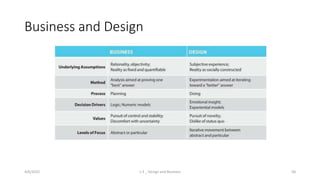
Business Thinking Vs Design Thinking
4/6/2022 1.3 _ Design and Business 56
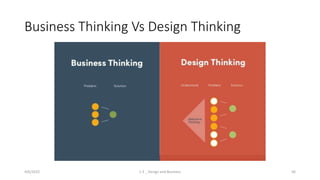
Business thinking vs Design Thinking
• Business thinking assumes rationality and objectivity.
• Design thinking assumes instead human experience, always messy, as
its decision driver and sees true objectivity as an illusion. Reality, for
designers, is always constructed by the people living it.
• Hence, the MBAs analyzed trend data; the designers observed the
shopper’s experience.
4/6/2022 1.3 _ Design and Business 57
Business and Design
4/6/2022 1.3 _ Design and Business 58
Business needs design
• In today’s increasingly fast-paced and unpredictable
environment, business needs design precisely
because of all the differences we’ve noted:
• First, design is all about action, and business too often gets
stuck at the talking stage.
• Second, design teaches us how to make things feel real,
and most business rhetoric today remains largely
irrelevant to the people who are supposed to make things
happen.
• Third, design is tailored to dealing with uncertainty, and
business’s obsession with analysis is best suited for a
stable and predictable world.
• Fourth, design understands that products and services are
bought by human beings, not target markets segmented
into demographic categories.
4/6/2022 1.3 _ Design and Business 59
Design needs business
• Design needs business thinking for good reasons:
• First, because novelty does not necessarily create value.
• Second, because even value creation is not enough.
• And third, because how many more stylish toasters and corkscrews do any of
us need?
4/6/2022 1.3 _ Design and Business 60
Thank you
4/6/2022 1.3 _ Design and Business 61
Poll Question 1
• Empathy is ____?
• Feeling
• Understanding
4/6/2022 1.3 _ Design and Business 62
Poll Question 2
• As I had lost my job last year, I had ______ for my friend when she
was fired?
• Sympathy
• Empathy
4/6/2022 1.3 _ Design and Business 63
Poll Question 3
• Education is a ____
• Want
• Need
4/6/2022 1.3 _ Design and Business 64
Poll Question 4
• Which one give you more than one solution for a particular problem?
• Business Thinking
• Design Thinking
4/6/2022 1.3 _ Design and Business 65
Unit I : Contents
1. Introduction
2. Need for design thinking
3. Design and Business
4. The Design Process
5. Design Brief
6. Visualization
7. Four Questions & Ten Tools
4/6/2022 66
1.4 _ Design Process
8. Explore
9. STEEP Analysis
10. Strategic Priorities
11. Activity System
12. Stakeholder Mapping
13. Opportunity Framing
Design Process Stages
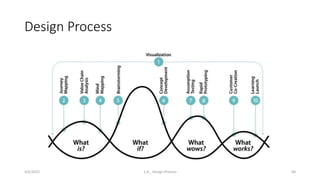
• Design process deals with 4 basic questions also
called 4 stages of Design process.
• What is?
• explores current reality.
• refers to the present.
• What if?
• builds on the present to envisions a new future.
• What wows?
• makes some choices and narrow choices to the best.
• helps teams focus on solutions that stand out.
• What works?
• takes us into the marketplace.
• tests possible solutions with actual users in the real world.
4/6/2022 1.4 _ Design Process 67
Design Process
4/6/2022 1.4 _ Design Process 68
Design Process
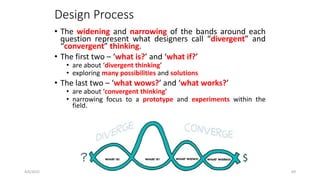
• The widening and narrowing of the bands around each
question represent what designers call “divergent” and
“convergent” thinking.
• The first two – ‘what is?’ and ‘what if?’
• are about ‘divergent thinking’
• exploring many possibilities and solutions
• The last two – ‘what wows?’ and ‘what works?’
• are about ‘convergent thinking’
• narrowing focus to a prototype and experiments within the
field.
4/6/2022 1.4 _ Design Process 69
Convergent Thinking Vs Divergent Thinking
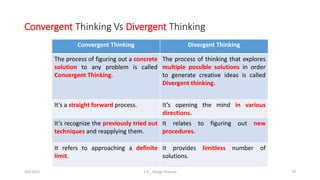
Convergent Thinking Divergent Thinking
The process of figuring out a concrete
solution to any problem is called
Convergent Thinking.
The process of thinking that explores
multiple possible solutions in order
to generate creative ideas is called
Divergent thinking.
It’s a straight forward process. It’s opening the mind in various
directions.
It’s recognize the previously tried out
techniques and reapplying them.
It relates to figuring out new
procedures.
It refers to approaching a definite
limit.
It provides limitless number of
solutions.
4/6/2022 1.4 _ Design Process 70
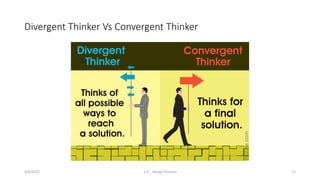
Divergent Thinker Vs Convergent Thinker
4/6/2022 1.4 _ Design Process 71
What is?
• In this phase, teams exploit the knowledge existing in the
organisation across the value chain.
• It’s about getting buried in the current ways of doing things to
surface the known problems.
• It requires empathising with individuals involved and getting
clear on their issues without judgement.
• To develop a sense of empathy or user centric view of the
problem.
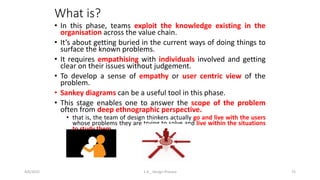
• Sankey diagrams can be a useful tool in this phase.
• This stage enables one to answer the scope of the problem
often from deep ethnographic perspective.
• that is, the team of design thinkers actually go and live with the users
whose problems they are trying to solve and live within the situations
to study them.
4/6/2022 1.4 _ Design Process 72
Sankey Diagram
4/6/2022 1.4 _ Design Process 73
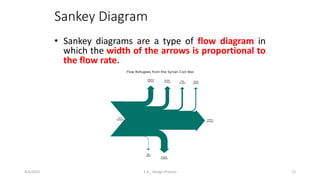
• Sankey diagrams are a type of flow diagram in
which the width of the arrows is proportional to
the flow rate.
What if ?
• The aim of this stage is to come up with as many ideas as possible.
• 100 ideas is OK. Anything is constructive.
• Generate plenty of ideas and then narrow down to a few ideas.
• No wrongs answers, giving voice to everybody.
• Wild dreams, humble incremental improvements, it’s all good.
• During this stage, it’s vital to remove the power dynamics.
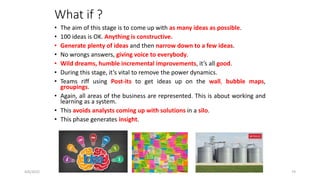
• Teams riff using Post-its to get ideas up on the wall, bubble maps,
groupings.
• Again, all areas of the business are represented. This is about working and
learning as a system.
• This avoids analysts coming up with solutions in a silo.
• This phase generates insight.
4/6/2022 1.4 _ Design Process 74
What wows?
4/6/2022 1.4 _ Design Process 75
• Now we’re narrowing down ideas into the potentially
viable ones – ideas to wow.
• Here the team build prototypes.
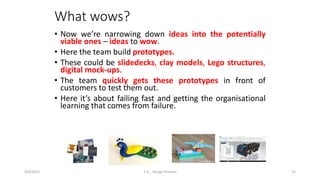
• These could be slidedecks, clay models, Lego structures,
digital mock-ups.
• The team quickly gets these prototypes in front of
customers to test them out.
• Here it’s about failing fast and getting the organisational
learning that comes from failure.
What Works?
• This is point where we ask:
• Can we make money out of us?
• Which of these things would work based on the constraints in
the business?
• If it won’t work now, when might it work?
• If a team has found something that they think works, now
is the time to engage in multi-stage planning.
• Experimenting, testing and implementing.
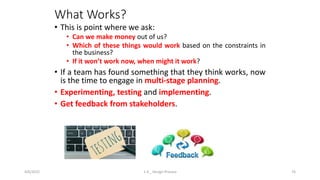
• Get feedback from stakeholders.
4/6/2022 1.4 _ Design Process 76
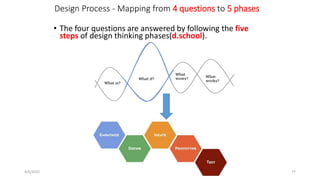
Design Process - Mapping from 4 questions to 5 phases
4/6/2022 1.4 _ Design Process 77
• The four questions are answered by following the five
steps of design thinking phases(d.school).
5 Stages of Design Thinking Process
4/6/2022 1.4 _ Design Process 78
Thank you
4/6/2022 1.4 _ Design Process 79
Poll Question 1
• Exploring many possibilities and solutions are ____?
• Divergent Thinking
• Convergent Thinking
4/6/2022 1.4 _ Design Process 80
Poll Question 2
• Who thinks for final solution?
• Divergent thinker
• Convergent thinker
4/6/2022 1.4 _ Design Process 81
Poll Question 3
• Post-it sticky notes used in which stage?
• What is?
• What if?
• What wows?
• What works?
4/6/2022 1.4 _ Design Process 82
Poll Question 4
• “What wows?” stage focus on which concept____.
• Empathise
• Define
• Ideate
• Prototype
• Test
4/6/2022 1.4 _ Design Process 83
Poll Question 5
• “What wows?” stage uses ____.
• Sankey Diagram
• Sticky notes
• Lego structures
4/6/2022 1.4 _ Design Process 84
Unit I : Contents
1. Introduction
2. Need for design thinking
3. Design and Business
4. The Design Process
5. Design Brief
6. Visualization
7. Four Questions & Ten Tools
4/6/2022 85
1.5 _ Design Brief and Visualization
8. Explore
9. STEEP Analysis
10. Strategic Priorities
11. Activity System
12. Stakeholder Mapping
13. Opportunity Framing
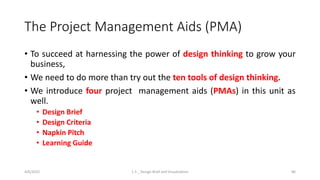
The Project Management Aids (PMA)
• To succeed at harnessing the power of design thinking to grow your
business,
• We need to do more than try out the ten tools of design thinking.
• We introduce four project management aids (PMAs) in this unit as
well.
• Design Brief
• Design Criteria
• Napkin Pitch
• Learning Guide
4/6/2022 1.5 _ Design Brief and Visualization 86
The Project Management Aids (PMA)
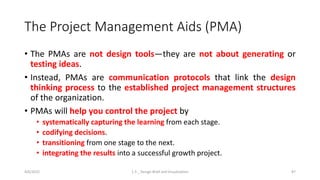
• The PMAs are not design tools—they are not about generating or
testing ideas.
• Instead, PMAs are communication protocols that link the design
thinking process to the established project management structures
of the organization.
• PMAs will help you control the project by
• systematically capturing the learning from each stage.
• codifying decisions.
• transitioning from one stage to the next.
• integrating the results into a successful growth project.
4/6/2022 1.5 _ Design Brief and Visualization 87
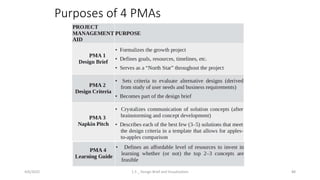
Purposes of 4 PMAs
4/6/2022 1.5 _ Design Brief and Visualization 88
4/6/2022 1.5 _ Design Brief and Visualization 89
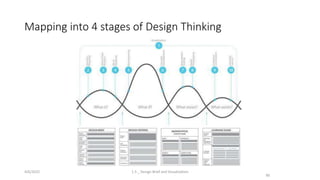
Mapping into 4 stages of Design Thinking
4/6/2022 1.5 _ Design Brief and Visualization
90
Design Brief
• The design thinking team starts with a design brief
(project management aid 1).
• It clarified the scope of the project, its intent, the questions it
hoped to explore, and the target market it wanted to explore
them with.
• What is?
• starts with the creation of the design brief and
• ends with the identification of design criteria.
• Between those two project management aids are four
design thinking tools:
• visualization
• journey mapping
• value chain analysis
• mind mapping
4/6/2022 1.5 _ Design Brief and Visualization 91
Design Brief (PMA 1)
• PMA 1 forces you to clarify your ambitions and constraints.
• It asks you to frame your design challenge,
• define its scope, and
• pose the key questions to explore at the outset:
• What do you expect to get out of this work?
• What would success look like?
• How will you know if the project added value?
4/6/2022 1.5 _ Design Brief and Visualization 92
Design Brief - Positives
• A design brief tells the project team where it is going and why, what
pitfalls to avoid, and what resources are required.
• Use the design brief to kick off the project, and revisit it at every key
milestone.
• It sets the schedule, names the important milestones, and lays out
the metrics that will assess the project.
• Not surprisingly, brevity is a key attribute of a good design brief.
• The document— two or three pages at most—should give the team
plenty of leeway to use their creativity.
• The design brief provides that guidance throughout the project.
4/6/2022 1.5 _ Design Brief and Visualization 93
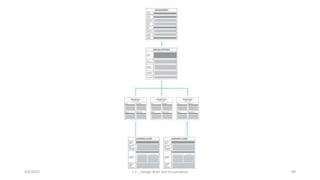
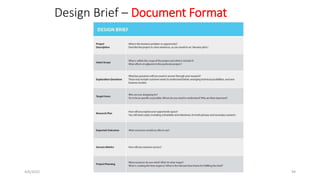
Design Brief – Document Format
4/6/2022 1.5 _ Design Brief and Visualization 94
4/6/2022 1.5 _ Design Brief and Visualization 95
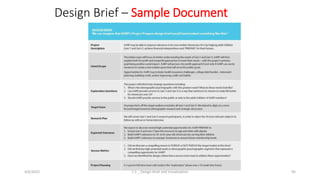
Design Brief – Sample Document
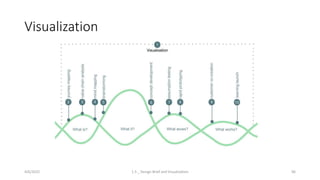
Visualization
4/6/2022 1.5 _ Design Brief and Visualization 96
Visualization
• Visualization is about using images.
• It’s not about drawing; it’s about visual thinking.
• It pushes us beyond using words or language alone.
• It is a way of unlocking a different part of our brains that
allows us to think nonverbally and that managers might
not normally use.
• When you explain an idea using words, the rest of us will
form our own mental pictures.
• For example,
• When you say, “We need a new growth platform,” the IT
specialist sees servers and code and the marketing guru sees an
advertising campaign.
• If instead you present your idea to us by drawing a picture
of it, you reduce the possibility of unmatched mental
models.
4/6/2022 1.5 _ Design Brief and Visualization 97
Visualization
• Visualization is a very special design tool.
• This is really a “meta” tool, so fundamental to the way
designers work that it shows up in virtually every stage in the
process of designing for growth.
• Often, visualization is integral to the other tools we will talk
about.
• It is an approach for identifying, organizing, and
communicating in ways that access “right brain” thinking
while decreasing our dependency on “left brain” media such
as numbers.
• Visualization consciously inserts visual imagery into our work
processes.
• It focuses on bringing an idea to life, simplifying team
collaboration and (eventually) creating stories that go to the
heart of how designers cultivate empathy in every phase of
their work and use it to generate excitement for new ideas.
4/6/2022 1.5 _ Design Brief and Visualization 98
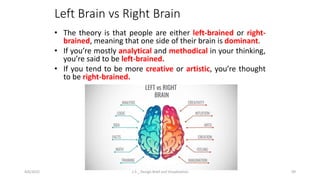
Left Brain vs Right Brain
4/6/2022 1.5 _ Design Brief and Visualization 99
• The theory is that people are either left-brained or right-
brained, meaning that one side of their brain is dominant.
• If you’re mostly analytical and methodical in your thinking,
you’re said to be left-brained.
• If you tend to be more creative or artistic, you’re thought
to be right-brained.
Thank you
4/6/2022 1.5 _ Design Brief and Visualization 100