DESIGN IS THE NEW MANAGEMENT CONSULTING
A TALKBY KATIELUKAS
OCTOBER 11 2018
ABOUT KATIE
My career grew up with the web, starting in 1995 working on the very
first weather.com site at Siegel & Gale, getting very excited about
Macromedia Director and the new CSS layers implementation. Which
is a long way of saying I am just incredibly old.
Throughout these past twenty-odd years, there have been
innumerable changes and cycles in technology, but much more
momentous and interesting are the sea changes in how we
create, organize, lead, and think about organizations and the
people within them.
2
INTRODUCTION
At every talk I give or attend, in every conversation online, in all the
literature, the same questions keep coming up: “How do I get the
company to pay for all this UX/CX/research stuff?”
This talk is structured to give you the tools to answer that question with
another: “How can you make wise and frugal choices without it?”
THIS IS MANAGEMENTBYDESIGN.
3
INSPIRATIONAL MILITARY STRATEGY SLIDE
Variety
Rapidity
Harmony
Initiative
Agility
4
Do lots of things fast
Co-exist with those around you; do not be passive
Follow the above, and emphasize the implicit over the
explicit by allowing the whole team to continuously
interact with the external world and with each other
5
A LITTLE BACKGROUND
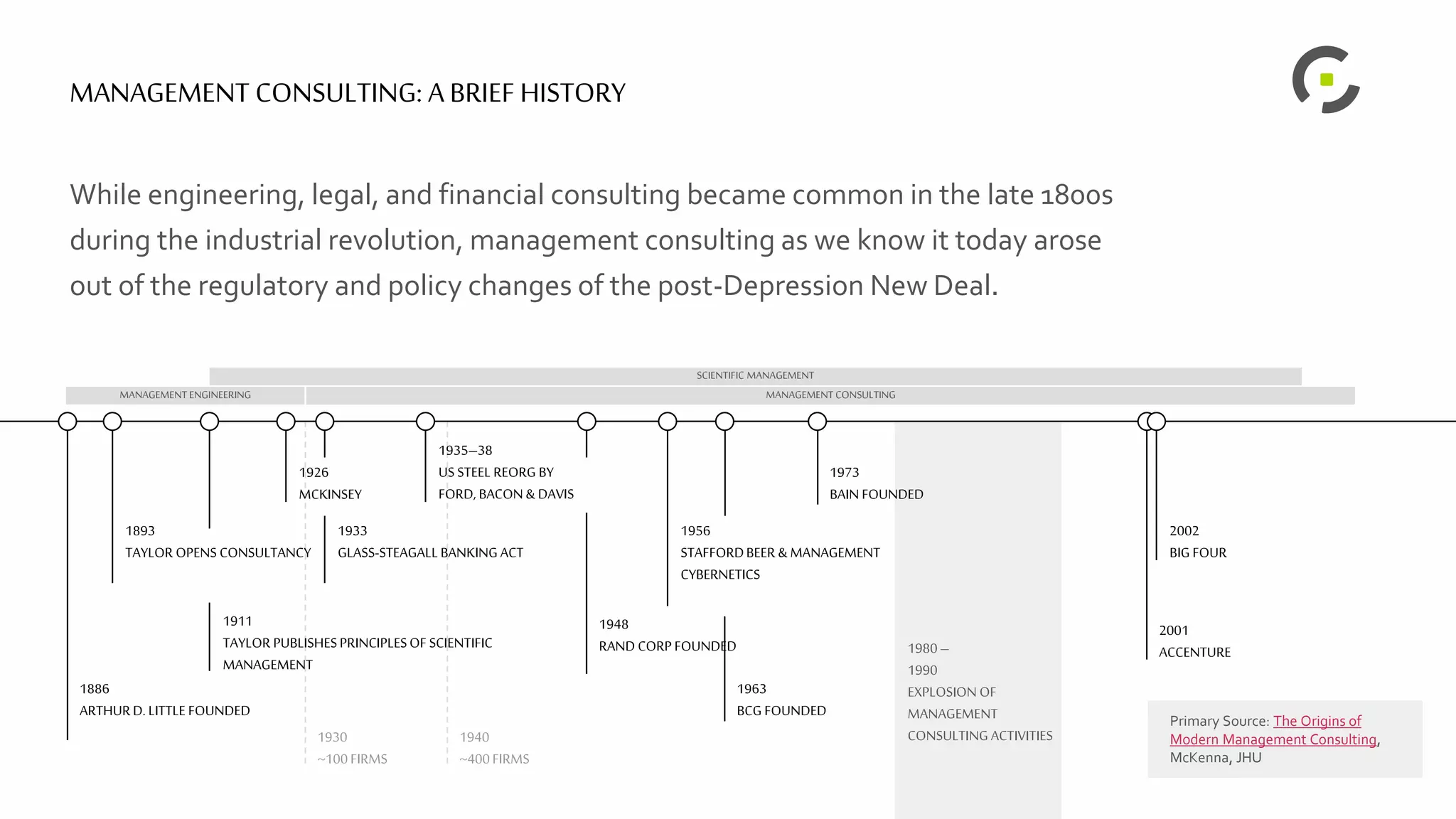
MANAGEMENT CONSULTING: A BRIEF HISTORY
While engineering, legal, and financial consulting became common in the late 1800s
during the industrial revolution, management consulting as we know it today arose
out of the regulatory and policy changes of the post-Depression New Deal.
1886
ARTHURD. LITTLE FOUNDED
1893
TAYLOR OPENS CONSULTANCY
1911
TAYLOR PUBLISHESPRINCIPLESOF SCIENTIFIC
MANAGEMENT
1933
GLASS-STEAGALLBANKING ACT
1926
MCKINSEY
MANAGEMENT ENGINEERING MANAGEMENT CONSULTING
SCIENTIFIC MANAGEMENT
1930
~100FIRMS
1940
~400FIRMS
1935–38
US STEEL REORG BY
FORD, BACON & DAVIS
1948
RAND CORP FOUNDED
1956
STAFFORDBEER & MANAGEMENT
CYBERNETICS
2001
ACCENTURE
1980–
1990
EXPLOSION OF
MANAGEMENT
CONSULTING ACTIVITIES
2002
BIG FOUR
1963
BCG FOUNDED
1973
BAIN FOUNDED
Primary Source: The Origins of
Modern Management Consulting,
McKenna, JHU
MANAGEMENT CONSULTING KEY CONCEPTS
ACCOUNTING
LEGAL ENGINEERING
THEN
OPERATIONS
STRATEGY
EXPERIENCE
DESIGN
HUMAN
RESOURCES
PLANNING
IT
DIGITAL
TRANSFOR-
MATION
CHANGE
MANAGEMENT
RISK
DESIGN
MARKETING
RESEARCH&
ANALYTICS
NOW
7
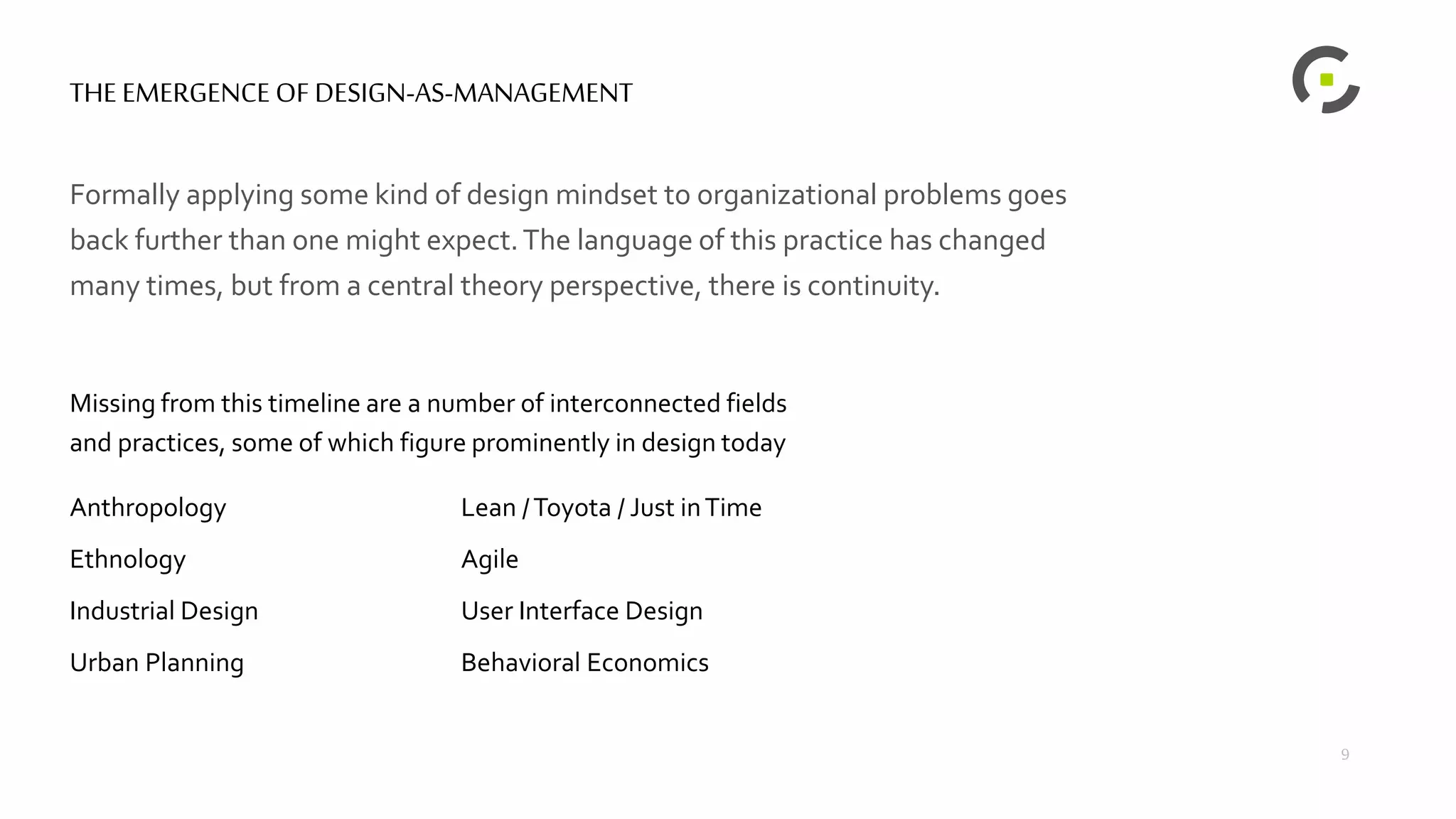
THE EMERGENCE OF DESIGN-AS-MANAGEMENT
Formally applying some kind of design mindset to organizational problems goes
back further than one might expect.The language of this practice has changed
many times, but from a central theory perspective, there is continuity.
1937
von Bertalanffy develops
term "general systems
theory"
1948
Weiner defines
cybernetics
1957
Bucky Fuller introduces
"Design Science"
1962
Conference on Design
Methods, London
1965
L. Bruce Archer,
Systematic Method for
Designers
1968
Herbert Simon, The
Sciences of the Artificial
1970s
Scandinavian cooperative/
participatory design
1971
Victor Papanek - Design
for the Real World
1972
Koberg & Bagnall, The
Universal Traveler
1973
Horst Rittel describes
"wicked problems"
1980
Lawson, How Designers
Think
1982
G. Lynn Shostack
introduces the "service
blueprint"
1982
Nigel Cross launches
"Designerly Ways of
Knowing" series
1983
The Psychology of
Human–Computer
Interaction
1983
Schön, The Reflective
Practitioner
1987
Peter Rowe, Design
Thinking
1991
IDEO founded by merger
1992
Buchanan, "Wicked
Problems in Design
Thinking"
1993
Norman popularizes "User
Experience" as a term
1994
Lou Carbone coins
"customer experience"
1999
Sachse & Specker, Design
Thinking
2001
Livework - 1st service
design consultancy
2005
Stanford's d.school starts
teaching design thinking
2007
Inaugural Service Design
Conference
2009
Tim Brown, Change by
Design
2010
Stickdorn – This is Service
Design Thinking
2012
Manning, Bernoff, Bodine,
Outside In
EXPLOSIVEGROWTH; DIFFICULTTO CATALOGUE
SEVERALBEGINNINGS SCIENCE OF DESIGN
PHILOSOPHY OF DESIGN
RISE OF THE COMPUTER
DESIGN FOR ALL
Sources include: Design Thinking
Origin Story, Designerly Ways of
Knowing, and the Interaction Design
Foundation Resources
8
THE EMERGENCE OF DESIGN-AS-MANAGEMENT
Formally applying some kind of design mindset to organizational problems goes
back further than one might expect.The language of this practice has changed
many times, but from a central theory perspective, there is continuity.
Missing from this timeline are a number of interconnected fields
and practices, some of which figure prominently in design today
Anthropology
Ethnology
Industrial Design
Urban Planning
Lean /Toyota / Just inTime
Agile
User Interface Design
Behavioral Economics
9
COMPETING WITH MANAGEMENT CONSULTANCIES?
Management Consultants have gotten the memo.They are talking
constantly about design, design thinking, CX – and often to good
effect. However, the big guns have a few weaknesses:
10
They are incredibly
expensive.
Their messages are
often inconsistent.
They are external
and monolithic.
11
CONTEXT & FRAMING
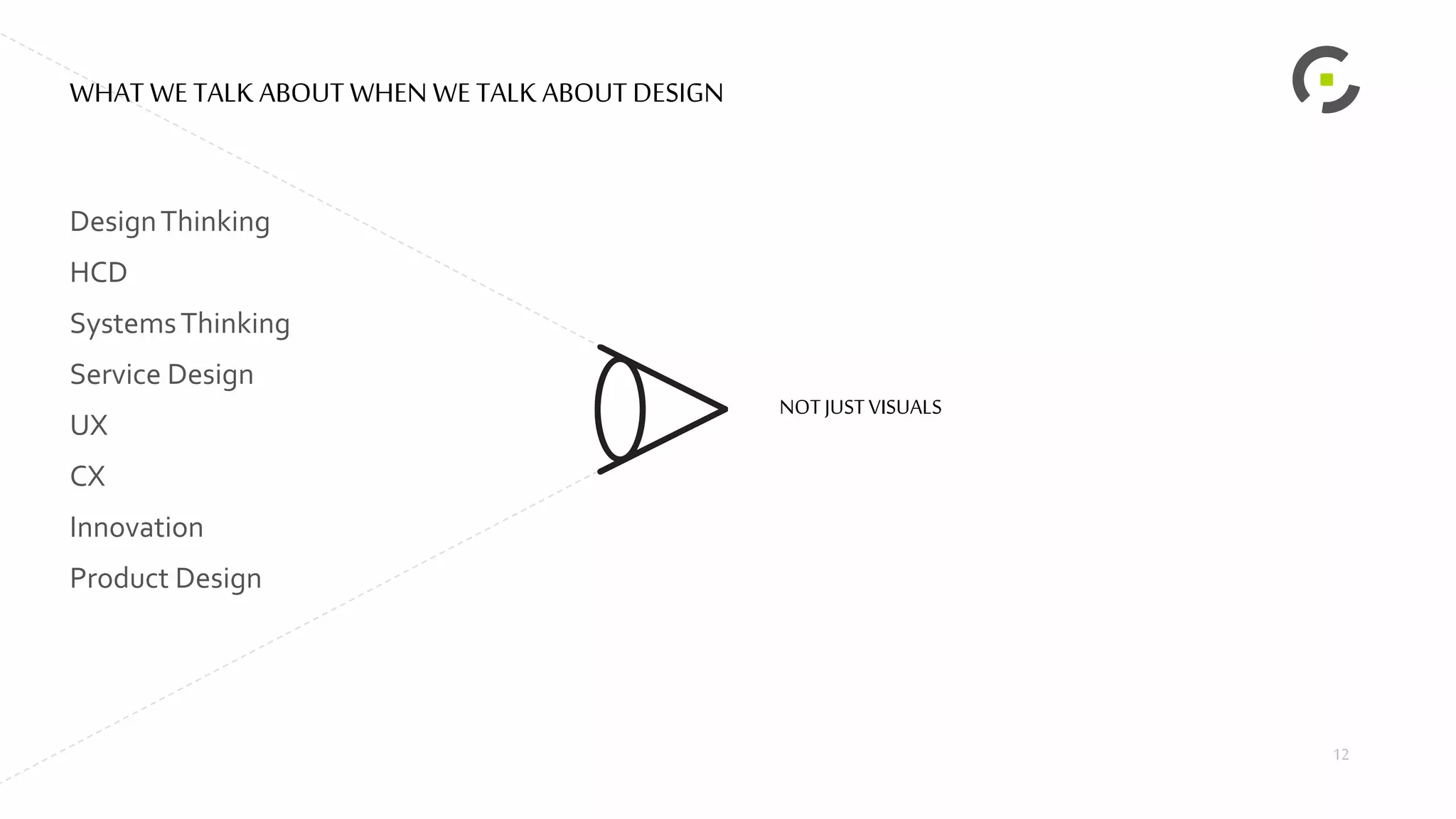
WHAT WE TALK ABOUT WHEN WE TALK ABOUT DESIGN
DesignThinking
HCD
SystemsThinking
Service Design
UX
CX
Innovation
Product Design
NOTJUSTVISUALS
12
BUSINESS COLLISION: WHY IS THIS HAPPENING NOW?
UNCERTAINTY
COMPLEXITY
WEIRDPOLITICS
Companies hear constantly that they
must digitally transform to survive. Adapt
or die. Innovate or starve. Fear is a great
motivator.
Alongside this, design thinking has matured
as a practice. Results are in. Not all of them
are good! But it has become very difficult to
ignore the force of design.
1930s
Policy changes spur
growth of management
consultancies
2010s
Technology, economic, and
workforce complexity spawn new
ways of thinking about business
13
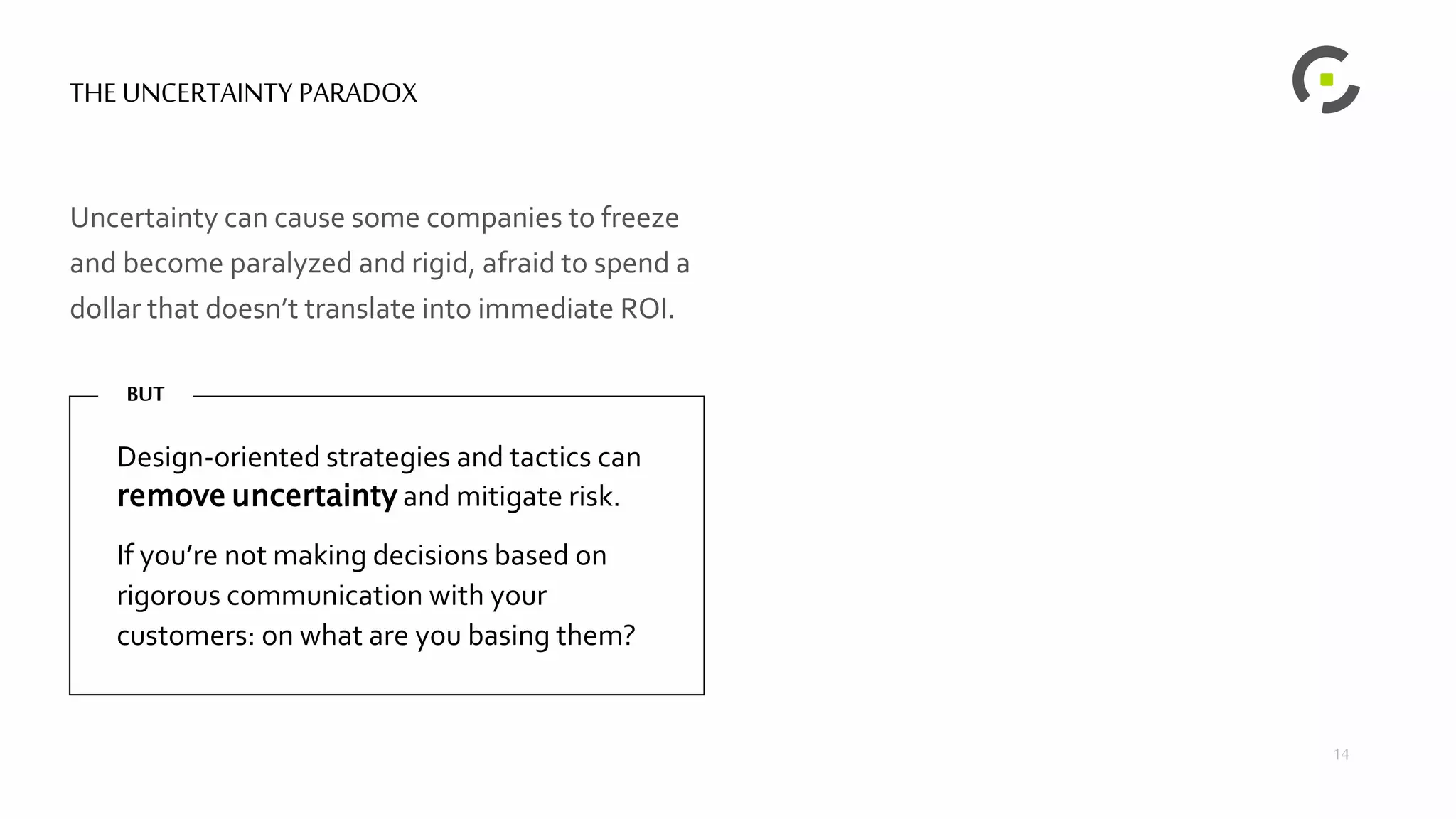
THE UNCERTAINTY PARADOX
Uncertainty can cause some companies to freeze
and become paralyzed and rigid, afraid to spend a
dollar that doesn’t translate into immediate ROI.
Design-oriented strategies and tactics can
remove uncertainty and mitigate risk.
If you’re not making decisions based on
rigorous communication with your
customers: on what are you basing them?
BUT
RIGIDITY &
PARALYSIS
INNOVATION &RE-
INVENTION
14
15
KEY CONCEPTS
DATA& ANALYSIS INTERVIEWS &
ETHNOLOGY
WHY THE PRINCIPLES OFDESIGN WORK FORBUSINESS
Listen to your customers
Prototype & test /Test & learn
Everyone who affects the product is a designer
Think deeply about your decisions
Iterate, iterate, iterate
16
WEHAVE DESIGNEDTHETHING!
WEHAVE MADETHETHING!
WEHAVE ADVERTISEDTHETHING!
WEHAVE SPENTOUR BUDGET!
NOW, WHOWANTSTHETHINGWEHAVE MADE?
WEHAVE WATCHEDTHECUSTOMER!
WEHAVE LISTENEDTOTHECUSTOMER!
WEHAVE SYNTHESIZEDTHEDATA!
WEHAVE DESIGNEDTHETHING!
WEHAVE MADETHETHING!
WEKNOWWHOWANTSTHETHING!
MOVING THE VIEWPORT (PROACTIVE VS.REACTIVE)
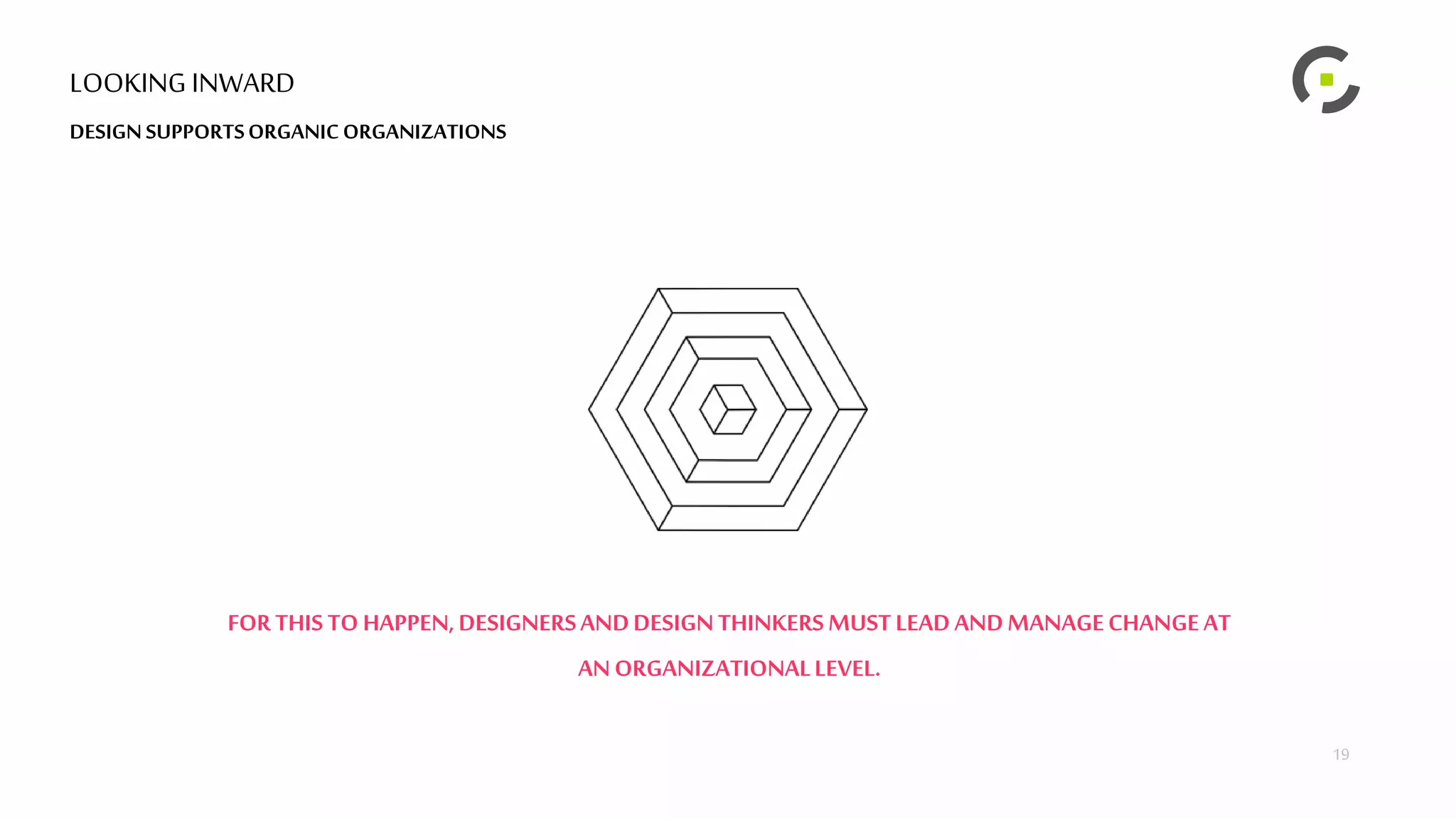
LOOKING INWARD
DESIGNSUPPORTSORGANICORGANIZATIONS
Design-led organizations begin to shed some of the rigid hierarchy and
siloed departments that repel open communication and ossify teams.
Small, autonomous, cross-disciplinary teams organized around the
natural experience of the customer move quickly, make better decisions,
communicate better, and deliver greater value.
It is terrifying to change to this trust-based model, but the results have
been demonstrated repeatedly – when implemented honestly.
18
LOOKING INWARD
DESIGNSUPPORTSORGANICORGANIZATIONS
FORTHIS TO HAPPEN,DESIGNERSANDDESIGNTHINKERSMUSTLEADANDMANAGECHANGEAT
ANORGANIZATIONALLEVEL.
19
Structuring teams around customer experiences and introducing
design-led, customer-centric organizational strategy opens up the
possibility for substantial competitive advantage.
Generative research geared towards identifying opportunities by
observing and listening to customers highlights market openings.
Design activities focused on identifying what should be built and
why provides the product team with concrete, logical goals and
effective means to test success.
LOOKING OUTWARD
ANTICIPATORY&GENERATIVE DESIGN
20
COMMUNICATION
A design-led organization or team constantly engages with visuals to
communicate with each other and with customers and stakeholders
about what’s going on. In a designed organization, we can use pictures
to show and see what’s going on throughout the business.
Pictures, sticky notes, scribbles, maps, and diagrams do much better
than words.
21
JUST DRAW A PICTURE
RISK & FAILURE
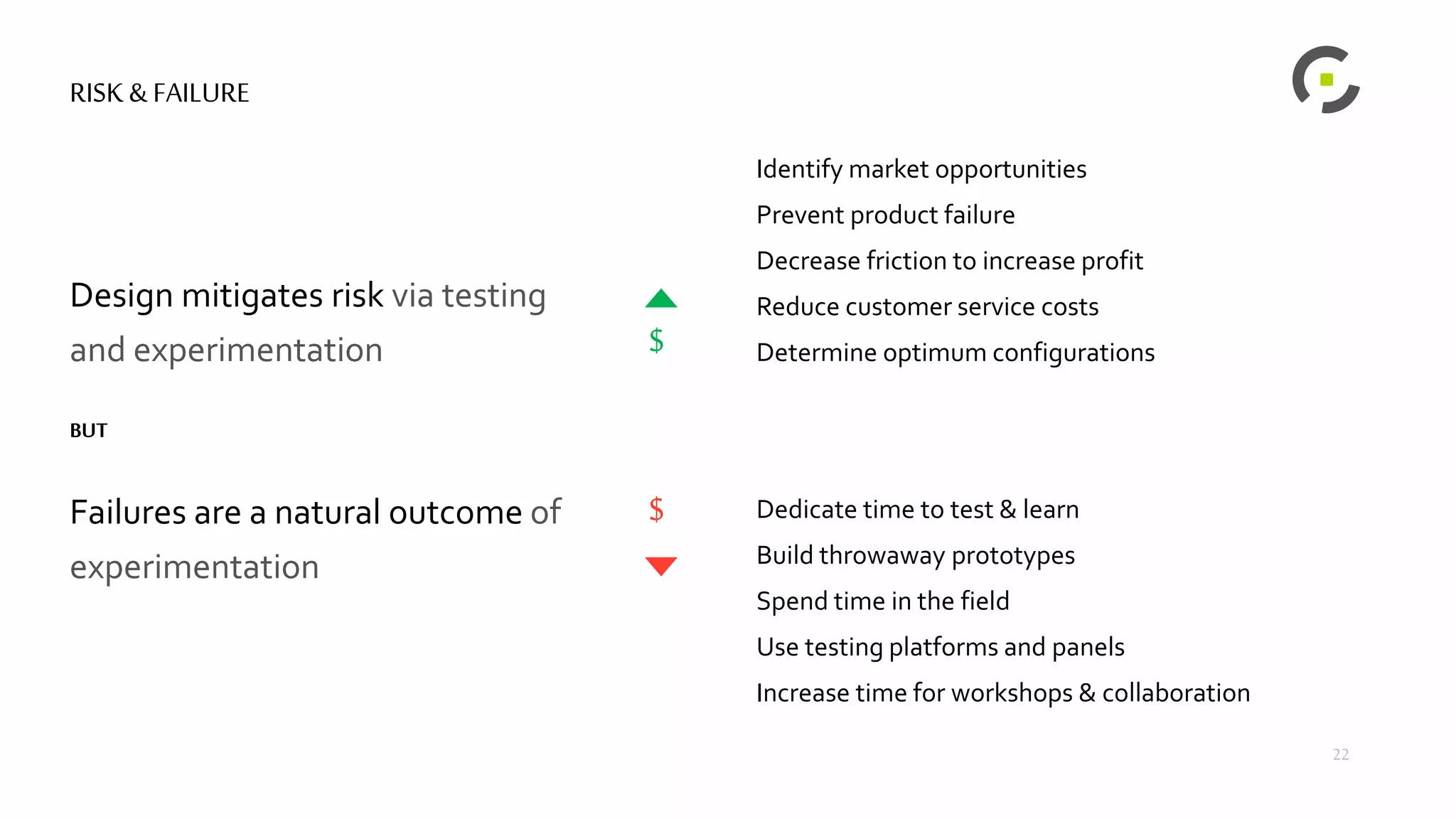
Design mitigates risk via testing
and experimentation
BUT
Failures are a natural outcome of
experimentation
22
Identify market opportunities
Prevent product failure
Decrease friction to increase profit
Reduce customer service costs
Determine optimum configurations
Dedicate time to test & learn
Build throwaway prototypes
Spend time in the field
Use testing platforms and panels
Increase time for workshops & collaboration
$
$
23
PRACTICAL ADVICE
HARD AND SOFT LANGUAGE
UX and customer experience work can be perceived as soft and
fluffy.Words like “empathy” and “journey” are seen by some as
incompatible with the perceived hard-nosed strategy and tactics of
Business. Design is sometimes boiled down to visuals.
24
EMPATHIZE WITH MANAGERS AS WELL AS USERS
25
SAYS
THINKS
DOES
FEELS
WHY IS THIS SO
EXPENSIVE
IDONOT
UNDERSTAND THIS
CONFUSEDAND
THREATENED
WHAT ISFAMILIAR &
COMFORTING
KNOWABOUT THINGS
Know about lots and lots of things!Things like:
TECHNIQUES& METHODS TOOLS,APPS,& PLATFORMS SMART PEOPLEOTHERTHAN
YOU
BOOKS& MAGAZINES CONFERENCES&
ORGANIZATIONS
PITFALLS
Overpromising.
Bad examples.
Reliance on too few methods.
Lone ranger.
27
28
TAKEAWAYS
KEY TAKEAWAYS
If there is one thing I hope you take
away from this talk, it is that an
organization cannot know what to
build, cannot truly know the market,
without doing the work of
understanding the customer.
The answer to “how can I afford this” is
“what will you do without it?”
29
That’s the beginning of the work of
transforming into a customer-centric,
design-led organization.
KEY TAKEAWAYS
Use the designer’s talent for communication purposefully and
intentionally to build support for your goals.
Organizations need leaders who can think in design; start thinking
about leading with your practice and bringing people along with you.
The process of creating what companies make is inextricably tied to
how those companies are put together.
30
DESIGNYOURPRODUCTS
DESIGNYOURWORK
DESIGNYOURTEAM
DESIGNYOURINTERACTIONS
DESIGNYOURCOMPANY
THANK YOU
VISIT MANAGEMENTBY.DESIGNTODOWNLOADTHESLIDES

Design is the New Management Consulting

  • 1.
    DESIGN IS THENEW MANAGEMENT CONSULTING A TALKBY KATIELUKAS OCTOBER 11 2018
  • 2.
    ABOUT KATIE My careergrew up with the web, starting in 1995 working on the very first weather.com site at Siegel & Gale, getting very excited about Macromedia Director and the new CSS layers implementation. Which is a long way of saying I am just incredibly old. Throughout these past twenty-odd years, there have been innumerable changes and cycles in technology, but much more momentous and interesting are the sea changes in how we create, organize, lead, and think about organizations and the people within them. 2
  • 3.
    INTRODUCTION At every talkI give or attend, in every conversation online, in all the literature, the same questions keep coming up: “How do I get the company to pay for all this UX/CX/research stuff?” This talk is structured to give you the tools to answer that question with another: “How can you make wise and frugal choices without it?” THIS IS MANAGEMENTBYDESIGN. 3
  • 4.
    INSPIRATIONAL MILITARY STRATEGYSLIDE Variety Rapidity Harmony Initiative Agility 4 Do lots of things fast Co-exist with those around you; do not be passive Follow the above, and emphasize the implicit over the explicit by allowing the whole team to continuously interact with the external world and with each other
  • 5.
  • 6.
    MANAGEMENT CONSULTING: ABRIEF HISTORY While engineering, legal, and financial consulting became common in the late 1800s during the industrial revolution, management consulting as we know it today arose out of the regulatory and policy changes of the post-Depression New Deal. 1886 ARTHURD. LITTLE FOUNDED 1893 TAYLOR OPENS CONSULTANCY 1911 TAYLOR PUBLISHESPRINCIPLESOF SCIENTIFIC MANAGEMENT 1933 GLASS-STEAGALLBANKING ACT 1926 MCKINSEY MANAGEMENT ENGINEERING MANAGEMENT CONSULTING SCIENTIFIC MANAGEMENT 1930 ~100FIRMS 1940 ~400FIRMS 1935–38 US STEEL REORG BY FORD, BACON & DAVIS 1948 RAND CORP FOUNDED 1956 STAFFORDBEER & MANAGEMENT CYBERNETICS 2001 ACCENTURE 1980– 1990 EXPLOSION OF MANAGEMENT CONSULTING ACTIVITIES 2002 BIG FOUR 1963 BCG FOUNDED 1973 BAIN FOUNDED Primary Source: The Origins of Modern Management Consulting, McKenna, JHU
  • 7.
    MANAGEMENT CONSULTING KEYCONCEPTS ACCOUNTING LEGAL ENGINEERING THEN OPERATIONS STRATEGY EXPERIENCE DESIGN HUMAN RESOURCES PLANNING IT DIGITAL TRANSFOR- MATION CHANGE MANAGEMENT RISK DESIGN MARKETING RESEARCH& ANALYTICS NOW 7
  • 8.
    THE EMERGENCE OFDESIGN-AS-MANAGEMENT Formally applying some kind of design mindset to organizational problems goes back further than one might expect.The language of this practice has changed many times, but from a central theory perspective, there is continuity. 1937 von Bertalanffy develops term "general systems theory" 1948 Weiner defines cybernetics 1957 Bucky Fuller introduces "Design Science" 1962 Conference on Design Methods, London 1965 L. Bruce Archer, Systematic Method for Designers 1968 Herbert Simon, The Sciences of the Artificial 1970s Scandinavian cooperative/ participatory design 1971 Victor Papanek - Design for the Real World 1972 Koberg & Bagnall, The Universal Traveler 1973 Horst Rittel describes "wicked problems" 1980 Lawson, How Designers Think 1982 G. Lynn Shostack introduces the "service blueprint" 1982 Nigel Cross launches "Designerly Ways of Knowing" series 1983 The Psychology of Human–Computer Interaction 1983 Schön, The Reflective Practitioner 1987 Peter Rowe, Design Thinking 1991 IDEO founded by merger 1992 Buchanan, "Wicked Problems in Design Thinking" 1993 Norman popularizes "User Experience" as a term 1994 Lou Carbone coins "customer experience" 1999 Sachse & Specker, Design Thinking 2001 Livework - 1st service design consultancy 2005 Stanford's d.school starts teaching design thinking 2007 Inaugural Service Design Conference 2009 Tim Brown, Change by Design 2010 Stickdorn – This is Service Design Thinking 2012 Manning, Bernoff, Bodine, Outside In EXPLOSIVEGROWTH; DIFFICULTTO CATALOGUE SEVERALBEGINNINGS SCIENCE OF DESIGN PHILOSOPHY OF DESIGN RISE OF THE COMPUTER DESIGN FOR ALL Sources include: Design Thinking Origin Story, Designerly Ways of Knowing, and the Interaction Design Foundation Resources 8
  • 9.
    THE EMERGENCE OFDESIGN-AS-MANAGEMENT Formally applying some kind of design mindset to organizational problems goes back further than one might expect.The language of this practice has changed many times, but from a central theory perspective, there is continuity. Missing from this timeline are a number of interconnected fields and practices, some of which figure prominently in design today Anthropology Ethnology Industrial Design Urban Planning Lean /Toyota / Just inTime Agile User Interface Design Behavioral Economics 9
  • 10.
    COMPETING WITH MANAGEMENTCONSULTANCIES? Management Consultants have gotten the memo.They are talking constantly about design, design thinking, CX – and often to good effect. However, the big guns have a few weaknesses: 10 They are incredibly expensive. Their messages are often inconsistent. They are external and monolithic.
  • 11.
  • 12.
    WHAT WE TALKABOUT WHEN WE TALK ABOUT DESIGN DesignThinking HCD SystemsThinking Service Design UX CX Innovation Product Design NOTJUSTVISUALS 12
  • 13.
    BUSINESS COLLISION: WHYIS THIS HAPPENING NOW? UNCERTAINTY COMPLEXITY WEIRDPOLITICS Companies hear constantly that they must digitally transform to survive. Adapt or die. Innovate or starve. Fear is a great motivator. Alongside this, design thinking has matured as a practice. Results are in. Not all of them are good! But it has become very difficult to ignore the force of design. 1930s Policy changes spur growth of management consultancies 2010s Technology, economic, and workforce complexity spawn new ways of thinking about business 13
  • 14.
    THE UNCERTAINTY PARADOX Uncertaintycan cause some companies to freeze and become paralyzed and rigid, afraid to spend a dollar that doesn’t translate into immediate ROI. Design-oriented strategies and tactics can remove uncertainty and mitigate risk. If you’re not making decisions based on rigorous communication with your customers: on what are you basing them? BUT RIGIDITY & PARALYSIS INNOVATION &RE- INVENTION 14
  • 15.
  • 16.
    DATA& ANALYSIS INTERVIEWS& ETHNOLOGY WHY THE PRINCIPLES OFDESIGN WORK FORBUSINESS Listen to your customers Prototype & test /Test & learn Everyone who affects the product is a designer Think deeply about your decisions Iterate, iterate, iterate 16
  • 17.
    WEHAVE DESIGNEDTHETHING! WEHAVE MADETHETHING! WEHAVEADVERTISEDTHETHING! WEHAVE SPENTOUR BUDGET! NOW, WHOWANTSTHETHINGWEHAVE MADE? WEHAVE WATCHEDTHECUSTOMER! WEHAVE LISTENEDTOTHECUSTOMER! WEHAVE SYNTHESIZEDTHEDATA! WEHAVE DESIGNEDTHETHING! WEHAVE MADETHETHING! WEKNOWWHOWANTSTHETHING! MOVING THE VIEWPORT (PROACTIVE VS.REACTIVE)
  • 18.
    LOOKING INWARD DESIGNSUPPORTSORGANICORGANIZATIONS Design-led organizationsbegin to shed some of the rigid hierarchy and siloed departments that repel open communication and ossify teams. Small, autonomous, cross-disciplinary teams organized around the natural experience of the customer move quickly, make better decisions, communicate better, and deliver greater value. It is terrifying to change to this trust-based model, but the results have been demonstrated repeatedly – when implemented honestly. 18
  • 19.
    LOOKING INWARD DESIGNSUPPORTSORGANICORGANIZATIONS FORTHIS TOHAPPEN,DESIGNERSANDDESIGNTHINKERSMUSTLEADANDMANAGECHANGEAT ANORGANIZATIONALLEVEL. 19
  • 20.
    Structuring teams aroundcustomer experiences and introducing design-led, customer-centric organizational strategy opens up the possibility for substantial competitive advantage. Generative research geared towards identifying opportunities by observing and listening to customers highlights market openings. Design activities focused on identifying what should be built and why provides the product team with concrete, logical goals and effective means to test success. LOOKING OUTWARD ANTICIPATORY&GENERATIVE DESIGN 20
  • 21.
    COMMUNICATION A design-led organizationor team constantly engages with visuals to communicate with each other and with customers and stakeholders about what’s going on. In a designed organization, we can use pictures to show and see what’s going on throughout the business. Pictures, sticky notes, scribbles, maps, and diagrams do much better than words. 21 JUST DRAW A PICTURE
  • 22.
    RISK & FAILURE Designmitigates risk via testing and experimentation BUT Failures are a natural outcome of experimentation 22 Identify market opportunities Prevent product failure Decrease friction to increase profit Reduce customer service costs Determine optimum configurations Dedicate time to test & learn Build throwaway prototypes Spend time in the field Use testing platforms and panels Increase time for workshops & collaboration $ $
  • 23.
  • 24.
    HARD AND SOFTLANGUAGE UX and customer experience work can be perceived as soft and fluffy.Words like “empathy” and “journey” are seen by some as incompatible with the perceived hard-nosed strategy and tactics of Business. Design is sometimes boiled down to visuals. 24
  • 25.
    EMPATHIZE WITH MANAGERSAS WELL AS USERS 25 SAYS THINKS DOES FEELS WHY IS THIS SO EXPENSIVE IDONOT UNDERSTAND THIS CONFUSEDAND THREATENED WHAT ISFAMILIAR & COMFORTING
  • 26.
    KNOWABOUT THINGS Know aboutlots and lots of things!Things like: TECHNIQUES& METHODS TOOLS,APPS,& PLATFORMS SMART PEOPLEOTHERTHAN YOU BOOKS& MAGAZINES CONFERENCES& ORGANIZATIONS
  • 27.
    PITFALLS Overpromising. Bad examples. Reliance ontoo few methods. Lone ranger. 27
  • 28.
  • 29.
    KEY TAKEAWAYS If thereis one thing I hope you take away from this talk, it is that an organization cannot know what to build, cannot truly know the market, without doing the work of understanding the customer. The answer to “how can I afford this” is “what will you do without it?” 29 That’s the beginning of the work of transforming into a customer-centric, design-led organization.
  • 30.
    KEY TAKEAWAYS Use thedesigner’s talent for communication purposefully and intentionally to build support for your goals. Organizations need leaders who can think in design; start thinking about leading with your practice and bringing people along with you. The process of creating what companies make is inextricably tied to how those companies are put together. 30
  • 31.
  • 32.