


Transforming Challenges
into Opportunities
DESIGNTHINKING
Dr. Ashwani K. Dhingra
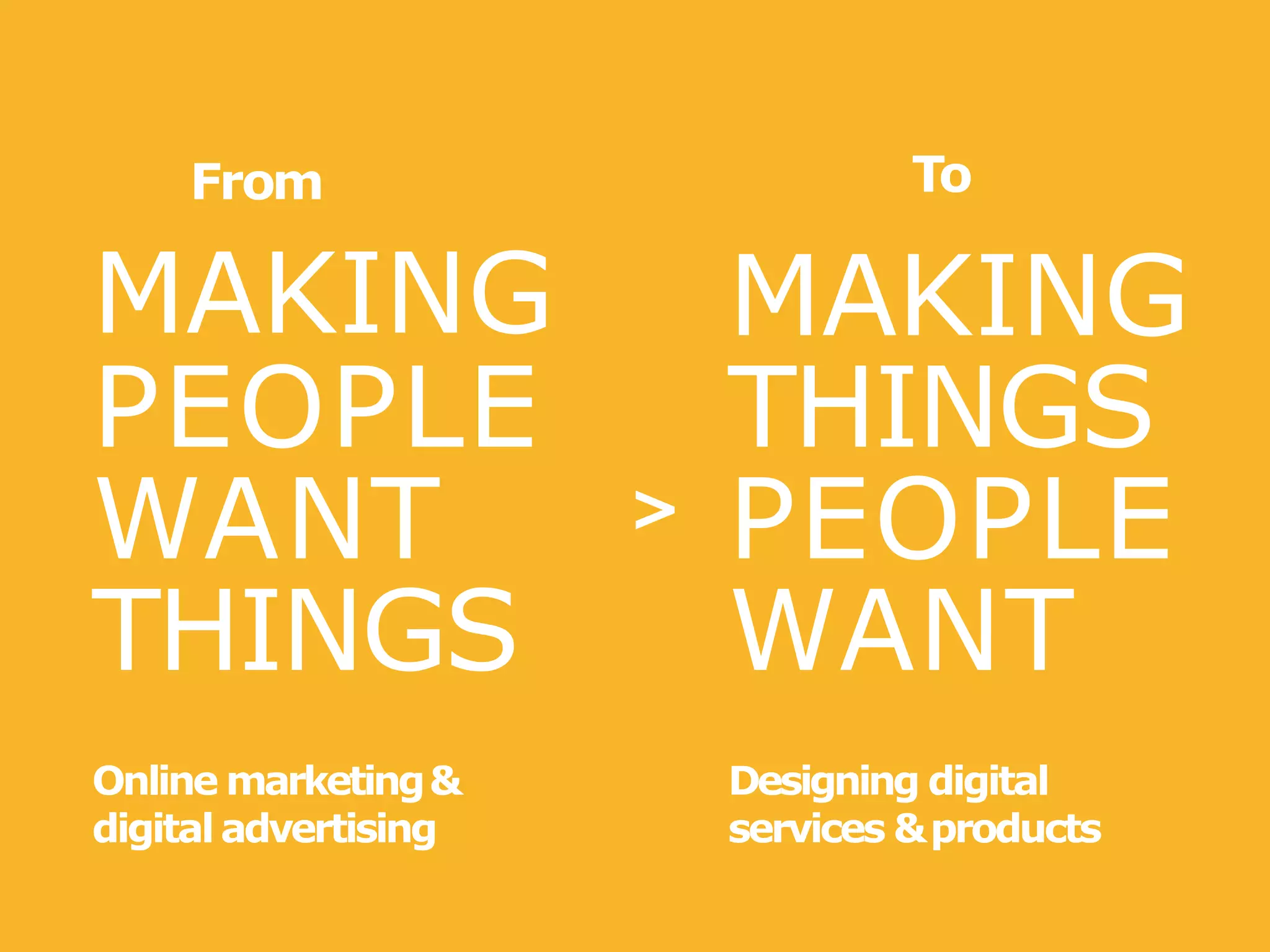
MAKING
PEOPLE
WANT
MAKING
THINGS
PEOPLE
From To
>
THINGS
Online marketing&
digital advertising
WANT
Designing digital
services &products
What actuallyis
designthinking?
And what it’s not.
1
Product Experience
Event
Aesthetic
Design thinking is often
confused with visual design
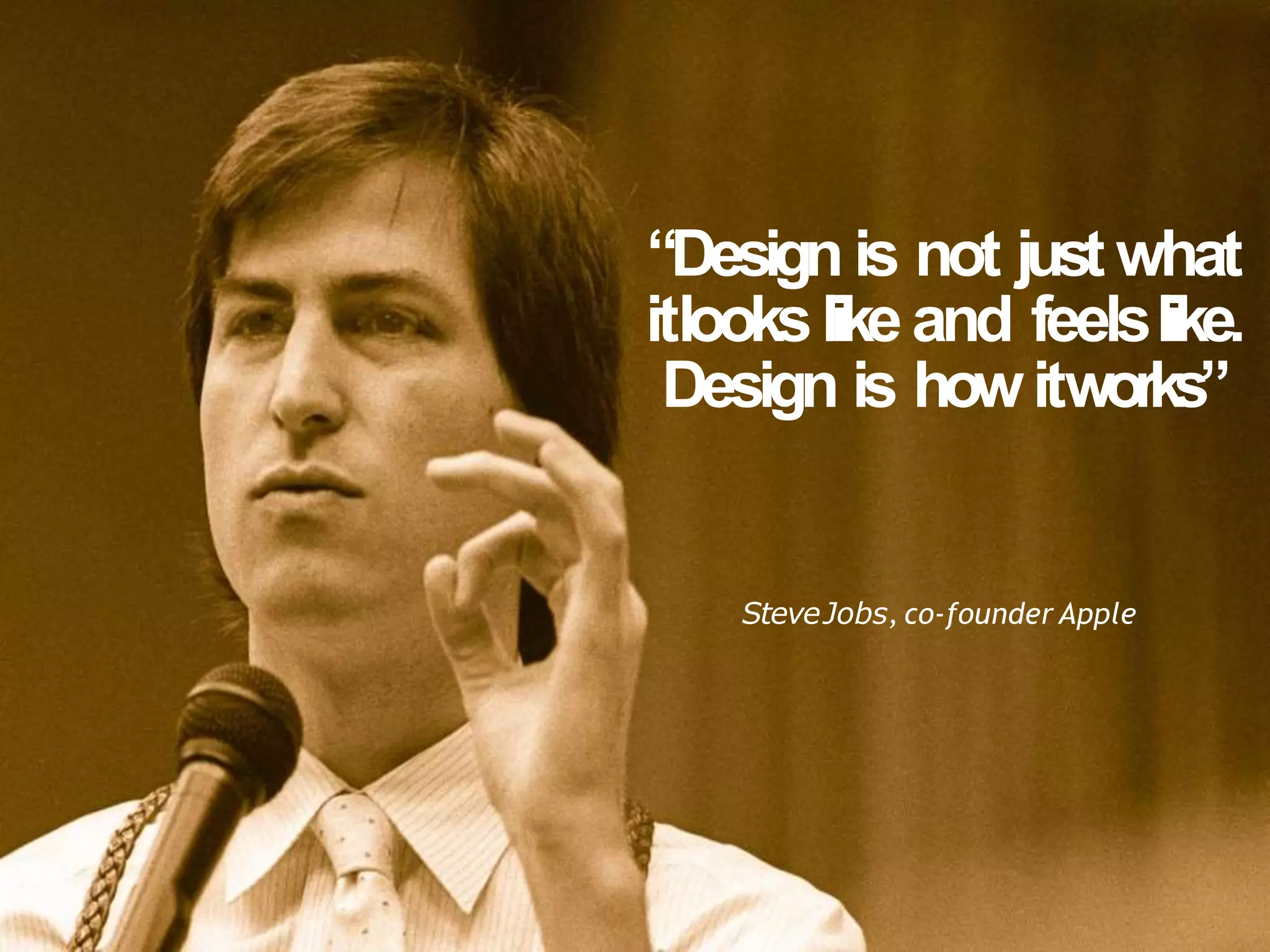
SteveJobs, co-founder Apple
“Designis not just what
itlookslikeand feelslike.
Design is howitworks”
“Everythingis
designed.”
Start stop >
loweremissions >
lowertaxes>
Ican afford driving pleasure
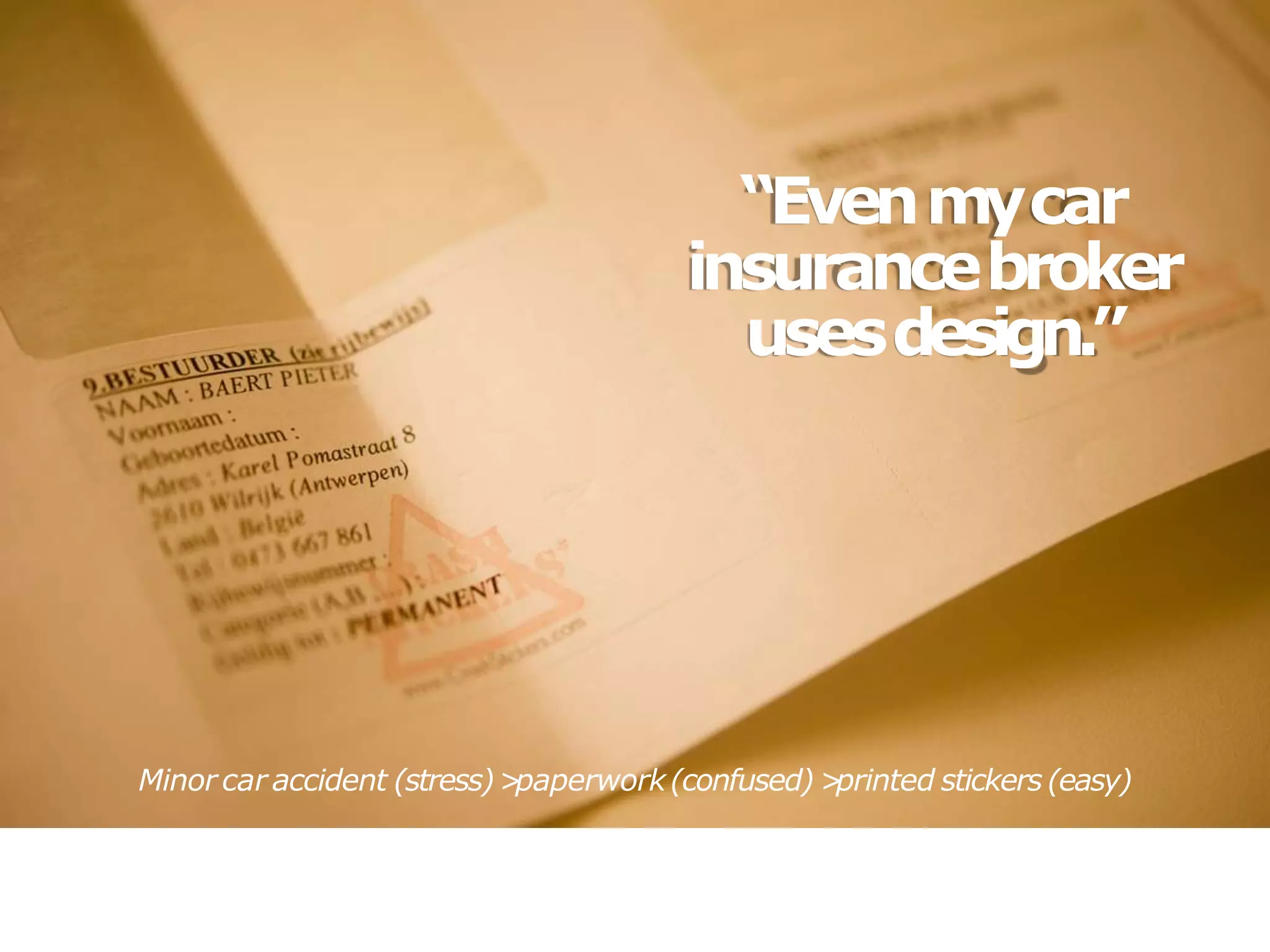
“Evenmycar
insurancebroker
usesdesign.”
Minor car accident (stress)>
paperwork(confused) >
printed stickers (easy)
!
Keyelements
1. People-centered
2. Highlycreative
3. Hands-on
4. Iterative
People-centered
1
You start from what people, users, customers,
consumers, (…) need or want to do. Their motivations
and the problems they are trying to solve.
Empathy is key. It’s not about you. You need the
ability to understand and share the feelings of
others.
HighlyCreative
Design thinking stimulates you to look at
situations differently and come up with new
solutions, that go beyond and improve
existing alternatives.
Integrative thinking is key. You need the ability
to look at all the different aspects of a problem
2
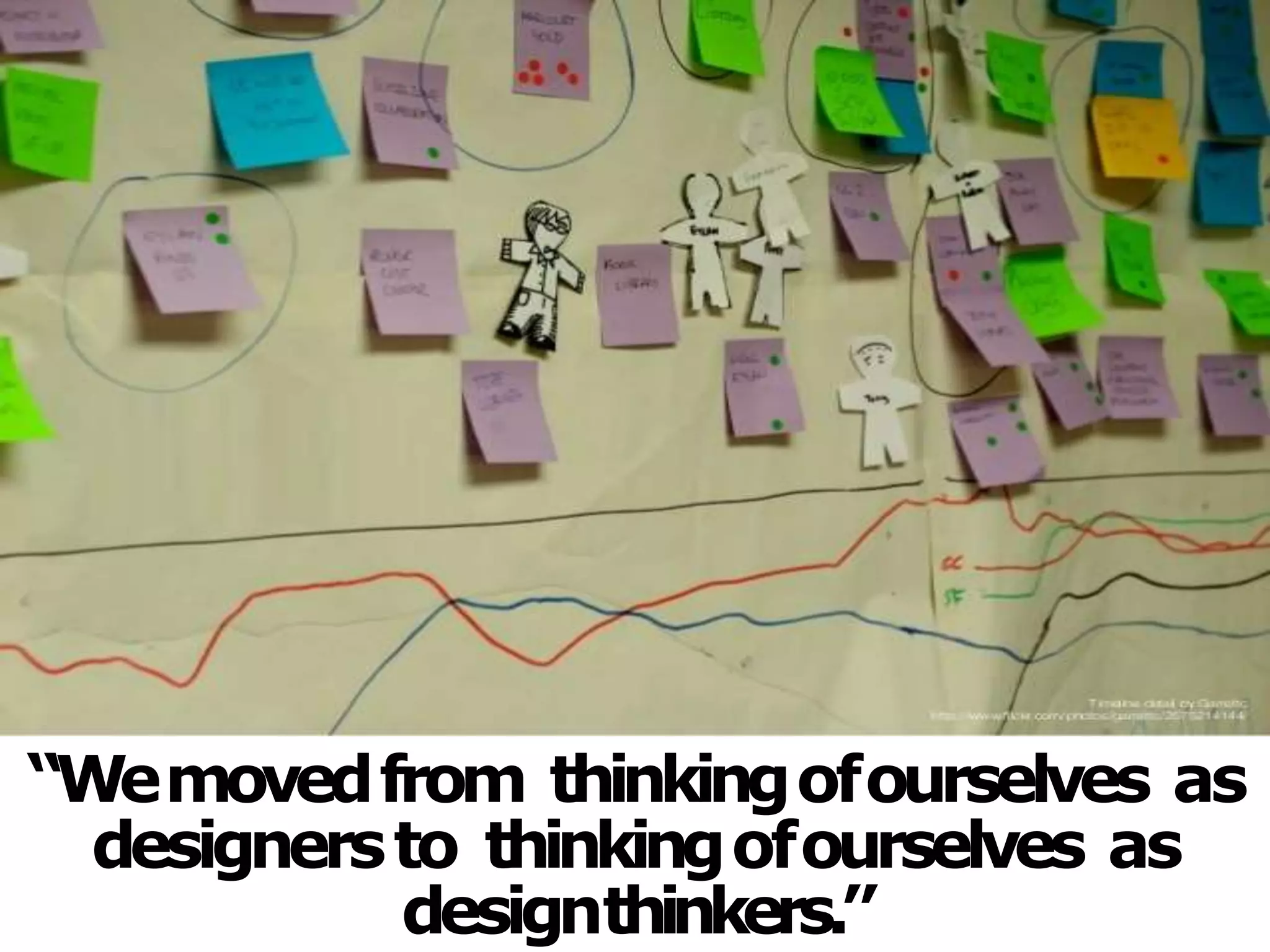
“Wemovedfrom thinkingofourselves as
designersto thinkingofourselves as
designthinkers.”
Hands-on
Stop discussing, start working. Make ideas
tangible. Prototyping is thinking with your
hands. Test your hypnotises.
Failure is a (necessary) part of the process in
order to succeed. Experiments with trial and
error are key.
3
Actuallydesignthinking
islessabout thinking
and moreaboutdoing
I
terative
The road to success does not follow a straight
line. The more you are able to loop through
“understand >create >
learn”
cycle the higher chance you have for good results.
4
GoogleVentures‘DesignSprint’
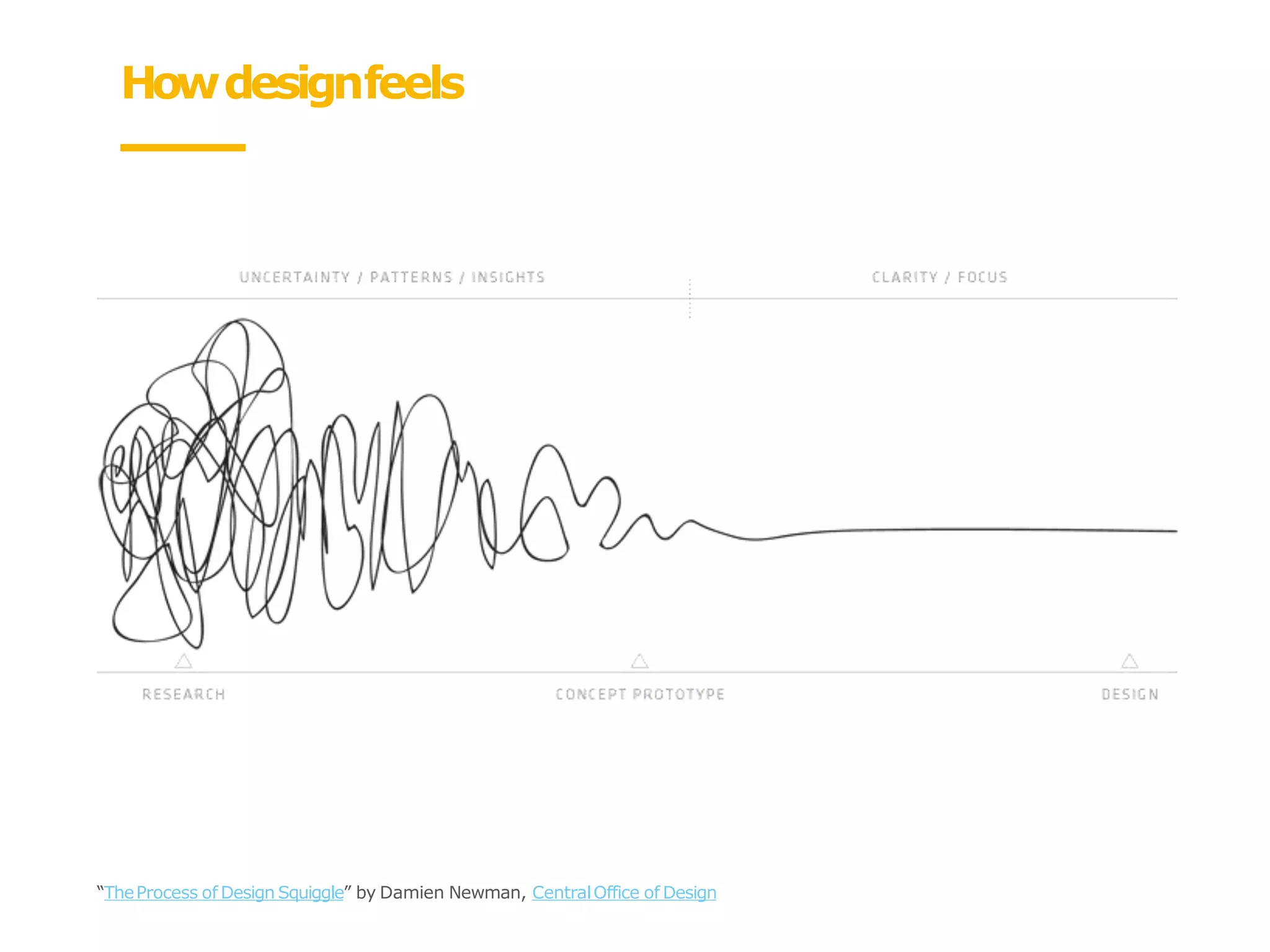
Howdesignfeels
“TheProcess of Design Squiggle” by Damien Newman, CentralOffice of Design
Whencan design
thinkingbehelpful?
‘Wicked’problems
Problems that are ill-defined: both problem and
solution are unknown at the beginning. A large part
of the problem solving is actually defining the
problem.
And/or tricky: it involves quite a bit of risk, as you
are leaving the comfort zone of the organisation.
?
Noteveryproblem
Design thinking (creative, intuitive, emotional) is not
the answer to every singleproblem.
For some question you will need rational thinking,
spreadsheets, powerpoint and wo/men in suits to
come to a valid answer. >
>e.g. acquiring a local
competitor
!
Howdoyouapply
designthinking?
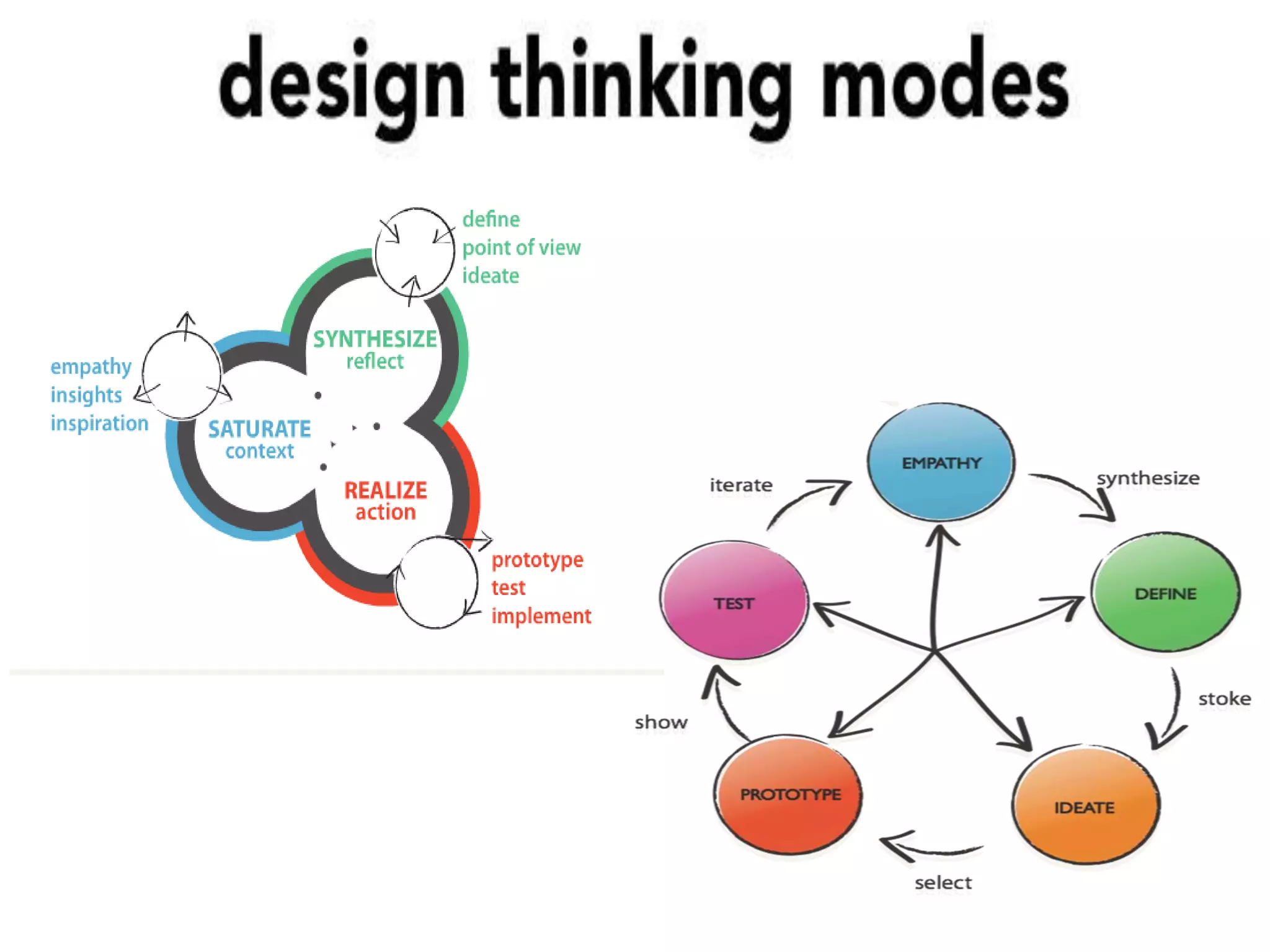
Key pillars, model & process
2
No‘one size fits all’ approach
!
There is not one single proces or toolkit that serves
every single case. There is a wide variety of processes
and tools that people customise to serve their needs.
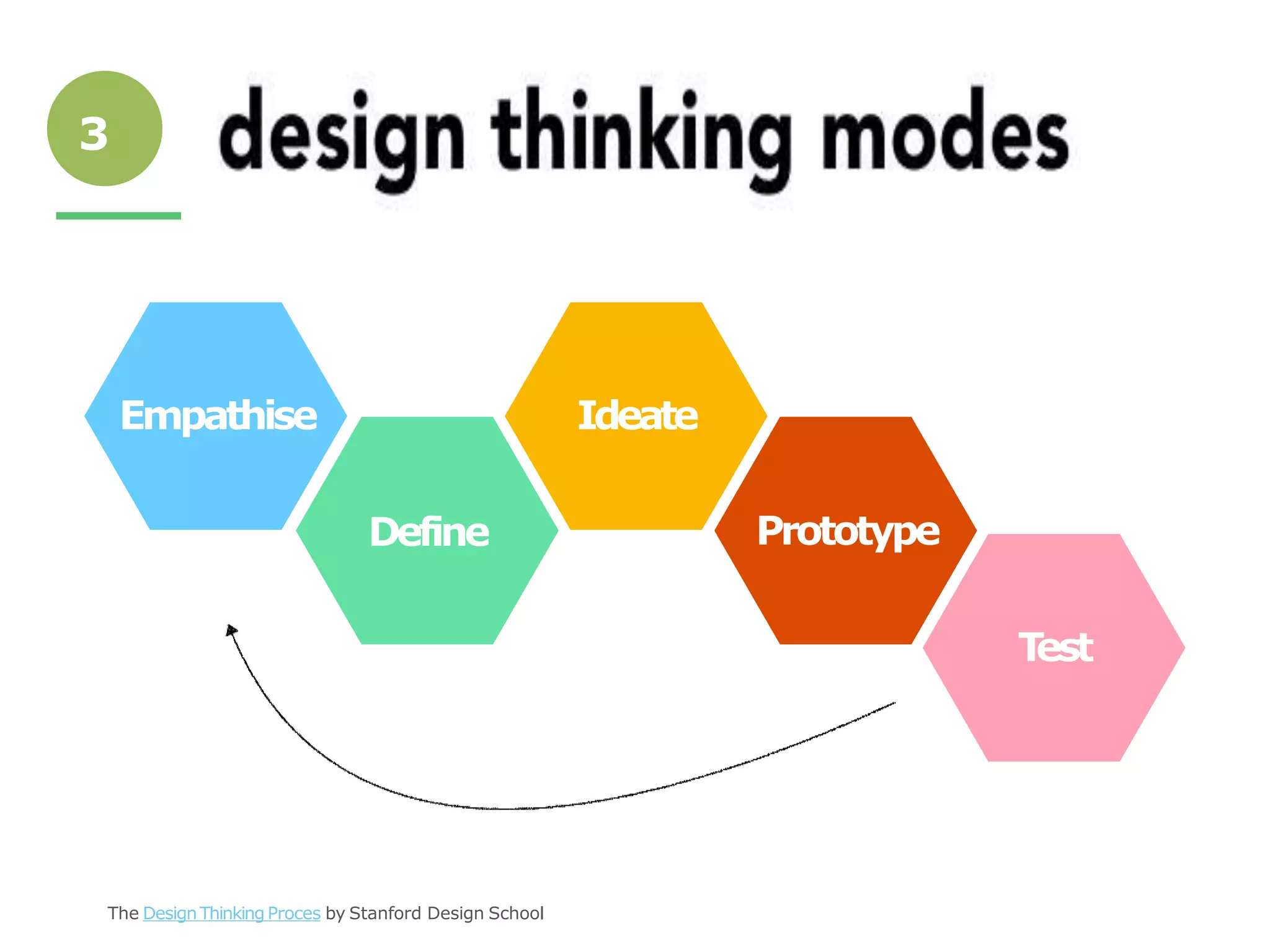
The five step process from Stanford Design School
is a model that is broadly used and has proven its
value.
The DesignThinking Proces by Stanford Design School
Empathise
Define
Ideate
Prototype
T
est
3
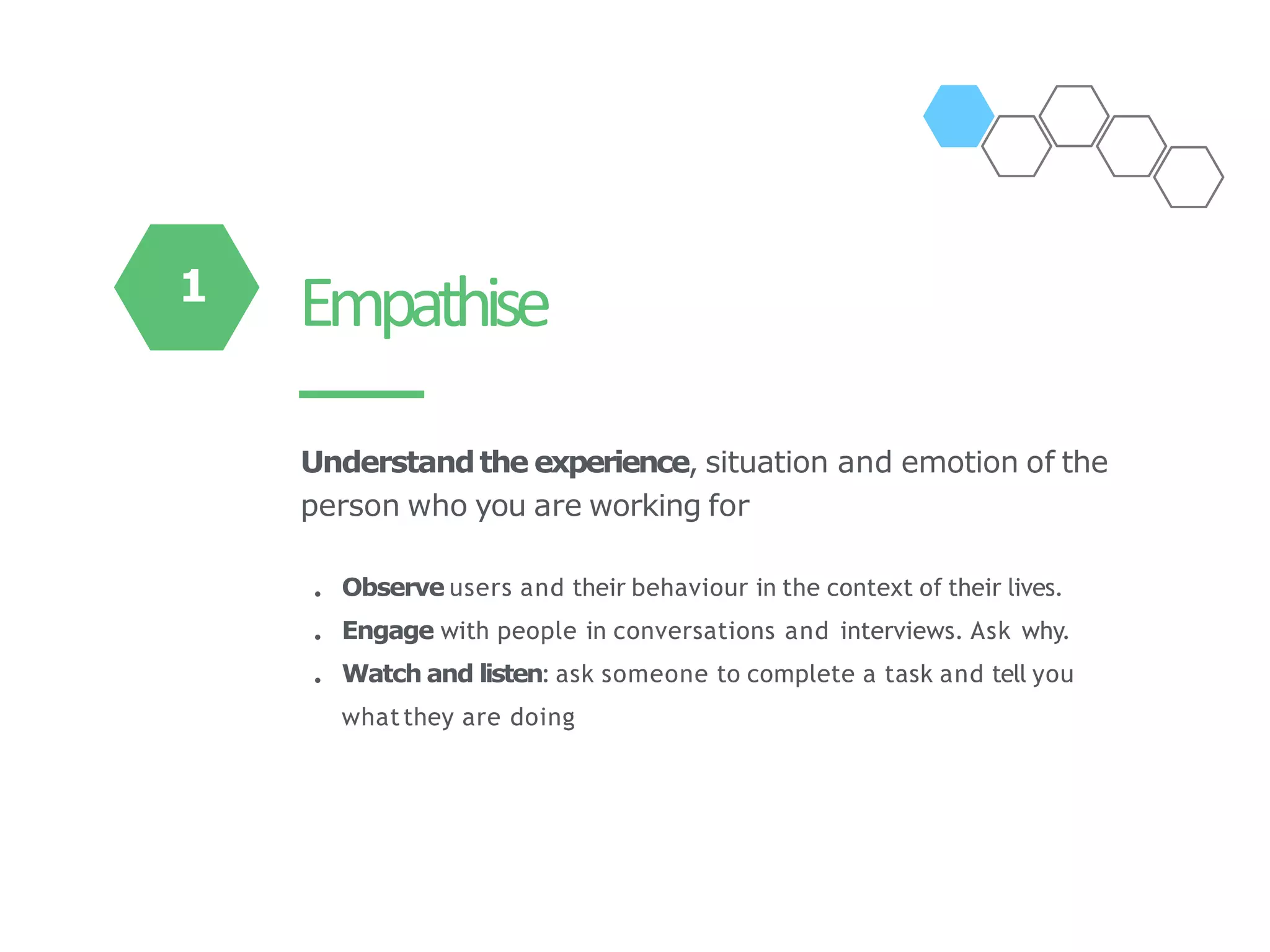
Empathise
Understandthe experience, situation and emotion of the
person who you are working for
Observe users and their behaviour in the context of their lives.
Engage with people in conversations and interviews. Ask why.
Watch and listen: ask someone to complete a task and tell you
whatthey are doing
1
•
•
•
Process and synthesisethe findings inorder toform a
user point of viewthatyouwilladdress
User: develop an understanding of the type of person you are
designing for
Needs: synthesise and select a limited set of needs that you think
are important to fulfil
Insights: express insights you developed and define principles
•
•
•
Define
2
Id
eate
Focus on idea generation. You translate problems into
solutions. Explore a wide variety and large quantity of
ideas to go beyond the obvious solutions to a problem.
Creativity: combine the un/conscious with rational thoughts and
imagination
Group synergy:leverage the group to reach out new ideas an
build upon other’s ideas
Separate the generation and evaluation of ideas to give
imagination a voice
•
•
•
3
Prototype
Buildto think.A simple, cheap and fast wayto shape
ideas so youcan experience and interact withthem.
Start building: Create an artefact in low resolution. This can be a
physical object or a digital clickable sketch. Do it quick and dirty.
Storyboard: create a scenario you can role play in a physical
environment and let people experience your solution
•
•
4
Askforfeedback onyourprototypes.Learn aboutyour
user,reframe yourviewand refine yourprototype.
Show: let people use your prototype. Give it in their hands and let
them use it. Listen to what they say.
Create experiences: let people talk about how they experience it
and how they feel
•
•
5
T
est
- Make a problem statement
- Find analogous solutions
- Brainstorm in tornadoes
- Find the middle group
- Start prototyping
- Join the dots for a system map
- Make a most effective solution and
make manage itself
- Find a new problem area & go to step 1
methodology
Howdoesdesignthinking
benefitstothe
organization/institutions?
Designthinking
helpsyouinnovate
3.1
With PowerPoint presentations full of statistics
and customer insights, you need to make big
bets on new products, technologies, and
premium services that go to market and flop,
often for reasons that are hard to figure out.
Bigbets
A
Design thinking stimulates you to be highly
creative and at the same time allows for quick
validation of those concepts with the target
customers and business model (as such limiting
potentialrisk).
Aleanapproach
B
…helpsyoudifferentiate
fromcompetitors
3.2
As it becomes increasingly harder to differentiate
on price, product range or local presence,
“customer experience” becomes a key
differentiator for
banks. “Serving is the new selling."
A
Servingisselling
3.3
…helpsyouincrease
customersatisfaction
A customer centric mindset helps youimprovethe
customerexperience over different channels and touch-
points and positively impacts customer satisfaction.
Customers are more loyal, buy more and higher margin
products from you. It also improves your net promotor
score. (ambassadorship)
Customerretention
>
What shouldyou
remember?
Keytake outs
!
Designthinkingisauser-centered
approachtoproblemsolving.
Empathyiskey.
1
Designthinkingisespeciallyhelpful
for “wicked”problems.
2
Designthinkingisastep-by-step
processthat isrepeatedover
multipleiterations.
3
Designthinkingisaboutdoing.
Let’sstarttogethertoday.
4
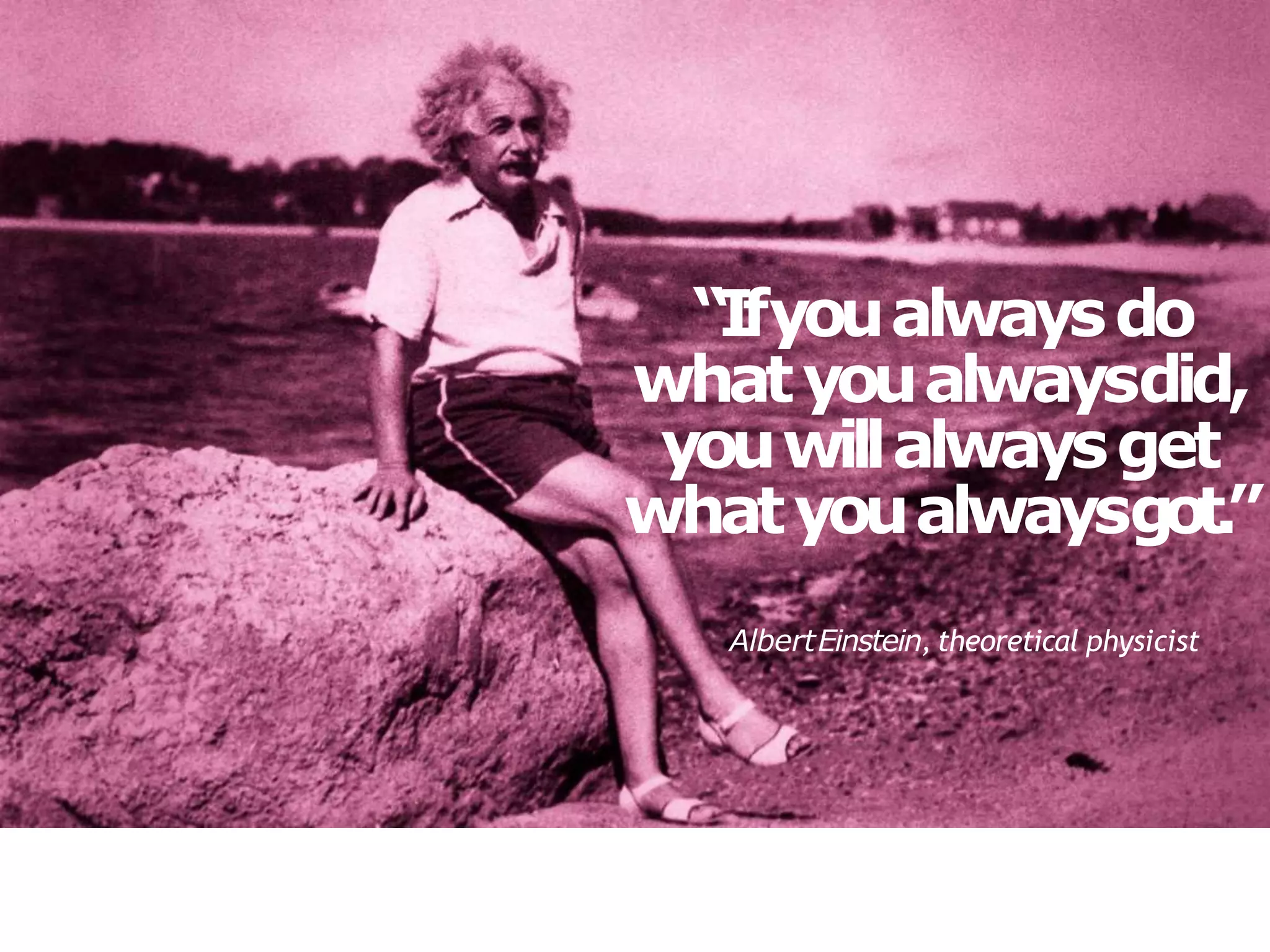
AlbertEinstein, theoretical physicist
“Ifyoualwaysdo
whatyoualwaysdid,
youwillalwaysget
whatyoualwaysgot.”
QUESTIONS?
SHOOT
.
Dr. Ashwani K. Dhingra
Mob. No. 9996230055
ashwani1683@gnkgei.ac.in

Design Thinking