Design Thinking
  for Startups
Amir Khella
@amirkhella
What is Design?


It’s the process by which an artifact is
brought into existence.

               “Design is art that people use”
                                - Ellen Lupton
What is design
      thinking?


It’s a mindset of combining creative and
analytical thinking and applying it toward
solving a specific problem.
Bad definition.


"Unlike analytical thinking, design thinking
is a creative process based around the
‘building up’ of ideas."

                                  - Wikipedia
Good definition.

“A process of creative and critical thinking
that allows information and ideas to be
organized, decisions to be made, situations to
be improved, and knowledge to be gained.”

                           - Charles Burnette
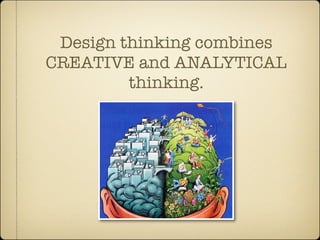
Design thinking combines
CREATIVE and ANALYTICAL
         thinking.
It’s both abductive
   and deductive.
Being deductive means
using past knowledge to
solve current problems.
Being abductive means
     imagining and
  visualizing a future
 that should yet exist.
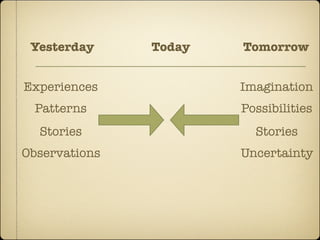
Yesterday     Today   Tomorrow


Experiences            Imagination
 Patterns              Possibilities
  Stories                Stories
Observations           Uncertainty
Then, what’s
innovation?
It’s a byproduct of
 design thinking.
It’s being comfortable
  going forward in a
 state of uncertainty
It’s believing that the
best solution is yet to
       be found.
It’s the willingness to
   fail early and fail
          often.
Unfortunately, that’s
not what we learn in
      school.
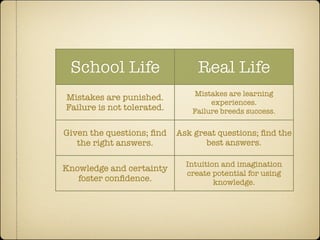
School Life                     Real Life
                               Mistakes are learning
Mistakes are punished.
                                    experiences.
Failure is not tolerated.      Failure breeds success.

Given the questions; find    Ask great questions; find the
   the right answers.              best answers.

                              Intuition and imagination
Knowledge and certainty
                              create potential for using
   foster confidence.                  knowledge.
What makes a good
 design thinker?
An observing eye and a constant
       sense of wonder.
An empathetic attitude toward
 people’s behavior and habits.
A questioning mindset that goes
     beyond the obvious.
Patience to remain in problem
space until the right questions are
             identified.
A holistic approach to problem
            solving.
The willingness to experiment and
              build.
A passion for collaboration.
So, how does a
 startup integrate
design thinking into
    its process?
1. Understand that design
  thinking is not just the
    designer’s role; it’s
     everyone’s role.
Design is not about products;
     it’s about people.


        Think beyond tasks;
Their lives. Their challenges. Their dreams.
The user’s journey starts long before they click that button.
2. Understand and define the
      problem you’re trying to
              solve.


Take the time to ask a lot of annoying WHY questions.
  And don’t move to the solution space too soon.
Create a story.
Our brains are hardwired for stories. If
  we like them, we remember them
               forever.

          Like a good movie,
          design should tell a
              good story.
Communicate your story, and
 ask people to tell you what they
   heard and what they think.


 * Don’t be afraid that someone will steal your story; it’s very likely
that many people had that idea before you, and did nothing about it.
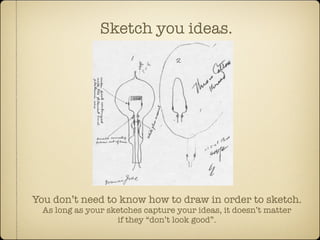
Sketch you ideas.


You don’t need to know how to draw in order to sketch.
  As long as your sketches capture your ideas, it doesn’t matter
                    if they “don’t look good”.
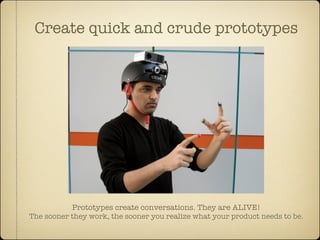
Create quick and crude prototypes


           Prototypes create conversations. They are ALIVE!
The sooner they work, the sooner you realize what your product needs to be.
3. Refine your prototype until it
becomes like a movie trailer for
        your product.


   It will always remind you of your story.
And don’t worry about it being too functional or
                 good looking.
Create a design-friendly
     environment
Remove walls between people.
And encourage frequent conversations.
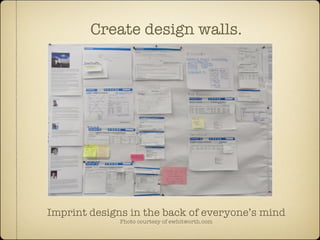
Create design walls.


Imprint designs in the back of everyone’s mind
              Photo courtesy of ewhitworth.com
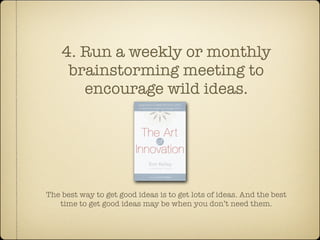
4. Run a weekly or monthly
     brainstorming meeting to
       encourage wild ideas.


The best way to get good ideas is to get lots of ideas. And the best
   time to get good ideas may be when you don’t need them.
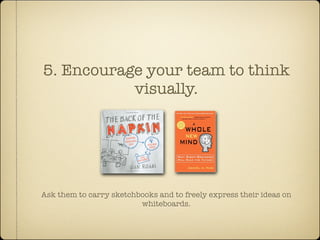
5. Encourage your team to think
           visually.


Ask them to carry sketchbooks and to freely express their ideas on
                         whiteboards.
Visit a design agency for a day


Design agencies typically create great design environments.
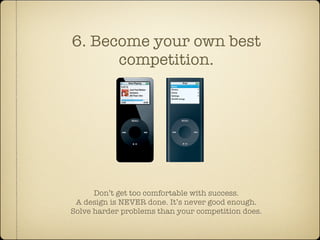
6. Become your own best
      competition.


      Don’t get too comfortable with success.
 A design is NEVER done. It’s never good enough.
Solve harder problems than your competition does.
Define and embrace constraints
 as part of the creative process.


The main difference between a rocket and a bomb is that the former
                     is a controlled explosion.
Create a character for your
               product


  What will your product be if it were a car? a phone? a shoe?
Who will your product be if it were a movie star? a political figure?
        Describe your products in human-like adjectives.
7. Hire T-shaped individuals.


 They tend to be professional in one area, but
       are skilled in many other areas.
          They are highly intuitive.
And they work as bridges between disciplines.
Discourage rigid roles.


   Leave these roles to enterprises.
Everyone should be a product caretaker.
Encourage cross-training.


Give your designers business training and your
          developers design training.


Invite outsiders to come and talk about what they do,
even if it’s nothing related to what your team is working on.
If possible, elect a CDO role
    (Chief Design Officer)


Let people in your company understand that
  design is as valuable as technology and
                  business.
Anyone can be a designer
Anyone can be a good design thinker
The most inspiring quote from a founder I’ve
               worked with.


   “This looks exciting and
      scary. Let’s do it!”
Where to go from here?
•Follow me on Twitter: @amirkhella
 I tweet links, quick insights and advice about
 Design Thinking for Startups

•Visit my blog: www.amirkhella.com
 I write short posts about design, business and life

•Sign up for an upcoming webinar
 Get one-on-one design advice about your product and
 business

                              Amir Khella
                              User Experience Guru
                              amir@fictiv.com

Design Thinking for Startups - Are You Design Driven?

  • 1.
    Design Thinking for Startups Amir Khella @amirkhella
  • 2.
    What is Design? It’sthe process by which an artifact is brought into existence. “Design is art that people use” - Ellen Lupton
  • 3.
    What is design thinking? It’s a mindset of combining creative and analytical thinking and applying it toward solving a specific problem.
  • 4.
    Bad definition. "Unlike analyticalthinking, design thinking is a creative process based around the ‘building up’ of ideas." - Wikipedia
  • 5.
    Good definition. “A processof creative and critical thinking that allows information and ideas to be organized, decisions to be made, situations to be improved, and knowledge to be gained.” - Charles Burnette
  • 6.
    Design thinking combines CREATIVEand ANALYTICAL thinking.
  • 7.
    It’s both abductive and deductive.
  • 8.
    Being deductive means usingpast knowledge to solve current problems.
  • 9.
    Being abductive means imagining and visualizing a future that should yet exist.
  • 10.
    Yesterday Today Tomorrow Experiences Imagination Patterns Possibilities Stories Stories Observations Uncertainty
  • 11.
  • 12.
    It’s a byproductof design thinking.
  • 13.
    It’s being comfortable going forward in a state of uncertainty
  • 14.
    It’s believing thatthe best solution is yet to be found.
  • 15.
    It’s the willingnessto fail early and fail often.
  • 16.
  • 17.
    School Life Real Life Mistakes are learning Mistakes are punished. experiences. Failure is not tolerated. Failure breeds success. Given the questions; find Ask great questions; find the the right answers. best answers. Intuition and imagination Knowledge and certainty create potential for using foster confidence. knowledge.
  • 18.
    What makes agood design thinker?
  • 19.
    An observing eyeand a constant sense of wonder.
  • 20.
    An empathetic attitudetoward people’s behavior and habits.
  • 21.
    A questioning mindsetthat goes beyond the obvious.
  • 22.
    Patience to remainin problem space until the right questions are identified.
  • 23.
    A holistic approachto problem solving.
  • 24.
    The willingness toexperiment and build.
  • 25.
    A passion forcollaboration.
  • 26.
    So, how doesa startup integrate design thinking into its process?
  • 27.
    1. Understand thatdesign thinking is not just the designer’s role; it’s everyone’s role.
  • 28.
    Design is notabout products; it’s about people. Think beyond tasks; Their lives. Their challenges. Their dreams. The user’s journey starts long before they click that button.
  • 29.
    2. Understand anddefine the problem you’re trying to solve. Take the time to ask a lot of annoying WHY questions. And don’t move to the solution space too soon.
  • 30.
    Create a story. Ourbrains are hardwired for stories. If we like them, we remember them forever. Like a good movie, design should tell a good story.
  • 31.
    Communicate your story,and ask people to tell you what they heard and what they think. * Don’t be afraid that someone will steal your story; it’s very likely that many people had that idea before you, and did nothing about it.
  • 32.
    Sketch you ideas. Youdon’t need to know how to draw in order to sketch. As long as your sketches capture your ideas, it doesn’t matter if they “don’t look good”.
  • 33.
    Create quick andcrude prototypes Prototypes create conversations. They are ALIVE! The sooner they work, the sooner you realize what your product needs to be.
  • 34.
    3. Refine yourprototype until it becomes like a movie trailer for your product. It will always remind you of your story. And don’t worry about it being too functional or good looking.
  • 35.
  • 36.
    Remove walls betweenpeople. And encourage frequent conversations.
  • 37.
    Create design walls. Imprintdesigns in the back of everyone’s mind Photo courtesy of ewhitworth.com
  • 38.
    4. Run aweekly or monthly brainstorming meeting to encourage wild ideas. The best way to get good ideas is to get lots of ideas. And the best time to get good ideas may be when you don’t need them.
  • 39.
    5. Encourage yourteam to think visually. Ask them to carry sketchbooks and to freely express their ideas on whiteboards.
  • 40.
    Visit a designagency for a day Design agencies typically create great design environments.
  • 41.
    6. Become yourown best competition. Don’t get too comfortable with success. A design is NEVER done. It’s never good enough. Solve harder problems than your competition does.
  • 42.
    Define and embraceconstraints as part of the creative process. The main difference between a rocket and a bomb is that the former is a controlled explosion.
  • 43.
    Create a characterfor your product What will your product be if it were a car? a phone? a shoe? Who will your product be if it were a movie star? a political figure? Describe your products in human-like adjectives.
  • 44.
    7. Hire T-shapedindividuals. They tend to be professional in one area, but are skilled in many other areas. They are highly intuitive. And they work as bridges between disciplines.
  • 45.
    Discourage rigid roles. Leave these roles to enterprises. Everyone should be a product caretaker.
  • 46.
    Encourage cross-training. Give yourdesigners business training and your developers design training. Invite outsiders to come and talk about what they do, even if it’s nothing related to what your team is working on.
  • 47.
    If possible, electa CDO role (Chief Design Officer) Let people in your company understand that design is as valuable as technology and business.
  • 48.
    Anyone can bea designer Anyone can be a good design thinker
  • 49.
    The most inspiringquote from a founder I’ve worked with. “This looks exciting and scary. Let’s do it!”
  • 50.
    Where to gofrom here? •Follow me on Twitter: @amirkhella I tweet links, quick insights and advice about Design Thinking for Startups •Visit my blog: www.amirkhella.com I write short posts about design, business and life •Sign up for an upcoming webinar Get one-on-one design advice about your product and business Amir Khella User Experience Guru amir@fictiv.com