DEOXYRIBONUCLEIC ACID
Sufyan Liaqat Cheema 21011507-121
Zarish Fatima 22011507-073
IV-B
Department of Chemistry
Biochemistry-I
CHEM-206
Presented to : Ma’am Asifa Nasarullah
Table of Contents
Sr No# CONTENTS Pg No#
01 Introduction 01
02 Representation of Polynucleotides 02
03 Chargaff’s rule of DNA composition 03
04 DNA double helix structure 05
05 Conformation of DNA double helix 07
06 Other types of DNA structure 09
07 Size of DNA molecule 13
08 Denaturation of DNA structure 16
09 Organization of DNA in the cell 20
01- Introduction of DNA Structure
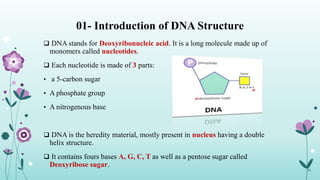
 DNA stands for Deoxyribonucleic acid. It is a long molecule made up of
monomers called nucleotides.
 Each nucleotide is made of 3 parts:
• a 5-carbon sugar
• A phosphate group
• A nitrogenous base
 DNA is the heredity material, mostly present in nucleus having a double
helix structure.
 It contains fours bases A, G, C, T as well as a pentose sugar called
Deoxyribose sugar.
01
02- Representation of Polynucleotides
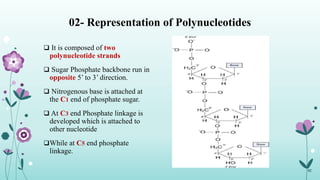
 It is composed of two
polynucleotide strands
 Sugar Phosphate backbone run in
opposite 5’ to 3’ direction.
 Nitrogenous base is attached at
the C1 end of phosphate sugar.
 At C3 end Phosphate linkage is
developed which is attached to
other nucleotide
While at C5 end phosphate
linkage.
02
03- Chargaff’s rule of DNA composition
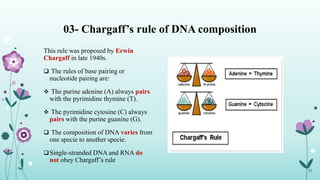
This rule was proposed by Erwin
Chargaff in late 1940s.
 The rules of base pairing or
nucleotide pairing are:
 The purine adenine (A) always pairs
with the pyrimidine thymine (T).
 The pyrimidine cytosine (C) always
pairs with the purine guanine (G).
 The composition of DNA varies from
one specie to another specie.
Single-stranded DNA and RNA do
not obey Chargaff’s rule
03
Summary of Chargaff’s Rule
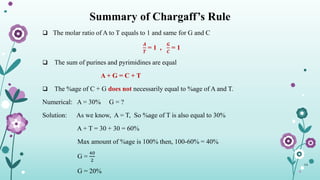
 The molar ratio of A to T equals to 1 and same for G and C
𝑨
𝑻
= 1 ,
𝑮
𝑪
= 1
 The sum of purines and pyrimidines are equal
A + G = C + T
 The %age of C + G does not necessarily equal to %age of A and T.
Numerical: A = 30% G = ?
Solution: As we know, A = T, So %age of T is also equal to 30%
A + T = 30 + 30 = 60%
Max amount of %age is 100% then, 100-60% = 40%
G =
40
2
G = 20%
04
04- DNA Double Helix
 The double helix structure of DNA was proposed by James Watson and Francis
Crick in 1953.
 The structure of DNA is comparable to a twisted ladder.
 It consists of two polydeoxyribonucleotide chains (strands) twisted around each
other on a common axis.
 Two strands are antiparallel to each other, i.e., one stand runs in the 5’ to 3’ while
the other in 3’ to 5’ direction and if we know the sequence of one strand then we can
guess the sequence of other stand.
 The width or diameter of double helix structure is 20 A (2nm).
 Each turn of the helix is 34 A (3.4nm) with 10 pairs of nucleotides, each pair placed
at a distance of about 3.4 A
 Deoxyribose phosphate backbone has hydrophilic in nature while bases which are
stacked inside are hydrophobic.
05
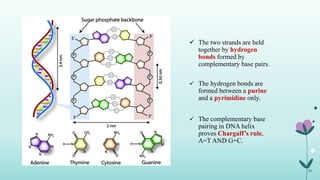
 The two strands are held
together by hydrogen
bonds formed by
complementary base pairs.
 The hydrogen bonds are
formed between a purine
and a pyrimidine only.
 The complementary base
pairing in DNA helix
proves Chargaff’s rule,
A=T AND G=C.
06
05- Conformation of DNA double helix
 Variation in the conformational of the nucleotides of DNA is associated with
conformational variants of DNA.
 The double helix structure of DNA exists in at least 6 different forms:
o A-DNA
o B-DNA
o C-DNA
o D-DNA
o E-DNA
o Z-DNA
 Among these types of DNA, B, A, and Z forms are important.
 B form of DNA double helix described by Watson and Crick
07
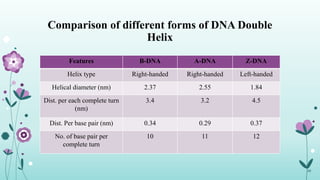
Comparison of different forms of DNA Double
Helix
Features B-DNA A-DNA Z-DNA
Helix type Right-handed Right-handed Left-handed
Helical diameter (nm) 2.37 2.55 1.84
Dist. per each complete turn
(nm)
3.4 3.2 4.5
Dist. Per base pair (nm) 0.34 0.29 0.37
No. of base pair per
complete turn
10 11 12
08
06 Types of DNA
09
DNA exist in some unusual structures to perform some appropriate
functions
Structure of DNA is important for the molecular recognition of DNA by
proteins and enzymes
These unusual structures are as follow:
 Bent DNA
 Triple stranded DNA
 Four stranded DNA
Bent DNA
10
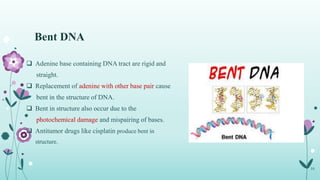
 Adenine base containing DNA tract are rigid and
straight.
 Replacement of adenine with other base pair cause
bent in the structure of DNA.
 Bent in structure also occur due to the
photochemical damage and mispairing of bases.
 Antitumor drugs like cisplatin produce bent in
structure.
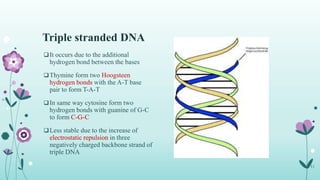
Triple stranded DNA
It occurs due to the additional
hydrogen bond between the bases
Thymine form two Hoogsteen
hydrogen bonds with the A-T base
pair to form T-A-T
In same way cytosine form two
hydrogen bonds with guanine of G-C
to form C-G-C
Less stable due to the increase of
electrostatic repulsion in three
negatively charged backbone strand of
triple DNA
11
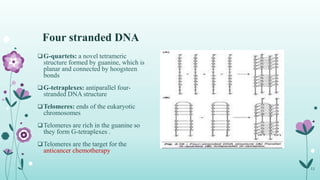
Four stranded DNA
G-quartets: a novel tetrameric
structure formed by guanine, which is
planar and connected by hoogsteen
bonds
G-tetraplexes: antiparallel four-
stranded DNA structure
Telomeres: ends of the eukaryotic
chromosomes
Telomeres are rich in the guanine so
they form G-tetraplexes .
Telomeres are the target for the
anticancer chemotherapy
12
07 The size of DNA molecule
A pair of B-DNA has molecular weight of 660 Daltons with the thickness of 0.34nm.
DNA-double stranded structure is expressed in the form of base pairs(bp).
1 Kb = 1000 bp
1 Mb = 1000kb = 1000000 bp
1Gb = 1000 Mb = 1000000000 bp
RNA molecules can never be expressed in bp because these are single stranded.
Contour length: total length of genomic DNA in a cell
Length of DNA varies from specie to specie.
13
Continue….
Examples
Lambda phage virus_ 4.8 x 10^4_contour length = 16.5m
 E.coli_ 4.6 X 10 ^ 6 bp _contour length =1.5mm
Diploid human cell(46 chromosomes) _6.0 x 10^9 bp _contour length = 2 m
Genomic DNA :
it is larger then the DNA of cell or nucleolus contains it
 size of DNA = 2 meter
 size of nucleus = 10 micrometer
14
continue…..
It may be linear or circular.
Bacteria , mitochondria and chloroplast of eukaryotic cells contain
circular DNA
Chromosomal DNAs are linear in higher organisms.
Human chromosomes contain a single DNA molecule with variable sizes
compactly packed
 Smallest chromosomes contain 34 Mb while the largest one has 263 Mb
15
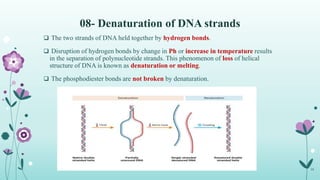
08- Denaturation of DNA strands
 The two strands of DNA held together by hydrogen bonds.
 Disruption of hydrogen bonds by change in Ph or increase in temperature results
in the separation of polynucleotide strands. This phenomenon of loss of helical
structure of DNA is known as denaturation or melting.
 The phosphodiester bonds are not broken by denaturation.
16
Continue...
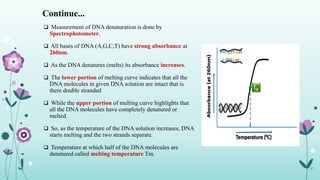
 Measurement of DNA denaturation is done by
Spectrophotometer.
 All bases of DNA (A,G,C,T) have strong absorbance at
260nm.
 As the DNA denatures (melts) its absorbance increases.
 The lower portion of melting curve indicates that all the
DNA molecules in given DNA solution are intact that is
there double stranded
 While the upper portion of melting curve highlights that
all the DNA molecules have completely denatured or
melted.
 So, as the temperature of the DNA solution increases, DNA
starts melting and the two strands separate.
 Temperature at which half of the DNA molecules are
denatured called melting temperature Tm.
17
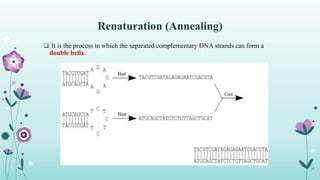
Renaturation (Annealing)
 It is the process in which the separated complementary DNA strands can form a
double helix.
18
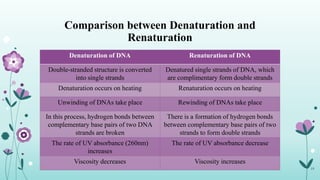
Comparison between Denaturation and
Renaturation
Denaturation of DNA Renaturation of DNA
Double-stranded structure is converted
into single strands
Denatured single strands of DNA, which
are complimentary form double strands
Denaturation occurs on heating Renaturation occurs on heating
Unwinding of DNAs take place Rewinding of DNAs take place
In this process, hydrogen bonds between
complementary base pairs of two DNA
strands are broken
There is a formation of hydrogen bonds
between complementary base pairs of two
strands to form double strands
The rate of UV absorbance (260nm)
increases
The rate of UV absorbance decrease
Viscosity decreases Viscosity increases
19
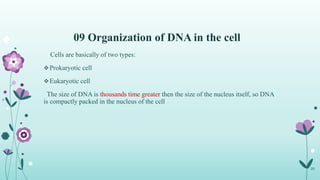
09 Organization of DNA in the cell
Cells are basically of two types:
Prokaryotic cell
Eukaryotic cell
The size of DNA is thousands time greater then the size of the nucleus itself, so DNA
is compactly packed in the nucleus of the cell
20
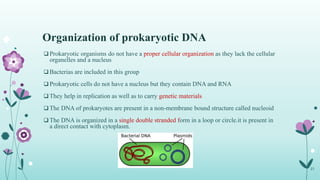
Organization of prokaryotic DNA
 Prokaryotic organisms do not have a proper cellular organization as they lack the cellular
organelles and a nucleus
 Bacterias are included in this group
 Prokaryotic cells do not have a nucleus but they contain DNA and RNA
 They help in replication as well as to carry genetic materials
 The DNA of prokaryotes are present in a non-membrane bound structure called nucleoid
 The DNA is organized in a single double stranded form in a loop or circle.it is present in
a direct contact with cytoplasm.
21
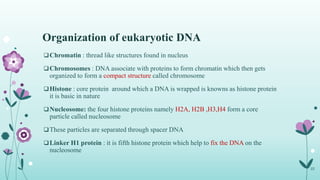
Organization of eukaryotic DNA
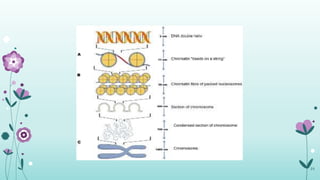
Chromatin : thread like structures found in nucleus
Chromosomes : DNA associate with proteins to form chromatin which then gets
organized to form a compact structure called chromosome
Histone : core protein around which a DNA is wrapped is knowns as histone protein
it is basic in nature
Nucleosome: the four histone proteins namely H2A, H2B ,H3,H4 form a core
particle called nucleosome
These particles are separated through spacer DNA
Linker H1 protein : it is fifth histone protein which help to fix the DNA on the
nucleosome
22
Continue…
10nm fiber : the continues string of nucleosome ,representing beads-on-a string form
of chromatin is termed as 10nm fibers
Length will be reduced due to formation of 10nm fibers
Solenoid : the 10nm fibers further coiled to produce 30nm fibers called solenoid
structure withy six nucleosome in every turn.
Looped domain: the solenoid fibers form loops called loop domain.
Metaphase chromosomes: during the course of mitosis, the loops are further coiled,
the chromosomes condense and become visible.
23
24
Biochem-I (DNA). presentation phospholipid

Biochem-I (DNA). presentation phospholipid

  • 1.
    DEOXYRIBONUCLEIC ACID Sufyan LiaqatCheema 21011507-121 Zarish Fatima 22011507-073 IV-B Department of Chemistry Biochemistry-I CHEM-206 Presented to : Ma’am Asifa Nasarullah
  • 2.
    Table of Contents SrNo# CONTENTS Pg No# 01 Introduction 01 02 Representation of Polynucleotides 02 03 Chargaff’s rule of DNA composition 03 04 DNA double helix structure 05 05 Conformation of DNA double helix 07 06 Other types of DNA structure 09 07 Size of DNA molecule 13 08 Denaturation of DNA structure 16 09 Organization of DNA in the cell 20
  • 3.
    01- Introduction ofDNA Structure  DNA stands for Deoxyribonucleic acid. It is a long molecule made up of monomers called nucleotides.  Each nucleotide is made of 3 parts: • a 5-carbon sugar • A phosphate group • A nitrogenous base  DNA is the heredity material, mostly present in nucleus having a double helix structure.  It contains fours bases A, G, C, T as well as a pentose sugar called Deoxyribose sugar. 01
  • 4.
    02- Representation ofPolynucleotides  It is composed of two polynucleotide strands  Sugar Phosphate backbone run in opposite 5’ to 3’ direction.  Nitrogenous base is attached at the C1 end of phosphate sugar.  At C3 end Phosphate linkage is developed which is attached to other nucleotide While at C5 end phosphate linkage. 02
  • 5.
    03- Chargaff’s ruleof DNA composition This rule was proposed by Erwin Chargaff in late 1940s.  The rules of base pairing or nucleotide pairing are:  The purine adenine (A) always pairs with the pyrimidine thymine (T).  The pyrimidine cytosine (C) always pairs with the purine guanine (G).  The composition of DNA varies from one specie to another specie. Single-stranded DNA and RNA do not obey Chargaff’s rule 03
  • 6.
    Summary of Chargaff’sRule  The molar ratio of A to T equals to 1 and same for G and C 𝑨 𝑻 = 1 , 𝑮 𝑪 = 1  The sum of purines and pyrimidines are equal A + G = C + T  The %age of C + G does not necessarily equal to %age of A and T. Numerical: A = 30% G = ? Solution: As we know, A = T, So %age of T is also equal to 30% A + T = 30 + 30 = 60% Max amount of %age is 100% then, 100-60% = 40% G = 40 2 G = 20% 04
  • 7.
    04- DNA DoubleHelix  The double helix structure of DNA was proposed by James Watson and Francis Crick in 1953.  The structure of DNA is comparable to a twisted ladder.  It consists of two polydeoxyribonucleotide chains (strands) twisted around each other on a common axis.  Two strands are antiparallel to each other, i.e., one stand runs in the 5’ to 3’ while the other in 3’ to 5’ direction and if we know the sequence of one strand then we can guess the sequence of other stand.  The width or diameter of double helix structure is 20 A (2nm).  Each turn of the helix is 34 A (3.4nm) with 10 pairs of nucleotides, each pair placed at a distance of about 3.4 A  Deoxyribose phosphate backbone has hydrophilic in nature while bases which are stacked inside are hydrophobic. 05
  • 8.
     The twostrands are held together by hydrogen bonds formed by complementary base pairs.  The hydrogen bonds are formed between a purine and a pyrimidine only.  The complementary base pairing in DNA helix proves Chargaff’s rule, A=T AND G=C. 06
  • 9.
    05- Conformation ofDNA double helix  Variation in the conformational of the nucleotides of DNA is associated with conformational variants of DNA.  The double helix structure of DNA exists in at least 6 different forms: o A-DNA o B-DNA o C-DNA o D-DNA o E-DNA o Z-DNA  Among these types of DNA, B, A, and Z forms are important.  B form of DNA double helix described by Watson and Crick 07
  • 10.
    Comparison of differentforms of DNA Double Helix Features B-DNA A-DNA Z-DNA Helix type Right-handed Right-handed Left-handed Helical diameter (nm) 2.37 2.55 1.84 Dist. per each complete turn (nm) 3.4 3.2 4.5 Dist. Per base pair (nm) 0.34 0.29 0.37 No. of base pair per complete turn 10 11 12 08
  • 11.
    06 Types ofDNA 09 DNA exist in some unusual structures to perform some appropriate functions Structure of DNA is important for the molecular recognition of DNA by proteins and enzymes These unusual structures are as follow:  Bent DNA  Triple stranded DNA  Four stranded DNA
  • 12.
    Bent DNA 10  Adeninebase containing DNA tract are rigid and straight.  Replacement of adenine with other base pair cause bent in the structure of DNA.  Bent in structure also occur due to the photochemical damage and mispairing of bases.  Antitumor drugs like cisplatin produce bent in structure.
  • 13.
    Triple stranded DNA Itoccurs due to the additional hydrogen bond between the bases Thymine form two Hoogsteen hydrogen bonds with the A-T base pair to form T-A-T In same way cytosine form two hydrogen bonds with guanine of G-C to form C-G-C Less stable due to the increase of electrostatic repulsion in three negatively charged backbone strand of triple DNA 11
  • 14.
    Four stranded DNA G-quartets:a novel tetrameric structure formed by guanine, which is planar and connected by hoogsteen bonds G-tetraplexes: antiparallel four- stranded DNA structure Telomeres: ends of the eukaryotic chromosomes Telomeres are rich in the guanine so they form G-tetraplexes . Telomeres are the target for the anticancer chemotherapy 12
  • 15.
    07 The sizeof DNA molecule A pair of B-DNA has molecular weight of 660 Daltons with the thickness of 0.34nm. DNA-double stranded structure is expressed in the form of base pairs(bp). 1 Kb = 1000 bp 1 Mb = 1000kb = 1000000 bp 1Gb = 1000 Mb = 1000000000 bp RNA molecules can never be expressed in bp because these are single stranded. Contour length: total length of genomic DNA in a cell Length of DNA varies from specie to specie. 13
  • 16.
    Continue…. Examples Lambda phage virus_4.8 x 10^4_contour length = 16.5m  E.coli_ 4.6 X 10 ^ 6 bp _contour length =1.5mm Diploid human cell(46 chromosomes) _6.0 x 10^9 bp _contour length = 2 m Genomic DNA : it is larger then the DNA of cell or nucleolus contains it  size of DNA = 2 meter  size of nucleus = 10 micrometer 14
  • 17.
    continue….. It may belinear or circular. Bacteria , mitochondria and chloroplast of eukaryotic cells contain circular DNA Chromosomal DNAs are linear in higher organisms. Human chromosomes contain a single DNA molecule with variable sizes compactly packed  Smallest chromosomes contain 34 Mb while the largest one has 263 Mb 15
  • 18.
    08- Denaturation ofDNA strands  The two strands of DNA held together by hydrogen bonds.  Disruption of hydrogen bonds by change in Ph or increase in temperature results in the separation of polynucleotide strands. This phenomenon of loss of helical structure of DNA is known as denaturation or melting.  The phosphodiester bonds are not broken by denaturation. 16
  • 19.
    Continue...  Measurement ofDNA denaturation is done by Spectrophotometer.  All bases of DNA (A,G,C,T) have strong absorbance at 260nm.  As the DNA denatures (melts) its absorbance increases.  The lower portion of melting curve indicates that all the DNA molecules in given DNA solution are intact that is there double stranded  While the upper portion of melting curve highlights that all the DNA molecules have completely denatured or melted.  So, as the temperature of the DNA solution increases, DNA starts melting and the two strands separate.  Temperature at which half of the DNA molecules are denatured called melting temperature Tm. 17
  • 20.
    Renaturation (Annealing)  Itis the process in which the separated complementary DNA strands can form a double helix. 18
  • 21.
    Comparison between Denaturationand Renaturation Denaturation of DNA Renaturation of DNA Double-stranded structure is converted into single strands Denatured single strands of DNA, which are complimentary form double strands Denaturation occurs on heating Renaturation occurs on heating Unwinding of DNAs take place Rewinding of DNAs take place In this process, hydrogen bonds between complementary base pairs of two DNA strands are broken There is a formation of hydrogen bonds between complementary base pairs of two strands to form double strands The rate of UV absorbance (260nm) increases The rate of UV absorbance decrease Viscosity decreases Viscosity increases 19
  • 22.
    09 Organization ofDNA in the cell Cells are basically of two types: Prokaryotic cell Eukaryotic cell The size of DNA is thousands time greater then the size of the nucleus itself, so DNA is compactly packed in the nucleus of the cell 20
  • 23.
    Organization of prokaryoticDNA  Prokaryotic organisms do not have a proper cellular organization as they lack the cellular organelles and a nucleus  Bacterias are included in this group  Prokaryotic cells do not have a nucleus but they contain DNA and RNA  They help in replication as well as to carry genetic materials  The DNA of prokaryotes are present in a non-membrane bound structure called nucleoid  The DNA is organized in a single double stranded form in a loop or circle.it is present in a direct contact with cytoplasm. 21
  • 24.
    Organization of eukaryoticDNA Chromatin : thread like structures found in nucleus Chromosomes : DNA associate with proteins to form chromatin which then gets organized to form a compact structure called chromosome Histone : core protein around which a DNA is wrapped is knowns as histone protein it is basic in nature Nucleosome: the four histone proteins namely H2A, H2B ,H3,H4 form a core particle called nucleosome These particles are separated through spacer DNA Linker H1 protein : it is fifth histone protein which help to fix the DNA on the nucleosome 22
  • 25.
    Continue… 10nm fiber :the continues string of nucleosome ,representing beads-on-a string form of chromatin is termed as 10nm fibers Length will be reduced due to formation of 10nm fibers Solenoid : the 10nm fibers further coiled to produce 30nm fibers called solenoid structure withy six nucleosome in every turn. Looped domain: the solenoid fibers form loops called loop domain. Metaphase chromosomes: during the course of mitosis, the loops are further coiled, the chromosomes condense and become visible. 23
  • 26.