High Speed & RF Design and Layout:
RFI/EMI Considerations
Advanced Techniques of Higher Performance Signal Processing
Legal Disclaimer
 Notice of proprietary information, Disclaimers and Exclusions Of Warranties
The ADI Presentation is the property of ADI. All copyright, trademark, and other intellectual property and
proprietary rights in the ADI Presentation and in the software, text, graphics, design elements, audio and all
other materials originated or used by ADI herein (the "ADI Information") are reserved to ADI and its
licensors. The ADI Information may not be reproduced, published, adapted, modified, displayed, distributed
or sold in any manner, in any form or media, without the prior written permission of ADI.
THE ADI INFORMATION AND THE ADI PRESENTATION ARE PROVIDED "AS IS". WHILE ADI INTENDS THE
ADI INFORMATION AND THE ADI PRESENTATION TO BE ACCURATE, NO WARRANTIES OF ANY KIND ARE
MADE WITH RESPECT TO THE ADI PRESENTATION AND THE ADI INFORMATION, INCLUDING WITHOUT
LIMITATION ANY WARRANTIES OF ACCURACY OR COMPLETENESS. TYPOGRAPHICAL ERRORS AND
OTHER INACCURACIES OR MISTAKES ARE POSSIBLE. ADI DOES NOT WARRANT THAT THE ADI
INFORMATION AND THE ADI PRESENTATION WILL MEET YOUR REQUIREMENTS, WILL BE ACCURATE, OR
WILL BE UNINTERRUPTED OR ERROR FREE. ADI EXPRESSLY EXCLUDES AND DISCLAIMS ALL EXPRESS
AND IMPLIED WARRANTIES OF MERCHANTABILITY, FITNESS FOR A PARTICULAR PURPOSE AND NON-
INFRINGEMENT OF ANY THIRD PARTY INTELLECTUAL PROPERTY RIGHTS. ADI SHALL NOT BE
RESPONSIBLE FOR ANY DAMAGE OR LOSS OF ANY KIND ARISING OUT OF OR RELATED TO YOUR USE
OF THE ADI INFORMATION AND THE ADI PRESENTATION, INCLUDING WITHOUT LIMITATION DATA LOSS
OR CORRUPTION, COMPUTER VIRUSES, ERRORS, OMISSIONS, INTERRUPTIONS, DEFECTS OR OTHER
FAILURES, REGARDLESS OF WHETHER SUCH LIABILITY IS BASED IN TORT, CONTRACT OR OTHERWISE.
USE OF ANY THIRD-PARTY SOFTWARE REFERENCED WILL BE GOVERNED BY THE APPLICABLE
LICENSE AGREEMENT, IF ANY, WITH SUCH THIRD PARTY.
©2013 Analog Devices, Inc. All rights reserved.
2
Todays Agenda
PCB Layout Overview
Schematic
Critical Component Location and Signal Routing
Power Supply Bypassing
Parasitics, Vias and Placement
Ground Plane
Layout Review
Summary
3
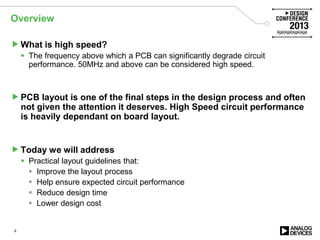
Overview
What is high speed?
 The frequency above which a PCB can significantly degrade circuit
performance. 50MHz and above can be considered high speed.
PCB layout is one of the final steps in the design process and often
not given the attention it deserves. High Speed circuit performance
is heavily dependant on board layout.
Today we will address
 Practical layout guidelines that:
 Improve the layout process
 Help ensure expected circuit performance
 Reduce design time
 Lower design cost
4
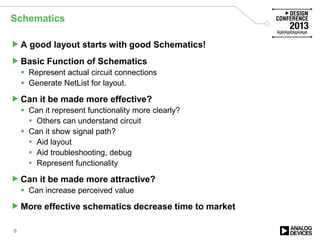
Schematics
Schematics
A good layout starts with good Schematics!
Basic Function of Schematics
 Represent actual circuit connections
 Generate NetList for layout.
Can it be made more effective?
 Can it represent functionality more clearly?
 Others can understand circuit
 Can it show signal path?
 Aid layout
 Aid troubleshooting, debug
 Represent functionality
Can it be made more attractive?
 Can increase perceived value
More effective schematics decrease time to market
6
Schematics
7
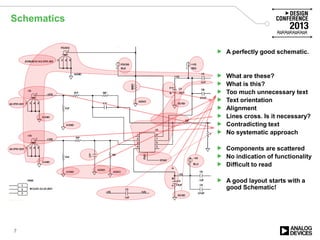
 A perfectly good schematic.
 What are these?
 What is this?
 Too much unnecessary text
 Text orientation
 Alignment
 Lines cross. Is it necessary?
 Contradicting text
 No systematic approach
 Components are scattered
 No indication of functionality
 Difficult to read
 A good layout starts with a
good Schematic!
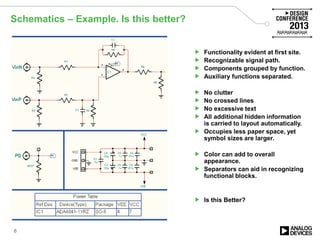
Schematics – Example. Is this better?
8
 Functionality evident at first site.
 Recognizable signal path.
 Components grouped by function.
 Auxiliary functions separated.
 No clutter
 No crossed lines
 No excessive text
 All additional hidden information
is carried to layout automatically.
 Occupies less paper space, yet
symbol sizes are larger.
 Color can add to overall
appearance.
 Separators can aid in recognizing
functional blocks.
 Is this Better?
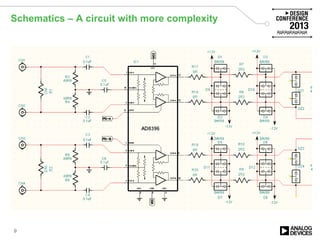
Schematics – A circuit with more complexity
9
Component Placement
and Signal Routing
Component Placement and Signal Routing
Just as in real estate location is everything!
Input/output and power connections on a board are
typically defined
Component placement and Signal routing require
deliberate thought and planning
11
Component Placement and Signal Routing
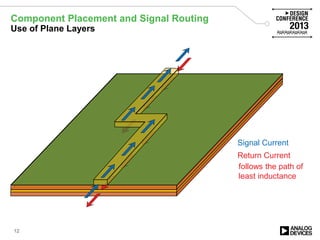
Use of Plane Layers
Plane LayerPrepregCopper Signal TraceSolder MaskSignal Current
Return Current
follows the path of
least inductance
12
Component Placement and Signal Routing
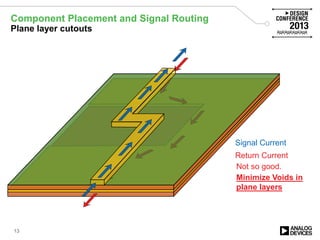
Plane layer cutouts
Plane LayerPrepregCopper Signal TraceSolder MaskSignal Current
Return Current
Not so good.
Minimize Voids in
plane layers
13
Component Placement and Signal Routing
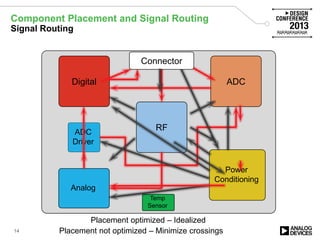
Signal Routing
Placement not optimized – Minimize crossings
Connector
Digital ADC
RF
Power
Conditioning
Analog
Temp
Sensor
Connector
ADC
Driver
Placement optimized – Idealized
14
Component Placement and Signal Routing
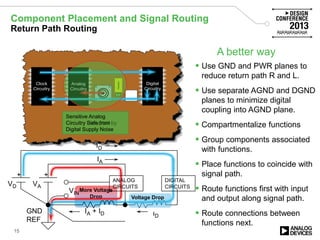
Return Path Routing
Clock
Circuitry
Analog
Circuitry
Resistor
Digital
Circuitry
Sensitive Analog
Circuitry Disrupted by
Digital Supply Noise
Not so good
ID
Voltage Drop
A better way
Sensitive Analog
Circuitry Safe from
Digital Supply Noise
 Use GND and PWR planes to
reduce return path R and L.
 Use separate AGND and DGND
planes to minimize digital
coupling into AGND plane.
 Compartmentalize functions
 Group components associated
with functions.
 Place functions to coincide with
signal path.
 Route functions first with input
and output along signal path.
 Route connections between
functions next.
Voltage Drop
More Voltage
Drop
ANALOG
CIRCUITS
DIGITAL
CIRCUITSVD VA
+ +
ID
IA
IA + ID
VIN
GND
REF
15
Component Placement and Signal Routing
Example
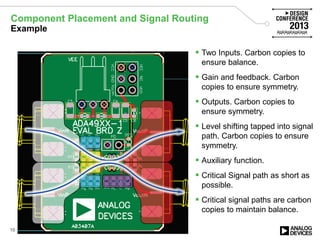
 Two Inputs. Carbon copies to
ensure balance.
 Gain and feedback. Carbon
copies to ensure symmetry.
 Outputs. Carbon copies to
ensure symmetry.
 Level shifting tapped into signal
path. Carbon copies to ensure
symmetry.
 Auxiliary function.
 Critical Signal path as short as
possible.
 Critical signal paths are carbon
copies to maintain balance.
16
Component Placement and Signal Routing
Packaging and Pinout choices
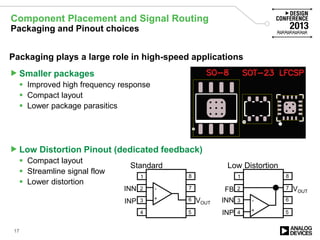
Packaging plays a large role in high-speed applications
Smaller packages
 Improved high frequency response
 Compact layout
 Lower package parasitics
Low Distortion Pinout (dedicated feedback)
 Compact layout
 Streamline signal flow
 Lower distortion
1
2
3
4
8
7
6
5
FB
INP
INN
VOUT
+
-
Low Distortion
1
2
3
4
8
7
6
5
VOUT
+
-
Standard
INP
INN
17
PCB
18
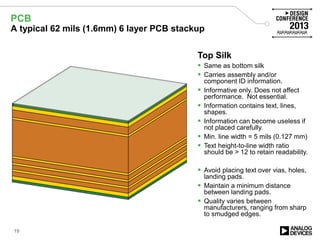
Bottom Silk
 Carries assembly and/or
component ID information.
 Informative only. Does not affect
performance. Not essential.
 Information contains text, lines,
shapes.
 Information can become useless if
not placed carefully.
 Min. line width = 5 mils (0.127 mm)
 Text height-to-line width ratio
should be > 12 to retain readability.
 Avoid placing text over vias, holes,
landing pads.
 Maintain a minimum distance
between landing pads.
 Quality varies between
manufacturers, ranging from sharp
to smudged edges.
Bottom Mask
 Protects copper from environmental
effects.
 Minimizes solder bridging. Can
prevent bridging if designed with
care.
 Affects PCB performance
somewhat.
 Not required. Essential to maintain
PCB longevity. Greatly increases
PCB assembly yield.
 Normally green. Other popular
colors are black, blue red, white.
Bottom Copper
 Can be a signal layer or a plane
layer.
 Normally a 1.4 mils (0.04 mm) thick
copper plate. Can be thicker.
 Etched to form signal traces and
landing pads.
 Minimum trace width is 4 mils (0.1
mm).
 Minimum space requirement
between two objects is 4 mils (0.1
mm).
 Forms a capacitor with other
nearby copper plates.
 Has inductance.
PrePreg
 Separates two copper layers.
 Is a woven glass epoxy base
material with glue.
 Has relative permittivity between
about 4.7 and 2.2.
 Weave density determines high
frequency performance.
 Comes in a range of thickness. A
1080 laminate is 3.2 mils (0.08 mm)
thick.
 Material determines maximum
soldering temperature.
Core
 Two copper foils already attached
to a woven glass material.
 Same as Prepreg but already
glued.
 Same characteristics as PrePreg.
 Can provide “built-in” or “inter-
planar” capacitance if one or both
copper foils are used as GND or
PWR planes.
Another PrePreg and Core
 Can act as a spacer to ensure
specified finished PCB thickness
 If made thick, it minimizes
interplanar capacitance.
One more PrePreg
 Can form controlled impedance
lines when combined with copper
traces above and GND plane
below.
 Impedance depends on trace width
above and thickness and
permittivity of PrePreg.
 Impedance accuracy depends on
the weave density.
Top Copper
 Usually a signal layer.
 Normally a 1.4 mils (0.04 mm) thick
copper plate. Can be thicker.
 Etched to form signal traces and
landing pads.
 Minimum trace width is 4 mils (0.1
mm).
 Minimum space requirement
between two objects is 4 mils (0.1
mm).
 Forms a capacitor with other
nearby copper plates.
 Traces have inductance.
Top Mask
 Same as bottom mask
 Protects copper from environmental
effects.
 Minimizes solder bridging. Can
prevent bridging if designed with
care.
 Affects PCB performance
somewhat.
 Not required. Essential to maintain
PCB longevity. Greatly increases
PCB assembly yield.
 Normally green. Other popular
colors are black, blue red, white.
Top Silk
 Same as bottom silk
 Carries assembly and/or
component ID information.
 Informative only. Does not affect
performance. Not essential.
 Information contains text, lines,
shapes.
 Information can become useless if
not placed carefully.
 Min. line width = 5 mils (0.127 mm)
 Text height-to-line width ratio
should be > 12 to retain readability.
 Avoid placing text over vias, holes,
landing pads.
 Maintain a minimum distance
between landing pads.
 Quality varies between
manufacturers, ranging from sharp
to smudged edges.
PCB
A typical 62 mils (1.6mm) 6 layer PCB stackup
19
PCB
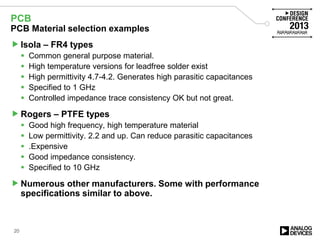
PCB Material selection examples
Isola – FR4 types
 Common general purpose material.
 High temperature versions for leadfree solder exist
 High permittivity 4.7-4.2. Generates high parasitic capacitances
 Specified to 1 GHz
 Controlled impedance trace consistency OK but not great.
Rogers – PTFE types
 Good high frequency, high temperature material
 Low permittivity. 2.2 and up. Can reduce parasitic capacitances
 .Expensive
 Good impedance consistency.
 Specified to 10 GHz
Numerous other manufacturers. Some with performance
specifications similar to above.
20
PCB
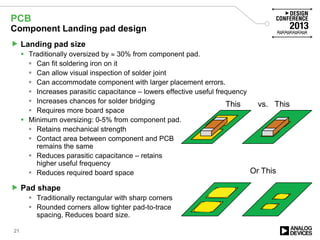
Component Landing pad design
 Landing pad size
 Traditionally oversized by ≈ 30% from component pad.
 Can fit soldering iron on it
 Can allow visual inspection of solder joint
 Can accommodate component with larger placement errors.
 Increases parasitic capacitance – lowers effective useful frequency
 Increases chances for solder bridging
 Requires more board space
 Minimum oversizing: 0-5% from component pad.
 Retains mechanical strength
 Contact area between component and PCB
remains the same
 Reduces parasitic capacitance – retains
higher useful frequency
 Reduces required board space
 Pad shape
 Traditionally rectangular with sharp corners
 Rounded corners allow tighter pad-to-trace
spacing. Reduces board size.
21
This vs. This
ThisOr This
Signal Routing
Signal Routing
Use GND and PWR Planes
 Connect pads to planes using “Via-in-pad” method to minimize parasitics
Place components of a functional block as close as possible
 0.5 mm component-to-component spacing is sufficient for manual placement
Minimize vias in signal traces. The less the better.
 Keep traces within a functional block on the same layer.
Use interplanar capacitance for bypassing
Keep plane layers as contiguous as possible
 Avoid unnecessary vias perforating plane layers.
 Avoid cutouts in plane layers
Keep traces as straight as possible
 Minimize bends and turns
23
Examples
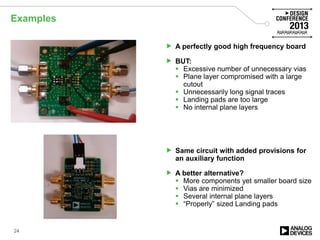
 A perfectly good high frequency board
 BUT:
 Excessive number of unnecessary vias
 Plane layer compromised with a large
cutout
 Unnecessarily long signal traces
 Landing pads are too large
 No internal plane layers
 Same circuit with added provisions for
an auxiliary function
 A better alternative?
 More components yet smaller board size
 Vias are minimized
 Several internal plane layers
 “Properly” sized Landing pads
24
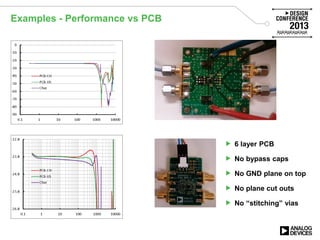
Examples - Performance vs PCB
 6 layer PCB
 No bypass caps
 No GND plane on top
 No plane cut outs
 No “stitching” vias
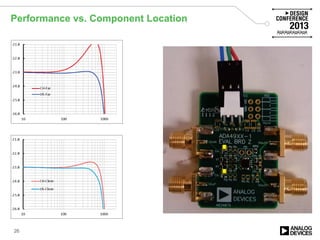
Performance vs. Component Location
26
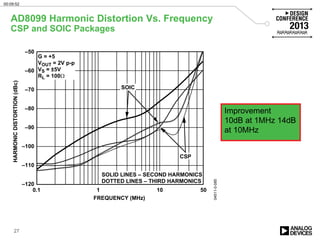
AD8099 Harmonic Distortion Vs. Frequency
CSP and SOIC Packages
27
HARMONICDISTORTION(dBc)
0.1
–120
–100
–110
–80
–90
–60
–70
–50
1 10 50
04511-0-085
SOLID LINES – SECOND HARMONICS
DOTTED LINES – THIRD HARMONICS
G = +5
VOUT = 2V p-p
VS = ±5V
RL = 100Ω
FREQUENCY (MHz)
SOIC
CSP
Improvement
10dB at 1MHz 14dB
at 10MHz
00:09:52
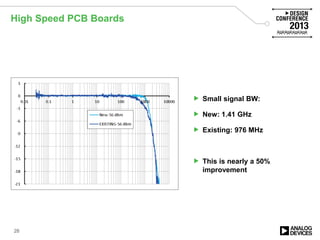
High Speed PCB Boards
 Small signal BW:
 New: 1.41 GHz
 Existing: 976 MHz
 This is nearly a 50%
improvement
28
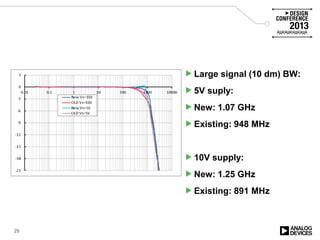
Large signal (10 dm) BW:
5V suply:
New: 1.07 GHz
Existing: 948 MHz
10V supply:
New: 1.25 GHz
Existing: 891 MHz
29
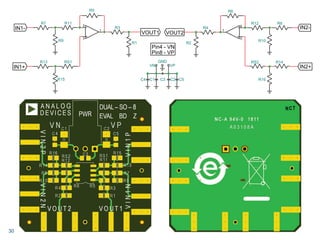
Pin4 - VN
Pin8 - VP
VOUT2
R5
1
VOUT1
R13
IN1+
R7
2
3
IN1-
R1
R3
RS1
R11
R15
R9
7
5
6
R14
IN2+
R8
IN2-
R6
R2
R16
RS2
R12
R4
R10
C3 C2C1
VPVN
GND
C4 C5
30
Crosstalk and Coupling
Capacitive Crosstalk or Coupling
 This results from traces running on top of each other, which forms a parasitic
capacitor
 Solutions run traces orthogonal, to minimize trace coupling and lower area
profile
Inductive Crosstalk
 Inductive crosstalk exists due to the magnetic field interaction between long
traces parallel traces
 There are two types of inductive crosstalk; forward and backward
 Backward is the noise observed nearest the driver on the victim trace
 Forward is the noise observed farthest from the driver on the driven line
Minimize crosstalk by
 Increasing trace separation (improving isolation)
 Using guard traces
 Using differential signals
31
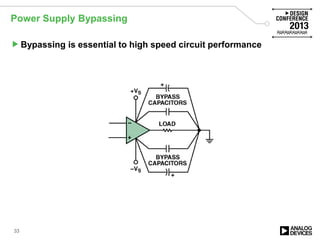
Power Supply Bypassing
Bypassing is essential to high speed circuit performance
33
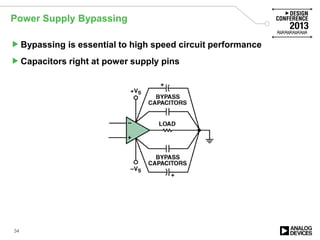
Power Supply Bypassing
Bypassing is essential to high speed circuit performance
Capacitors right at power supply pins
34
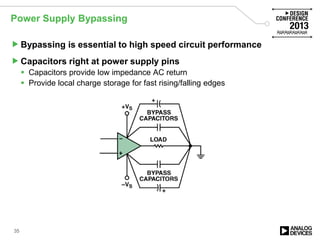
Power Supply Bypassing
Bypassing is essential to high speed circuit performance
Capacitors right at power supply pins
 Capacitors provide low impedance AC return
 Provide local charge storage for fast rising/falling edges
35
Power Supply Bypassing
Bypassing is essential to high speed circuit performance
Capacitors right at power supply pins
 Capacitors provide low impedance AC return
 Provide local charge storage for fast
rising/falling edges
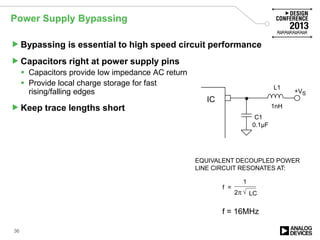
Keep trace lengths short
EQUIVALENT DECOUPLED POWER
LINE CIRCUIT RESONATES AT:
f =
1
2π LC√
IC
+VS
C1
L1
0.1µF
1nH
f = 16MHz
36
Power Supply Bypassing
Bypassing is essential to high speed circuit performance
Capacitors right at power supply pins
 Capacitors provide low impedance AC return
 Provide local charge storage for fast rising/falling edges
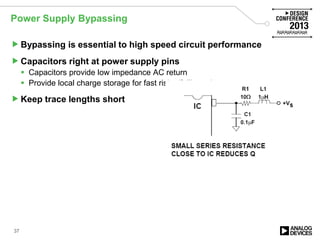
Keep trace lengths short
37
Power Supply Bypassing
Bypassing is essential to high speed circuit performance
Capacitors right at power supply pins
 Capacitors provide low impedance AC return
 Provide local charge storage for fast rising/falling edges
Keep trace lengths short
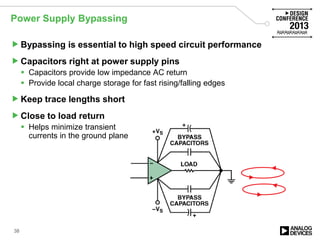
Close to load return
 Helps minimize transient
currents in the ground plane
38
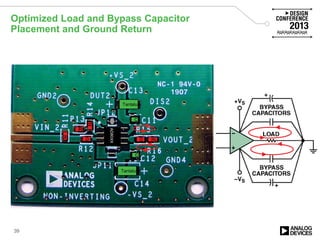
Optimized Load and Bypass Capacitor
Placement and Ground Return
Tantalum
Tantalum
C
C
RL
AD80XX
RT
RG
RF
00
39
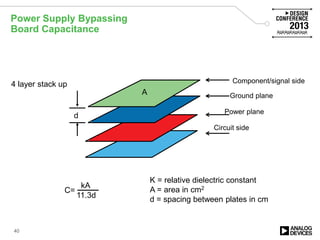
Power Supply Bypassing
Board Capacitance
40
4 layer stack up Component/signal side
Ground plane
Power plane
Circuit side
d
K = relative dielectric constant
A = area in cm2
d = spacing between plates in cm
A
kA
11.3d
C=
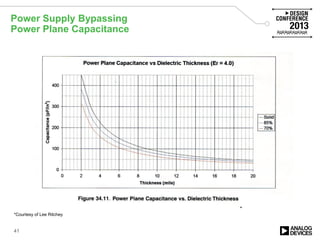
Power Supply Bypassing
Power Plane Capacitance
*Courtesy of Lee Ritchey
*
41
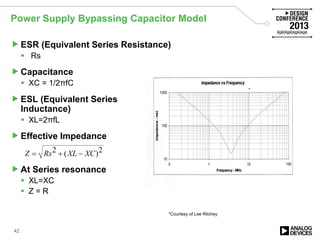
Power Supply Bypassing Capacitor Model
ESR (Equivalent Series Resistance)
 Rs
Capacitance
 XC = 1/2πfC
ESL (Equivalent Series
Inductance)
 XL=2πfL
Effective Impedance
At Series resonance
 XL=XC
 Z = R
2)(2 XCXLRsZ −+=
*Courtesy of Lee Ritchey
*
42
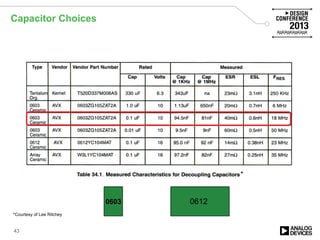
Capacitor Choices
0603 0612
*Courtesy of Lee Ritchey
*
43
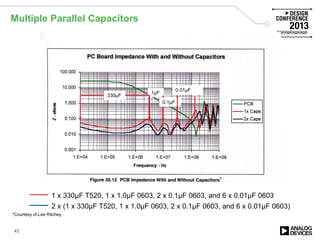
Multiple Parallel Capacitors
1 x 330µF T520, 1 x 1.0µF 0603, 2 x 0.1µF 0603, and 6 x 0.01µF 0603
*Courtesy of Lee Ritchey
*
2 x (1 x 330µF T520, 1 x 1.0µF 0603, 2 x 0.1µF 0603, and 6 x 0.01µF 0603)
1µF
330µF
0.1µF
0.01µF
45
Parasitics
46
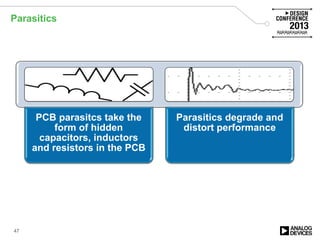
Parasitics
47
PCB parasitcs take the
form of hidden
capacitors, inductors
and resistors in the PCB
Parasitics degrade and
distort performance
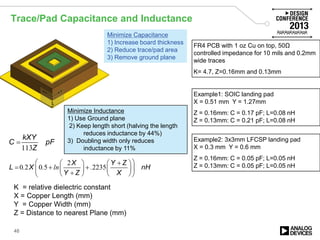
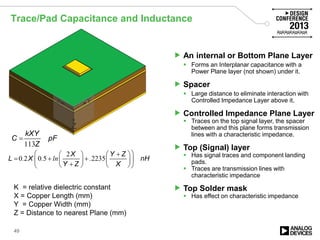
Trace/Pad Capacitance and Inductance
48
113
kXY
C pF
Z
=
K = relative dielectric constant
X = Copper Length (mm)
Y = Copper Width (mm)
Z = Distance to nearest Plane (mm)
Example1: SOIC landing pad
X = 0.51 mm Y = 1.27mm
Z = 0.16mm: C = 0.17 pF; L=0.08 nH
Z = 0.13mm: C = 0.21 pF; L=0.08 nH
2
0 2 0 5 2235
X Y Z
L X nH
Y Z X
. . ln .
 +   
= + +    +    
Example2: 3x3mm LFCSP landing pad
X = 0.3 mm Y = 0.6 mm
Z = 0.16mm: C = 0.05 pF; L=0.05 nH
Z = 0.13mm: C = 0.05 pF; L=0.05 nH
FR4 PCB with 1 oz Cu on top, 50Ω
controlled impedance for 10 mils and 0.2mm
wide traces
K= 4.7, Z=0.16mm and 0.13mm
Minimize Capacitance
1) Increase board thickness
2) Reduce trace/pad area
3) Remove ground plane
Minimize Inductance
1) Use Ground plane
2) Keep length short (halving the length
reduces inductance by 44%)
3) Doubling width only reduces
inductance by 11%
Trace/Pad Capacitance and Inductance
49
113
kXY
C pF
Z
=
K = relative dielectric constant
X = Copper Length (mm)
Y = Copper Width (mm)
Z = Distance to nearest Plane (mm)
2
0 2 0 5 2235
X Y Z
L X nH
Y Z X
. . ln .
 +   
= + +    +    
Z
 An internal or Bottom Plane Layer
 Forms an Interplanar capacitance with a
Power Plane layer (not shown) under it.
 Spacer
 Large distance to eliminate interaction with
Controlled Impedance Layer above it.
 Controlled Impedance Plane Layer
 Traces on the top signal layer, the spacer
between and this plane forms transmission
lines with a characteristic impedance.
 Top (Signal) layer
 Has signal traces and component landing
pads.
 Traces are transmission lines with
characteristic impedance
 Top Solder mask
 Has effect on characteristic impedance
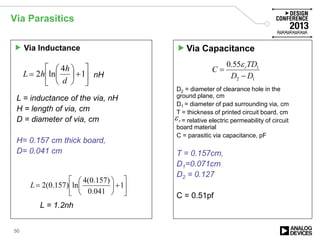
Via Parasitics
50






+





= 1
4
ln2
d
h
hL
L = inductance of the via, nH
H = length of via, cm
D = diameter of via, cm
H= 0.157 cm thick board,
D= 0.041 cm
 Via Inductance Via Capacitance






+





= 1
041.0
)157.0(4
ln)157.0(2L
L = 1.2nh
12
155.0
DD
TD
C r
−
=
ε
D2 = diameter of clearance hole in the
ground plane, cm
D1 = diameter of pad surrounding via, cm
T = thickness of printed circuit board, cm
= relative electric permeability of circuit
board material
C = parasitic via capacitance, pF
T = 0.157cm,
D1=0.071cm
D2 = 0.127
C = 0.51pf
rε
nH
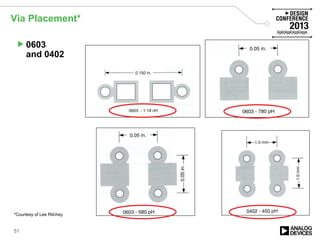
Via Placement*
0603
and 0402
51
*Courtesy of Lee Ritchey
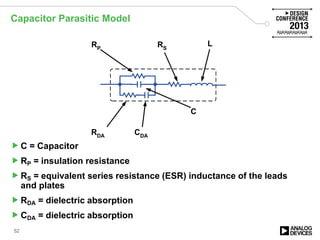
Capacitor Parasitic Model
C = Capacitor
RP = insulation resistance
RS = equivalent series resistance (ESR) inductance of the leads
and plates
RDA = dielectric absorption
CDA = dielectric absorption
52
L
r
RP
C
RDA CDA
RS
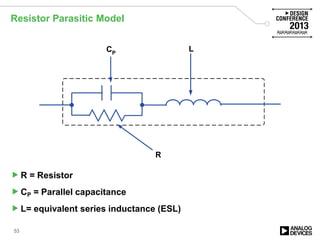
Resistor Parasitic Model
R = Resistor
CP = Parallel capacitance
L= equivalent series inductance (ESL)
53
CP
R
L
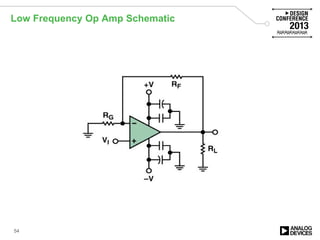
Low Frequency Op Amp Schematic
54
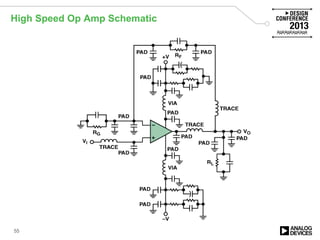
High Speed Op Amp Schematic
55
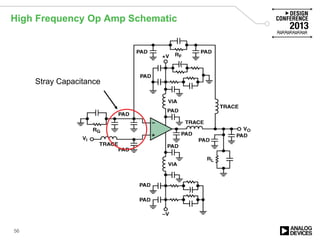
High Frequency Op Amp Schematic
56
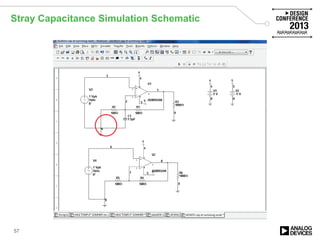
Stray Capacitance
Stray Capacitance Simulation Schematic
57
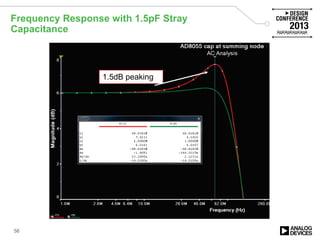
Frequency Response with 1.5pF Stray
Capacitance
1.5dB peaking
58
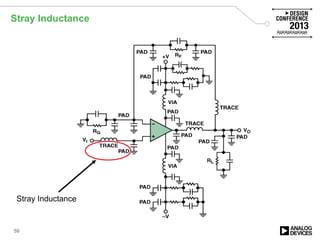
Stray Inductance
Stray Inductance
59
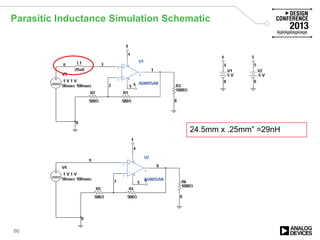
Parasitic Inductance Simulation Schematic
24.5mm x .25mm” =29nH
60
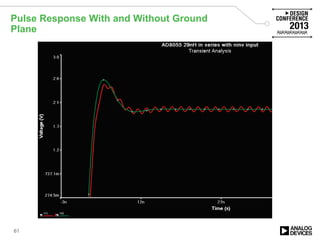
Pulse Response With and Without Ground
Plane
0.6dB overshoot
61
Ground and Power Planes
Ground and Power Planes Provide
A common reference point
Shielding
Lowers noise
Reduces parasitics
Heat sink
Power distribution
High value capacitance
63
Ground Plane Recommendations
 There is no single grounding method which is guaranteed to work 100% of
the time!
 At least one layer on each PC board MUST be dedicated to ground plane!
 Provide as much ground plane as possible especially under traces that
operate at high frequency
 Use thickest metal as feasible (reduces resistance and provides improved
thermal transfer)
 Use multiple vias to connect same ground planes together
 Do initial layout with dedicated plane for analog and digital ground planes,
split only if required
 Follow recommendations on mixed signal device data sheet.
 Keep bypass capacitors and load returns close to reduce distortion
 Provide jumper options for joining analog and digital ground planes
together
64
Tweet it out! @ADI_News #ADIDC13
What we covered
 High speed PCB design requires deliberate thought and attention to detail!
 Load the schematic with as much information as possible
 Where you put components on the board is just as important as to where
you put entire circuits
 Take the lead when laying out your board, don’t leave anything to chance
 Use multiple capacitors for power supply bypassing
 Parasitics must be considered and dealt with
 Ground and Power planes play a key role in reducing noise and parasitics
 New packaging and pinouts allow for improved performance and more
compact layouts
 There are many options for signal distribution, make sure you choose the
right one for your application
 Check the layout very carefully
65
Tweet it out! @ADI_News #ADIDC13
Electromagnetic compatibility (EMC)
There are two aspects of EMC:
 It describes the ability of electronic systems to operate without interfering with
other systems
 It also describes the ability of such systems to operate as intended within a
specified electromagnetic environment
Primary specifications are IEC-60050 and IEC1000
Extensive reviews in tutorial MT-095 and Analog Dialog 30-4 on
Analog Devices website (www.analog.com)
Inability to meet these requirements will compromise your
equipment
Inability to meet these requirements will severely limit the ability to
sell the equipment to customers
66

High Speed & RF Design and Layout: RFI/EMI Considerations (Design Conference 2013)

  • 1.
    High Speed &RF Design and Layout: RFI/EMI Considerations Advanced Techniques of Higher Performance Signal Processing
  • 2.
    Legal Disclaimer  Noticeof proprietary information, Disclaimers and Exclusions Of Warranties The ADI Presentation is the property of ADI. All copyright, trademark, and other intellectual property and proprietary rights in the ADI Presentation and in the software, text, graphics, design elements, audio and all other materials originated or used by ADI herein (the "ADI Information") are reserved to ADI and its licensors. The ADI Information may not be reproduced, published, adapted, modified, displayed, distributed or sold in any manner, in any form or media, without the prior written permission of ADI. THE ADI INFORMATION AND THE ADI PRESENTATION ARE PROVIDED "AS IS". WHILE ADI INTENDS THE ADI INFORMATION AND THE ADI PRESENTATION TO BE ACCURATE, NO WARRANTIES OF ANY KIND ARE MADE WITH RESPECT TO THE ADI PRESENTATION AND THE ADI INFORMATION, INCLUDING WITHOUT LIMITATION ANY WARRANTIES OF ACCURACY OR COMPLETENESS. TYPOGRAPHICAL ERRORS AND OTHER INACCURACIES OR MISTAKES ARE POSSIBLE. ADI DOES NOT WARRANT THAT THE ADI INFORMATION AND THE ADI PRESENTATION WILL MEET YOUR REQUIREMENTS, WILL BE ACCURATE, OR WILL BE UNINTERRUPTED OR ERROR FREE. ADI EXPRESSLY EXCLUDES AND DISCLAIMS ALL EXPRESS AND IMPLIED WARRANTIES OF MERCHANTABILITY, FITNESS FOR A PARTICULAR PURPOSE AND NON- INFRINGEMENT OF ANY THIRD PARTY INTELLECTUAL PROPERTY RIGHTS. ADI SHALL NOT BE RESPONSIBLE FOR ANY DAMAGE OR LOSS OF ANY KIND ARISING OUT OF OR RELATED TO YOUR USE OF THE ADI INFORMATION AND THE ADI PRESENTATION, INCLUDING WITHOUT LIMITATION DATA LOSS OR CORRUPTION, COMPUTER VIRUSES, ERRORS, OMISSIONS, INTERRUPTIONS, DEFECTS OR OTHER FAILURES, REGARDLESS OF WHETHER SUCH LIABILITY IS BASED IN TORT, CONTRACT OR OTHERWISE. USE OF ANY THIRD-PARTY SOFTWARE REFERENCED WILL BE GOVERNED BY THE APPLICABLE LICENSE AGREEMENT, IF ANY, WITH SUCH THIRD PARTY. ©2013 Analog Devices, Inc. All rights reserved. 2
  • 3.
    Todays Agenda PCB LayoutOverview Schematic Critical Component Location and Signal Routing Power Supply Bypassing Parasitics, Vias and Placement Ground Plane Layout Review Summary 3
  • 4.
    Overview What is highspeed?  The frequency above which a PCB can significantly degrade circuit performance. 50MHz and above can be considered high speed. PCB layout is one of the final steps in the design process and often not given the attention it deserves. High Speed circuit performance is heavily dependant on board layout. Today we will address  Practical layout guidelines that:  Improve the layout process  Help ensure expected circuit performance  Reduce design time  Lower design cost 4
  • 5.
  • 6.
    Schematics A good layoutstarts with good Schematics! Basic Function of Schematics  Represent actual circuit connections  Generate NetList for layout. Can it be made more effective?  Can it represent functionality more clearly?  Others can understand circuit  Can it show signal path?  Aid layout  Aid troubleshooting, debug  Represent functionality Can it be made more attractive?  Can increase perceived value More effective schematics decrease time to market 6
  • 7.
    Schematics 7  A perfectlygood schematic.  What are these?  What is this?  Too much unnecessary text  Text orientation  Alignment  Lines cross. Is it necessary?  Contradicting text  No systematic approach  Components are scattered  No indication of functionality  Difficult to read  A good layout starts with a good Schematic!
  • 8.
    Schematics – Example.Is this better? 8  Functionality evident at first site.  Recognizable signal path.  Components grouped by function.  Auxiliary functions separated.  No clutter  No crossed lines  No excessive text  All additional hidden information is carried to layout automatically.  Occupies less paper space, yet symbol sizes are larger.  Color can add to overall appearance.  Separators can aid in recognizing functional blocks.  Is this Better?
  • 9.
    Schematics – Acircuit with more complexity 9
  • 10.
  • 11.
    Component Placement andSignal Routing Just as in real estate location is everything! Input/output and power connections on a board are typically defined Component placement and Signal routing require deliberate thought and planning 11
  • 12.
    Component Placement andSignal Routing Use of Plane Layers Plane LayerPrepregCopper Signal TraceSolder MaskSignal Current Return Current follows the path of least inductance 12
  • 13.
    Component Placement andSignal Routing Plane layer cutouts Plane LayerPrepregCopper Signal TraceSolder MaskSignal Current Return Current Not so good. Minimize Voids in plane layers 13
  • 14.
    Component Placement andSignal Routing Signal Routing Placement not optimized – Minimize crossings Connector Digital ADC RF Power Conditioning Analog Temp Sensor Connector ADC Driver Placement optimized – Idealized 14
  • 15.
    Component Placement andSignal Routing Return Path Routing Clock Circuitry Analog Circuitry Resistor Digital Circuitry Sensitive Analog Circuitry Disrupted by Digital Supply Noise Not so good ID Voltage Drop A better way Sensitive Analog Circuitry Safe from Digital Supply Noise  Use GND and PWR planes to reduce return path R and L.  Use separate AGND and DGND planes to minimize digital coupling into AGND plane.  Compartmentalize functions  Group components associated with functions.  Place functions to coincide with signal path.  Route functions first with input and output along signal path.  Route connections between functions next. Voltage Drop More Voltage Drop ANALOG CIRCUITS DIGITAL CIRCUITSVD VA + + ID IA IA + ID VIN GND REF 15
  • 16.
    Component Placement andSignal Routing Example  Two Inputs. Carbon copies to ensure balance.  Gain and feedback. Carbon copies to ensure symmetry.  Outputs. Carbon copies to ensure symmetry.  Level shifting tapped into signal path. Carbon copies to ensure symmetry.  Auxiliary function.  Critical Signal path as short as possible.  Critical signal paths are carbon copies to maintain balance. 16
  • 17.
    Component Placement andSignal Routing Packaging and Pinout choices Packaging plays a large role in high-speed applications Smaller packages  Improved high frequency response  Compact layout  Lower package parasitics Low Distortion Pinout (dedicated feedback)  Compact layout  Streamline signal flow  Lower distortion 1 2 3 4 8 7 6 5 FB INP INN VOUT + - Low Distortion 1 2 3 4 8 7 6 5 VOUT + - Standard INP INN 17
  • 18.
  • 19.
    Bottom Silk  Carriesassembly and/or component ID information.  Informative only. Does not affect performance. Not essential.  Information contains text, lines, shapes.  Information can become useless if not placed carefully.  Min. line width = 5 mils (0.127 mm)  Text height-to-line width ratio should be > 12 to retain readability.  Avoid placing text over vias, holes, landing pads.  Maintain a minimum distance between landing pads.  Quality varies between manufacturers, ranging from sharp to smudged edges. Bottom Mask  Protects copper from environmental effects.  Minimizes solder bridging. Can prevent bridging if designed with care.  Affects PCB performance somewhat.  Not required. Essential to maintain PCB longevity. Greatly increases PCB assembly yield.  Normally green. Other popular colors are black, blue red, white. Bottom Copper  Can be a signal layer or a plane layer.  Normally a 1.4 mils (0.04 mm) thick copper plate. Can be thicker.  Etched to form signal traces and landing pads.  Minimum trace width is 4 mils (0.1 mm).  Minimum space requirement between two objects is 4 mils (0.1 mm).  Forms a capacitor with other nearby copper plates.  Has inductance. PrePreg  Separates two copper layers.  Is a woven glass epoxy base material with glue.  Has relative permittivity between about 4.7 and 2.2.  Weave density determines high frequency performance.  Comes in a range of thickness. A 1080 laminate is 3.2 mils (0.08 mm) thick.  Material determines maximum soldering temperature. Core  Two copper foils already attached to a woven glass material.  Same as Prepreg but already glued.  Same characteristics as PrePreg.  Can provide “built-in” or “inter- planar” capacitance if one or both copper foils are used as GND or PWR planes. Another PrePreg and Core  Can act as a spacer to ensure specified finished PCB thickness  If made thick, it minimizes interplanar capacitance. One more PrePreg  Can form controlled impedance lines when combined with copper traces above and GND plane below.  Impedance depends on trace width above and thickness and permittivity of PrePreg.  Impedance accuracy depends on the weave density. Top Copper  Usually a signal layer.  Normally a 1.4 mils (0.04 mm) thick copper plate. Can be thicker.  Etched to form signal traces and landing pads.  Minimum trace width is 4 mils (0.1 mm).  Minimum space requirement between two objects is 4 mils (0.1 mm).  Forms a capacitor with other nearby copper plates.  Traces have inductance. Top Mask  Same as bottom mask  Protects copper from environmental effects.  Minimizes solder bridging. Can prevent bridging if designed with care.  Affects PCB performance somewhat.  Not required. Essential to maintain PCB longevity. Greatly increases PCB assembly yield.  Normally green. Other popular colors are black, blue red, white. Top Silk  Same as bottom silk  Carries assembly and/or component ID information.  Informative only. Does not affect performance. Not essential.  Information contains text, lines, shapes.  Information can become useless if not placed carefully.  Min. line width = 5 mils (0.127 mm)  Text height-to-line width ratio should be > 12 to retain readability.  Avoid placing text over vias, holes, landing pads.  Maintain a minimum distance between landing pads.  Quality varies between manufacturers, ranging from sharp to smudged edges. PCB A typical 62 mils (1.6mm) 6 layer PCB stackup 19
  • 20.
    PCB PCB Material selectionexamples Isola – FR4 types  Common general purpose material.  High temperature versions for leadfree solder exist  High permittivity 4.7-4.2. Generates high parasitic capacitances  Specified to 1 GHz  Controlled impedance trace consistency OK but not great. Rogers – PTFE types  Good high frequency, high temperature material  Low permittivity. 2.2 and up. Can reduce parasitic capacitances  .Expensive  Good impedance consistency.  Specified to 10 GHz Numerous other manufacturers. Some with performance specifications similar to above. 20
  • 21.
    PCB Component Landing paddesign  Landing pad size  Traditionally oversized by ≈ 30% from component pad.  Can fit soldering iron on it  Can allow visual inspection of solder joint  Can accommodate component with larger placement errors.  Increases parasitic capacitance – lowers effective useful frequency  Increases chances for solder bridging  Requires more board space  Minimum oversizing: 0-5% from component pad.  Retains mechanical strength  Contact area between component and PCB remains the same  Reduces parasitic capacitance – retains higher useful frequency  Reduces required board space  Pad shape  Traditionally rectangular with sharp corners  Rounded corners allow tighter pad-to-trace spacing. Reduces board size. 21 This vs. This ThisOr This
  • 22.
  • 23.
    Signal Routing Use GNDand PWR Planes  Connect pads to planes using “Via-in-pad” method to minimize parasitics Place components of a functional block as close as possible  0.5 mm component-to-component spacing is sufficient for manual placement Minimize vias in signal traces. The less the better.  Keep traces within a functional block on the same layer. Use interplanar capacitance for bypassing Keep plane layers as contiguous as possible  Avoid unnecessary vias perforating plane layers.  Avoid cutouts in plane layers Keep traces as straight as possible  Minimize bends and turns 23
  • 24.
    Examples  A perfectlygood high frequency board  BUT:  Excessive number of unnecessary vias  Plane layer compromised with a large cutout  Unnecessarily long signal traces  Landing pads are too large  No internal plane layers  Same circuit with added provisions for an auxiliary function  A better alternative?  More components yet smaller board size  Vias are minimized  Several internal plane layers  “Properly” sized Landing pads 24
  • 25.
    Examples - Performancevs PCB  6 layer PCB  No bypass caps  No GND plane on top  No plane cut outs  No “stitching” vias
  • 26.
  • 27.
    AD8099 Harmonic DistortionVs. Frequency CSP and SOIC Packages 27 HARMONICDISTORTION(dBc) 0.1 –120 –100 –110 –80 –90 –60 –70 –50 1 10 50 04511-0-085 SOLID LINES – SECOND HARMONICS DOTTED LINES – THIRD HARMONICS G = +5 VOUT = 2V p-p VS = ±5V RL = 100Ω FREQUENCY (MHz) SOIC CSP Improvement 10dB at 1MHz 14dB at 10MHz 00:09:52
  • 28.
    High Speed PCBBoards  Small signal BW:  New: 1.41 GHz  Existing: 976 MHz  This is nearly a 50% improvement 28
  • 29.
    Large signal (10dm) BW: 5V suply: New: 1.07 GHz Existing: 948 MHz 10V supply: New: 1.25 GHz Existing: 891 MHz 29
  • 30.
    Pin4 - VN Pin8- VP VOUT2 R5 1 VOUT1 R13 IN1+ R7 2 3 IN1- R1 R3 RS1 R11 R15 R9 7 5 6 R14 IN2+ R8 IN2- R6 R2 R16 RS2 R12 R4 R10 C3 C2C1 VPVN GND C4 C5 30
  • 31.
    Crosstalk and Coupling CapacitiveCrosstalk or Coupling  This results from traces running on top of each other, which forms a parasitic capacitor  Solutions run traces orthogonal, to minimize trace coupling and lower area profile Inductive Crosstalk  Inductive crosstalk exists due to the magnetic field interaction between long traces parallel traces  There are two types of inductive crosstalk; forward and backward  Backward is the noise observed nearest the driver on the victim trace  Forward is the noise observed farthest from the driver on the driven line Minimize crosstalk by  Increasing trace separation (improving isolation)  Using guard traces  Using differential signals 31
  • 32.
  • 33.
    Power Supply Bypassing Bypassingis essential to high speed circuit performance 33
  • 34.
    Power Supply Bypassing Bypassingis essential to high speed circuit performance Capacitors right at power supply pins 34
  • 35.
    Power Supply Bypassing Bypassingis essential to high speed circuit performance Capacitors right at power supply pins  Capacitors provide low impedance AC return  Provide local charge storage for fast rising/falling edges 35
  • 36.
    Power Supply Bypassing Bypassingis essential to high speed circuit performance Capacitors right at power supply pins  Capacitors provide low impedance AC return  Provide local charge storage for fast rising/falling edges Keep trace lengths short EQUIVALENT DECOUPLED POWER LINE CIRCUIT RESONATES AT: f = 1 2π LC√ IC +VS C1 L1 0.1µF 1nH f = 16MHz 36
  • 37.
    Power Supply Bypassing Bypassingis essential to high speed circuit performance Capacitors right at power supply pins  Capacitors provide low impedance AC return  Provide local charge storage for fast rising/falling edges Keep trace lengths short 37
  • 38.
    Power Supply Bypassing Bypassingis essential to high speed circuit performance Capacitors right at power supply pins  Capacitors provide low impedance AC return  Provide local charge storage for fast rising/falling edges Keep trace lengths short Close to load return  Helps minimize transient currents in the ground plane 38
  • 39.
    Optimized Load andBypass Capacitor Placement and Ground Return Tantalum Tantalum C C RL AD80XX RT RG RF 00 39
  • 40.
    Power Supply Bypassing BoardCapacitance 40 4 layer stack up Component/signal side Ground plane Power plane Circuit side d K = relative dielectric constant A = area in cm2 d = spacing between plates in cm A kA 11.3d C=
  • 41.
    Power Supply Bypassing PowerPlane Capacitance *Courtesy of Lee Ritchey * 41
  • 42.
    Power Supply BypassingCapacitor Model ESR (Equivalent Series Resistance)  Rs Capacitance  XC = 1/2πfC ESL (Equivalent Series Inductance)  XL=2πfL Effective Impedance At Series resonance  XL=XC  Z = R 2)(2 XCXLRsZ −+= *Courtesy of Lee Ritchey * 42
  • 43.
  • 44.
    Multiple Parallel Capacitors 1x 330µF T520, 1 x 1.0µF 0603, 2 x 0.1µF 0603, and 6 x 0.01µF 0603 *Courtesy of Lee Ritchey * 2 x (1 x 330µF T520, 1 x 1.0µF 0603, 2 x 0.1µF 0603, and 6 x 0.01µF 0603) 1µF 330µF 0.1µF 0.01µF 45
  • 45.
  • 46.
    Parasitics 47 PCB parasitcs takethe form of hidden capacitors, inductors and resistors in the PCB Parasitics degrade and distort performance
  • 47.
    Trace/Pad Capacitance andInductance 48 113 kXY C pF Z = K = relative dielectric constant X = Copper Length (mm) Y = Copper Width (mm) Z = Distance to nearest Plane (mm) Example1: SOIC landing pad X = 0.51 mm Y = 1.27mm Z = 0.16mm: C = 0.17 pF; L=0.08 nH Z = 0.13mm: C = 0.21 pF; L=0.08 nH 2 0 2 0 5 2235 X Y Z L X nH Y Z X . . ln .  +    = + +    +     Example2: 3x3mm LFCSP landing pad X = 0.3 mm Y = 0.6 mm Z = 0.16mm: C = 0.05 pF; L=0.05 nH Z = 0.13mm: C = 0.05 pF; L=0.05 nH FR4 PCB with 1 oz Cu on top, 50Ω controlled impedance for 10 mils and 0.2mm wide traces K= 4.7, Z=0.16mm and 0.13mm Minimize Capacitance 1) Increase board thickness 2) Reduce trace/pad area 3) Remove ground plane Minimize Inductance 1) Use Ground plane 2) Keep length short (halving the length reduces inductance by 44%) 3) Doubling width only reduces inductance by 11%
  • 48.
    Trace/Pad Capacitance andInductance 49 113 kXY C pF Z = K = relative dielectric constant X = Copper Length (mm) Y = Copper Width (mm) Z = Distance to nearest Plane (mm) 2 0 2 0 5 2235 X Y Z L X nH Y Z X . . ln .  +    = + +    +     Z  An internal or Bottom Plane Layer  Forms an Interplanar capacitance with a Power Plane layer (not shown) under it.  Spacer  Large distance to eliminate interaction with Controlled Impedance Layer above it.  Controlled Impedance Plane Layer  Traces on the top signal layer, the spacer between and this plane forms transmission lines with a characteristic impedance.  Top (Signal) layer  Has signal traces and component landing pads.  Traces are transmission lines with characteristic impedance  Top Solder mask  Has effect on characteristic impedance
  • 49.
    Via Parasitics 50       +      = 1 4 ln2 d h hL L= inductance of the via, nH H = length of via, cm D = diameter of via, cm H= 0.157 cm thick board, D= 0.041 cm  Via Inductance Via Capacitance       +      = 1 041.0 )157.0(4 ln)157.0(2L L = 1.2nh 12 155.0 DD TD C r − = ε D2 = diameter of clearance hole in the ground plane, cm D1 = diameter of pad surrounding via, cm T = thickness of printed circuit board, cm = relative electric permeability of circuit board material C = parasitic via capacitance, pF T = 0.157cm, D1=0.071cm D2 = 0.127 C = 0.51pf rε nH
  • 50.
  • 51.
    Capacitor Parasitic Model C= Capacitor RP = insulation resistance RS = equivalent series resistance (ESR) inductance of the leads and plates RDA = dielectric absorption CDA = dielectric absorption 52 L r RP C RDA CDA RS
  • 52.
    Resistor Parasitic Model R= Resistor CP = Parallel capacitance L= equivalent series inductance (ESL) 53 CP R L
  • 53.
    Low Frequency OpAmp Schematic 54
  • 54.
    High Speed OpAmp Schematic 55
  • 55.
    High Frequency OpAmp Schematic 56 Stray Capacitance
  • 56.
  • 57.
    Frequency Response with1.5pF Stray Capacitance 1.5dB peaking 58
  • 58.
  • 59.
    Parasitic Inductance SimulationSchematic 24.5mm x .25mm” =29nH 60
  • 60.
    Pulse Response Withand Without Ground Plane 0.6dB overshoot 61
  • 61.
  • 62.
    Ground and PowerPlanes Provide A common reference point Shielding Lowers noise Reduces parasitics Heat sink Power distribution High value capacitance 63
  • 63.
    Ground Plane Recommendations There is no single grounding method which is guaranteed to work 100% of the time!  At least one layer on each PC board MUST be dedicated to ground plane!  Provide as much ground plane as possible especially under traces that operate at high frequency  Use thickest metal as feasible (reduces resistance and provides improved thermal transfer)  Use multiple vias to connect same ground planes together  Do initial layout with dedicated plane for analog and digital ground planes, split only if required  Follow recommendations on mixed signal device data sheet.  Keep bypass capacitors and load returns close to reduce distortion  Provide jumper options for joining analog and digital ground planes together 64
  • 64.
    Tweet it out!@ADI_News #ADIDC13 What we covered  High speed PCB design requires deliberate thought and attention to detail!  Load the schematic with as much information as possible  Where you put components on the board is just as important as to where you put entire circuits  Take the lead when laying out your board, don’t leave anything to chance  Use multiple capacitors for power supply bypassing  Parasitics must be considered and dealt with  Ground and Power planes play a key role in reducing noise and parasitics  New packaging and pinouts allow for improved performance and more compact layouts  There are many options for signal distribution, make sure you choose the right one for your application  Check the layout very carefully 65
  • 65.
    Tweet it out!@ADI_News #ADIDC13 Electromagnetic compatibility (EMC) There are two aspects of EMC:  It describes the ability of electronic systems to operate without interfering with other systems  It also describes the ability of such systems to operate as intended within a specified electromagnetic environment Primary specifications are IEC-60050 and IEC1000 Extensive reviews in tutorial MT-095 and Analog Dialog 30-4 on Analog Devices website (www.analog.com) Inability to meet these requirements will compromise your equipment Inability to meet these requirements will severely limit the ability to sell the equipment to customers 66