A SURVEY ON GREEN COMMUNICATION
AND SECURITY CHALLENGES IN 5G
WIRELESS COMMUNICATION NETWORKS
Done By: Ahmad Taweel1
OUTLINE
I. INTRODUCTION
II. TECHNIQUES FOR POWER ALLOCATION
AND GREENNESS MEASUREMENT
III. 5G NETWORKS TECHNOLOGYS
IV. SECURE POWER OPTIMIZATION
V. RESEARCH CHALLENGES
VI. CONCLUSION
2
I. INTRODUCTION
 4G networks can support data rate up to 3Gbps
 increasing number of subscribers
 consumption of energy results in increasing
 carbon dioxide levels in the atmosphere
3
I. INTRODUCTION
 energy-efficient communication becomes a
prerequisite for the evolving cellular network
architecture
 evolution of green communication
 green 5G cellular networks is expected to increase
the energy efficiency up to 1000x
 Renewable sources
4
II. TECHNIQUES FOR
POWER ALLOCATION
AND GREENNESS
MEASUREMENT 5
TECHNIQUES FOR POWER ALLOCATION (1/2)
 The energy efficiency in cellular networks is
measured using different modeling techniques:
 Equal Power Allocation:
 each user is allocated an equal amount of power
 different amounts of power may be allocated to them, as per
their prerequisite
 inactive user will be allocated power
 Complexity is less
6
TECHNIQUES FOR POWER ALLOCATION (2/2)
 Game theory:
 An important mathematical tool for modeling a wireless
network
 cellular network is modeled as a game
 users serving as players
 compete for resources in the network
7
GREENNESS MEASUREMENT (1/2)
 Require energy efficiency metrics
1. Energy Efficiency (EE)
 ratio of total ( throughput to power consumed ).
2. Secrecy Energy Efficiency
 ratio of (transmission bits to energy consumed )
 SEE is the most important metric
maximize the SEE in the network -> better secrecy of net
3. Area Energy Efficiency (AEE)
 ratio of the energy efficiency to the area of macro cell in
square-kilometer.
8
GREENNESS MEASUREMENT (2/2)
 A single metric is not enough
 Cost aspects (QoS and QoE requirements)
 Delay
9
III. 5G
NETWORKS
TECHNOLOGYS
10
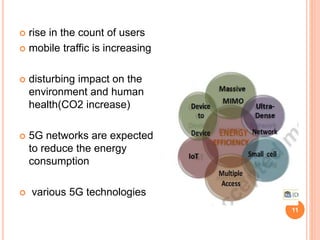
 rise in the count of users
 mobile traffic is increasing
 disturbing impact on the
environment and human
health(CO2 increase)
 5G networks are expected
to reduce the energy
consumption
 various 5G technologies
11
DEVICE-TO-DEVICE (D2D) COMMUNICATION (1/3)
 supports a short-range communication
 Latency is greatly reduced
 improved system throughput
 devices communicate over direct links
 Offloading data from mobile network (reduce traffic)
 obtain high capacity with in cellular networks
12
MASSIVE MIMO (1/3)
 large number of antennas deployed at the base station
 freedom for information transmission
 Data rate enhancement
 Spectral efficiency enhancement
 Energy efficiency enhancement
13
MULTIPLE ACCESS
 Multi-path transmission technology enables a
device to use multiple transmission
protocols(Cellular, wlan, bluetooth…)
simultaneously.
 Multi-path transmission enhances connection
reliability and data transmission rates
 MPTCP(Multi-path TCP) enables a device to
configure several TCP sessions simultaneously by
utilizing multiple network connections and
addresses. 14
MULTIPLE ACCESS
 Throughput maximization based on path capacity
enhancement and channel error reduction.
 Mobility improvement and latency reduction using
improved path switching control
15
SMALL CELL (1/2)
 low-powered cellular radio access
nodes
 range of 10 meters to a few kilometers
which is shorter than macrocell
range(antennas)
 handle fewer concurrent calls or
sessions
16
SMALL CELL (2/2)
 Large number of small cells in a
given area can provide significant
throughput enhancements
 Needs Distributed and self
configured network technology that
enables easy deployment of small
cells which is the main focus of
small cells technology in 5G.
17
INTERNET OF THINGS
 seamless connectivity between devices
 seamless connectivity to the internet
 seamless integration of the physical world with the
cyber world
 improved access to data and information.
 sensor-dependent
 Transmission power Optimized
 senses the critical data
 ensures timely reliable delivery.
18
IV. SECURE
POWER
OPTIMIZATION
19
DEVICE-TO-DEVICE (D2D)
concerns solutions
direct link formation is highly
effected by jamming
Internet Protocol Security (IP Sec)
secrecy capacity joint power and access control
(JPAC)
power control joint power and access control
(JPAC)
Eavesdropper interference between the D2D users
and cellular users
secrecy of communication. interference between the D2D users
and cellular users 20
MASSIVE MIMO
concerns solutions
intruders artificial noise(AN) energy detect
Security constrained power facilitated using random matrix
theory
secrecy transmission rate Artificial noise improve
power transfer efficiency massive MIMO relay network
enhance
21
INTERNET OF THINGS
Concerns solutions
location-based services Cryptographic solutions to secure
system secrecy variety of algorithms
Power levels. A three-layer architecture
saving energy A three-layer architecture
22
FULL-DUPLEX
Concerns solutions
power consumption design transmit beamforming
Security of wireless system transmit power for uplink and
downlink are minimized
23
V. RESEARCH CHALLENGES
 power consumption may exceed limits.
 Energy efficiency (EE) and latency in 5G networks
bears a trade-off relation.
 large amount of overhead, and extra power
consumption
 Cost factor
 security concerns.
 using renewable sources for harvesting energy has
limitations
24
VI. CONCLUSION (1/2)
 Concern in wireless networks is the energy efficiency
 Energy consumption is expected to drastically rise
 Serious economic and ecological concerns
 Increase amount of CO2 in the atmosphere due to higher
power consumption
 Advent of green communication in wireless networks
25
VI. CONCLUSION (2/2)
 Energy efficiency can be assured through power control
 The 5G networks aggregate a number of efficient
technologies, supporting green communication.
 Network security is the one aspect which cannot be
compromised.
26
THANK
YOU 27

5G green communication

  • 1.
    A SURVEY ONGREEN COMMUNICATION AND SECURITY CHALLENGES IN 5G WIRELESS COMMUNICATION NETWORKS Done By: Ahmad Taweel1
  • 2.
    OUTLINE I. INTRODUCTION II. TECHNIQUESFOR POWER ALLOCATION AND GREENNESS MEASUREMENT III. 5G NETWORKS TECHNOLOGYS IV. SECURE POWER OPTIMIZATION V. RESEARCH CHALLENGES VI. CONCLUSION 2
  • 3.
    I. INTRODUCTION  4Gnetworks can support data rate up to 3Gbps  increasing number of subscribers  consumption of energy results in increasing  carbon dioxide levels in the atmosphere 3
  • 4.
    I. INTRODUCTION  energy-efficientcommunication becomes a prerequisite for the evolving cellular network architecture  evolution of green communication  green 5G cellular networks is expected to increase the energy efficiency up to 1000x  Renewable sources 4
  • 5.
    II. TECHNIQUES FOR POWERALLOCATION AND GREENNESS MEASUREMENT 5
  • 6.
    TECHNIQUES FOR POWERALLOCATION (1/2)  The energy efficiency in cellular networks is measured using different modeling techniques:  Equal Power Allocation:  each user is allocated an equal amount of power  different amounts of power may be allocated to them, as per their prerequisite  inactive user will be allocated power  Complexity is less 6
  • 7.
    TECHNIQUES FOR POWERALLOCATION (2/2)  Game theory:  An important mathematical tool for modeling a wireless network  cellular network is modeled as a game  users serving as players  compete for resources in the network 7
  • 8.
    GREENNESS MEASUREMENT (1/2) Require energy efficiency metrics 1. Energy Efficiency (EE)  ratio of total ( throughput to power consumed ). 2. Secrecy Energy Efficiency  ratio of (transmission bits to energy consumed )  SEE is the most important metric maximize the SEE in the network -> better secrecy of net 3. Area Energy Efficiency (AEE)  ratio of the energy efficiency to the area of macro cell in square-kilometer. 8
  • 9.
    GREENNESS MEASUREMENT (2/2) A single metric is not enough  Cost aspects (QoS and QoE requirements)  Delay 9
  • 10.
  • 11.
     rise inthe count of users  mobile traffic is increasing  disturbing impact on the environment and human health(CO2 increase)  5G networks are expected to reduce the energy consumption  various 5G technologies 11
  • 12.
    DEVICE-TO-DEVICE (D2D) COMMUNICATION(1/3)  supports a short-range communication  Latency is greatly reduced  improved system throughput  devices communicate over direct links  Offloading data from mobile network (reduce traffic)  obtain high capacity with in cellular networks 12
  • 13.
    MASSIVE MIMO (1/3) large number of antennas deployed at the base station  freedom for information transmission  Data rate enhancement  Spectral efficiency enhancement  Energy efficiency enhancement 13
  • 14.
    MULTIPLE ACCESS  Multi-pathtransmission technology enables a device to use multiple transmission protocols(Cellular, wlan, bluetooth…) simultaneously.  Multi-path transmission enhances connection reliability and data transmission rates  MPTCP(Multi-path TCP) enables a device to configure several TCP sessions simultaneously by utilizing multiple network connections and addresses. 14
  • 15.
    MULTIPLE ACCESS  Throughputmaximization based on path capacity enhancement and channel error reduction.  Mobility improvement and latency reduction using improved path switching control 15
  • 16.
    SMALL CELL (1/2) low-powered cellular radio access nodes  range of 10 meters to a few kilometers which is shorter than macrocell range(antennas)  handle fewer concurrent calls or sessions 16
  • 17.
    SMALL CELL (2/2) Large number of small cells in a given area can provide significant throughput enhancements  Needs Distributed and self configured network technology that enables easy deployment of small cells which is the main focus of small cells technology in 5G. 17
  • 18.
    INTERNET OF THINGS seamless connectivity between devices  seamless connectivity to the internet  seamless integration of the physical world with the cyber world  improved access to data and information.  sensor-dependent  Transmission power Optimized  senses the critical data  ensures timely reliable delivery. 18
  • 19.
  • 20.
    DEVICE-TO-DEVICE (D2D) concerns solutions directlink formation is highly effected by jamming Internet Protocol Security (IP Sec) secrecy capacity joint power and access control (JPAC) power control joint power and access control (JPAC) Eavesdropper interference between the D2D users and cellular users secrecy of communication. interference between the D2D users and cellular users 20
  • 21.
    MASSIVE MIMO concerns solutions intrudersartificial noise(AN) energy detect Security constrained power facilitated using random matrix theory secrecy transmission rate Artificial noise improve power transfer efficiency massive MIMO relay network enhance 21
  • 22.
    INTERNET OF THINGS Concernssolutions location-based services Cryptographic solutions to secure system secrecy variety of algorithms Power levels. A three-layer architecture saving energy A three-layer architecture 22
  • 23.
    FULL-DUPLEX Concerns solutions power consumptiondesign transmit beamforming Security of wireless system transmit power for uplink and downlink are minimized 23
  • 24.
    V. RESEARCH CHALLENGES power consumption may exceed limits.  Energy efficiency (EE) and latency in 5G networks bears a trade-off relation.  large amount of overhead, and extra power consumption  Cost factor  security concerns.  using renewable sources for harvesting energy has limitations 24
  • 25.
    VI. CONCLUSION (1/2) Concern in wireless networks is the energy efficiency  Energy consumption is expected to drastically rise  Serious economic and ecological concerns  Increase amount of CO2 in the atmosphere due to higher power consumption  Advent of green communication in wireless networks 25
  • 26.
    VI. CONCLUSION (2/2) Energy efficiency can be assured through power control  The 5G networks aggregate a number of efficient technologies, supporting green communication.  Network security is the one aspect which cannot be compromised. 26
  • 27.