PRE-EMPHASIS AND DE-
EMPHASIS CIRCUITS
ELECTRONICS AND COMMUNICATION
By: Shivangi Singh
WHAT IS EMPHASIS?
 Emphasis is the process of boosting the Amplitude Vs Frequency characteristics of a signal
to reduce the effects caused by noise while transmission or reception of message signal
over the channel.
 The noise that may occurs include both single frequency interference and thermal noise.
Noise is inherently greater in amplitude at higher modulating signal than at lower
frequencies, because the signals with higher frequencies have low SNR (Signal to Noise
Ratio).
 By emphasis, approximately a 12db of improvement in noise can be achieved in FM.
WHAT IS PRE-EMPHASIS?
 Signals with higher modulation frequencies have lower SNR, In order to
compensate this, the high frequency signals are emphasised or boosted in
amplitude at the transmitter section of a communication system prior to the
modulation process.
 That is, the pre emphasis network allows the high frequency modulating signal to
modulate the carrier at higher level, this causes more frequency deviation.
 The Pre-emphasis helps amplify high frequency signal components such that they
will have magnitude higher than noise components. This lead to improvement in
the Signal to Noise Ratio i.e. SNR.
PRE-EMPHASIS CIRCUIT
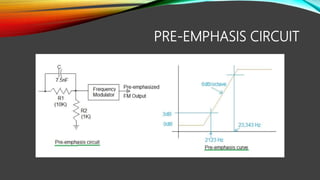
 The circuit consists of R and C components such that t = R1*C where in t should be
about 75 µs . This circuit will have lower frequency cutoff at 2123 Hz. As mentioned
in the curve, all the frequencies higher than 2123 is amplified at the rate of
6dB/octave.
 Pre-emphasis circuit also has upper cutoff frequency from where signal
enhancement will be flatten.
Upper cutoff frequency,
Fu = R1+(R2/(2*pi*R1*R2*C))
 Due to this characteristics, it is simple High Pass Filter with amplification.
ADVANTAGES AND
DISADVANTAGES
Advantages
 It helps to amplify high frequency signal components so that they have a higher
magnitude than the noise components. It improves the Signal to Noise Ratio or
SNR.
 It has a upper cutoff frequency from where the signal enhancement is flattened.
 It is a simple High Pass Filter with amplification.
Disadvantage
 If it is done beyond a limit there can be over modulation.
WHAT IS DE-EMPHASIS?
 De emphasis is the inverse process of pre-emphasis, used to attenuate the high
frequency signal that is boosted at the transmitter section.
 The deemphasis network at the receiver section restores the original amplitude Vs
frequency characteristics of the information signal, after the demodulation process.
 The pre-emphasis and deemphasis produces a more uniform SNR throughout
the modulating signal frequency spectrum.
 It is a simple Low Pass Filter with time constant of about 75 µs .
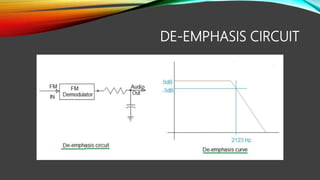
DE-EMPHASIS CIRCUIT
DE-EMPHASIS CIRCUIT
 The circuit shows a passive de emphasis network consisting of a resistor and a
capacitor.
 It is basically a low pass filter or an integrator. The pre emphasis network in front of
the FM modulator and a deemphasis network at the output of the FM
demodulator improves the Signal to Noise Ratio for higher modulating signal
frequencies, thus producing a more uniform SNR at the output of demodulator.
 De-emphasis circuit will have cutoff frequency of about 2123 Hz. To bring the
signal back to normal level, all the frequency components above 2123 Hz is
attenuated at 6dB/octave.
ADVANTAGES AND
DISADVANTAGES
 Advantages
 It helps to bring the pre-amplified signal back to the normal amplitude level.
 It has a cutoff frequency of about 2123 Hz.
 It is a simple Low Pass Filter with time constant of around 75 µs.
 Disadvantage
 Risk of over modulation.
COMBINED FREQUENCY
RESPONSE
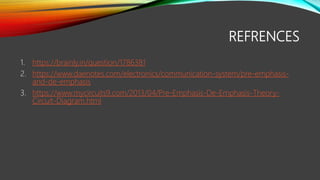
 The combined effect of pre-emphasis and de-emphasis is to increase the high
frequency components during transmission so that they will be stronger and not
masked by noise.
REFRENCES
1. https://brainly.in/question/1786381
2. https://www.daenotes.com/electronics/communication-system/pre-emphasis-
and-de-emphasis
3. https://www.mycircuits9.com/2013/04/Pre-Emphasis-De-Emphasis-Theory-
Circuit-Diagram.html

Pre-emphasis and de-emphasis circuits

  • 1.
    PRE-EMPHASIS AND DE- EMPHASISCIRCUITS ELECTRONICS AND COMMUNICATION By: Shivangi Singh
  • 2.
    WHAT IS EMPHASIS? Emphasis is the process of boosting the Amplitude Vs Frequency characteristics of a signal to reduce the effects caused by noise while transmission or reception of message signal over the channel.  The noise that may occurs include both single frequency interference and thermal noise. Noise is inherently greater in amplitude at higher modulating signal than at lower frequencies, because the signals with higher frequencies have low SNR (Signal to Noise Ratio).  By emphasis, approximately a 12db of improvement in noise can be achieved in FM.
  • 3.
    WHAT IS PRE-EMPHASIS? Signals with higher modulation frequencies have lower SNR, In order to compensate this, the high frequency signals are emphasised or boosted in amplitude at the transmitter section of a communication system prior to the modulation process.  That is, the pre emphasis network allows the high frequency modulating signal to modulate the carrier at higher level, this causes more frequency deviation.  The Pre-emphasis helps amplify high frequency signal components such that they will have magnitude higher than noise components. This lead to improvement in the Signal to Noise Ratio i.e. SNR.
  • 4.
  • 5.
    PRE-EMPHASIS CIRCUIT  Thecircuit consists of R and C components such that t = R1*C where in t should be about 75 µs . This circuit will have lower frequency cutoff at 2123 Hz. As mentioned in the curve, all the frequencies higher than 2123 is amplified at the rate of 6dB/octave.  Pre-emphasis circuit also has upper cutoff frequency from where signal enhancement will be flatten. Upper cutoff frequency, Fu = R1+(R2/(2*pi*R1*R2*C))  Due to this characteristics, it is simple High Pass Filter with amplification.
  • 6.
    ADVANTAGES AND DISADVANTAGES Advantages  Ithelps to amplify high frequency signal components so that they have a higher magnitude than the noise components. It improves the Signal to Noise Ratio or SNR.  It has a upper cutoff frequency from where the signal enhancement is flattened.  It is a simple High Pass Filter with amplification. Disadvantage  If it is done beyond a limit there can be over modulation.
  • 7.
    WHAT IS DE-EMPHASIS? De emphasis is the inverse process of pre-emphasis, used to attenuate the high frequency signal that is boosted at the transmitter section.  The deemphasis network at the receiver section restores the original amplitude Vs frequency characteristics of the information signal, after the demodulation process.  The pre-emphasis and deemphasis produces a more uniform SNR throughout the modulating signal frequency spectrum.  It is a simple Low Pass Filter with time constant of about 75 µs .
  • 8.
  • 9.
    DE-EMPHASIS CIRCUIT  Thecircuit shows a passive de emphasis network consisting of a resistor and a capacitor.  It is basically a low pass filter or an integrator. The pre emphasis network in front of the FM modulator and a deemphasis network at the output of the FM demodulator improves the Signal to Noise Ratio for higher modulating signal frequencies, thus producing a more uniform SNR at the output of demodulator.  De-emphasis circuit will have cutoff frequency of about 2123 Hz. To bring the signal back to normal level, all the frequency components above 2123 Hz is attenuated at 6dB/octave.
  • 10.
    ADVANTAGES AND DISADVANTAGES  Advantages It helps to bring the pre-amplified signal back to the normal amplitude level.  It has a cutoff frequency of about 2123 Hz.  It is a simple Low Pass Filter with time constant of around 75 µs.  Disadvantage  Risk of over modulation.
  • 11.
    COMBINED FREQUENCY RESPONSE  Thecombined effect of pre-emphasis and de-emphasis is to increase the high frequency components during transmission so that they will be stronger and not masked by noise.
  • 12.