Phase Locked Loops (PLL)
Note
Jay Chang
1
2
Outline
• Simple PLL
• VCO, PD
• PLL transfer function
• Phase Margin
• Type-I PLL
• Type-II PLL
• PFD
• Charge Pump
• CP PLL transfer function
• CP PLL stability
• Open loop bandwidth
• Design strategy
• Higher order PLL transfer function
• Higher order PLL design rule of thumb
3
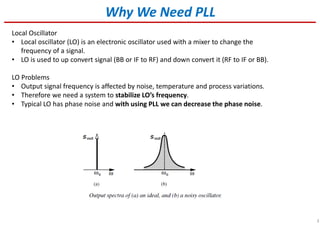
Local Oscillator
• Local oscillator (LO) is an electronic oscillator used with a mixer to change the
frequency of a signal.
• LO is used to up convert signal (BB or IF to RF) and down convert it (RF to IF or BB).
LO Problems
• Output signal frequency is affected by noise, temperature and process variations.
• Therefore we need a system to stabilize LO’s frequency.
• Typical LO has phase noise and with using PLL we can decrease the phase noise.
Why We Need PLL
4
What is PLL
• A phase-locked loop or PLL is a control system that generates an output signal whose phase is
related to the phase of an input signal.
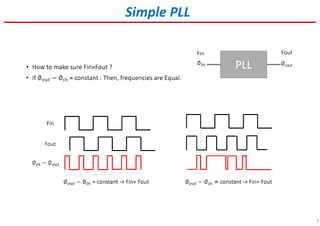
• Keeping the input and output phase in lock means keeping the input and output frequencies
the same. (If phase difference varies with time, the frequencies of two signals are not equal).
• Consequently, in addition to synchronizing signals, a PLL can track an input frequency, or it can
generate a frequency that is a multiple of the input frequency.
5
Simple PLL
6
Simple PLL
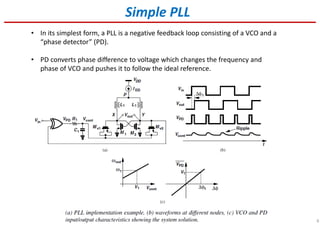
• In its simplest form, a PLL is a negative feedback loop consisting of a VCO and a
“phase detector” (PD).
• PD converts phase difference to voltage which changes the frequency and
phase of VCO and pushes it to follow the ideal reference.
7
Simple PLL Problem
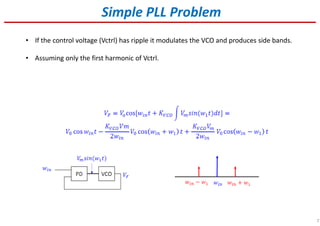
• If the control voltage (Vctrl) has ripple it modulates the VCO and produces side bands.
• Assuming only the first harmonic of Vctrl.
8
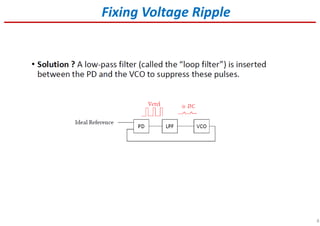
Fixing Voltage Ripple
9
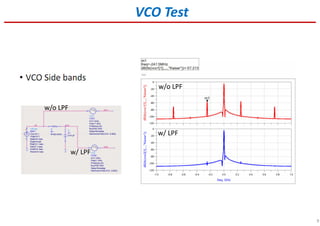
VCO Test
w/o LPF
w/ LPF
w/o LPF
w/ LPF
10
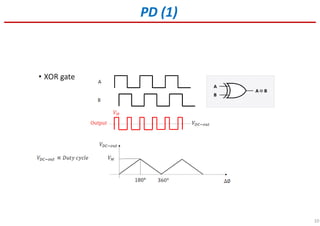
PD (1)
11
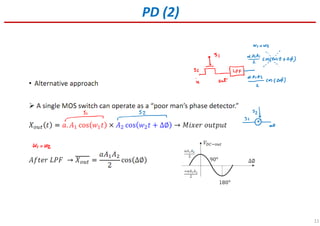
PD (2)
12
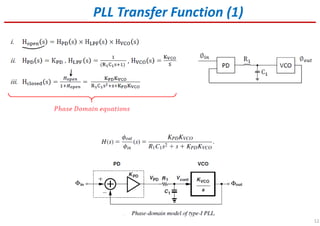
PLL Transfer Function (1)
13
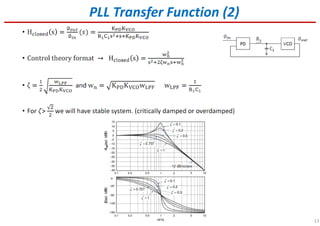
PLL Transfer Function (2)
14
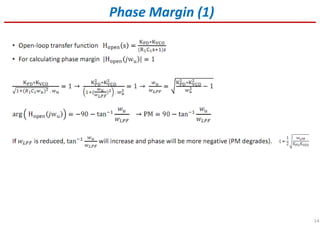
Phase Margin (1)
15
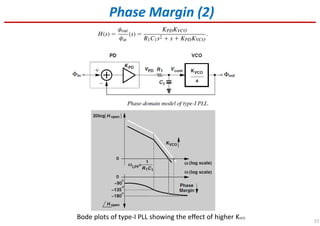
Bode plots of type-I PLL showing the effect of higher KVCO
Phase Margin (2)
16
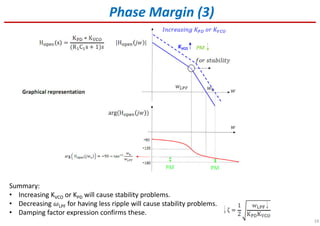
Phase Margin (3)
KVCO PM
Summary:
• Increasing KVCO or KPD will cause stability problems.
• Decreasing ߱LPF for having less ripple will cause stability problems.
• Damping factor expression confirms these.
17
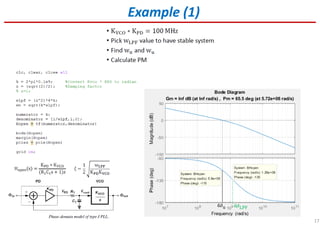
Example (1)
߱u ߱LPF
18
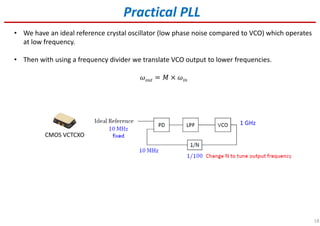
Practical PLL
• We have an ideal reference crystal oscillator (low phase noise compared to VCO) which operates
at low frequency.
• Then with using a frequency divider we translate VCO output to lower frequencies.
߱‫ݐݑ݋‬ = ‫ܯ‬ × ߱݅݊
CMOS VCTCXO
1 GHz
19
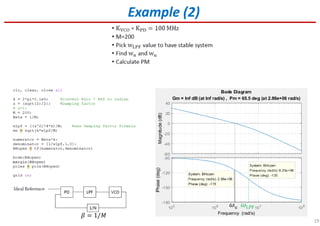
Example (2)
ߚ = 1/‫ܯ‬
߱u ߱LPF
20
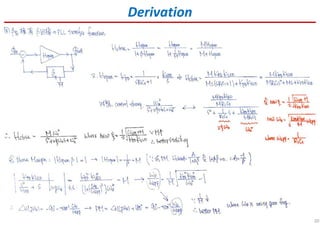
Derivation
21
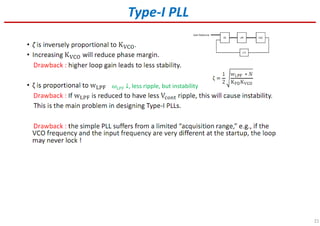
Type-I PLL
߱LPF ↓, less ripple, but instability
22
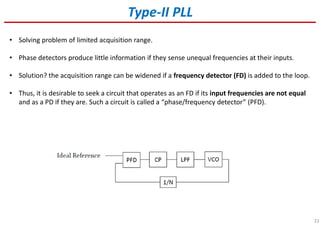
• Solving problem of limited acquisition range.
• Phase detectors produce little information if they sense unequal frequencies at their inputs.
• Solution? the acquisition range can be widened if a frequency detector (FD) is added to the loop.
• Thus, it is desirable to seek a circuit that operates as an FD if its input frequencies are not equal
and as a PD if they are. Such a circuit is called a “phase/frequency detector” (PFD).
Type-II PLL
23
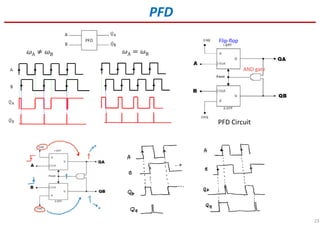
PFD
߱A ≠ ߱B ߱A = ߱B
PFD Circuit
Flip-flop
AND gate
24
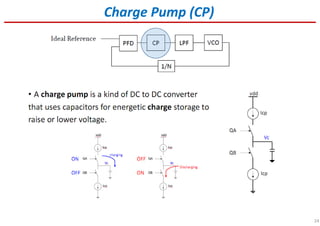
Charge Pump (CP)
25
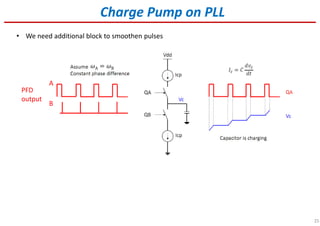
Charge Pump on PLL
• We need additional block to smoothen pulses
߱A = ߱B
PFD
output
A
B
26
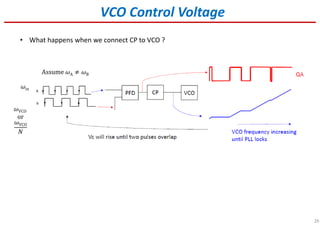
VCO Control Voltage
• What happens when we connect CP to VCO ?
Assume ߱A ≠ ߱B
߱in
߱VCO
or
߱VCO
ܰ
27
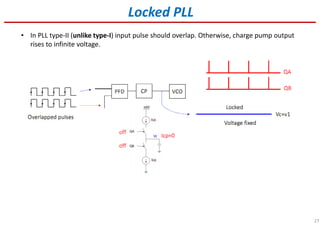
Locked PLL
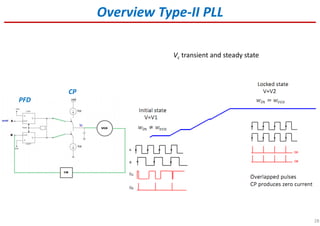
• In PLL type-II (unlike type-I) input pulse should overlap. Otherwise, charge pump output
rises to infinite voltage.
28
PFD
CP
Overview Type-II PLL
Vc transient and steady state
29
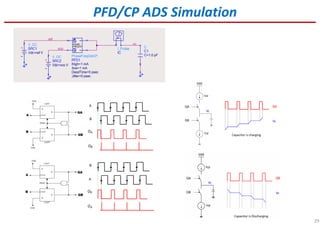
PFD/CP ADS Simulation
30
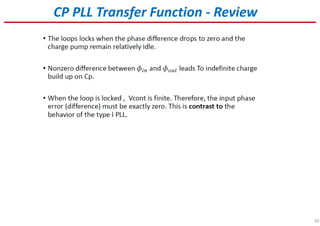
CP PLL Transfer Function - Review
31
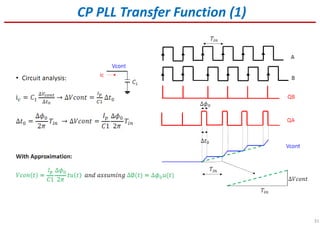
CP PLL Transfer Function (1)
32
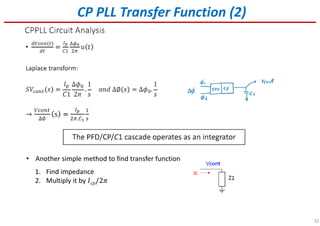
CP PLL Transfer Function (2)
• Another simple method to find transfer function
1. Find impedance
2. Multiply it by ‫ܫ‬ܿ‫݌‬/2ߨ
33
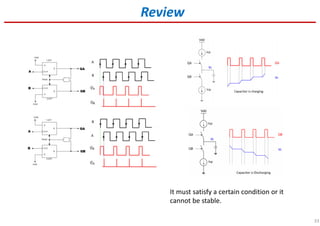
Review
It must satisfy a certain condition or it
cannot be stable.
34
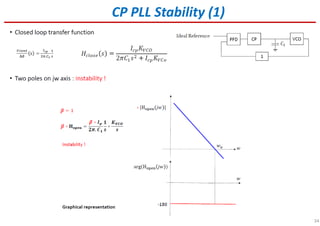
CP PLL Stability (1)
35
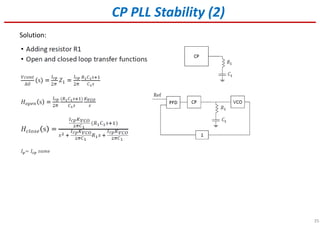
CP PLL Stability (2)
Solution:
36
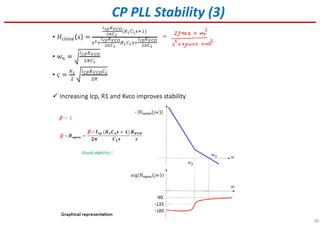
CP PLL Stability (3)
37
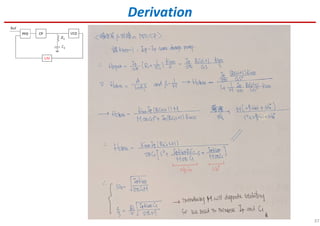
Derivation
38
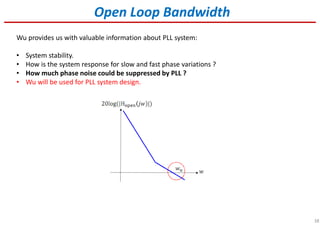
Open Loop Bandwidth
Wu provides us with valuable information about PLL system:
• System stability.
• How is the system response for slow and fast phase variations ?
• How much phase noise could be suppressed by PLL ?
• Wu will be used for PLL system design.
39
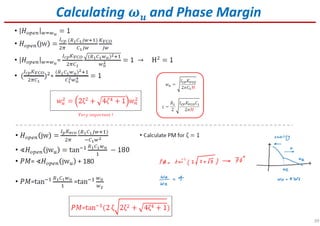
Calculating ࢛ and Phase Margin
40
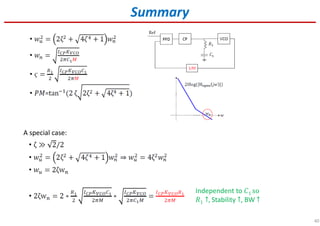
Summary
A special case:
Independent to ‫ܥ‬1 so
ܴ1 ↑, Stability ↑, BW ↑
41
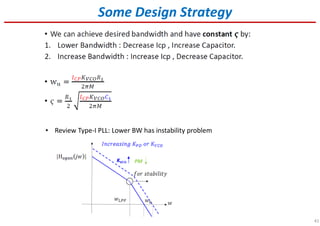
Some Design Strategy
• Review Type-I PLL: Lower BW has instability problem
42
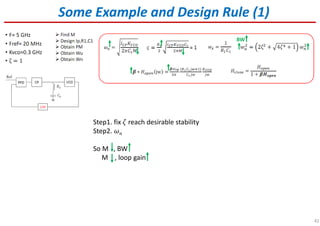
Some Example and Design Rule (1)
BW
Step1. fix ߞ reach desirable stability
Step2. ߱݊
So M , BW
M , loop gain
43
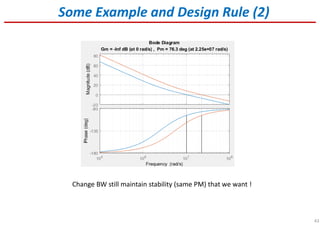
Change BW still maintain stability (same PM) that we want !
Some Example and Design Rule (2)
44
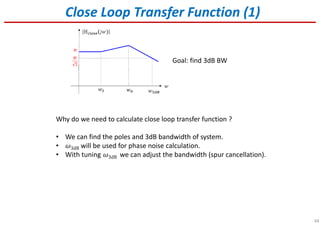
Close Loop Transfer Function (1)
Goal: find 3dB BW
Why do we need to calculate close loop transfer function ?
• We can find the poles and 3dB bandwidth of system.
• ߱3dB will be used for phase noise calculation.
• With tuning ߱3dB we can adjust the bandwidth (spur cancellation).
45
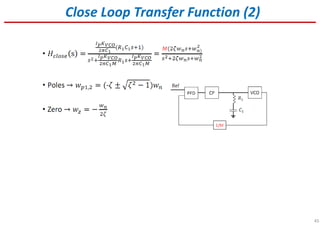
Close Loop Transfer Function (2)
46
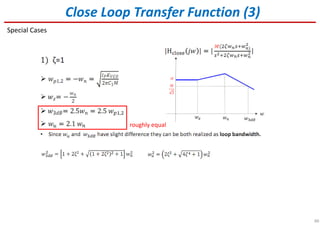
Close Loop Transfer Function (3)
Special Cases
roughly equal
47
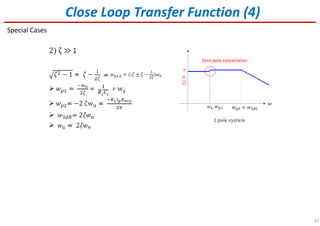
Close Loop Transfer Function (4)
Special Cases
ଵ
ோଵ஼ଵ
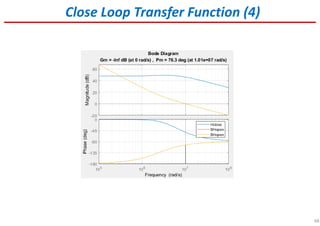
48
Close Loop Transfer Function (4)
49
High Order PLL
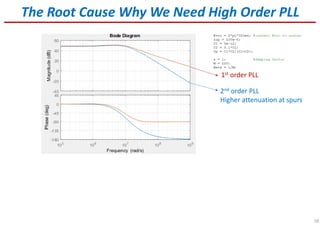
• Why do we need high order PLL ?
• Do to same non-ideal effects in PLL circuit analysis, Vcontrol will have some ripple
and this ripple causes side bands (spur) at the output of VCO.
• In order to suppress Vcontrol ripple and therefore suppress spurs we need to have
higher order filters.
50
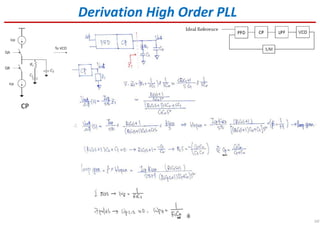
Derivation High Order PLL
CP
51
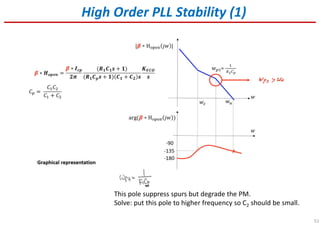
High Order PLL Stability (1)
This pole suppress spurs but degrade the PM.
Solve: put this pole to higher frequency so C2 should be small.
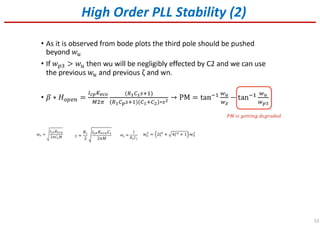
52
High Order PLL Stability (2)
53
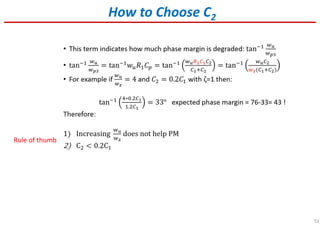
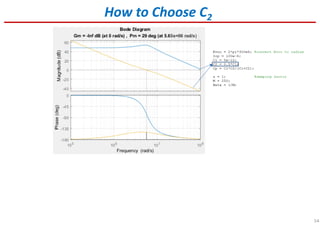
How to Choose C2
Rule of thumb
54
How to Choose C2
55
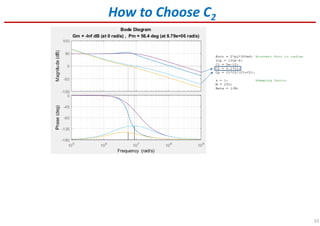
How to Choose C2
56
The Root Cause Why We Need High Order PLL
1st order PLL
2nd order PLL
Higher attenuation at spurs
57
Happy moon festival
and have a good holidays
58
Thank you for your attention

PLL Note

  • 1.
    Phase Locked Loops(PLL) Note Jay Chang 1
  • 2.
    2 Outline • Simple PLL •VCO, PD • PLL transfer function • Phase Margin • Type-I PLL • Type-II PLL • PFD • Charge Pump • CP PLL transfer function • CP PLL stability • Open loop bandwidth • Design strategy • Higher order PLL transfer function • Higher order PLL design rule of thumb
  • 3.
    3 Local Oscillator • Localoscillator (LO) is an electronic oscillator used with a mixer to change the frequency of a signal. • LO is used to up convert signal (BB or IF to RF) and down convert it (RF to IF or BB). LO Problems • Output signal frequency is affected by noise, temperature and process variations. • Therefore we need a system to stabilize LO’s frequency. • Typical LO has phase noise and with using PLL we can decrease the phase noise. Why We Need PLL
  • 4.
    4 What is PLL •A phase-locked loop or PLL is a control system that generates an output signal whose phase is related to the phase of an input signal. • Keeping the input and output phase in lock means keeping the input and output frequencies the same. (If phase difference varies with time, the frequencies of two signals are not equal). • Consequently, in addition to synchronizing signals, a PLL can track an input frequency, or it can generate a frequency that is a multiple of the input frequency.
  • 5.
  • 6.
    6 Simple PLL • Inits simplest form, a PLL is a negative feedback loop consisting of a VCO and a “phase detector” (PD). • PD converts phase difference to voltage which changes the frequency and phase of VCO and pushes it to follow the ideal reference.
  • 7.
    7 Simple PLL Problem •If the control voltage (Vctrl) has ripple it modulates the VCO and produces side bands. • Assuming only the first harmonic of Vctrl.
  • 8.
  • 9.
    9 VCO Test w/o LPF w/LPF w/o LPF w/ LPF
  • 10.
  • 11.
  • 12.
  • 13.
  • 14.
  • 15.
    15 Bode plots oftype-I PLL showing the effect of higher KVCO Phase Margin (2)
  • 16.
    16 Phase Margin (3) KVCOPM Summary: • Increasing KVCO or KPD will cause stability problems. • Decreasing ߱LPF for having less ripple will cause stability problems. • Damping factor expression confirms these.
  • 17.
  • 18.
    18 Practical PLL • Wehave an ideal reference crystal oscillator (low phase noise compared to VCO) which operates at low frequency. • Then with using a frequency divider we translate VCO output to lower frequencies. ߱‫ݐݑ݋‬ = ‫ܯ‬ × ߱݅݊ CMOS VCTCXO 1 GHz
  • 19.
    19 Example (2) ߚ =1/‫ܯ‬ ߱u ߱LPF
  • 20.
  • 21.
    21 Type-I PLL ߱LPF ↓,less ripple, but instability
  • 22.
    22 • Solving problemof limited acquisition range. • Phase detectors produce little information if they sense unequal frequencies at their inputs. • Solution? the acquisition range can be widened if a frequency detector (FD) is added to the loop. • Thus, it is desirable to seek a circuit that operates as an FD if its input frequencies are not equal and as a PD if they are. Such a circuit is called a “phase/frequency detector” (PFD). Type-II PLL
  • 23.
    23 PFD ߱A ≠ ߱B߱A = ߱B PFD Circuit Flip-flop AND gate
  • 24.
  • 25.
    25 Charge Pump onPLL • We need additional block to smoothen pulses ߱A = ߱B PFD output A B
  • 26.
    26 VCO Control Voltage •What happens when we connect CP to VCO ? Assume ߱A ≠ ߱B ߱in ߱VCO or ߱VCO ܰ
  • 27.
    27 Locked PLL • InPLL type-II (unlike type-I) input pulse should overlap. Otherwise, charge pump output rises to infinite voltage.
  • 28.
    28 PFD CP Overview Type-II PLL Vctransient and steady state
  • 29.
  • 30.
    30 CP PLL TransferFunction - Review
  • 31.
    31 CP PLL TransferFunction (1)
  • 32.
    32 CP PLL TransferFunction (2) • Another simple method to find transfer function 1. Find impedance 2. Multiply it by ‫ܫ‬ܿ‫݌‬/2ߨ
  • 33.
    33 Review It must satisfya certain condition or it cannot be stable.
  • 34.
  • 35.
    35 CP PLL Stability(2) Solution:
  • 36.
  • 37.
  • 38.
    38 Open Loop Bandwidth Wuprovides us with valuable information about PLL system: • System stability. • How is the system response for slow and fast phase variations ? • How much phase noise could be suppressed by PLL ? • Wu will be used for PLL system design.
  • 39.
  • 40.
    40 Summary A special case: Independentto ‫ܥ‬1 so ܴ1 ↑, Stability ↑, BW ↑
  • 41.
    41 Some Design Strategy •Review Type-I PLL: Lower BW has instability problem
  • 42.
    42 Some Example andDesign Rule (1) BW Step1. fix ߞ reach desirable stability Step2. ߱݊ So M , BW M , loop gain
  • 43.
    43 Change BW stillmaintain stability (same PM) that we want ! Some Example and Design Rule (2)
  • 44.
    44 Close Loop TransferFunction (1) Goal: find 3dB BW Why do we need to calculate close loop transfer function ? • We can find the poles and 3dB bandwidth of system. • ߱3dB will be used for phase noise calculation. • With tuning ߱3dB we can adjust the bandwidth (spur cancellation).
  • 45.
  • 46.
    46 Close Loop TransferFunction (3) Special Cases roughly equal
  • 47.
    47 Close Loop TransferFunction (4) Special Cases ଵ ோଵ஼ଵ
  • 48.
  • 49.
    49 High Order PLL •Why do we need high order PLL ? • Do to same non-ideal effects in PLL circuit analysis, Vcontrol will have some ripple and this ripple causes side bands (spur) at the output of VCO. • In order to suppress Vcontrol ripple and therefore suppress spurs we need to have higher order filters.
  • 50.
  • 51.
    51 High Order PLLStability (1) This pole suppress spurs but degrade the PM. Solve: put this pole to higher frequency so C2 should be small.
  • 52.
    52 High Order PLLStability (2)
  • 53.
    53 How to ChooseC2 Rule of thumb
  • 54.
  • 55.
  • 56.
    56 The Root CauseWhy We Need High Order PLL 1st order PLL 2nd order PLL Higher attenuation at spurs
  • 57.
    57 Happy moon festival andhave a good holidays
  • 58.
    58 Thank you foryour attention