DATA ANALYSIS FOR ALL STUDENTS
© Relay Graduate School of Education. All rights reserved. 2
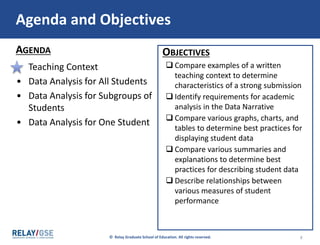
AGENDA OBJECTIVES
Agenda and Objectives
• Teaching Context
• Data Analysis for All Students
• Data Analysis for Subgroups of
Students
• Data Analysis for One Student
 Compare examples of a written
teaching context to determine
characteristics of a strong submission
 Identify requirements for academic
analysis in the Data Narrative
 Compare various graphs, charts, and
tables to determine best practices for
displaying student data
 Compare various summaries and
explanations to determine best
practices for describing student data
 Describe relationships between
various measures of student
performance
© Relay Graduate School of Education. All rights reserved. 3
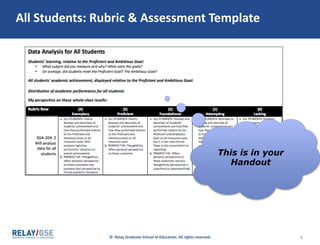
All Students: Rubric & Assessment Template
This is in your
Handout
© Relay Graduate School of Education. All rights reserved. 4
Read Kip’s All Students Section.
Consider Questions Below.
1) What is one strong feature of
the graphics Kip displays?
2) What is one strong feature of
the write-up that Kip drafted?
3) How did Kip complete the “All
Students” section according to
directions in the assessment
template?
Click ahead when
you’ve read the
appropriate section
of the Sample Data
Narrative
© Relay Graduate School of Education. All rights reserved. 6
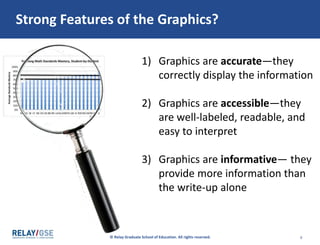
Strong Features of the Graphics?
1) Graphics are accurate—they
correctly display the information
2) Graphics are accessible—they
are well-labeled, readable, and
easy to interpret
3) Graphics are informative— they
provide more information than
the write-up alone
© Relay Graduate School of Education. All rights reserved. 7
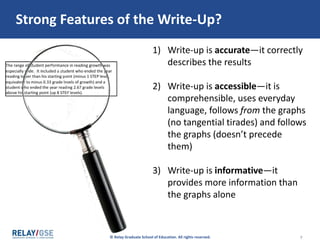
Strong Features of the Write-Up?
1) Write-up is accurate—it correctly
describes the results
2) Write-up is accessible—it is
comprehensible, uses everyday
language, follows from the graphs
(no tangential tirades) and follows
the graphs (doesn’t precede
them)
3) Write-up is informative—it
provides more information than
the graphs alone
© Relay Graduate School of Education. All rights reserved. 8
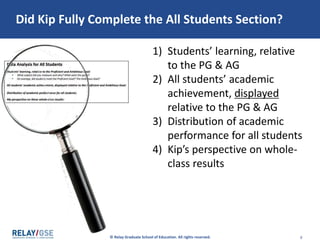
Did Kip Fully Complete the All Students Section?
1) Students’ learning, relative
to the PG & AG
2) All students’ academic
achievement, displayed
relative to the PG & AG
3) Distribution of academic
performance for all students
4) Kip’s perspective on whole-
class results
© Relay Graduate School of Education. All rights reserved. 9
How Did Kip Learn to Create Those Graphics?
The “Additional
Resources” section of
this module has
published tutorials for
each of the graphics in
Kip’s sample Data
Narrative.
© Relay Graduate School of Education. All rights reserved. 10
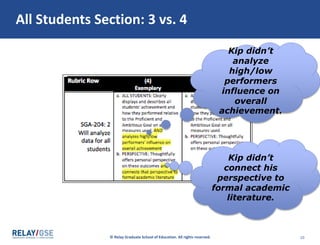
All Students Section: 3 vs. 4
Kip didn’t
analyze
high/low
performers
influence on
overall
achievement.
Kip didn’t
connect his
perspective to
formal academic
literature.

Data Analysis for All Students

  • 1.
    DATA ANALYSIS FORALL STUDENTS
  • 2.
    © Relay GraduateSchool of Education. All rights reserved. 2 AGENDA OBJECTIVES Agenda and Objectives • Teaching Context • Data Analysis for All Students • Data Analysis for Subgroups of Students • Data Analysis for One Student  Compare examples of a written teaching context to determine characteristics of a strong submission  Identify requirements for academic analysis in the Data Narrative  Compare various graphs, charts, and tables to determine best practices for displaying student data  Compare various summaries and explanations to determine best practices for describing student data  Describe relationships between various measures of student performance
  • 3.
    © Relay GraduateSchool of Education. All rights reserved. 3 All Students: Rubric & Assessment Template This is in your Handout
  • 4.
    © Relay GraduateSchool of Education. All rights reserved. 4 Read Kip’s All Students Section. Consider Questions Below. 1) What is one strong feature of the graphics Kip displays? 2) What is one strong feature of the write-up that Kip drafted? 3) How did Kip complete the “All Students” section according to directions in the assessment template?
  • 5.
    Click ahead when you’veread the appropriate section of the Sample Data Narrative
  • 6.
    © Relay GraduateSchool of Education. All rights reserved. 6 Strong Features of the Graphics? 1) Graphics are accurate—they correctly display the information 2) Graphics are accessible—they are well-labeled, readable, and easy to interpret 3) Graphics are informative— they provide more information than the write-up alone
  • 7.
    © Relay GraduateSchool of Education. All rights reserved. 7 Strong Features of the Write-Up? 1) Write-up is accurate—it correctly describes the results 2) Write-up is accessible—it is comprehensible, uses everyday language, follows from the graphs (no tangential tirades) and follows the graphs (doesn’t precede them) 3) Write-up is informative—it provides more information than the graphs alone
  • 8.
    © Relay GraduateSchool of Education. All rights reserved. 8 Did Kip Fully Complete the All Students Section? 1) Students’ learning, relative to the PG & AG 2) All students’ academic achievement, displayed relative to the PG & AG 3) Distribution of academic performance for all students 4) Kip’s perspective on whole- class results
  • 9.
    © Relay GraduateSchool of Education. All rights reserved. 9 How Did Kip Learn to Create Those Graphics? The “Additional Resources” section of this module has published tutorials for each of the graphics in Kip’s sample Data Narrative.
  • 10.
    © Relay GraduateSchool of Education. All rights reserved. 10 All Students Section: 3 vs. 4 Kip didn’t analyze high/low performers influence on overall achievement. Kip didn’t connect his perspective to formal academic literature.

Editor's Notes

  • #3 Say: Here we are in the agenda…   Before we move on, take a moment to flip to the last page of the IH. This is a place for you to keep track of questions during this session. Jot down any questions you might have for your faculty advisor now. We’ll take 30 seconds at the end of every section for you to record your question.   Note: This is optional to include, but is a good idea especially if you’re teaching in a large group.
  • #4 Say The next part of the data narrative is the “All Students” section. In this section, you will present and discuss the progress of your class, as a whole, toward the AF and AG.   Give G/S’s 30 seconds to read through rubric and assessment template.   Ask / Turn and Talk What is required in this part of the Data Narrative?   Review That's right, the "All Students" section should give a high-level summary of Whether students met the Floor/Goal in one/both Pathway measures Student outcomes relative to goal (how many Floor/Goal/neither) Overall student performance, student-by-student ("distribution")
  • #5 Here are the three things to look for when you review this section: 1) What is one strong feature of the graphics Kip displays? 2) What is one strong feature of the write-up that Kip drafted? 3) Did Kip complete the “All Students” section according to directions in the assessment template?   We’re going to take 5 minutes to read these 4.5 pages   Do: Professor will circulate with a clipboard and identify Grad Students who have answered the questions and can be a warm-call to discuss whole-class, and then call on those people to describe what they found (suggested - award them raffle tickets for participating to award a grand prize at the end as a way to encourage participation and engagement, while modeling).
  • #7 Ask What were some of the strong features of Kip’s graphics? Wait Time + Warm Call   Summarize Graphics are accurate, accessible and informative. (see slide)_ Clear how many students met the goals Graphs are clearly labeled – titles, axes, Figure 1.3 Data is sorted from low to high achievement   Accessible" means comprehensible, intelligible, easy to understand. An inaccessible graph would not be standalone. An accessible graph tells me what I'm looking at. Then the write-up tells me what to make of the graph. That's how they work in tandem. The graph should be self-explanatory. The write-up provides further insights.
  • #8 Ask What were some of the strong features of Kip’s write up? Wait Time + Warm Call   Summarize Write up is accurate, accessible, informative (see slide) Write up isn’t redundant of graphics, but provides further insights into the data His reflection is honest and detailed
  • #9 Say: As peers who are reviewing Kip's work, I want to help him by ensuring that my review also includes a check to be certain that he's completed all the necessary components of this section. Indeed, he has given a high-level summary of: Whether students met the Floor/Goal in both Pathway measures Student outcomes relative to goal (how many Floor/Goal/neither) Overall student performance, student-by-student ("distribution")   Transition: Next, we're going to take a look at the "Subgroups" of students section. We're moving at a great pace here, let's keep it up!
  • #10 Say: Kip’s a second grade teacher, he doesn’t have a Master’s Degree in Microsoft Excel! That’s why he went to the “Additional Readings” section of the Course Platform for this SGA-203 module and learned how to do all the things he saw in the Sample Data Narrative. You can do that too.”
  • #11 Say: Kip earned a 3 on all these strands. He didn’t analyze high/low performers influence on overall achievement, he made tangential mention of it by saying “Our class average was still above 1 year of reading growth, presumably because scores of high-performers who achieved over 2 grade levels of growth balanced out those of the low performers.” (pg. 4) That’s not an analysis.” He didn’t compare the performance of students with alternative goals to the overall progress. They were 1 for 2 with regard to the Floor and 0 for 2 with regard to the Goal, which he didn’t compare against the remainder of the class. In his perspective, he makes mention of the impending “struggle” for his students in 3rd grade reading, but doesn’t cite sources or leverage research.