DATA ANALYSIS FOR ONE STUDENT
© Relay Graduate School of Education. All rights reserved. 2
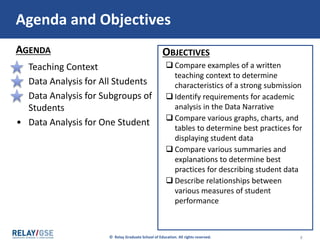
AGENDA OBJECTIVES
Agenda and Objectives
• Teaching Context
• Data Analysis for All Students
• Data Analysis for Subgroups of
Students
• Data Analysis for One Student
 Compare examples of a written
teaching context to determine
characteristics of a strong submission
 Identify requirements for academic
analysis in the Data Narrative
 Compare various graphs, charts, and
tables to determine best practices for
displaying student data
 Compare various summaries and
explanations to determine best
practices for describing student data
 Describe relationships between
various measures of student
performance
© Relay Graduate School of Education. All rights reserved. 3
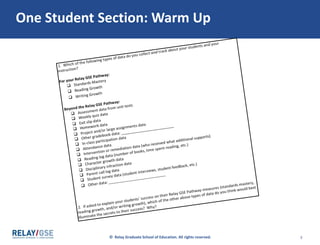
One Student Section: Warm Up
Click ahead when
you’ve completed the
appropriate section
of your Handout
© Relay Graduate School of Education. All rights reserved. 5
One Student Section: Warm Up
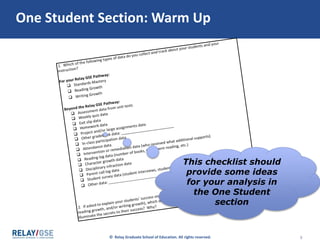
This checklist should
provide some ideas
for your analysis in
the One Student
section
© Relay Graduate School of Education. All rights reserved. 6
One Student: Rubric & Assessment Template
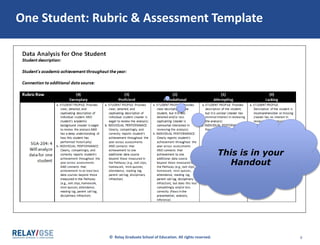
This is in your
Handout
© Relay Graduate School of Education. All rights reserved. 7
Kip’s One Student Section: What to Read
Pg. 14, after
“…and Queen!”
© Relay Graduate School of Education. All rights reserved. 8
Read Kip’s One Student Section.
Consider Questions Below.
1) Why does the ‘Student Profile’
subsection score a 3 on the
rubric? Why not 4 nor 2?
2) Why is Figure 1.9 (pg. 12)
better than just showing
Michael’s scores alone?
3) How does Kip conclude with a
strong inference that also
avoids extrapolating too
broadly?
Click ahead when
you’ve read the
appropriate section
of the Sample Data
Narrative
© Relay Graduate School of Education. All rights reserved. 10
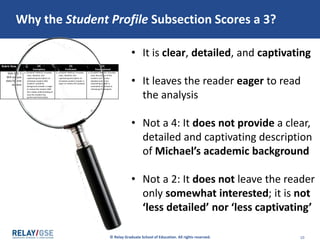
Why the Student Profile Subsection Scores a 3?
• It is clear, detailed, and captivating
• It leaves the reader eager to read
the analysis
• Not a 4: It does not provide a clear,
detailed and captivating description
of Michael’s academic background
• Not a 2: It does not leave the reader
only somewhat interested; it is not
‘less detailed’ nor ‘less captivating’
Rubric Row (4)
Exemplary
(3)
Proficient
(2)
Foundational
SGA-203: 5
Will analyze
data for one
student
a. STUDENT PROFILE: Provides
clear, detailed, and
captivating description of
individual student AND
student’s academic
background (reader is eager
to review the analysis AND
has a deep understanding of
how this student has
performed historically)
a. STUDENT PROFILE: Provides
clear, detailed, and
captivating description of
individual student (reader is
eager to review the analysis)
a. STUDENT PROFILE: Provides
clear description of the
student, but it is less
detailed and/or less
captivating (reader is
somewhat interested in
reviewing the analysis)
© Relay Graduate School of Education. All rights reserved. 11
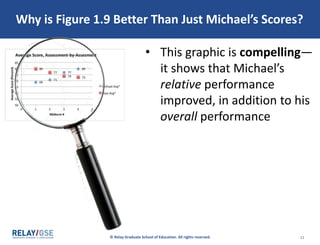
Why is Figure 1.9 Better Than Just Michael’s Scores?
• This graphic is compelling—
it shows that Michael’s
relative performance
improved, in addition to his
overall performance
© Relay Graduate School of Education. All rights reserved. 12
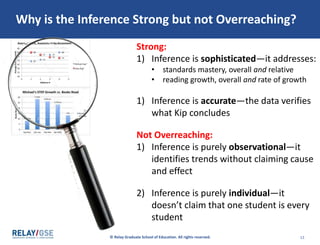
Why is the Inference Strong but not Overreaching?
Strong:
1) Inference is sophisticated—it addresses:
• standards mastery, overall and relative
• reading growth, overall and rate of growth
1) Inference is accurate—the data verifies
what Kip concludes
Not Overreaching:
1) Inference is purely observational—it
identifies trends without claiming cause
and effect
2) Inference is purely individual—it
doesn’t claim that one student is every
student
© Relay Graduate School of Education. All rights reserved. 13
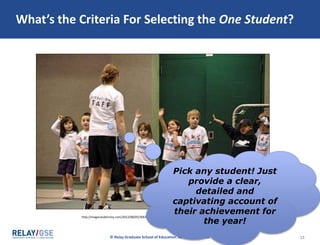
What’s the Criteria For Selecting the One Student?
http://meganandtimmy.com/2012/08/05/306365-8-events-that-ruined-sports-for-me/picking-teams/
Pick any student! Just
provide a clear,
detailed and
captivating account of
their achievement for
the year!
© Relay Graduate School of Education. All rights reserved.
How will you use all this to
write your Data Narrative?
Take a minute to reflect as we reach
the conclusion of this session
© Relay Graduate School of Education. All rights reserved. 15
A Word of Advice: Stay Caught up
The end of the
year is
approaching
quickly. Stay
caught up with
your work!
http://3.bp.blogspot.com/_cVP7TqMESIY/TG7uTXzDQ5I/AAAAAAAACXA/aXbzflsbMCY/s1600/043.JPG
© Relay Graduate School of Education. All rights reserved.
Thanks for completing
the session!

Data Analysis for One Student

  • 1.
    DATA ANALYSIS FORONE STUDENT
  • 2.
    © Relay GraduateSchool of Education. All rights reserved. 2 AGENDA OBJECTIVES Agenda and Objectives • Teaching Context • Data Analysis for All Students • Data Analysis for Subgroups of Students • Data Analysis for One Student  Compare examples of a written teaching context to determine characteristics of a strong submission  Identify requirements for academic analysis in the Data Narrative  Compare various graphs, charts, and tables to determine best practices for displaying student data  Compare various summaries and explanations to determine best practices for describing student data  Describe relationships between various measures of student performance
  • 3.
    © Relay GraduateSchool of Education. All rights reserved. 3 One Student Section: Warm Up
  • 4.
    Click ahead when you’vecompleted the appropriate section of your Handout
  • 5.
    © Relay GraduateSchool of Education. All rights reserved. 5 One Student Section: Warm Up This checklist should provide some ideas for your analysis in the One Student section
  • 6.
    © Relay GraduateSchool of Education. All rights reserved. 6 One Student: Rubric & Assessment Template This is in your Handout
  • 7.
    © Relay GraduateSchool of Education. All rights reserved. 7 Kip’s One Student Section: What to Read Pg. 14, after “…and Queen!”
  • 8.
    © Relay GraduateSchool of Education. All rights reserved. 8 Read Kip’s One Student Section. Consider Questions Below. 1) Why does the ‘Student Profile’ subsection score a 3 on the rubric? Why not 4 nor 2? 2) Why is Figure 1.9 (pg. 12) better than just showing Michael’s scores alone? 3) How does Kip conclude with a strong inference that also avoids extrapolating too broadly?
  • 9.
    Click ahead when you’veread the appropriate section of the Sample Data Narrative
  • 10.
    © Relay GraduateSchool of Education. All rights reserved. 10 Why the Student Profile Subsection Scores a 3? • It is clear, detailed, and captivating • It leaves the reader eager to read the analysis • Not a 4: It does not provide a clear, detailed and captivating description of Michael’s academic background • Not a 2: It does not leave the reader only somewhat interested; it is not ‘less detailed’ nor ‘less captivating’ Rubric Row (4) Exemplary (3) Proficient (2) Foundational SGA-203: 5 Will analyze data for one student a. STUDENT PROFILE: Provides clear, detailed, and captivating description of individual student AND student’s academic background (reader is eager to review the analysis AND has a deep understanding of how this student has performed historically) a. STUDENT PROFILE: Provides clear, detailed, and captivating description of individual student (reader is eager to review the analysis) a. STUDENT PROFILE: Provides clear description of the student, but it is less detailed and/or less captivating (reader is somewhat interested in reviewing the analysis)
  • 11.
    © Relay GraduateSchool of Education. All rights reserved. 11 Why is Figure 1.9 Better Than Just Michael’s Scores? • This graphic is compelling— it shows that Michael’s relative performance improved, in addition to his overall performance
  • 12.
    © Relay GraduateSchool of Education. All rights reserved. 12 Why is the Inference Strong but not Overreaching? Strong: 1) Inference is sophisticated—it addresses: • standards mastery, overall and relative • reading growth, overall and rate of growth 1) Inference is accurate—the data verifies what Kip concludes Not Overreaching: 1) Inference is purely observational—it identifies trends without claiming cause and effect 2) Inference is purely individual—it doesn’t claim that one student is every student
  • 13.
    © Relay GraduateSchool of Education. All rights reserved. 13 What’s the Criteria For Selecting the One Student? http://meganandtimmy.com/2012/08/05/306365-8-events-that-ruined-sports-for-me/picking-teams/ Pick any student! Just provide a clear, detailed and captivating account of their achievement for the year!
  • 14.
    © Relay GraduateSchool of Education. All rights reserved. How will you use all this to write your Data Narrative? Take a minute to reflect as we reach the conclusion of this session
  • 15.
    © Relay GraduateSchool of Education. All rights reserved. 15 A Word of Advice: Stay Caught up The end of the year is approaching quickly. Stay caught up with your work! http://3.bp.blogspot.com/_cVP7TqMESIY/TG7uTXzDQ5I/AAAAAAAACXA/aXbzflsbMCY/s1600/043.JPG
  • 16.
    © Relay GraduateSchool of Education. All rights reserved. Thanks for completing the session!

Editor's Notes

  • #3 Here we are in the agenda…   Before we move on, take a moment to flip to the last page of the IH. Jot down any questions you might have for your faculty advisor now.   Note: This is optional to include, but is a good idea especially if you’re teaching in a large group.
  • #4 Warm Up to the “One Student” Section Give G/S’s 2 minutes to fill out the warm up for the “one student” section   Note: In order to ensure that all Graduate Students exit this session positioned to draft their "One Student" analysis, the warm-up prompts them to consider what data source they could connect to performance on the Pathway measures. The requirements of the "One Student" analysis will be new to GS.   Say The next part of the data narrative is the “One Student” section In this section you will dive into the data and tell the student of one student who you taught.   One Student – Rubric Row & Assessment Template: Give G/S’s 30 seconds to read through the rubric and the assessment template.   Ask / Turn and Talk What is required in this part of the Data Narrative?   Review That's right, the "One Student" section should do the following: Describe the student Provide info on the student's academic achievement throughout year Make a connection to an additional data source   Say: Quick Note – this additional data source question is something that you began exploring with our warm-up today. As you're reading, you should consider what ideas for an additional data source you might use to corroborate your student achievement results from Pathway measures.  
  • #6 Warm Up to the “One Student” Section Give G/S’s 2 minutes to fill out the warm up for the “one student” section   Note: In order to ensure that all Graduate Students exit this session positioned to draft their "One Student" analysis, the warm-up prompts them to consider what data source they could connect to performance on the Pathway measures. The requirements of the "One Student" analysis will be new to GS.   Say The next part of the data narrative is the “One Student” section In this section you will dive into the data and tell the student of one student who you taught.   One Student – Rubric Row & Assessment Template: Give G/S’s 30 seconds to read through the rubric and the assessment template.   Ask / Turn and Talk What is required in this part of the Data Narrative?   Review That's right, the "One Student" section should do the following: Describe the student Provide info on the student's academic achievement throughout year Make a connection to an additional data source   Say: Quick Note – this additional data source question is something that you began exploring with our warm-up today. As you're reading, you should consider what ideas for an additional data source you might use to corroborate your student achievement results from Pathway measures.  
  • #7 Say: "We’re going to now take a look at Kip’s data narrative for the "One Student" section. Before we begin, please go to pg. 14 and draw a line after the word 'Queen', which is where his “One Student” section ends.  
  • #8 http://3.bp.blogspot.com/-L0AVUj5DI-Q/TlGyENjT09I/AAAAAAAAAi0/WhJ3tQ0DiUw/s1600/NapDynamite_062Pyxurz.jpg http://www.kurtzandblum.com/traffic-attorneys/speed-traffic-tickets/stop-sign-red-light-violations
  • #9 Here are the three things to look for when you review this section: 1) Why does the “Student Profile” score a 3 on the rubric? Why not 4 nor 2? 2) Why is Figure 1.9 (pg. 12) better than just showing Michael’s scores alone? 3) How does Kip conclude with a strong inference that also avoids extrapolating too broadly? We’re going to take 5 minutes to read these 3 pages." Do: Professor will circulate with a clipboard and identify Grad Students who have answered the questions and can be a warm-call to discuss whole-class, and then call on those people to describe what they found (and award them raffle tickets for participating to award a grand prize at the end).
  • #11 Ask: Why does the “Student Profile” section score a 3, not a 4 or a 2? Wait Time + Warm Call   Say: "To earn a 4, Kip would have needed to provide clear, detailed, and captivating description of Michael's academic background. Saying that he started the school year below grade-level is NOT considered detailed, nor captivating."   "To earn a 2, Kip's description of Michael would need to be 'less detailed' and 'less captivating'. We get a great picture of who Michael is as a person AND as a student. That is why he earns a 3. If he only provided one or the other, meaning if he only spoke to Michael's disposition or Michael's academics, he would have been missing detail or missing captivation."
  • #12 Why is Figure 1.9 better than just Michael’s scores?   Ask: Why is Figure 1.9 better than just Michael’s scores? Wait Time + Warm Call   Say: "This figure shows a great nuance in Kip's understanding of student performance, and paints a compelling picture of Michael's improvements during the year. It shows what statisticians term 'relative performance'. Without this figure, we begin to wonder if Michael peaked mid-year. Here we can see that isn't the case."
  • #13 Ask: Why is the inference made here strong, but not overreaching? Wait Time + Warm Call   Say: "We're going to start by talking about why this is a strong inference. Striking the balance between writing a strong inference without overreaching is a practice that just takes thought and proper care. So, we saw that it was strong because the inference is sophisticated. Kip picks up on this cool thing where we see that not only did Michael's reading level increase, the rate of increase varied with the rate of reading. Very cool. Of course, nothing can be strong without the old 'accurate' characteristic.   Regarding 'Not overreaching'…In the middle of page 14, Kip says: 'Michael's increased reading levels could have been a contributing factor to his corresponding increased math ability.' And then he says 'Michael is only a single student and his story doesn't speak for everybody.' Kip's explaining that there is probably a connection, but not necessarily. For all we know, Michael was getting math tutoring outside of school with his Uncle over the weekends, and that's why his math improved. Causation is sooooooo hard to prove, unless we can lock two sets of rats in identical cages and give them the exact same diet every day and the exact same exercise routines every day, but apply cigarette smoke to one cage and not the other, then see which set of rats gets cancer. But that didn't happen here. I want to say this again. Michael's increased reading level did not cause his increased math scores. It may have been a contributing factor."
  • #14 Say: "You don’t need to necessarily select a student who rocked it, like Michael did. Pick a kid for whom you can provide a clear, detailed, and captivating description of the individual student you chose for this narrative, in addition to being able to clearly, compellingly, and correctly report the student's achievement throughout the year, across assessments.” http://meganandtimmy.com/2012/08/05/306365-8-events-that-ruined-sports-for-me/picking-teams/
  • #15 Say: Take 60 seconds to think about applications from everything we saw to your Data Narrative. Maybe you have some new ideas for research questions for your “Subgroups of Students” section. Maybe you have some new ideas for what additional data source you can leverage to your “One Student” section. Go ahead and jot that down before we shift gears.
  • #16 Great work here. You’ve done an awesome job showing how you could provide feedback to Kip, as his peer. Thoughts or questions before we move on? Image from http://3.bp.blogspot.com/_cVP7TqMESIY/TG7uTXzDQ5I/AAAAAAAACXA/aXbzflsbMCY/s1600/043.JPG
  • #17 Optional Turn & Talk: Tell your partner 1-2 concepts that stuck with you today