READING ASSESSMENT
THE Phil-IRI:
Assessing the LEARNERS’
READING DIFFICULTIES and
DESIGNING Appropriate
Intervention
Felicitas E. Pado, PhD
Presented by: ALMA B. NISPEROS
OBJECTIVES:
-Discuss feedback and suggestions from the field
regarding the use of Phil-IRI as an assessment tool in
schools.
-Assess the learner’s reading difficulties using Phil-IRI
-Follow the steps in administering Phil-IRI
-Analyze and interpret Phil-IRI results.
In What level will you belong based
on the statements?
Level 1- I have heard of Phil-IRI.
Level 2-I know about Phil-IRI, but I have never
used it.
Level 3- I know about Phil-IRI,I use it in my
class as an assessment tool.
Level 4- I know about Phil-IRI,I use it in my
class as an assessment tool for classroom
intervention.
Give at least one adjective that will
describe Phil-IRI’s:
a. Strengths
b. Weaknesses
c. Challenges
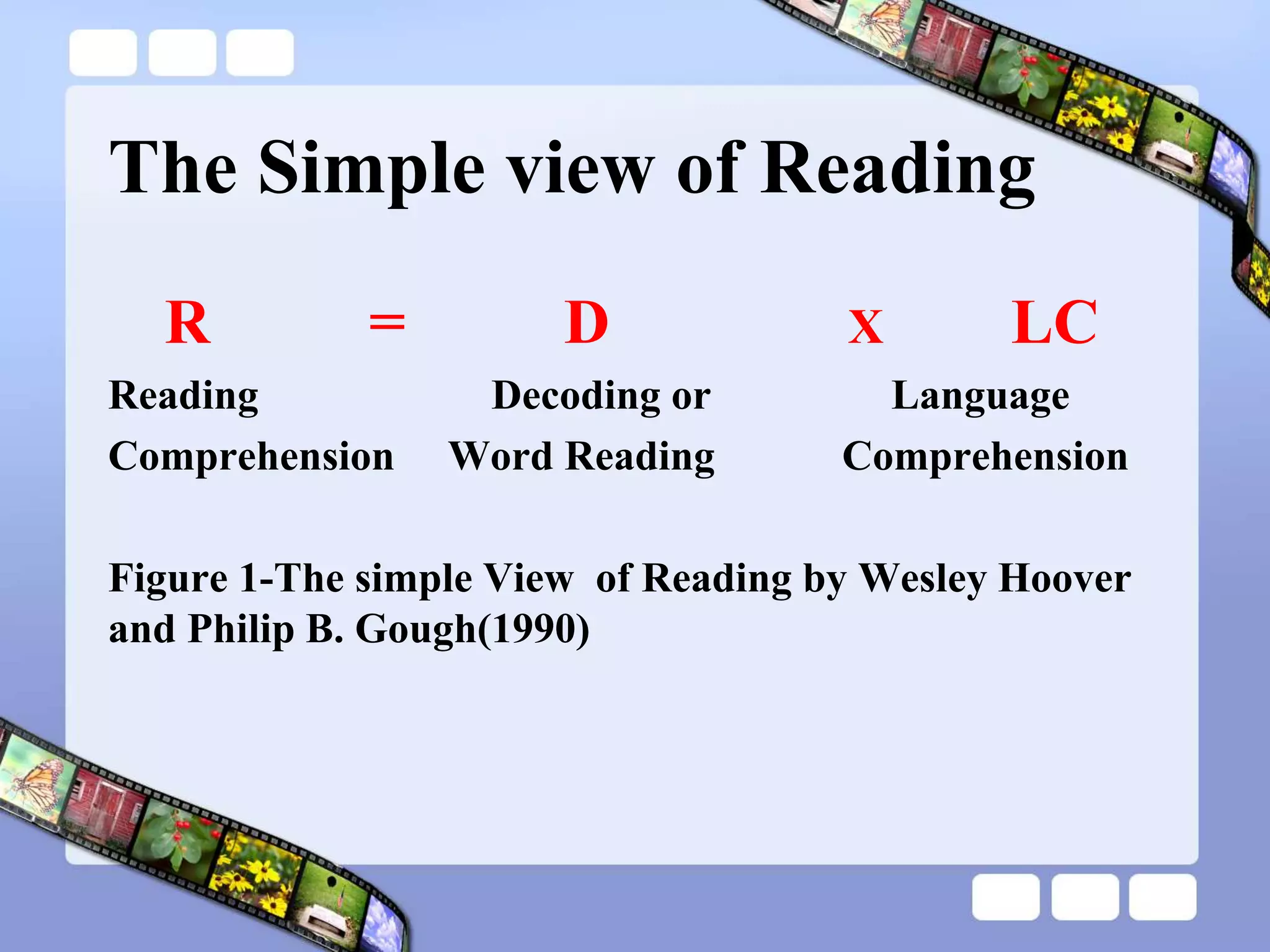
The Simple view of Reading
R = D X LC
Reading Decoding or Language
Comprehension Word Reading Comprehension
Figure 1-The simple View of Reading by Wesley Hoover
and Philip B. Gough(1990)
VIDEO –1
(Feedback on 2010-Phil-IRI)
Feedback on Phil-IRI
• -Passages are too long
• -Costly
• -No intervention-Lack of time
WHAT IS Phil-IRI?
The Phil-IRI is one of the
initiatives put in place in support
of the Every Child A Reader
Program of the Department of
Education
Phil-IRI-
 a classroom-based reading assessment
 assesses the student’s interaction with
print orally and silently
 informs the classroom teacher the reading
performance of the students in terms of
their reading strengths and difficulties
 and helps the teacher design appropriate
classroom intervention
What reading skills are
diagnosed/assessed?
 phonics and word recognition
 fluency
 rate of reading
 listening/reading comprehension
Felicitas E. Pado, PhD
Components of the Phil-IRI 2014
• Group Screening Test
• Passages for Oral Reading,
Filipino and English pretest and
• Passages for Silent Reading, posttest
Filipino and English
• Comprehension questions
Felicitas E. Pado, PhD
1.Group Screening Test (GST)
Aims
• (1) to determine who among the
students in a class are reading at level
in Filipino and/or in English and need
not undergo a more rigorous
assessment of his/her reading ability
Felicitas E. Pado, PhD
Group Screening Test (GST)
• (2) to identify the pupils who are
performing below grade level
expectation in reading and should
undergo the Phi-IRI for further
assessment of reading difficulties
Felicitas E. Pado, PhD
The Group Screening Test
• Grades 2 to 6: 3 to 4 short passages in
Filipino and a 20-item comprehension
check
• Grade 3 to 6: 3 to 4 short passages in
English and a 20-item comprehension
check
Felicitas E. Pado, PhD
The Phil-IRI
Tests
Felicitas E. Pado, PhD
Reading Passages
Readability level: Kindergarten to Grade 7
Types of Text:..English, Set B
• Narrative texts (Kindergarten to Grade 4)
• Expository texts: (Grades 5 to 7)
Topics of expository texts
for Filipino: Social Studies
for English: Science
Felicitas E. Pado, PhD
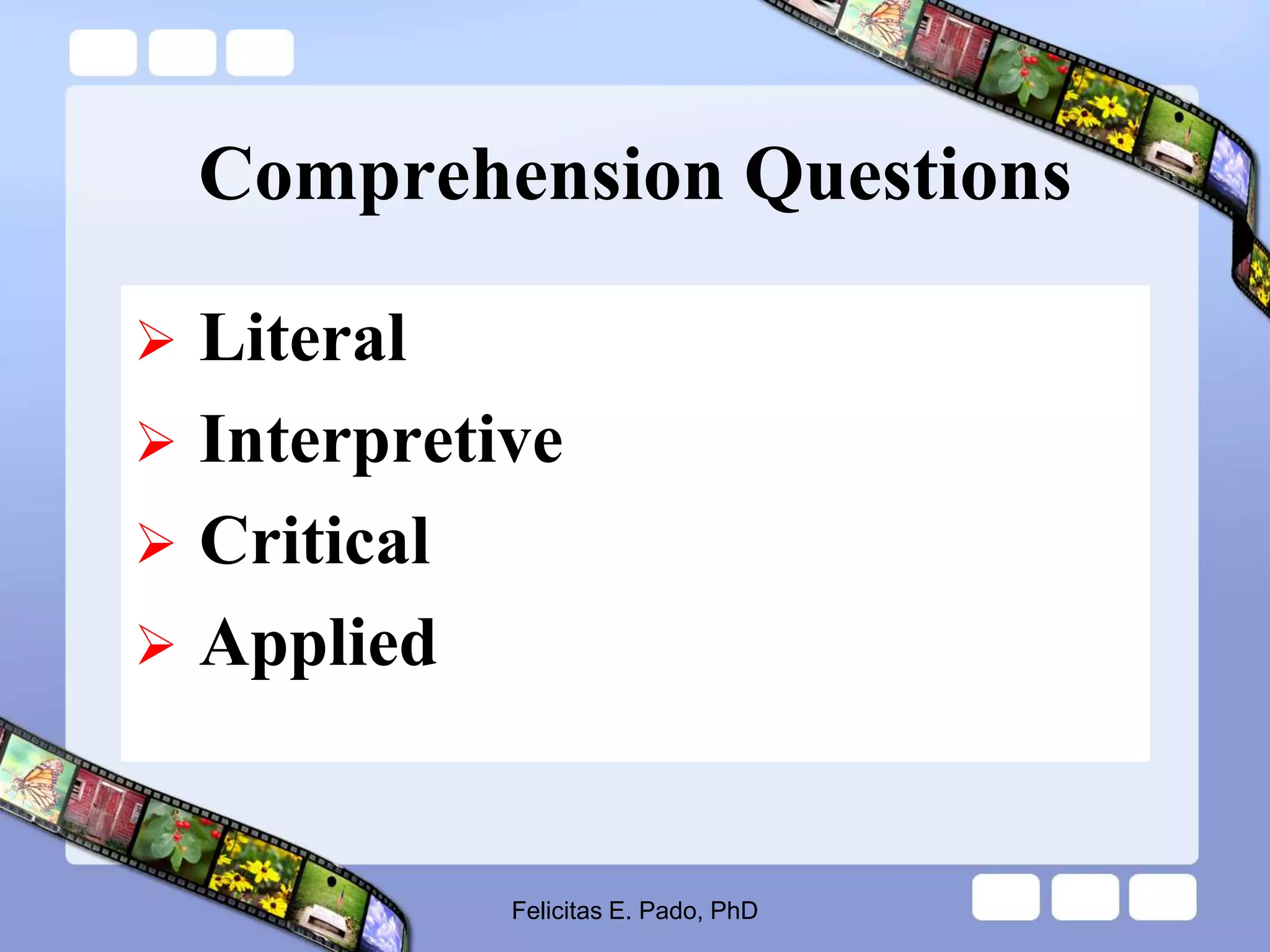
Comprehension Questions
 Literal
 Interpretive
 Critical
 Applied
Felicitas E. Pado, PhD
Number of Comprehension
Questions
K and Grade 1 passages- 5
Grade 2 and 3- 6
Grade 4 and 5- 7
Grade 6 and 7- 8
Felicitas E. Pado, PhD
Oral Reading
Purpose : to assess a reader’s
 word recognition
 fluency
 comprehension
Felicitas E. Pado, PhD
Assessing Oral Reading Performance
• Word Recognition: measured through a
Reading Miscue Inventory
• Rate of Reading: measured by recording the
time spent in reading the selection.
• Comprehension: measured by answering 5 to
8–item comprehension questions
Felicitas E. Pado, PhD
Listening Comprehension
Is the difficulty in answering the
comprehension questions due to poor word
recognition skills?
Felicitas E. Pado, PhD
• Listening Comprehension assesses
how well the pupil understands the
passage that she/he listened to.
Felicitas E. Pado, PhD
Listening Comprehension
 Teacher reads the selection while the pupil
listens.
 Teacher reads the questions and pupil
writes/gives the letter of the correct answer
 Is there a difference between the score in oral
reading and in listening?
Felicitas E. Pado, PhD
Silent Reading
Purpose: to gauge the pupil’s
reading speed and
comprehension
Felicitas E. Pado, PhD
Silent Reading
• Reading speed: measured by recording
the time it takes the child to read each
passage completely
• Reading comprehension: measured by
asking the student to read and answer
5 to 8 comprehension questions
Felicitas E. Pado, PhD
What affects the readability
of a passage?
1. font: type and size
2. spacing
3. Length of words, sentences, passage
4. illustration
5. type of words used
6. relation of the passage to a reader’s
prior knowledge
Felicitas E. Pado, PhD
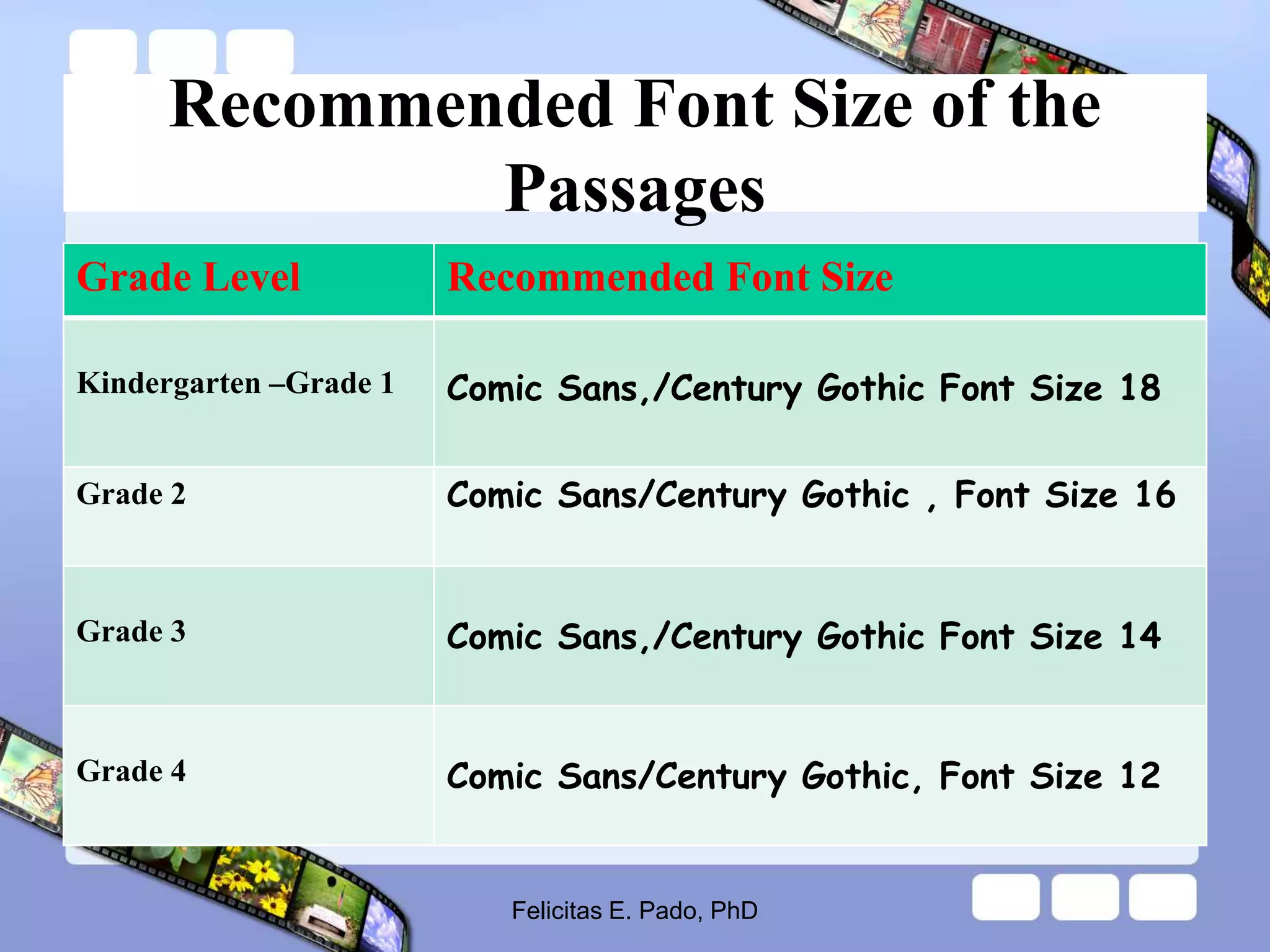
Recommended Font Size of the
Passages
Grade Level Recommended Font Size
Kindergarten –Grade 1 Comic Sans,/Century Gothic Font Size 18
Grade 2 Comic Sans/Century Gothic , Font Size 16
Grade 3 Comic Sans,/Century Gothic Font Size 14
Grade 4 Comic Sans/Century Gothic, Font Size 12
Felicitas E. Pado, PhD
Steps in Administering the Phil-IRI
Felicitas E. Pado, PhD
Stage 1:
• Administration of the Initial Screening :
Group Screening Test
Felicitas E. Pado, PhD
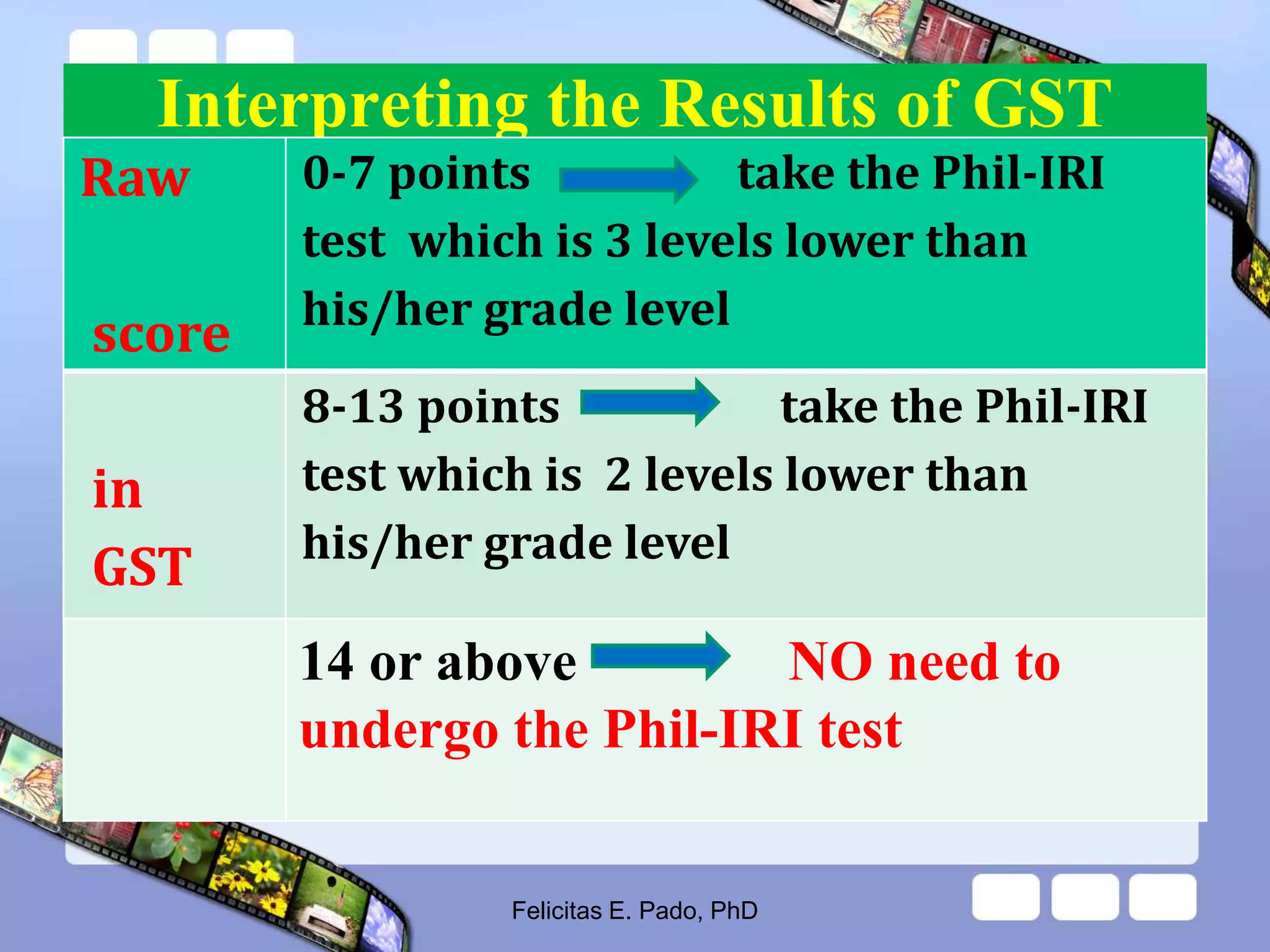
Interpreting the Results of GST
Raw
score
0-7 points take the Phil-IRI
test which is 3 levels lower than
his/her grade level
in
GST
8-13 points take the Phil-IRI
test which is 2 levels lower than
his/her grade level
14 or above NO need to
undergo the Phil-IRI test
Felicitas E. Pado, PhD
• This initial screening allows the
teacher to focus more on the students
with reading difficulties.
Felicitas E. Pado, PhD
The Phil-IRI-Group Screening Test
• -There is a screening test for each grade
level.
• Each test includes 4 selections.
• There is a Filipino and English Version.
• Each Selection has multiple-choice items.
• The total number of test items is worth 20
points
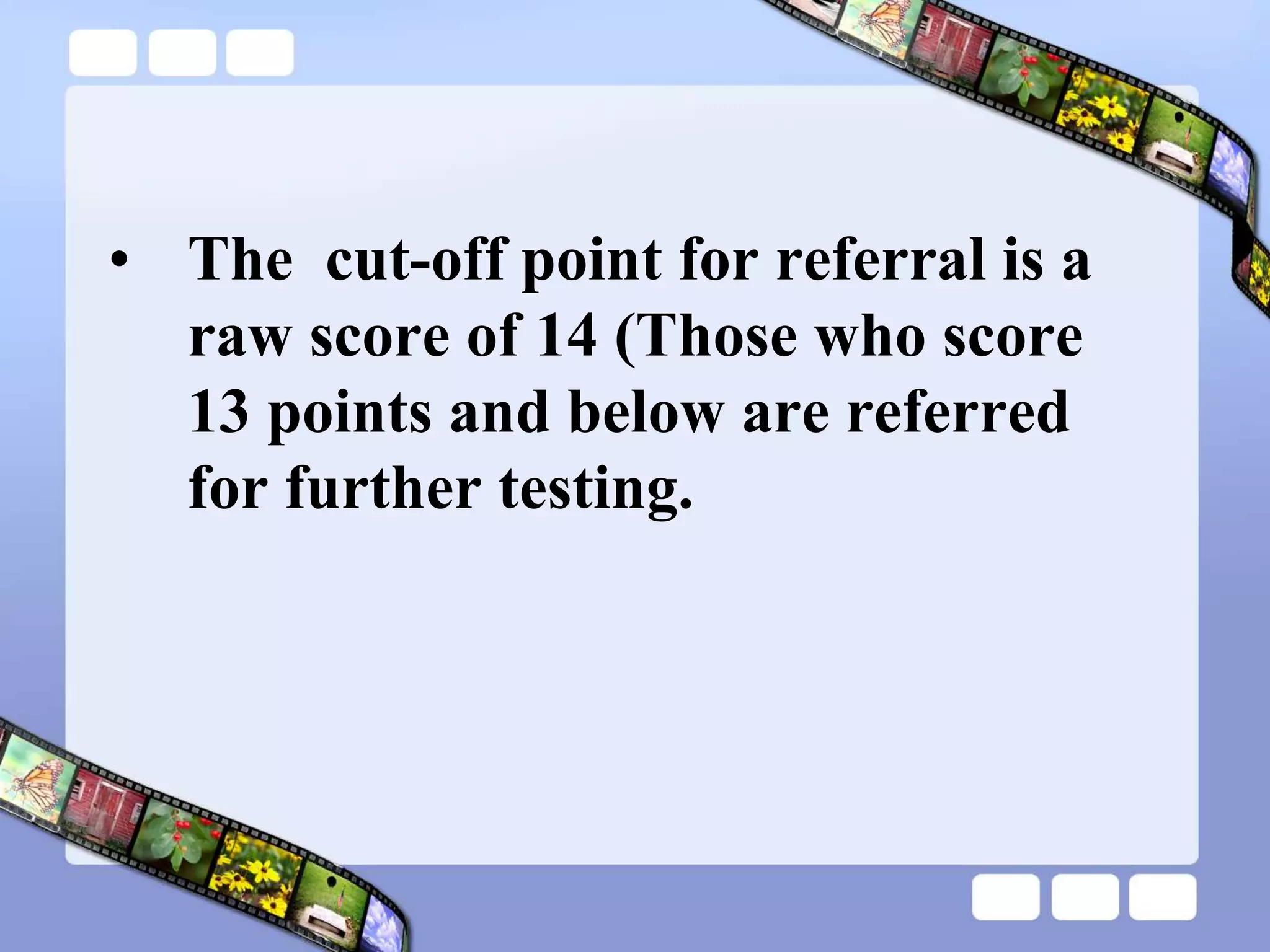
• The cut-off point for referral is a
raw score of 14 (Those who score
13 points and below are referred
for further testing.
•
Stage 2. Administration of the Phil-IRI
A. Oral Reading Test
Objectives:
 identify the student’s miscues in oral
reading;
• record the number of words that a student
reads per minute; and
 find out how well a student understands the
passage read
Felicitas E. Pado, PhD
Miscue
• a deviation or difference between
what a reader says and the word in
the page (Goodman, 1973)
Felicitas E. Pado, PhD
Common Miscues of Readers
1. Mispronunciation
2. Omission
3. Substitution
4. Insertion
5. Repetition
6. Reversal
7. Hesitation
Defining and Marking the
Miscues
Felicitas E. Pado, PhD
1.Mispronunciation – when a word or words
is not pronounced or read properly (pupil
reads a word phonetically)
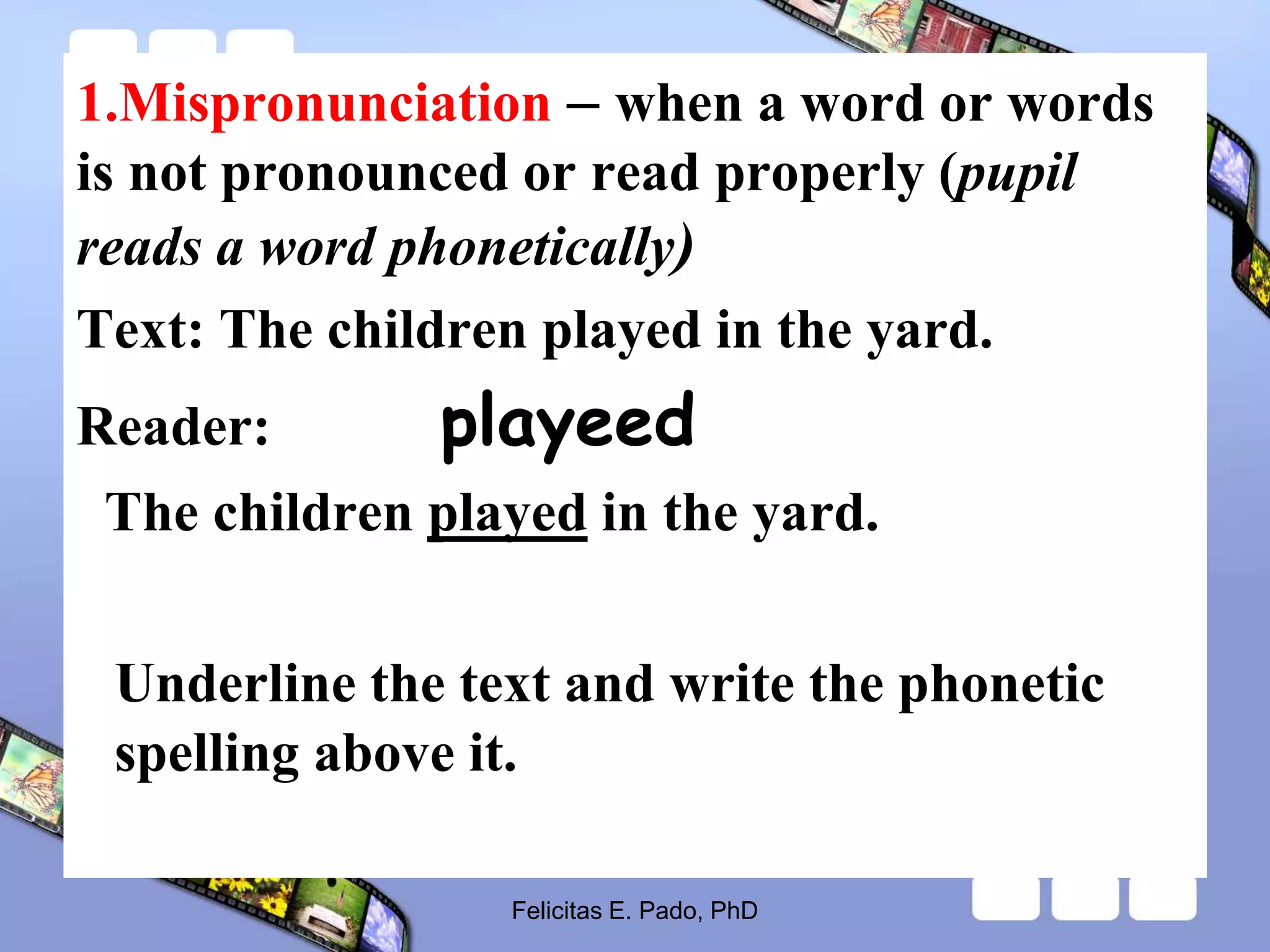
Text: The children played in the yard.
Reader: playeed
The children played in the yard.
Underline the text and write the phonetic
spelling above it.
Felicitas E. Pado, PhD
• 2.Omission – when a word or words are
omitted.
Text: Tony saw an enormous elephant in the
zoo.
Reader: Tony saw an elephant in the zoo.
Circle the omitted word.
Tony saw an enormous elephant in the zoo.
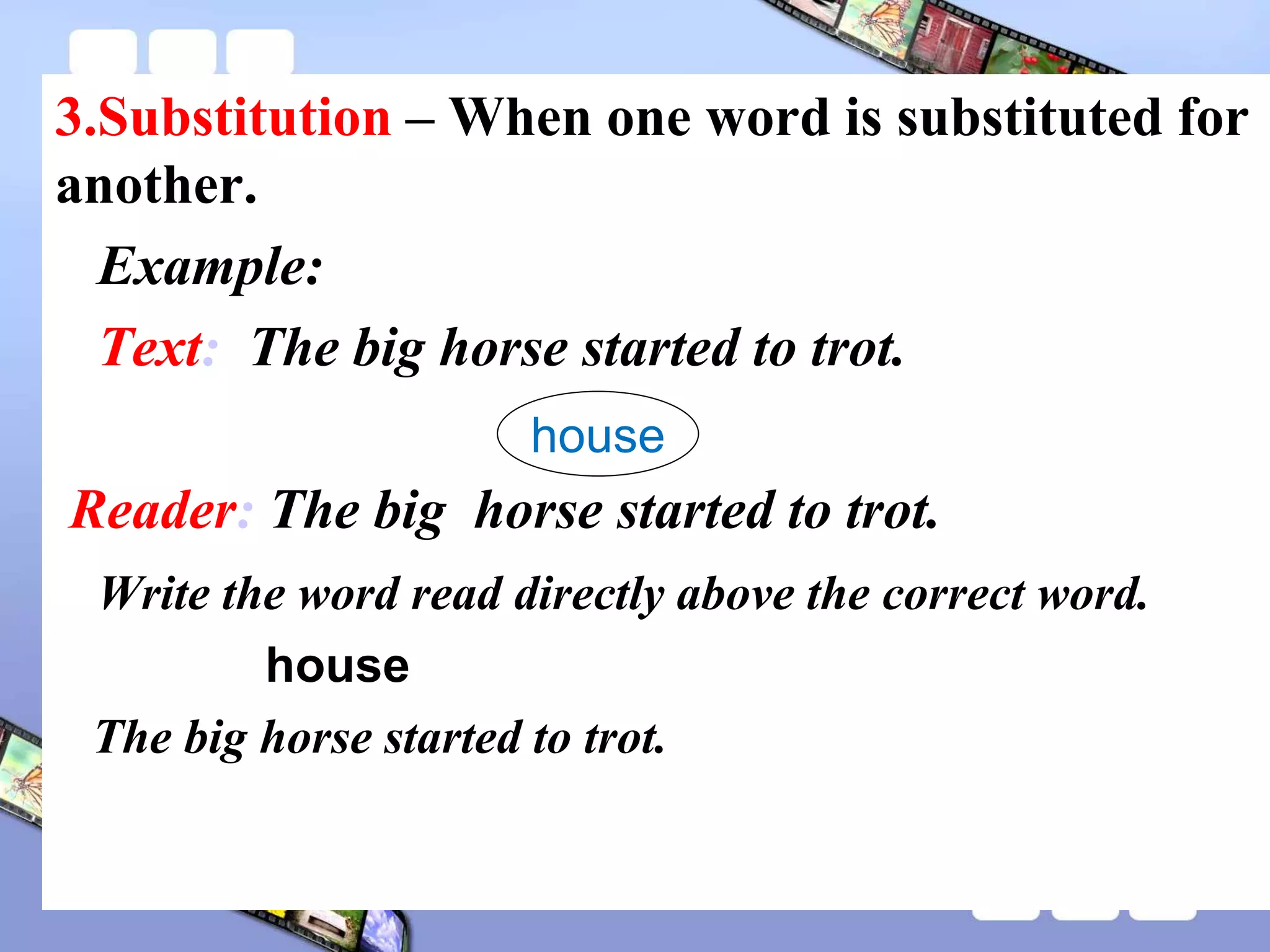
3.Substitution – When one word is substituted for
another.
Example:
Text: The big horse started to trot.
Reader: The big horse started to trot.
Write the word read directly above the correct word.
house
The big horse started to trot.
house
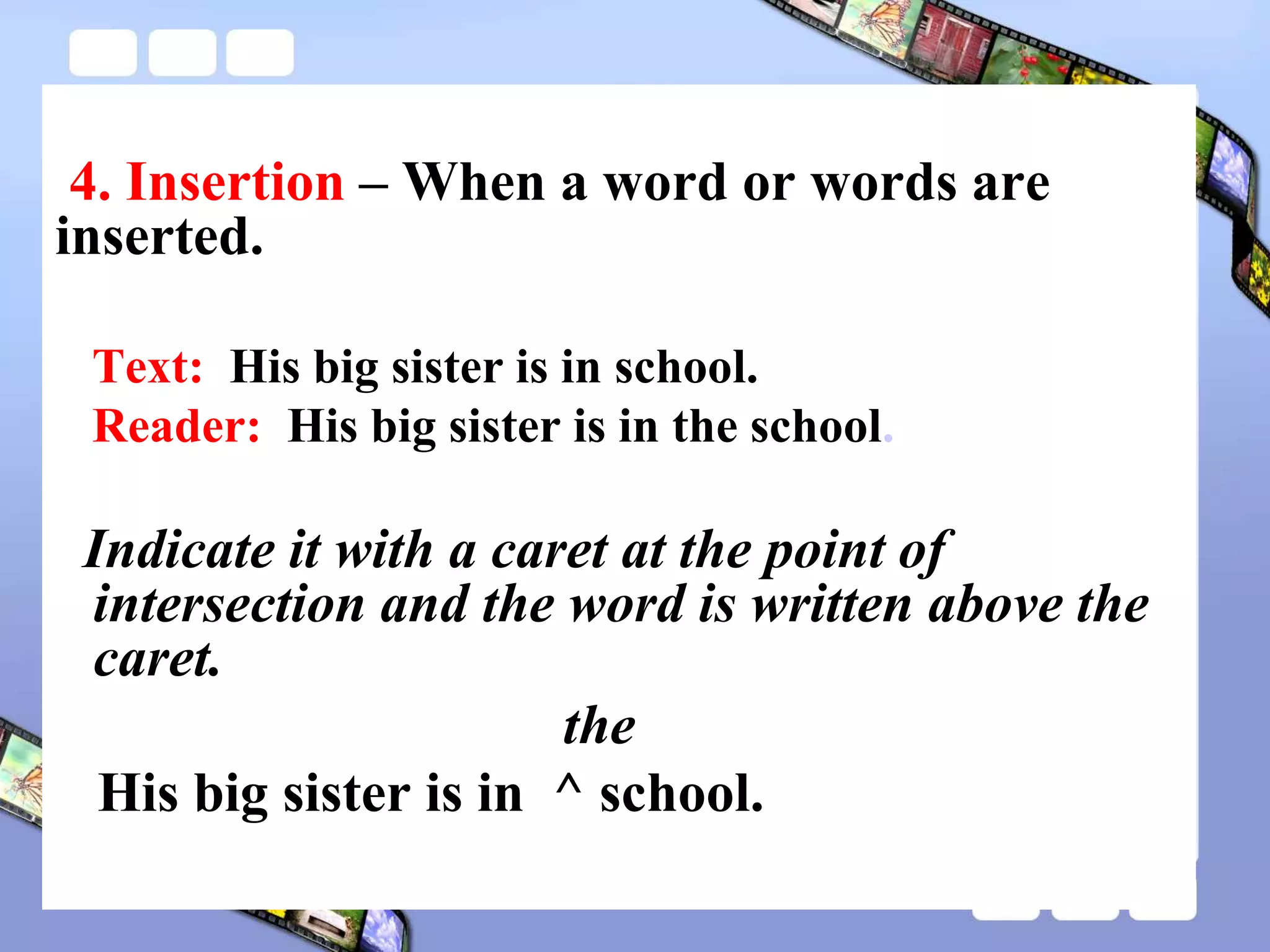
4. Insertion – When a word or words are
inserted.
Text: His big sister is in school.
Reader: His big sister is in the school.
Indicate it with a caret at the point of
intersection and the word is written above the
caret.
the
His big sister is in ^ school.
5.Repetition – when a word /phrase is repeated.
Text: The red roses are in the lovely vase.
Reader: The red roses are in the in the lovely
vase
Draw a line from the point at which the reader
decides to retrace his steps to the point the
repetition begins.
The red roses are in the in the lovely vase.
6.Reversal – when two words are reversed.
Text: The gardener is working in his vegetable
garden.
Reader: The gardener is working in his garden
vegetable.
• Use a proofreader’s symbol for transposition.
The gardener is working in his vegetable garden.
Scoring the Oral Reading
Miscues
Type of
Miscue
Marking the
Miscue
Example Scoring
Mispro
nunciation
Underline the
text and
write the
phonetic
spelling
above it.
sleed
slide
Count as 1
error every
mispronunc
iation
Felicitas E. Pado, PhD
Marking the Oral Reading Miscues
Type of
Miscue
Marking the
Miscue
Example Scoring
Omission Circle the
omitted
unit of a
language.
The
elephant
Count as 1
error a
word or
phrase
omitted.
Felicitas E. Pado, PhD
huge
Marking the Oral Reading Miscues
Type of
Miscue
Marking the
Miscue
Example Scoring
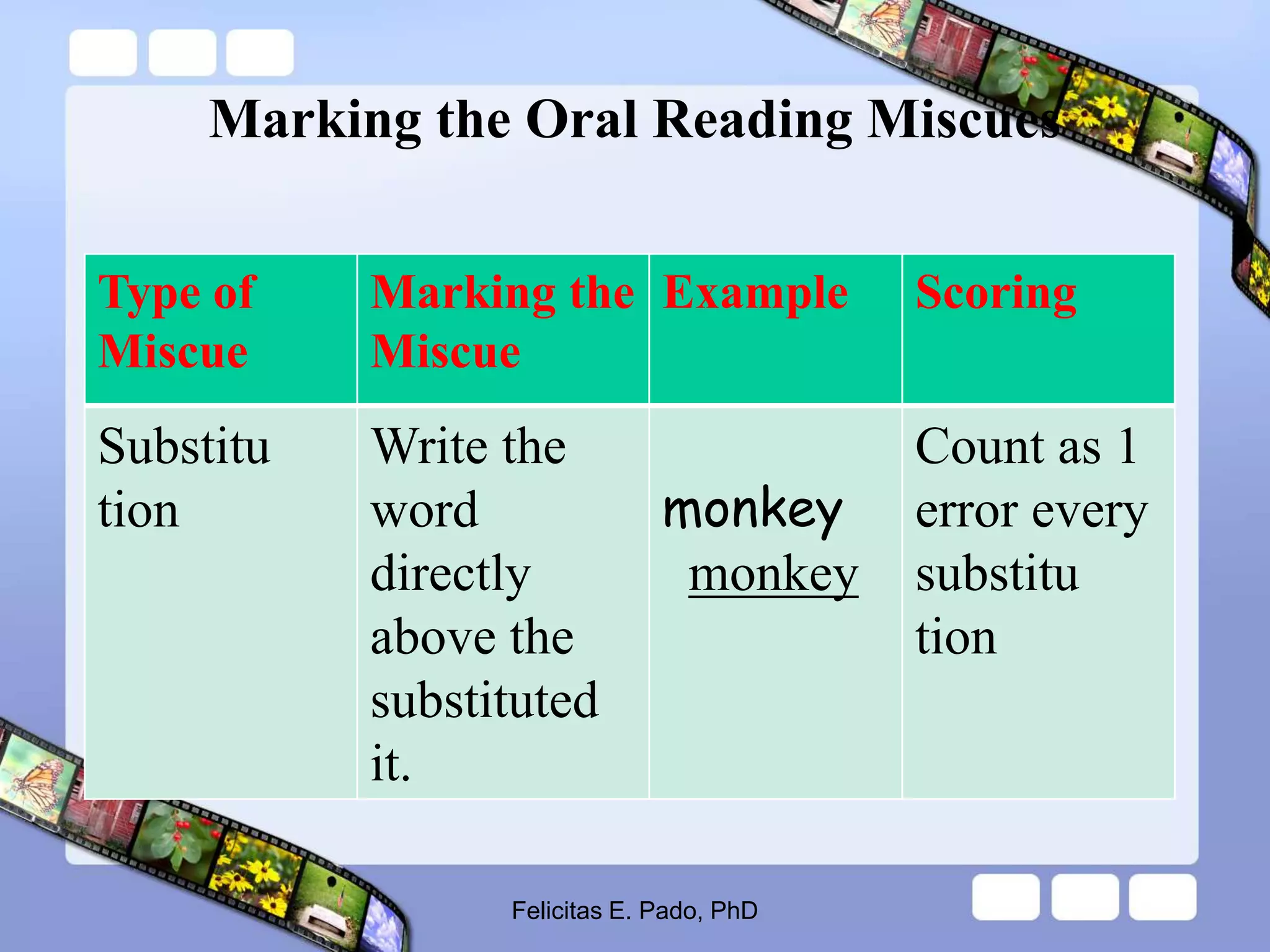
Substitu
tion
Write the
word
directly
above the
substituted
it.
monkey
monkey
Count as 1
error every
substitu
tion
Felicitas E. Pado, PhD
Marking the Oral Reading Miscues
Type of
Miscue
Marking the
Miscue
Example Scoring
Insertion Use a caret to
show where
the word/s
was inserted
and write the
word above
the caret.
lovely
the^ flowers
in the vase
Count a
word or a
phrase
inserted as
one error.
Felicitas E. Pado, PhD
Marking the Oral Reading Miscues
Type of
Miscue
Marking the
Miscue
Example Scoring
Repeti-
tion
Draw a line from
the point at which
the reader
decides to retrace
his steps to the
point the
repetition begins.
They found
it in the
Count as
one error
every word
or phrase
repeated.
Felicitas E. Pado, PhD
Marking the Oral Reading Miscues
Type of
Miscue
Marking the
Miscue
Example Scoring
Reversal Write the
word/nonw
ord above
the correct
word.
dab
bad
Count as
one error
every
reversal
made.
Felicitas E. Pado, PhD
Marking the Oral Reading Miscues
Type of
Miscue
Marking the
Miscue
Example Scoring
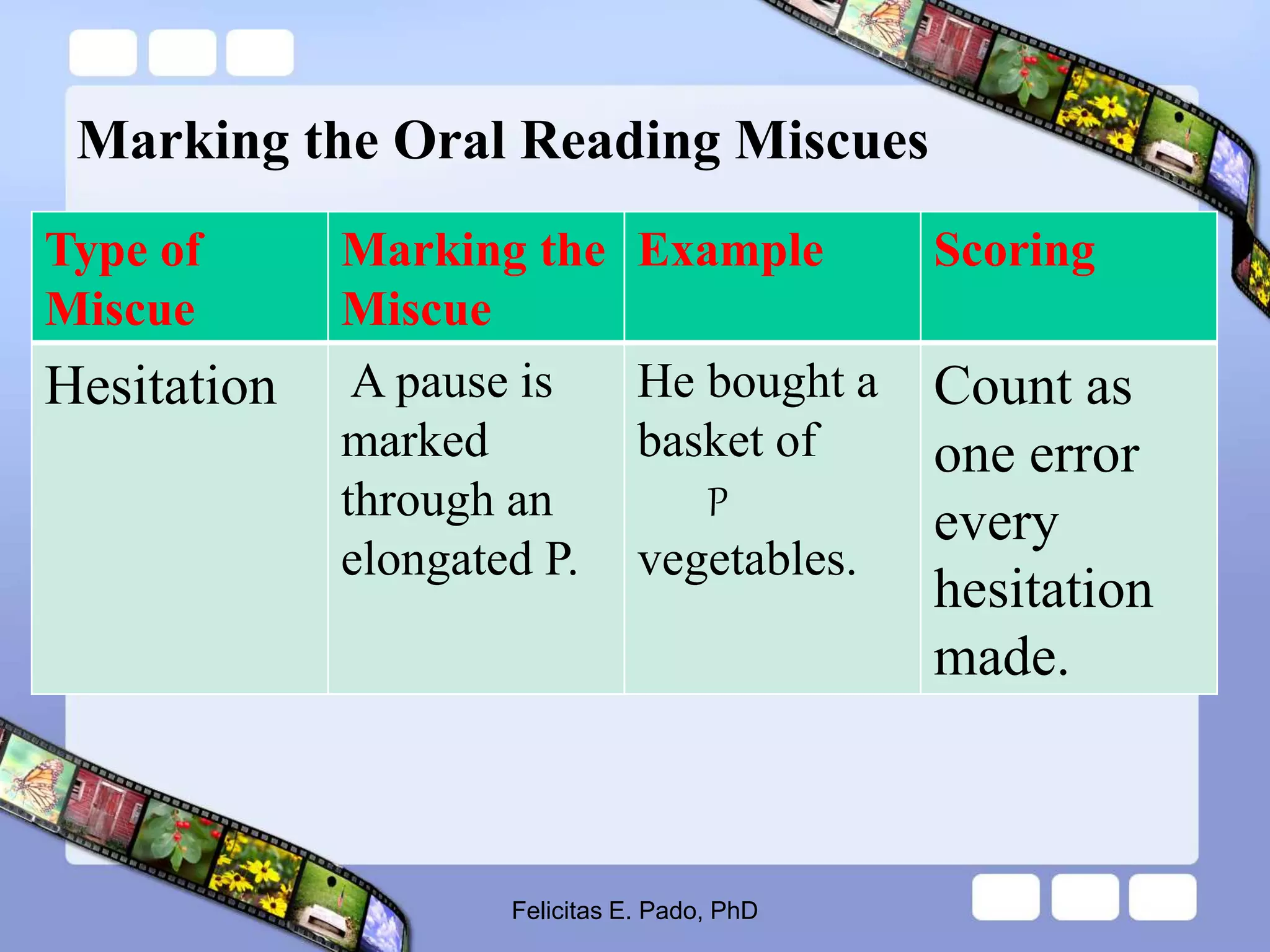
Hesitation A pause is
marked
through an
elongated P.
He bought a
basket of
P
vegetables.
Count as
one error
every
hesitation
made.
Felicitas E. Pado, PhD
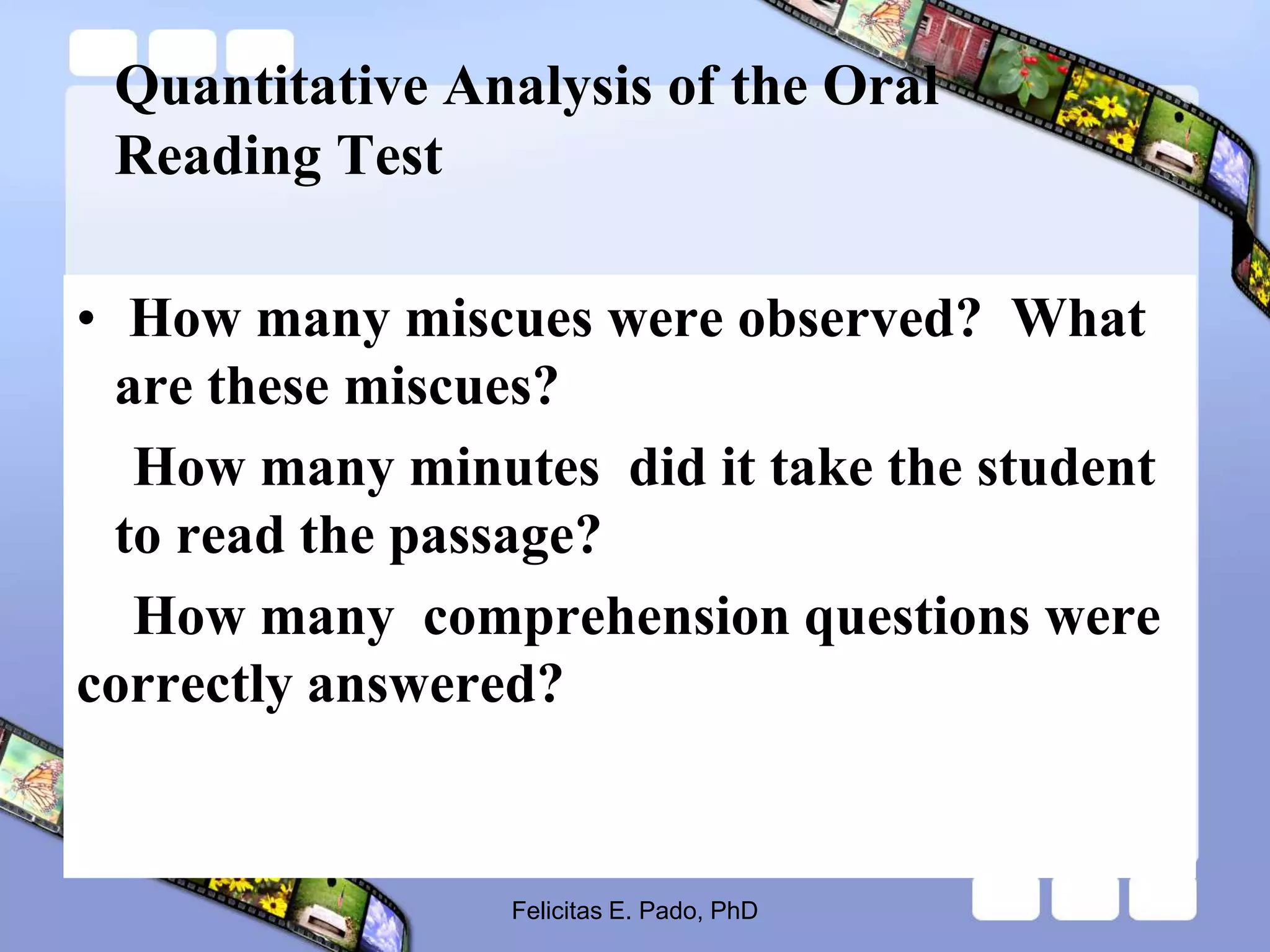
Quantitative Analysis of the Oral
Reading Test
• How many miscues were observed? What
are these miscues?
How many minutes did it take the student
to read the passage?
How many comprehension questions were
correctly answered?
Felicitas E. Pado, PhD
Computing the Percentage of the
Number of Words Correctly Read
No. of words in the passage –number of miscues X 100
number of words
Felicitas E. Pado, PhD
Example:
Karlo’s Performance in Oral
Reading
No. of words in the passage: 65
No. of miscues: 15
65-15= 50 x 100 = 76.9%
65
% of words correctly read: 76.9%
Felicitas E. Pado, PhD
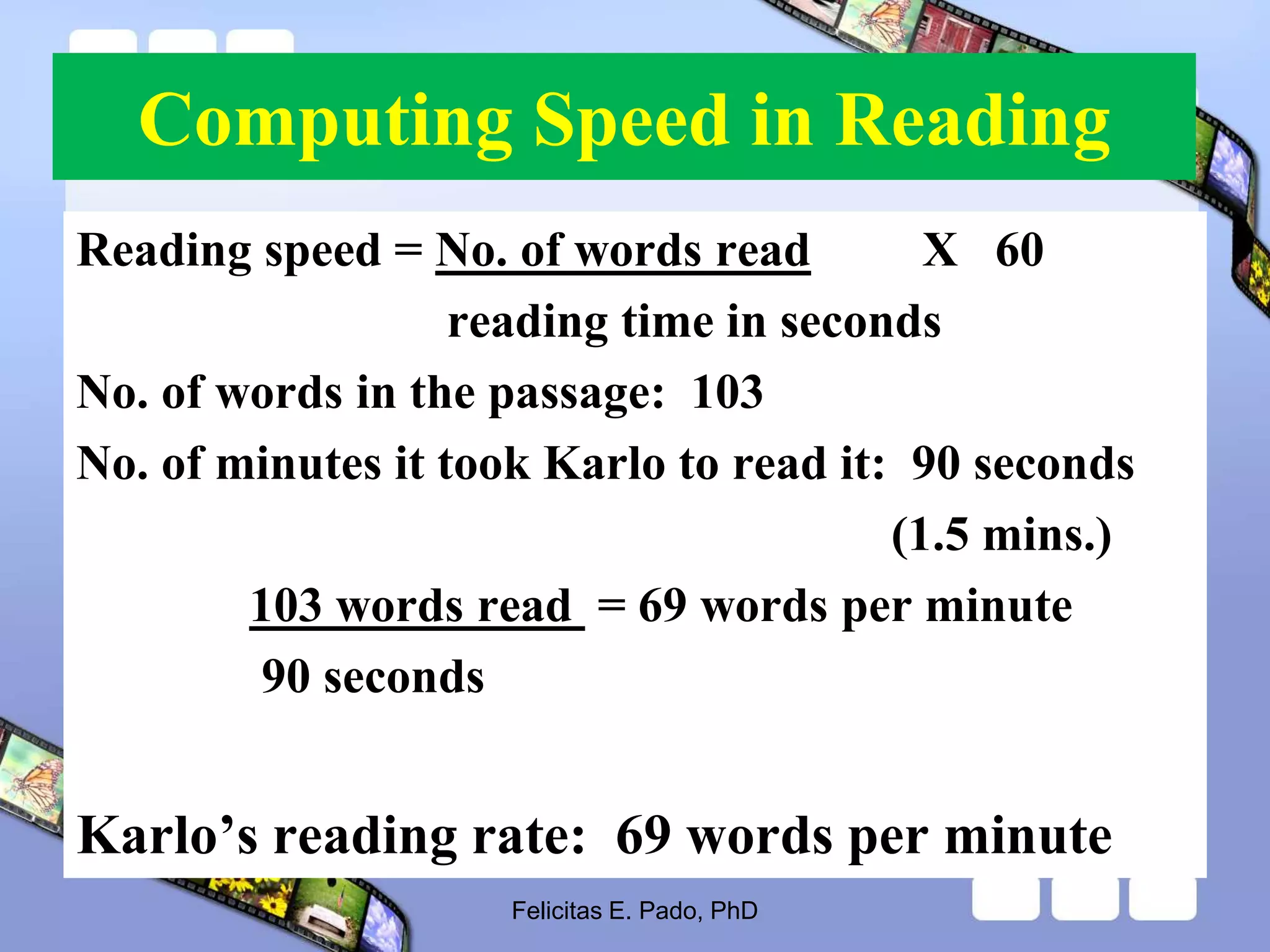
Computing Speed in Reading
Reading speed = No. of words read X 60
reading time in seconds
No. of words in the passage: 103
No. of minutes it took Karlo to read it: 90 seconds
(1.5 mins.)
103 words read = 69 words per minute
90 seconds
Karlo’s reading rate: 69 words per minute
Felicitas E. Pado, PhD
Computing for Comprehension
Comprehension= No. of correct answers
No. of questions
No. of correct answers: 4
Total no. of questions: 7
4/7 = 57
Karlo’s comprehension skill: 57%
Felicitas E. Pado, PhD
Determining the Reading Level
Reading Level: the level at which a learner
can read and comprehend a levelled text or
graded passage
The different reading levels:
Independent
Instructional
Frustration
Felicitas E. Pado, PhD
INDEPENDENT LEVEL
“I can read this on my own.”
• the level at which a learner can read and
comprehend a levelled text on his/her own.
• The reader is familiar with most, if not all, of the
words in the text. The pupil reads smoothly,
fluently and with expression.
• The level of comprehension is high.
Felicitas E. Pado, PhD
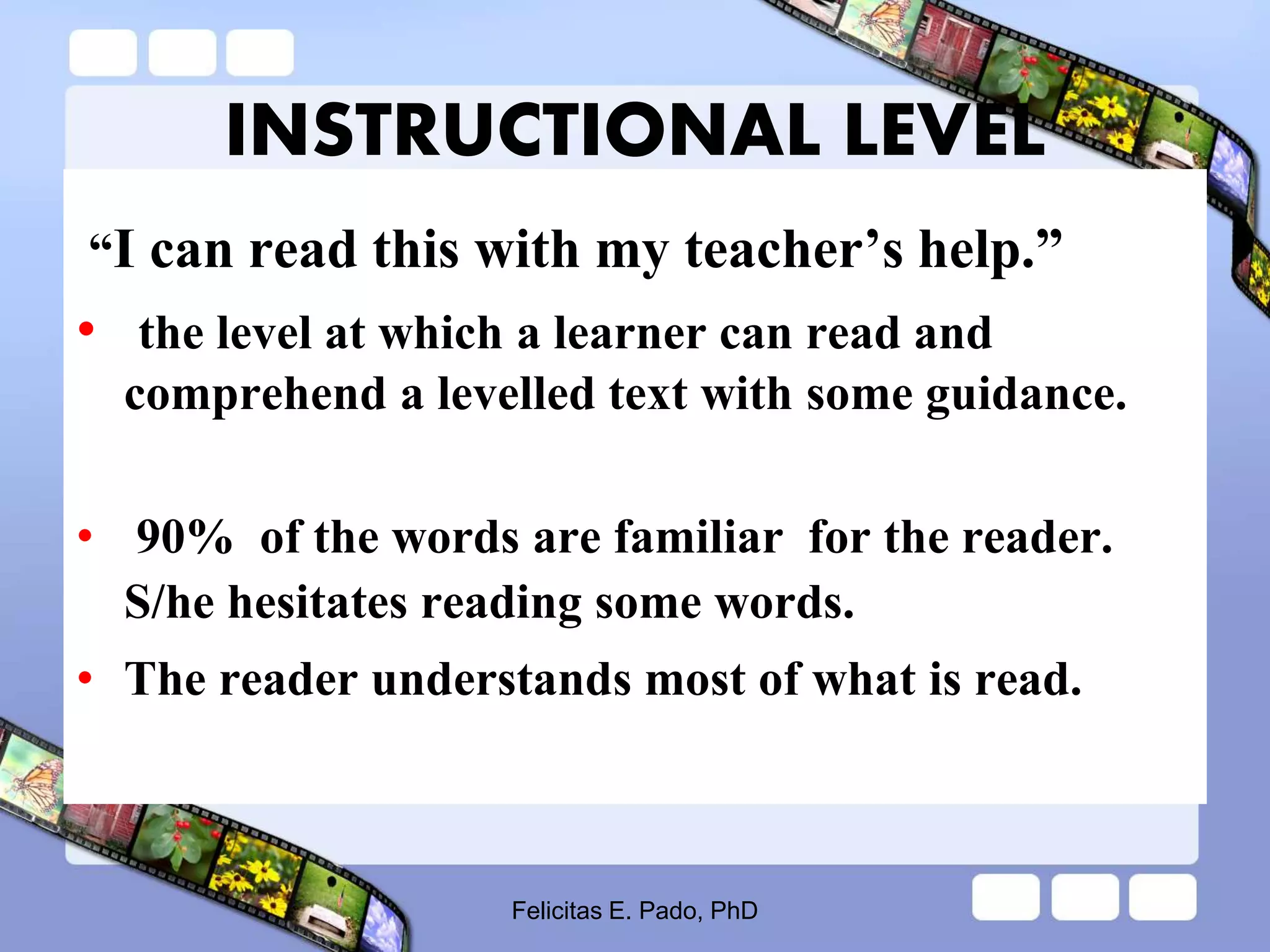
INSTRUCTIONAL LEVEL
“I can read this with my teacher’s help.”
• the level at which a learner can read and
comprehend a levelled text with some guidance.
• 90% of the words are familiar for the reader.
S/he hesitates reading some words.
• The reader understands most of what is read.
Felicitas E. Pado, PhD
FRUSTRATION LEVEL
“This is difficult.”
• the level at which a learner experiences much
difficulty in reading and comprehending a
levelled text.
• Most words are unfamiliar; hence, reading is
choppy with lots of hesitations.
• Reader rarely understands what s/he is
reading.
Felicitas E. Pado, PhD
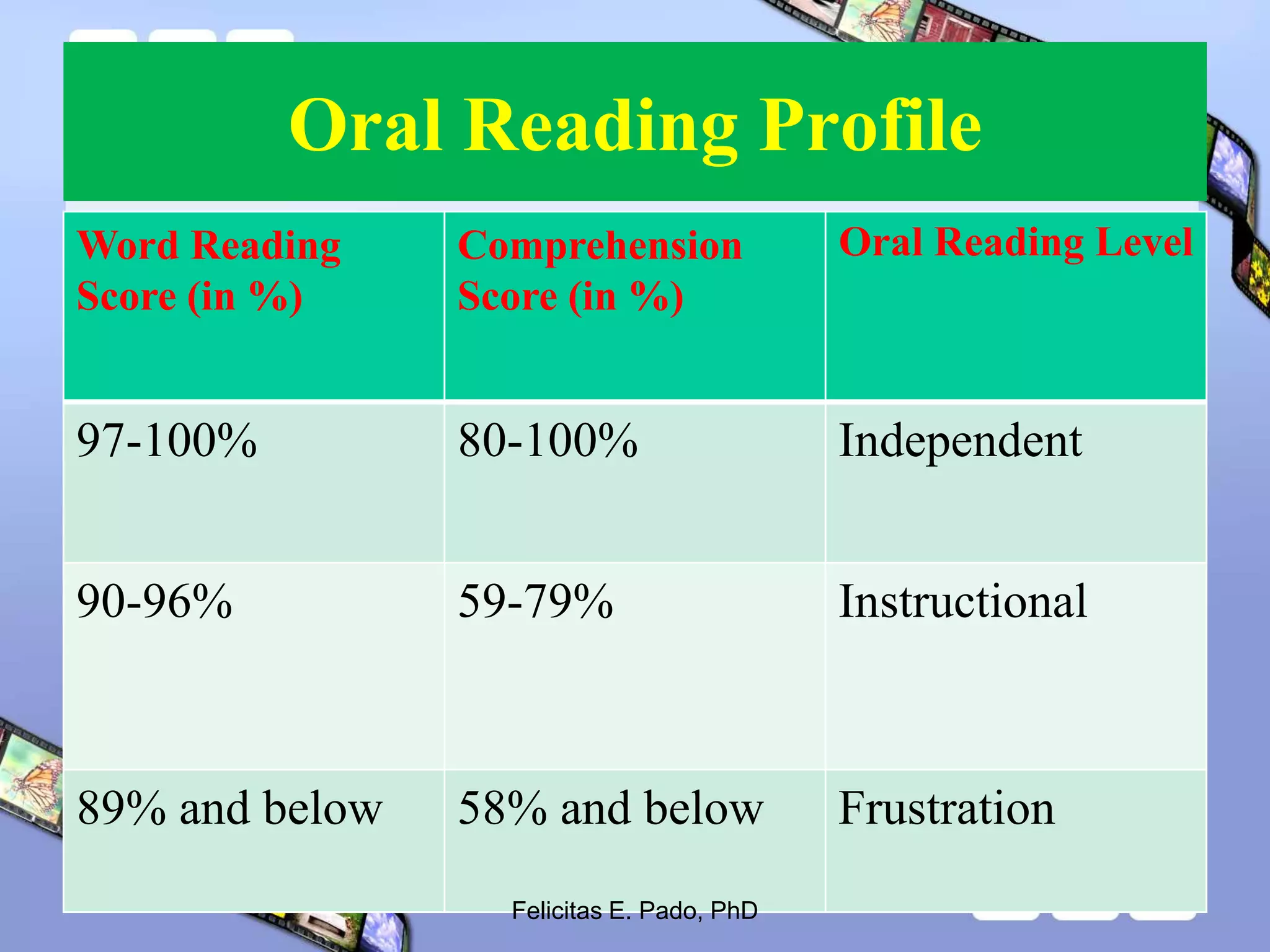
Oral Reading Profile
Word Reading
Score (in %)
Comprehension
Score (in %)
Oral Reading Level
97-100% 80-100% Independent
90-96% 59-79% Instructional
89% and below 58% and below Frustration
Felicitas E. Pado, PhD
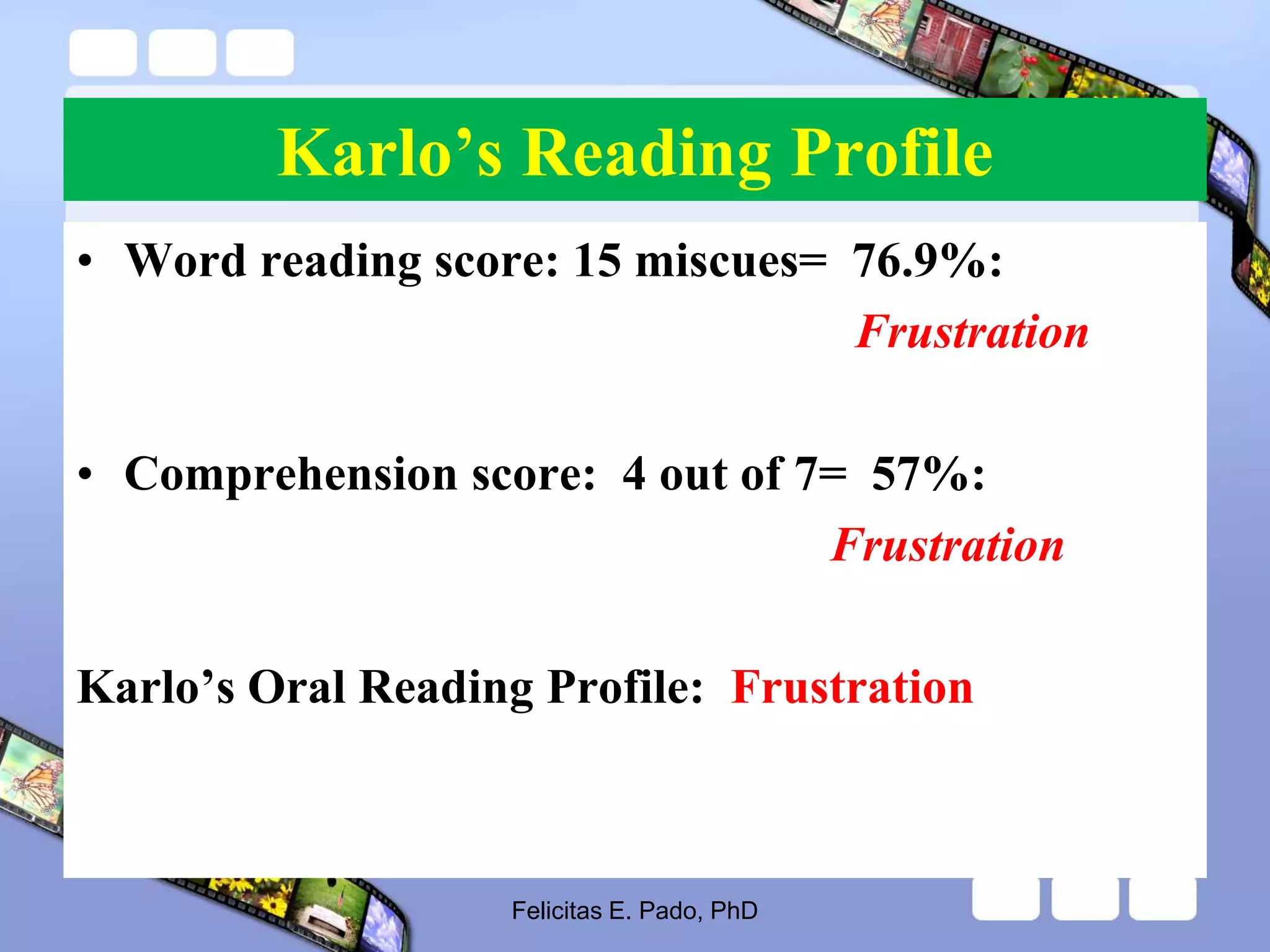
Karlo’s Reading Profile
• Word reading score: 15 miscues= 76.9%:
Frustration
• Comprehension score: 4 out of 7= 57%:
Frustration
Karlo’s Oral Reading Profile: Frustration
Felicitas E. Pado, PhD
• What should the teacher do with
pupils like Karlo?
Felicitas E. Pado, PhD
Qualitative analysis
Does word-by-word reading
Lacks expression; reads in a monotonous tone
Voice is hardly audible
Disregards punctuation
Points to each word with his/her finger
Employs little or no method of analysis
Other observations
Felicitas E. Pado, PhD
Behavior
while
Reading
B. Listening Comprehension
• What is the level of
comprehension?
Felicitas E. Pado, PhD
C. The Phil-IRI Silent Reading Test
Assesses the student’s
• reading speed
• comprehension
Felicitas E. Pado, PhD
Computing the speed and comprehension
Reading speed = No. of words read X 60
reading time in seconds
Comprehension= No. of correct answers
No. of questions
Felicitas E. Pado, PhD
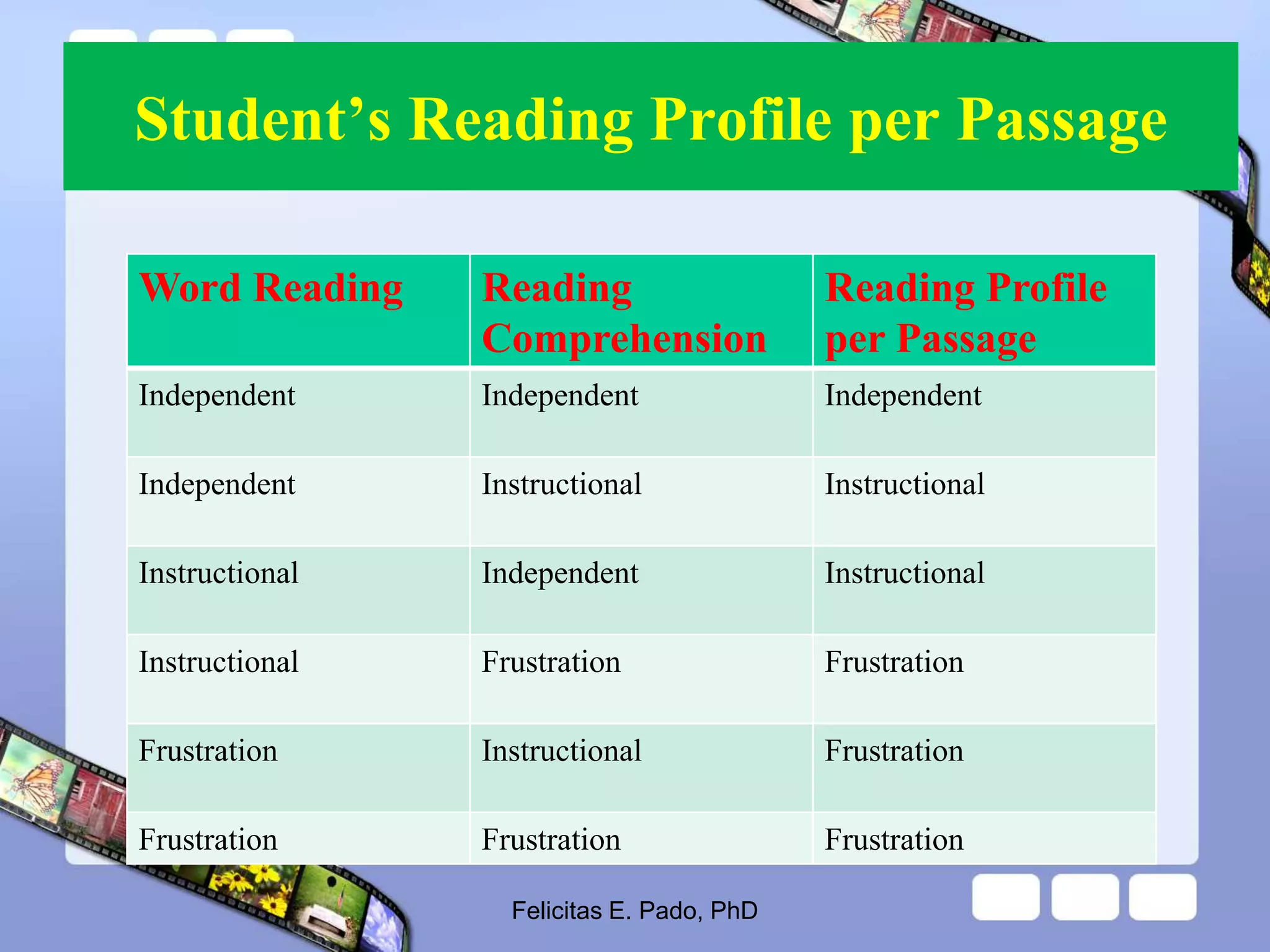
Student’s Reading Profile per Passage
Word Reading Reading
Comprehension
Reading Profile
per Passage
Independent Independent Independent
Independent Instructional Instructional
Instructional Independent Instructional
Instructional Frustration Frustration
Frustration Instructional Frustration
Frustration Frustration Frustration
Felicitas E. Pado, PhD
How Should the Phil-IRI Results Be
Used?
• to design or adjust classroom,
small group or individualized
instruction in Reading
Felicitas E. Pado, PhD
• Stage 3: Analysis of reading
difficulties and planning for
intervention
Felicitas E. Pado, PhD
Reading Difficulty: Very poor word
recognition
How does s/he try to decode a word?
How many miscues were recorded?
What type of miscues were made?
What kind of intervention should be done?
Felicitas E. Pado, PhD
EXAMPLES OF INTERVENTION
• Phonological awareness-decoding-phonemes-
ability to manipulate sounds of the letters-
• prosody
• Alphabet Knowledge
-identifying each letter of the alphabet
-sounding each letter (in MT or Filipino) or
each consonant (in English)
• Blending the letters to form words
• Explicit instruction on word recognition
Felicitas E. Pado, PhD
Reading Difficulty: Very poor
fluency
• -Can read each word but does word-
by-word reading
• -Lacks expression in reading
• -Disregards punctuation marks
Felicitas E. Pado, PhD
If a pupil does word-by word reading, does
s/he understand what is being read?
What kind of intervention should be done?
Felicitas E. Pado, PhD
Examples of intervention
• Explicit instruction on word
recognition
• Phrase/sentence reading
• Regular oral reading activity
• One-minute reading
Felicitas E. Pado, PhD
Reading Difficulty: Very poor
comprehension
• Very poor word recognition (PWR)
• Word –by-word reading (F)
• Does not understand most of the words (V)
• “Can read the whole passage but can’t
understand what is being read.” (C)
Felicitas E. Pado, PhD
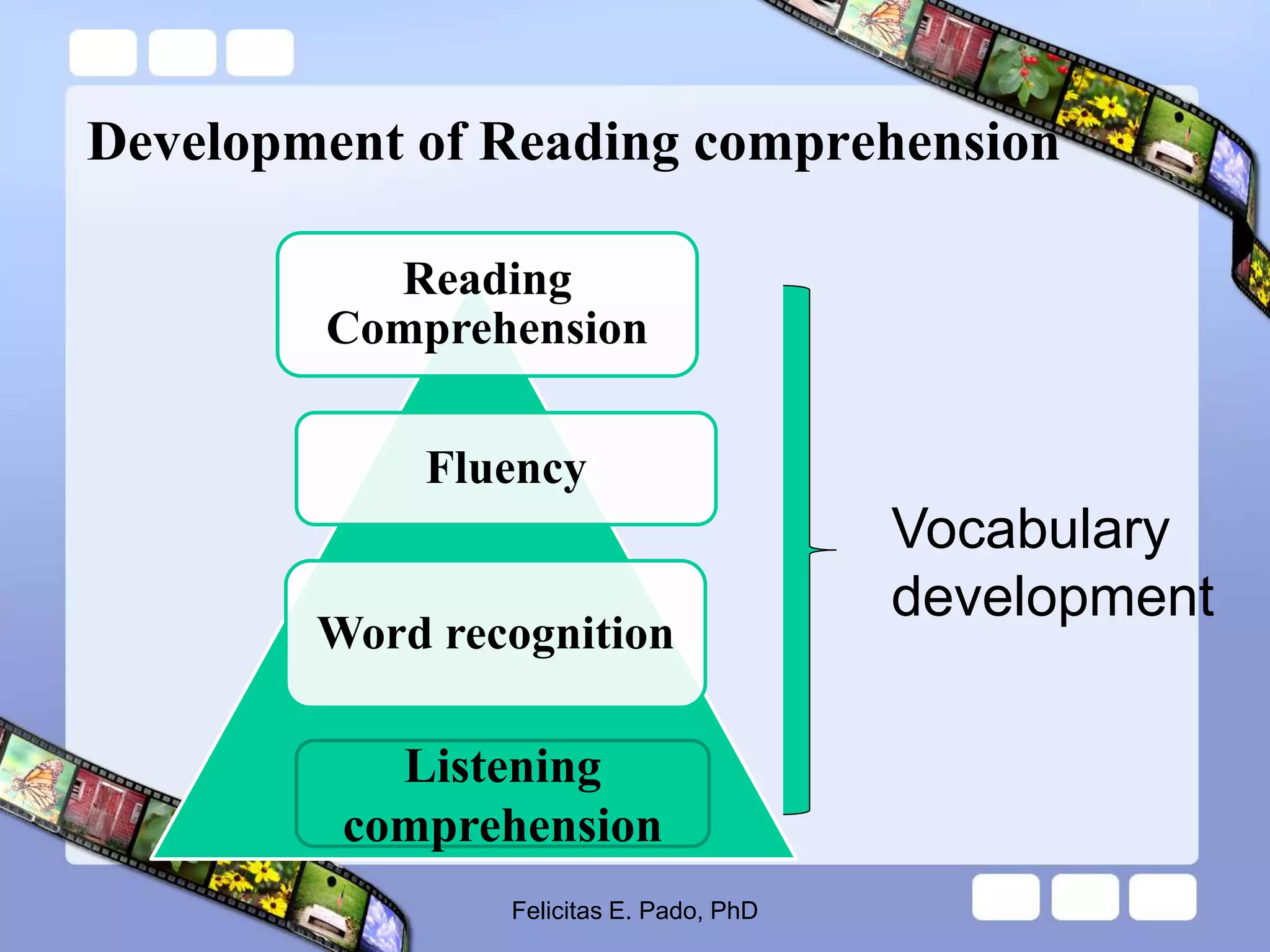
Development of Reading comprehension
Reading
Comprehension
Fluency
Word recognition
Felicitas E. Pado, PhD
Vocabulary
development
Listening
comprehension
Word recognition and
comprehension
Word recognition must be accurate, rapid
and require little conscious attention so that
attention can be directed to the
comprehension process
One reason students may not comprehend
text is that they are spending all their
attention and energy on figuring out the
words.
Felicitas E. Pado, PhD
Examples of intervention
 Development of listening comprehension
 Intensive instruction on word recognition
 Vocabulary development
 Regular oral reading activity followed by
exercises on comprehension
 Explicit instruction of comprehension
skills . . .
Felicitas E. Pado, PhD
Planning for Intervention
1. Differentiated activity within a reading
class.
2. Scheduling a special session outside the
regular class:
a. small group among students of
similar needs
b. individual student
Felicitas E. Pado, PhD
Stage 4: Phil-IRI Post test
• Is there an improvement in his/her
word recognition skills?
• Can s/he now read with accuracy,
automaticity and proper expression?
• Can s/he now understand the passage
that s/he reads?
Felicitas E. Pado, PhD
Analyze the post test results
-Is there reading progress?
-What reading difficulties were
addressed?; what reading difficulties
still persist?
-What other interventions should be
done?
Felicitas E. Pado, PhD
LET’S PRACTICE
Performance of Child A
(Grade 3)
Reading “Mang Sammy”( Grade 3 Level
Text)
WORD READING SCORE
56 - 31= 25/56= 45%
FRUSTRATION
QUESTIONS TO PONDER
• What does the performance tell about
GOOD READERS?
• How should self-corrections be viewed?
• Can we definitely say that Child A is a
good reader? What makes you say so?
• (Hint: Remember the simple view of
reading)
FOOD FOR THOUGHT
• Even good readers make mistakes.
• Self-correction shows that some
monitoring of one’s reading is occurring
as a STRENGHT.
• Remember decoding by itself is NOT
reading.
Word Reading Score
91- 9 = 82/91 = 90%
INSTRUCTIONAL LEVEL
Action Research - Power Point by:
Dr. Tarek Chebbi, FIU
Performance of Child B
(Grade 3)
Reading Summer Fun (Grade 2 level)
Questions to Ponder:
• What do we notice about CHILD B’s
Performance in Filipino and in English?
• In what way have the assumptions made
earlier changed after having listened to
CHILD B read in Filipino?
Action Research - Power Point by:
Dr. Tarek Chebbi, FIU
Food for thought:
• Just because they struggle learning to
read in one language, does NOT mean
their performance is the same for the
other language.
• Poor performance in reading should
NOT be used as a way of gauging the
learner’s intelligence.
SHARING TIME
THANK YOU
FOR LISTENING!
GOD BLESS …

Phil-IRI-SLIDE.ppt

  • 1.
    READING ASSESSMENT THE Phil-IRI: Assessingthe LEARNERS’ READING DIFFICULTIES and DESIGNING Appropriate Intervention Felicitas E. Pado, PhD Presented by: ALMA B. NISPEROS
  • 2.
    OBJECTIVES: -Discuss feedback andsuggestions from the field regarding the use of Phil-IRI as an assessment tool in schools. -Assess the learner’s reading difficulties using Phil-IRI -Follow the steps in administering Phil-IRI -Analyze and interpret Phil-IRI results.
  • 3.
    In What levelwill you belong based on the statements? Level 1- I have heard of Phil-IRI. Level 2-I know about Phil-IRI, but I have never used it. Level 3- I know about Phil-IRI,I use it in my class as an assessment tool. Level 4- I know about Phil-IRI,I use it in my class as an assessment tool for classroom intervention.
  • 4.
    Give at leastone adjective that will describe Phil-IRI’s: a. Strengths b. Weaknesses c. Challenges
  • 5.
    The Simple viewof Reading R = D X LC Reading Decoding or Language Comprehension Word Reading Comprehension Figure 1-The simple View of Reading by Wesley Hoover and Philip B. Gough(1990)
  • 6.
  • 7.
    Feedback on Phil-IRI •-Passages are too long • -Costly • -No intervention-Lack of time
  • 8.
    WHAT IS Phil-IRI? ThePhil-IRI is one of the initiatives put in place in support of the Every Child A Reader Program of the Department of Education
  • 9.
    Phil-IRI-  a classroom-basedreading assessment  assesses the student’s interaction with print orally and silently  informs the classroom teacher the reading performance of the students in terms of their reading strengths and difficulties  and helps the teacher design appropriate classroom intervention
  • 10.
    What reading skillsare diagnosed/assessed?  phonics and word recognition  fluency  rate of reading  listening/reading comprehension Felicitas E. Pado, PhD
  • 11.
    Components of thePhil-IRI 2014 • Group Screening Test • Passages for Oral Reading, Filipino and English pretest and • Passages for Silent Reading, posttest Filipino and English • Comprehension questions Felicitas E. Pado, PhD
  • 12.
    1.Group Screening Test(GST) Aims • (1) to determine who among the students in a class are reading at level in Filipino and/or in English and need not undergo a more rigorous assessment of his/her reading ability Felicitas E. Pado, PhD
  • 13.
    Group Screening Test(GST) • (2) to identify the pupils who are performing below grade level expectation in reading and should undergo the Phi-IRI for further assessment of reading difficulties Felicitas E. Pado, PhD
  • 14.
    The Group ScreeningTest • Grades 2 to 6: 3 to 4 short passages in Filipino and a 20-item comprehension check • Grade 3 to 6: 3 to 4 short passages in English and a 20-item comprehension check Felicitas E. Pado, PhD
  • 15.
  • 16.
    Reading Passages Readability level:Kindergarten to Grade 7 Types of Text:..English, Set B • Narrative texts (Kindergarten to Grade 4) • Expository texts: (Grades 5 to 7) Topics of expository texts for Filipino: Social Studies for English: Science Felicitas E. Pado, PhD
  • 17.
    Comprehension Questions  Literal Interpretive  Critical  Applied Felicitas E. Pado, PhD
  • 18.
    Number of Comprehension Questions Kand Grade 1 passages- 5 Grade 2 and 3- 6 Grade 4 and 5- 7 Grade 6 and 7- 8 Felicitas E. Pado, PhD
  • 19.
    Oral Reading Purpose :to assess a reader’s  word recognition  fluency  comprehension Felicitas E. Pado, PhD
  • 20.
    Assessing Oral ReadingPerformance • Word Recognition: measured through a Reading Miscue Inventory • Rate of Reading: measured by recording the time spent in reading the selection. • Comprehension: measured by answering 5 to 8–item comprehension questions Felicitas E. Pado, PhD
  • 21.
    Listening Comprehension Is thedifficulty in answering the comprehension questions due to poor word recognition skills? Felicitas E. Pado, PhD
  • 22.
    • Listening Comprehensionassesses how well the pupil understands the passage that she/he listened to. Felicitas E. Pado, PhD
  • 23.
    Listening Comprehension  Teacherreads the selection while the pupil listens.  Teacher reads the questions and pupil writes/gives the letter of the correct answer  Is there a difference between the score in oral reading and in listening? Felicitas E. Pado, PhD
  • 24.
    Silent Reading Purpose: togauge the pupil’s reading speed and comprehension Felicitas E. Pado, PhD
  • 25.
    Silent Reading • Readingspeed: measured by recording the time it takes the child to read each passage completely • Reading comprehension: measured by asking the student to read and answer 5 to 8 comprehension questions Felicitas E. Pado, PhD
  • 26.
    What affects thereadability of a passage? 1. font: type and size 2. spacing 3. Length of words, sentences, passage 4. illustration 5. type of words used 6. relation of the passage to a reader’s prior knowledge Felicitas E. Pado, PhD
  • 27.
    Recommended Font Sizeof the Passages Grade Level Recommended Font Size Kindergarten –Grade 1 Comic Sans,/Century Gothic Font Size 18 Grade 2 Comic Sans/Century Gothic , Font Size 16 Grade 3 Comic Sans,/Century Gothic Font Size 14 Grade 4 Comic Sans/Century Gothic, Font Size 12 Felicitas E. Pado, PhD
  • 28.
    Steps in Administeringthe Phil-IRI Felicitas E. Pado, PhD
  • 29.
    Stage 1: • Administrationof the Initial Screening : Group Screening Test Felicitas E. Pado, PhD
  • 30.
    Interpreting the Resultsof GST Raw score 0-7 points take the Phil-IRI test which is 3 levels lower than his/her grade level in GST 8-13 points take the Phil-IRI test which is 2 levels lower than his/her grade level 14 or above NO need to undergo the Phil-IRI test Felicitas E. Pado, PhD
  • 31.
    • This initialscreening allows the teacher to focus more on the students with reading difficulties. Felicitas E. Pado, PhD
  • 32.
    The Phil-IRI-Group ScreeningTest • -There is a screening test for each grade level. • Each test includes 4 selections. • There is a Filipino and English Version. • Each Selection has multiple-choice items. • The total number of test items is worth 20 points
  • 33.
    • The cut-offpoint for referral is a raw score of 14 (Those who score 13 points and below are referred for further testing.
  • 34.
    • Stage 2. Administrationof the Phil-IRI A. Oral Reading Test Objectives:  identify the student’s miscues in oral reading; • record the number of words that a student reads per minute; and  find out how well a student understands the passage read Felicitas E. Pado, PhD
  • 35.
    Miscue • a deviationor difference between what a reader says and the word in the page (Goodman, 1973) Felicitas E. Pado, PhD
  • 36.
    Common Miscues ofReaders 1. Mispronunciation 2. Omission 3. Substitution 4. Insertion 5. Repetition 6. Reversal 7. Hesitation
  • 37.
    Defining and Markingthe Miscues Felicitas E. Pado, PhD
  • 38.
    1.Mispronunciation – whena word or words is not pronounced or read properly (pupil reads a word phonetically) Text: The children played in the yard. Reader: playeed The children played in the yard. Underline the text and write the phonetic spelling above it. Felicitas E. Pado, PhD
  • 39.
    • 2.Omission –when a word or words are omitted. Text: Tony saw an enormous elephant in the zoo. Reader: Tony saw an elephant in the zoo. Circle the omitted word. Tony saw an enormous elephant in the zoo.
  • 40.
    3.Substitution – Whenone word is substituted for another. Example: Text: The big horse started to trot. Reader: The big horse started to trot. Write the word read directly above the correct word. house The big horse started to trot. house
  • 41.
    4. Insertion –When a word or words are inserted. Text: His big sister is in school. Reader: His big sister is in the school. Indicate it with a caret at the point of intersection and the word is written above the caret. the His big sister is in ^ school.
  • 42.
    5.Repetition – whena word /phrase is repeated. Text: The red roses are in the lovely vase. Reader: The red roses are in the in the lovely vase Draw a line from the point at which the reader decides to retrace his steps to the point the repetition begins. The red roses are in the in the lovely vase.
  • 43.
    6.Reversal – whentwo words are reversed. Text: The gardener is working in his vegetable garden. Reader: The gardener is working in his garden vegetable. • Use a proofreader’s symbol for transposition. The gardener is working in his vegetable garden.
  • 44.
    Scoring the OralReading Miscues Type of Miscue Marking the Miscue Example Scoring Mispro nunciation Underline the text and write the phonetic spelling above it. sleed slide Count as 1 error every mispronunc iation Felicitas E. Pado, PhD
  • 45.
    Marking the OralReading Miscues Type of Miscue Marking the Miscue Example Scoring Omission Circle the omitted unit of a language. The elephant Count as 1 error a word or phrase omitted. Felicitas E. Pado, PhD huge
  • 46.
    Marking the OralReading Miscues Type of Miscue Marking the Miscue Example Scoring Substitu tion Write the word directly above the substituted it. monkey monkey Count as 1 error every substitu tion Felicitas E. Pado, PhD
  • 47.
    Marking the OralReading Miscues Type of Miscue Marking the Miscue Example Scoring Insertion Use a caret to show where the word/s was inserted and write the word above the caret. lovely the^ flowers in the vase Count a word or a phrase inserted as one error. Felicitas E. Pado, PhD
  • 48.
    Marking the OralReading Miscues Type of Miscue Marking the Miscue Example Scoring Repeti- tion Draw a line from the point at which the reader decides to retrace his steps to the point the repetition begins. They found it in the Count as one error every word or phrase repeated. Felicitas E. Pado, PhD
  • 49.
    Marking the OralReading Miscues Type of Miscue Marking the Miscue Example Scoring Reversal Write the word/nonw ord above the correct word. dab bad Count as one error every reversal made. Felicitas E. Pado, PhD
  • 50.
    Marking the OralReading Miscues Type of Miscue Marking the Miscue Example Scoring Hesitation A pause is marked through an elongated P. He bought a basket of P vegetables. Count as one error every hesitation made. Felicitas E. Pado, PhD
  • 51.
    Quantitative Analysis ofthe Oral Reading Test • How many miscues were observed? What are these miscues? How many minutes did it take the student to read the passage? How many comprehension questions were correctly answered? Felicitas E. Pado, PhD
  • 52.
    Computing the Percentageof the Number of Words Correctly Read No. of words in the passage –number of miscues X 100 number of words Felicitas E. Pado, PhD
  • 53.
    Example: Karlo’s Performance inOral Reading No. of words in the passage: 65 No. of miscues: 15 65-15= 50 x 100 = 76.9% 65 % of words correctly read: 76.9% Felicitas E. Pado, PhD
  • 54.
    Computing Speed inReading Reading speed = No. of words read X 60 reading time in seconds No. of words in the passage: 103 No. of minutes it took Karlo to read it: 90 seconds (1.5 mins.) 103 words read = 69 words per minute 90 seconds Karlo’s reading rate: 69 words per minute Felicitas E. Pado, PhD
  • 55.
    Computing for Comprehension Comprehension=No. of correct answers No. of questions No. of correct answers: 4 Total no. of questions: 7 4/7 = 57 Karlo’s comprehension skill: 57% Felicitas E. Pado, PhD
  • 56.
    Determining the ReadingLevel Reading Level: the level at which a learner can read and comprehend a levelled text or graded passage The different reading levels: Independent Instructional Frustration Felicitas E. Pado, PhD
  • 57.
    INDEPENDENT LEVEL “I canread this on my own.” • the level at which a learner can read and comprehend a levelled text on his/her own. • The reader is familiar with most, if not all, of the words in the text. The pupil reads smoothly, fluently and with expression. • The level of comprehension is high. Felicitas E. Pado, PhD
  • 58.
    INSTRUCTIONAL LEVEL “I canread this with my teacher’s help.” • the level at which a learner can read and comprehend a levelled text with some guidance. • 90% of the words are familiar for the reader. S/he hesitates reading some words. • The reader understands most of what is read. Felicitas E. Pado, PhD
  • 59.
    FRUSTRATION LEVEL “This isdifficult.” • the level at which a learner experiences much difficulty in reading and comprehending a levelled text. • Most words are unfamiliar; hence, reading is choppy with lots of hesitations. • Reader rarely understands what s/he is reading. Felicitas E. Pado, PhD
  • 60.
    Oral Reading Profile WordReading Score (in %) Comprehension Score (in %) Oral Reading Level 97-100% 80-100% Independent 90-96% 59-79% Instructional 89% and below 58% and below Frustration Felicitas E. Pado, PhD
  • 61.
    Karlo’s Reading Profile •Word reading score: 15 miscues= 76.9%: Frustration • Comprehension score: 4 out of 7= 57%: Frustration Karlo’s Oral Reading Profile: Frustration Felicitas E. Pado, PhD
  • 62.
    • What shouldthe teacher do with pupils like Karlo? Felicitas E. Pado, PhD
  • 63.
    Qualitative analysis Does word-by-wordreading Lacks expression; reads in a monotonous tone Voice is hardly audible Disregards punctuation Points to each word with his/her finger Employs little or no method of analysis Other observations Felicitas E. Pado, PhD Behavior while Reading
  • 64.
    B. Listening Comprehension •What is the level of comprehension? Felicitas E. Pado, PhD
  • 65.
    C. The Phil-IRISilent Reading Test Assesses the student’s • reading speed • comprehension Felicitas E. Pado, PhD
  • 66.
    Computing the speedand comprehension Reading speed = No. of words read X 60 reading time in seconds Comprehension= No. of correct answers No. of questions Felicitas E. Pado, PhD
  • 67.
    Student’s Reading Profileper Passage Word Reading Reading Comprehension Reading Profile per Passage Independent Independent Independent Independent Instructional Instructional Instructional Independent Instructional Instructional Frustration Frustration Frustration Instructional Frustration Frustration Frustration Frustration Felicitas E. Pado, PhD
  • 68.
    How Should thePhil-IRI Results Be Used? • to design or adjust classroom, small group or individualized instruction in Reading Felicitas E. Pado, PhD
  • 69.
    • Stage 3:Analysis of reading difficulties and planning for intervention Felicitas E. Pado, PhD
  • 70.
    Reading Difficulty: Verypoor word recognition How does s/he try to decode a word? How many miscues were recorded? What type of miscues were made? What kind of intervention should be done? Felicitas E. Pado, PhD
  • 71.
    EXAMPLES OF INTERVENTION •Phonological awareness-decoding-phonemes- ability to manipulate sounds of the letters- • prosody • Alphabet Knowledge -identifying each letter of the alphabet -sounding each letter (in MT or Filipino) or each consonant (in English) • Blending the letters to form words • Explicit instruction on word recognition Felicitas E. Pado, PhD
  • 72.
    Reading Difficulty: Verypoor fluency • -Can read each word but does word- by-word reading • -Lacks expression in reading • -Disregards punctuation marks Felicitas E. Pado, PhD
  • 73.
    If a pupildoes word-by word reading, does s/he understand what is being read? What kind of intervention should be done? Felicitas E. Pado, PhD
  • 74.
    Examples of intervention •Explicit instruction on word recognition • Phrase/sentence reading • Regular oral reading activity • One-minute reading Felicitas E. Pado, PhD
  • 75.
    Reading Difficulty: Verypoor comprehension • Very poor word recognition (PWR) • Word –by-word reading (F) • Does not understand most of the words (V) • “Can read the whole passage but can’t understand what is being read.” (C) Felicitas E. Pado, PhD
  • 76.
    Development of Readingcomprehension Reading Comprehension Fluency Word recognition Felicitas E. Pado, PhD Vocabulary development Listening comprehension
  • 77.
    Word recognition and comprehension Wordrecognition must be accurate, rapid and require little conscious attention so that attention can be directed to the comprehension process One reason students may not comprehend text is that they are spending all their attention and energy on figuring out the words. Felicitas E. Pado, PhD
  • 78.
    Examples of intervention Development of listening comprehension  Intensive instruction on word recognition  Vocabulary development  Regular oral reading activity followed by exercises on comprehension  Explicit instruction of comprehension skills . . . Felicitas E. Pado, PhD
  • 79.
    Planning for Intervention 1.Differentiated activity within a reading class. 2. Scheduling a special session outside the regular class: a. small group among students of similar needs b. individual student Felicitas E. Pado, PhD
  • 80.
    Stage 4: Phil-IRIPost test • Is there an improvement in his/her word recognition skills? • Can s/he now read with accuracy, automaticity and proper expression? • Can s/he now understand the passage that s/he reads? Felicitas E. Pado, PhD
  • 81.
    Analyze the posttest results -Is there reading progress? -What reading difficulties were addressed?; what reading difficulties still persist? -What other interventions should be done? Felicitas E. Pado, PhD
  • 82.
  • 83.
    Performance of ChildA (Grade 3) Reading “Mang Sammy”( Grade 3 Level Text)
  • 84.
    WORD READING SCORE 56- 31= 25/56= 45% FRUSTRATION
  • 85.
    QUESTIONS TO PONDER •What does the performance tell about GOOD READERS? • How should self-corrections be viewed? • Can we definitely say that Child A is a good reader? What makes you say so? • (Hint: Remember the simple view of reading)
  • 86.
    FOOD FOR THOUGHT •Even good readers make mistakes. • Self-correction shows that some monitoring of one’s reading is occurring as a STRENGHT. • Remember decoding by itself is NOT reading.
  • 87.
    Word Reading Score 91-9 = 82/91 = 90% INSTRUCTIONAL LEVEL Action Research - Power Point by: Dr. Tarek Chebbi, FIU
  • 88.
    Performance of ChildB (Grade 3) Reading Summer Fun (Grade 2 level)
  • 89.
    Questions to Ponder: •What do we notice about CHILD B’s Performance in Filipino and in English? • In what way have the assumptions made earlier changed after having listened to CHILD B read in Filipino? Action Research - Power Point by: Dr. Tarek Chebbi, FIU
  • 90.
    Food for thought: •Just because they struggle learning to read in one language, does NOT mean their performance is the same for the other language. • Poor performance in reading should NOT be used as a way of gauging the learner’s intelligence.
  • 91.
  • 92.

Editor's Notes

  • #20 WHEN USED TO ASSESS ORAL READING SKILLS,PHILIRI MAY BE USED TO DESCRIBE DECODING THE ABILITY TO READ ISOLATED WORD USING PHONICS LANGUAGE FLUENCY-READING WITH SPEED,ACCURACY AND PROSODY-THE PATTERNS OF STRESS AND INTONATION IN A LANGUAGE WORD RECOGNITION-THE ABILITY TO IDENTIFY AUTOMATICALLY WORDS ON SIGHT