MULTI-MODAL
TEXTS
Module 2 – Lesson 3
JOHN ALBERT M. NARES
Table of Contents
OBJECTIVES ACTIVITY
Preliminary activities
Lesson objectives will be
presented here.
DISCUSSION APPLICATION
Exercise Activities
What is MULTIMODAL?
01 02
03 04
OBJECTIVES
01
LESSON OBJECTIVES
At the end of the lesson, the students shall:
1. Define multimodal text;
2. Apply different strategies in extracting the meaning of
presented multimodal texts; and
3. State the importance of understanding the concept of
multimodal texts based on one’s culture.
activity
02
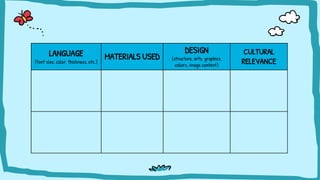
LANGUAGE
(font size, color, thickness, etc.)
MATERIALS USED
DESIGN
(structure, arts, graphics,
colors, image content)
CULTURAL
RELEVANCE
What is multimodal text?
03
Multimodal text
• Many texts are multimodal, in which all the information is expressed by integrating
different or even more modes.
• In a multimodal text, each mode has its own role and function (Kress, 2010, p. 28) in
the meaning-making process, and usually only carries a portion of the message.
• Written language, spoken language, and visual, auditory, gestural, tactile, and spatial
patterns of meaning are all modes.
• Different kinds of modes that we take in information from other people
(Mamiko, 2010).
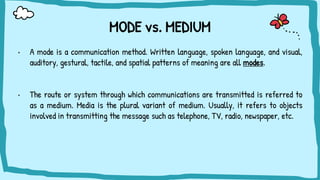
MODE vs. MEDIUM
• A mode is a communication method. Written language, spoken language, and visual,
auditory, gestural, tactile, and spatial patterns of meaning are all modes.
• The route or system through which communications are transmitted is referred to
as a medium. Media is the plural variant of medium. Usually, it refers to objects
involved in transmitting the message such as telephone, TV, radio, newspaper, etc.
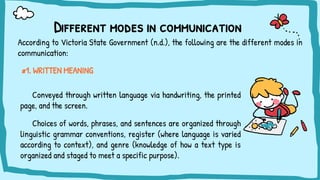
Different modes in communication
#1. WRITTEN MEANING
Conveyed through written language via handwriting, the printed
page, and the screen.
Choices of words, phrases, and sentences are organized through
linguistic grammar conventions, register (where language is varied
according to context), and genre (knowledge of how a text type is
organized and staged to meet a specific purpose).
According to Victoria State Government (n.d.), the following are the different modes in
communication:
Different modes in communication
#2. SPOKEN MEANING
Conveyed through spoken language via live or recorded
speech and can be monologic or dialogic.
Composing oral meaning includes choices around mood,
emotion, emphasis, fluency, speed, volume, tempo, pitch,
rhythm, pronunciation, intonation, and dialect
According to Victoria State Government (n.d.), the following are the different modes in
communication:
Different modes in communication
#3. VISUAL MEANING
Conveyed through choices of visual resources and includes both still
image and moving images. Images may include diverse cultural
connotations, symbolism and portray different people, cultures and
practices
Visual resources include: framing, vectors, symbols, perspective,
gaze, point of view, color, texture, line, shape, casting, saliency, distance,
angles, form, power, involvement/detachment, contrast, lighting,
naturalistic/non-naturalistic, camera movement, and subject movement
According to Victoria State Government (n.d.), the following are the different modes in
communication:
Different modes in communication
#4. AUDIO MEANING
Conveyed through sound, including choices of music
representing different cultures, ambient sounds, noises, alerts,
silence, natural/unnatural sounds, and use of volume, beat, tempo,
pitch, and rhythm.
Lyrics in a song may also include multiple languages.
According to Victoria State Government (n.d.), the following are the different modes in
communication:
Different modes in communication
#5. SPATIAL MEANING
Conveyed through design of spaces, using choices of spatial
resources including: scale, proximity, boundaries, direction, layout,
and organization of objects in the space.
Space extends from design of the page in a book, a page in a
graphic novel or comic, a webpage on the screen, framing of shots
in moving image, to the design of a room, architecture,
streetscapes, and landscapes.
According to Victoria State Government (n.d.), the following are the different modes in
communication:
Different modes in communication
#6. GESTURE MEANING
Conveyed through choices of body movement; facial expression,
eye movements and gaze, demeanor, gait, dance, acting, action
sequences. It also includes use of rhythm, speed, stillness and
angles, including ‘timing, frequency, ceremony and ritual’ (Cope &
Kalantzis, 2009. p. 362).
Gestures and body language may have diverse cultural
connotations.
According to Victoria State Government (n.d.), the following are the different modes in
communication:
Types of multimodal texts
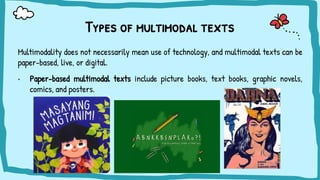
Multimodality does not necessarily mean use of technology, and multimodal texts can be
paper-based, live, or digital.
• Paper-based multimodal texts include picture books, text books, graphic novels,
comics, and posters.
Types of multimodal texts
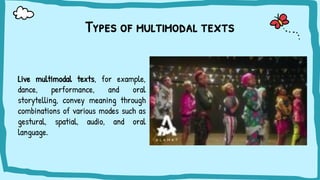
Live multimodal texts, for example,
dance, performance, and oral
storytelling, convey meaning through
combinations of various modes such as
gestural, spatial, audio, and oral
language.
Type of multimodal texts
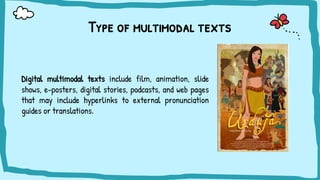
Digital multimodal texts include film, animation, slide
shows, e-posters, digital stories, podcasts, and web pages
that may include hyperlinks to external pronunciation
guides or translations.
APPLICATION
04
APPLICATION
1. Go to your Google Maps.
2. Search for places that you find interesting to visit.
3. Look for signs or symbols nearby that is related to Covid-19 (may it be a warning sign,
a poster, etc.).
4. Take a screenshot of the symbol that you have seen and paste it here:
https://jamboard.google.com/d/1vVeUh75NErPQMUvXXYaFgmeoImbS_hG-
Q1jzAqbSYjc/edit?usp=sharing
APPLICATION
5. Then, evaluate the image according to the following:
▪ Text (language/s used, font style, size, color, etc.)
▪ Paper (color, layout, size)
▪ Design (arts, graphics, colors, image content, etc.)
▪ Location where it is posted (if on the door, which place? In the middle? Left side or
right side?)
6. Taking all the observations, what information can you get from those poster/signages?

Multimodal texts

  • 1.
    MULTI-MODAL TEXTS Module 2 –Lesson 3 JOHN ALBERT M. NARES
  • 2.
    Table of Contents OBJECTIVESACTIVITY Preliminary activities Lesson objectives will be presented here. DISCUSSION APPLICATION Exercise Activities What is MULTIMODAL? 01 02 03 04
  • 3.
  • 4.
    LESSON OBJECTIVES At theend of the lesson, the students shall: 1. Define multimodal text; 2. Apply different strategies in extracting the meaning of presented multimodal texts; and 3. State the importance of understanding the concept of multimodal texts based on one’s culture.
  • 5.
  • 8.
    LANGUAGE (font size, color,thickness, etc.) MATERIALS USED DESIGN (structure, arts, graphics, colors, image content) CULTURAL RELEVANCE
  • 9.
  • 10.
    Multimodal text • Manytexts are multimodal, in which all the information is expressed by integrating different or even more modes. • In a multimodal text, each mode has its own role and function (Kress, 2010, p. 28) in the meaning-making process, and usually only carries a portion of the message. • Written language, spoken language, and visual, auditory, gestural, tactile, and spatial patterns of meaning are all modes. • Different kinds of modes that we take in information from other people (Mamiko, 2010).
  • 11.
    MODE vs. MEDIUM •A mode is a communication method. Written language, spoken language, and visual, auditory, gestural, tactile, and spatial patterns of meaning are all modes. • The route or system through which communications are transmitted is referred to as a medium. Media is the plural variant of medium. Usually, it refers to objects involved in transmitting the message such as telephone, TV, radio, newspaper, etc.
  • 12.
    Different modes incommunication #1. WRITTEN MEANING Conveyed through written language via handwriting, the printed page, and the screen. Choices of words, phrases, and sentences are organized through linguistic grammar conventions, register (where language is varied according to context), and genre (knowledge of how a text type is organized and staged to meet a specific purpose). According to Victoria State Government (n.d.), the following are the different modes in communication:
  • 13.
    Different modes incommunication #2. SPOKEN MEANING Conveyed through spoken language via live or recorded speech and can be monologic or dialogic. Composing oral meaning includes choices around mood, emotion, emphasis, fluency, speed, volume, tempo, pitch, rhythm, pronunciation, intonation, and dialect According to Victoria State Government (n.d.), the following are the different modes in communication:
  • 14.
    Different modes incommunication #3. VISUAL MEANING Conveyed through choices of visual resources and includes both still image and moving images. Images may include diverse cultural connotations, symbolism and portray different people, cultures and practices Visual resources include: framing, vectors, symbols, perspective, gaze, point of view, color, texture, line, shape, casting, saliency, distance, angles, form, power, involvement/detachment, contrast, lighting, naturalistic/non-naturalistic, camera movement, and subject movement According to Victoria State Government (n.d.), the following are the different modes in communication:
  • 15.
    Different modes incommunication #4. AUDIO MEANING Conveyed through sound, including choices of music representing different cultures, ambient sounds, noises, alerts, silence, natural/unnatural sounds, and use of volume, beat, tempo, pitch, and rhythm. Lyrics in a song may also include multiple languages. According to Victoria State Government (n.d.), the following are the different modes in communication:
  • 16.
    Different modes incommunication #5. SPATIAL MEANING Conveyed through design of spaces, using choices of spatial resources including: scale, proximity, boundaries, direction, layout, and organization of objects in the space. Space extends from design of the page in a book, a page in a graphic novel or comic, a webpage on the screen, framing of shots in moving image, to the design of a room, architecture, streetscapes, and landscapes. According to Victoria State Government (n.d.), the following are the different modes in communication:
  • 17.
    Different modes incommunication #6. GESTURE MEANING Conveyed through choices of body movement; facial expression, eye movements and gaze, demeanor, gait, dance, acting, action sequences. It also includes use of rhythm, speed, stillness and angles, including ‘timing, frequency, ceremony and ritual’ (Cope & Kalantzis, 2009. p. 362). Gestures and body language may have diverse cultural connotations. According to Victoria State Government (n.d.), the following are the different modes in communication:
  • 18.
    Types of multimodaltexts Multimodality does not necessarily mean use of technology, and multimodal texts can be paper-based, live, or digital. • Paper-based multimodal texts include picture books, text books, graphic novels, comics, and posters.
  • 19.
    Types of multimodaltexts Live multimodal texts, for example, dance, performance, and oral storytelling, convey meaning through combinations of various modes such as gestural, spatial, audio, and oral language.
  • 20.
    Type of multimodaltexts Digital multimodal texts include film, animation, slide shows, e-posters, digital stories, podcasts, and web pages that may include hyperlinks to external pronunciation guides or translations.
  • 21.
  • 22.
    APPLICATION 1. Go toyour Google Maps. 2. Search for places that you find interesting to visit. 3. Look for signs or symbols nearby that is related to Covid-19 (may it be a warning sign, a poster, etc.). 4. Take a screenshot of the symbol that you have seen and paste it here: https://jamboard.google.com/d/1vVeUh75NErPQMUvXXYaFgmeoImbS_hG- Q1jzAqbSYjc/edit?usp=sharing
  • 23.
    APPLICATION 5. Then, evaluatethe image according to the following: ▪ Text (language/s used, font style, size, color, etc.) ▪ Paper (color, layout, size) ▪ Design (arts, graphics, colors, image content, etc.) ▪ Location where it is posted (if on the door, which place? In the middle? Left side or right side?) 6. Taking all the observations, what information can you get from those poster/signages?