What is
Developmental
Reading?
Refers to a comprehensive reading program
which consists of several periods or stages.
These periods usually coincide with the
developmental stages of growth of the
individual. It is believed that one progresses
gradually in acquiring and developing certain
skills.
A DEVELOPMENTAL TASK IS A SPECIFIC RESPONSIBILITY
THAT THE INDIVIDUAL FACES AT CERTAIN STAGES OF LIFE IN
ORDER TO BE WELL-ADJUSTED. (HAVIGHURST 1981)
IN COLLEGE…
REFERS TO THE REFINEMENT OF VOCABULARY, COMPREHENSION,
LITERARY APPRECIATION, AND STUDY SKILLS WHICH ARE NEEDED
IN BOTH INTENSIVE AND EXTENSIVE READING.
WHAT IS
READING?
… it is a developmental
task
Cause No. 1- Inadequate Instruction
Cause No. 2- Lack of Appropriate Materials
Cause No. 3- Big Unmanageable Classes
Cause No. 4- Poor Attitude Towards Reading
Cause No. 5- Conflict with Interests
READING PROBLEMS
Skills required for Proficient Reading
• Phonemic Awareness
• Phonics
• Fluency
• Vocabulary
• Reading Comprehension
*National Reading Panel (2000)
Skills required for Proficient Reading
• Phonemic Awareness- ability to distinguish and
manipulate the individual sounds of language
• Phonics- study of sound
• Fluency-ability to read with speed, accuracy and
vocal expression
• Vocabulary-knowledge of words and word
meanings
• Reading Comprehension-engagement with text
Developmental Reading Stages
Stage 0 (Birth-Age 6)
Reading Readiness/
Pre Reading
Stage 1 (Age 6-7,
Grade 1-2)
Initial Reading or
Decoding
Learning to recognize the alphabet,
imitation reading,
experimentation with letters and
learning sounds
Understanding the world around
them
Sounding out words from print
Utilize consonants and vowels to
blend together simple words
Developmental Reading Stages
Stage 2(Age 7-8, Grades 2-3)
Fluency
Stage 3 (Age 9-13, Grades 4 to 2nd
Year)
Reading for Learning the New Stage
Considered to be on the ‘real’
reading stage. They are fairly
good at reading and spelling and
are ready to read without
sounding everything out.
Re-reading allows them to
concentrate on meaning and
builds fluency
Sounding out unfamiliar words and
read with fluency
Readers need to bring prior
knowledge to their reading
Acquisition of facts
Developmental Reading Stages
Stage 4 (High School;
Ages 14-18)
Multiple Viewpoints
Stage
Stage 5 (College; Ages
18 and up)
Construction and
Reconstruction
Stage
Readers are instructed in reading and
study skills
Learn to analyze what they read and
react critically
Share multiple views and concepts
Reads materials useful to them and
apply those skills
Readers know what not to read, as well
as what to read
They have the ability to synthesize
critically the works of others and
able to defend their stand on specific
issues
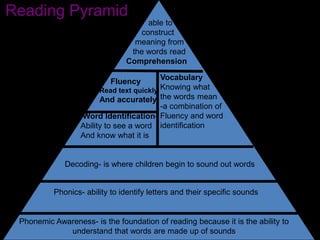
Reading Pyramid
Phonemic Awareness- is the foundation of reading because it is the ability to
understand that words are made up of sounds
Phonics- ability to identify letters and their specific sounds
Decoding- is where children begin to sound out words
Word Identification-
Ability to see a word
And know what it is
Fluency
Read text quickly
And accurately
Vocabulary
Knowing what
the words mean
-a combination of
Fluency and word
identification
able to
construct
meaning from
the words read
Comprehension
Thank you for Listening!

What is Developmental Reading?

  • 1.
  • 2.
    Refers to acomprehensive reading program which consists of several periods or stages. These periods usually coincide with the developmental stages of growth of the individual. It is believed that one progresses gradually in acquiring and developing certain skills.
  • 3.
    A DEVELOPMENTAL TASKIS A SPECIFIC RESPONSIBILITY THAT THE INDIVIDUAL FACES AT CERTAIN STAGES OF LIFE IN ORDER TO BE WELL-ADJUSTED. (HAVIGHURST 1981)
  • 4.
    IN COLLEGE… REFERS TOTHE REFINEMENT OF VOCABULARY, COMPREHENSION, LITERARY APPRECIATION, AND STUDY SKILLS WHICH ARE NEEDED IN BOTH INTENSIVE AND EXTENSIVE READING.
  • 5.
  • 6.
    … it isa developmental task
  • 7.
    Cause No. 1-Inadequate Instruction Cause No. 2- Lack of Appropriate Materials Cause No. 3- Big Unmanageable Classes Cause No. 4- Poor Attitude Towards Reading Cause No. 5- Conflict with Interests READING PROBLEMS
  • 8.
    Skills required forProficient Reading • Phonemic Awareness • Phonics • Fluency • Vocabulary • Reading Comprehension *National Reading Panel (2000)
  • 9.
    Skills required forProficient Reading • Phonemic Awareness- ability to distinguish and manipulate the individual sounds of language • Phonics- study of sound • Fluency-ability to read with speed, accuracy and vocal expression • Vocabulary-knowledge of words and word meanings • Reading Comprehension-engagement with text
  • 10.
    Developmental Reading Stages Stage0 (Birth-Age 6) Reading Readiness/ Pre Reading Stage 1 (Age 6-7, Grade 1-2) Initial Reading or Decoding Learning to recognize the alphabet, imitation reading, experimentation with letters and learning sounds Understanding the world around them Sounding out words from print Utilize consonants and vowels to blend together simple words
  • 11.
    Developmental Reading Stages Stage2(Age 7-8, Grades 2-3) Fluency Stage 3 (Age 9-13, Grades 4 to 2nd Year) Reading for Learning the New Stage Considered to be on the ‘real’ reading stage. They are fairly good at reading and spelling and are ready to read without sounding everything out. Re-reading allows them to concentrate on meaning and builds fluency Sounding out unfamiliar words and read with fluency Readers need to bring prior knowledge to their reading Acquisition of facts
  • 12.
    Developmental Reading Stages Stage4 (High School; Ages 14-18) Multiple Viewpoints Stage Stage 5 (College; Ages 18 and up) Construction and Reconstruction Stage Readers are instructed in reading and study skills Learn to analyze what they read and react critically Share multiple views and concepts Reads materials useful to them and apply those skills Readers know what not to read, as well as what to read They have the ability to synthesize critically the works of others and able to defend their stand on specific issues
  • 13.
    Reading Pyramid Phonemic Awareness-is the foundation of reading because it is the ability to understand that words are made up of sounds Phonics- ability to identify letters and their specific sounds Decoding- is where children begin to sound out words Word Identification- Ability to see a word And know what it is Fluency Read text quickly And accurately Vocabulary Knowing what the words mean -a combination of Fluency and word identification able to construct meaning from the words read Comprehension
  • 14.
    Thank you forListening!