Washington State University August 12, 2009
Jack McCullough, Planning and Solutions Coach The Center for Educational Effectiveness, Inc.
Group Norms Participate in a positive manner. Actively listen to the viewpoints of your colleagues.  Disagree in a respectful manner. Take care of personal needs. Stay on task.  Refrain from sidebar conversations. Have fun!
Today you will: Receive one set of Data Carousel Planning Templates per person and learn how to use it Share stories concerning common experience with data reviews Refine your Theory of Action surrounding the use of data Identify common concerns when proposing a data review Receive one Data Primer and discuss how it might be used Receive one Data Carousel Accelerator sample and discuss how it might be used Begin planning your data carousel/activity  Receive a list of potential resources.
“ Even if you're on the right track, you'll get run over if you just sit there." — Will Rogers
Creating the case for Common Language and Consistent Practice Using Marvin’s Model An engagement activity
A Culture of Inquiry What comes to your mind? Using Marvin’s Model
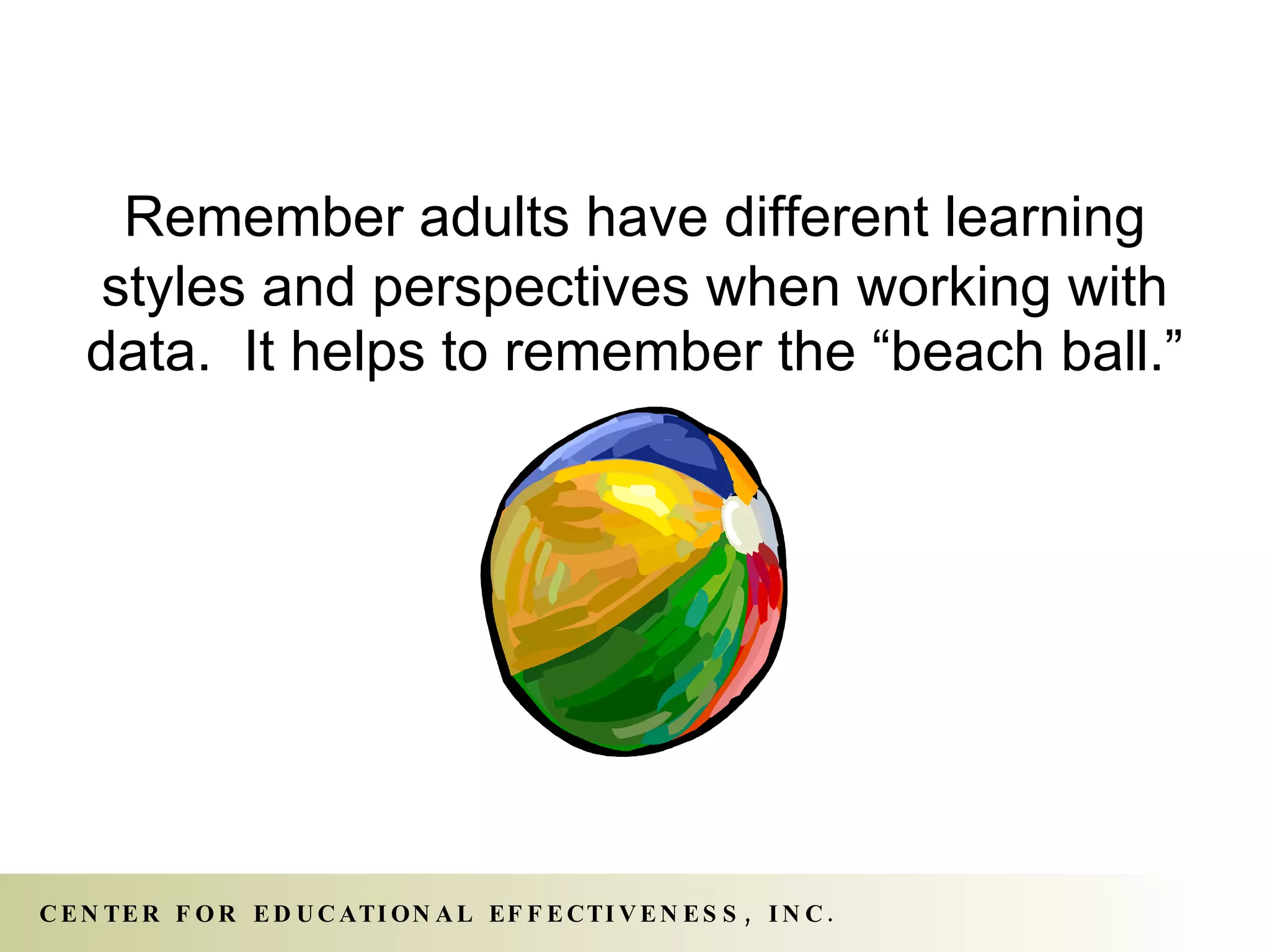
Remember adults have different learning styles and perspectives when working with   data.  It helps to remember the “beach ball.”
  Data-analysis is like the ocean because…
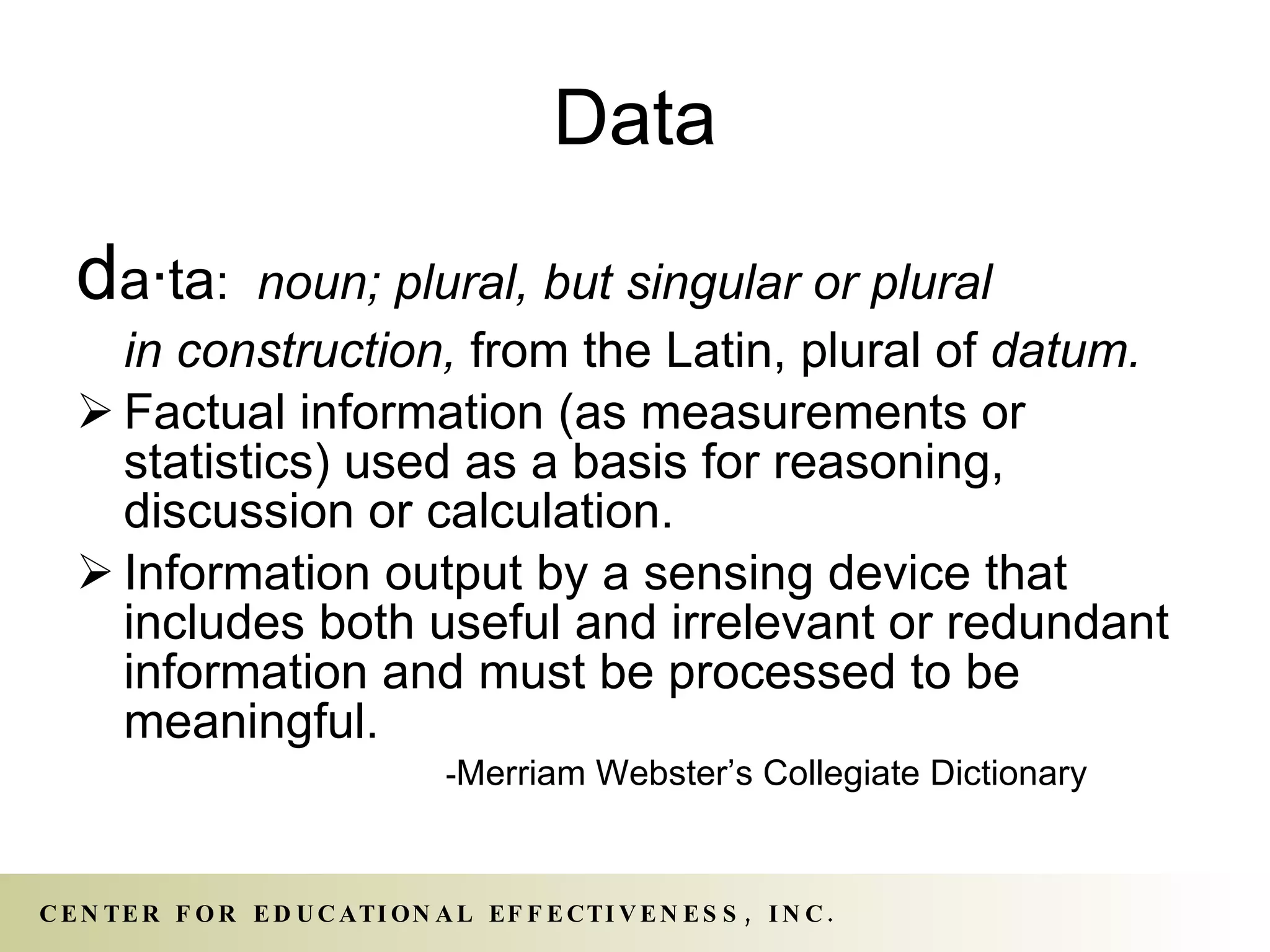
Data d a · ta :  noun; plural, but singular or plural  in construction,  from the Latin, plural of  datum. Factual information (as measurements or statistics) used as a basis for reasoning, discussion or calculation. Information output by a sensing device that includes both useful and irrelevant or redundant information and must be processed to be meaningful. - Merriam Webster’s Collegiate Dictionary
“ We are a society that is data rich but information poor.”   -Robert H. Waterman
Avoid the Drip D ata  R ich   I nformation  P oor
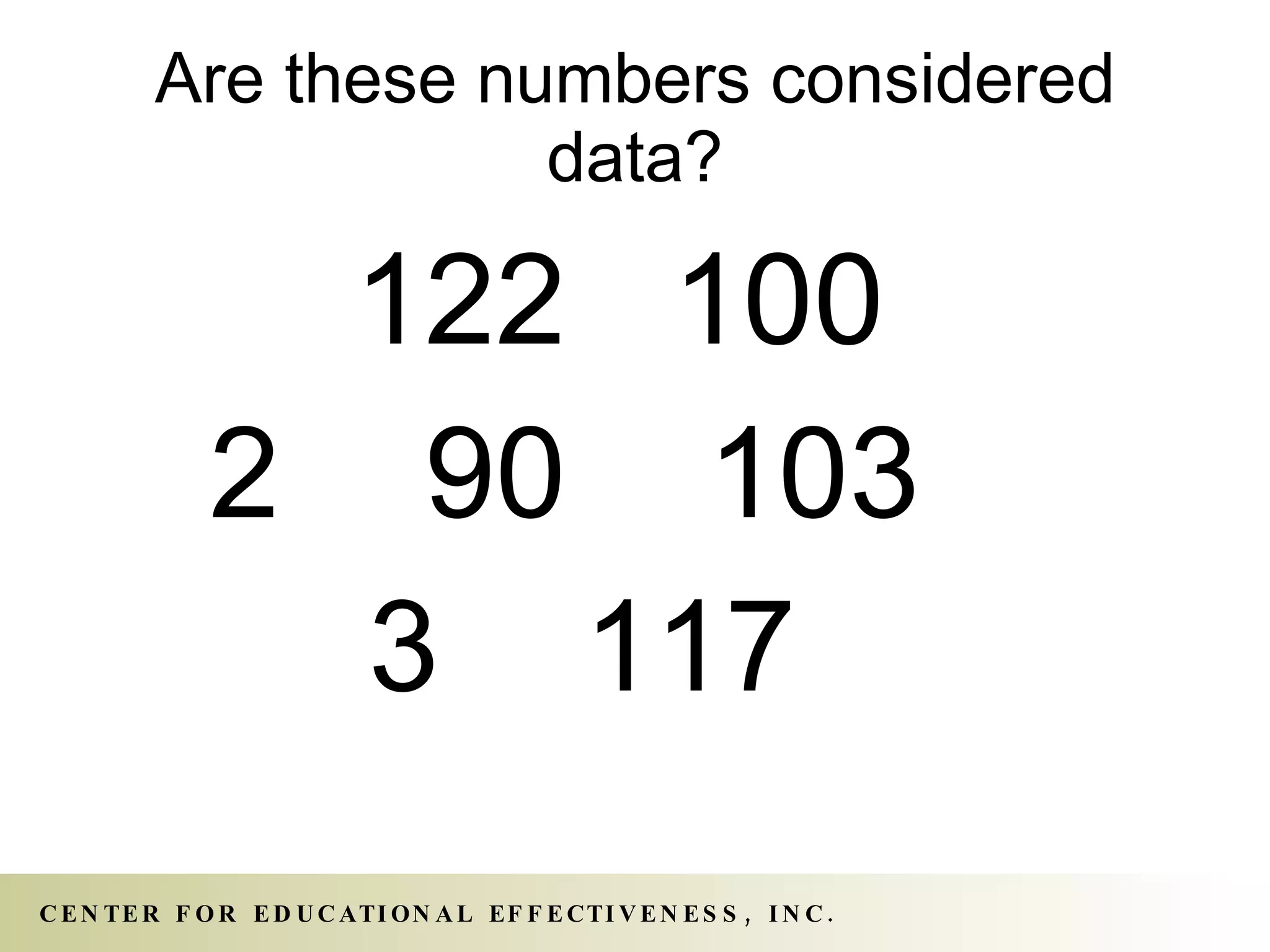
Are these numbers considered data? 122   100 90   103   117
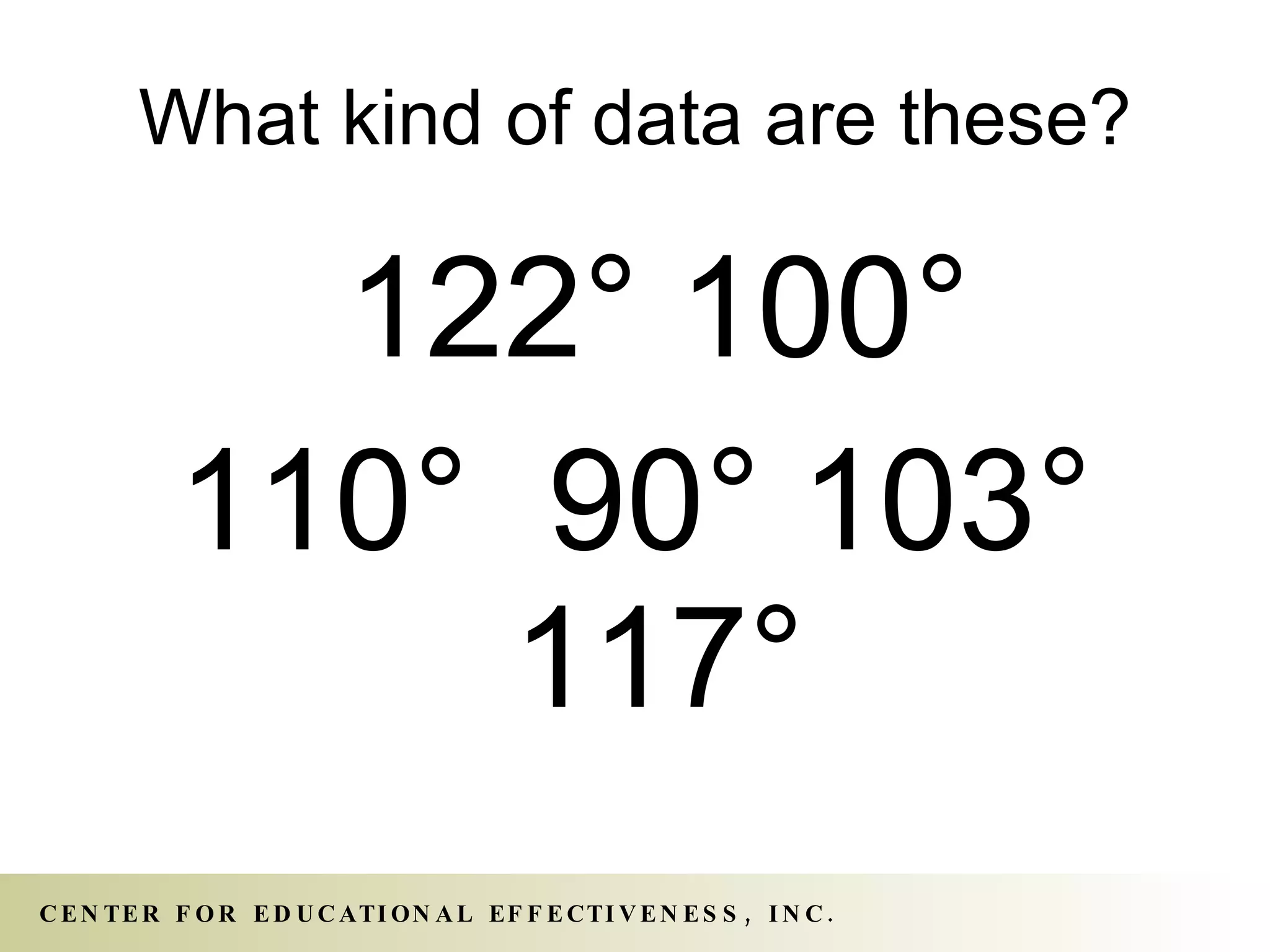
What kind of data are these? 122 °  100 ° 110 °  90 °  103 °  117 °
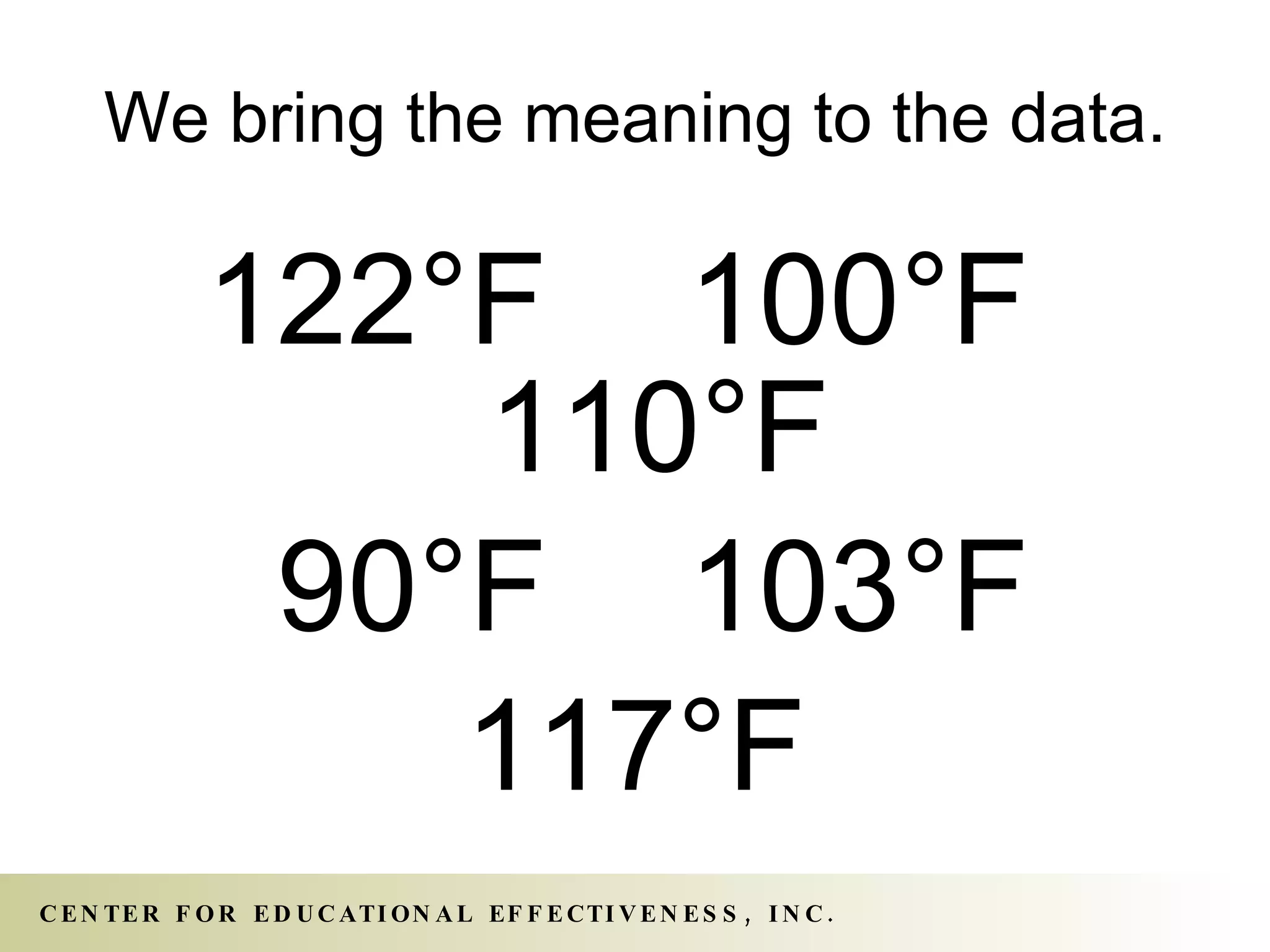
We bring the meaning to the data. 122 °F  100 °F  110 °F 90 °F  103 °F  117 °F
Guiding Assumptions 1. Data have no meaning. Data are just information until people organize, analyze and interpret meaning.  Interpretation is subjective; data are objective.  Frames of reference influence the meaning we derive from the data we collect and select.
2.  Understanding should proceed planning. Determine the desired outcome. Clearly define the problems. Cultivate collegial dialogue prior  to planning.
3. Knowledge is both a personal and a social construction. Human beings are meaning-making organisms.  We sift through personal and social filters, forming beliefs and ways of knowing.  Individuals interact with information and with others shape new understandings about our world.
4.  Cycles of inquiry Inquiry, experimentation and reflection accelerate continuous growth and learning. Learning occurs when we shift from professional certainty to conscious curiosity.  Constant pursuit of meaningful questions from thoughtful data analysis and ongoing monitoring of progress.
5. Norms of data-driven collaboration Data alone leads to no action. Collective inquiry generates continuous improvements. Meaning and action result from professional learning communities that develop a shared commitment to improve student learning. - Wellman, Bruce and Lipton, Laura.(2004). Data Driven Dialogue.
“Teachers blaze the path to knowledge when they purposefully use data as a source for analyzing progress and proactively plan for improvement.” Wellman & Lipton. (2004).  Data Driven Dialogue.
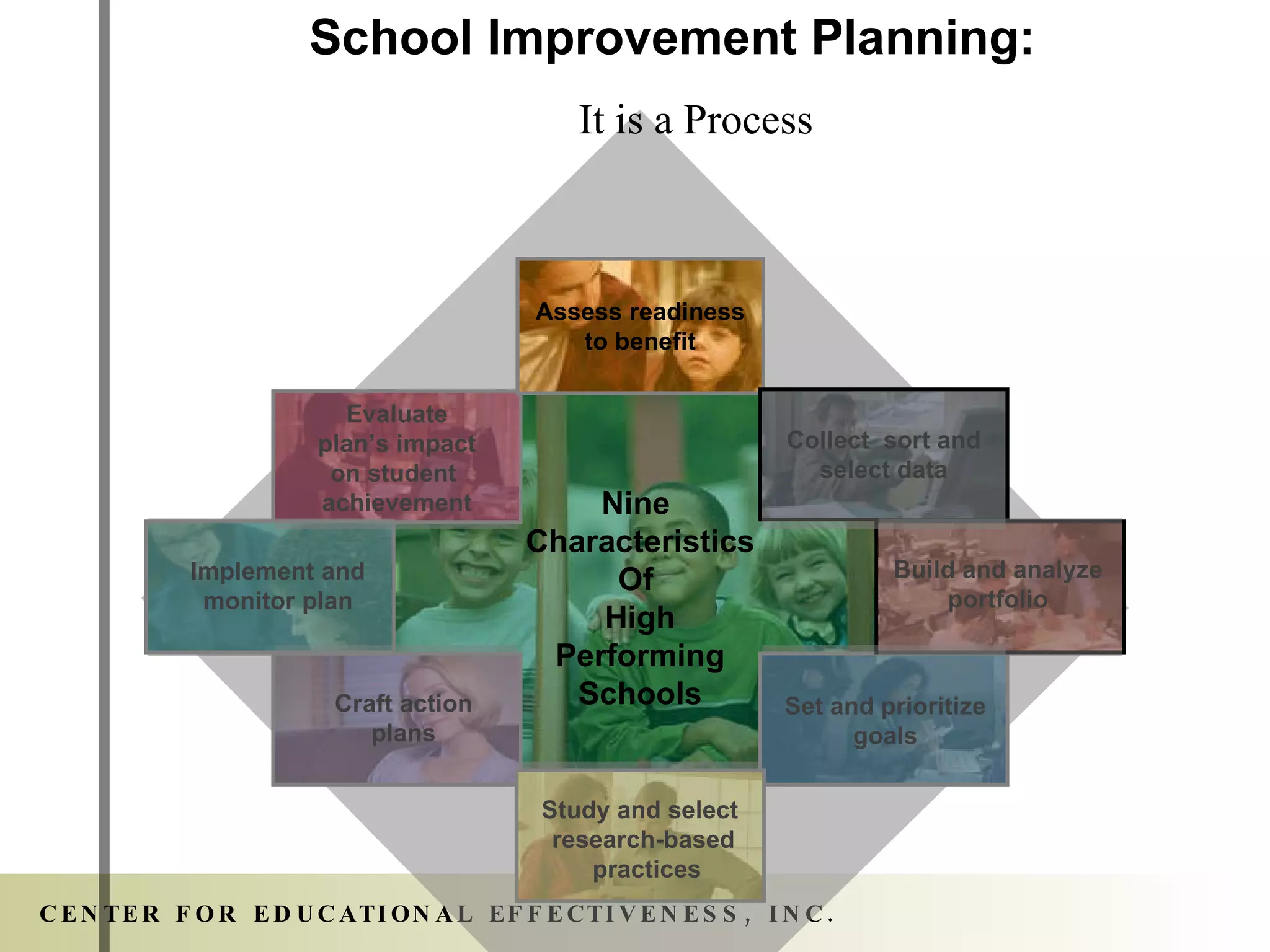
School Improvement Planning: Nine  Characteristics Of  High Performing Schools Evaluate plan’s impact on student  achievement Set and prioritize goals It is a Process Craft action plans Study and select  research-based practices Assess readiness to benefit Collect  sort and select data Build and analyze portfolio Implement and monitor plan
Benefits of data analysis It is more than solving a particular student learning problem School/District improvement teams become more efficient and effective Decisions making becomes ore collaborative Teachers develop more positive attitudes about their and their students’ abilities Educators feel more in charge of their own destinies Development of school wide culture if inquiry
Data Carousel Planning Template CEE has created template sheets to assist your team in planning your data carousel activity. You will spend time today using these sheets and will identify (today) many of your challenges for planning and executing a successful carousel.
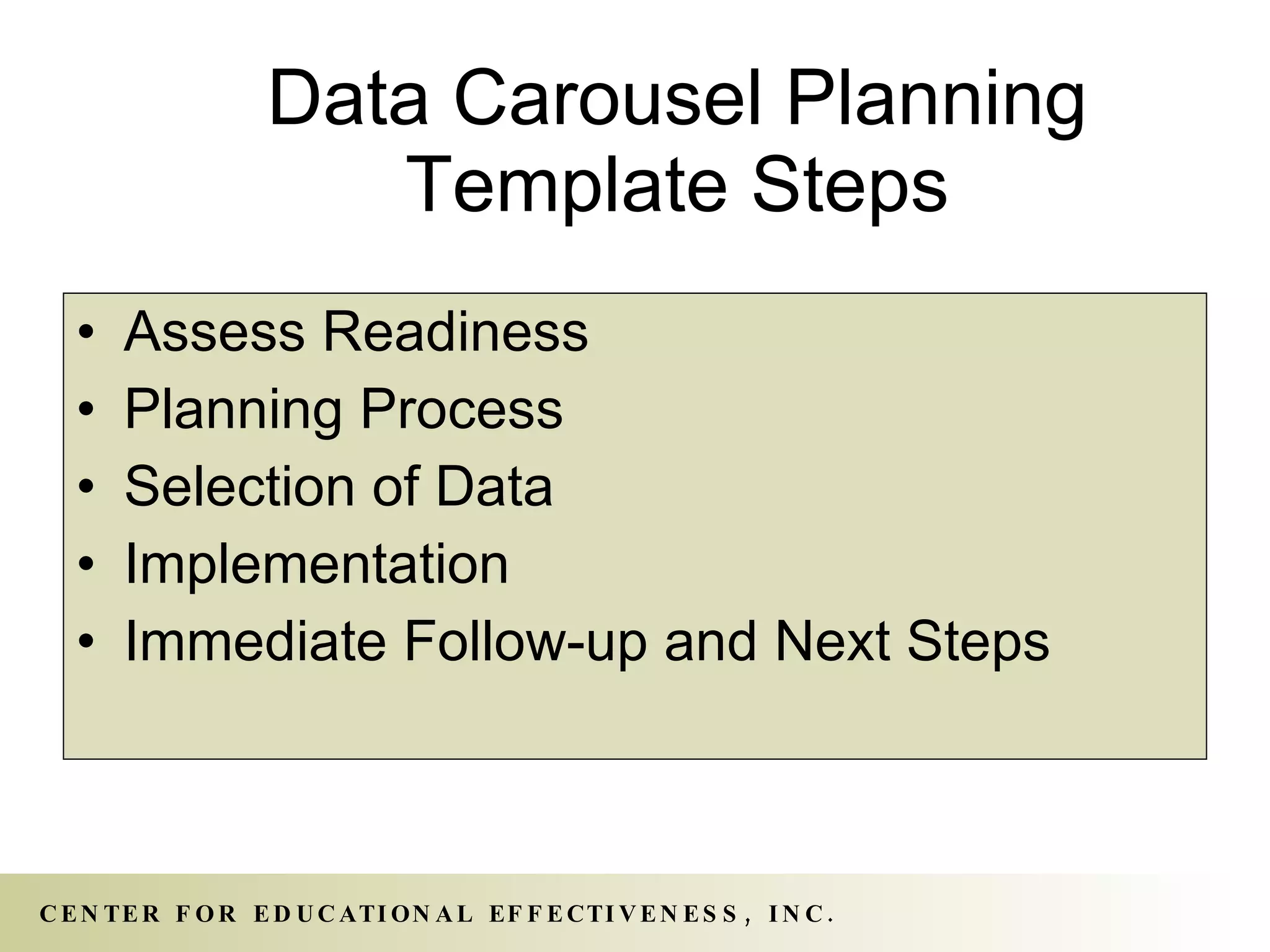
Data Carousel Planning Template Steps Assess Readiness Planning Process Selection of Data Implementation Immediate Follow-up and Next Steps
Key Data Decisions Depth & breadth of data Carousel model Presentation of data Responding to Guiding Questions Planning Process
Carousels are: A data sharing and exploration strategy A data analysis activity A process to identify needs and “next steps” in digging deeper Effective to engage multiple times per year
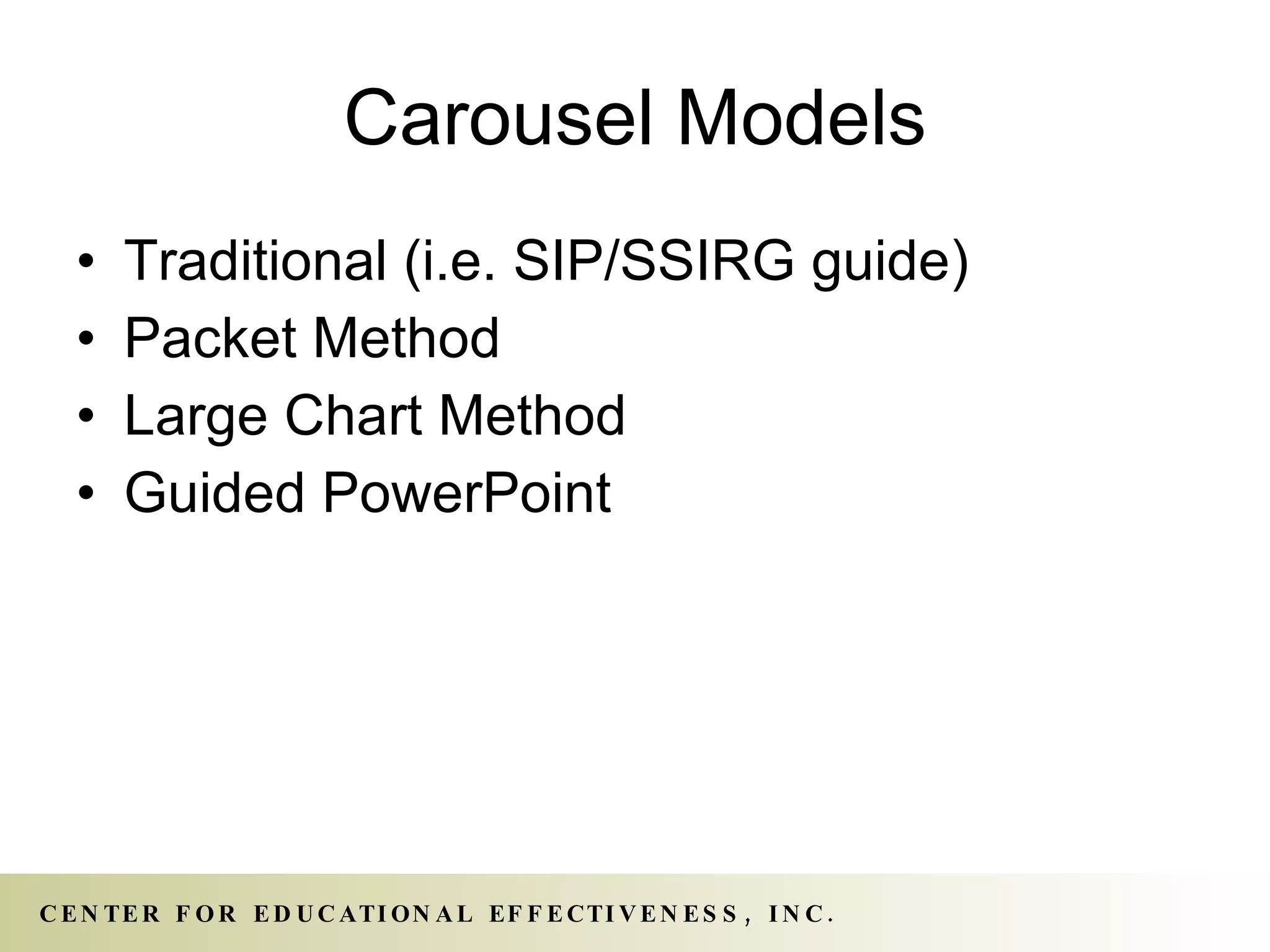
Carousel Models Traditional (i.e. SIP/SSIRG guide) Packet Method Large Chart Method Guided PowerPoint
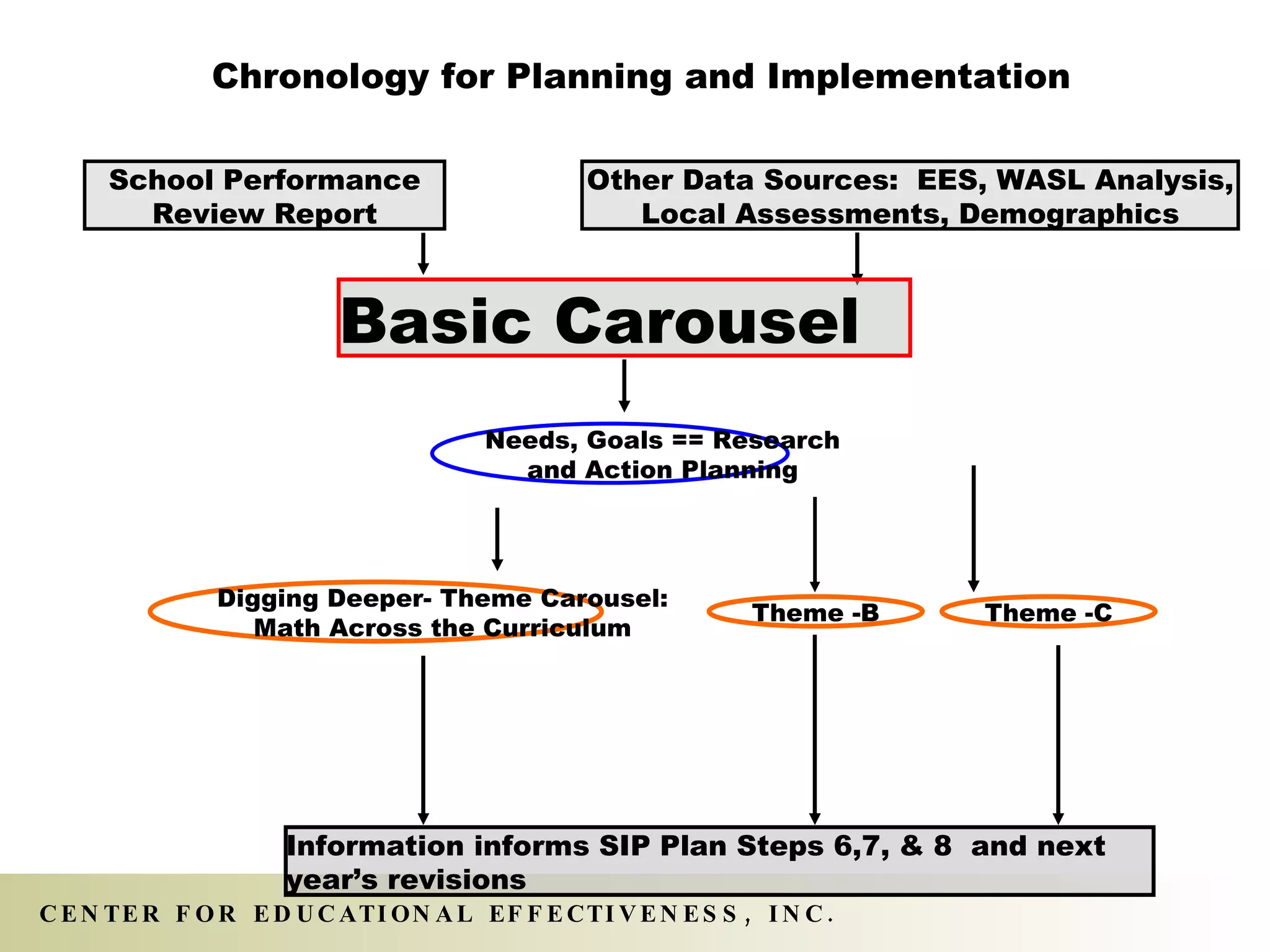
Digging Deeper- Theme Carousel: Math Across the Curriculum Needs, Goals == Research and Action Planning Theme -B Theme -C Other Data Sources:  EES, WASL Analysis, Local Assessments, Demographics Basic Carousel Information informs SIP Plan Steps 6,7, & 8  and next year’s revisions School Performance Review Report Chronology for Planning and Implementation
Data Carousel  A means for engaging the entire staff in the process of data analysis Typically 2-3 hours in length if done at one setting (My bias is not to do it in one setting) Intended to be a high level scan to determine trends, strengths and concerns
Arrangements Space Materials Roles Timeline/schedule Food or snacks Reminders Distribute prep materials Prepare facilitators Implementation
Time and People Decisions Number Stakeholders Skills Communication
Data Training Requirements 4 Domains of Data Writing narratives Types of carousel
Why are some schools successful and others not when implementing the same improvement strategies? Readiness   Guiding Question   Assess readiness to benefit
Willingness – attitudes, experiences, buy-in Process Skills Decision-making Conflict management Problem-solving Code of cooperation Roles We Play Assess Readiness
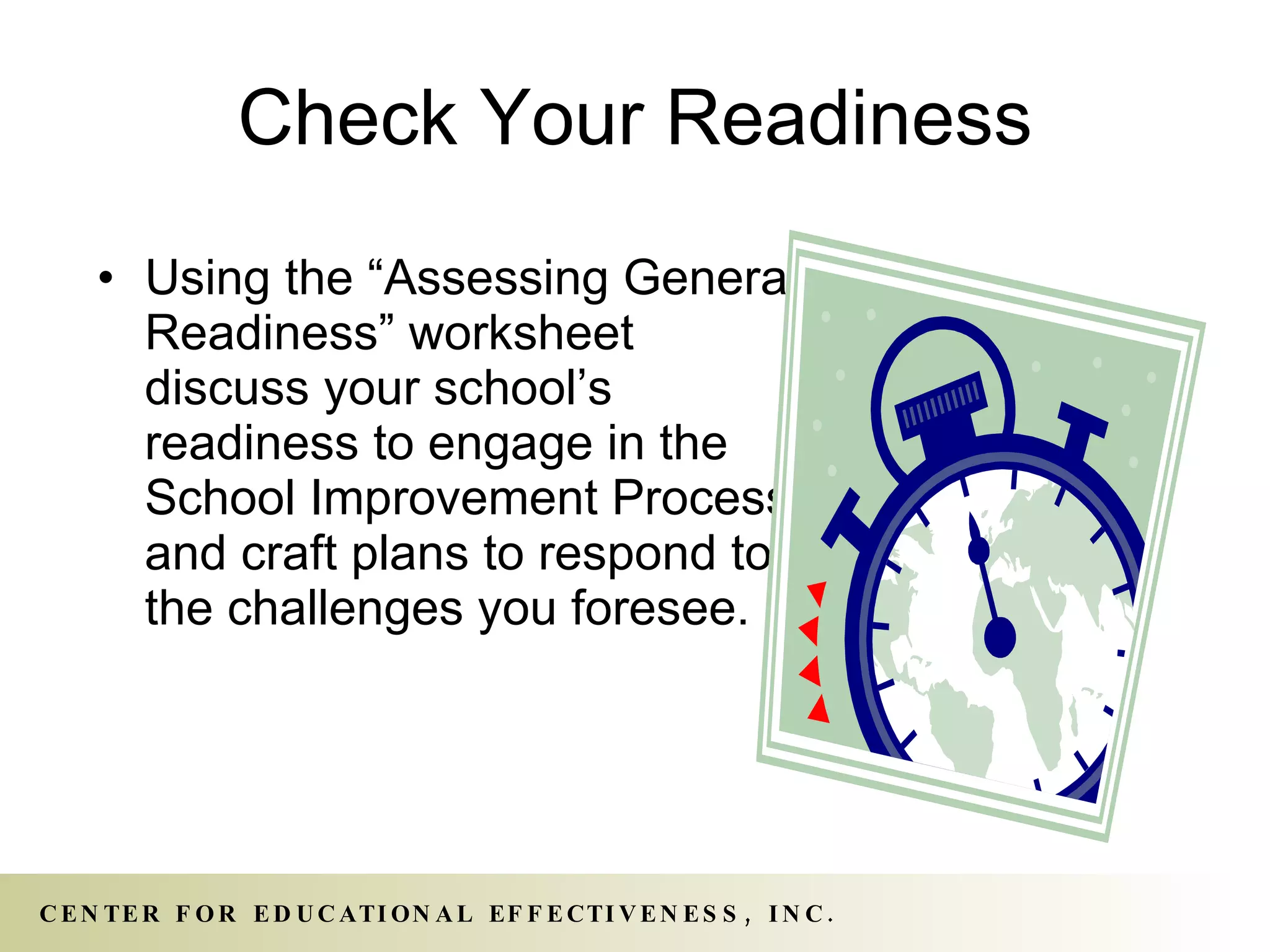
Check Your Readiness Using the “Assessing General Readiness” worksheet discuss your school’s readiness to engage in the School Improvement Process and craft plans to respond to the challenges you foresee.
Basic or Initial Carousels All 4 Domains of Data Designed to give large groups (i.e. all staff, all certs, all certs+IA/ParaPros or greater “community stakeholders”) a broad view of information Contain “non-negotiables”
Process 1: Carousel So, let’s say there are 4 tables for the 4 data groups… Staff are asked to look at the data and craft narratives They do this for about 20 minutes Then they move to the next table Repeat until all data has been reviewed Logistical Considerations: Who will be involved in the Carousel? What could you do to make it even more fun? A theme perhaps? Should staff be assigned tables? Snacks, meals and comfort of participants?
Pause and Reflect on what you saw and heard.  What is running around in your head?
Where Do We Go From Here? Teachers and principals alike assess student and teacher achievement early and often – and use the information to drive improvement rather than assign blame. The key, however, is not simply that the successful schools have data – it’s who is using the data and how they use the data.   Beat The Odds (2006)
Guided Questions  Help bring clarity Helps bring focus to more than one thing Helps bring focus to elements of leadership Guided Question Stem “What evidence do I have…”
Well conceived guided questions should Inquire into the nature (what) Inquire into the quality (how well) Inquire into the frequency (how often)
Remember that with data analysis you are trying to  define the problem , not solve it.
Triangulation - Adding relevance and meaning through multiple data sources
Some guided questions to use when thinking about  Dr. Ken Jenkins UNC @Chapel Hill Where are your widest achievement gaps? How persistent have these gaps been? Are there dramatic difference from one year to the next? What might explain the differences? Are the gender difference worth noting? Is there any relationship you can determine between the population of free and reduced price lunch students and general student achievement? For High School, are there differences between major curriculum areas worth noting? What are the bright spots contained within the data?
Has the team collected data from multiple indicators (i.e. student assessment, perception, demographic, school context)? Has the team determined what data should be included in the school’s portfolio? Has the team determined a process for allowing all stakeholders to analyze the data? Has the team determined how the data will be displayed? Collect, Sort and Select Data
Characteristics, Qualities and Types 4 Domains Formative Summative Longitudinal Relevant Reliable Valid Aligned with standards Community sensitive Selection of Data
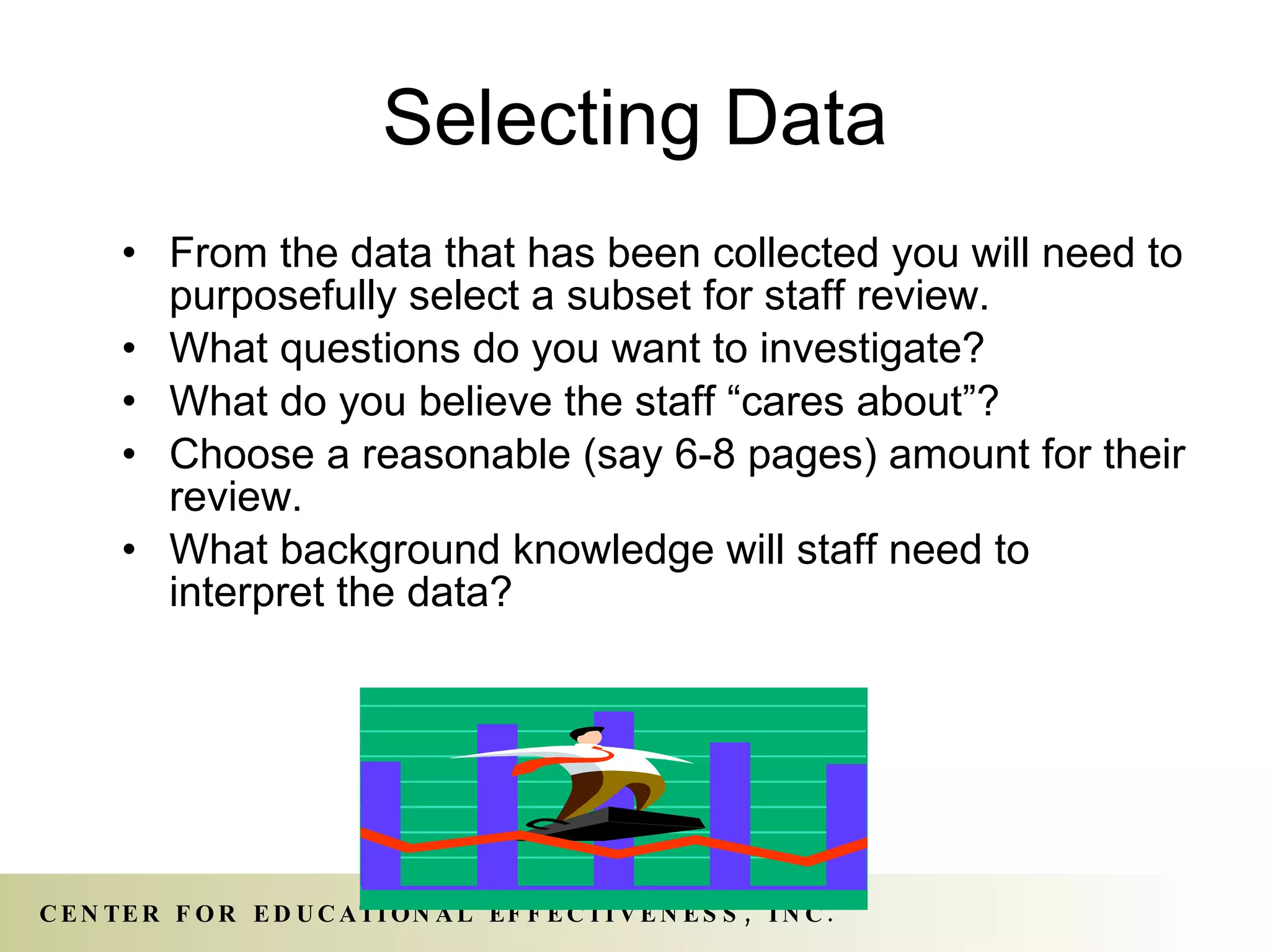
Selecting Data From the data that has been collected you will need to purposefully select a subset for staff review. What questions do you want to investigate? What do you believe the staff “cares about”? Choose a reasonable (say 6-8 pages) amount for their review. What background knowledge will staff need to interpret the data?
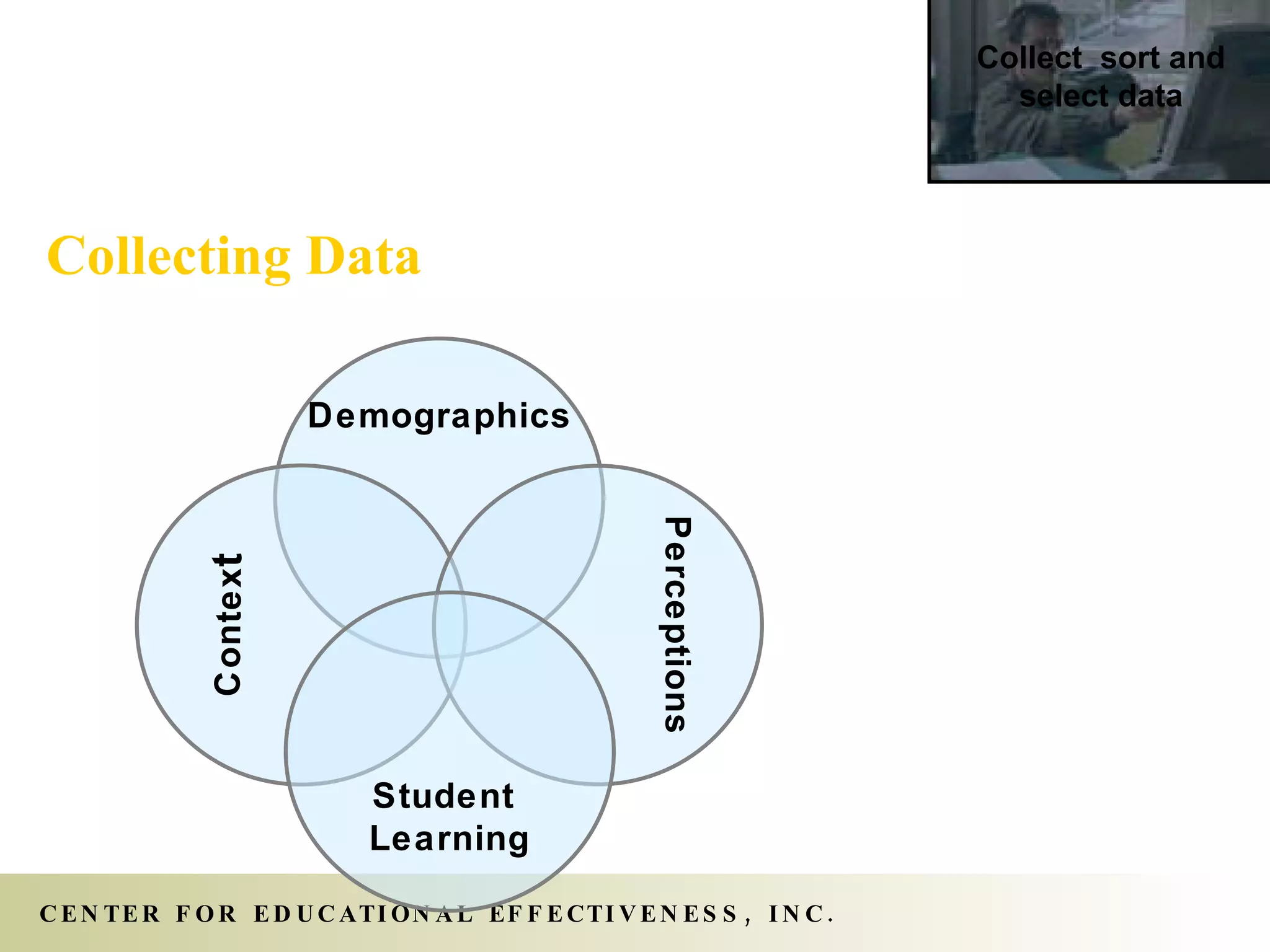
Demographics Contex t Perceptions Student  Learning Collecting Data Collect  sort and select data
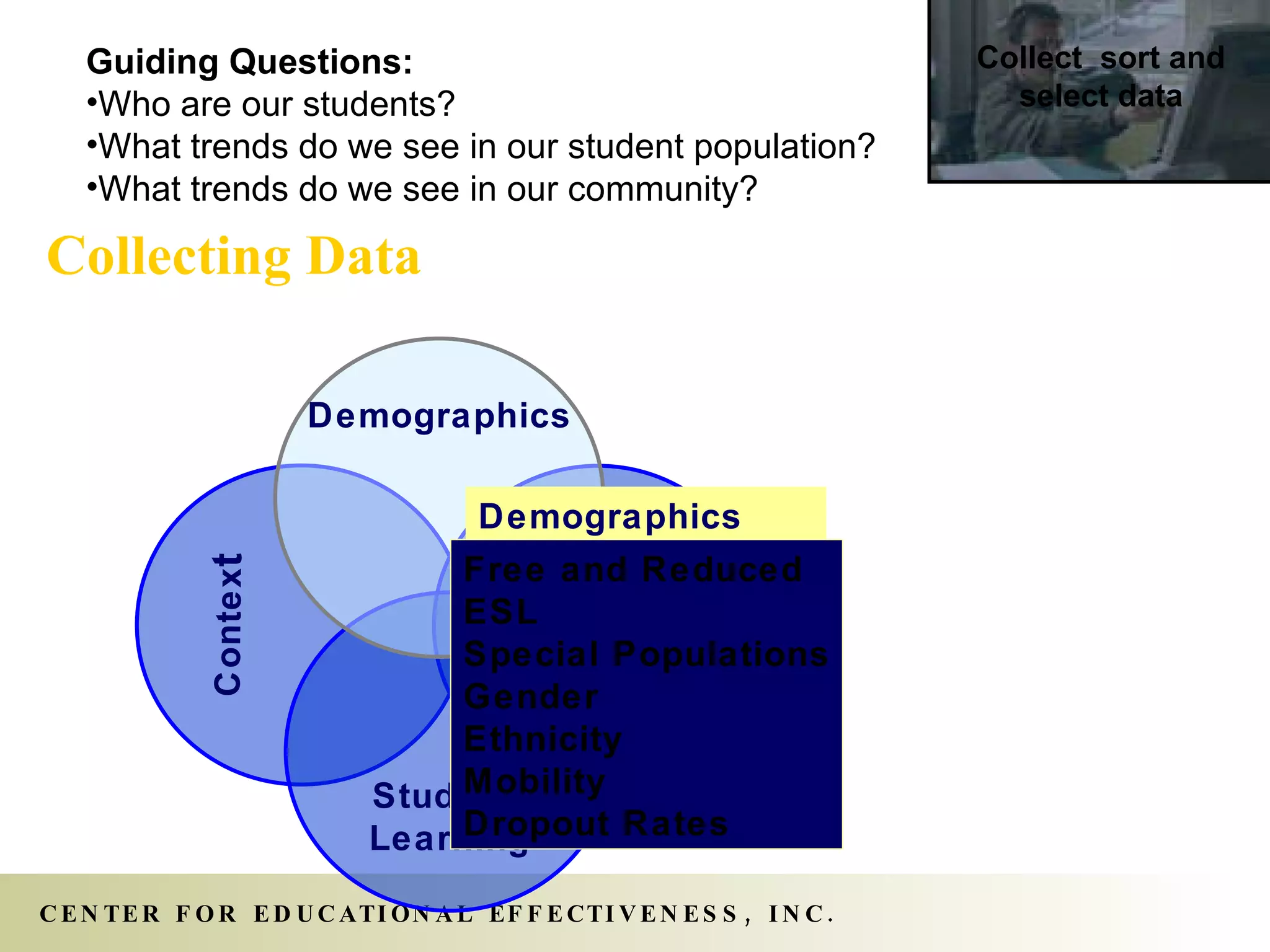
Collecting Data Contex t Perceptions Student  Learning Demographics Guiding Questions: Who are our students? What trends do we see in our student population? What trends do we see in our community? Collect  sort and select data Free and Reduced ESL Special Populations Gender Ethnicity Mobility Dropout Rates Demographics
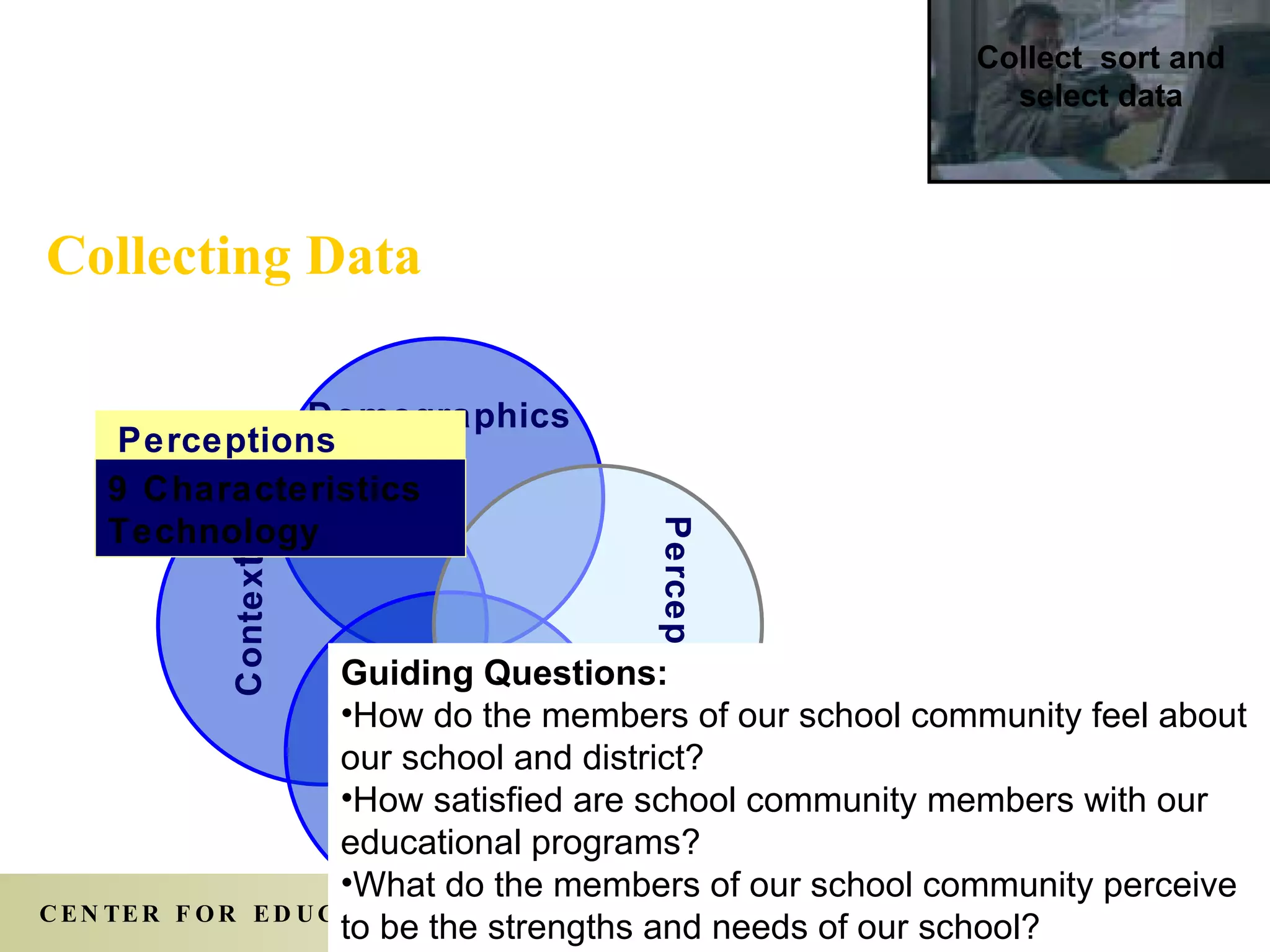
Collecting Data Demographics Contex t Student  Learning Perceptions Guiding Questions: How do the members of our school community feel about our school and district? How satisfied are school community members with our educational programs? What do the members of our school community perceive to be the strengths and needs of our school? Collect  sort and select data Perceptions 9 Characteristics Technology
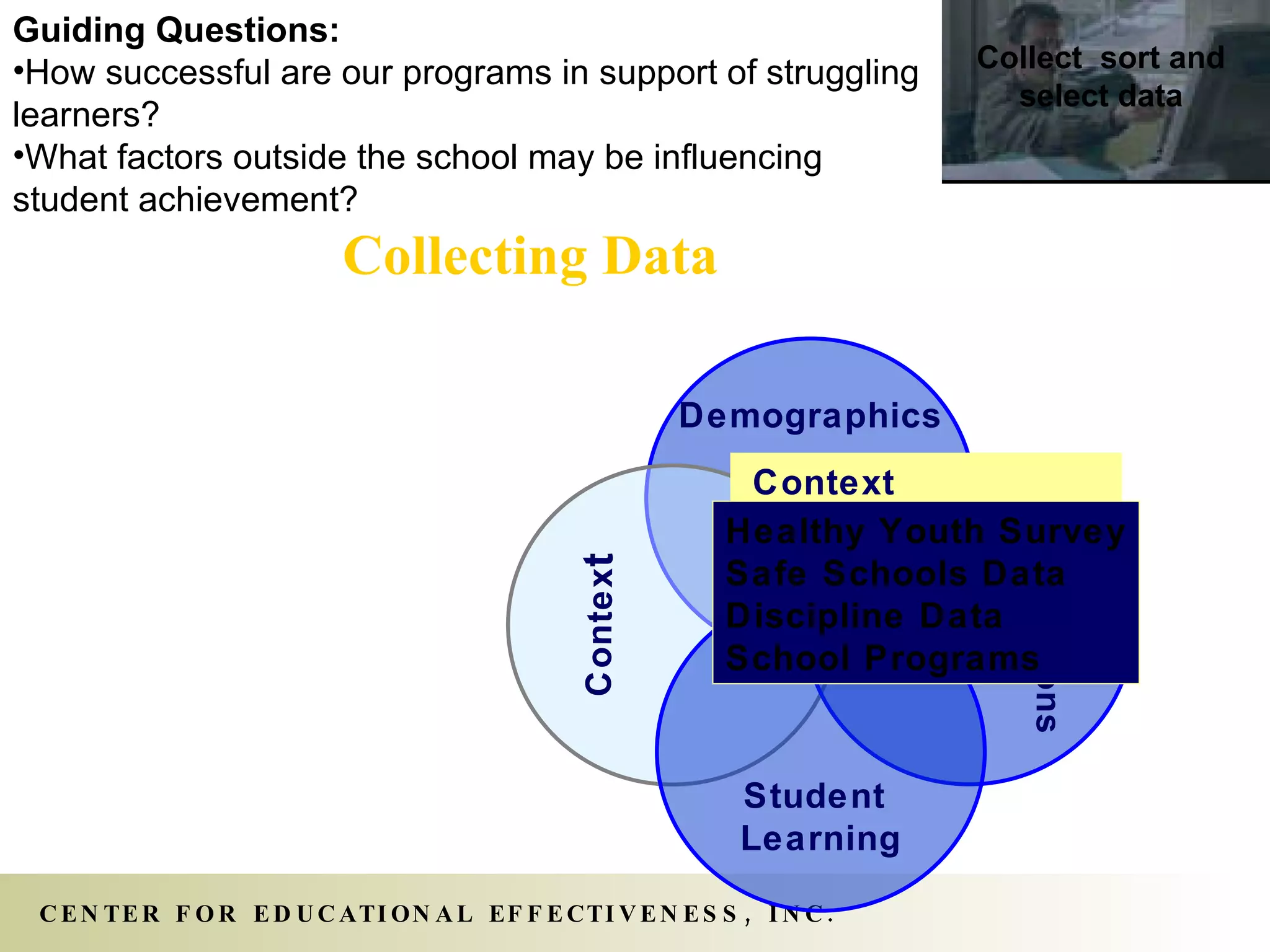
Collecting Data Demographics Contex t Perceptions Student  Learning Guiding Questions: How successful are our programs in support of struggling learners? What factors outside the school may be influencing student achievement? Collect  sort and select data Context Healthy Youth Survey Safe Schools Data Discipline Data School Programs
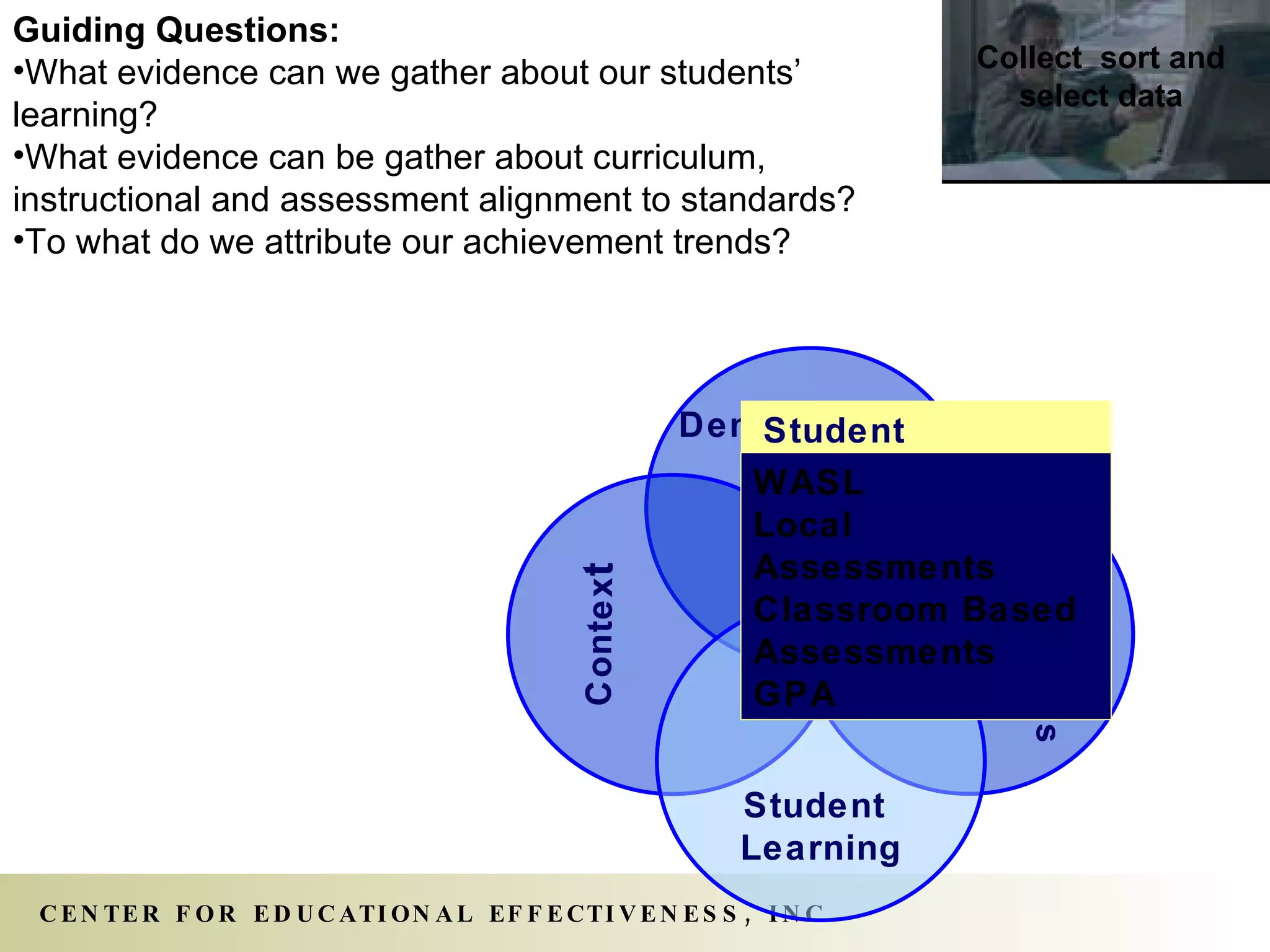
Demographics Perceptions Contex t Student  Learning Guiding Questions: What evidence can we gather about our students’ learning? What evidence can be gather about curriculum, instructional and assessment alignment to standards? To what do we attribute our achievement trends? Collect  sort and select data Student Learning WASL Local Assessments Classroom Based Assessments GPA
Has the team selected appropriate data from each domain? Is data displayed in a manner that is easy to interpret? Do staff members know how to craft narrative statements? Is there a process for engaging staff in review of data? Is there a model for reaching consensus? Build and Analyze Portfolio
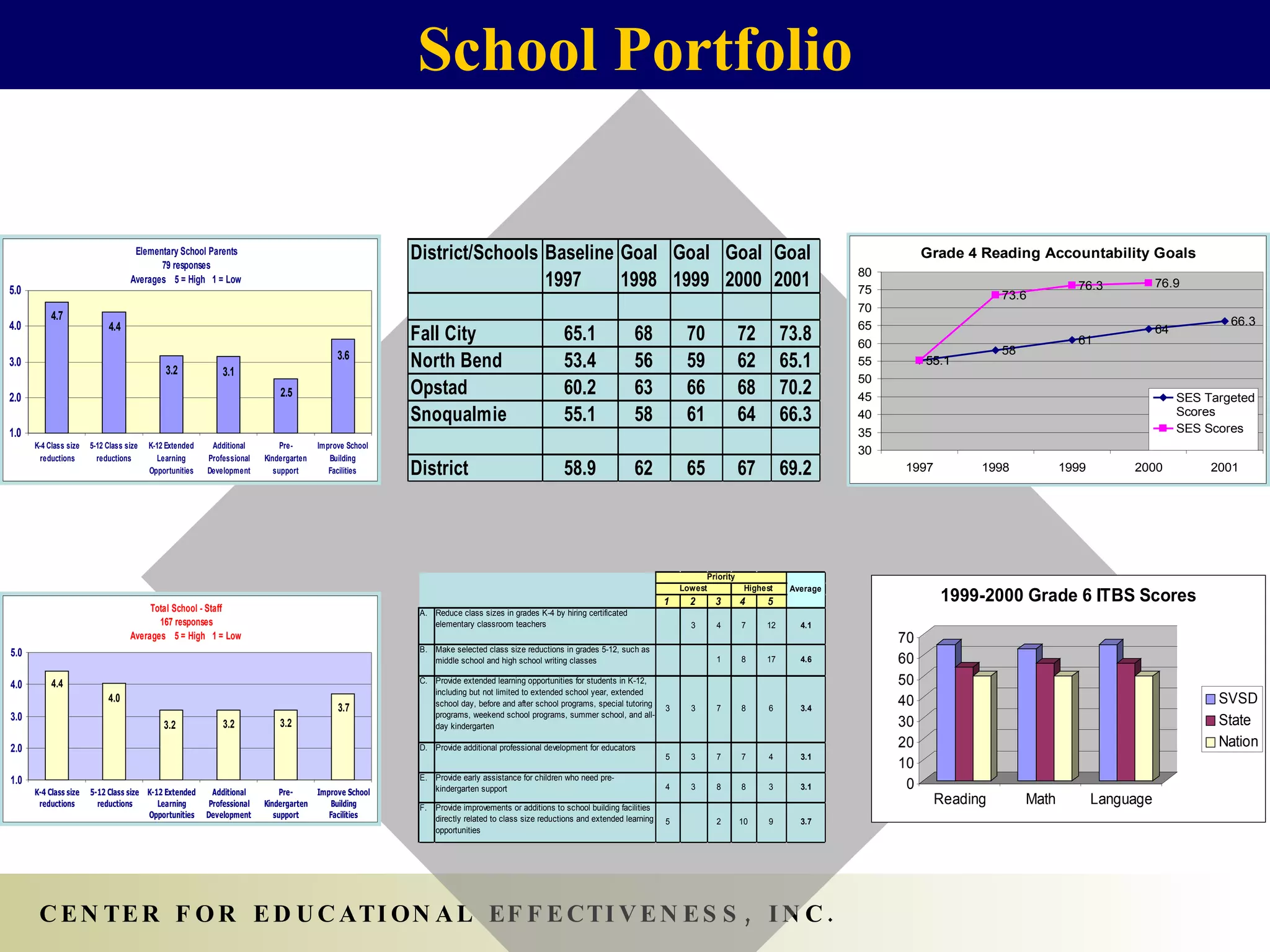
School Portfolio
Data exploration during the carousel activity Logistics – people, facility, movement of data, # of copies, cost Encourage open-mindedness
During the carousel activity Review why and process Basic skill review Allow all participants opportunity to see data Narrative statements - process
Writing Narratives Keep it simple- Communicate a single idea. Make them short and easy to read Avoid Evaluation- Describe what you see, not what caused it or what to do about it
Criteria for Good Narratives Content Describe building wide performance Describe trends in performance over time Describe high and low performing groups Compare performance in your building with a benchmark for example statewide performance Format Good Narratives Communicate a single idea about student performance Are short, clear sentences or phrases Are descriptive rather than evaluative Use everyday language that is easy to understand Are independent statement that incorporate numbers
Product 1: List of Concerns At the end of the Carrousel, the staff should have access to a list of concerns based on data You will need to determine the method for collecting concerns and returning them to staff
Process 2: Rating and Ranking The team should select a process for reaching consensus about the school’s priority concerns. We have used a rating and ranking activity Staff is given printed copies of the concerns from the Data Carousel They are asked to read for clarification (not allowed to lobby for or against a concern) They are also asked to eliminate any duplicates Staff select their 5 greatest concerns Staff assign points to their concerns (5 to 1) with 5 points assigned to the greatest concern and 1 go the least Public vote for each concern Most points wins
Product 2: A prioritized list of concerns At the end of the Data Carrousel, the staff will leave with a list of prioritized concerns. Next step is typically a leadership team activity:  Group concerns into themes and craft goal statements. This process results in a deeper understanding of the school’s data, allows for staff input regarding priorities, supports a transparent decision making process.
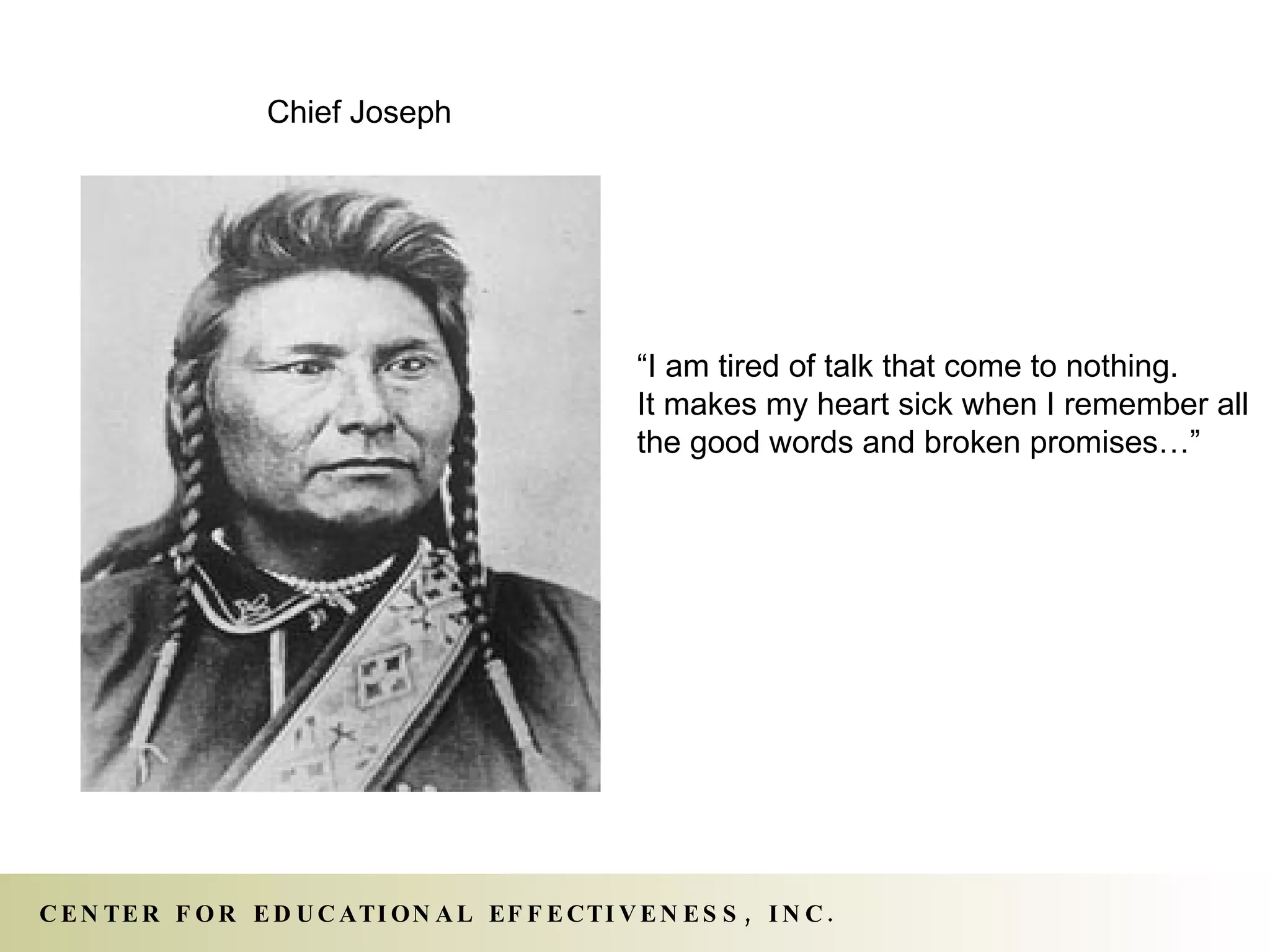
“I am tired of talk that come to nothing. It makes my heart sick when I remember all the good words and broken promises…” Chief Joseph
 
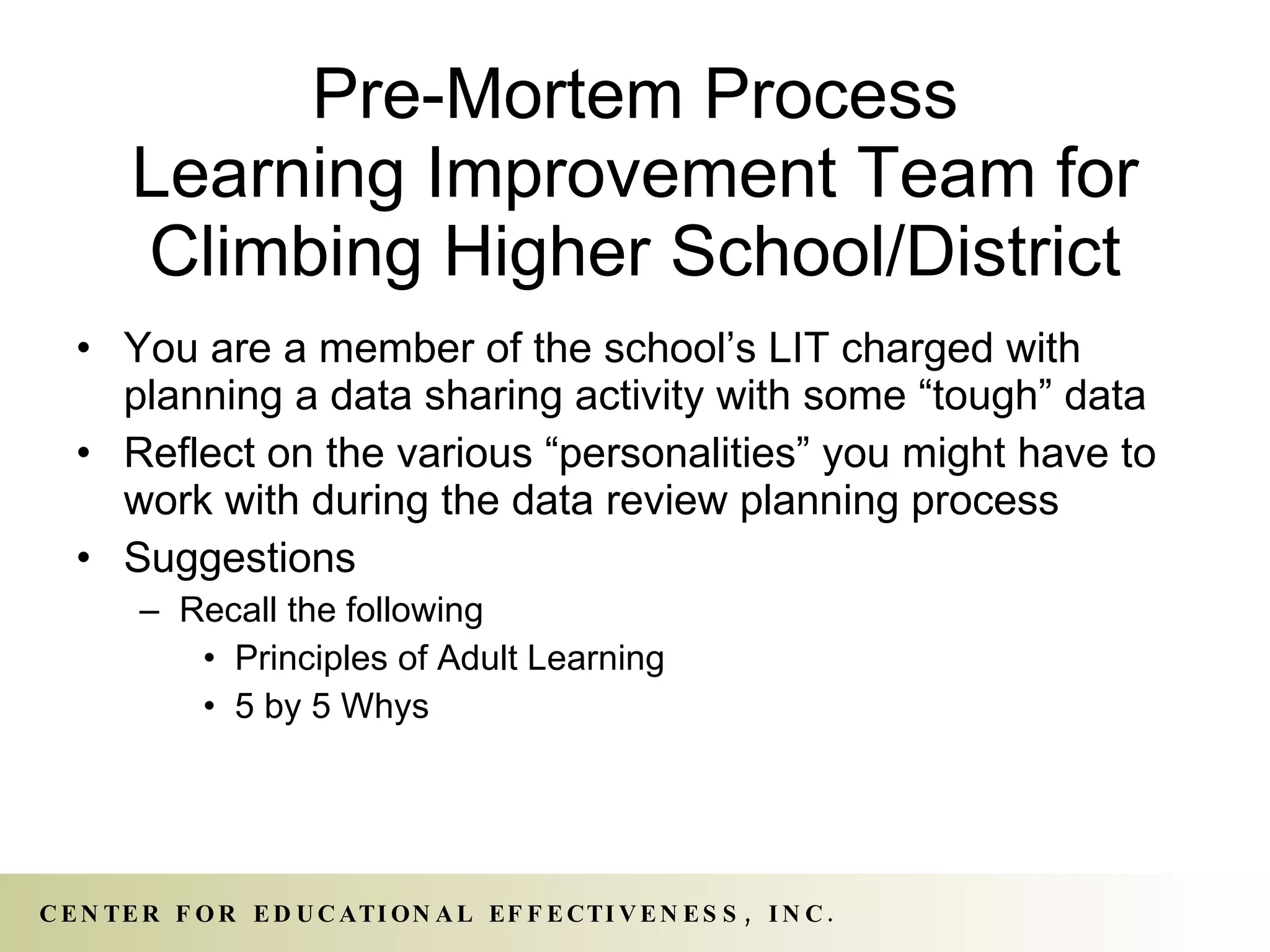
Pre-Mortem Process Learning Improvement Team for Climbing Higher School/District You are a member of the school’s LIT charged with planning a data sharing activity with some “tough” data Reflect on the various “personalities” you might have to work with during the data review planning process Suggestions  Recall the following Principles of Adult Learning 5 by 5 Whys


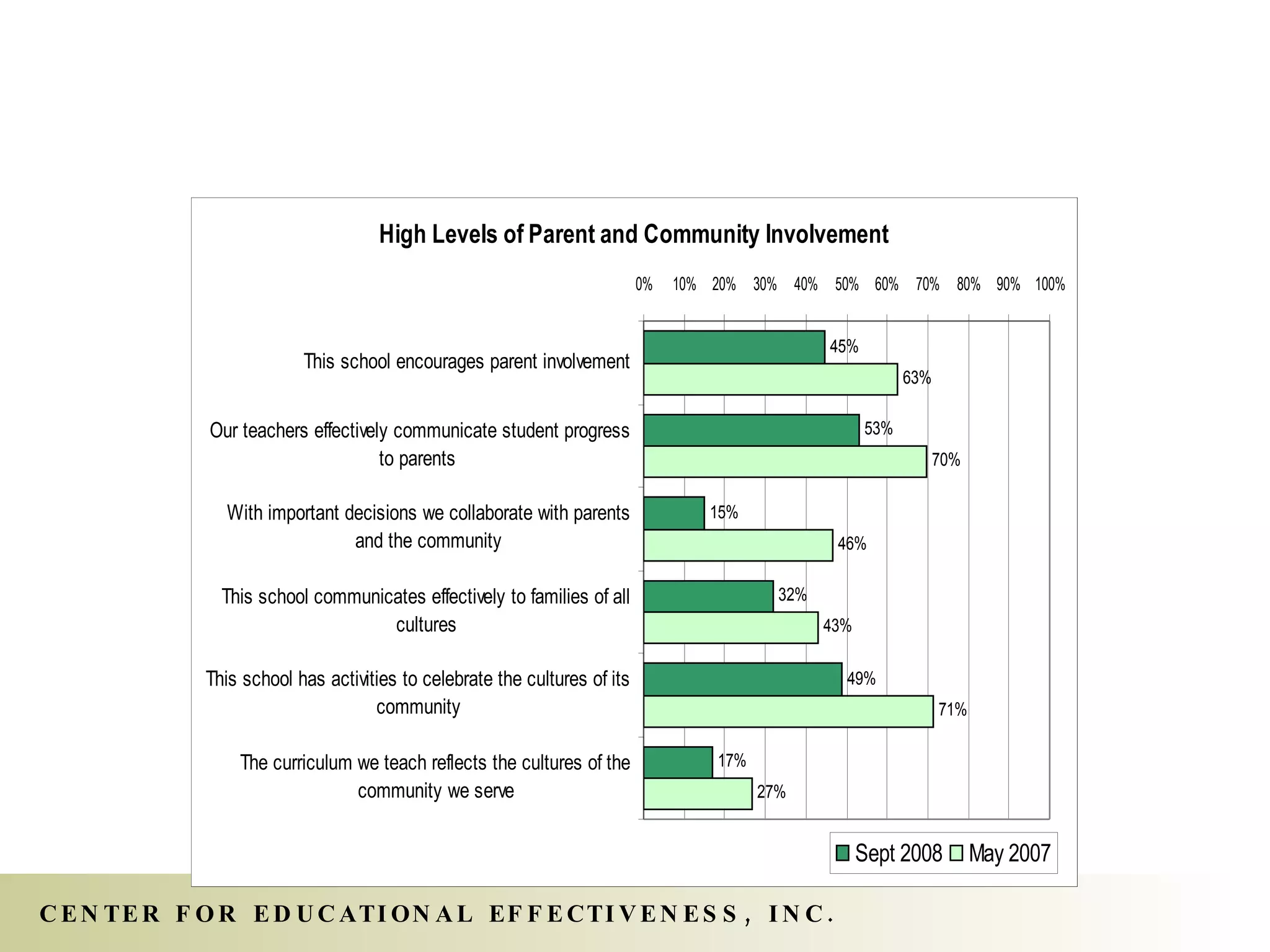
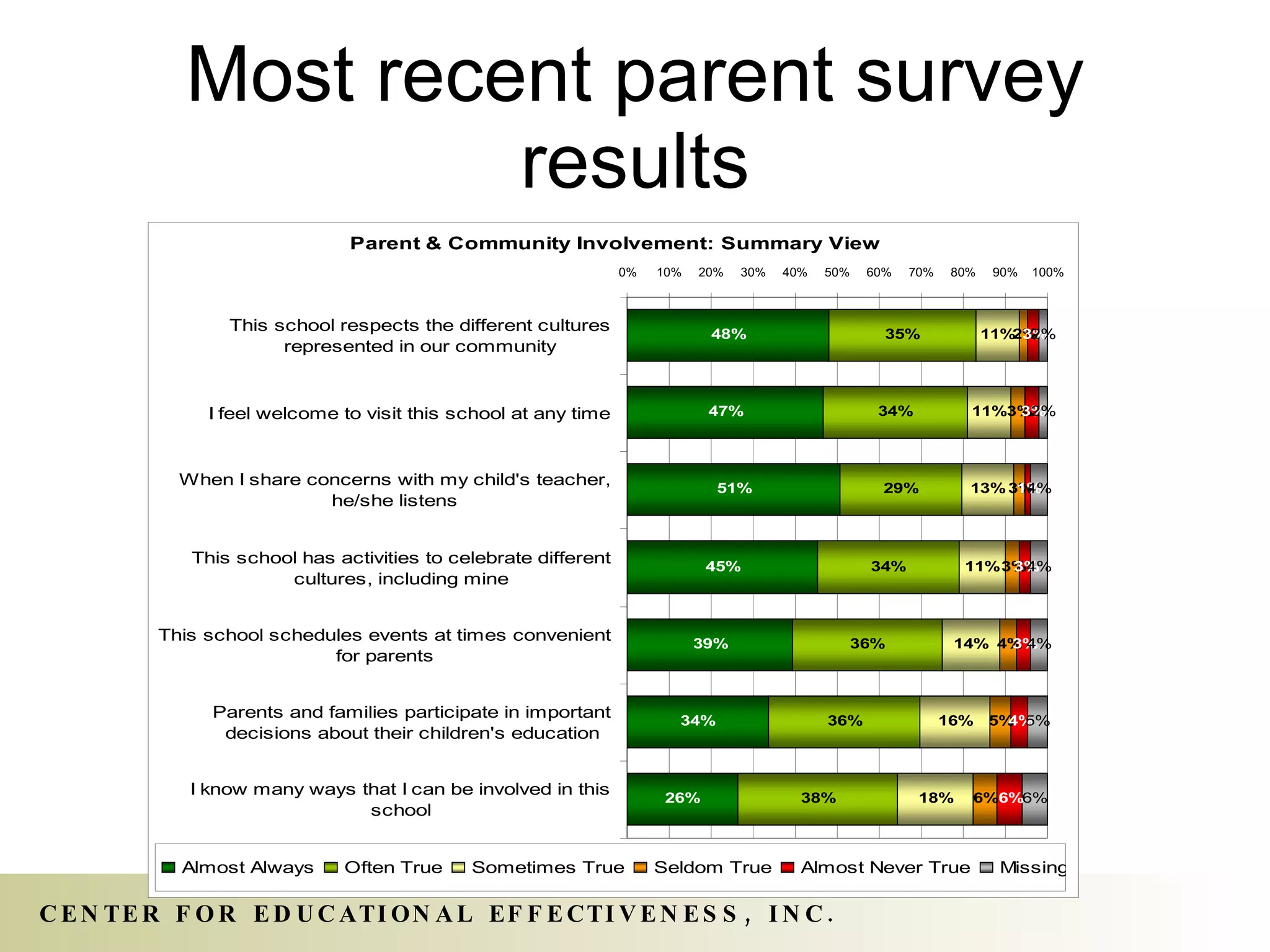
Most recent parent survey results
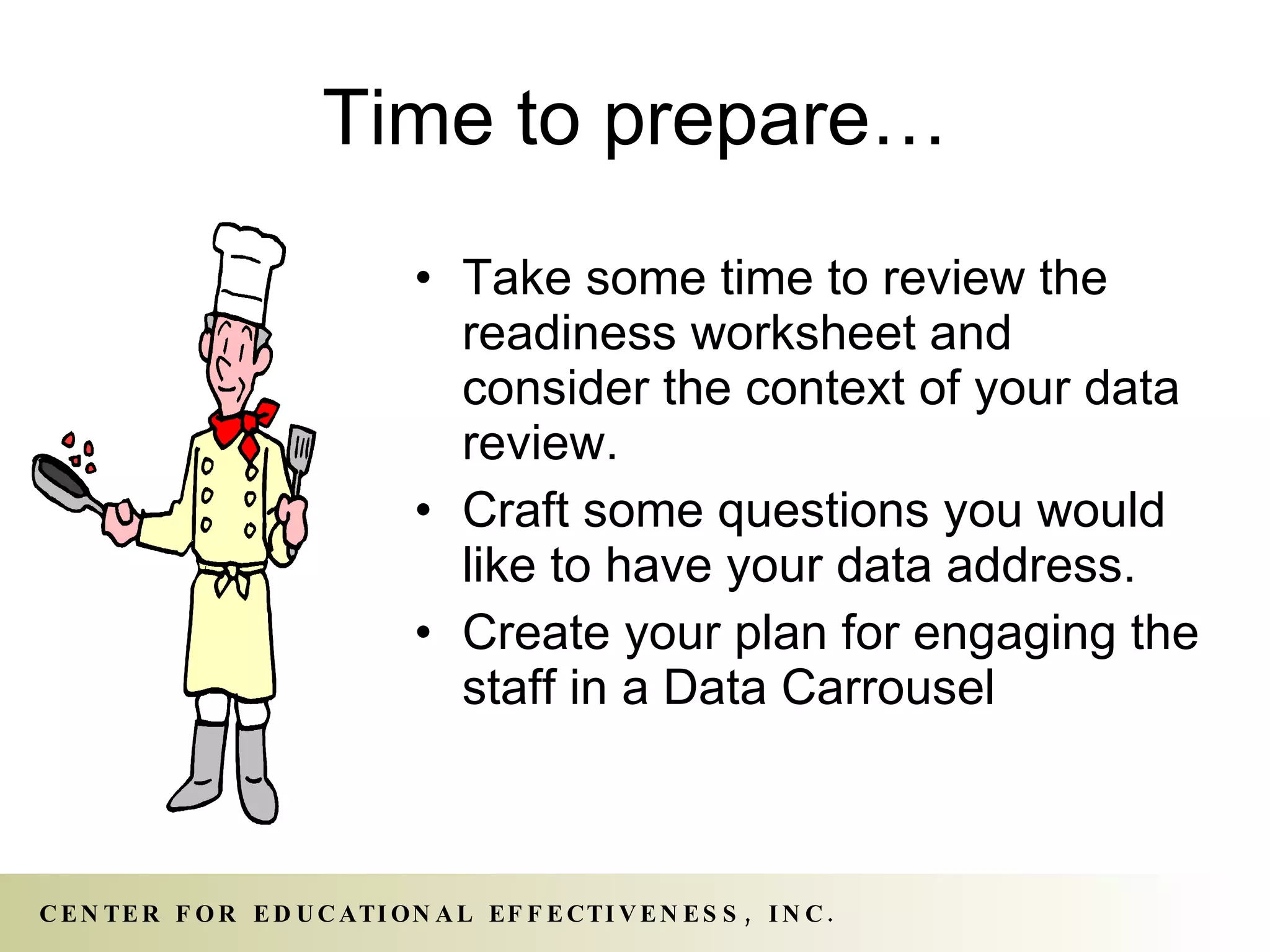
Time to prepare… Take some time to review the readiness worksheet and consider the context of your data review. Craft some questions you would like to have your data address. Create your plan for engaging the staff in a Data Carrousel
Additional Resources Informing Practices and Improving Results with Data-Driven Decisions (August 2000-ECS (Education Commission of the States  www.ecs.org   Issued Paper) “ The Flywheel Effect” by Timothy D. Kanold “ Buried Treasure-Developing a Management Guide to Mountains of School Data”-January 2005 (Center for reinventing public education authored by Mary Beth Celio and James Harvey)
Source: “Addressing Barriers to Learning” Vol. 9, Number 4.  Fall 2004. From School Mental Health Project/Center for Mental Health in Schools, UCLA.
Questions? Don’t hesitate to call CEE – 425-283-0384  Sue is ext 1#, Greg is ext 2#, Jack at 425-444-6600 and Terry at ? OR you can email us: [email_address] [email_address] [email_address] [email_address]

Presentation For Gene S Revision 3
  • 1.
  • 2.
    Jack McCullough, Planningand Solutions Coach The Center for Educational Effectiveness, Inc.

  • 3.
    Group Norms Participatein a positive manner. Actively listen to the viewpoints of your colleagues. Disagree in a respectful manner. Take care of personal needs. Stay on task. Refrain from sidebar conversations. Have fun!
  • 4.
    Today you will:Receive one set of Data Carousel Planning Templates per person and learn how to use it Share stories concerning common experience with data reviews Refine your Theory of Action surrounding the use of data Identify common concerns when proposing a data review Receive one Data Primer and discuss how it might be used Receive one Data Carousel Accelerator sample and discuss how it might be used Begin planning your data carousel/activity Receive a list of potential resources.
  • 5.
    “ Even ifyou're on the right track, you'll get run over if you just sit there." — Will Rogers
  • 6.
    Creating the casefor Common Language and Consistent Practice Using Marvin’s Model An engagement activity
  • 7.
    A Culture ofInquiry What comes to your mind? Using Marvin’s Model
  • 8.
    Remember adults havedifferent learning styles and perspectives when working with data. It helps to remember the “beach ball.”
  • 9.
    Data-analysisis like the ocean because…
  • 10.
    Data d a· ta : noun; plural, but singular or plural in construction, from the Latin, plural of datum. Factual information (as measurements or statistics) used as a basis for reasoning, discussion or calculation. Information output by a sensing device that includes both useful and irrelevant or redundant information and must be processed to be meaningful. - Merriam Webster’s Collegiate Dictionary
  • 11.
    “ We area society that is data rich but information poor.” -Robert H. Waterman
  • 12.
    Avoid the DripD ata R ich I nformation P oor
  • 13.
    Are these numbersconsidered data? 122 100 90 103 117
  • 14.
    What kind ofdata are these? 122 ° 100 ° 110 ° 90 ° 103 ° 117 °
  • 15.
    We bring themeaning to the data. 122 °F 100 °F 110 °F 90 °F 103 °F 117 °F
  • 16.
    Guiding Assumptions 1.Data have no meaning. Data are just information until people organize, analyze and interpret meaning. Interpretation is subjective; data are objective. Frames of reference influence the meaning we derive from the data we collect and select.
  • 17.
    2. Understandingshould proceed planning. Determine the desired outcome. Clearly define the problems. Cultivate collegial dialogue prior to planning.
  • 18.
    3. Knowledge isboth a personal and a social construction. Human beings are meaning-making organisms. We sift through personal and social filters, forming beliefs and ways of knowing. Individuals interact with information and with others shape new understandings about our world.
  • 19.
    4. Cyclesof inquiry Inquiry, experimentation and reflection accelerate continuous growth and learning. Learning occurs when we shift from professional certainty to conscious curiosity. Constant pursuit of meaningful questions from thoughtful data analysis and ongoing monitoring of progress.
  • 20.
    5. Norms ofdata-driven collaboration Data alone leads to no action. Collective inquiry generates continuous improvements. Meaning and action result from professional learning communities that develop a shared commitment to improve student learning. - Wellman, Bruce and Lipton, Laura.(2004). Data Driven Dialogue.
  • 21.
    “Teachers blaze thepath to knowledge when they purposefully use data as a source for analyzing progress and proactively plan for improvement.” Wellman & Lipton. (2004). Data Driven Dialogue.
  • 22.
    School Improvement Planning:Nine Characteristics Of High Performing Schools Evaluate plan’s impact on student achievement Set and prioritize goals It is a Process Craft action plans Study and select research-based practices Assess readiness to benefit Collect sort and select data Build and analyze portfolio Implement and monitor plan
  • 23.
    Benefits of dataanalysis It is more than solving a particular student learning problem School/District improvement teams become more efficient and effective Decisions making becomes ore collaborative Teachers develop more positive attitudes about their and their students’ abilities Educators feel more in charge of their own destinies Development of school wide culture if inquiry
  • 24.
    Data Carousel PlanningTemplate CEE has created template sheets to assist your team in planning your data carousel activity. You will spend time today using these sheets and will identify (today) many of your challenges for planning and executing a successful carousel.
  • 25.
    Data Carousel PlanningTemplate Steps Assess Readiness Planning Process Selection of Data Implementation Immediate Follow-up and Next Steps
  • 26.
    Key Data DecisionsDepth & breadth of data Carousel model Presentation of data Responding to Guiding Questions Planning Process
  • 27.
    Carousels are: Adata sharing and exploration strategy A data analysis activity A process to identify needs and “next steps” in digging deeper Effective to engage multiple times per year
  • 28.
    Carousel Models Traditional(i.e. SIP/SSIRG guide) Packet Method Large Chart Method Guided PowerPoint
  • 29.
    Digging Deeper- ThemeCarousel: Math Across the Curriculum Needs, Goals == Research and Action Planning Theme -B Theme -C Other Data Sources: EES, WASL Analysis, Local Assessments, Demographics Basic Carousel Information informs SIP Plan Steps 6,7, & 8 and next year’s revisions School Performance Review Report Chronology for Planning and Implementation
  • 30.
    Data Carousel A means for engaging the entire staff in the process of data analysis Typically 2-3 hours in length if done at one setting (My bias is not to do it in one setting) Intended to be a high level scan to determine trends, strengths and concerns
  • 31.
    Arrangements Space MaterialsRoles Timeline/schedule Food or snacks Reminders Distribute prep materials Prepare facilitators Implementation
  • 32.
    Time and PeopleDecisions Number Stakeholders Skills Communication
  • 33.
    Data Training Requirements4 Domains of Data Writing narratives Types of carousel
  • 34.
    Why are someschools successful and others not when implementing the same improvement strategies? Readiness Guiding Question Assess readiness to benefit
  • 35.
    Willingness – attitudes,experiences, buy-in Process Skills Decision-making Conflict management Problem-solving Code of cooperation Roles We Play Assess Readiness
  • 36.
    Check Your ReadinessUsing the “Assessing General Readiness” worksheet discuss your school’s readiness to engage in the School Improvement Process and craft plans to respond to the challenges you foresee.
  • 37.
    Basic or InitialCarousels All 4 Domains of Data Designed to give large groups (i.e. all staff, all certs, all certs+IA/ParaPros or greater “community stakeholders”) a broad view of information Contain “non-negotiables”
  • 38.
    Process 1: CarouselSo, let’s say there are 4 tables for the 4 data groups… Staff are asked to look at the data and craft narratives They do this for about 20 minutes Then they move to the next table Repeat until all data has been reviewed Logistical Considerations: Who will be involved in the Carousel? What could you do to make it even more fun? A theme perhaps? Should staff be assigned tables? Snacks, meals and comfort of participants?
  • 39.
    Pause and Reflecton what you saw and heard. What is running around in your head?
  • 40.
    Where Do WeGo From Here? Teachers and principals alike assess student and teacher achievement early and often – and use the information to drive improvement rather than assign blame. The key, however, is not simply that the successful schools have data – it’s who is using the data and how they use the data. Beat The Odds (2006)
  • 41.
    Guided Questions Help bring clarity Helps bring focus to more than one thing Helps bring focus to elements of leadership Guided Question Stem “What evidence do I have…”
  • 42.
    Well conceived guidedquestions should Inquire into the nature (what) Inquire into the quality (how well) Inquire into the frequency (how often)
  • 43.
    Remember that withdata analysis you are trying to define the problem , not solve it.
  • 44.
    Triangulation - Addingrelevance and meaning through multiple data sources
  • 45.
    Some guided questionsto use when thinking about Dr. Ken Jenkins UNC @Chapel Hill Where are your widest achievement gaps? How persistent have these gaps been? Are there dramatic difference from one year to the next? What might explain the differences? Are the gender difference worth noting? Is there any relationship you can determine between the population of free and reduced price lunch students and general student achievement? For High School, are there differences between major curriculum areas worth noting? What are the bright spots contained within the data?
  • 46.
    Has the teamcollected data from multiple indicators (i.e. student assessment, perception, demographic, school context)? Has the team determined what data should be included in the school’s portfolio? Has the team determined a process for allowing all stakeholders to analyze the data? Has the team determined how the data will be displayed? Collect, Sort and Select Data
  • 47.
    Characteristics, Qualities andTypes 4 Domains Formative Summative Longitudinal Relevant Reliable Valid Aligned with standards Community sensitive Selection of Data
  • 48.
    Selecting Data Fromthe data that has been collected you will need to purposefully select a subset for staff review. What questions do you want to investigate? What do you believe the staff “cares about”? Choose a reasonable (say 6-8 pages) amount for their review. What background knowledge will staff need to interpret the data?
  • 49.
    Demographics Contex tPerceptions Student Learning Collecting Data Collect sort and select data
  • 50.
    Collecting Data Context Perceptions Student Learning Demographics Guiding Questions: Who are our students? What trends do we see in our student population? What trends do we see in our community? Collect sort and select data Free and Reduced ESL Special Populations Gender Ethnicity Mobility Dropout Rates Demographics
  • 51.
    Collecting Data DemographicsContex t Student Learning Perceptions Guiding Questions: How do the members of our school community feel about our school and district? How satisfied are school community members with our educational programs? What do the members of our school community perceive to be the strengths and needs of our school? Collect sort and select data Perceptions 9 Characteristics Technology
  • 52.
    Collecting Data DemographicsContex t Perceptions Student Learning Guiding Questions: How successful are our programs in support of struggling learners? What factors outside the school may be influencing student achievement? Collect sort and select data Context Healthy Youth Survey Safe Schools Data Discipline Data School Programs
  • 53.
    Demographics Perceptions Context Student Learning Guiding Questions: What evidence can we gather about our students’ learning? What evidence can be gather about curriculum, instructional and assessment alignment to standards? To what do we attribute our achievement trends? Collect sort and select data Student Learning WASL Local Assessments Classroom Based Assessments GPA
  • 54.
    Has the teamselected appropriate data from each domain? Is data displayed in a manner that is easy to interpret? Do staff members know how to craft narrative statements? Is there a process for engaging staff in review of data? Is there a model for reaching consensus? Build and Analyze Portfolio
  • 55.
  • 56.
    Data exploration duringthe carousel activity Logistics – people, facility, movement of data, # of copies, cost Encourage open-mindedness
  • 57.
    During the carouselactivity Review why and process Basic skill review Allow all participants opportunity to see data Narrative statements - process
  • 58.
    Writing Narratives Keepit simple- Communicate a single idea. Make them short and easy to read Avoid Evaluation- Describe what you see, not what caused it or what to do about it
  • 59.
    Criteria for GoodNarratives Content Describe building wide performance Describe trends in performance over time Describe high and low performing groups Compare performance in your building with a benchmark for example statewide performance Format Good Narratives Communicate a single idea about student performance Are short, clear sentences or phrases Are descriptive rather than evaluative Use everyday language that is easy to understand Are independent statement that incorporate numbers
  • 60.
    Product 1: Listof Concerns At the end of the Carrousel, the staff should have access to a list of concerns based on data You will need to determine the method for collecting concerns and returning them to staff
  • 61.
    Process 2: Ratingand Ranking The team should select a process for reaching consensus about the school’s priority concerns. We have used a rating and ranking activity Staff is given printed copies of the concerns from the Data Carousel They are asked to read for clarification (not allowed to lobby for or against a concern) They are also asked to eliminate any duplicates Staff select their 5 greatest concerns Staff assign points to their concerns (5 to 1) with 5 points assigned to the greatest concern and 1 go the least Public vote for each concern Most points wins
  • 62.
    Product 2: Aprioritized list of concerns At the end of the Data Carrousel, the staff will leave with a list of prioritized concerns. Next step is typically a leadership team activity: Group concerns into themes and craft goal statements. This process results in a deeper understanding of the school’s data, allows for staff input regarding priorities, supports a transparent decision making process.
  • 63.
    “I am tiredof talk that come to nothing. It makes my heart sick when I remember all the good words and broken promises…” Chief Joseph
  • 64.
  • 65.
    Pre-Mortem Process LearningImprovement Team for Climbing Higher School/District You are a member of the school’s LIT charged with planning a data sharing activity with some “tough” data Reflect on the various “personalities” you might have to work with during the data review planning process Suggestions Recall the following Principles of Adult Learning 5 by 5 Whys
  • 66.
  • 67.
  • 68.
  • 69.
  • 70.
    Most recent parentsurvey results
  • 71.
    Time to prepare…Take some time to review the readiness worksheet and consider the context of your data review. Craft some questions you would like to have your data address. Create your plan for engaging the staff in a Data Carrousel
  • 72.
    Additional Resources InformingPractices and Improving Results with Data-Driven Decisions (August 2000-ECS (Education Commission of the States www.ecs.org Issued Paper) “ The Flywheel Effect” by Timothy D. Kanold “ Buried Treasure-Developing a Management Guide to Mountains of School Data”-January 2005 (Center for reinventing public education authored by Mary Beth Celio and James Harvey)
  • 73.
    Source: “Addressing Barriersto Learning” Vol. 9, Number 4. Fall 2004. From School Mental Health Project/Center for Mental Health in Schools, UCLA.
  • 74.
    Questions? Don’t hesitateto call CEE – 425-283-0384 Sue is ext 1#, Greg is ext 2#, Jack at 425-444-6600 and Terry at ? OR you can email us: [email_address] [email_address] [email_address] [email_address]

Editor's Notes

  • #3 Highlight our desire to differentiate based on each school’s needs.
  • #25 This slide is in both presentations, basic and themed.
  • #26 This slide is in both presentations.
  • #27 This slide is both presentations. Refer back to guiding questions from the fall. Bring copy of those guiding questions for both presentations.
  • #28 Slide in both presentations. Reinforce the concept of themed carousal when new data surfaces.
  • #29 Slide in both presentations Stress each method can be modified to address basic or themed format
  • #30 Slide in both presentations Generate ideas on from audience of themed carousel-What examples can you share concerning themed carousel?
  • #31 Slide only in Basic presentation.
  • #32 Slide in both presentations Emphasize these are some of the topics that the leadership team should address when planning their carousel activity.
  • #33 Slide found in both presentations Emphasis on readiness component around needed skills.
  • #34 Slide found in both presentations Emphasis on these are readiness issues no matter what format is used.
  • #35 Reference SIP guide section. Reference Guiding questions from the fall.
  • #36 Slide in both presentations Question to ask-Why process skills?
  • #37 Slide in both presentations Reference SIP guide
  • #38 Slide found in Basic training Question to ask—What do we mean by Domains of Data? Question to ask-What do we mean by non-negotiable?
  • #39 Slide found in Basic training.
  • #47 Slide in both presentations Emphasis the team (referencing the leadership team.
  • #48 Slide in both presentations. What might be examples of “community sensitive”?
  • #49 Slide in both presentations
  • #50 Slide in both presentation
  • #51 Slide in both presentations Emphasize I-3 as a new sources of data
  • #52 Slide in both presentations Incorporate the SPR as an additional data source.
  • #53 Slide in both presentations
  • #54 Slide in both presentations
  • #55 Slide in both Team is leadership team.
  • #56 Slide in both presentations
  • #61 Have sample data from xyz school to get audience involved
  • #62 Have spreadsheet from xyz school district to show what the concerns look like