Curriculum * instruction
Department
Curriculum planning
Faculty of
Education
The definition of
curriculum:
Edglossary.com
*The term curriculum refers
to the lessons and
academic content taught in
a school or in a specific
course or program.
* Depending on how broadly
educators define or employ the term
,curriculum typically refers to the
knowledge and skills students are
expected to learn .
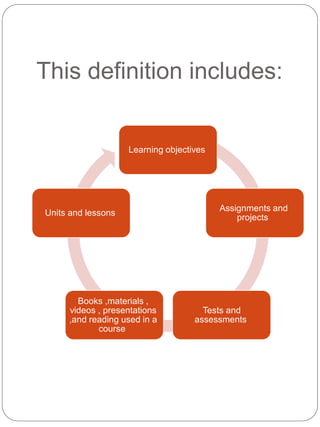
This definition includes:
Learning objectives
Assignments and
projects
Tests and
assessments
Books ,materials ,
videos , presentations
,and reading used in a
course
Units and lessons
Education .com
*Curriculum refers to the means and
materials with which students will
interact for the purpose of achieving
identified educational outcomes.
* Curriculum is a planned experiences
that the school offers as part of its
educational responsibility .
* Curriculum includes not only the
planned ,but also the unplanned
experiences as well .
The /recent/ modern /new
definition of curriculum:
A combination/ collection of
information, skills
,experiences and
situations based on
scientific foundations
when they gathered and
collected according to a
psychological and
scientific principles and
presented by methods
and strategies of teaching
inside and outside the
school .
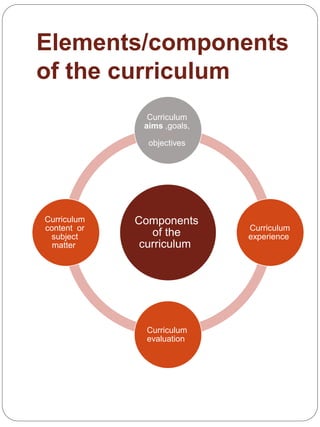
Elements/components
of the curriculum
Components
of the
curriculum
Curriculum
aims ,goals,
and
objectives
Curriculum
experience
Curriculum
evaluation
Curriculum
content or
subject
matter
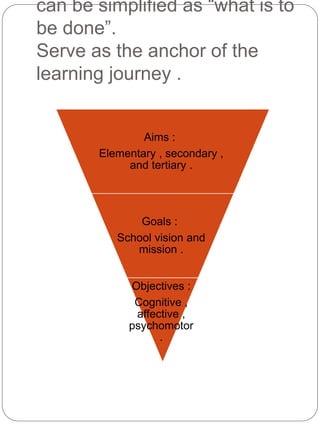
can be simplified as “what is to
be done”.
Serve as the anchor of the
learning journey .
Aims :
Elementary , secondary ,
and tertiary .
Goals :
School vision and
mission .
Objectives :
Cognitive ,
affective ,
psychomotor
.
The second
component :
Curriculum content or subject
matter :
* What subject matter to be included .
* A compendium of facts, concepts ,
generalization , principles , theories .
* Serve as the meat of the educational
journey .
The third and fourth
elements
Curriculum
experience:
Can be
simplified as ,
what
instructional
strategies ,
resources and
activities will be
employed .
The instructional
strategies and
methods will put
into action the
goals and use of
the content in
order to produce
an outcome .
Curriculum
evaluation :
What methods
and
instruments
will be used to
assess the
results of the
curriculum .
Serves as the
barometer as
to how far had
the learners
understood on
the educational
journey .
The importance of the
curriculum:
For the teacher : For the content :
.1aims and
objectives of
the
educational
process .
.2Teaching
methods and
strategies .
.3Teaching aids
.
.4Evaluation
principles .
.1The criteria for
selecting the
content and
educational
experiences .
.2Organizing the
educational
experiences in
an effective
way .
The importance of the
curriculum :
For the students :
Develop an integrated
personality ,socially efficient and
capable of further growth and
progressive adjustment .
the capacity for this requires the
development of critical thinking , of
open- mindedness and freedom from
prejudice , unimpeded by ill-regulated
emotion .
Curriculum mapping :
Away of developing a systematic
overview what students need to
learn at every level .
Is a method of charting the knowledge
and skills that students are expected to
master over a period of years .
*road trip :
imagine going on long road trip with
no GPS . You have written down which
route numbers you need to take , but
you do not know in what order the turns
should be made or how long you need
to stay on each road . It probably would
not be a very successful road trip .!
Knowing the order of the turns and
how long to drive on each road would
help you reach the final destination
much more efficiently .
Essentially , in education , this is what a
curriculum map does .

Curriculum planning 2

  • 1.
  • 2.
  • 3.
    Edglossary.com *The term curriculumrefers to the lessons and academic content taught in a school or in a specific course or program. * Depending on how broadly educators define or employ the term ,curriculum typically refers to the knowledge and skills students are expected to learn .
  • 4.
    This definition includes: Learningobjectives Assignments and projects Tests and assessments Books ,materials , videos , presentations ,and reading used in a course Units and lessons
  • 5.
    Education .com *Curriculum refersto the means and materials with which students will interact for the purpose of achieving identified educational outcomes. * Curriculum is a planned experiences that the school offers as part of its educational responsibility . * Curriculum includes not only the planned ,but also the unplanned experiences as well .
  • 6.
    The /recent/ modern/new definition of curriculum: A combination/ collection of information, skills ,experiences and situations based on scientific foundations when they gathered and collected according to a psychological and scientific principles and presented by methods and strategies of teaching inside and outside the school .
  • 7.
    Elements/components of the curriculum Components ofthe curriculum Curriculum aims ,goals, and objectives Curriculum experience Curriculum evaluation Curriculum content or subject matter
  • 8.
    can be simplifiedas “what is to be done”. Serve as the anchor of the learning journey . Aims : Elementary , secondary , and tertiary . Goals : School vision and mission . Objectives : Cognitive , affective , psychomotor .
  • 9.
    The second component : Curriculumcontent or subject matter : * What subject matter to be included . * A compendium of facts, concepts , generalization , principles , theories . * Serve as the meat of the educational journey .
  • 10.
    The third andfourth elements Curriculum experience: Can be simplified as , what instructional strategies , resources and activities will be employed . The instructional strategies and methods will put into action the goals and use of the content in order to produce an outcome . Curriculum evaluation : What methods and instruments will be used to assess the results of the curriculum . Serves as the barometer as to how far had the learners understood on the educational journey .
  • 11.
    The importance ofthe curriculum: For the teacher : For the content : .1aims and objectives of the educational process . .2Teaching methods and strategies . .3Teaching aids . .4Evaluation principles . .1The criteria for selecting the content and educational experiences . .2Organizing the educational experiences in an effective way .
  • 12.
    The importance ofthe curriculum : For the students : Develop an integrated personality ,socially efficient and capable of further growth and progressive adjustment . the capacity for this requires the development of critical thinking , of open- mindedness and freedom from prejudice , unimpeded by ill-regulated emotion .
  • 13.
    Curriculum mapping : Awayof developing a systematic overview what students need to learn at every level . Is a method of charting the knowledge and skills that students are expected to master over a period of years . *road trip : imagine going on long road trip with no GPS . You have written down which route numbers you need to take , but you do not know in what order the turns should be made or how long you need to stay on each road . It probably would not be a very successful road trip .! Knowing the order of the turns and how long to drive on each road would help you reach the final destination much more efficiently . Essentially , in education , this is what a curriculum map does .