By Mr. Antonio T. Delgado, BSE III
        General De Jesus College
 Definition of Curriculum, revisited
 Curriculum Design, defined
 Types of Curriculum Design
 Elements of Curriculum Design
 Selection of Objectives
 Selection of Content
 Selection of Learning Experiences
   The sum of learning stated as
    educational ends, educational
    activities, school subjects and/or
    topics decided upon and provided
    within the framework of an
    educational institution or in a less
    formal setup ( Garcia, 2007).
   All the learning which is planned and
    guided by the school, whether it is
    carried on in groups or individually,
    inside or outside the school.
   something's form and structure
           (Microsoft® Encarta® 2009)
   way something is made
           (Microsoft® Encarta® 2009)
   Refers to the structure or the
    arrangement of the components or
    elements of a curriculum
 may be broadly categorized into the
  following major groups:
1. Traditional or subject centered
   designs
2. Learner-centered designs
3. Problem-centered or society-
   centered designs
 Are subject-centered
 The emphasis is on making the
  learners absorb as much knowledge
  as possible concerning a particular
  course or broad field
 Are easy to develop and to implement
  because highly-structured
 Criticized because they do not make
  provisions for the differential needs
  and interests of learners
 Most popular not only in the
  Philippines but in most parts of the
  world
 May be based on the anticipated
  needs and interest of the learners
 Usually built upon normal activities
  children engage in (i.e. playing,
  storytelling, drawing)
 Content is not organized into subjects
  (Math, Science, etc.) but into
  courseworks (playing, storytelling)
 The three R’s are integrated into the
  courseworks
 Criticized as neglecting the
  intellectual development of learners
 Heavily loaded with societal
  concerns, problems and issues
 May be aimed at making the
  school, the teachers and the students
  agents of social change
 What educational purposes should the
  school seek to attain?
 What educational experience can be
  provided that is likely to obtain the
  purpose?
 How can these educational
  experiences be effectively organized?
 How can we determine whether these
  purposes are being attained?
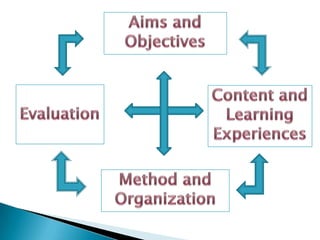
1.   Aims and objectives
2.   Content and learning experiences
3.   Method and organization
4.   Evaluation
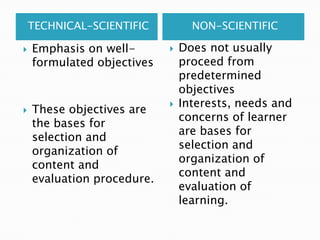
TECHNICAL-SCIENTIFIC          NON-SCIENTIFIC

   Emphasis on well-          Does not usually
    formulated objectives       proceed from
                                predetermined
                                objectives
                               Interests, needs and
   These objectives are
                                concerns of learner
    the bases for
                                are bases for
    selection and
                                selection and
    organization of
                                organization of
    content and
                                content and
    evaluation procedure.
                                evaluation of
                                learning.
   Based on desired outcomes of
    teaching-learning process:
    development of
    knowledge, skills, values, attitudes
    and habits
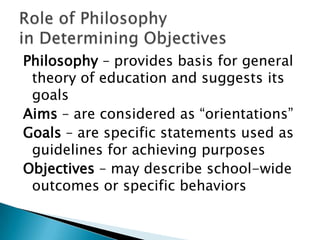
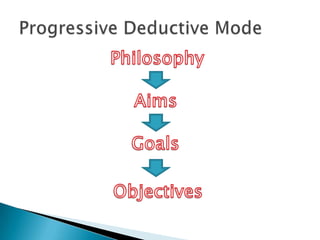
Philosophy – provides basis for general
 theory of education and suggests its
 goals
Aims – are considered as “orientations”
Goals – are specific statements used as
 guidelines for achieving purposes
Objectives – may describe school-wide
 outcomes or specific behaviors
The major educational philosophies are:
   Perennialism
   Essentialism
   Humanism/Progressivism
   Reconceptualism
   Reconstructionism
 Oldest and most traditional
 “perennial” means everlasting
 Education is viewed as the
  transmission of the unchanging
  knowledge of the universe
 Focus is on permanent studies which
  are timeless (e.g.
  philosophy, logic, etc.)
 Protest against perennialist thinking
 Education is viewed as human
  development that starts from the
  needs and interest of learners.
 Focuses more on the child than the
  subject matter
 Related to progressivism
 Learner-centered, relevant and
  humanistic education
 More emphasis on holistic,
  transcendental, linguistic and artistic
  aspects of the teaching-learning
  process
 Surfaced in opposition to
  progressivism
 Education is viewed as mastery of
  essential skills.
 Focus is on the three R’s, English,
  history and science.
 Criticized progressivists’ over-
  emphasis on child-centered learning
 Is society-centered
 Asserts that the creation of a better
  society is the ultimate purpose of
  education
 Focus is alleviating discrimination and
  poverty, school integration
Three Different Domains
 Cognitive
 Affective
 Psychomotor
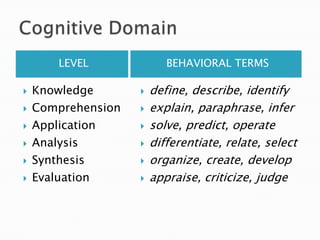
LEVEL              BEHAVIORAL TERMS

   Knowledge          define, describe, identify
   Comprehension      explain, paraphrase, infer
   Application        solve, predict, operate
   Analysis           differentiate, relate, select
   Synthesis          organize, create, develop
   Evaluation         appraise, criticize, judge
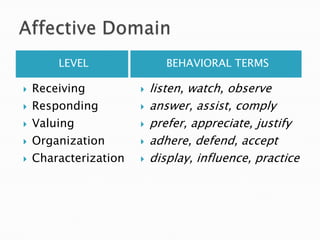
LEVEL                 BEHAVIORAL TERMS

   Receiving             listen, watch, observe
   Responding            answer, assist, comply
   Valuing               prefer, appreciate, justify
   Organization          adhere, defend, accept
   Characterization      display, influence, practice
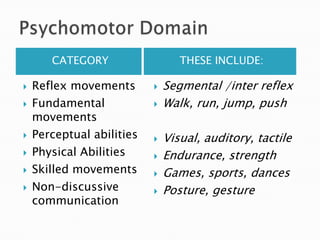
CATEGORY                   THESE INCLUDE:

   Reflex movements          Segmental /inter reflex
   Fundamental               Walk, run, jump, push
    movements
   Perceptual abilities      Visual, auditory, tactile
   Physical Abilities        Endurance, strength
   Skilled movements         Games, sports, dances
   Non-discussive            Posture, gesture
    communication
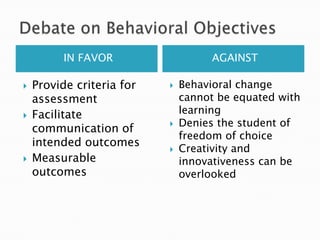
IN FAVOR                    AGAINST

   Provide criteria for      Behavioral change
    assessment                 cannot be equated with
   Facilitate                 learning
                               Denies the student of
    communication of       
                               freedom of choice
    intended outcomes
                              Creativity and
   Measurable                 innovativeness can be
    outcomes                   overlooked
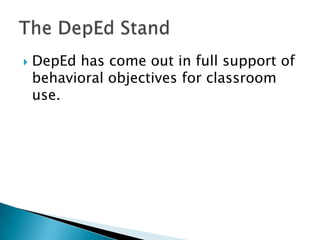
   DepEd has come out in full support of
    behavioral objectives for classroom
    use.
Content can have different meanings:
 A list of subjects for a grade or year
  level
 A discipline (i.e. science, math)
 A specific subject (e.g.
  biology, physics)
Content has three components which
  are considered in selection of content:
1. Knowledge
2. Process/skill
3. Affective
Concepts – regularities in objects of
 events designated by labels
 Ex: concept of water (liquid, colorless)
Principles – significant relationships
 between and among concepts
 Ex: Water boils at 100˚C
Theories – contain a set of logically
 related principles that attempt to
 explain a phenomenon
 Ex: Theory of Relativity
Laws – theories that have wide
 applicability and have been
 continuously proven to hold true.
 Ex: Laws of Motion
Mental processes – used in
 handling, dealing with or transforming
 information and concepts
Physical/manipulative processes – used
 for moving and handling objects
Attitudes– have feeling and emotional
 tones
 Ex: openness, respect for others’
         rights
Values – serve as basis for determining
 when attitudes and behaviors are
 appropriate and which are not.
 Ex: truth, honesty, justice
Relevance – Content reflects the social,
 cultural and technological realities of
 the time
Balance – There is a balance between
 the two polar goals of education: what
 is constant and what is changing.
    There should also be balance
 between the three domains of
 learning.
Validity – refers to accuracy or
 inaccuracy of the content.
    Content should also coincide with
 the expressed aims of the curriculum.
Learnability – Content should be
 selected in consideration with the
 learners’ level of development.
Feasibility – This criterion considers:
  • resources (human, physical and
    financial)
  • time allotment
  • school calendar
  • enabling legislation
  • public support
 Instructional component of the
  curriculum providing for the
  interaction between teacher, student
  and content
 These include:
      Teaching methods
      Learning activities
Appropriateness – Learning experiences
 should be suitable to content,
 objectives, domain, and learners’ level
 of development.
Feasibility – feasible in terms of time,
 qualification, experience of staff,
 available resources, safety and legal
 considerations
Variety – Different activities and
 methods are required by different
 disciplines and domains.
Optimal Value – Learning experiences
 should encourage learners to continue
 learning on their own.
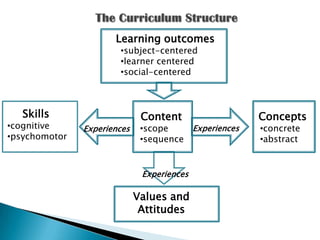
Learning outcomes
                       •subject-centered
                       •learner centered
                       •social-centered


   Skills                     Content                 Concepts
•cognitive     Experiences    •scope    Experiences   •concrete
•psychomotor                  •sequence               •abstract


                              Experiences

                             Values and
                              Attitudes
 Curriculum Development: The
  Philippine Experience.
 Garcia, Dolores (2007). Designing
  Curriculum. Rex Book Store.
   Reyes, Flordeliza C. (2000).
    Engineering the Curriculum. De La
    Salle University Press.

Curriculum design

  • 1.
    By Mr. AntonioT. Delgado, BSE III General De Jesus College
  • 2.
     Definition ofCurriculum, revisited  Curriculum Design, defined  Types of Curriculum Design  Elements of Curriculum Design  Selection of Objectives  Selection of Content  Selection of Learning Experiences
  • 3.
    The sum of learning stated as educational ends, educational activities, school subjects and/or topics decided upon and provided within the framework of an educational institution or in a less formal setup ( Garcia, 2007).
  • 4.
    All the learning which is planned and guided by the school, whether it is carried on in groups or individually, inside or outside the school.
  • 5.
    something's form and structure (Microsoft® Encarta® 2009)  way something is made (Microsoft® Encarta® 2009)
  • 6.
    Refers to the structure or the arrangement of the components or elements of a curriculum
  • 7.
     may bebroadly categorized into the following major groups: 1. Traditional or subject centered designs 2. Learner-centered designs 3. Problem-centered or society- centered designs
  • 8.
     Are subject-centered The emphasis is on making the learners absorb as much knowledge as possible concerning a particular course or broad field  Are easy to develop and to implement because highly-structured
  • 9.
     Criticized becausethey do not make provisions for the differential needs and interests of learners  Most popular not only in the Philippines but in most parts of the world
  • 10.
     May bebased on the anticipated needs and interest of the learners  Usually built upon normal activities children engage in (i.e. playing, storytelling, drawing)  Content is not organized into subjects (Math, Science, etc.) but into courseworks (playing, storytelling)
  • 11.
     The threeR’s are integrated into the courseworks  Criticized as neglecting the intellectual development of learners
  • 12.
     Heavily loadedwith societal concerns, problems and issues  May be aimed at making the school, the teachers and the students agents of social change
  • 13.
     What educationalpurposes should the school seek to attain?  What educational experience can be provided that is likely to obtain the purpose?  How can these educational experiences be effectively organized?  How can we determine whether these purposes are being attained?
  • 14.
    1. Aims and objectives 2. Content and learning experiences 3. Method and organization 4. Evaluation
  • 16.
    TECHNICAL-SCIENTIFIC NON-SCIENTIFIC  Emphasis on well-  Does not usually formulated objectives proceed from predetermined objectives  Interests, needs and  These objectives are concerns of learner the bases for are bases for selection and selection and organization of organization of content and content and evaluation procedure. evaluation of learning.
  • 17.
    Based on desired outcomes of teaching-learning process: development of knowledge, skills, values, attitudes and habits
  • 18.
    Philosophy – providesbasis for general theory of education and suggests its goals Aims – are considered as “orientations” Goals – are specific statements used as guidelines for achieving purposes Objectives – may describe school-wide outcomes or specific behaviors
  • 20.
    The major educationalphilosophies are:  Perennialism  Essentialism  Humanism/Progressivism  Reconceptualism  Reconstructionism
  • 21.
     Oldest andmost traditional  “perennial” means everlasting  Education is viewed as the transmission of the unchanging knowledge of the universe  Focus is on permanent studies which are timeless (e.g. philosophy, logic, etc.)
  • 22.
     Protest againstperennialist thinking  Education is viewed as human development that starts from the needs and interest of learners.  Focuses more on the child than the subject matter
  • 23.
     Related toprogressivism  Learner-centered, relevant and humanistic education  More emphasis on holistic, transcendental, linguistic and artistic aspects of the teaching-learning process
  • 24.
     Surfaced inopposition to progressivism  Education is viewed as mastery of essential skills.  Focus is on the three R’s, English, history and science.
  • 25.
     Criticized progressivists’over- emphasis on child-centered learning  Is society-centered  Asserts that the creation of a better society is the ultimate purpose of education  Focus is alleviating discrimination and poverty, school integration
  • 26.
    Three Different Domains Cognitive  Affective  Psychomotor
  • 27.
    LEVEL BEHAVIORAL TERMS  Knowledge  define, describe, identify  Comprehension  explain, paraphrase, infer  Application  solve, predict, operate  Analysis  differentiate, relate, select  Synthesis  organize, create, develop  Evaluation  appraise, criticize, judge
  • 28.
    LEVEL BEHAVIORAL TERMS  Receiving  listen, watch, observe  Responding  answer, assist, comply  Valuing  prefer, appreciate, justify  Organization  adhere, defend, accept  Characterization  display, influence, practice
  • 29.
    CATEGORY THESE INCLUDE:  Reflex movements  Segmental /inter reflex  Fundamental  Walk, run, jump, push movements  Perceptual abilities  Visual, auditory, tactile  Physical Abilities  Endurance, strength  Skilled movements  Games, sports, dances  Non-discussive  Posture, gesture communication
  • 30.
    IN FAVOR AGAINST  Provide criteria for  Behavioral change assessment cannot be equated with  Facilitate learning Denies the student of communication of  freedom of choice intended outcomes  Creativity and  Measurable innovativeness can be outcomes overlooked
  • 31.
    DepEd has come out in full support of behavioral objectives for classroom use.
  • 32.
    Content can havedifferent meanings:  A list of subjects for a grade or year level  A discipline (i.e. science, math)  A specific subject (e.g. biology, physics)
  • 33.
    Content has threecomponents which are considered in selection of content: 1. Knowledge 2. Process/skill 3. Affective
  • 34.
    Concepts – regularitiesin objects of events designated by labels Ex: concept of water (liquid, colorless) Principles – significant relationships between and among concepts Ex: Water boils at 100˚C
  • 35.
    Theories – containa set of logically related principles that attempt to explain a phenomenon Ex: Theory of Relativity Laws – theories that have wide applicability and have been continuously proven to hold true. Ex: Laws of Motion
  • 36.
    Mental processes –used in handling, dealing with or transforming information and concepts Physical/manipulative processes – used for moving and handling objects
  • 37.
    Attitudes– have feelingand emotional tones Ex: openness, respect for others’ rights Values – serve as basis for determining when attitudes and behaviors are appropriate and which are not. Ex: truth, honesty, justice
  • 38.
    Relevance – Contentreflects the social, cultural and technological realities of the time Balance – There is a balance between the two polar goals of education: what is constant and what is changing. There should also be balance between the three domains of learning.
  • 39.
    Validity – refersto accuracy or inaccuracy of the content. Content should also coincide with the expressed aims of the curriculum. Learnability – Content should be selected in consideration with the learners’ level of development.
  • 40.
    Feasibility – Thiscriterion considers: • resources (human, physical and financial) • time allotment • school calendar • enabling legislation • public support
  • 41.
     Instructional componentof the curriculum providing for the interaction between teacher, student and content  These include:  Teaching methods  Learning activities
  • 42.
    Appropriateness – Learningexperiences should be suitable to content, objectives, domain, and learners’ level of development. Feasibility – feasible in terms of time, qualification, experience of staff, available resources, safety and legal considerations
  • 43.
    Variety – Differentactivities and methods are required by different disciplines and domains. Optimal Value – Learning experiences should encourage learners to continue learning on their own.
  • 44.
    Learning outcomes •subject-centered •learner centered •social-centered Skills Content Concepts •cognitive Experiences •scope Experiences •concrete •psychomotor •sequence •abstract Experiences Values and Attitudes
  • 45.
     Curriculum Development:The Philippine Experience.  Garcia, Dolores (2007). Designing Curriculum. Rex Book Store.  Reyes, Flordeliza C. (2000). Engineering the Curriculum. De La Salle University Press.