Scheduling-Major Components Activity time Should be the largest block of the day wherein children can self-select their activities Large group activity Also called circle-time, group time and is almost always teacher led.  Remember age appropriate activities and time  Small group activity Depends upon the type of curriculum.  Largely used in High-scope types of curriculum wherein a small group of children work with one teacher for a short period
Outdoor Not just a time for teachers to “get other things done”.  Just like indoor activities, it should be set up to provide for each child’s needs, guiding behavior, providing experiences, teaching concepts, letting children enjoy the beauty of outdoors Routines Often overlooked as just part of the day, routines are an important part of each day and should be treated as such.  Rushing through such activities as clean-up, eating, toileting, napping, deprives both the child and the teacher of positive one-on-one interactions and learning experiences.  Use the routines to get to know children better.
Guidelines for Scheduling Alternating active and quiet time Balancing child-initiated and teacher-initiated Activity and developmental level of the children Group size Arrival and departure Seasonal considerations
Curriculum Curriculum is, literally, everything that happens in the course of a school day It is the process of translating theories of education into practice It is spontaneous, yet organized; it is planned, yet it emerges; it is based on children’s interests tempered by adult awareness of children’s needs.
Four areas of Focus The content- “what” is being taught The process-”how” and “when” learning takes place The teacher-”who”creates the curriculum, planning, and providing for activities The context-”why” certain projects are chosen
Different Types of Curriculum  Open Education or Themes Teachers guide, facilitate, setting up the environment to promote independence and self-sufficiency.  The emphasis is on the integration of the total curriculum rather than on separate subject matter.  Many programs are based on a thematic approach.
Themes Remember to make the curriculum  real & relevant  using children’s experiences as the guide: Children as the focus Family as the focus Community as the focus
Emergent Curriculum The Project Approach A process oriented approach that calls for collaboration on the part of the teachers with children and other adults.  It is based on the premise that curriculum is everything that happens throughout the day; it is all of the children’s experiences as they interact with people and materials
Elements of Emergent Curriculum The image of the child The environment The emergent curriculum-”Projects” Documentation
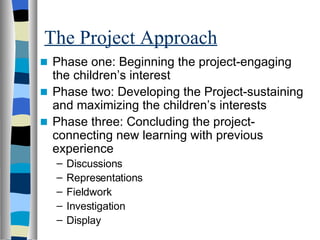
The Project Approach Phase one: Beginning the project-engaging the children’s interest Phase two: Developing the Project-sustaining and maximizing the children’s interests Phase three: Concluding the project-connecting new learning with previous experience Discussions Representations Fieldwork Investigation Display
Developmentally appropriate curriculum Based on the theory, research, and experience of knowing how young children develop and learn Appropriateness Individual appropriateness Cultural appropriateness
Culturally Appropriate Curriculum A curriculum that reflects the cultural plurality of contemporary American society in general and the individual classroom in particular, and present it in sensitive, relevant ways
Planning Curriculum Written plans Planning by objectives Objectives are the stated concepts that children will learn through a specific experience 2 important factors in developing curriculum objectives How much knowledge and understanding the children have What they are interested in?
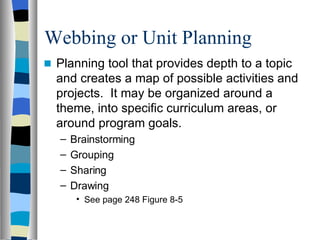
Webbing or Unit Planning Planning tool that provides depth to a topic and creates a map of possible activities and projects.  It may be organized around a theme, into specific curriculum areas, or around program goals. Brainstorming Grouping Sharing Drawing See page 248 Figure 8-5
Advantages of Written Plans Helps teachers focus Provides direction Clarifies thoughts and articulate a rationale Stimulates teamwork Provides a concrete format from which evaluation and assessment can be made Serves as a communication tool Teachers can see how much they offer children
Teacher Considerations Educational philosophy and goals of the program The children themselves Knowledge of children in general
Guidelines for Planning Curriculum Set goals Establish priorities Know the  resources Plan ahead Evaluate
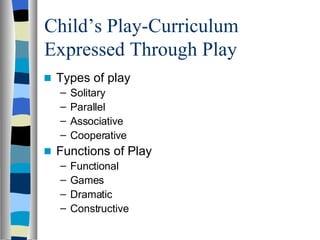
Child’s Play-Curriculum Expressed Through Play Types of play Solitary Parallel Associative Cooperative Functions of Play Functional Games Dramatic Constructive
Teacher as a Facilitator Guides but does not direct Capitalizes on children’s thoughts and ideas Models play when necessary Helps children start, end, and begin again Focuses the children on one another Encourages them to interact Interprets the children’s behaviors Expands play potential

Curriculum Planning

  • 1.
    Scheduling-Major Components Activitytime Should be the largest block of the day wherein children can self-select their activities Large group activity Also called circle-time, group time and is almost always teacher led. Remember age appropriate activities and time Small group activity Depends upon the type of curriculum. Largely used in High-scope types of curriculum wherein a small group of children work with one teacher for a short period
  • 2.
    Outdoor Not justa time for teachers to “get other things done”. Just like indoor activities, it should be set up to provide for each child’s needs, guiding behavior, providing experiences, teaching concepts, letting children enjoy the beauty of outdoors Routines Often overlooked as just part of the day, routines are an important part of each day and should be treated as such. Rushing through such activities as clean-up, eating, toileting, napping, deprives both the child and the teacher of positive one-on-one interactions and learning experiences. Use the routines to get to know children better.
  • 3.
    Guidelines for SchedulingAlternating active and quiet time Balancing child-initiated and teacher-initiated Activity and developmental level of the children Group size Arrival and departure Seasonal considerations
  • 4.
    Curriculum Curriculum is,literally, everything that happens in the course of a school day It is the process of translating theories of education into practice It is spontaneous, yet organized; it is planned, yet it emerges; it is based on children’s interests tempered by adult awareness of children’s needs.
  • 5.
    Four areas ofFocus The content- “what” is being taught The process-”how” and “when” learning takes place The teacher-”who”creates the curriculum, planning, and providing for activities The context-”why” certain projects are chosen
  • 6.
    Different Types ofCurriculum Open Education or Themes Teachers guide, facilitate, setting up the environment to promote independence and self-sufficiency. The emphasis is on the integration of the total curriculum rather than on separate subject matter. Many programs are based on a thematic approach.
  • 7.
    Themes Remember tomake the curriculum real & relevant using children’s experiences as the guide: Children as the focus Family as the focus Community as the focus
  • 8.
    Emergent Curriculum TheProject Approach A process oriented approach that calls for collaboration on the part of the teachers with children and other adults. It is based on the premise that curriculum is everything that happens throughout the day; it is all of the children’s experiences as they interact with people and materials
  • 9.
    Elements of EmergentCurriculum The image of the child The environment The emergent curriculum-”Projects” Documentation
  • 10.
    The Project ApproachPhase one: Beginning the project-engaging the children’s interest Phase two: Developing the Project-sustaining and maximizing the children’s interests Phase three: Concluding the project-connecting new learning with previous experience Discussions Representations Fieldwork Investigation Display
  • 11.
    Developmentally appropriate curriculumBased on the theory, research, and experience of knowing how young children develop and learn Appropriateness Individual appropriateness Cultural appropriateness
  • 12.
    Culturally Appropriate CurriculumA curriculum that reflects the cultural plurality of contemporary American society in general and the individual classroom in particular, and present it in sensitive, relevant ways
  • 13.
    Planning Curriculum Writtenplans Planning by objectives Objectives are the stated concepts that children will learn through a specific experience 2 important factors in developing curriculum objectives How much knowledge and understanding the children have What they are interested in?
  • 14.
    Webbing or UnitPlanning Planning tool that provides depth to a topic and creates a map of possible activities and projects. It may be organized around a theme, into specific curriculum areas, or around program goals. Brainstorming Grouping Sharing Drawing See page 248 Figure 8-5
  • 15.
    Advantages of WrittenPlans Helps teachers focus Provides direction Clarifies thoughts and articulate a rationale Stimulates teamwork Provides a concrete format from which evaluation and assessment can be made Serves as a communication tool Teachers can see how much they offer children
  • 16.
    Teacher Considerations Educationalphilosophy and goals of the program The children themselves Knowledge of children in general
  • 17.
    Guidelines for PlanningCurriculum Set goals Establish priorities Know the resources Plan ahead Evaluate
  • 18.
    Child’s Play-Curriculum ExpressedThrough Play Types of play Solitary Parallel Associative Cooperative Functions of Play Functional Games Dramatic Constructive
  • 19.
    Teacher as aFacilitator Guides but does not direct Capitalizes on children’s thoughts and ideas Models play when necessary Helps children start, end, and begin again Focuses the children on one another Encourages them to interact Interprets the children’s behaviors Expands play potential