ED 9: THETEACHER AND THE SCHOOL CURRICULUM
MODULE 1:
UNDERSTANDING
CURRICULUM
2.
OBJECTIVES:
At the endof this chapter, you should be able
to:
> define curriculum;
> analyze the different types of curriculum;
> discuss curriculum foundations; and
> discuss different conceptions.
2
3.
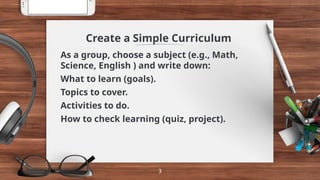
Create a SimpleCurriculum
As a group, choose a subject (e.g., Math,
Science, English ) and write down:
What to learn (goals).
Topics to cover.
Activities to do.
How to check learning (quiz, project).
3
4.
DEFINITIONS:
This lesson presentsa selection of definitions as
proposed by various authors:
1. Curriculum as a list of subjects: permanent
or traditional list of subjects offered in the
school curriculum.
2. Curriculum as learning experiences:
Curricular and Co-curricular activities in
school.
3. Curriculum as intended learning
4
5.
DEFINITIONS:
4. Curriculum asplanned learning experiences. It
is a structured guide that outlines the goals,
content, teaching methods, and assessments
designed to facilitate student learning.
5. Curriculum as a discipline. It means figuring
out the best way to plan lessons and activities so
students can learn well. It helps teachers decide
what to teach and how to make learning better.
5
6.
DEFINITIONS:
6. Curriculum ascontent or subject matter. It
refers to the specific topics, lessons, and
knowledge that are taught in a course or
program.
6
1. IDEAL ORRECOMMENDED
CURRICULUM
> This refers to what scholars propose
as the most appropriate curriculum
for the learners.
> Curriculum standards recommended
by professional organizations are
example of ideal or recommended
curriculum.
8
9.
2. INTENDED, OFFICIALOR WRITTEN
CURRICULUM
> This refers to the official curriculum
embodied in approved state
curriculum guides.
> Examples:
> Kindergarten curriculum standards
> The K-12 Curriculum
> TESDA Modules and Competencies
9
10.
3. IMPLEMENTED CURRICULUM
>This type of curriculum refers to the
actual implementation of the
curriculum or what teachers in the
school teach.
> For example, in a Grade 3 math class,
students learn addition and subtraction
by following teacher instructions,
completing practice exercises, and
participating in activities like "Math
Bingo" to reinforce the concepts.
10
11.
4. ACHIEVED CURRICULUMOR
LEARNED CURRICULUM
> This refers to the result of the curriculum
or what students actually learned in
school (Print 1993).
> For example, after a Grade 3 math unit
on addition and subtraction, students
can successfully solve two-digit addition
and subtraction problems independently
and demonstrate their understanding
through a quiz, showing they've achieved
11
12.
5. TESTED CURRICULUM
>This is a set of learning that is assessed
in teacher-made classroom tests,
curriculum-referenced tests and in
standardized tests.
12
13.
6. ENTITLEMENT CURRICULUM
•It refers to what the people or the
general society believed the learners
should expect to learn in the
educational system for them to be
good members of the society.
> Example: All students must complete
health education to learn about
nutrition, fitness, and well-being.
13
14.
7. SUPPORTED CURRICULUM
>This refers to how the curriculum is
influenced by the resources, like
teachers, textbooks, and technology,
that are available to help teach it.
> For example, if a school has limited
access to computers, it might not be
able to offer as many digital learning
opportunities, affecting how the
curriculum is taught.
14
15.
8. NULL ORCENSORED CURRICULUM
> This refers to topics that should not be
taught to students.
> Example: Teaching harmful or
misleading information, like false
medical claims, should be avoided.
15
16.
9. HIDDEN CURRICULUM
>This refers to the skills, knowledge,
and attitudes students gain through
interactions at school.
> Example: Students learn teamwork
and communication skills by working
on group projects.
16
17.
CURRICULUM FOUNDATIONS
According toPrint (1993), Psychology can
provide information in five important areas:
1. Educational Objectives: Goals
2. Student Characteristics: Traits
3. Learning Processes: Activities
4. Teaching Methods: Approaches
5. Evaluation Procedures: Assessment
17
18.
CURRICULUM CONCEPTIONS
McNeil (2006),Eisener (1985) and
Print (1993) identified six curriculum
conceptions:
1. ACADEMIC RATIONALIST
CONCEPTION: considered as the
oldest among the curriculum
conceptions. It has been a key part of
education for a long time, focusing
more on content than on teaching
18
19.
CURRICULUM CONCEPTIONS
2. COGNITIVEPROCESSES CONCEPTION
> Seeks to develop a collection of
cognitive skills that are applicable to a
wide range of intellectual problems.
> Example: In a reading class, students
are taught how to identify the main
idea, make inferences, and summarize.
These skills can be used not just in
reading, but also in understanding
other subjects like science or history.
19
20.
CURRICULUM CONCEPTIONS
3. HUMANISTICCONCEPTION
> the main goal of teaching is to help
students grow and develop all their
abilities, focusing on their personal
and academic potential.
20
21.
CURRICULUM CONCEPTIONS
4. SOCIALRECONSTRUCTIONIST
CONCEPTION
> Views the school or schooling as an
agency for social change.
society.Example: In a social studies class,
students might discuss issues like
inequality and human rights, and work on
projects that promote awareness and
solutions to social problems, encouraging
them to become active participants in
21
22.
CURRICULUM CONCEPTIONS
5. TECHNOLOGICALCONCEPTION
> is about using organized methods and
tools to plan and improve teaching and
learning in a practical way.
way.Example: In a classroom, a teacher
might use educational software and
online resources to help students
practice math skills, track their
progress, and provide immediate
feedback, making the learning process
22
23.
CURRICULUM CONCEPTIONS
6. ECLECTICCONCEPTION
> It is where curriculum workers find
themselves aligning their ideas with
two or more curriculum conceptions.
approach.Example: A teacher may use
both the humanistic approach,
focusing on students' personal growth,
and the technological approach,
incorporating online tools and
methods to improve learning. This
allows the teacher to address both the
23
24.
Elements of acurriculum
1. CURRICULUM INTENT
> Print (1993) uses the term to
describe the course or approach
that curriculum developers choose
to follow based on their experiences
and involvement in the curriculum
process. Example: If a curriculum
developer has experience in project-
based learning, they may design a
curriculum that focuses on hands-
on, real-world projects to help
24
25.
Elements of acurriculum
1. CURRICULUM INTENT
a. AIMS: include what is hoped to be
achieved by the entire curriculum.
b. GOALS: general statements of what
concepts, skills and values should be
learned in the curriculum.
25
26.
Elements of acurriculum
1. CURRICULUM INTENT
c. OBJECTIVES: includes what specific
skills, concepts and values should be
learned by the students.
26
27.
Elements of acurriculum
2. LEARNING EXPERIENCES
> include all instructional strategies
that are useful for the
implementation of the curriculum.
Example: In a science class,
learning experiences may include
hands-on experiments, group
discussions, and watching videos,
all aimed at helping students
27
28.
Elements of acurriculum
3. EVALUATION
> includes the different ways and
tools used for evaluating whether
or not the curriculum intents were
realized. achieved. Example: In a
history class, evaluation might
include quizzes, essays, and group
projects to see if students have
understood the historical concepts
28
29.
Hilda and Taba(1962) observed that all
curricula no matter what design they
have are composed of certain
elements:
> A curriculum defines what students
should learn.
> Sets clear goals, and arranges the
topics in a certain order.
> It also suggests how teaching and
learning should happen to meet these
goals.
29
#2 By the end of this chapter, you should be able to:Explain what curriculum is;Identify the different types of curriculum;Understand the foundations of curriculum;Understand various ideas about curriculum
#4 Here are the definitions explained in simpler terms with examples:Curriculum as a list of subjects:This is like a traditional list of subjects offered in school.Example: In high school, you have subjects like Math, English, Science, and History. This list is the school’s curriculum.Curriculum as learning experiences:This refers to the activities or experiences students go through to learn, both inside and outside of the classroom.Example: School clubs, sports events, field trips, and classroom activities like group discussions. These are all parts of the learning experience.Curriculum as intended learning outcomes:This is about the goals or skills students are expected to learn after completing the course or program.Example: After studying English, students should be able to write an essay or read a novel. These goals are the intended learning outcomes.
#5 Curriculum as planned learning experiences: A structured plan that details the goals, content, teaching methods, and assessments to help students learn.Curriculum as a discipline: It focuses on finding the best ways to plan lessons and activities for effective student learning. It guides teachers on what to teach and how to improve the learning process.
#6 Curriculum as content or subject matter: It refers to the specific topics, lessons, and knowledge that are taught in a course or program.
#8 Ideal or Recommended Curriculum: This refers to the curriculum that experts suggest is best for students. An example of this is the curriculum standards recommended by professional organizations.
#9 Intended, Official, or Written Curriculum: This refers to the official curriculum found in approved state curriculum guides.Examples:Kindergarten curriculum standardsThe K-12 CurriculumTESDA Modules and Competencies
#10 Implemented Curriculum: This refers to the actual teaching of the curriculum, or what teachers actually teach in the classroom.For example, in a Grade 3 math class, students learn addition and subtraction by following the teacher's instructions, completing practice exercises, and doing activities like "Math Bingo" to help reinforce the concepts.
#11 Achieved Curriculum or Learned Curriculum: This refers to the actual result of the curriculum, or what students have really learned in school (Print 1993).For example, after a Grade 3 math unit on addition and subtraction, students can solve two-digit addition and subtraction problems on their own and show their understanding through a quiz, proving they've reached the intended learning goals.
#12 Tested Curriculum: This refers to the set of learning that is evaluated through teacher-made classroom tests, curriculum-referenced tests, and standardized tests.
#13 Entitlement Curriculum: This refers to what society believes students should learn in the education system to become good members of society.Example: All students must complete health education to learn about nutrition, fitness, and well-being.
#14 Supported Curriculum: This refers to how the curriculum is shaped by the resources available, such as teachers, textbooks, and technology, that help in teaching it.For example, if a school has limited access to computers, it may not be able to offer as many digital learning opportunities, which could affect how the curriculum is taught.
#15 Null or Censored Curriculum: This refers to topics that are intentionally not taught to students.Example: Teaching harmful or misleading information, such as false medical claims, should be avoided.
#16 Hidden Curriculum: This refers to the skills, knowledge, and attitudes that students learn through interactions at school, outside of formal lessons.Example: Students learn teamwork and communication skills by working on group projects.
#17 According to Print (1993), psychology can provide useful information in five key areas:Educational Objectives: The goals of education.Student Characteristics: The traits of students.Learning Processes: The activities involved in learning.Teaching Methods: The approaches used in teaching.Evaluation Procedures: The methods of assessing student progress.
#18 Curriculum ConceptionsMcNeil (2006), Eisener (1985), and Print (1993) identified six curriculum conceptions:Academic Rationalist Conception: This is the oldest curriculum conception. It has been a key part of education for a long time, emphasizing content over teaching methods or student interests.
#19 Cognitive Processes Conception: This focuses on developing a set of cognitive skills that can be applied to various intellectual problems.
#20 Humanistic Conception: The main goal of teaching is to help students grow and develop their abilities, focusing on both their personal and academic potential.Example: In a classroom, a teacher encourages students to explore their interests, build self-confidence, and work on projects that reflect their individual strengths, helping them become well-rounded individuals.
#21 Social Reconstructionist Conception: This view sees schools as a place to promote social change and improve society.Example: In a social studies class, students might discuss issues like inequality and human rights, and work on projects that promote awareness and solutions to social problems, encouraging them to become active participants in changing society for the better
#22 Technological Conception: This focuses on using organized methods and tools to plan and improve teaching and learning in a practical way.Example: In a classroom, a teacher might use educational software and online resources to help students practice math skills, track their progress, and provide immediate feedback, making the learning process more efficient and effective.
#23 Eclectic Conception: This is when curriculum planners combine ideas from two or more curriculum conceptions to create a well-rounded approach.Example: A teacher may use both the humanistic approach, focusing on students' personal growth, and the technological approach, incorporating online tools and methods to improve learning. This allows the teacher to address both the emotional and academic needs of students.
#24 Curriculum Intent: Print (1993) uses this term to describe the course or approach that curriculum developers choose to follow, based on their experiences and involvement in the curriculum process.Example: If a curriculum developer has experience in project-based learning, they may design a curriculum that focuses on hands-on, real-world projects to help students apply what they learn.
#25 Curriculum Intent is about what the curriculum is trying to achieve and why it exists.a. Aims: These are the big ideas of what the whole curriculum hopes to accomplish. They describe the overall purpose of the learning program.b. Goals: These are more specific things that the curriculum wants students to learn. They describe what students should know, be able to do, or value after completing the curriculum.
#26 Curriculum Intentc. Objectives: These are specific things that students should learn, such as skills, concepts, and values. Objectives give clear, detailed targets that show exactly what students need to achieve during their studies. They focus on what students will know or be able to do by the end of a lesson or course.
#27 Learning Experiences: These include all the instructional strategies that help in carrying out the curriculum. Example: In a science class, learning experiences may include hands-on experiments, group discussions, and watching videos, all aimed at helping students understand scientific concepts.
#28 Evaluation: This includes the various methods and tools used to assess whether the curriculum's goals have been achieved.Example: In a history class, evaluation might include quizzes, essays, and group projects to see if students have understood the historical concepts taught in the curriculum.
#29 A curriculum defines what students need to learn. It sets clear goals and organizes the topics in a specific order. It also provides suggestions on how teaching and learning should take place to achieve these goals.