Curriculum
SUBMITTED BY –SHIVALI SRIVASTAVA
MOT 1ST YR ( ORTHO)
Curriculum
1.Meaning and concept
2. Basic for curriculum formulation/development
3. Process of curriculum development
4. Effective curriculum development
5. Evaluation of curriculum
Introduction
 Curriculum is the crux of the whole educational process.
Without curriculum, we cannot conceive any educational
Endeavour.
 The curriculum in a literal sense ,a pathway towards a
goal.
 Curriculum is actually what happens during a course
i.e., lecture , demonstrations, field visits, the work with the
client and so on.
 Curriculum also means a written description of what
happens.
 Curriculum is an important element of education. Aims of
education are reflected in the curriculum. In other words, the
curriculum is determined by the aims of life and society.
Aims of life and society are subject to constant change.
 The term curriculum has been derived from a Latin word
„Currere‟ which means a „race course‟ or a runway on which one
runs to reach a goal. If the teacher is the guide, the curriculum is
the path. Curriculum is the total structure of ideas and activities.
Definition
 “A course, especially the course of study in a university” –
Dictionary .
 “All the experiences of pupil which has undertaken in the
guience of the school”-blond‟s encyclopedia(1969).
 All educational ideas must find expression in curricula before
we can tell whether they are day dreams or contributions to
practice. Many educational ideas are not found wanting
because they cannot be found at all."
 Stenhouse (1980)
 "A curriculum is an attempt to communicate the essential
principles and features of an educational proposal in such a
form that it is open to critical scrutiny and capable of
effective translation into practice."
 All the learning activites which are planned and guided by
the school ,whether they are carried out in groups or
individually ,inside and outside the school‟- kerr (1968).
 „curriculum is tool in the hand of the artist (teacher) to
mould his material in accordance with his ideals in the
school – Cunningham .
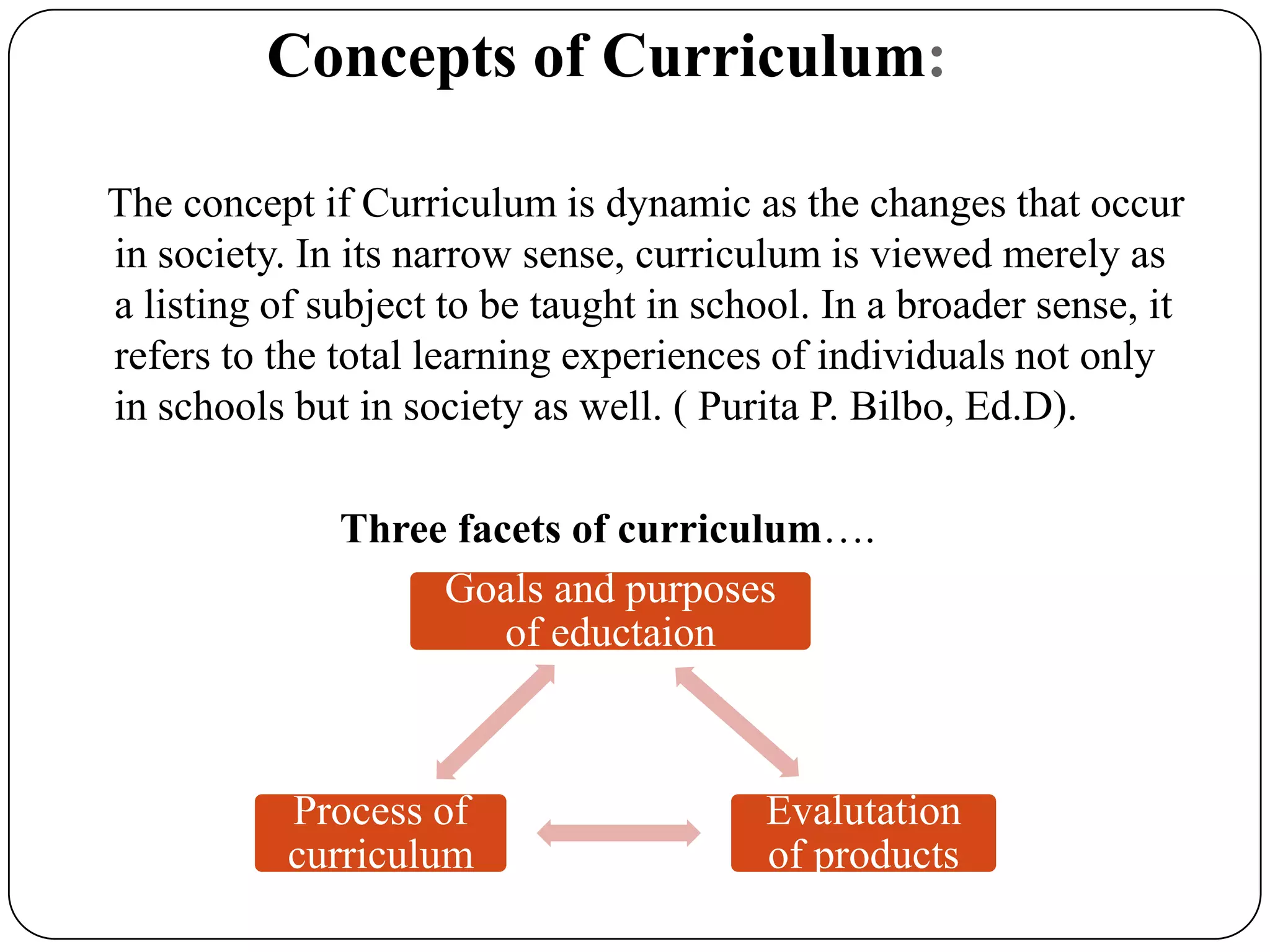
Concepts of Curriculum:
The concept if Curriculum is dynamic as the changes that occur
in society. In its narrow sense, curriculum is viewed merely as
a listing of subject to be taught in school. In a broader sense, it
refers to the total learning experiences of individuals not only
in schools but in society as well. ( Purita P. Bilbo, Ed.D).
Three facets of curriculum….
Goals and purposes
of eductaion
Evalutation
of products
Process of
curriculum
 Curriculum includes course of studies, methods of
teaching extra and co curricular activities in –
addition to the regular programes.
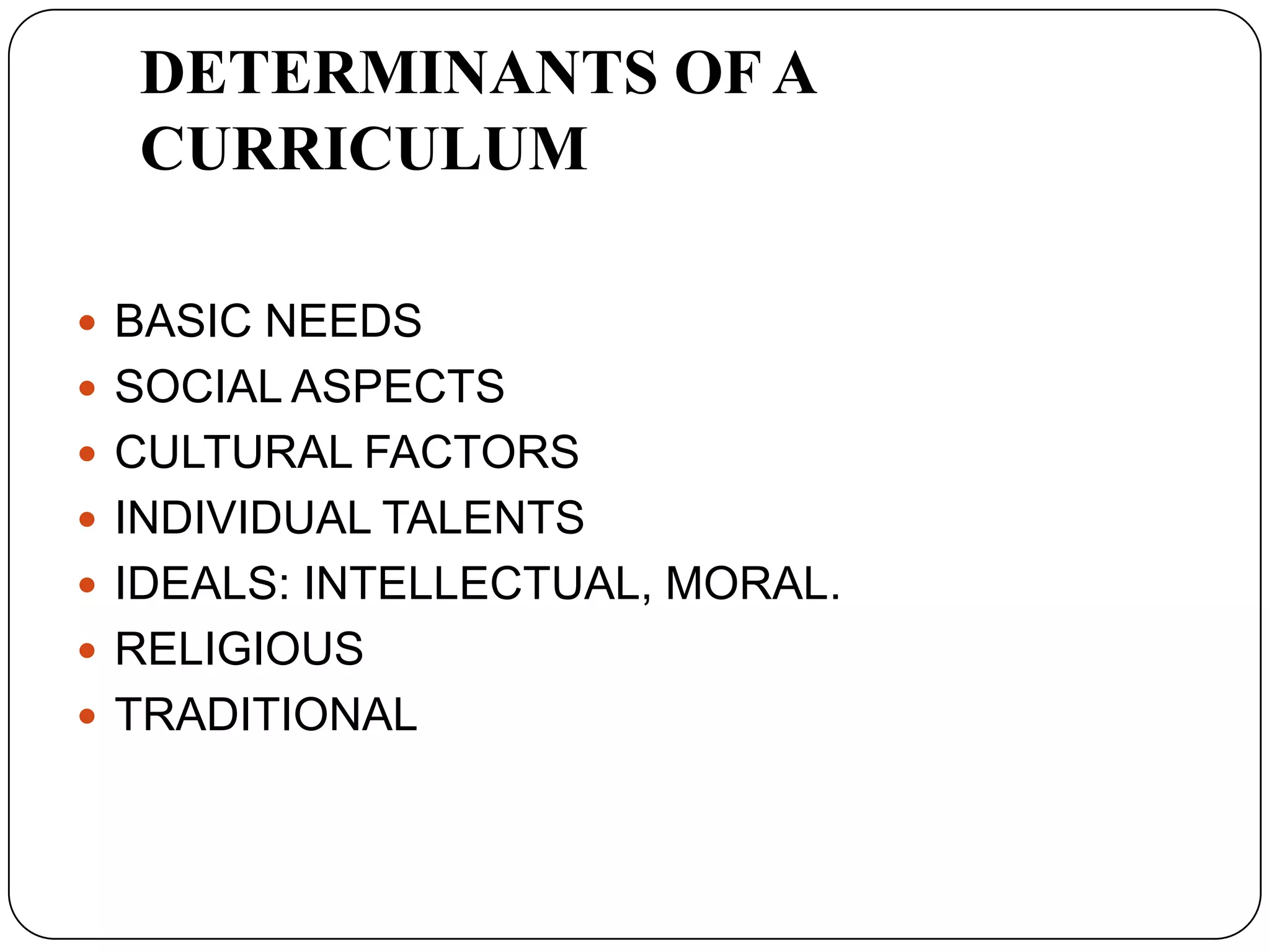
DETERMINANTS OF A
CURRICULUM
 BASIC NEEDS
 SOCIAL ASPECTS
 CULTURAL FACTORS
 INDIVIDUAL TALENTS
 IDEALS: INTELLECTUAL, MORAL.
 RELIGIOUS
 TRADITIONAL
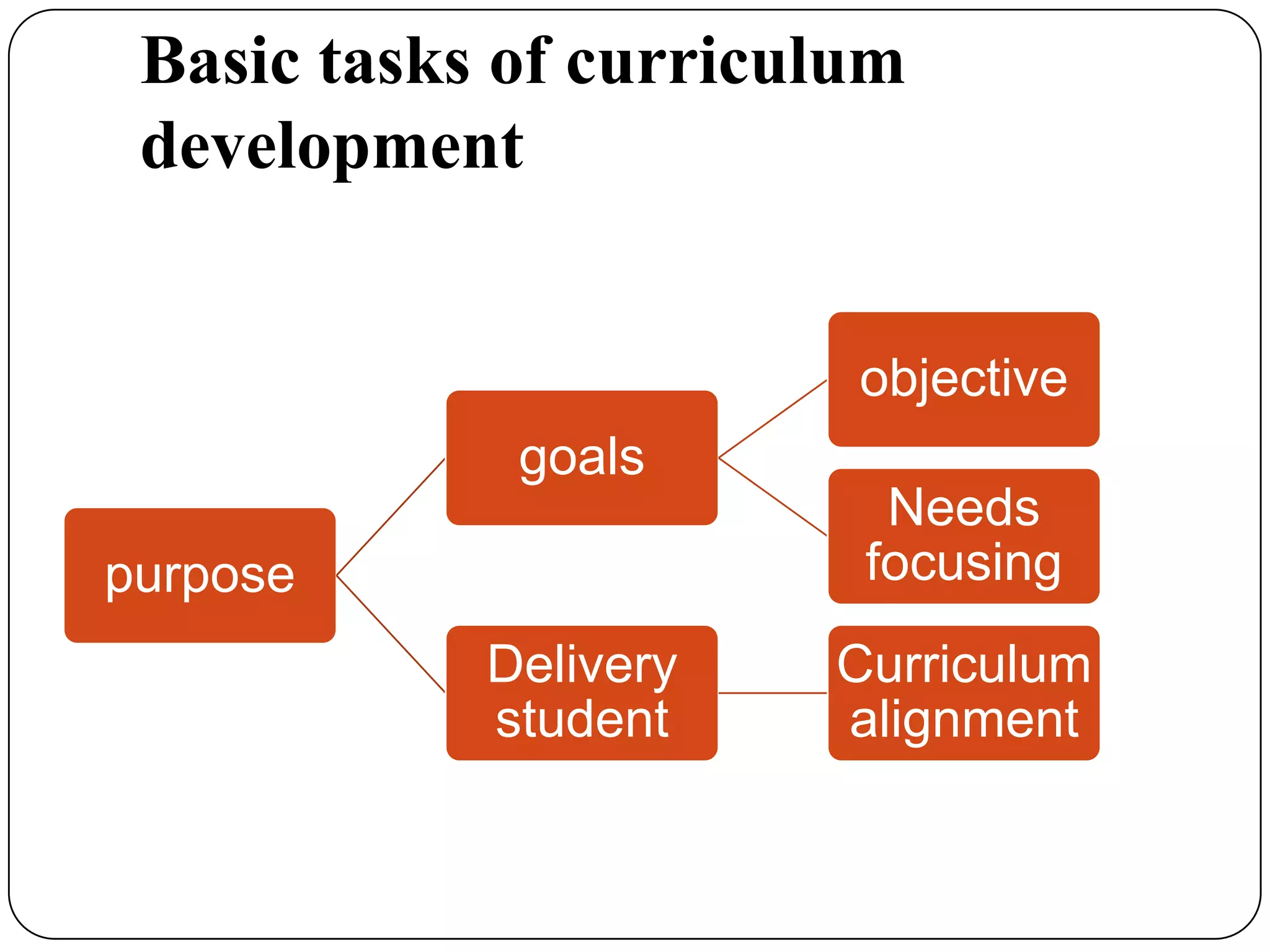
Basic tasks of curriculum
development
purpose
goals
objective
Needs
focusing
Delivery
student
Curriculum
alignment
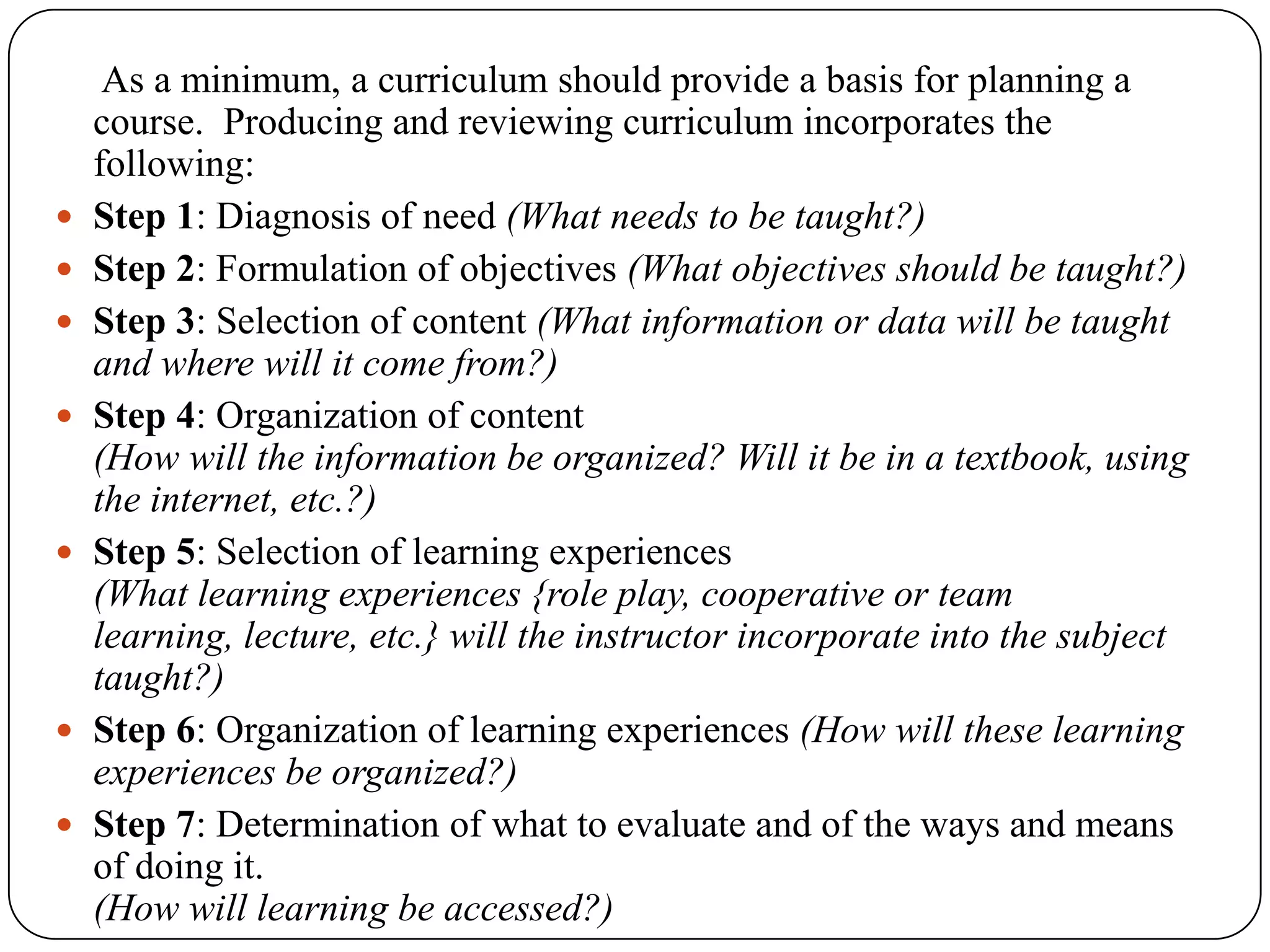
As a minimum, a curriculum should provide a basis for planning a
course. Producing and reviewing curriculum incorporates the
following:
 Step 1: Diagnosis of need (What needs to be taught?)
 Step 2: Formulation of objectives (What objectives should be taught?)
 Step 3: Selection of content (What information or data will be taught
and where will it come from?)
 Step 4: Organization of content
(How will the information be organized? Will it be in a textbook, using
the internet, etc.?)
 Step 5: Selection of learning experiences
(What learning experiences {role play, cooperative or team
learning, lecture, etc.} will the instructor incorporate into the subject
taught?)
 Step 6: Organization of learning experiences (How will these learning
experiences be organized?)
 Step 7: Determination of what to evaluate and of the ways and means
of doing it.
(How will learning be accessed?)
ORIENTATIONS TO CURRICULUM
 child-centered.
 society-centered.
 knowledge-centered.
Curriculum Development
Process of curriculum development
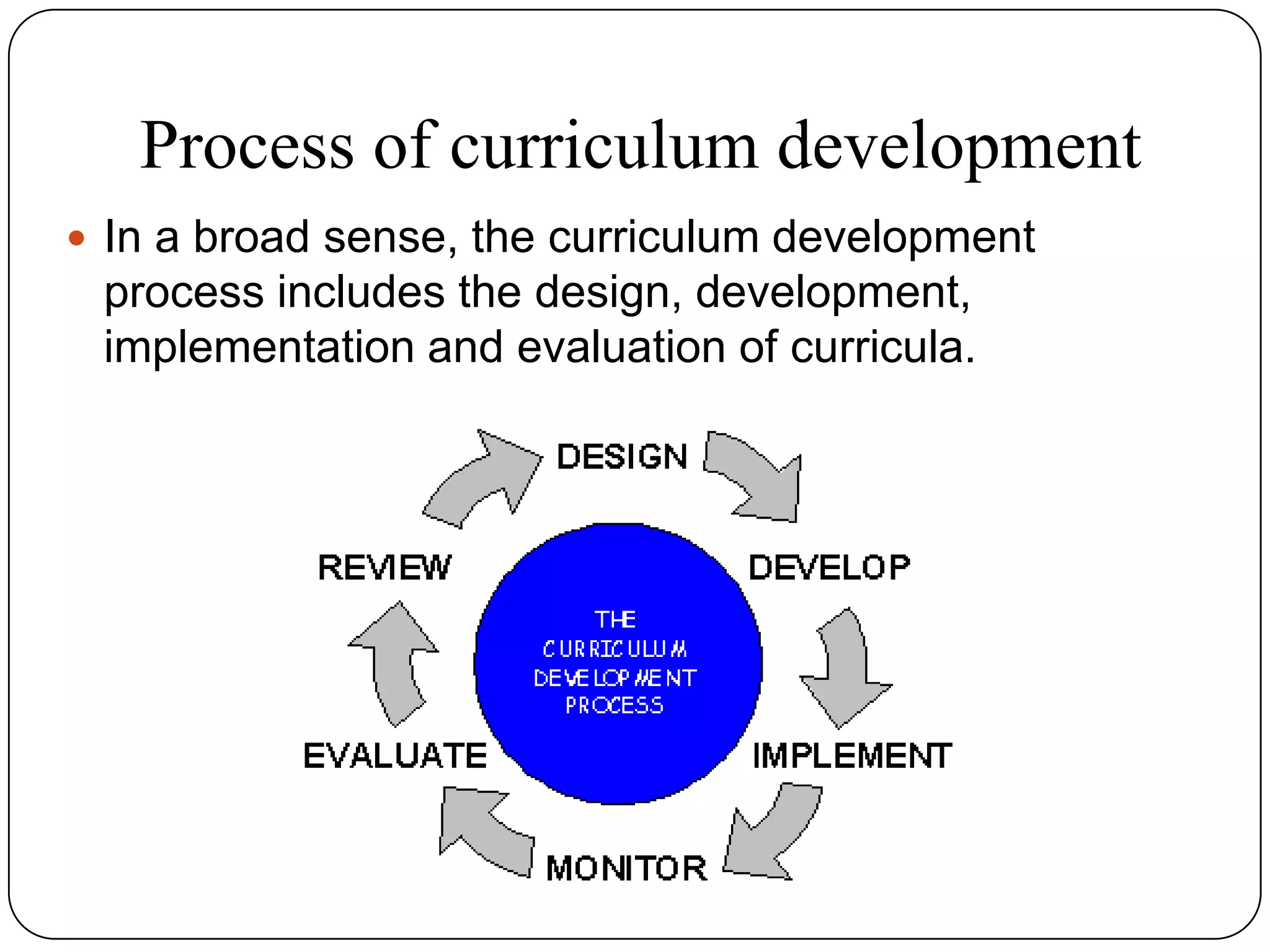
 In a broad sense, the curriculum development
process includes the design, development,
implementation and evaluation of curricula.
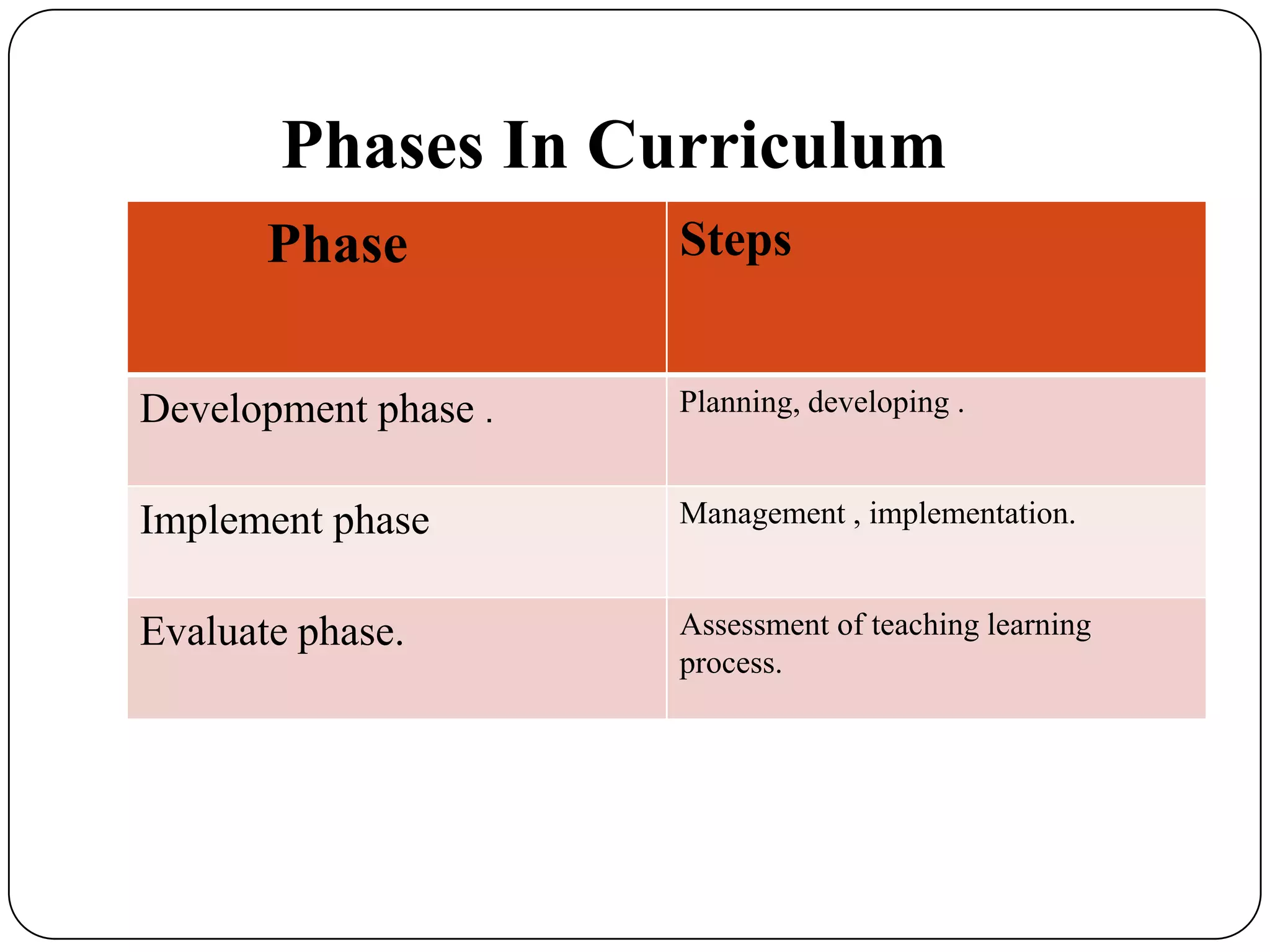
Phases In Curriculum
Phase Steps
Development phase . Planning, developing .
Implement phase Management , implementation.
Evaluate phase. Assessment of teaching learning
process.
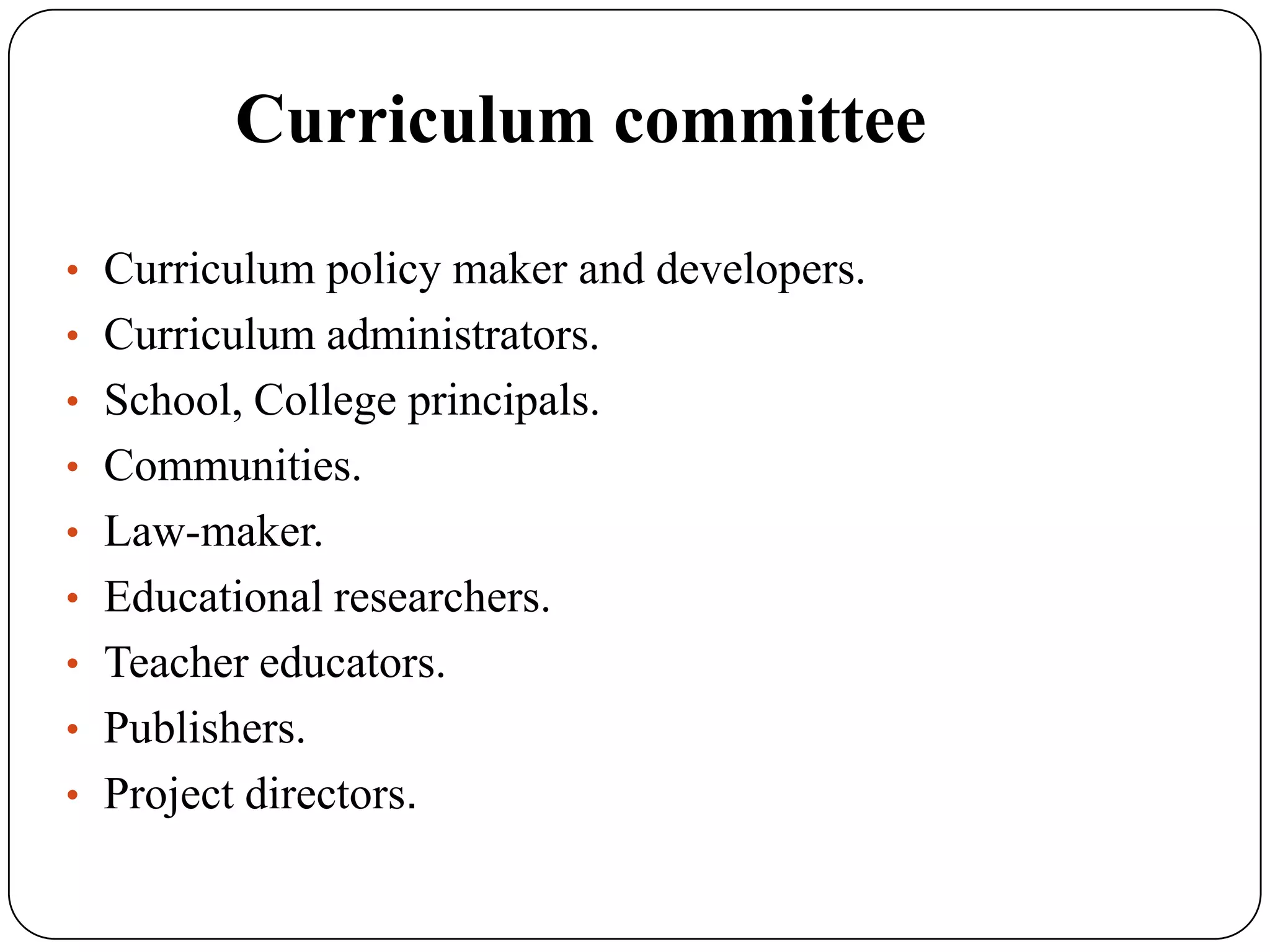
Curriculum committee
• Curriculum policy maker and developers.
• Curriculum administrators.
• School, College principals.
• Communities.
• Law-maker.
• Educational researchers.
• Teacher educators.
• Publishers.
• Project directors.
Step in curriculum construction
PLANNING
 Planning to determine the need and purposes, identification and analysis of
existing situation has to be done.
 Formulate the philosophy of educational programme.
Constitute a committee for curriculum preparation.
The four C‟s of curriculum planning.
 Cooperative: programmed prepared jointly by a group of persons will be less
liable to error then one prepared by a single person.
 Continuous: The preparation of a programme is not a one –shot
operation, provision should be made for its continuous revision.
 Comprehensive: all the programme components must be defined with the
requisite precision.
 Concrete: general & abstract consideration are not a sufficient basis fr
drawing up a constitute the essential structure of a relevant programme.
 Decide the philosophy and policy of the organization
,e.g. student recruitment, type of educational
programme, methods of teaching, group
involved, duration of the period, staffing requirement
,e.g. teaching, supervised clinical practice, teaching-
learning activities, selection of learning experience-
theory and practice.
Developmental phase
Organization and sequencing of :
 Theory .
 Practicals.
 Supervised clinical practice .
 Individual student rotation plan.
 Preparation of teaching-learning materials, av aids.
 Curriculum committee, reviews the progress
identifies constraints, assess needs for modification
and formation of the other standing committees for
management of the curriculum.
CURRICULUM DESIGN
 Analysis of social needs
 Translating the needs into
course/general/learning/terminal objectives
 Splitting the objectives into specific objectives
 Grouping the specific objectives into subjects
 Deriving the subjects from the above classification
 Specifying objectives
 Unitising each subject matter
 Specification of required time
 Syllabus formulation
IMPLEMENTATION OF THE
CURRICULUM
 Instructional scheme of each subject to be
completed in the semester.
 Planning the lessons as per the timetable
 Using the transactional strategies
 Using the appropriate media
 Providing the learning resources
 Promoting classroom learning experiences
 Progressive testing
CURRICULUM EVALUATION
 Intra-curricular evaluation
 Teacher evaluation of students
 Student evaluation of teachers
 Materials evaluation
 Verification of methods
 Evaluation of tests and examinations
 Checking the learning outcomes while on the field
 Curriculum review/ improvement/ change/
modification
 System revision
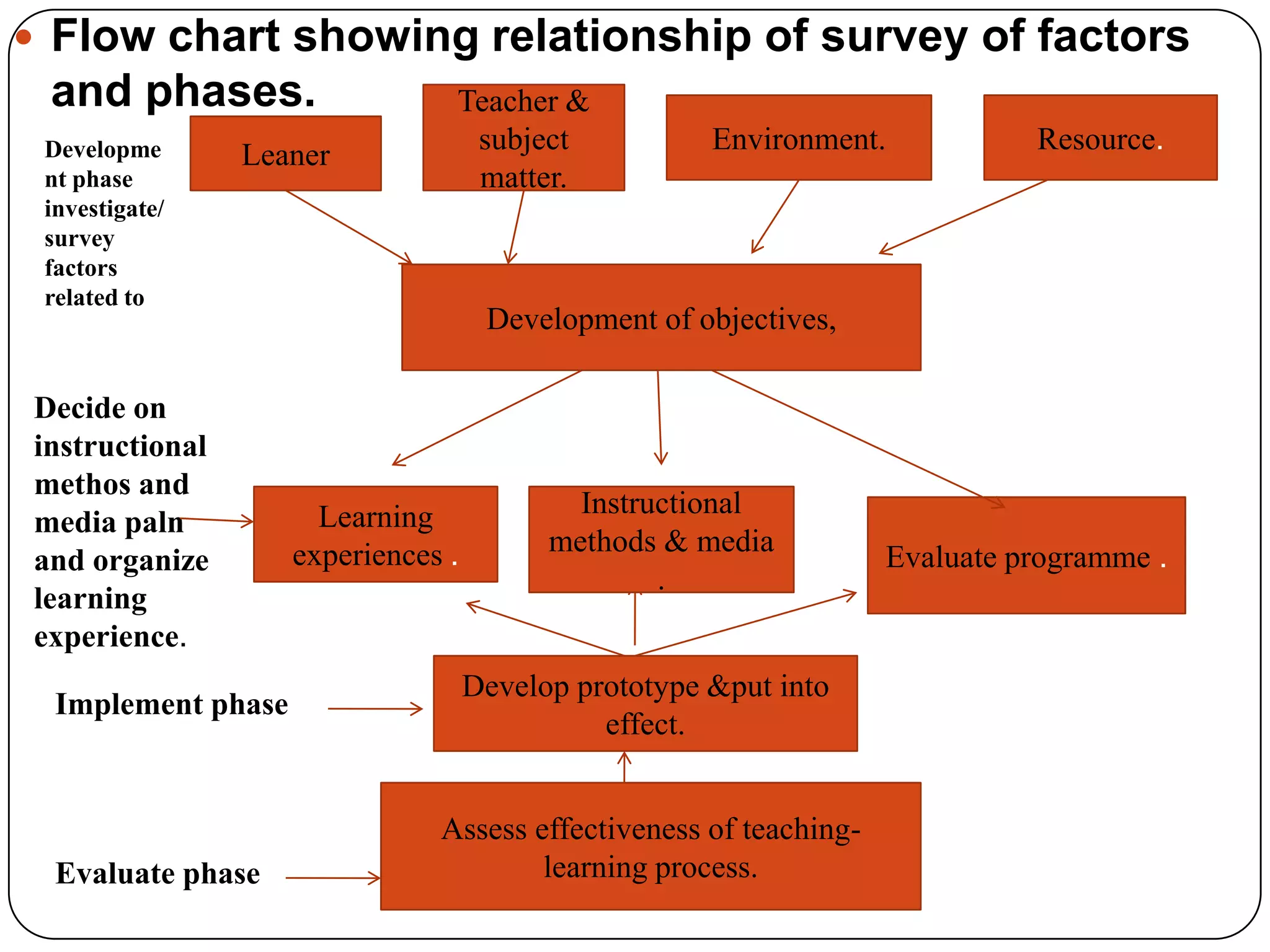
 Flow chart showing relationship of survey of factors
and phases.
Assess effectiveness of teaching-
learning process.
Develop prototype &put into
effect.
Learning
experiences . Evaluate programme .
Instructional
methods & media
.
Development of objectives,
Leaner
Teacher &
subject
matter.
Environment. Resource.
Evaluate phase
Implement phase
Decide on
instructional
methos and
media paln
and organize
learning
experience.
Developme
nt phase
investigate/
survey
factors
related to
CURRICULUM EVALUATION
Curriculum Evaluation
 Evaluation describes how to assess the nature, impact and
value of an activity through the systematic collection, analysis
and interpretation of information with a view to making an
informed decision.
Evaluation involves 3 activities:
 Outlining clear purposes
 Gathering evidences
 Judgment
 Evaluation is part of development rather than apart from it.
 It is a process of assessment ; certain specific
characteristics of the programme, individual or an
institution described, these will serve as the basis for
making an assessment about the individual programme or
the institution.
 It is a continuous process, helps in making decisions about
student, teaching-learning techniques, facilities, objectives
to be realised.
 It helps in to clarify objectives and also to know the extent
of objectives achieved. It leads to improvement of
instruction and the teaching learning process motivates the
student, determine the students level of knowledge ,skills .
Two-fold points of view of evaluation of
curriculum
1. Curriculum evaluation is concerned with
the measurement of the achievement of
objectives.
2. Curriculum evaluation is the collection and
use of information to make decisions
about the educational progremme.
METHODS AND TECHNIQUES OF
CURRICULUM EVALUATION
 Discussions.
 Experiments.
 Interview – individual, group.
 Opinions.
 Observation.
 Questionnaire.
 Schedules.
 Practical performance.
 Anecdotal records.
Need for curriculum revision
 To restructure the curriculum according to the
needs of learners society.
 To eliminate unnecessary units. Teaching methods
and contents.
 To introduce latest and update methods of teaching
and content ,new knowledge and practices.
 To add or delete number of clinical hours of
insturction.
Nine Competencies of medical
curriculum
 I. Effective Communication
 II. Basic Clinical skills
 III. Using Science to Guide
Diagnosis, Management, Therapeutics, and
Prevention
 IV. Lifelong Learning
 V. Self-Awareness,Self-Care ,and Personal Growth
 VI. The Social and Community Contexts of Health
Care
 VII. Moral Reasoning and Ethical Judgment
 VIII. Problem-Solving
 IX. Professionalism and Role Recognition LEVELS.
References
 Text book of nursing education by KP neeraja.
 www.goggle.com
Thank you

Curriculum

  • 1.
    Curriculum SUBMITTED BY –SHIVALISRIVASTAVA MOT 1ST YR ( ORTHO)
  • 2.
    Curriculum 1.Meaning and concept 2.Basic for curriculum formulation/development 3. Process of curriculum development 4. Effective curriculum development 5. Evaluation of curriculum
  • 3.
    Introduction  Curriculum isthe crux of the whole educational process. Without curriculum, we cannot conceive any educational Endeavour.  The curriculum in a literal sense ,a pathway towards a goal.  Curriculum is actually what happens during a course i.e., lecture , demonstrations, field visits, the work with the client and so on.  Curriculum also means a written description of what happens.
  • 4.
     Curriculum isan important element of education. Aims of education are reflected in the curriculum. In other words, the curriculum is determined by the aims of life and society. Aims of life and society are subject to constant change.  The term curriculum has been derived from a Latin word „Currere‟ which means a „race course‟ or a runway on which one runs to reach a goal. If the teacher is the guide, the curriculum is the path. Curriculum is the total structure of ideas and activities.
  • 5.
    Definition  “A course,especially the course of study in a university” – Dictionary .  “All the experiences of pupil which has undertaken in the guience of the school”-blond‟s encyclopedia(1969).  All educational ideas must find expression in curricula before we can tell whether they are day dreams or contributions to practice. Many educational ideas are not found wanting because they cannot be found at all."  Stenhouse (1980)  "A curriculum is an attempt to communicate the essential principles and features of an educational proposal in such a form that it is open to critical scrutiny and capable of effective translation into practice."
  • 6.
     All thelearning activites which are planned and guided by the school ,whether they are carried out in groups or individually ,inside and outside the school‟- kerr (1968).  „curriculum is tool in the hand of the artist (teacher) to mould his material in accordance with his ideals in the school – Cunningham .
  • 7.
    Concepts of Curriculum: Theconcept if Curriculum is dynamic as the changes that occur in society. In its narrow sense, curriculum is viewed merely as a listing of subject to be taught in school. In a broader sense, it refers to the total learning experiences of individuals not only in schools but in society as well. ( Purita P. Bilbo, Ed.D). Three facets of curriculum…. Goals and purposes of eductaion Evalutation of products Process of curriculum
  • 8.
     Curriculum includescourse of studies, methods of teaching extra and co curricular activities in – addition to the regular programes.
  • 9.
    DETERMINANTS OF A CURRICULUM BASIC NEEDS  SOCIAL ASPECTS  CULTURAL FACTORS  INDIVIDUAL TALENTS  IDEALS: INTELLECTUAL, MORAL.  RELIGIOUS  TRADITIONAL
  • 10.
    Basic tasks ofcurriculum development purpose goals objective Needs focusing Delivery student Curriculum alignment
  • 11.
    As a minimum,a curriculum should provide a basis for planning a course. Producing and reviewing curriculum incorporates the following:  Step 1: Diagnosis of need (What needs to be taught?)  Step 2: Formulation of objectives (What objectives should be taught?)  Step 3: Selection of content (What information or data will be taught and where will it come from?)  Step 4: Organization of content (How will the information be organized? Will it be in a textbook, using the internet, etc.?)  Step 5: Selection of learning experiences (What learning experiences {role play, cooperative or team learning, lecture, etc.} will the instructor incorporate into the subject taught?)  Step 6: Organization of learning experiences (How will these learning experiences be organized?)  Step 7: Determination of what to evaluate and of the ways and means of doing it. (How will learning be accessed?)
  • 12.
    ORIENTATIONS TO CURRICULUM child-centered.  society-centered.  knowledge-centered.
  • 13.
  • 14.
    Process of curriculumdevelopment  In a broad sense, the curriculum development process includes the design, development, implementation and evaluation of curricula.
  • 15.
    Phases In Curriculum PhaseSteps Development phase . Planning, developing . Implement phase Management , implementation. Evaluate phase. Assessment of teaching learning process.
  • 16.
    Curriculum committee • Curriculumpolicy maker and developers. • Curriculum administrators. • School, College principals. • Communities. • Law-maker. • Educational researchers. • Teacher educators. • Publishers. • Project directors.
  • 17.
    Step in curriculumconstruction PLANNING  Planning to determine the need and purposes, identification and analysis of existing situation has to be done.  Formulate the philosophy of educational programme. Constitute a committee for curriculum preparation. The four C‟s of curriculum planning.  Cooperative: programmed prepared jointly by a group of persons will be less liable to error then one prepared by a single person.  Continuous: The preparation of a programme is not a one –shot operation, provision should be made for its continuous revision.  Comprehensive: all the programme components must be defined with the requisite precision.  Concrete: general & abstract consideration are not a sufficient basis fr drawing up a constitute the essential structure of a relevant programme.
  • 18.
     Decide thephilosophy and policy of the organization ,e.g. student recruitment, type of educational programme, methods of teaching, group involved, duration of the period, staffing requirement ,e.g. teaching, supervised clinical practice, teaching- learning activities, selection of learning experience- theory and practice.
  • 19.
    Developmental phase Organization andsequencing of :  Theory .  Practicals.  Supervised clinical practice .  Individual student rotation plan.  Preparation of teaching-learning materials, av aids.  Curriculum committee, reviews the progress identifies constraints, assess needs for modification and formation of the other standing committees for management of the curriculum.
  • 20.
    CURRICULUM DESIGN  Analysisof social needs  Translating the needs into course/general/learning/terminal objectives  Splitting the objectives into specific objectives  Grouping the specific objectives into subjects  Deriving the subjects from the above classification  Specifying objectives  Unitising each subject matter  Specification of required time  Syllabus formulation
  • 21.
    IMPLEMENTATION OF THE CURRICULUM Instructional scheme of each subject to be completed in the semester.  Planning the lessons as per the timetable  Using the transactional strategies  Using the appropriate media  Providing the learning resources  Promoting classroom learning experiences  Progressive testing
  • 22.
    CURRICULUM EVALUATION  Intra-curricularevaluation  Teacher evaluation of students  Student evaluation of teachers  Materials evaluation  Verification of methods  Evaluation of tests and examinations  Checking the learning outcomes while on the field  Curriculum review/ improvement/ change/ modification  System revision
  • 23.
     Flow chartshowing relationship of survey of factors and phases. Assess effectiveness of teaching- learning process. Develop prototype &put into effect. Learning experiences . Evaluate programme . Instructional methods & media . Development of objectives, Leaner Teacher & subject matter. Environment. Resource. Evaluate phase Implement phase Decide on instructional methos and media paln and organize learning experience. Developme nt phase investigate/ survey factors related to
  • 24.
  • 25.
    Curriculum Evaluation  Evaluationdescribes how to assess the nature, impact and value of an activity through the systematic collection, analysis and interpretation of information with a view to making an informed decision. Evaluation involves 3 activities:  Outlining clear purposes  Gathering evidences  Judgment  Evaluation is part of development rather than apart from it.
  • 26.
     It isa process of assessment ; certain specific characteristics of the programme, individual or an institution described, these will serve as the basis for making an assessment about the individual programme or the institution.  It is a continuous process, helps in making decisions about student, teaching-learning techniques, facilities, objectives to be realised.  It helps in to clarify objectives and also to know the extent of objectives achieved. It leads to improvement of instruction and the teaching learning process motivates the student, determine the students level of knowledge ,skills .
  • 27.
    Two-fold points ofview of evaluation of curriculum 1. Curriculum evaluation is concerned with the measurement of the achievement of objectives. 2. Curriculum evaluation is the collection and use of information to make decisions about the educational progremme.
  • 28.
    METHODS AND TECHNIQUESOF CURRICULUM EVALUATION  Discussions.  Experiments.  Interview – individual, group.  Opinions.  Observation.  Questionnaire.  Schedules.  Practical performance.  Anecdotal records.
  • 29.
    Need for curriculumrevision  To restructure the curriculum according to the needs of learners society.  To eliminate unnecessary units. Teaching methods and contents.  To introduce latest and update methods of teaching and content ,new knowledge and practices.  To add or delete number of clinical hours of insturction.
  • 30.
    Nine Competencies ofmedical curriculum  I. Effective Communication  II. Basic Clinical skills  III. Using Science to Guide Diagnosis, Management, Therapeutics, and Prevention  IV. Lifelong Learning  V. Self-Awareness,Self-Care ,and Personal Growth  VI. The Social and Community Contexts of Health Care  VII. Moral Reasoning and Ethical Judgment  VIII. Problem-Solving  IX. Professionalism and Role Recognition LEVELS.
  • 31.
    References  Text bookof nursing education by KP neeraja.  www.goggle.com
  • 32.