CURRICULUM PLANNING
in the
PHILIPPINES
Presented by:
CHRISTIAN D. EVANGELISTA
MARIANNE T. EVANGELISTA, MSHRM
DIVINE MERCY COLLEGE
FOUNDATION INC.
Caloocan City
Professional Education
OUTLINE OF PRESENTATION
• Definition of Curriculum Planning
• Needs and Importance
• The Need for Curriculum Framework
• The Bases for Curriculum Planning
• Factors in Curriculum Planning
• 2 Major Issues as to Who Plans the Curriculum
• Characteristics of Curriculum Planners
• The Use of Research in Curriculum Planning
CURRICULUM PLANNING
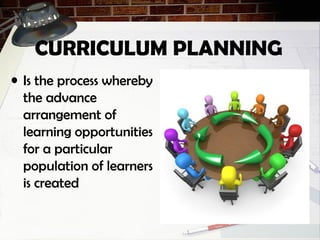
• Is the process whereby
the advance
arrangement of
learning opportunities
for a particular
population of learners
is created
NEEDS AND IMPORTANCE OF
CURRICULUM PLANNING
 The need for Exactness and Particularity in making
decisions about ends and means demands scientific
curriculum planning.
 Curriculum planning develop well-coordinated,
quality teaching, learning and assessment programs,
which build students’ knowledge, skills and behaviors in
the disciplines, as well as their interdisciplinary and/or
physical, personal and social capacities.
 The full range of learning needs of students are
addressed
THE BASES OF CURRICULUM
PLANNING
• History
• Philosophy
• Social forces
• Psychology
• Religion
• Contemporary Issues
LACK OF CURRICULUM PLANNING
AND FRAMEWORK WILL RESULT TO:
• Sari-sari (hodgepodge)
• Pira-piraso (piemal)
• Tagpi-tagpi (patchwork)
• Sabog (lack of focus)
• Malabo (vague)
• Lakas ng kutob (gutfeel)
• Hula-hula (hunches)
• Gaya-gaya (patterned from an existing model)
• Bahala na (by chance)
• Patama-tama (non-deliberate)
2 MAJOR ISSUES AS TO WHO
PLANS THE CURRICULUM
1. National or State and Local curriculum
control.
2. Relationship of laymen, academic
scholars, and elementary school and
secondary school and collegiate educators
in curriculum planning, parents and etc.
NATIONAL OR STATE AND LOCAL
CURRICULUM CONTROL
• The existing uniformity and the national
influences in the curriculum are frequently cited
as an argument for stronger national
curriculum control.
• However, many curriculum leaders have
observed that the real progress in curriculum
development is on a broken front.
CONTINUATION:
• Schools do not achieve minimum or other
standards at the same time. Neither do they
develop with equal interest and success new
ventures in the curriculum . Due to recognition
to the role of local and regional
experimentation in curriculum development
must be granted.
• Stakeholders are individuals or
institutions that are interested in school
curriculum.
• These stakeholders shape the school
curriculum implementation.
ROLE OF STAKEHOLDERS IN
CURRICULUM IMPLEMENTATION
“LEARNERS”
AS THE CENTER OF THE CURRICULUM
• For a particular curriculum design
mentioned earlier, the learner is placed at the
center.
• The learners are the very reason a
curriculum is developed. They are the ones who
are directly influenced by it. Learners in all
levels make or unmake the curriculum by
their active and direct involvement.
“TEACHERS”
As curriculum developers and implementers
Planning and writing the curriculum are the
primary roles of the teacher.
• A teacher is a curriculum maker. He/she
writes a curriculum daily through a lesson plan , a
unit plan or a yearly plan.
• The teacher addresses the goals, needs,
interests of the learners by creating experiences
from where the students can learn.
• The teacher designs, enriches and modifies
the curriculum to suit the learner’s
characteristics.
• As a curriculum developer, teachers are
part of textbooks committees, faculty
selection boards, school evaluation committee
or textbook writers themselves.
CONTINUATION:
From a designer or technician to a decision
maker.
• At this point, teachers’ role shift from a developer to
an implementer.
• Which of the plans should be put in to action and
how should it be done are decisions which the teachers
should make.
• Curriculum implementation is now giving life to the
written material. To do this, there is the need of another
actor, the learners. No curriculum will succeed without
the learners
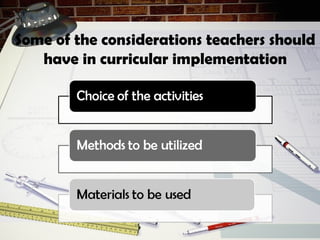
Some of the considerations teachers should
have in curricular implementation
A Student’s view about the teacher as a
curriculum maker and implementer
• Teachers shape the school curriculum by
sharing the experiences that they have and the
resources they are capable of giving or
imparting to the learners.
• But as the old saying goes , ”What can you
give if you have nothing to give? Applies to this
demand of teaches in curriculum
implementation”- Marianna
“CURRICULUM MANAGERS
AND ADMINISTRATORS”
• In a school organization, there is always a
curriculum manager or school administrator. In fact,
for school principals, one of their functions is being a
curriculum manager.
• They supervise curriculum implementation,
select and recruit new teachers, admit students,
procure equipment and materials needed for
effective learning. They also plan for the
improvement of school facilities and physical plants.
Why are school administrators and
curriculum managers important to
curriculum implementation?
• The school administrators play an important role in
shaping the school curriculum because they are the
people who are responsible in the formulation of the
schools’ vision, philosophy, mission and objectives.
• They provide necessary leadership in evaluating
teaching personnel and school program. Keeping records
of curriculum and reporting learning outcomes are also
the manger’s responsibilities.- Ceres
How do parents shape the curriculum and why are they
considered stakeholders? Here are some observations:
1.Effective parental involvement in school affairs may be
linked to parent educational programs which is central to
high quality educational experiences of the children .
2.The parents involvement extends from the confine of
the school to the homes. The parents become part of the
environment of learning at home.
3.In most schools the Parent Association is organized. This
organization is provided by law.
“PARENTS”
AS PART OF THE CURRICULUM PLANNING
2 FACTORS IN
CURRICULUM PLANNING
1. Identifying relevant substantive decisions at
increasing levels of specificity and precision
2. Checking for consistency between and among
the ends—and—means decisions by a two—
way process of derivation and evaluation at
each stage and by referring to data sources for
basic information
CHARACTERISTICS OF A
CURRICULUM PLANNER
• Open-minded
• Willing to listen
• Ready to Adapt
OPENMINDED
• Is an indispensable characteristics in those
who plan the curriculum
• Understanding of the values of the past
practices and of school community and
traditions is important.
• Must analyze and evaluate all aspects of
the program of schools to make certain in
providing the best program. And to avoid
hindering the acceptance of new ideas.
WILLING TO LISTEN
• Well-founded criticisms on the curriculum
and education must be listened to by the
curriculum planners.
• Remediation of the curriculum ills strengthen
the school program.
READY TO ADAPT
• There is a wisdom adopting relevant foreign
educational practices and must not resist
change and experimentation.
• Curriculum leaders should critically and
thoroughly educational practices in other
countries seeking new plans, methods, and
programs that will be useful in improving
the curriculum of our country.
THE USE OF RESEARCH IN
CURRICULUM PLANNING
• Research affects many curriculum in many ways like
for example:
1. Sound proposals presented for considerations,
(Hypotheses to be tested by actual tryout in school
programs
2. People who are engaged in curriculum planning
can do their jobs effectively because they are aware
of the latest or least review, related studies about
curriculum change and etc.
End of Presentation
Thank you!!!
Presented to:
DEAN L. NIEVES
Prof. Ed Students (Batch 2013)

CURRICULUM PLANNING IN THE PHILIPPINES

  • 1.
    CURRICULUM PLANNING in the PHILIPPINES Presentedby: CHRISTIAN D. EVANGELISTA MARIANNE T. EVANGELISTA, MSHRM DIVINE MERCY COLLEGE FOUNDATION INC. Caloocan City Professional Education
  • 2.
    OUTLINE OF PRESENTATION •Definition of Curriculum Planning • Needs and Importance • The Need for Curriculum Framework • The Bases for Curriculum Planning • Factors in Curriculum Planning • 2 Major Issues as to Who Plans the Curriculum • Characteristics of Curriculum Planners • The Use of Research in Curriculum Planning
  • 3.
    CURRICULUM PLANNING • Isthe process whereby the advance arrangement of learning opportunities for a particular population of learners is created
  • 4.
    NEEDS AND IMPORTANCEOF CURRICULUM PLANNING  The need for Exactness and Particularity in making decisions about ends and means demands scientific curriculum planning.  Curriculum planning develop well-coordinated, quality teaching, learning and assessment programs, which build students’ knowledge, skills and behaviors in the disciplines, as well as their interdisciplinary and/or physical, personal and social capacities.  The full range of learning needs of students are addressed
  • 5.
    THE BASES OFCURRICULUM PLANNING • History • Philosophy • Social forces • Psychology • Religion • Contemporary Issues
  • 6.
    LACK OF CURRICULUMPLANNING AND FRAMEWORK WILL RESULT TO: • Sari-sari (hodgepodge) • Pira-piraso (piemal) • Tagpi-tagpi (patchwork) • Sabog (lack of focus) • Malabo (vague) • Lakas ng kutob (gutfeel) • Hula-hula (hunches) • Gaya-gaya (patterned from an existing model) • Bahala na (by chance) • Patama-tama (non-deliberate)
  • 7.
    2 MAJOR ISSUESAS TO WHO PLANS THE CURRICULUM 1. National or State and Local curriculum control. 2. Relationship of laymen, academic scholars, and elementary school and secondary school and collegiate educators in curriculum planning, parents and etc.
  • 8.
    NATIONAL OR STATEAND LOCAL CURRICULUM CONTROL • The existing uniformity and the national influences in the curriculum are frequently cited as an argument for stronger national curriculum control. • However, many curriculum leaders have observed that the real progress in curriculum development is on a broken front.
  • 9.
    CONTINUATION: • Schools donot achieve minimum or other standards at the same time. Neither do they develop with equal interest and success new ventures in the curriculum . Due to recognition to the role of local and regional experimentation in curriculum development must be granted.
  • 10.
    • Stakeholders areindividuals or institutions that are interested in school curriculum. • These stakeholders shape the school curriculum implementation. ROLE OF STAKEHOLDERS IN CURRICULUM IMPLEMENTATION
  • 11.
    “LEARNERS” AS THE CENTEROF THE CURRICULUM • For a particular curriculum design mentioned earlier, the learner is placed at the center. • The learners are the very reason a curriculum is developed. They are the ones who are directly influenced by it. Learners in all levels make or unmake the curriculum by their active and direct involvement.
  • 12.
    “TEACHERS” As curriculum developersand implementers Planning and writing the curriculum are the primary roles of the teacher. • A teacher is a curriculum maker. He/she writes a curriculum daily through a lesson plan , a unit plan or a yearly plan. • The teacher addresses the goals, needs, interests of the learners by creating experiences from where the students can learn.
  • 13.
    • The teacherdesigns, enriches and modifies the curriculum to suit the learner’s characteristics. • As a curriculum developer, teachers are part of textbooks committees, faculty selection boards, school evaluation committee or textbook writers themselves. CONTINUATION:
  • 14.
    From a designeror technician to a decision maker. • At this point, teachers’ role shift from a developer to an implementer. • Which of the plans should be put in to action and how should it be done are decisions which the teachers should make. • Curriculum implementation is now giving life to the written material. To do this, there is the need of another actor, the learners. No curriculum will succeed without the learners
  • 15.
    Some of theconsiderations teachers should have in curricular implementation
  • 16.
    A Student’s viewabout the teacher as a curriculum maker and implementer • Teachers shape the school curriculum by sharing the experiences that they have and the resources they are capable of giving or imparting to the learners. • But as the old saying goes , ”What can you give if you have nothing to give? Applies to this demand of teaches in curriculum implementation”- Marianna
  • 17.
    “CURRICULUM MANAGERS AND ADMINISTRATORS” •In a school organization, there is always a curriculum manager or school administrator. In fact, for school principals, one of their functions is being a curriculum manager. • They supervise curriculum implementation, select and recruit new teachers, admit students, procure equipment and materials needed for effective learning. They also plan for the improvement of school facilities and physical plants.
  • 18.
    Why are schooladministrators and curriculum managers important to curriculum implementation? • The school administrators play an important role in shaping the school curriculum because they are the people who are responsible in the formulation of the schools’ vision, philosophy, mission and objectives. • They provide necessary leadership in evaluating teaching personnel and school program. Keeping records of curriculum and reporting learning outcomes are also the manger’s responsibilities.- Ceres
  • 19.
    How do parentsshape the curriculum and why are they considered stakeholders? Here are some observations: 1.Effective parental involvement in school affairs may be linked to parent educational programs which is central to high quality educational experiences of the children . 2.The parents involvement extends from the confine of the school to the homes. The parents become part of the environment of learning at home. 3.In most schools the Parent Association is organized. This organization is provided by law. “PARENTS” AS PART OF THE CURRICULUM PLANNING
  • 20.
    2 FACTORS IN CURRICULUMPLANNING 1. Identifying relevant substantive decisions at increasing levels of specificity and precision 2. Checking for consistency between and among the ends—and—means decisions by a two— way process of derivation and evaluation at each stage and by referring to data sources for basic information
  • 21.
    CHARACTERISTICS OF A CURRICULUMPLANNER • Open-minded • Willing to listen • Ready to Adapt
  • 22.
    OPENMINDED • Is anindispensable characteristics in those who plan the curriculum • Understanding of the values of the past practices and of school community and traditions is important. • Must analyze and evaluate all aspects of the program of schools to make certain in providing the best program. And to avoid hindering the acceptance of new ideas.
  • 23.
    WILLING TO LISTEN •Well-founded criticisms on the curriculum and education must be listened to by the curriculum planners. • Remediation of the curriculum ills strengthen the school program.
  • 24.
    READY TO ADAPT •There is a wisdom adopting relevant foreign educational practices and must not resist change and experimentation. • Curriculum leaders should critically and thoroughly educational practices in other countries seeking new plans, methods, and programs that will be useful in improving the curriculum of our country.
  • 25.
    THE USE OFRESEARCH IN CURRICULUM PLANNING • Research affects many curriculum in many ways like for example: 1. Sound proposals presented for considerations, (Hypotheses to be tested by actual tryout in school programs 2. People who are engaged in curriculum planning can do their jobs effectively because they are aware of the latest or least review, related studies about curriculum change and etc.
  • 26.
    End of Presentation Thankyou!!! Presented to: DEAN L. NIEVES Prof. Ed Students (Batch 2013)