Curriculum
Development
Introduction
 Curriculum is a latin word,”currere” means ‘ the
race,the path,lap or course or runway’ which one
talks to reach a goal applied to a course of
study,if the teacher is the guide ,the curriculum is
the path.curriculum is the total structure of ideas
and activities.
 Curriculum may be considered as an
educationalprogramme.
 Curriculum is actually what happens during a
course i.e. lecture.demonstrations.field visits.the
work with the clients and so on.curriculum also
means a written description of what happens.
 The course study means the specific content of
education,the details of the study,which the
students have to study to obtain different
certificates or degrees from the educational
instituitions.the course of study forms the basis
for writing of textbooks and preparing teachers’
guide.
Meaning and concept of curriculum:-
 It includes all the learning experience which
a child has,regardless of when or how they
take place under the guidance of the school.
 The systemic arrangement of arrangement
of certain courses designed with certain
objectives for the pupil.
 Curriculum refers to the totality of activity
and experiences planned by the school
with a view to achieve the objectives of
education.
 Curriculum is the blue print or plan of the
school that includes the experiences for
the learners to have.
 It is a tool in the hands of the teachers to
give training to children in the art of living.
Three facets of curriculum are:-
 goals and purposes of education
process of evaluation of products
curriculum
co-curricular extra-curricular
programmes programmes
curricular programmes
school
 The basic reason for the existence of a school is
generally accepted to be the intellectual
development of the learner
 Intellectual development is conceived as a mastery
of subject matter achieved primarily through
teachers’ exposition,drills,tests etc.
 Growth of the learner is interrelated:emotional
health,personal and social adjustment,skill in group
interaction,physical health all contribute and are
essential to intellectual effectiveness
 Therefore,the curriculum must give
consideration to curriculur and cocurriculur
activities,e.g.emphasis on the inclusion of
Subject matter and directed learning
experiences relating to interpersonal
relations
 More and better use of group techniques
Widening the nursing student’s contact with
students and teachers.
 The curriculum for nursing includes:
 All the planned learning opportunities
 Subject matter
 Knowledge
 Skills
 Values
 Attitudes
 Learning activities that the faculty plans and
implements in all settings:
classroom,laboratory,hospital,public health
agency,for a particular group of students at a
specified time period.
 Curriculum is a plan of logical sequence of
correlated and interated subjects which students
may pursue in the attainment of a given goal.
 In reality 2 curriculum in each sentence:
 Planned by faculty
 Experienced by each student
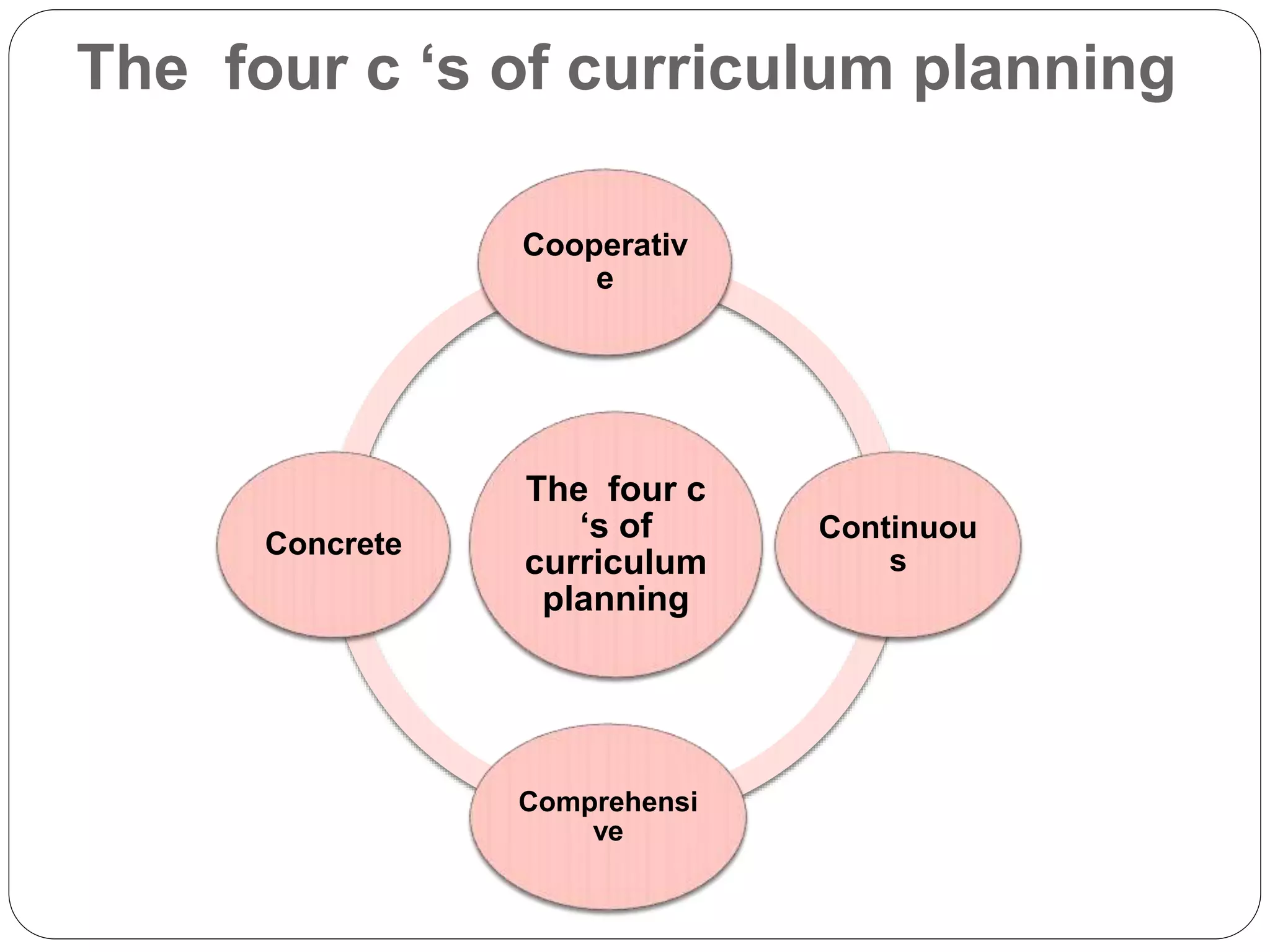
The four c ‘s of curriculum planning
The four c
‘s of
curriculum
planning
Cooperativ
e
Continuou
s
Comprehensi
ve
Concrete
The four c ‘s of curriculum
planning
 Cooperative: a programme prepared jointly by a group of
persons will be less liable to error than one prepared by a
single person
 Continuous: the preparation of a programme is not a one
shot operation,provision should be made for its continuous
revision
 Comprehensive:-in an approach which accepts the
interaction of all the programme components must be
defined with the requisite precision.
 Concrete:-general and abstract considerations are not a
sufficient basls for drawin up a programme.concrete
professional tasks must constitute the essential structure of
a relavant programme.
Definition:-
 “A course especially the course of study in
a university”-Dictionary
 “all the learning activities which are
planned and guided by the school,whether
they are carried out in groups or
individually ,inside and outside the school”-
kerr(1968)
 “a systemic arrnement of the sum total of selected
experiences planned by a school or a
defined group of students to attain the
aims of a particular educational
programme”
 “curriculum is a tool in the hands of the
artist (teachers) to mould his material (the
pupil) in accordance with his ideals in his
studio(school)”-cunningham.
Determinants of curriculum
Determinants
of
curriculum:-
Philosophical
Sociological
Psychological
Determinants of curriculum:-
 The development of curriculum depands largely on three
fields:
 Philosophy
 Sociology
 Psychology
 The knowledge of three fields will help them to satisfy their
lives within the context of the society.
 Philosophical criteria sociological
considerations
 Aims social change
 Worth whileness,the economical factors
 Structure of the knowledge scientific
advancement
Technological change
Ideological change
curriculum:-
 Philosophy is a powerful determinant factor of aims
of education,but is also equally a strong deciding
factor of contents and methods of education
 It aims at the all round development of the individual
 It is based on the philosophy of the nation
 It reflects the ideals and aspirations of the people
 It inculcates the desired ideals of the life in the
youngsters
 It helps in the development of proper philosophy of
life
 It is in accordance with the aspiration leval of the
individual
 It enables the learners to learn the desirable cultural
values.intellectual virtues,social norms and moral
doctarine.
 It helps in development of personal and national
character
 The philolophical foundations of education
includes:-
 Child centredness(naturalistic philosophy)
 Need centredness(pragmatic philosophy)
 Activity centredness(project and basic curriculum)
Sociological determinants of
curriculum :-
 Schools are the social institutions specially set up for
preservation and transmission of culture by society.
schools seek to discharge this function through the
curriculum
 Sociological considerations that guide the curriculum
development are:
 Need of Indian society
 Demands of modernization
 Good family life,ways of life
 Democratic temper of society
 Faiths,attitude and beliefs of people
 Cooperation
 Population explosion
 Regional and national imbalances
 Economic efficiency
 Creative and purposeful activities
 Cultural ,political factors
 Knowledge,attitude,beliefs
 The characteristics of the curriculum i.e. determined
by sociological foundations of education are:
 To realize the social aims of education
 Keeps in mind the social changes and reflects
 Related to social interests and problems of the society
 Develops desirable social attitudes
 Principles:-
 Integratedness
 Lifecentredness
 Social utillitarinism
Psychological determinants of
curriculum
 Human growth and development
 Knowledge of growth and development
 Curriculum to be child centred,learning
experiences should be provided in
accordance with the mental development
of the learner i.e.abiliity grouping
 Interests of the learner
 The determinants of curriculum may be
enumerated as follows:
 National ideology
 Sociological consideration
 Educational philosophy
 National goals
 Religious doctrine
 Cultural factors
 Psychological foundations
 Scientific and technological advancement
 Economic planning
 Need for modernization
Stages of curriculum
directive
Formative
Functional
Evaluative
Stages of curriculum
 According to torres and Stanton the curriculum process
involves four main stages:
 The directive stage:-
 It lays foundations for all other stages by
 Identify the beliefs,knowledge and concepts which forms
the basis of the curriculum
 Formulation of the theoretical framework in the selection
and sequencing of content.
 It will be done by:
 Systemic gathering of information from the literature
 Exploration of common beliefs about the nature of
nursing
 Formulation of philosophy of the curriculum
Formative stage:-
 Overall design of the curriculum will takes place
based on philosophy of educational institution
programme and nature of nursing
 Objectives (general and specific) will be written
 Content mapping
Functional stage/implementation
stage:-
 The curriculum assumes more practical form
 Teaching methods and learning experiences will be
planned(theory as well as practical experiences)
 Evaluative stage
 Input evaluation- what the students bring to the
course,e.g. problem solving abilities
 Evaluation for continued learning- It provides
feedback for students to improve their learning
 Throughout evaluation-all the tests and activities
that students undergo as they progress through the
course.
Functional stage/implementation
stage:-
 Output evaluation- achievement of the
characteristics identified in the directive stage
 Evaluation for curriculum revision:- it involves
assessment of the total curriculum package

Curriculum development.ppt made by sonal patel

  • 1.
  • 2.
    Introduction  Curriculum isa latin word,”currere” means ‘ the race,the path,lap or course or runway’ which one talks to reach a goal applied to a course of study,if the teacher is the guide ,the curriculum is the path.curriculum is the total structure of ideas and activities.  Curriculum may be considered as an educationalprogramme.
  • 3.
     Curriculum isactually what happens during a course i.e. lecture.demonstrations.field visits.the work with the clients and so on.curriculum also means a written description of what happens.  The course study means the specific content of education,the details of the study,which the students have to study to obtain different certificates or degrees from the educational instituitions.the course of study forms the basis for writing of textbooks and preparing teachers’ guide.
  • 4.
    Meaning and conceptof curriculum:-  It includes all the learning experience which a child has,regardless of when or how they take place under the guidance of the school.  The systemic arrangement of arrangement of certain courses designed with certain objectives for the pupil.
  • 5.
     Curriculum refersto the totality of activity and experiences planned by the school with a view to achieve the objectives of education.  Curriculum is the blue print or plan of the school that includes the experiences for the learners to have.  It is a tool in the hands of the teachers to give training to children in the art of living.
  • 6.
    Three facets ofcurriculum are:-  goals and purposes of education process of evaluation of products curriculum co-curricular extra-curricular programmes programmes curricular programmes school
  • 7.
     The basicreason for the existence of a school is generally accepted to be the intellectual development of the learner  Intellectual development is conceived as a mastery of subject matter achieved primarily through teachers’ exposition,drills,tests etc.  Growth of the learner is interrelated:emotional health,personal and social adjustment,skill in group interaction,physical health all contribute and are essential to intellectual effectiveness
  • 8.
     Therefore,the curriculummust give consideration to curriculur and cocurriculur activities,e.g.emphasis on the inclusion of Subject matter and directed learning experiences relating to interpersonal relations  More and better use of group techniques Widening the nursing student’s contact with students and teachers.
  • 9.
     The curriculumfor nursing includes:  All the planned learning opportunities  Subject matter  Knowledge  Skills  Values  Attitudes
  • 10.
     Learning activitiesthat the faculty plans and implements in all settings: classroom,laboratory,hospital,public health agency,for a particular group of students at a specified time period.  Curriculum is a plan of logical sequence of correlated and interated subjects which students may pursue in the attainment of a given goal.  In reality 2 curriculum in each sentence:  Planned by faculty  Experienced by each student
  • 11.
    The four c‘s of curriculum planning The four c ‘s of curriculum planning Cooperativ e Continuou s Comprehensi ve Concrete
  • 12.
    The four c‘s of curriculum planning  Cooperative: a programme prepared jointly by a group of persons will be less liable to error than one prepared by a single person  Continuous: the preparation of a programme is not a one shot operation,provision should be made for its continuous revision  Comprehensive:-in an approach which accepts the interaction of all the programme components must be defined with the requisite precision.  Concrete:-general and abstract considerations are not a sufficient basls for drawin up a programme.concrete professional tasks must constitute the essential structure of a relavant programme.
  • 13.
    Definition:-  “A courseespecially the course of study in a university”-Dictionary  “all the learning activities which are planned and guided by the school,whether they are carried out in groups or individually ,inside and outside the school”- kerr(1968)
  • 14.
     “a systemicarrnement of the sum total of selected experiences planned by a school or a defined group of students to attain the aims of a particular educational programme”  “curriculum is a tool in the hands of the artist (teachers) to mould his material (the pupil) in accordance with his ideals in his studio(school)”-cunningham.
  • 15.
  • 16.
    Determinants of curriculum:- The development of curriculum depands largely on three fields:  Philosophy  Sociology  Psychology  The knowledge of three fields will help them to satisfy their lives within the context of the society.  Philosophical criteria sociological considerations  Aims social change  Worth whileness,the economical factors  Structure of the knowledge scientific advancement Technological change Ideological change
  • 17.
    curriculum:-  Philosophy isa powerful determinant factor of aims of education,but is also equally a strong deciding factor of contents and methods of education  It aims at the all round development of the individual  It is based on the philosophy of the nation  It reflects the ideals and aspirations of the people  It inculcates the desired ideals of the life in the youngsters  It helps in the development of proper philosophy of life
  • 18.
     It isin accordance with the aspiration leval of the individual  It enables the learners to learn the desirable cultural values.intellectual virtues,social norms and moral doctarine.  It helps in development of personal and national character  The philolophical foundations of education includes:-  Child centredness(naturalistic philosophy)  Need centredness(pragmatic philosophy)  Activity centredness(project and basic curriculum)
  • 19.
    Sociological determinants of curriculum:-  Schools are the social institutions specially set up for preservation and transmission of culture by society. schools seek to discharge this function through the curriculum  Sociological considerations that guide the curriculum development are:  Need of Indian society  Demands of modernization  Good family life,ways of life  Democratic temper of society  Faiths,attitude and beliefs of people  Cooperation  Population explosion  Regional and national imbalances  Economic efficiency
  • 20.
     Creative andpurposeful activities  Cultural ,political factors  Knowledge,attitude,beliefs  The characteristics of the curriculum i.e. determined by sociological foundations of education are:  To realize the social aims of education  Keeps in mind the social changes and reflects  Related to social interests and problems of the society  Develops desirable social attitudes  Principles:-  Integratedness  Lifecentredness  Social utillitarinism
  • 21.
    Psychological determinants of curriculum Human growth and development  Knowledge of growth and development  Curriculum to be child centred,learning experiences should be provided in accordance with the mental development of the learner i.e.abiliity grouping  Interests of the learner
  • 22.
     The determinantsof curriculum may be enumerated as follows:  National ideology  Sociological consideration  Educational philosophy  National goals  Religious doctrine  Cultural factors  Psychological foundations  Scientific and technological advancement  Economic planning  Need for modernization
  • 23.
  • 24.
    Stages of curriculum According to torres and Stanton the curriculum process involves four main stages:  The directive stage:-  It lays foundations for all other stages by  Identify the beliefs,knowledge and concepts which forms the basis of the curriculum  Formulation of the theoretical framework in the selection and sequencing of content.  It will be done by:  Systemic gathering of information from the literature  Exploration of common beliefs about the nature of nursing  Formulation of philosophy of the curriculum
  • 25.
    Formative stage:-  Overalldesign of the curriculum will takes place based on philosophy of educational institution programme and nature of nursing  Objectives (general and specific) will be written  Content mapping
  • 26.
    Functional stage/implementation stage:-  Thecurriculum assumes more practical form  Teaching methods and learning experiences will be planned(theory as well as practical experiences)  Evaluative stage  Input evaluation- what the students bring to the course,e.g. problem solving abilities  Evaluation for continued learning- It provides feedback for students to improve their learning  Throughout evaluation-all the tests and activities that students undergo as they progress through the course.
  • 27.
    Functional stage/implementation stage:-  Outputevaluation- achievement of the characteristics identified in the directive stage  Evaluation for curriculum revision:- it involves assessment of the total curriculum package