CURRICULUM
ANAMIKA RAMAWAT
M.Sc. Nursing Prev.
GCON, Jodhpur
INTRODUCTION
The term “curriculum’’ is a Latin word
‘currere’ which means ‘the race course or
runway’ which one talk to reach a goal
applied to a course of study. Curriculum is
the base in education on which the teaching-
learning process are implemented.
DEFINITIONS
“A course especially the course of study in a university”.
-Dictionary
“A systematic arrangement of the sum total of selected experiences
planned by a school or a defined group of students to attain the aims
of particular educational program.”
-Florence Nightingale International Foundation;
Basic nursing education.
“All the experience of pupil which has undertaken in the guidance
of the school”.
-Bland’s Encyclopedia
“All the learning activities which are planned and guided
by the school, whether they are carried out in groups and
individually, inside or outside the school or college”.
-Kerr (1968)
“A curriculum is an attempt to communicate the essentials
principles and features of an educational proposal in such a
form that it is open to critical scrutiny and capable of
effective translation into practice”.
-Stenhouse
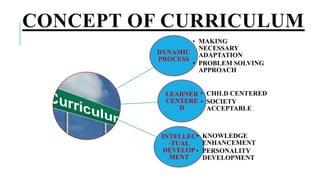
CONCEPT OF CURRICULUM
DYNAMIC
PROCESS
• MAKING
NECESSARY
ADAPTATION
• PROBLEM SOLVING
APPROACH
LEARNER
CENTERE
D
• CHILD CENTERED
• SOCIETY
ACCEPTABLE
INTELLEC
-TUAL
DEVELOP
MENT
• KNOWLEDGE
ENHANCEMENT
• PERSONALITY
DEVELOPMENT
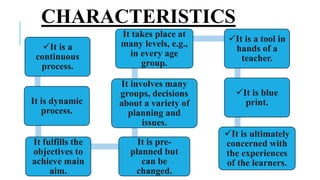
It is a
continuous
process.
It is dynamic
process.
It fulfills the
objectives to
achieve main
aim.
It is pre-
planned but
can be
changed.
It involves many
groups, decisions
about a variety of
planning and
issues.
It takes place at
many levels, e.g.,
in every age
group.
It is a tool in
hands of a
teacher.
It is blue
print.
It is ultimately
concerned with
the experiences
of the learners.
CHARACTERISTICS
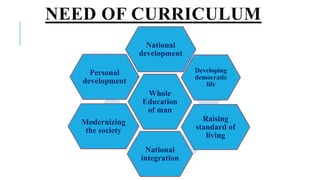
NEED OF CURRICULUM
Whole
Education
of man
National
development
Developing
democratic
life
Raising
standard of
living
National
integration
Modernizing
the society
Personal
development
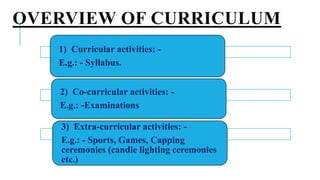
OVERVIEW OF CURRICULUM
1) Curricular activities: -
E.g.: - Syllabus.
2) Co-curricular activities: -
E.g.: -Examinations
3) Extra-curricular activities: -
E.g.: - Sports, Games, Capping
ceremonies (candle lighting ceremonies
etc.)
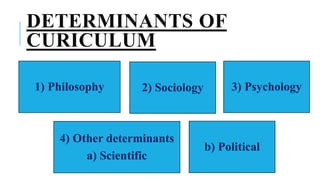
DETERMINANTS OF
CURICULUM
1) Philosophy 2) Sociology 3) Psychology
4) Other determinants
a) Scientific
b) Political
PRINCIPLES OF
CURRICULUM
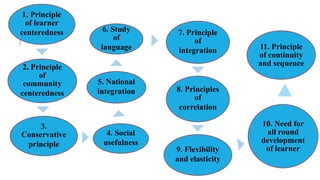
1. Principle
of learner
centeredness
2. Principle
of
community
centeredness
3.
Conservative
principle
4. Social
usefulness
5. National
integration
6. Study
of
language
7. Principle
of
integration
8. Principles
of
correlation
9. Flexibility
and elasticity
10. Need for
all round
development
of learner
11. Principle
of continuity
and sequence
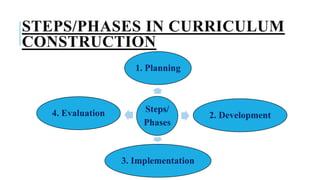
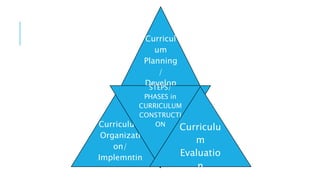
STEPS/PHASES IN CURRICULUM
CONSTRUCTION
Steps/
Phases
1. Planning
2. Development
3. Implementation
4. Evaluation
Curricul
um
Planning
/
Develop
ment
Curriculum
Organizati
on/
Implemntin
g
STEPS/
PHASES in
CURRICULUM
CONSTRUCTI
ON
Curriculu
m
Evaluatio
n
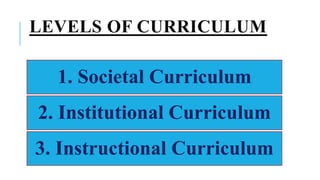
LEVELS OF CURRICULUM
1. Societal Curriculum
2. Institutional Curriculum
3. Instructional Curriculum
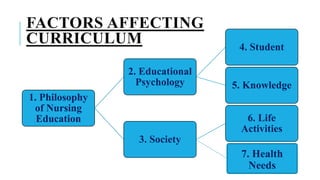
FACTORS AFFECTING
CURRICULUM
1. Philosophy
of Nursing
Education
2. Educational
Psychology
4. Student
5. Knowledge
3. Society
6. Life
Activities
7. Health
Needs
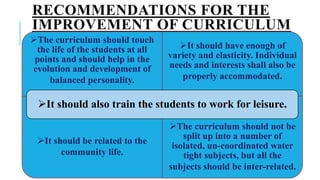
RECOMMENDATIONS FOR THE
IMPROVEMENT OF CURRICULUM
The curriculum should touch
the life of the students at all
points and should help in the
evolution and development of
balanced personality.
It should have enough of
variety and elasticity. Individual
needs and interests shall also be
properly accommodated.
It should be related to the
community life.
The curriculum should not be
split up into a number of
isolated, un-coordinated water
tight subjects, but all the
subjects should be inter-related.
It should also train the students to work for leisure.
PRINCIPLES RELATED TO THE
DEVELOPMENT OF NURSING CURICULUM
Nursing curriculum should equip the students with the essential
knowledge, skills and attitude so that they can fulfill their duties and
responsibilities during the upcoming professional life.
The expected results of the curriculum should be made clear to the
students as well as the teacher.
Curriculum development should consider the community needs with
special emphasis to the health needs, lifestyle and cultural
background of people, health services available and changes in the
health pattern of the community.
CONTINUE….
As nursing students are living under the influence of the
media and modern lifestyles, special measures have to be
formulated in the curriculum for inculcating right attitude in
them.
Posting to the concerned clinical area should be preceded by
adequate coverage of the related theory. Curriculum should
offer adequate teaching learning activities in the class room,
clinical area and community settings.
Curriculum development has to consider the guidelines laid
down by the statutory bodies like nursing council, universities,
examination boards and the like.
CONTINUE….
Curriculum development should give due
importance to high-tech-high touch approach in the
nursing care. This will help to maintain the human
component of nursing in the midst of technological
advancements in patient care.
Curriculum should allow a participatory approach in
the teaching- learning process where students are
mainly responsible for their leaning and teacher
assumes the role of a facilitator of learning.
SUMMARY
The curriculum describes the teaching, learning and assessment materials
available for a given course of study. Any curriculum includes the philosophy of
the program, total duration, learning experience teaching methods and materials
including AV aids and a program of evaluation. there are 4 phases in curriculum
development they are planning phase, development phase, implementation
phase, and evaluation phase. The curriculum should be constructed in such a way
that the purpose and educational objectives of the program should be achieved
the teaching learning activities and learning experiences related to theory and
practical components should be in conformity with the educational objectives of
the program.
The educational objectives should be stated in clear, and behavioral terms. The
student and teachers of the particular educational programs should have a clear
perception of the expected result.
Curriculum Introduction & Process

Curriculum Introduction & Process

  • 3.
  • 4.
    INTRODUCTION The term “curriculum’’is a Latin word ‘currere’ which means ‘the race course or runway’ which one talk to reach a goal applied to a course of study. Curriculum is the base in education on which the teaching- learning process are implemented.
  • 5.
    DEFINITIONS “A course especiallythe course of study in a university”. -Dictionary “A systematic arrangement of the sum total of selected experiences planned by a school or a defined group of students to attain the aims of particular educational program.” -Florence Nightingale International Foundation; Basic nursing education. “All the experience of pupil which has undertaken in the guidance of the school”. -Bland’s Encyclopedia
  • 6.
    “All the learningactivities which are planned and guided by the school, whether they are carried out in groups and individually, inside or outside the school or college”. -Kerr (1968) “A curriculum is an attempt to communicate the essentials principles and features of an educational proposal in such a form that it is open to critical scrutiny and capable of effective translation into practice”. -Stenhouse
  • 7.
    CONCEPT OF CURRICULUM DYNAMIC PROCESS •MAKING NECESSARY ADAPTATION • PROBLEM SOLVING APPROACH LEARNER CENTERE D • CHILD CENTERED • SOCIETY ACCEPTABLE INTELLEC -TUAL DEVELOP MENT • KNOWLEDGE ENHANCEMENT • PERSONALITY DEVELOPMENT
  • 8.
    It is a continuous process. Itis dynamic process. It fulfills the objectives to achieve main aim. It is pre- planned but can be changed. It involves many groups, decisions about a variety of planning and issues. It takes place at many levels, e.g., in every age group. It is a tool in hands of a teacher. It is blue print. It is ultimately concerned with the experiences of the learners. CHARACTERISTICS
  • 9.
    NEED OF CURRICULUM Whole Education ofman National development Developing democratic life Raising standard of living National integration Modernizing the society Personal development
  • 10.
    OVERVIEW OF CURRICULUM 1)Curricular activities: - E.g.: - Syllabus. 2) Co-curricular activities: - E.g.: -Examinations 3) Extra-curricular activities: - E.g.: - Sports, Games, Capping ceremonies (candle lighting ceremonies etc.)
  • 11.
    DETERMINANTS OF CURICULUM 1) Philosophy2) Sociology 3) Psychology 4) Other determinants a) Scientific b) Political
  • 12.
  • 13.
    1. Principle of learner centeredness 2.Principle of community centeredness 3. Conservative principle 4. Social usefulness 5. National integration 6. Study of language 7. Principle of integration 8. Principles of correlation 9. Flexibility and elasticity 10. Need for all round development of learner 11. Principle of continuity and sequence
  • 14.
    STEPS/PHASES IN CURRICULUM CONSTRUCTION Steps/ Phases 1.Planning 2. Development 3. Implementation 4. Evaluation
  • 15.
  • 16.
    LEVELS OF CURRICULUM 1.Societal Curriculum 2. Institutional Curriculum 3. Instructional Curriculum
  • 17.
    FACTORS AFFECTING CURRICULUM 1. Philosophy ofNursing Education 2. Educational Psychology 4. Student 5. Knowledge 3. Society 6. Life Activities 7. Health Needs
  • 18.
    RECOMMENDATIONS FOR THE IMPROVEMENTOF CURRICULUM The curriculum should touch the life of the students at all points and should help in the evolution and development of balanced personality. It should have enough of variety and elasticity. Individual needs and interests shall also be properly accommodated. It should be related to the community life. The curriculum should not be split up into a number of isolated, un-coordinated water tight subjects, but all the subjects should be inter-related. It should also train the students to work for leisure.
  • 19.
    PRINCIPLES RELATED TOTHE DEVELOPMENT OF NURSING CURICULUM Nursing curriculum should equip the students with the essential knowledge, skills and attitude so that they can fulfill their duties and responsibilities during the upcoming professional life. The expected results of the curriculum should be made clear to the students as well as the teacher. Curriculum development should consider the community needs with special emphasis to the health needs, lifestyle and cultural background of people, health services available and changes in the health pattern of the community.
  • 20.
    CONTINUE…. As nursing studentsare living under the influence of the media and modern lifestyles, special measures have to be formulated in the curriculum for inculcating right attitude in them. Posting to the concerned clinical area should be preceded by adequate coverage of the related theory. Curriculum should offer adequate teaching learning activities in the class room, clinical area and community settings. Curriculum development has to consider the guidelines laid down by the statutory bodies like nursing council, universities, examination boards and the like.
  • 21.
    CONTINUE…. Curriculum development shouldgive due importance to high-tech-high touch approach in the nursing care. This will help to maintain the human component of nursing in the midst of technological advancements in patient care. Curriculum should allow a participatory approach in the teaching- learning process where students are mainly responsible for their leaning and teacher assumes the role of a facilitator of learning.
  • 22.
    SUMMARY The curriculum describesthe teaching, learning and assessment materials available for a given course of study. Any curriculum includes the philosophy of the program, total duration, learning experience teaching methods and materials including AV aids and a program of evaluation. there are 4 phases in curriculum development they are planning phase, development phase, implementation phase, and evaluation phase. The curriculum should be constructed in such a way that the purpose and educational objectives of the program should be achieved the teaching learning activities and learning experiences related to theory and practical components should be in conformity with the educational objectives of the program. The educational objectives should be stated in clear, and behavioral terms. The student and teachers of the particular educational programs should have a clear perception of the expected result.