MRS.SHALINI
MSC (N),MEDICAL SURGICAL NURSING
ASSISTANT.PROFESSOR
GANGA COLLEGE OF NURSING
COIMBATORE
PRESENTED BY
MRS.SHALINI, MSC(NURSING),
ASST.PROFESSOR,
GANGA COLLEGE OF NURSING
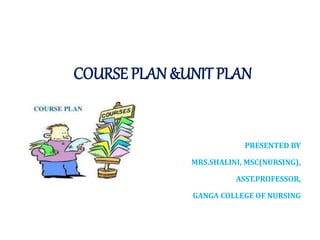
COURSE PLAN&UNIT PLAN
INTRODUCTION
"Course planning refers to planning
courses of instructions. It serves as a guide for
the teacher as well as for the students in
creating conductive atmosphere for
worthwhile learning and purposeful activities
DEFINITION
• “It is defined as a process of planning the
entire content of the programme which has to
be done before the commencement of
course”
• “It is a planning ahead of the system which
requires a continues refining”
PURPOSE
 To ensure autonomy
 It gives stability
 It helps to solve the problem
 It supports the curriculum process.
 It secures future progress
 It brings about improvements.
 It promotes utilization of resources
PRINCIPLES
• The state the objective in behavioural terms
which has to be achieved.
• Establish sequence.
• Organize the content focusing on the students
rather than subject matter
• It should allow for individual differences &
according to the level of the students
• There should be a logic in organizing units and
also should allow for problem solving.
• Promote cumulative learning
• Integration
• Avoid repetition
• The course should provide variety in modes of
learning.
LEVEL OF COURSE PLAN
Courses are planned at:
• University level
• Institutional level
• Instructional level
LEVEL OF COURSE PLAN
• Pertaining to organizing both content and
learning experiences within a unit or a
subject.
• Deals with designing the pattern for the entire
program at the program level.
STRUCTURES OF COURSE PLAN
In planning course two kinds of planning are
involved:
1. Identifying the kinds of elements and which
specific learning has to be organized.
2. Selection of specific organizing cent ers on
which learners entire development be
focused.
ELEMENTS OF COURSE PLAN
• Objectives
• Specification for level learner and placement
within curriculum
• Resources materials needed for the course.
• Organize the organization content topic wise,
unit wise or lesson plan wise.
• Describe the resource materials and methods
of teaching.
• Prepare the plan of learning activities for
students, eg.; Assignment record,
Observations procedures, Plan for rotation
with field experiences, supervised and guided
practice.
• Evaluation the measures-Describe the
procedures for ongoing concurrent and
terminal evaluation
• Bibliography for both student and teachers.
•
PROCESS OF ORGANIZING LEARNING
EXPERIENCES
 The concerned faculty for teaching the course
and administration of the program will discuss
and agree the general scheme of organization of
the course and its smooth implementation.
Agreement should be made regarding the general
principles of organization i.e; continuity,
sequence and integrity.
The basic units should be included
The flexible plan should be developed which can
be handled by the teacher.
•
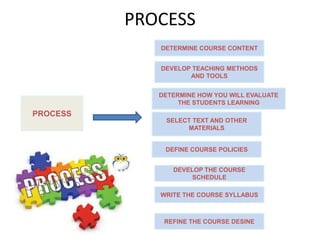
PROCESS
DETERMINE COURSE CONTENT
DEVELOP TEACHING METHODS
AND TOOLS
DETERMINE HOW YOU WILL EVALUATE
THE STUDENTS LEARNING
SELECT TEXT AND OTHER
MATERIALS
PROCESS
DEFINE COURSE POLICIES
DEVELOP THE COURSE
SCHEDULE
WRITE THE COURSE SYLLABUS
REFINE THE COURSE DESINE
1.DETERMINE COURSE CONTENT
1. Select the major topics and determine the order in which
you will teach them.
2. Select the main topics to be covered. To obtain an initial
list of course topics, look in current textbooks or the
current literature.
3. Refine your list by considering your course goals and the
Characteristics of your students. At the same time use the
desired content to refine the course goals.
4. Determine the structure of the course
2.DEVELOP TEACHING METHODS AND
TOOLS
• Determine the course goals and content.
• Appropriate the size of the class
• Teaching style
• Deciding whether or not you will use technology
in the teaching, identify specific goals that
technology will help you reach.
• Plan to use teaching methods that will require
and measure active students learning.
3.DETERMINE HOW YOU WILL
EVALUATE THE STUDENTS LEARNING
 Evaluation must go hand –in-hand with course
goals.
 For example, if one course goals is to improve
problem-solving skills, the exam should not
contain only questions that ask students to recall
facts.
4.SELECT TEXT AND OTHER
MATERIALS
• Decide whether the course goals will be best
met by using published text or material
published.
• Consider placing some of the material on
reserve at the library.
5.DEFINE COURSE POLICIES
• Grade all required work, including all
assignments, papers, exams and if applicable,
class participation.
• Learn the policy on academic integrity.
• Include all course policies on the syllabus and
plan to review with students on the first day of
class.
6.DEVELOP THE COURSE SCHEDULE
 Allow time for active learning to occur during
class and for students to complete major
assignments and prepare for exams.
 Consult the relevant academic calendars, and
keep in mind major religious holidays and
significant campus event.
7.WRITE TE COURSE SYLLABUS
8.REFINE THE COURSE DESINE
 Course planning is a continual process
 Undertaking others in mind, necessarily revision
each time
 As you plan and revise courses, remember the
importance of teaching core concepts and
critical thinking skills.
TEACHERS ROLE IN COURSE
PLANNING
 Teachers plan unit of work
Teachers should select materials and
learning activities according to the level of
students.
Teachers should plan carefully.
Teachers should avoid gaps and non-
projective repetition in subject matter content.
Teachers should provide enforcement of
previous learning.
CONT….
 Teachers has to set up working groups .
 Teachers should formulate the objectives prior
to the planning.
 Teachers should possess knowledge
adequately.
 Teachers should have skills related to the area
that they are teaching.
 The teachers plan should focuses on general
objectives of the course, the unit plan , and the
class plan.
 Teachers should be efficient in preparing
course plan.
 Teachers should plan equally to all the students.
AT THE INSTRUCTIONAL LEVEL,
TEACHERS PLAN.
 Basis for planning.
 Units of work.
 Select materials and learning activities.
 Arrange the teaching-learning environment.
UNIT PLAN
INTRODUCTION
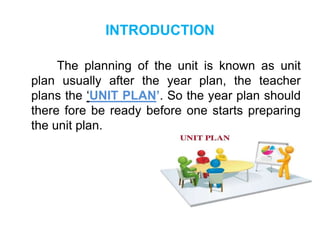
The planning of the unit is known as unit
plan usually after the year plan, the teacher
plans the ‘UNIT PLAN’. So the year plan should
there fore be ready before one starts preparing
the unit plan.
DEFINITION
A unit plan consists of many lesson and will
be taught for a long period .
Unit plan usually consists of:-
• vision/unit goals
• unit content in detail
• time allocated for the completion of each stage
• how lessons/stages are designed to realize
these goals collectively
• pre and post-tests
• cross-curricular connections, etc.
PRINCIPLES OF UNIT PLANNING
• Principle of comprehensiveness
• Principle of clarity
• Principle of systematic presentation
• Principle of economy in time.
CHARACTERISTIC OF UNIT PLANNING
 Effectively in terms of whole rather than fraction
 Developmental and therefore provide for vertical
horizontal organization of learning experience.
 Effective when is an understanding and
acceptance of goal to be achieved and there is
full and free participation in planning for the
attainment of those goals.
CHARACTERISTIC
Necessity for providing for individual
differences in rates of learning & interests
Unit planning recognizes that true learning
renders the learners increasingly skill in self
directions.
Unit planning provides sound basis for
evaluation.
TYPES OF UNIT PLANNING
1. Subject matter units
 Topical unit
 The generalization unit
 The unit based on significant aspect of
environment or culture.
2. Experience unit.
 Unit based on center of interest
 Unit based on student purpose
 Unit based on student need
UNIT PLANNING IN NURSING COURSE
Wide applicability of all type of unit plan in
nursing courses, the term ‘teaching learning
unit’ has been used to describe unit planning in
nursing course.
The term teaching-learning unit embodies the
new concept of unified learning experiences
involving comprehensive problems or projects
which are important to the students in nursing.
THE ESSENTIAL ACTIVITIES OF UNIT
PLANNING
1. Selection & statement of objectives
2. Selection of type of unit to be used
3. Selection of learning situations
4. Selection of knowledge component
5. Selection of the organizing centers-learning &
teaching activities
6. Selection of method of evaluation.
STEPS IN UNIT PLANNING
1.Selection and systematization of the unit:
The first steps in the preparation of a unit
plan is to select a unit from the subject. A unit

should be viewed as a whole.
2. Content Analysis:
After selecting the unit, the teacher has to
analysis its content carefully. This analysis help
the teacher to have a through knowledge of the
subject matter.
3.Determination of objectives:
The third step is to determine the major as
well as specific objectives that should be
realised by teaching this unit.
4. Learning Experience: Deciding upon the major
learning experience is the next step. These should
be objective based life centered and learned
centered
5.Selecting of Teaching Aids: For making the
learning experiences objectives based and
effective a variety of instructional aids may
become necessary. The next step is to decide
carefully what are the teaching aids should be
used.
6.Evaluation:The types of evaluation tools and
techniques for assessing the realisation of the
predetermined goals are to be selected in this
stage.
7.Assignment: The final step is to decide upon the
assignment to be given to students.
SUMMARY
• Introduction course plan
• Definition course plan
• Purpose course plan
• Principles course plan
• Level of course plan
• Elements of course plan
• Process
• Teachers role in course planning
• Introduction unit plan
• Definition unit plan
• Characteristic of unit planning
• Types of unit planning
• Unit planning in nursing course
• The essential activities of unit planning
• Steps in unit planning
REFERENCE
• Text book of nursing education, K.P neeraja
• Text book of nursing education , Latha venkatesan
• Nursing Education, BT Basavanthappa, 2003,
Jaypee Brothers.
• Curriculum Development and Evaluation in
Nursing, Sarah B. Keating. Third Edition
• http://www.moe.govtt/curriculum process.html
• www.nursetogether.com
• www.google.com.
COURSE PLAN &UNIT PLAN

COURSE PLAN &UNIT PLAN

  • 1.
    MRS.SHALINI MSC (N),MEDICAL SURGICALNURSING ASSISTANT.PROFESSOR GANGA COLLEGE OF NURSING COIMBATORE
  • 2.
    PRESENTED BY MRS.SHALINI, MSC(NURSING), ASST.PROFESSOR, GANGACOLLEGE OF NURSING COURSE PLAN&UNIT PLAN
  • 3.
    INTRODUCTION "Course planning refersto planning courses of instructions. It serves as a guide for the teacher as well as for the students in creating conductive atmosphere for worthwhile learning and purposeful activities
  • 4.
    DEFINITION • “It isdefined as a process of planning the entire content of the programme which has to be done before the commencement of course” • “It is a planning ahead of the system which requires a continues refining”
  • 5.
    PURPOSE  To ensureautonomy  It gives stability  It helps to solve the problem  It supports the curriculum process.  It secures future progress  It brings about improvements.  It promotes utilization of resources
  • 6.
    PRINCIPLES • The statethe objective in behavioural terms which has to be achieved. • Establish sequence. • Organize the content focusing on the students rather than subject matter • It should allow for individual differences & according to the level of the students • There should be a logic in organizing units and also should allow for problem solving. • Promote cumulative learning • Integration • Avoid repetition • The course should provide variety in modes of learning.
  • 7.
    LEVEL OF COURSEPLAN Courses are planned at: • University level • Institutional level • Instructional level
  • 8.
    LEVEL OF COURSEPLAN • Pertaining to organizing both content and learning experiences within a unit or a subject. • Deals with designing the pattern for the entire program at the program level.
  • 9.
    STRUCTURES OF COURSEPLAN In planning course two kinds of planning are involved: 1. Identifying the kinds of elements and which specific learning has to be organized. 2. Selection of specific organizing cent ers on which learners entire development be focused.
  • 10.
    ELEMENTS OF COURSEPLAN • Objectives • Specification for level learner and placement within curriculum • Resources materials needed for the course. • Organize the organization content topic wise, unit wise or lesson plan wise.
  • 11.
    • Describe theresource materials and methods of teaching. • Prepare the plan of learning activities for students, eg.; Assignment record, Observations procedures, Plan for rotation with field experiences, supervised and guided practice. • Evaluation the measures-Describe the procedures for ongoing concurrent and terminal evaluation • Bibliography for both student and teachers. •
  • 12.
    PROCESS OF ORGANIZINGLEARNING EXPERIENCES  The concerned faculty for teaching the course and administration of the program will discuss and agree the general scheme of organization of the course and its smooth implementation. Agreement should be made regarding the general principles of organization i.e; continuity, sequence and integrity. The basic units should be included The flexible plan should be developed which can be handled by the teacher. •
  • 13.
    PROCESS DETERMINE COURSE CONTENT DEVELOPTEACHING METHODS AND TOOLS DETERMINE HOW YOU WILL EVALUATE THE STUDENTS LEARNING SELECT TEXT AND OTHER MATERIALS PROCESS DEFINE COURSE POLICIES DEVELOP THE COURSE SCHEDULE WRITE THE COURSE SYLLABUS REFINE THE COURSE DESINE
  • 14.
    1.DETERMINE COURSE CONTENT 1.Select the major topics and determine the order in which you will teach them. 2. Select the main topics to be covered. To obtain an initial list of course topics, look in current textbooks or the current literature. 3. Refine your list by considering your course goals and the Characteristics of your students. At the same time use the desired content to refine the course goals. 4. Determine the structure of the course
  • 15.
    2.DEVELOP TEACHING METHODSAND TOOLS • Determine the course goals and content. • Appropriate the size of the class • Teaching style • Deciding whether or not you will use technology in the teaching, identify specific goals that technology will help you reach. • Plan to use teaching methods that will require and measure active students learning.
  • 16.
    3.DETERMINE HOW YOUWILL EVALUATE THE STUDENTS LEARNING  Evaluation must go hand –in-hand with course goals.  For example, if one course goals is to improve problem-solving skills, the exam should not contain only questions that ask students to recall facts.
  • 17.
    4.SELECT TEXT ANDOTHER MATERIALS • Decide whether the course goals will be best met by using published text or material published. • Consider placing some of the material on reserve at the library.
  • 18.
    5.DEFINE COURSE POLICIES •Grade all required work, including all assignments, papers, exams and if applicable, class participation. • Learn the policy on academic integrity. • Include all course policies on the syllabus and plan to review with students on the first day of class.
  • 19.
    6.DEVELOP THE COURSESCHEDULE  Allow time for active learning to occur during class and for students to complete major assignments and prepare for exams.  Consult the relevant academic calendars, and keep in mind major religious holidays and significant campus event.
  • 20.
  • 21.
    8.REFINE THE COURSEDESINE  Course planning is a continual process  Undertaking others in mind, necessarily revision each time  As you plan and revise courses, remember the importance of teaching core concepts and critical thinking skills.
  • 22.
    TEACHERS ROLE INCOURSE PLANNING  Teachers plan unit of work Teachers should select materials and learning activities according to the level of students. Teachers should plan carefully. Teachers should avoid gaps and non- projective repetition in subject matter content. Teachers should provide enforcement of previous learning.
  • 23.
    CONT….  Teachers hasto set up working groups .  Teachers should formulate the objectives prior to the planning.  Teachers should possess knowledge adequately.  Teachers should have skills related to the area that they are teaching.  The teachers plan should focuses on general objectives of the course, the unit plan , and the class plan.  Teachers should be efficient in preparing course plan.  Teachers should plan equally to all the students.
  • 24.
    AT THE INSTRUCTIONALLEVEL, TEACHERS PLAN.  Basis for planning.  Units of work.  Select materials and learning activities.  Arrange the teaching-learning environment.
  • 25.
  • 26.
    INTRODUCTION The planning ofthe unit is known as unit plan usually after the year plan, the teacher plans the ‘UNIT PLAN’. So the year plan should there fore be ready before one starts preparing the unit plan.
  • 27.
    DEFINITION A unit planconsists of many lesson and will be taught for a long period . Unit plan usually consists of:- • vision/unit goals • unit content in detail • time allocated for the completion of each stage • how lessons/stages are designed to realize these goals collectively • pre and post-tests • cross-curricular connections, etc.
  • 28.
    PRINCIPLES OF UNITPLANNING • Principle of comprehensiveness • Principle of clarity • Principle of systematic presentation • Principle of economy in time.
  • 29.
    CHARACTERISTIC OF UNITPLANNING  Effectively in terms of whole rather than fraction  Developmental and therefore provide for vertical horizontal organization of learning experience.  Effective when is an understanding and acceptance of goal to be achieved and there is full and free participation in planning for the attainment of those goals.
  • 30.
    CHARACTERISTIC Necessity for providingfor individual differences in rates of learning & interests Unit planning recognizes that true learning renders the learners increasingly skill in self directions. Unit planning provides sound basis for evaluation.
  • 31.
    TYPES OF UNITPLANNING 1. Subject matter units  Topical unit  The generalization unit  The unit based on significant aspect of environment or culture. 2. Experience unit.  Unit based on center of interest  Unit based on student purpose  Unit based on student need
  • 32.
    UNIT PLANNING INNURSING COURSE Wide applicability of all type of unit plan in nursing courses, the term ‘teaching learning unit’ has been used to describe unit planning in nursing course. The term teaching-learning unit embodies the new concept of unified learning experiences involving comprehensive problems or projects which are important to the students in nursing.
  • 33.
    THE ESSENTIAL ACTIVITIESOF UNIT PLANNING 1. Selection & statement of objectives 2. Selection of type of unit to be used 3. Selection of learning situations 4. Selection of knowledge component 5. Selection of the organizing centers-learning & teaching activities 6. Selection of method of evaluation.
  • 34.
    STEPS IN UNITPLANNING 1.Selection and systematization of the unit: The first steps in the preparation of a unit plan is to select a unit from the subject. A unit should be viewed as a whole. 2. Content Analysis: After selecting the unit, the teacher has to analysis its content carefully. This analysis help the teacher to have a through knowledge of the subject matter. 3.Determination of objectives: The third step is to determine the major as well as specific objectives that should be realised by teaching this unit.
  • 35.
    4. Learning Experience:Deciding upon the major learning experience is the next step. These should be objective based life centered and learned centered 5.Selecting of Teaching Aids: For making the learning experiences objectives based and effective a variety of instructional aids may become necessary. The next step is to decide carefully what are the teaching aids should be used. 6.Evaluation:The types of evaluation tools and techniques for assessing the realisation of the predetermined goals are to be selected in this stage. 7.Assignment: The final step is to decide upon the assignment to be given to students.
  • 36.
    SUMMARY • Introduction courseplan • Definition course plan • Purpose course plan • Principles course plan • Level of course plan • Elements of course plan • Process • Teachers role in course planning • Introduction unit plan • Definition unit plan • Characteristic of unit planning • Types of unit planning • Unit planning in nursing course • The essential activities of unit planning • Steps in unit planning
  • 37.
    REFERENCE • Text bookof nursing education, K.P neeraja • Text book of nursing education , Latha venkatesan • Nursing Education, BT Basavanthappa, 2003, Jaypee Brothers. • Curriculum Development and Evaluation in Nursing, Sarah B. Keating. Third Edition • http://www.moe.govtt/curriculum process.html • www.nursetogether.com • www.google.com.