By: Ms.Monica Shah
1
Quiz round
What can you think
about
Curriculum Planning?
2
It comes from a Latin word:Currere
Which means: Run
It is a runway or a course of
deeds, experiences through
which children grow and learn
It is content
Programme of planned
activities
Intented learning outcomes
3
According to
1)National Association of
Early Childhood Education:
-It is an Organized framework
that defines the content
children learn from the
process,through which
children achieve the
identified curriculum goals .
- It is a context in which
teaching and learning
occurs!
2)Acc to G.Hass:
-Curriculum is all of the
experiences that individual
learners have in a
programme of education
whose purpose is to achieve
goals, and objectives.
-Which are planned in terms of
a framework of theory and
research .
4
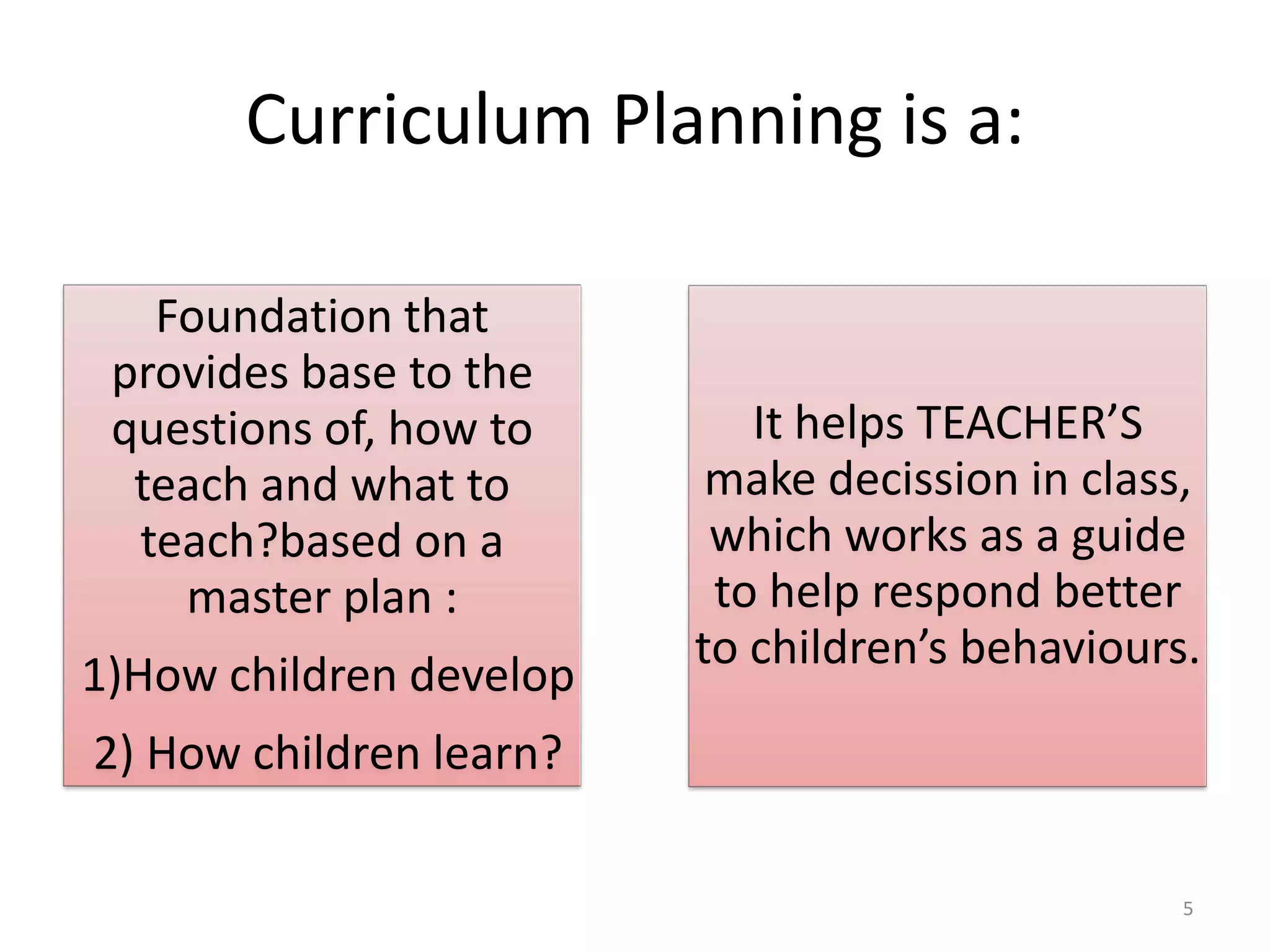
Curriculum Planning is a:
Foundation that
provides base to the
questions of, how to
teach and what to
teach?based on a
master plan :
1)How children develop
2) How children learn?
It helps TEACHER’S
make decission in class,
which works as a guide
to help respond better
to children’s behaviours.
5
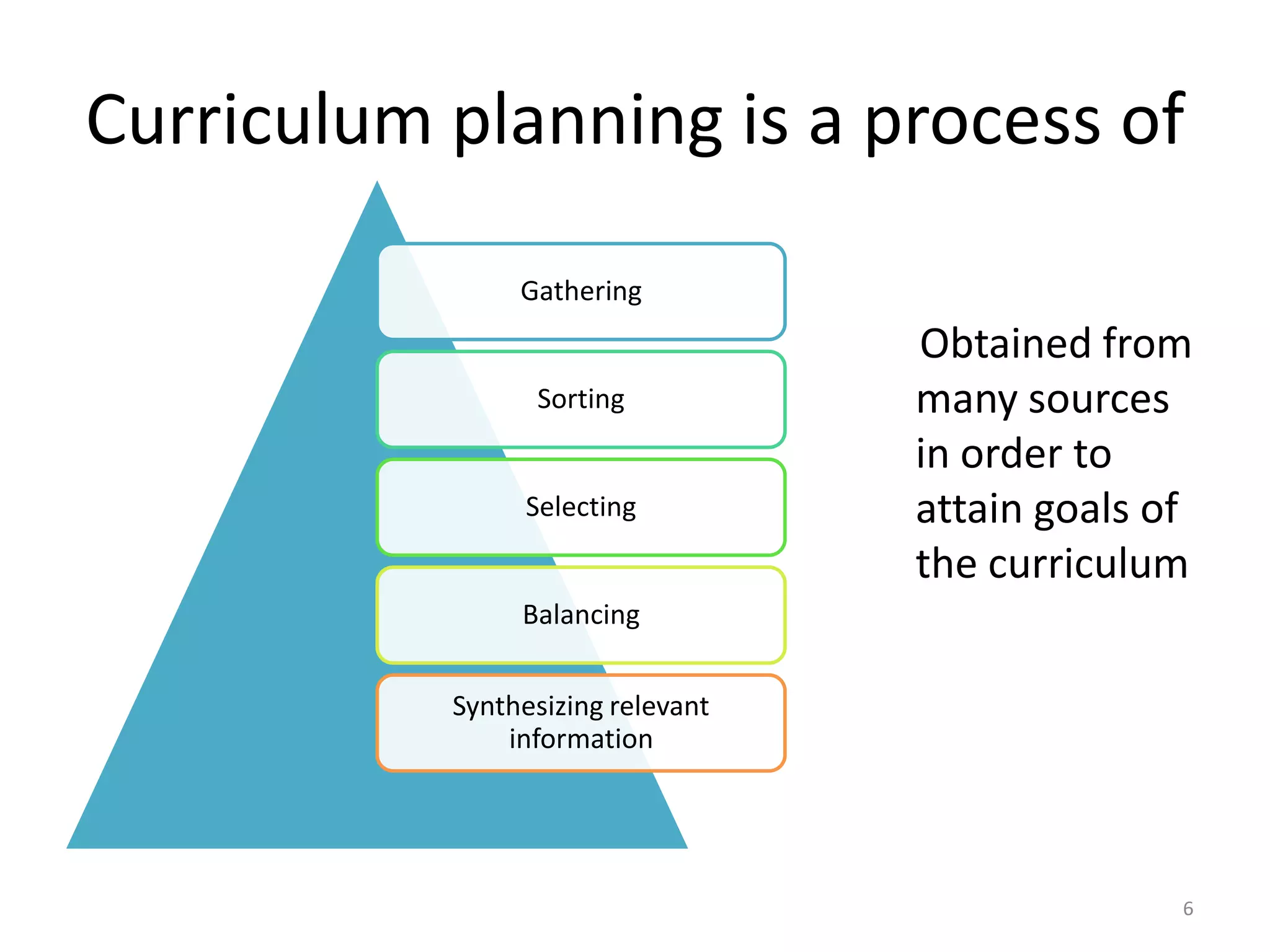
Curriculum planning is a process of
Gathering
Sorting
Selecting
Balancing
Synthesizing relevant
information
Obtained from
many sources
in order to
attain goals of
the curriculum
6
Importance of Curriculum in ECCE
• One of the important functions of a preschool is
to provide a stimulating and enriched
environment where children are encouraged to
learn –
• learning by doing
• observing
• exploring
• discovering
• inquiring
so active participation by the child is important.
7
A Curriculum should focus on:
• The total development of the child and his
understanding of the world around him, for
enhancing motor skills, language, communication
skills and socializing thus allowing children to
experiment: to touch, to watch, to hear and to
explore.
• It gives the children freedom to play, as play is an
activity in which they are completely absorbed.
Children also need experiences in music, art and
drama.
• Hence the curriculum is a planned guide of
opportunities and experiences for children.
8
9
What would be the AIM of
having
Curriculum Planning?
10
Aims
Introduces
surprise and
novelty in
learning new
concepts
Provides
experiences that
have a positive
impact on all
round
development
Provides children
with
opportunities to
follow individual
interests
Gives children
choices and
Provides an
environment of
trust so that
children can ask
questions
without fear of
making mistakes.
11
Principles of Curriculum Planning
A well balanced programme,
keeping in mind the
developmental levels of the
child, alternating quiet activities
with vigorous activities and self-
selection with direction.
A child-centered programme.
There should be a variety of
materials well laid out and
displayed.
Informality and opportunity for
child-to-child or adult-to child
interactions
12
Principles cntd..
Open space for free choice and
movement.
Activities which are challenging
to children’s intellectual power,
by which they are encouraged
to think, reason, remember,
experiment, generalize by doing
to find out and discover.
First hand experiences, sensory
exploration and learning by
doing
Freedom, spontaneity, self-
directed and self-corrective
activities, as much as possible,
through the use of indigenous
materials.
13
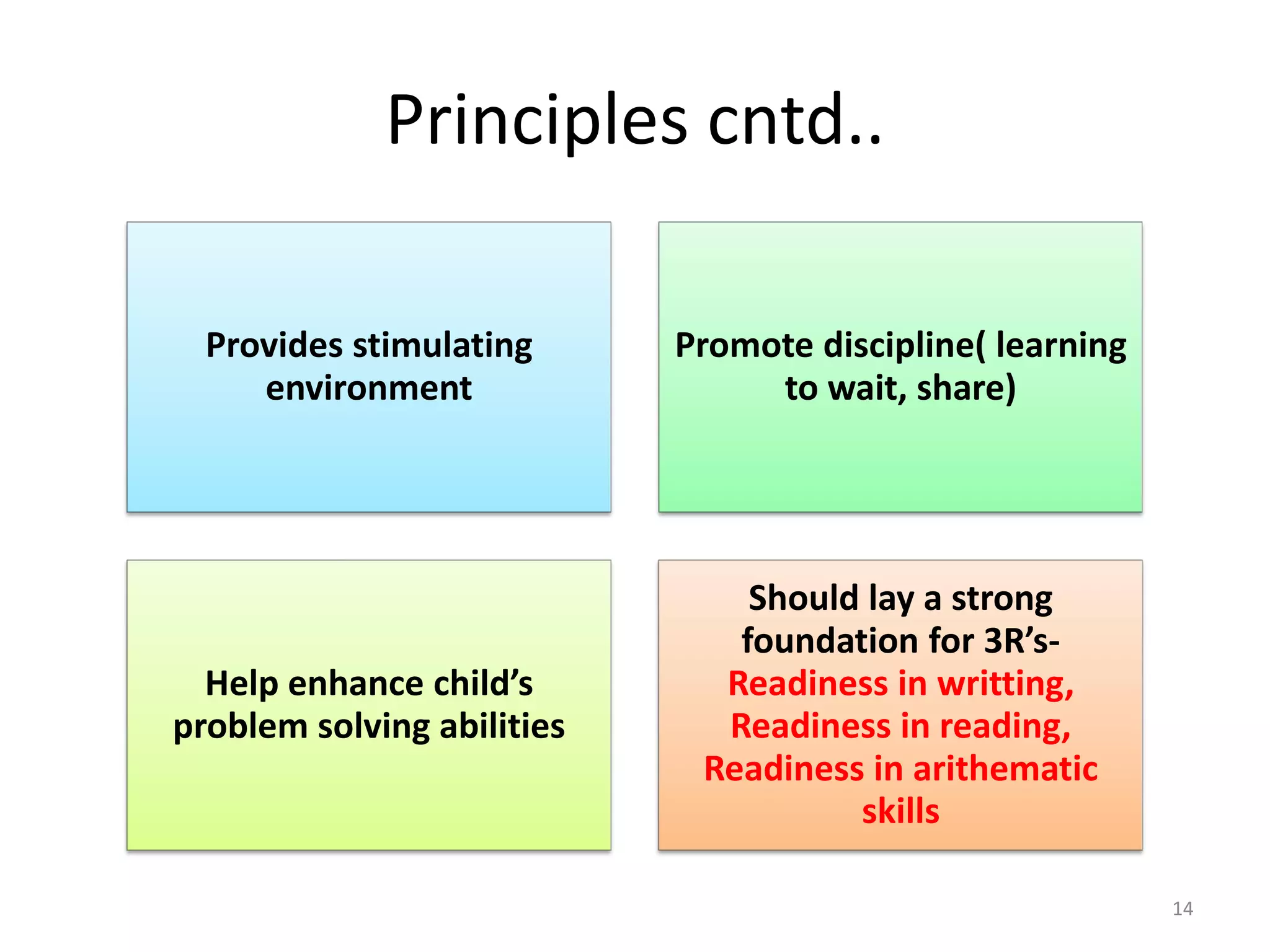
Principles cntd..
Provides stimulating
environment
Promote discipline( learning
to wait, share)
Help enhance child’s
problem solving abilities
Should lay a strong
foundation for 3R’s-
Readiness in writting,
Readiness in reading,
Readiness in arithematic
skills
14
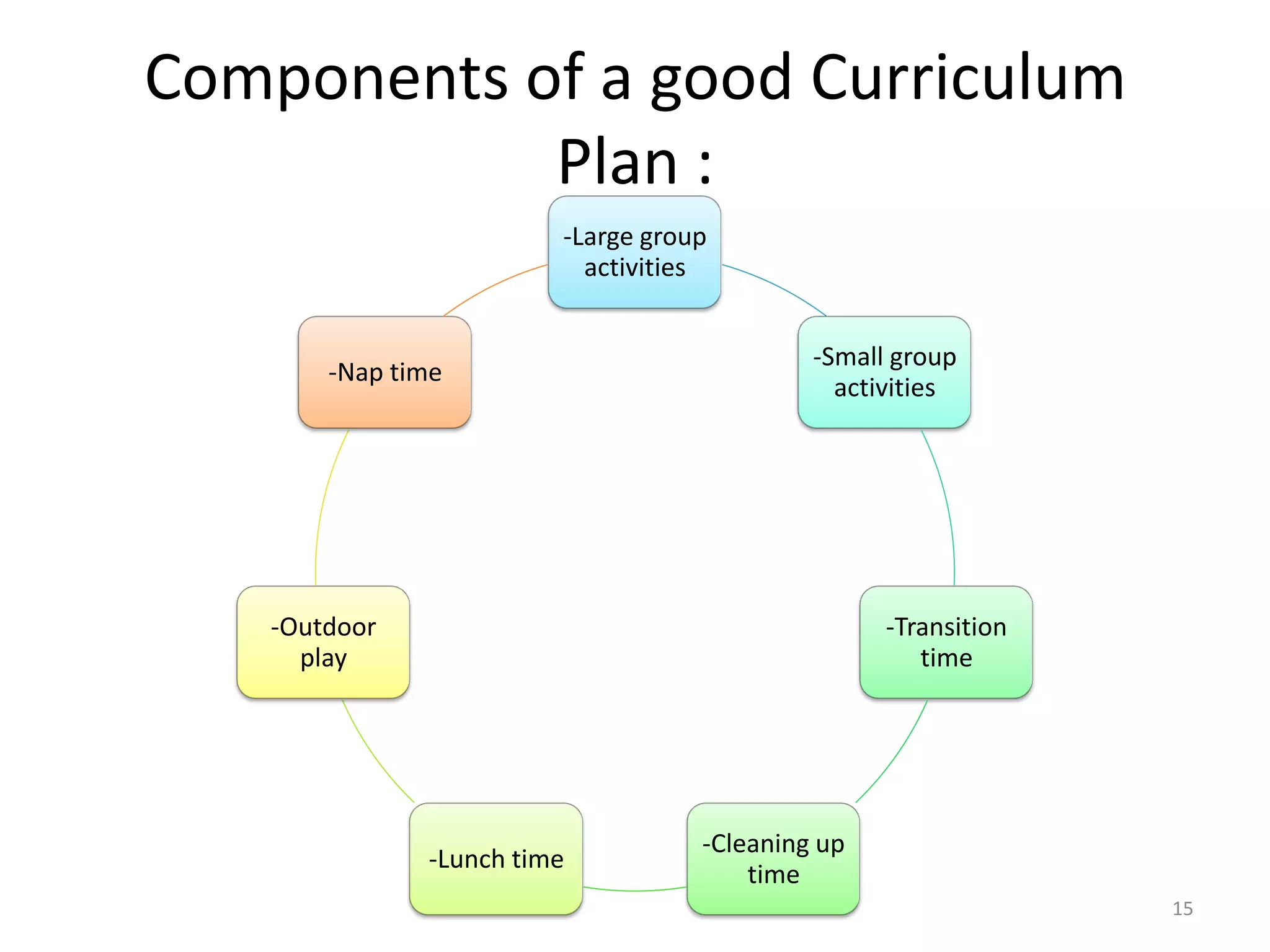
Components of a good Curriculum
Plan :
-Large group
activities
-Small group
activities
-Transition
time
-Cleaning up
time
-Lunch time
-Outdoor
play
-Nap time
15
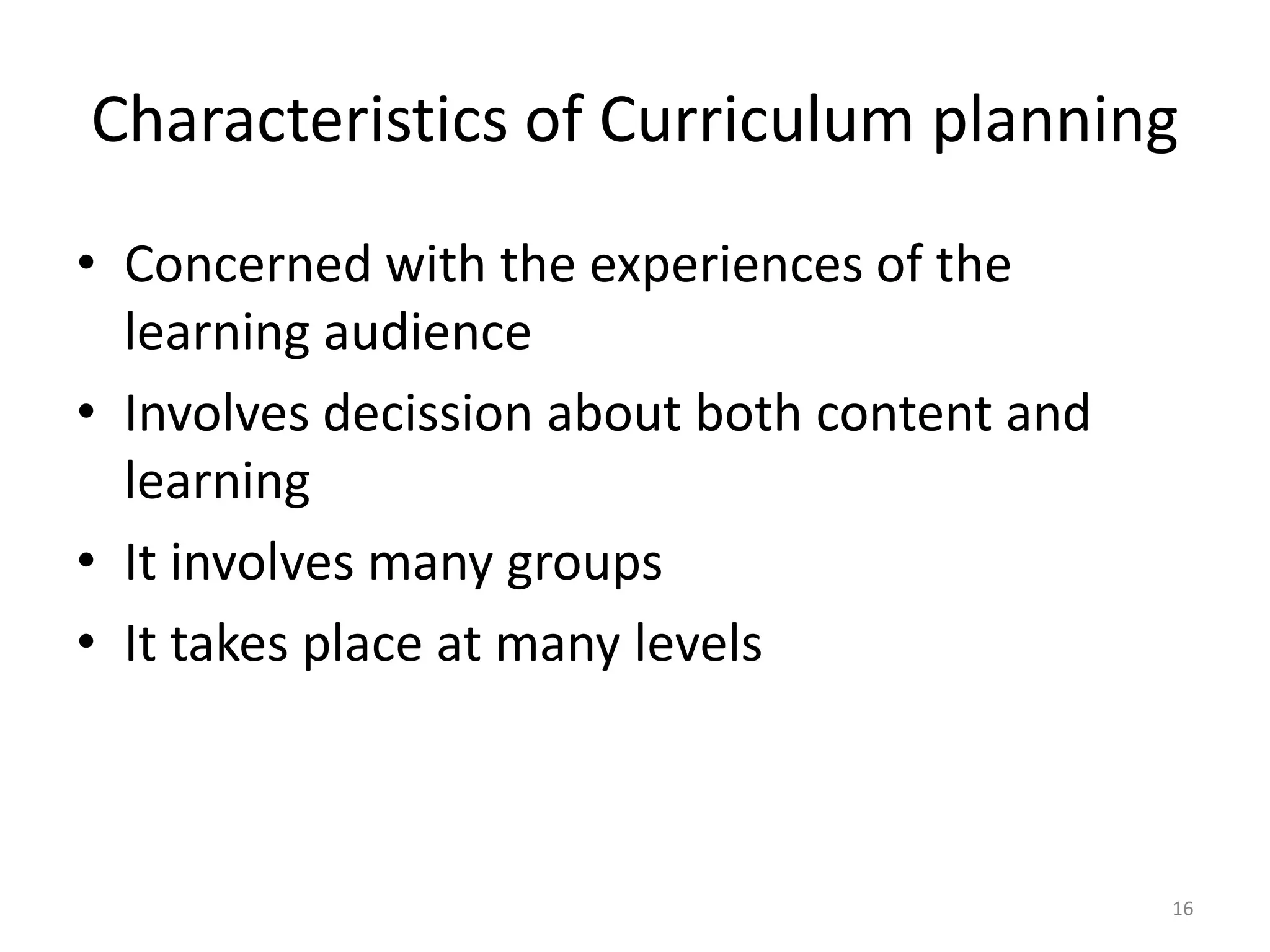
Characteristics of Curriculum planning
• Concerned with the experiences of the
learning audience
• Involves decission about both content and
learning
• It involves many groups
• It takes place at many levels
16
Factors affecting Curriculum planning
Time or duration of
activity
Availability of
resources
Physical
environment
Economic
conditions(budget)
Teacher child ratio
Demands and
expectations of the
audience
Transition from
one activity to
another
Transfer of routine
17
Reference
• Dr.Kamini Rege
• Early Childhood Curriculum: Carol E.Carton,
Jan Allen
• Introduction to Early Childhood Education-
Essa E.L
18

Ppt curriculum planning

  • 1.
  • 2.
    Quiz round What canyou think about Curriculum Planning? 2
  • 3.
    It comes froma Latin word:Currere Which means: Run It is a runway or a course of deeds, experiences through which children grow and learn It is content Programme of planned activities Intented learning outcomes 3
  • 4.
    According to 1)National Associationof Early Childhood Education: -It is an Organized framework that defines the content children learn from the process,through which children achieve the identified curriculum goals . - It is a context in which teaching and learning occurs! 2)Acc to G.Hass: -Curriculum is all of the experiences that individual learners have in a programme of education whose purpose is to achieve goals, and objectives. -Which are planned in terms of a framework of theory and research . 4
  • 5.
    Curriculum Planning isa: Foundation that provides base to the questions of, how to teach and what to teach?based on a master plan : 1)How children develop 2) How children learn? It helps TEACHER’S make decission in class, which works as a guide to help respond better to children’s behaviours. 5
  • 6.
    Curriculum planning isa process of Gathering Sorting Selecting Balancing Synthesizing relevant information Obtained from many sources in order to attain goals of the curriculum 6
  • 7.
    Importance of Curriculumin ECCE • One of the important functions of a preschool is to provide a stimulating and enriched environment where children are encouraged to learn – • learning by doing • observing • exploring • discovering • inquiring so active participation by the child is important. 7
  • 8.
    A Curriculum shouldfocus on: • The total development of the child and his understanding of the world around him, for enhancing motor skills, language, communication skills and socializing thus allowing children to experiment: to touch, to watch, to hear and to explore. • It gives the children freedom to play, as play is an activity in which they are completely absorbed. Children also need experiences in music, art and drama. • Hence the curriculum is a planned guide of opportunities and experiences for children. 8
  • 9.
  • 10.
    What would bethe AIM of having Curriculum Planning? 10
  • 11.
    Aims Introduces surprise and novelty in learningnew concepts Provides experiences that have a positive impact on all round development Provides children with opportunities to follow individual interests Gives children choices and Provides an environment of trust so that children can ask questions without fear of making mistakes. 11
  • 12.
    Principles of CurriculumPlanning A well balanced programme, keeping in mind the developmental levels of the child, alternating quiet activities with vigorous activities and self- selection with direction. A child-centered programme. There should be a variety of materials well laid out and displayed. Informality and opportunity for child-to-child or adult-to child interactions 12
  • 13.
    Principles cntd.. Open spacefor free choice and movement. Activities which are challenging to children’s intellectual power, by which they are encouraged to think, reason, remember, experiment, generalize by doing to find out and discover. First hand experiences, sensory exploration and learning by doing Freedom, spontaneity, self- directed and self-corrective activities, as much as possible, through the use of indigenous materials. 13
  • 14.
    Principles cntd.. Provides stimulating environment Promotediscipline( learning to wait, share) Help enhance child’s problem solving abilities Should lay a strong foundation for 3R’s- Readiness in writting, Readiness in reading, Readiness in arithematic skills 14
  • 15.
    Components of agood Curriculum Plan : -Large group activities -Small group activities -Transition time -Cleaning up time -Lunch time -Outdoor play -Nap time 15
  • 16.
    Characteristics of Curriculumplanning • Concerned with the experiences of the learning audience • Involves decission about both content and learning • It involves many groups • It takes place at many levels 16
  • 17.
    Factors affecting Curriculumplanning Time or duration of activity Availability of resources Physical environment Economic conditions(budget) Teacher child ratio Demands and expectations of the audience Transition from one activity to another Transfer of routine 17
  • 18.
    Reference • Dr.Kamini Rege •Early Childhood Curriculum: Carol E.Carton, Jan Allen • Introduction to Early Childhood Education- Essa E.L 18