PSYCHIATRIC EMERGENCY
ANAMIKA RAMAWAT
M.Sc. NURSING PREV.
BATCH 2017-18
GCON, JODHPUR
INTRODUCTION
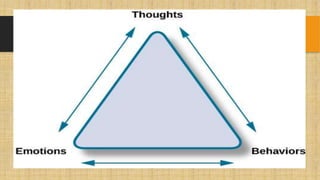
• Conditions in which there is alteration in behaviors, emotion or
thought, presenting in an acute form, in need of immediate
attention and care.
• Any condition/ situation making the patient & relatives to seek
immediate treatment.
• Disharmony between subject and environment.
• Sudden disorganization in personality which affects the socio-
occupational functioning.
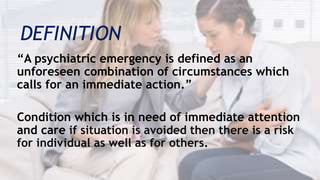
DEFINITION
“A psychiatric emergency is defined as an
unforeseen combination of circumstances which
calls for an immediate action.”
Condition which is in need of immediate attention
and care if situation is avoided then there is a risk
for individual as well as for others.
OBJECTIVE FOR EMERGENCY INTERVENTION
•To safeguard the life of patient.
•To bring down the anxiety of family
members.
•To enhance emotional security of others in
the environment.
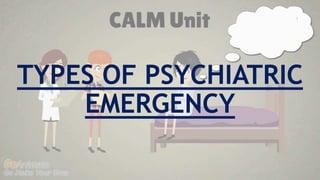
TYPES OF PSYCHIATRIC
EMERGENCY
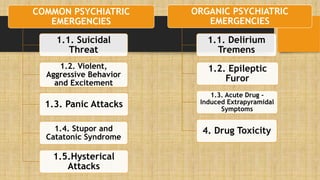
COMMON PSYCHIATRIC
EMERGENCIES
1.1. Suicidal
Threat
1.2. Violent,
Aggressive Behavior
and Excitement
1.3. Panic Attacks
1.4. Stupor and
Catatonic Syndrome
1.5.Hysterical
Attacks
ORGANIC PSYCHIATRIC
EMERGENCIES
1.1. Delirium
Tremens
1.2. Epileptic
Furor
1.3. Acute Drug -
Induced Extrapyramidal
Symptoms
4. Drug Toxicity
SUICIDAL THREAT
• In psychiatry a suicidal attempt is considered to be one of
the commonest emergencies.
• Suicide is a type of deliberate self-harm and is defined as
an intentional human act of killing oneself.
Types
• Suicide- self murder or deliberate self-harm in males
• Parasuicide/pseudocide- attempted suicide or non-fatal
deliberate self-harm in females
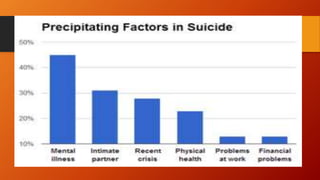
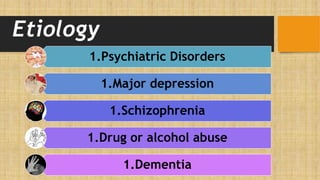
1.Psychiatric Disorders
1.Major depression
1.Schizophrenia
1.Drug or alcohol abuse
1.Dementia
Etiology
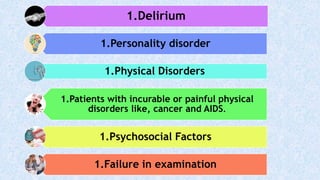
1.Delirium
1.Personality disorder
1.Physical Disorders
1.Patients with incurable or painful physical
disorders like, cancer and AIDS.
1.Psychosocial Factors
1.Failure in examination
1.Dowry difficulties
1.Marital difficulties
1.Loss of loved object
Isolation and alienation from social
groups
1.Financial and occupational difficulties
Risk Factors for Suicide-
1. Age-
males above 40 years of age
females above 55 years of age
2. Sex-
men have greater risk of suicide
suicide is 3 times more common in men than women.
3. Being unmarried, divorced, widowed or separated
4. History of previous suicidal attempts
5. Recent losses
Management
VIOLENT BEHAVIOR
• This is a severe form of aggressiveness. During this stage,
patient will be irrational, uncooperative, delusional and
assaultive.
Etiology-
• Organic psychiatric disorders like, delirium, dementia,
Wernicke-Korsakoff's psychosis.
• Other psychiatric disorders like, schizophrenia, mania,
agitated depression, withdrawal from alcohol and drugs,
epilepsy, acute stress reaction, panic disorder and personality
disorders.
MANAGEMENT
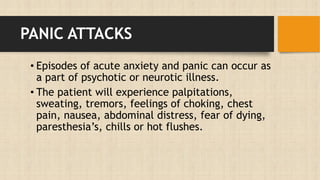
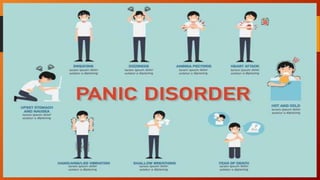
PANIC ATTACKS
• Episodes of acute anxiety and panic can occur as
a part of psychotic or neurotic illness.
• The patient will experience palpitations,
sweating, tremors, feelings of choking, chest
pain, nausea, abdominal distress, fear of dying,
paresthesia’s, chills or hot flushes.
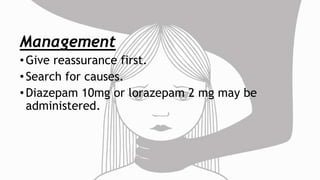
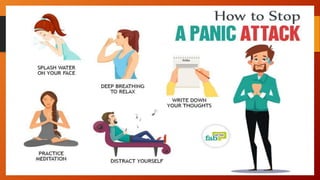
Management
•Give reassurance first.
•Search for causes.
•Diazepam 10mg or lorazepam 2 mg may be
administered.
CATATONIC STUPOR
• Stupor is a clinical syndrome of akinesias and mutism
but with relative preservation of conscious awareness.
Stupor is often associated with catatonic signs and
symptoms (catatonic withdrawal or catatonic stupor).
The various catatonic signs include mutism,
negativism, stupor, ambitendency, echolalia,
echopraxia, automatic obedience, posturing,
mannerisms, stereotypies, etc.
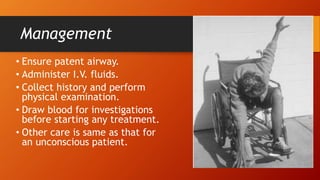
Management
• Ensure patent airway.
• Administer I.V. fluids.
• Collect history and perform
physical examination.
• Draw blood for investigations
before starting any treatment.
• Other care is same as that for
an unconscious patient.
General support-
• Maintaining hydration, Patency of airway.
• Checking cardiac function.
Others-
• Care for excretory function, preventing bed sores.
Special support-
• The identification and treatment of specific cause is
also required
HYSTERICAL ATTACKS
• A hysteric attack which is under voluntary control. Most common
risk in children and also in females. The common modes of
presentation may be:
Hysterical fits
Hysterical ataxia
Hysterical paraplegia
• All presentations are marked by a dramatic quality and sadness of
mood.
Management-
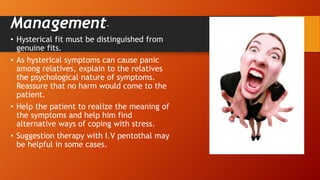
• Hysterical fit must be distinguished from
genuine fits.
• As hysterical symptoms can cause panic
among relatives, explain to the relatives
the psychological nature of symptoms.
Reassure that no harm would come to the
patient.
• Help the patient to realize the meaning of
the symptoms and help him find
alternative ways of coping with stress.
• Suggestion therapy with I.V pentothal may
be helpful in some cases.
Management-
• Keep the patient in a quiet and safe environment.
• Sedation is usually given with diazepam 10mg or
lorazepam 4mg IV, followed by oral administration.
• DOC -Tab. Haloperidol check for side effects.
• Maintain fluid and electrolyte balance.
• Reassure patient and family.
• An adequate intake of Vit B complex is important since
its deficiency may contribute to delirium.
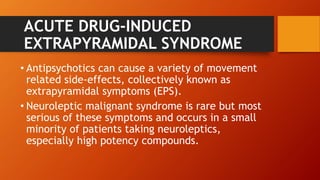
ACUTE DRUG-INDUCED
EXTRAPYRAMIDAL SYNDROME
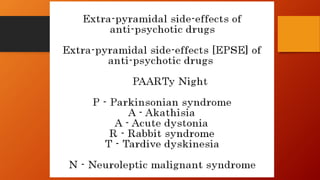
• Antipsychotics can cause a variety of movement
related side-effects, collectively known as
extrapyramidal symptoms (EPS).
• Neuroleptic malignant syndrome is rare but most
serious of these symptoms and occurs in a small
minority of patients taking neuroleptics,
especially high potency compounds.
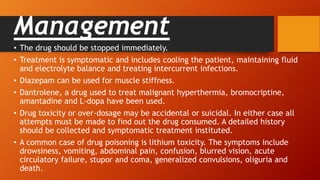
Management
• The drug should be stopped immediately.
• Treatment is symptomatic and includes cooling the patient, maintaining fluid
and electrolyte balance and treating intercurrent infections.
• Diazepam can be used for muscle stiffness.
• Dantrolene, a drug used to treat malignant hyperthermia, bromocriptine,
amantadine and L-dopa have been used.
• Drug toxicity or over-dosage may be accidental or suicidal. In either case all
attempts must be made to find out the drug consumed. A detailed history
should be collected and symptomatic treatment instituted.
• A common case of drug poisoning is lithium toxicity. The symptoms include
drowsiness, vomiting, abdominal pain, confusion, blurred vision, acute
circulatory failure, stupor and coma, generalized convulsions, oliguria and
death.
GENERAL GUIDELINES
TO MANAGE WITH THE
PSYCHIATRIC
EMERGENCY
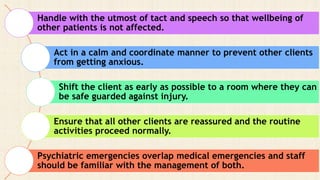
Handle with the utmost of tact and speech so that wellbeing of
other patients is not affected.
Act in a calm and coordinate manner to prevent other clients
from getting anxious.
Shift the client as early as possible to a room where they can
be safe guarded against injury.
Ensure that all other clients are reassured and the routine
activities proceed normally.
Psychiatric emergencies overlap medical emergencies and staff
should be familiar with the management of both.
SUMMARY…
Psychiatric Emergency

Psychiatric Emergency

  • 1.
    PSYCHIATRIC EMERGENCY ANAMIKA RAMAWAT M.Sc.NURSING PREV. BATCH 2017-18 GCON, JODHPUR
  • 2.
    INTRODUCTION • Conditions inwhich there is alteration in behaviors, emotion or thought, presenting in an acute form, in need of immediate attention and care. • Any condition/ situation making the patient & relatives to seek immediate treatment. • Disharmony between subject and environment. • Sudden disorganization in personality which affects the socio- occupational functioning.
  • 4.
    DEFINITION “A psychiatric emergencyis defined as an unforeseen combination of circumstances which calls for an immediate action.” Condition which is in need of immediate attention and care if situation is avoided then there is a risk for individual as well as for others.
  • 5.
    OBJECTIVE FOR EMERGENCYINTERVENTION •To safeguard the life of patient. •To bring down the anxiety of family members. •To enhance emotional security of others in the environment.
  • 6.
  • 7.
    COMMON PSYCHIATRIC EMERGENCIES 1.1. Suicidal Threat 1.2.Violent, Aggressive Behavior and Excitement 1.3. Panic Attacks 1.4. Stupor and Catatonic Syndrome 1.5.Hysterical Attacks ORGANIC PSYCHIATRIC EMERGENCIES 1.1. Delirium Tremens 1.2. Epileptic Furor 1.3. Acute Drug - Induced Extrapyramidal Symptoms 4. Drug Toxicity
  • 8.
    SUICIDAL THREAT • Inpsychiatry a suicidal attempt is considered to be one of the commonest emergencies. • Suicide is a type of deliberate self-harm and is defined as an intentional human act of killing oneself. Types • Suicide- self murder or deliberate self-harm in males • Parasuicide/pseudocide- attempted suicide or non-fatal deliberate self-harm in females
  • 10.
  • 11.
    1.Delirium 1.Personality disorder 1.Physical Disorders 1.Patientswith incurable or painful physical disorders like, cancer and AIDS. 1.Psychosocial Factors 1.Failure in examination
  • 12.
    1.Dowry difficulties 1.Marital difficulties 1.Lossof loved object Isolation and alienation from social groups 1.Financial and occupational difficulties
  • 13.
    Risk Factors forSuicide- 1. Age- males above 40 years of age females above 55 years of age 2. Sex- men have greater risk of suicide suicide is 3 times more common in men than women. 3. Being unmarried, divorced, widowed or separated 4. History of previous suicidal attempts 5. Recent losses

  • 14.
  • 15.
    VIOLENT BEHAVIOR • Thisis a severe form of aggressiveness. During this stage, patient will be irrational, uncooperative, delusional and assaultive. Etiology- • Organic psychiatric disorders like, delirium, dementia, Wernicke-Korsakoff's psychosis. • Other psychiatric disorders like, schizophrenia, mania, agitated depression, withdrawal from alcohol and drugs, epilepsy, acute stress reaction, panic disorder and personality disorders.
  • 16.
  • 17.
    PANIC ATTACKS • Episodesof acute anxiety and panic can occur as a part of psychotic or neurotic illness. • The patient will experience palpitations, sweating, tremors, feelings of choking, chest pain, nausea, abdominal distress, fear of dying, paresthesia’s, chills or hot flushes.
  • 19.
    Management •Give reassurance first. •Searchfor causes. •Diazepam 10mg or lorazepam 2 mg may be administered.
  • 21.
    CATATONIC STUPOR • Stuporis a clinical syndrome of akinesias and mutism but with relative preservation of conscious awareness. Stupor is often associated with catatonic signs and symptoms (catatonic withdrawal or catatonic stupor). The various catatonic signs include mutism, negativism, stupor, ambitendency, echolalia, echopraxia, automatic obedience, posturing, mannerisms, stereotypies, etc.
  • 22.
    Management • Ensure patentairway. • Administer I.V. fluids. • Collect history and perform physical examination. • Draw blood for investigations before starting any treatment. • Other care is same as that for an unconscious patient.
  • 23.
    General support- • Maintaininghydration, Patency of airway. • Checking cardiac function. Others- • Care for excretory function, preventing bed sores. Special support- • The identification and treatment of specific cause is also required
  • 24.
    HYSTERICAL ATTACKS • Ahysteric attack which is under voluntary control. Most common risk in children and also in females. The common modes of presentation may be: Hysterical fits Hysterical ataxia Hysterical paraplegia • All presentations are marked by a dramatic quality and sadness of mood.
  • 25.
    Management- • Hysterical fitmust be distinguished from genuine fits. • As hysterical symptoms can cause panic among relatives, explain to the relatives the psychological nature of symptoms. Reassure that no harm would come to the patient. • Help the patient to realize the meaning of the symptoms and help him find alternative ways of coping with stress. • Suggestion therapy with I.V pentothal may be helpful in some cases.
  • 27.
    Management- • Keep thepatient in a quiet and safe environment. • Sedation is usually given with diazepam 10mg or lorazepam 4mg IV, followed by oral administration. • DOC -Tab. Haloperidol check for side effects. • Maintain fluid and electrolyte balance. • Reassure patient and family. • An adequate intake of Vit B complex is important since its deficiency may contribute to delirium.
  • 29.
    ACUTE DRUG-INDUCED EXTRAPYRAMIDAL SYNDROME •Antipsychotics can cause a variety of movement related side-effects, collectively known as extrapyramidal symptoms (EPS). • Neuroleptic malignant syndrome is rare but most serious of these symptoms and occurs in a small minority of patients taking neuroleptics, especially high potency compounds.
  • 31.
    Management • The drugshould be stopped immediately. • Treatment is symptomatic and includes cooling the patient, maintaining fluid and electrolyte balance and treating intercurrent infections. • Diazepam can be used for muscle stiffness. • Dantrolene, a drug used to treat malignant hyperthermia, bromocriptine, amantadine and L-dopa have been used. • Drug toxicity or over-dosage may be accidental or suicidal. In either case all attempts must be made to find out the drug consumed. A detailed history should be collected and symptomatic treatment instituted. • A common case of drug poisoning is lithium toxicity. The symptoms include drowsiness, vomiting, abdominal pain, confusion, blurred vision, acute circulatory failure, stupor and coma, generalized convulsions, oliguria and death.
  • 32.
    GENERAL GUIDELINES TO MANAGEWITH THE PSYCHIATRIC EMERGENCY
  • 33.
    Handle with theutmost of tact and speech so that wellbeing of other patients is not affected. Act in a calm and coordinate manner to prevent other clients from getting anxious. Shift the client as early as possible to a room where they can be safe guarded against injury. Ensure that all other clients are reassured and the routine activities proceed normally. Psychiatric emergencies overlap medical emergencies and staff should be familiar with the management of both.
  • 34.