PRESENTED BY,
MS.SUSHMA.R
M.SC (N) I YEAR,
COLLEGE OF NURSING,
SRIPMS.
INTRODUCTION
 In today world of rapidly shifting resources,
institutions of higher education are facing the need to
make numerous changes to successfully meet the
challenges of the future.
 Blue print or outline of the course.
 Creative, innovative method of curriculum delivery
are being exposed in an effort to provide cost
effective, quality programming to an increasingly
diverse population of students.
MEANING
 The term “curriculum” was first used in Scotland as
early as 1820 and become part of education.
 The term “curriculum” is a Latin word “currere”
which means running race or runway, which one takes
to reach goal.
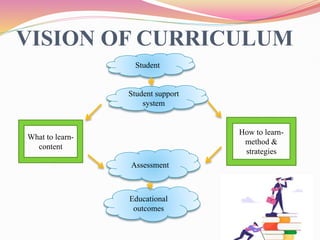
VISION OF CURRICULUM
Student
Student support
system
Assessment
Educational
outcomes
What to learn-
content
How to learn-
method &
strategies
DEFINITION
 Curriculum is defined as the formal and informal
content and process by which learners gain
knowledge and understanding, develop skills and alter
attitudes, appreciations and values under the auspices
of that school.
- Ronald. C. Doll(1996)
 Curriculum is a tool in the hands of the artist
(Teacher) to mould his (Pupils) according to his ideas
(Aims & objectives) in his studio (School).
- Cunningham.
Conti…
 Nursing curriculum is a learning opportunities
(subject matter) and the learning activities (clinical
experience and practices) that the faculty plans and
implement in various settings for a particular
group of students, for a specified period of time in
order to attain the objectives.
COMPONENTS
 A) The statements of philosophy of the educational
program
 B) The statement of the objectives of the educational
program.
 C) Total duration-of the educational program with
breakup of hours for theoretical and practical courses
and supervised clinical experience and clinical
practices.
Conti..
 D) Learning experience- for theory , practical and
clinical component with their respective objectives,
courses of studies, placement sequence and learning
situations.
 E) Method of teaching for the theoretical, practical
and clinical component of the educational program
 F) Program of evaluation- to ascertain effectiveness of
the educational program through curriculum courses.
CURRICULUM DEVELOPMENT
 Curriculum development is a deliberate process, not
a event, that takes concentrated time, effort and
faculty commitment
 The process consist of a serious of systemic, logical,
dynamic spiral and progressive stages that can be time
concerning and labor intensive.
STAGES
 1) Directive stage:
 It lays foundation of all the other stages.
 Identify beliefs, knowledge and concepts.
 Formulation of theoretical framework in selection &
sequence of the content.
 2) Formative stage:
 Philosophy of educational institution
 Objectives
 Nature/ content of nursing
Conti..
 3) Functional stage:
 Practical form of curriculum
 Planning teaching & learning experience
 4) Evaluative stage:
 Input evaluation
 Throughput evaluation
 Output evaluation
 Evaluation for curriculum revision.
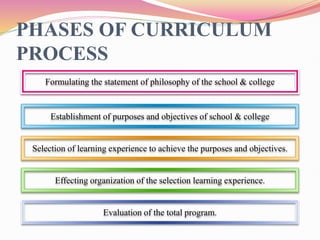
PHASES OF CURRICULUM
PROCESS
Formulating the statement of philosophy of the school & college
Establishment of purposes and objectives of school & college
Selection of learning experience to achieve the purposes and objectives.
Effecting organization of the selection learning experience.
Evaluation of the total program.
CURRICULUM REVISION
 Curriculum revision means making the curriculum
different in some way to give it a new position or
direction.
 This often means alteration to its philosophy by way
of its aims & objectives, reviewing the content
included, revising its methods & rethinking its
evaluatory procedure.
APPROACHES TO
CURRICULUM REVISION
 Addition
 Deletion
 Reorganization
STAGES OF CURRICULUM
REVISION
 Fred greaves describes the 7 stages in revising a
nursing curriculum.
 I-Formation of curriculum development & evaluation
committee
 II-Appraise the existing nursing & educational
practices
 III- Make a detailed study of the existing curriculum
content
Conti..
 IV-Establish criteria for decisions.
 V-Design & writing of the new curriculum changes.
 VI-Within this stages the actual implementation of
changes put into action.
 VII-Evaluate the effects of those changes & it is with
evaluation that this final stage is concerned.
ROLE OF TEACHERS
 The teachers working in aided and recognized school
have no freedom to plan their own curriculum. But,
the teachers working in experimental innovative
schools may have the opportunity to do so.
 But for the most of teachers it is not possible to be so.
They may only have some freedom in the transacting
the curriculum in prescribed framework.
RECAPITUALIZATION
 I]
 1) Define curriculum
 2) List out the levels
 3) Any 4 principles of curriculum
 II]
 1) Apporaches and models of curriculum
REFERENCES
 Sankaranarayanan. B (2012) learning and teaching
nursing (4 th ed.,pp.48-59) Newdelhi,Jaypee brothers
medical publishers.
 Sheeba. KT(2022) communication and educational
technology (3 rd ed.,pp.315-317) Frontline
publications, Hydrabad.
 Malarvizhi.S(2018) textbook of communication and
educational technology (2 nd ed.,pp.169-173)
EMMESS Publishers, Bangalore.
curriculum for bsc nursing students.pptx

curriculum for bsc nursing students.pptx

  • 1.
    PRESENTED BY, MS.SUSHMA.R M.SC (N)I YEAR, COLLEGE OF NURSING, SRIPMS.
  • 2.
    INTRODUCTION  In todayworld of rapidly shifting resources, institutions of higher education are facing the need to make numerous changes to successfully meet the challenges of the future.  Blue print or outline of the course.  Creative, innovative method of curriculum delivery are being exposed in an effort to provide cost effective, quality programming to an increasingly diverse population of students.
  • 3.
    MEANING  The term“curriculum” was first used in Scotland as early as 1820 and become part of education.  The term “curriculum” is a Latin word “currere” which means running race or runway, which one takes to reach goal.
  • 4.
    VISION OF CURRICULUM Student Studentsupport system Assessment Educational outcomes What to learn- content How to learn- method & strategies
  • 5.
    DEFINITION  Curriculum isdefined as the formal and informal content and process by which learners gain knowledge and understanding, develop skills and alter attitudes, appreciations and values under the auspices of that school. - Ronald. C. Doll(1996)  Curriculum is a tool in the hands of the artist (Teacher) to mould his (Pupils) according to his ideas (Aims & objectives) in his studio (School). - Cunningham.
  • 6.
    Conti…  Nursing curriculumis a learning opportunities (subject matter) and the learning activities (clinical experience and practices) that the faculty plans and implement in various settings for a particular group of students, for a specified period of time in order to attain the objectives.
  • 7.
    COMPONENTS  A) Thestatements of philosophy of the educational program  B) The statement of the objectives of the educational program.  C) Total duration-of the educational program with breakup of hours for theoretical and practical courses and supervised clinical experience and clinical practices.
  • 8.
    Conti..  D) Learningexperience- for theory , practical and clinical component with their respective objectives, courses of studies, placement sequence and learning situations.  E) Method of teaching for the theoretical, practical and clinical component of the educational program  F) Program of evaluation- to ascertain effectiveness of the educational program through curriculum courses.
  • 9.
    CURRICULUM DEVELOPMENT  Curriculumdevelopment is a deliberate process, not a event, that takes concentrated time, effort and faculty commitment  The process consist of a serious of systemic, logical, dynamic spiral and progressive stages that can be time concerning and labor intensive.
  • 10.
    STAGES  1) Directivestage:  It lays foundation of all the other stages.  Identify beliefs, knowledge and concepts.  Formulation of theoretical framework in selection & sequence of the content.  2) Formative stage:  Philosophy of educational institution  Objectives  Nature/ content of nursing
  • 11.
    Conti..  3) Functionalstage:  Practical form of curriculum  Planning teaching & learning experience  4) Evaluative stage:  Input evaluation  Throughput evaluation  Output evaluation  Evaluation for curriculum revision.
  • 12.
    PHASES OF CURRICULUM PROCESS Formulatingthe statement of philosophy of the school & college Establishment of purposes and objectives of school & college Selection of learning experience to achieve the purposes and objectives. Effecting organization of the selection learning experience. Evaluation of the total program.
  • 13.
    CURRICULUM REVISION  Curriculumrevision means making the curriculum different in some way to give it a new position or direction.  This often means alteration to its philosophy by way of its aims & objectives, reviewing the content included, revising its methods & rethinking its evaluatory procedure.
  • 14.
    APPROACHES TO CURRICULUM REVISION Addition  Deletion  Reorganization
  • 15.
    STAGES OF CURRICULUM REVISION Fred greaves describes the 7 stages in revising a nursing curriculum.  I-Formation of curriculum development & evaluation committee  II-Appraise the existing nursing & educational practices  III- Make a detailed study of the existing curriculum content
  • 16.
    Conti..  IV-Establish criteriafor decisions.  V-Design & writing of the new curriculum changes.  VI-Within this stages the actual implementation of changes put into action.  VII-Evaluate the effects of those changes & it is with evaluation that this final stage is concerned.
  • 17.
    ROLE OF TEACHERS The teachers working in aided and recognized school have no freedom to plan their own curriculum. But, the teachers working in experimental innovative schools may have the opportunity to do so.  But for the most of teachers it is not possible to be so. They may only have some freedom in the transacting the curriculum in prescribed framework.
  • 18.
    RECAPITUALIZATION  I]  1)Define curriculum  2) List out the levels  3) Any 4 principles of curriculum  II]  1) Apporaches and models of curriculum
  • 19.
    REFERENCES  Sankaranarayanan. B(2012) learning and teaching nursing (4 th ed.,pp.48-59) Newdelhi,Jaypee brothers medical publishers.  Sheeba. KT(2022) communication and educational technology (3 rd ed.,pp.315-317) Frontline publications, Hydrabad.  Malarvizhi.S(2018) textbook of communication and educational technology (2 nd ed.,pp.169-173) EMMESS Publishers, Bangalore.