COMMUNICATION
ANAMIKA RAMAWAT
RNRM, MSN(OBG NURSING)
NURSING LECTURER
VYAS CON, JODHPUR
 COMMUNICATION IN SIMPLE TERMS CAN BE DEFINE
AS SHARING OF THOUGHTS, FEELINGS AND IDEAS
FROM ONE PERSON TO ANOTHER.
Communication means the
interchange of thoughts or
information conveyed to a
person or persons in such a
way that the meaning received
is equivalent to those which
the initiator of the message
intended.
PURPOSE OF COMMUNICATION
 Avoid misunderstanding and confusion.
 Necessary for managerial staff for discharging their duties
efficiently,
 The lowest employees to listen to the instructions of their
supervisors and to perform their duties sincerely
 The attitudes necessary for motivation, co-operation and job
satisfaction, work satisfaction
 Assistance in decision-making because taking decisions needs
information
 Information and understanding necessary terms for group work
IMPORTANCE IN HEALTH CARE FACILITY
 Communication is important for the nurse to understand and to
exchange ideas with the clients and their relatives, the doctors and other
members of the health team.
 It reduces the interpersonal tensions and improves the interpersonal
relationships.
 Poor communication results in poor client's care and poor interpersonal
relationships.
 Good communication helps the nurse to modify her behaviour and at
the same time, she will be able to influence the behaviour of those with
whom she deals with.
 Good communication prevents disorders in the ward and hospital
organization.
 Good communication helps the nurse to interpret the hospital policies
and client care.
ELEMENTS/ESSENTIALS/PROCESS OF COMMUNICATION
 Referent
 The sender/Encoder
 Encoding
 The message
 The channel
 Decoding
 The receiver/Decoder
 Interpersonal Variables e.g., Noise etc.
 Feedback
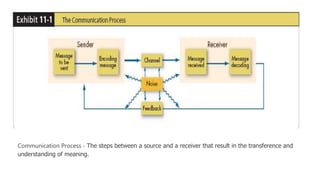
Communication Process - The steps between a source and a receiver that result in the transference and
understanding of meaning.
LEVELS OF COMMUNICATION
1. Intrapersonal Communication/One way – with in an individual, e.g., self-
talk.
2. Interpersonal Communication/ Two way – with others i.e./ one-to-one
interaction, face to face, e.g., N-P-R
3. Transpersonal Communication – with in person’s spiritual domain e.g.,
prayer, meditation, religious rituals etc.
4. Formal(Office workers) and Informal(Family members) Communication
5. Small-Group Communication – when small group of persons meet
together, e.g., goal-directed group.
6. Public Communication - with audience
7. Computer-aided/Tele Communication(audio and visual) – Email,
Videoconferencing, audioconferencing etc.
TYPES/FORMS OF COMMUNICATION
1. VERBAL COMMUNICATION – spoken and written words
2. NON-VERBAL COMMUNICATION – use of all 5 senses
3. SYMBOLIC COMMUNICATION – e.g., music, art, etc
4. META-COMMUNICATION – e.g., awareness of the tone of the
verbal response and the nonverbal behavior results in further
exploration of the client’s feelings and concerns.
VERBAL COMMUNICATION
 Vocabulary(words & phrases)
 Denotative(same) and Connotative(differ) meaning
 Pacing(speed)
 Intonation(tone)
 Clarity(clear word) and Brevity(concise and exact word) – giving appropriate
examples with repetition of important part
 Timing and Relevance – condition of the person and related message e.g.,
intervention
NONVERBAL COMMUNICATION
 Personal Appearance – physical characteristics, facial expression, dress
manner, grooming
 Posture and Gait – way of walking, sit, stand, move attitudes, emotions, health
status etc.
 Facial Expression - fear, anger, surprise, sadness, happiness etc.
 Eye Contact – shows respect and willingness to listen.
 Gestures - clarify the spoken words.
 Sounds – ohhh, ufff etc.
 Territoriality and Personal Space – Interpersonal interactions
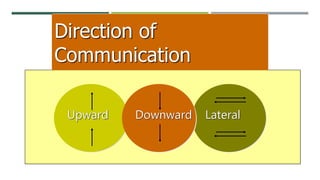
Direction of
Communication
Upward LateralDownward
COMMON FORMAL SMALL-GROUP NETWORKS COMMUNICATION
FACTORS INFLUENCING COMMUNICATION
 Perceptions – sense of understanding
 Values – sense of worthiness
 Emotions – sense of expressing
 Socio cultural background
 Gender
 Knowledge
 Role and relationships
 Environment
 Personal Space and territoriality(territory – space)
THERAPEUTIC COMMUNICATION TECHNIQUES
1) Active Listening
2) Sharing Observations
3) Sharing Empathy
4) Sharing Hope
5) Sharing Humor
6) Sharing Feelings
7) Using Touch
8) Using Silence
9) Providing Information
10)Clarifying
11)Focusing
12)Paraphrasing(restating)
13)Asking relevant QUESTIONS
14)Summarizing
15)Self-Disclosure
16)Confrontation (facing the situation)
19
ACTIVE LISTENING BEHAVIOURS
Paraphrase
Don’t overtalk
Be empathetic Make eye
contact
Exhibit affirmative
head nods and
appropriate
facial expressions
Active
Listening
Avoid distracting
actions or
gestures
Avoid interrupting
the speaker
Ask questions
© Prentice Hall, 2002 FOM 3.16Robbins et al., Fundamentals of Management, 4th Canadian Edition
©2005 Pearson Education Canada, Inc.
NONTHERAPEUTIC COMMUNICATION TECHNIQUES
1) Asking Personal Questions
2) Giving Personal Opinions
3) Changing the Subject
4) Automatic Responses
5) False Reassurance
6) Sympathy
7) Asking for Explanations
8) Approval or Disapproval
9) Defensive Responses
10)Passive or Aggressive Responses
11)Arguing
BARRIERS OF COMMUNICATION
A message may be distorted by the following:
 Emotional factors such as fear, suspicion, jealousy, anger, anxiety,
resentment(treated unfairly), antagonism, prejudices, lack of interest
and lack of listening.
 Physical factors such as fatigue, illness, speech defects, deafness and
pain
 Intellectual factors such as low I.Q., lack of knowledge,
misinterpretation of words etc
 Social factors such as differences in culture, language, race,
professional status, socioeconomic status etc
 Environmental factors such as noise, lack of privacy, uncomfortable
COMMUNICATION MAY BE BLOCKED BY THE FOLLOWING:
 Changing the subject
 Lack of listening
 Inappropriate use of
knowledge
 Jumping into
conclusions
 False and inappropriate
reassurance
 Stating one's own
opinions and ideas
PROFESSIONAL NURSING RELATIONSHIP COMMUNICATION
A. Nurse - Client Helping Relationship
B. Nurse - Family Relationship
C. Nurse - Health Care Team Relationship
D. Nurse - Community Relationship
SUMMARY…
Communication

Communication

  • 1.
    COMMUNICATION ANAMIKA RAMAWAT RNRM, MSN(OBGNURSING) NURSING LECTURER VYAS CON, JODHPUR
  • 2.
     COMMUNICATION INSIMPLE TERMS CAN BE DEFINE AS SHARING OF THOUGHTS, FEELINGS AND IDEAS FROM ONE PERSON TO ANOTHER.
  • 3.
    Communication means the interchangeof thoughts or information conveyed to a person or persons in such a way that the meaning received is equivalent to those which the initiator of the message intended.
  • 4.
    PURPOSE OF COMMUNICATION Avoid misunderstanding and confusion.  Necessary for managerial staff for discharging their duties efficiently,  The lowest employees to listen to the instructions of their supervisors and to perform their duties sincerely  The attitudes necessary for motivation, co-operation and job satisfaction, work satisfaction  Assistance in decision-making because taking decisions needs information  Information and understanding necessary terms for group work
  • 5.
    IMPORTANCE IN HEALTHCARE FACILITY  Communication is important for the nurse to understand and to exchange ideas with the clients and their relatives, the doctors and other members of the health team.  It reduces the interpersonal tensions and improves the interpersonal relationships.  Poor communication results in poor client's care and poor interpersonal relationships.  Good communication helps the nurse to modify her behaviour and at the same time, she will be able to influence the behaviour of those with whom she deals with.  Good communication prevents disorders in the ward and hospital organization.  Good communication helps the nurse to interpret the hospital policies and client care.
  • 6.
    ELEMENTS/ESSENTIALS/PROCESS OF COMMUNICATION Referent  The sender/Encoder  Encoding  The message  The channel  Decoding  The receiver/Decoder  Interpersonal Variables e.g., Noise etc.  Feedback
  • 8.
    Communication Process -The steps between a source and a receiver that result in the transference and understanding of meaning.
  • 9.
    LEVELS OF COMMUNICATION 1.Intrapersonal Communication/One way – with in an individual, e.g., self- talk. 2. Interpersonal Communication/ Two way – with others i.e./ one-to-one interaction, face to face, e.g., N-P-R 3. Transpersonal Communication – with in person’s spiritual domain e.g., prayer, meditation, religious rituals etc. 4. Formal(Office workers) and Informal(Family members) Communication 5. Small-Group Communication – when small group of persons meet together, e.g., goal-directed group. 6. Public Communication - with audience 7. Computer-aided/Tele Communication(audio and visual) – Email, Videoconferencing, audioconferencing etc.
  • 10.
    TYPES/FORMS OF COMMUNICATION 1.VERBAL COMMUNICATION – spoken and written words 2. NON-VERBAL COMMUNICATION – use of all 5 senses 3. SYMBOLIC COMMUNICATION – e.g., music, art, etc 4. META-COMMUNICATION – e.g., awareness of the tone of the verbal response and the nonverbal behavior results in further exploration of the client’s feelings and concerns.
  • 12.
    VERBAL COMMUNICATION  Vocabulary(words& phrases)  Denotative(same) and Connotative(differ) meaning  Pacing(speed)  Intonation(tone)  Clarity(clear word) and Brevity(concise and exact word) – giving appropriate examples with repetition of important part  Timing and Relevance – condition of the person and related message e.g., intervention
  • 13.
    NONVERBAL COMMUNICATION  PersonalAppearance – physical characteristics, facial expression, dress manner, grooming  Posture and Gait – way of walking, sit, stand, move attitudes, emotions, health status etc.  Facial Expression - fear, anger, surprise, sadness, happiness etc.  Eye Contact – shows respect and willingness to listen.  Gestures - clarify the spoken words.  Sounds – ohhh, ufff etc.  Territoriality and Personal Space – Interpersonal interactions
  • 14.
  • 15.
    COMMON FORMAL SMALL-GROUPNETWORKS COMMUNICATION
  • 17.
    FACTORS INFLUENCING COMMUNICATION Perceptions – sense of understanding  Values – sense of worthiness  Emotions – sense of expressing  Socio cultural background  Gender  Knowledge  Role and relationships  Environment  Personal Space and territoriality(territory – space)
  • 18.
    THERAPEUTIC COMMUNICATION TECHNIQUES 1)Active Listening 2) Sharing Observations 3) Sharing Empathy 4) Sharing Hope 5) Sharing Humor 6) Sharing Feelings 7) Using Touch 8) Using Silence 9) Providing Information 10)Clarifying 11)Focusing 12)Paraphrasing(restating) 13)Asking relevant QUESTIONS 14)Summarizing 15)Self-Disclosure 16)Confrontation (facing the situation)
  • 19.
    19 ACTIVE LISTENING BEHAVIOURS Paraphrase Don’tovertalk Be empathetic Make eye contact Exhibit affirmative head nods and appropriate facial expressions Active Listening Avoid distracting actions or gestures Avoid interrupting the speaker Ask questions © Prentice Hall, 2002 FOM 3.16Robbins et al., Fundamentals of Management, 4th Canadian Edition ©2005 Pearson Education Canada, Inc.
  • 20.
    NONTHERAPEUTIC COMMUNICATION TECHNIQUES 1)Asking Personal Questions 2) Giving Personal Opinions 3) Changing the Subject 4) Automatic Responses 5) False Reassurance 6) Sympathy 7) Asking for Explanations 8) Approval or Disapproval 9) Defensive Responses 10)Passive or Aggressive Responses 11)Arguing
  • 21.
    BARRIERS OF COMMUNICATION Amessage may be distorted by the following:  Emotional factors such as fear, suspicion, jealousy, anger, anxiety, resentment(treated unfairly), antagonism, prejudices, lack of interest and lack of listening.  Physical factors such as fatigue, illness, speech defects, deafness and pain  Intellectual factors such as low I.Q., lack of knowledge, misinterpretation of words etc  Social factors such as differences in culture, language, race, professional status, socioeconomic status etc  Environmental factors such as noise, lack of privacy, uncomfortable
  • 22.
    COMMUNICATION MAY BEBLOCKED BY THE FOLLOWING:  Changing the subject  Lack of listening  Inappropriate use of knowledge  Jumping into conclusions  False and inappropriate reassurance  Stating one's own opinions and ideas
  • 23.
    PROFESSIONAL NURSING RELATIONSHIPCOMMUNICATION A. Nurse - Client Helping Relationship B. Nurse - Family Relationship C. Nurse - Health Care Team Relationship D. Nurse - Community Relationship
  • 24.